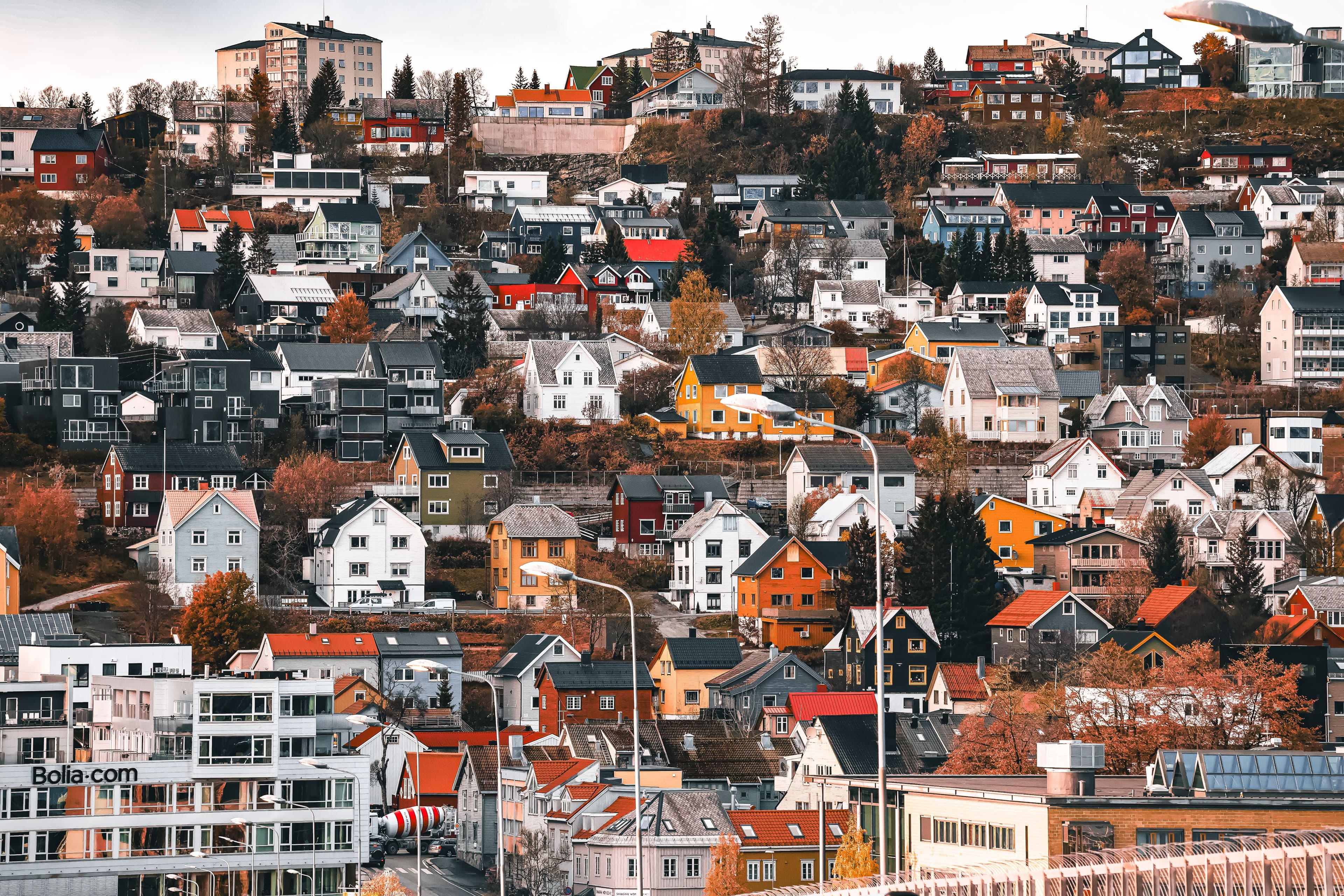
The departure board at Stockholm Central shows Narvik at 17:59, platform eight, and for a moment the name looks like it belongs on a different kind of map. The one with sea monsters at the edges. Narvik is 1,400 kilometres north of Stockholm, 250 kilometres above the Arctic Circle, reachable only by a train that will run through the night across the whole width of Swedish Lapland before descending a single-track mountain railway into a Norwegian fjord. The journey takes the better part of a day. The bus from Narvik to Tromsø takes another four hours after that.
Most runners taking the Midnight Sun Marathon fly. Oslo, one connection, done in the time it takes to get through security twice. But a growing number are working out that the overland route is not the consolation prize. It is, in some meaningful sense, the point.
The Short Cut
- Tromsø has no rail connection. Norway's rail network ends at Fauske, south of Bodø, and the Swedish network's northernmost terminus in Norway is Narvik, connected to Tromsø by a four-hour bus.
- The main overland route runs Stockholm to Boden overnight, then a daytime train through Swedish Lapland and the Ofoten line into Narvik, followed by Bus 100 to Tromsø. Total journey from Stockholm: roughly 22 to 24 hours.
- Stockholm and Oslo are the practical staging posts for the overland journey; both are well connected by air and rail from most major international hubs, and the northern leg begins from either city.
- The practical suggestion for a race trip is asymmetric: train one way, fly the other. The overland journey is rewarding enough to justify the time. Doing it both ways on tired marathon legs is a different calculation.
Boden at dawn
The night train to Boden leaves Stockholm in the late afternoon and arrives early the following morning, which gives you the better part of fourteen hours in a couchette watching Sweden thin out. The forests get taller and then shorter and then the birch starts to look more like lichen than tree. Around Gällivare, a hundred kilometres south of the Arctic Circle, the landscape has the quality of something that has not quite decided whether it is land or water. There are lakes between everything. The light changes in a way that is hard to account for: it is still light at 11 PM, blue and unmoving, the sky doing nothing so conventional as setting.
At Boden, you change. This is the new reality since 2026, when the direct overnight from Stockholm to Narvik was reorganised. The change is, frankly, early in the morning and involves coffee from a machine and a wait on a platform that has very little to recommend it. But the train that departs Boden heading north and west is where the journey earns everything.
The Ofoten line
The stretch between Kiruna and Narvik is called the Ofoten line. It was built between 1898 and 1902 to transport iron ore from the mines at Kiruna to the ice-free port at Narvik. The Gulf Stream keeps Narvik's harbour open year-round, which is the only geographical reason the railway exists at this latitude. The line climbs to 520 metres at Riksgränsen on the Swedish-Norwegian border before beginning a descent that covers 43 kilometres and loses that altitude in full. In June, with snow still on the highest ground and the Arctic summer at full intensity, the train runs through a landscape that has no ready comparison in most runners' experience of getting from A to B.
Abisko sits near the border on the Swedish side. The national park around it is one of the driest places in Scandinavia, sheltered by the mountain massif to the west, and on a clear day the visibility from the train is severe. A researcher studying the Caledonian orogeny, the mountain-building event that created the Scandinavian ranges roughly 400 million years ago, would have a productive hour between Abisko and Riksgränsen; everyone else just has their face against the glass. Both responses are appropriate.
The Norwegian side of the border brings the descent towards Narvik and the Rombaken fjord. The train comes down through curves that require careful braking, as the gradient is steep enough to have necessitated a special system when the line opened in 1902, a challenge its operators have managed ever since. At some point the water appears below, and then the town, and then the fjord opens out and you understand that this was the only sensible place to put a port.
Narvik to Tromsø by bus
Bus 100 runs from Narvik bus station to Tromsø several times daily. It takes approximately four hours. Seats are not bookable in advance; if demand exceeds capacity the operator adds a second vehicle, a policy that inspires confidence once you know about it. The route follows the E6 and E8 through fjord landscape that would be the highlight of a trip to almost any other country. Coming off the train from Lapland, it registers as normal. Your threshold for scenery adjusts quickly in northern Norway.
The bus deposits you at Prostneset terminal, on the Tromsø waterfront, which is also where the expo is held in the days before the race. The walk from the bus stop to most city-centre hotels is ten minutes. After 22 hours of travel from Stockholm, those ten minutes feel earned.
The case for going by sea
Hurtigruten has been sailing the Bergen to Kirkenes coastal route since 1893, with a stop at Tromsø in both directions, every day. Havila Voyages has run the same route since 2021, adding a second daily service. The northbound passage from Bergen takes five days and calls at 34 ports, crossing the Arctic Circle somewhere around Bodø on day three. In June, this means arriving in Tromsø in the midnight sun, watching the coast of northern Norway pass at a pace slow enough to actually look at it.
The practical case against is the time. Five days on a ship before a marathon is a large commitment, and the post-race body is not well suited to the southbound return journey either. The case for is harder to summarise in a single sentence, which is perhaps the point. Hurtigruten was built to connect isolated Norwegian coastal communities before roads reached them. What it incidentally became, somewhere in the last fifty years, is one of the better ways to understand what Norway's coastline actually is rather than what it looks like in photographs.
Port-to-port fares for the Bergen to Tromsø segment start from around £865 per person at the time of writing, with meals typically bookable as an add-on. Book at hurtigruten.com or havila.no, and verify current fares.
The asymmetric itinerary
The practical suggestion, for most runners, is this: go by train, come back by plane. Or the reverse. The overland journey to Tromsø rewards an unhurried disposition and a tolerance for consecutive nights of sleep that is only partial. The journey home from a marathon, when the legs are wrecked and the appetite for adventure has been temporarily satisfied, is better served by two hours in an aircraft and a window seat over the fjords.
Stockholm and Oslo are where the overland adventure properly begins. Both cities are well served by long-haul connections from North America, Asia, and the Gulf; both are reasonable stopover destinations in their own right before the train north. From Stockholm, the route is described above. From Oslo, Vy runs overnight trains to Trondheim, and from Trondheim there are long-distance buses north through Bodø and on to Narvik. It is a longer and more fragmented approach than the Swedish route, but it covers different country and arrives at the same bus.
The overland journey offers something that the flight does not: a gradual transition into the far north. By the time you reach the Ofoten line, you are already operating at a different pace from the runner who landed at Tromsø Airport ninety minutes after touching down in Oslo. The race starts at 8:30 PM and runs past midnight under a sun that refuses to set. It helps, it turns out, to have spent a day or two in transit before that becomes a normal thing to do.
What the journey does
There is a version of the Midnight Sun Marathon where you fly in Thursday, race Friday, fly home Saturday. It is entirely viable. But there is another version where the race is the end of a route rather than the reason for it, where the landscapes you have been passing through make the geography of the course legible in a way that a taxi from the airport does not. When you cross the Tromsø Bridge at the 2-kilometre mark and the fjord opens below you and the Arctic Cathedral is there on the far shore in the late-evening light, it is a different thing if you have already spent two days moving through the country that produced it.
The train is also, practically speaking, a forced act of rest before a race that requires unconventional preparation. You cannot do very much on a sleeper from Stockholm to Boden except eat, read, and look out of the window. As taper weeks go, there are worse frameworks.
Related reading: Full course details, hotel recommendations, and the "Sleeping in the Midnight Sun" advice for runners flying in are on the Midnight Sun Marathon race page. For the fuller story of Tromsø itself, its summer and winter marathons, and what the light does to both, see Running Out of Darkness: A Night Race in Daylight on the Destinations desk.
The Extra Mile
Booking the train: sj.se covers the Swedish legs. The Stockholm to Boden overnight and the Boden to Narvik daytime service can both be booked there. Interrail Global Pass holders pay reservation fees on top of the pass. Book early: sleeper berths on the northern routes sell out in summer, and June is peak season for Lapland travel.
The Oslo route: vy.no covers Norwegian rail. Oslo to Trondheim overnight, then long-distance bus north. A more fragmented journey than the Swedish route, but an option for runners already routing through Norway.
Bus 100, Narvik to Tromsø: No advance booking required. Operated by Troms fylkestrafikk. Runs several times daily. Allow 4 to 4.5 hours. Buy the ticket on the bus or via the Svipper app.
Hurtigruten: hurtigruten.com. Northbound Bergen to Tromsø, 5 days. Havila Voyages: havila.no. Same route, same frequency, different ships.
Midnight Sun Marathon: msm.no. 2027 edition: Friday 19 June 2027. Registration opens 21 July 2026.