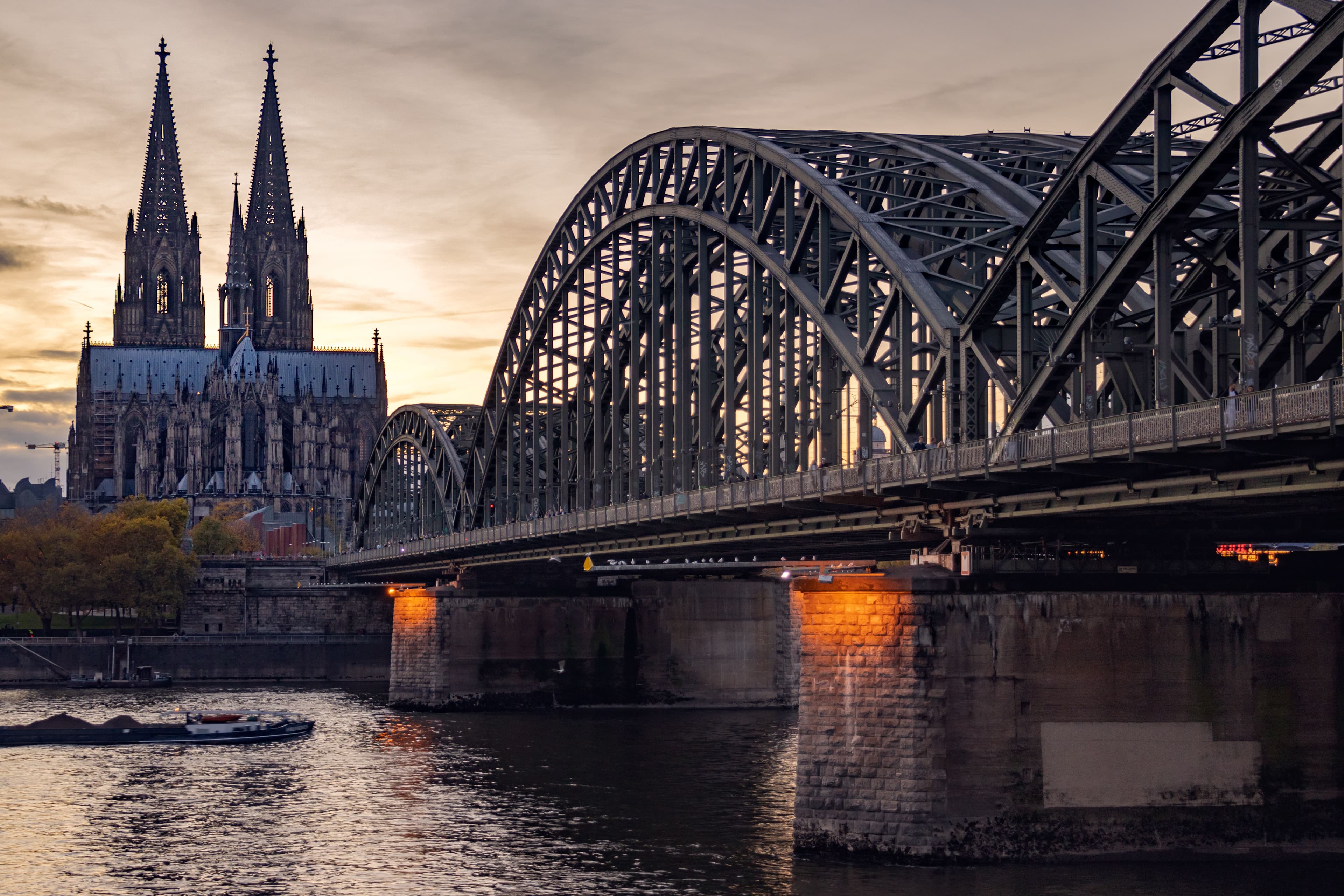
The Race
| Next Race Date | Sunday 3 October 2027 (provisional; the organiser has not yet published the 2027 date) |
|---|---|
| Course type | Loop: start at Ottoplatz, Deutz; finish at Komödienstraße near Cologne Cathedral, approximately 1.6 km apart by direct line |
| Registration | Open entry via the official Generali Köln Marathon site only, no ballot. Closes 20 September 2026 if the participant limit is not reached first. |
| Ballot Opens | Not applicable: standard open entry |
| Total finishers | Not published. An entry cap of roughly 7,000 marathon places was reported for the 2025 edition, but this is a cap, not a confirmed finisher count. |
| Avg race-day temp | Cool to mild October conditions with a real chance of rain; no specific °C range has been published |
| Cutoff time | Not published |
| Free race-day transport | Not confirmed either way |
| Course certification | World Athletics and AIMS certified; specific label tier (Gold/Silver/Bronze/Elite) not stated on official pages checked |
| Sleeper Train | Not accessible |
Three Times Through Rudolfplatz
Rudolfplatz is the only point on the course the race passes through three separate times, at roughly km 14.5, km 24 and km 40. The official course guide calls the second crossing, over the Hohenzollernring to Friesenplatz, the race’s emotional centre, and the third, near km 40, the point where spectator noise carries runners through the closing kilometres. For anyone watching without a car or a complicated multi-stop plan, staying at Rudolfplatz for the whole race and simply waiting for the same runner to reappear twice more is the single most efficient spectating strategy the course offers.
History
Cologne Marathon runs each October as the marathon leg of a wider event weekend that also includes a half marathon, a relay marathon, a schools marathon and a children’s run, organised by Kölner AusdauerSport under its current Generali title sponsorship. The race positions itself in the German autumn calendar as an alternative to Frankfurt and Berlin: a flat, certified-fast course through a major Rhineland city, without the scale or ballot pressure of Germany’s largest marathons.
The course has settled into a familiar shape: a start at Ottoplatz in Deutz, on the eastern bank of the Rhine, an immediate crossing of the Deutz Bridge with a view back at the cathedral and the old town, and a route working through Cologne’s southern and western districts, Bayenthal, Rodenkirchen, Sülz, Lindenthal and Ehrenfeld, before returning through the city centre to finish on Komödienstraße beside Cologne Cathedral. Rudolfplatz, a major square on the city’s inner ring, is crossed three times over the course of the race, a repeated landmark the official course guide itself calls the race’s emotional centre. Course certification carries both World Athletics recognition and AIMS certification, positioning Cologne as a credible fast-course option for runners chasing a personal best on the German autumn circuit.
The course
Cologne Marathon starts at Ottoplatz in Deutz, on the Rhine’s eastern bank, and finishes at Komödienstraße beside Cologne Cathedral on the western bank, a loop course with start and finish roughly 1.6 km apart. The route crosses the Deutz Bridge in the first kilometre, giving an early view of the cathedral and old town, then runs south through Bayenthal and Rodenkirchen before turning back through the Südstadt and into the city’s inner districts. Rudolfplatz is crossed three times, at roughly km 14.5, km 24 and km 40, functioning as the course’s recurring landmark and, on the final pass, its last major crowd point before the finish. The route also passes through Sülz, Lindenthal’s Dürener Straße, Ehrenfeld’s Venloer Straße and Nippes’s Neusser Straße before returning to the centre. The course is flat, with eleven refreshment stations spaced across the route, and finishes along Hohe Straße into Komödienstraße.
Km 0-5: Deutz and the river crossing. The race starts at Ottoplatz in Deutz and crosses the Deutz Bridge inside the first kilometre, giving an early view of Cologne Cathedral and the old town across the Rhine. The route passes the Rheinauhafen, home to the Chocolate Museum, the Sport and Olympia Museum and the architecturally distinctive Kranhäuser crane houses, before reaching Bayenthal and the Bismarck Column around km 5.
Km 5-14: Rodenkirchen and the return to Südstadt. The course continues south through Rodenkirchen before turning back into the city, passing under the Severinstorbogen on Severinstraße around km 12, back in the Südstadt district. Refreshment stations at km 4.9 and km 9.2 cover this stretch.
Km 14-24: the first two passes through Rudolfplatz.Rudolfplatz is reached for the first time around km 14.5, one of three crossings across the race. The route continues through Sülz and Sülzburgstraße around km 18.5, then Lindenthal and Dürener Straße, known locally as Cologne’s “Kö,” around km 21, and back along Aachener Straße past Melaten Cemetery and the Aachener Weiher around km 23, before Rudolfplatz a second time near km 24, running over the Hohenzollernring to Friesenplatz, a stretch the official course guide describes as the race’s emotional heart.
Km 24-34: Ehrenfeld and Nippes. The course runs through Ehrenfeld near Venloer Straße around km 27, back across the Neustadt-Nord to Ebertplatz around km 30, and out through Riehl to Nippes and Neusser Straße around km 34, before returning along Riehler Straße and the Hansaring. This is the longest stretch between the crowded inner-ring squares, and the quietest section of the race for runners who prefer to settle in without crowd noise.
Km 34-42.2: the third Rudolfplatz and the finish. Rudolfplatz is crossed a third time around km 40, bringing spectator noise back for the closing kilometres, followed by Neumarkt around km 40.5. The course finishes along Hohe Straße past thousands of spectators to the cathedral, with the timing mat at Komödienstraße just beyond the cathedral itself, not at the first sight of the towers.
Follow the blue tangent line throughout: with three passes through Rudolfplatz and a district-heavy route through the city’s inner ring, running wide of it through the corners adds real, measurable distance over 42.195 km. The finish timing mat sits on Komödienstraße, beyond the cathedral itself, not at the first sight of the towers on Hohe Straße.
Course Map
The map shows the loop route from Ottoplatz in Deutz across the Deutz Bridge, through Cologne’s inner-ring districts and the three Rudolfplatz crossings, to the finish at Komödienstraße beside Cologne Cathedral, plus the MOTORWORLD expo venue. Tap a marker for details, and scrub the slider or press play to move the orange marker along the course with the elevation profile beneath it.
A flat start at Ottoplatz followed by the Deutz Bridge crossing inside the first kilometre, with an early view of the cathedral. Settle into pace here; ignore the start-line crowd noise.
The course’s longest settling-in stretch, running south through Rodenkirchen before turning back through the Südstadt, Sülz and Lindenthal to Rudolfplatz for a second time around km 24.
The quietest section of the race, away from the inner-ring squares, running through Ehrenfeld and Nippes. Pacing discipline built earlier gets tested here without much crowd noise to lean on.
The course returns to Rudolfplatz a third time around km 40 for a final crowd surge before Neumarkt and the finish along Hohe Straße to Komödienstraße beside the cathedral.
Pacers
The ODLO Pacemaker programme provides official pacers for target finish times of 3:00, 3:15, 3:30, 3:45, 4:00, 4:15 and 4:30, identifiable by a blue balloon marked with their target time. There is no corral-based wave structure confirmed for this race; pacing strategy is set before the start depending on target time and weather, and runners can ask a pacer directly how they plan to run the race.
What to wear
Cologne runs in early October, which typically means cool starting temperatures with a real chance of rain and a milder midday than the start-line temperature suggests. The course is entirely urban and largely sheltered by buildings along the inner-ring sections, so wind exposure matters less here than on a coastal or river-adjacent course, though the Deutz Bridge crossing in the opening kilometre is more exposed than the rest of the route. A throwaway layer at the Ottoplatz start is worth bringing given the early-October chill; October mornings on the Rhine can carry mist that clears by mid-morning without necessarily meaning warm conditions all day.
Entry
Registration is handled exclusively through the official Generali Köln Marathon website, with no ballot system. Entry closes 20 September 2026 if the field’s participant limit has not already been reached, so entering promptly matters more than for a ballot-based race. A third-party listing gives a standard full-marathon entry fee of around €130 for a recent edition; the official price table has the current figure.
There is no confirmed fast-runner or Good for Age entry route; entry is standard open registration with no qualifying time required, consistent with the race’s positioning as an accessible flat-course option. The organiser runs an official starting-slot exchange (Startplatzbörse) allowing entered runners who can no longer take part to transfer their place to someone else through the official platform, a more structured option than most races offer for a change of plans. No charity-entry pathway has been published, though German city marathons commonly run one, so ask the organiser.
Fast Runner / GFA Standards
Not applicable. Cologne Marathon has no confirmed fast-runner or Good for Age entry route.
Race Weekend
Expo
The Running.EXPO runs over the two days immediately before race day at MOTORWORLD Cologne, a converted historic airport hangar site at Butzweilerstraße 35–39, roughly nine minutes by car from the cathedral and reachable by KVB tram line 5 (exit Ikea Am Butzweilerhof, about 22 minutes from Cologne Hauptbahnhof). For the 2026 edition the expo runs Friday 2 October, 12:00-20:00, and Saturday 3 October, 09:00-18:00, with entry free for all visitors. Around 60 running and sports exhibitors typically take part, alongside street food and a sponsor lounge. Bib numbers are collected at the expo only: race packets cannot be collected on race day itself, so every entrant needs to visit MOTORWORLD on the Friday or Saturday before racing. Bring booking confirmation and photo ID for collection. Visitor parking at MOTORWORLD’s P1 is free for the first hour, then €1.80 per hour, with additional free parking nearby at IKEA Am Butzweilerhof; the organiser recommends arriving by bike or public transport over driving.
Race Morning
The race starts at Ottoplatz in Deutz, on the eastern bank of the Rhine, reachable via Köln Messe/Deutz station, served by Deutsche Bahn regional and long-distance trains as well as KVB trams and buses, or by bike using the marked route into Ottoplatz. Runners driving are directed to the P1 car park at the LANXESS Arena, though public transport is the practical choice given road closures around the start and finish on race day.
Bag-drop and precise corral timing have not been confirmed in available sources. What is confirmed is the finish sequence: the course crosses Rudolfplatz a third time around km 40, running into Neumarkt around km 40.5 before the final stretch along Hohe Straße to the Komödienstraße finish beside Cologne Cathedral, one of the most heavily spectated finish approaches on the German marathon calendar given the cathedral’s visibility from the final kilometre.
After finishing, walking away from the immediate cathedral-area crowds before heading to Köln Hauptbahnhof, a short walk from the finish, or picking up a tram or U-Bahn connection, is the practical way to reach a hotel, given how dense the finish-area crowds get around Cologne’s most photographed landmark.
Nutrition on Course
Eleven refreshment stations are spaced across the course at km 4.9, 9.2, 13.8, 17.3, 21.3, 24.8, 27.3, 30.6, 33.9, 37.7 and 40.8, plus a final station in the finish area. Water is available at every station. Bananas and isotonic energy drink are added from the third station at km 13.8 onward. Cola and gel are introduced later in the race, first appearing at the km 30.6 station and continuing through km 33.9, 37.7, 40.8 and the finish, useful for runners planning a late-race caffeine or carbohydrate boost. The sports-nutrition brand used on course has not been published.
Spectating
Rudolfplatz is the single best spot on the course for spectators: the race passes through it three times, at roughly km 14.5, km 24 and km 40, meaning a spectator who stays put here can see the same runner three separate times without moving. The official course guide describes the second pass, over the Hohenzollernring to Friesenplatz, as the emotional heart of the race, with dense crowds and loud support. The Deutz Bridge crossing in the opening kilometre offers a striking early photo opportunity with the cathedral in the background, and the Komödienstraße finish, beside the cathedral itself, is the obvious final stop.
Itinerary A:Start at Ottoplatz in Deutz for the start and the Deutz Bridge crossing around km 1, then take a KVB tram or a short walk across the bridge into the city centre for Rudolfplatz’s first pass around km 14.5, staying at or near Rudolfplatz for the second pass around km 24.
Itinerary B: Base at Rudolfplatz for all three passes (km 14.5, km 24 and km 40), the single most efficient spectating plan on the course, then walk the short distance to Neumarkt around km 40.5 for a second sighting shortly before the finish.
Itinerary C: Go directly to the Komödienstraße finish near Cologne Cathedral, positioning along Hohe Straße for a sighting in the closing few hundred metres before the finish, and use Köln Hauptbahnhof, a short walk from the finish, as a pre-agreed meeting point away from the densest finish-line crowds.
Post-Race Food
Früh am Dom, a traditional Cologne brewhouse a short walk from the finish, serves the city’s Kölsch beer alongside hearty regional dishes like Himmel und Ääd, a fast way to replace calories in a setting that expects marathon crowds. Gaffel am Dom, another central brewhouse near the cathedral, offers a similar Kölsch-and-regional-food combination and is a reliable backup if Früh is at capacity, which is likely on marathon Sunday. L’Osteria Köln Hahnenstraße gives a carb-heavy Italian alternative for runners who want pizza or pasta over Rhineland classics, and takes bookings, worth doing ahead given how busy central Cologne gets on race day.
Where to Stay
Choose a neighbourhood based on proximity to the Komödienstraße finish near the cathedral rather than the Deutz start: Deutz is a straightforward five-minute tram ride or a walkable bridge crossing from almost anywhere central, while the finish area gets dense with crowds that make a long journey back to a hotel the harder problem on race day.
Altstadt and around the Dom
Puts a runner within walking distance of the finish and Cologne’s core sightseeing: the cathedral, the old town’s narrow streets and the Rhine promenade. It runs busy, noisy and touristy on marathon weekend, which suits runners who want to be in the middle of the post-race scene.
Neumarkt and Rudolfplatz
Just west of the Altstadt, sits directly on the course, crossed three times by the race itself, and offers Cologne’s densest concentration of restaurants and bars for a post-race night out. It runs loud and busy, and isn’t the best choice for anyone wanting quiet the night before racing.
Deutz
On the eastern bank near the start, has a more business-hotel feel than the old town’s character, with straightforward race-morning logistics and an easy river walk or short tram ride into the centre. It suits runners who prioritise race-morning simplicity over old-town evenings.
Belgisches Viertel
West of the centre, is Cologne’s most characterful food-and-café district, popular with locals, and reachable from the finish by a short tram or walk. It runs pricey and popular, and isn’t the fastest option if race-morning simplicity matters most.
Mülheim and the Messe edge
On the eastern bank near the exhibition grounds, is a practical, less scenic alternative with better-value business hotels and good access to the start, at the cost of postcard views of the old town.
Recommended hotels
A reliable, central Altstadt hotel within walking or short-transit distance of the Komödienstraße finish, suited to runners prioritising proximity over character.
A good-value design-chain option directly on the course route, with Cologne’s densest restaurant and bar concentration on the doorstep for the evening after.
Positioned directly on the start side of the Rhine with cathedral views across the water, an excellent race-morning base at the cost of a short river crossing back to the centre afterward.
A characterful design hotel in a quieter district just off the course’s Friesenplatz stretch, suited to runners who want a distinctive city-break base.
A practical budget-chain option with straightforward transit links to both the start and finish, suited to runners prioritising cost over location.
Booking timeline
Book accommodation as soon as entry is confirmed, and specifically check whether the marathon weekend clashes with a Köln Messe trade fair before booking, since Cologne’s exhibition calendar can drive hotel prices up independently of marathon demand. Cologne is a major business and trade-fair city year-round, so hotel supply is generally deeper than in a smaller marathon city, but central Altstadt and Rudolfplatz-area options still sell out or rise in price as race day approaches. Refundable rates are worth prioritising while exact race-day logistics are still being confirmed. Cologne Bonn Airport has direct rail links into the city centre, making flight timing relatively flexible for overseas entrants compared with cities requiring a longer airport transfer.
See & Do
The finish sits beside Cologne Cathedral, putting most of the city’s core sights within easy walking distance on tired legs.
Cologne Cathedral
0.3 km (0.2 miles) from finish. The Gothic cathedral that gives the finish line its backdrop is the obvious visit, its twin spires visible from the final kilometre of the race itself. The nave and ground-floor sections are manageable on tired legs; the 533-step south tower climb is better saved for a day the legs have recovered.
Rhine promenade
0.5 km (0.3 miles) from finish. A flat, paved riverside walk running along the western bank past the old town, with benches and river views throughout and no meaningful gradient, well suited to a slow recovery walk the day after finishing. October weather on the Rhine can turn quickly, so a layer is worth carrying even on a clear afternoon.
Museum Ludwig
0.4 km (0.25 miles) from finish. A modern and contemporary art collection housed beside the cathedral, with a strong Picasso holding and a largely flat, indoor layout that works well as a wet-weather or tired-legs option.
Belgian Quarter cafés
1.8 km (1.1 miles) from finish. A dense cluster of independent cafés and small restaurants west of the centre, good for a slow, no-booking-needed recovery meal away from the finish-area crowds. Expect it to be busy on weekend mornings regardless of the marathon.
Read Before you Run
The Clown
Heinrich Böll
Böll’s 1963 novel is set in Bonn and Cologne and captures the city’s postwar Catholic establishment through the eyes of a disaffected performer; Böll himself was a lifelong Cologne resident, and the novel’s Rhineland setting gives context to the cathedral city the marathon finishes in.
After the Race
Cologne Marathon runs in October. These itineraries range from a same-day walk around the cathedral and Rhine promenade to a three-night extension along the Rhine Valley’s castles.
A low-effort option for runners not travelling further: the cathedral’s ground-floor nave, a flat Rhine promenade walk, and Museum Ludwig as a wet-weather fallback. October weather is changeable, so flexibility matters more than a fixed plan.
The former West German capital, a short Rhine-side hop south of Cologne with a compact old town, Beethoven’s birthplace and a flat riverside walk. Close enough for an easy single night.
Cologne’s rival Rhine city, close enough for a short direct train and different enough to be worth the contrast: a longer Rhine promenade, the Altstadt’s own beer culture, and an art scene built around K20/K21. Works in any October weather given how much sits indoors.
The scenic stretch of the Rhine south of Cologne, lined with medieval castles and terraced vineyards. Autumn light suits the valley well, though river-cruise boat schedules thin out later in the season and are worth checking before planning a specific day around one.
Frequently asked questions
Should I stay near the start or the finish?
Base yourself near the Komödienstraße finish by the cathedral rather than the Deutz start. Deutz is a short tram ride or a walkable bridge crossing from almost anywhere central, while the finish area gets dense with crowds that make the return journey harder on tired legs.
How far in advance should I book a hotel?
Book as soon as your entry is confirmed, and check whether race weekend clashes with a Köln Messe trade fair, since Cologne’s exhibition calendar can push hotel prices up independently of marathon demand.
Is there free transport to the start?
This has not been confirmed either way. Runners should check the official race guide closer to the event.
What is the best area to stay?
Altstadt, around the cathedral, and Neumarkt/Rudolfplatz offer the best combination of finish proximity and Cologne’s densest restaurant and bar scene, with Rudolfplatz itself crossed three times by the race route.
When does the expo open?
The Running.EXPO runs over the two days before race day at MOTORWORLD Cologne, with bib collection required in person on the Friday or Saturday. Race packets cannot be collected on race day itself.
What is the weather typically like on race day?
Early October in Cologne typically brings cool, mild temperatures with a real chance of rain. The course runs largely through sheltered city streets, so wind exposure matters less here than on a coastal or riverside course, aside from the opening Deutz Bridge crossing.
How do I get from the airport to the city centre?
Cologne Bonn Airport has direct S-Bahn and regional rail links into central Cologne, making it a straightforward transfer for overseas entrants without needing a taxi or coach connection.
Is there a bag drop at the race?
This has not been confirmed in available sources; check the official participant guide closer to race day.
Should I bring a throwaway layer to the start?
Yes. Early October mornings at the Ottoplatz start are cool, and October in Cologne can carry morning mist that clears later without meaning warm conditions throughout the race.
How do I get back to my hotel after finishing?
Walk away from the immediate cathedral-area crowds before using Köln Hauptbahnhof, a short walk from the finish, or a tram or U-Bahn connection, given how dense the finish-area crowds get around one of Germany’s most visited landmarks.