The Race
| Next Race Date | 10 October 2026 |
|---|---|
| Course type | Point-to-point, coastal and riverside |
| Certification | World Athletics Elite Label |
| Start | Estrada N6-7, Carcavelos (NOVA School of Business & Economics) |
| Finish | Praça do Comércio, Lisbon city centre |
| Total finishers | ~15,000 (capacity) |
| Avg race-day temp | 15–22°C (October) |
| Cutoff time | 6 hours |
| Free race-day transport | Yes: trains, buses and Metro |
| Course certification | Portuguese Athletics Federation (FPA), AIMS, World Athletics |
| Sleeper train | Not accessible |
History
The EDP Lisbon Marathon has been running along the Atlantic waterfront since 1986, which makes it older than most people assume. Maratona Clube de Portugal has organised the race since its founding, growing it from a regional Portuguese athletics event into a 15,000-runner destination race with a World Athletics Elite Label and a place in the European Marathon Classics circuit alongside Copenhagen, Frankfurt, Madrid, Rome, Vienna and Warsaw.
The race's identity has always been shaped by its geography rather than its city centre. Where Berlin runs a loop through its historic heart, Lisbon heads out to the coast and runs home. Earlier editions started in Cascais, the resort town at the far end of the Cascais railway line. More recent editions have placed the start at various points along the corridor, and for 2026 the organiser has confirmed a start in Carcavelos, in front of NOVA School of Business & Economics on Estrada N6-7. The precise starting town changes, but the essential proposition does not: this is a marathon that begins near the Atlantic, follows the Estrada Marginal through the seaside suburbs of Oeiras and Estoril, transitions through the monument district of Belém, and ends at Praça do Comércio on the Tagus. By the organiser's own description, the course is 100% sea and riverside.
That geography has consequences for speed. The course is predominantly flat, and a westerly Atlantic wind at a runner's back can push times down. Andualem Belay Shiferaw ran the current men's course record of 2:05:45 in 2022, which gives some indication of what a good day on this course looks like. It is not Berlin's speed, but it is credibly fast. October temperatures in Lisbon can also reach the low-to-mid twenties, and the exposed coastal sections offer little shelter. Runners arriving expecting a cool autumn morning should check the forecast carefully rather than assume.
The race sits alongside the Saturday half marathon and Sunday EDP 8K on a two-day running weekend. The half marathon, a separate spring event in its own right, starts from the Vasco da Gama Bridge; the full marathon does not. Runners confusing the two events risk turning up at the wrong station.
The course
The 2026 EDP Lisbon Marathon starts at 08:00 at Estrada N6-7 in Carcavelos, in front of NOVA School of Business & Economics, and finishes at Praça do Comércio in central Lisbon. The course is point-to-point, following the Atlantic and Tagus waterfront corridor for the full 42.195 km. The surface is predominantly asphalt. In the final approach to Praça do Comércio, runners encounter cobbled sections that demand attention on fatigued legs.
The gradient is not flat in the sense that Berlin or Frankfurt is flat. Total elevation gain is approximately 154 m, distributed as small repeated rises and falls along the Estrada Marginal and Tagus riverfront rather than one sustained climb. Significant undulations appear between km 5 and km 15 along the coastal road, and again around km 25. The course then drops progressively toward the river and into central Lisbon.
Landmarks appear in sequence: Belém Tower and the Jerónimos Monastery at approximately km 27 to 30, the 25 de Abril Bridge visible from around km 30 and passing beneath it around km 32 to 35, then the open Tagus riverfront into Praça do Comércio. Crowd density builds sharply in the final 10 km.
Km 0 to 10: Out from Carcavelos. The start is on a wide main road, and the opening kilometres are deliberately straightforward: flat asphalt, sea air, Atlantic light. The course heads east from Carcavelos along the Estrada Marginal. This is where the field spreads and pace groups establish themselves. Do not get pulled by the open road and the adrenaline of a Saturday morning in October. The 25 de Abril Bridge will appear in the distance ahead within the first ten kilometres, and it will not seem to get any closer for a very long time. Avoid watching it.
Km 10 to 20: Through Oeiras toward Algés. The coastal resort feel of the early kilometres gives way to a more suburban riverside corridor. Running through Oeiras and into Algés, the waterfront is still constant but the feel shifts from beach town to coastal commuter belt. This is the section where the course's small undulations accumulate. None of them is severe; the rises are measurable rather than dramatic. The wind becomes tactically relevant here. A westerly tailwind is the gift this course can offer, pushing runners into Lisbon from the Atlantic edge. A crosswind or headwind on these exposed sections is a different matter and requires an honest pace adjustment.
Km 20 to 30: Belém. The emotional pivot of the race. The city begins to announce itself through monuments. The Tower of Belém appears on the riverside around km 27 to 28 as a pale, turreted silhouette against the Tagus. The Jerónimos Monastery sits slightly inland to the left but dominates the district with its long limestone facade. These are not incidental sightings; they are the moments most runners remember. They also arrive exactly when a fresh mental marker helps. Use Belém as a signal: the race is entering its decisive third, and you are still on the river.
Km 30 to 38: Under the bridge and into the city. The 25 de Abril Bridge is the largest physical presence of the final phase. The marathon does not use the bridge deck. The course runs through the corridor beneath or near the bridge's southern approaches, and from below the red suspension structure fills the sky. It is one of the course's most memorable few kilometres. After the bridge, the route follows the built-up riverfront through Alcântara toward the city centre. Crowds begin to build noticeably. The open waterfront sections can feel long if the sun has strengthened by mid-morning, and later waves should expect warmer conditions.
Km 38 to 42.195: Into Baixa and the finish. The final approach draws runners into the historic centre. The streets narrow and then open again into the Tagus riverfront, with the density of Baixa and the colonnaded arcades visible ahead. The final kilometres include cobbled sections, particularly in the immediate approach to Praça do Comércio. On fresh legs, cobbles are an inconvenience. After 38 km, they require genuine attention. Shorten your stride, keep your form composed, and resist the urge to accelerate aggressively on the uneven surface.
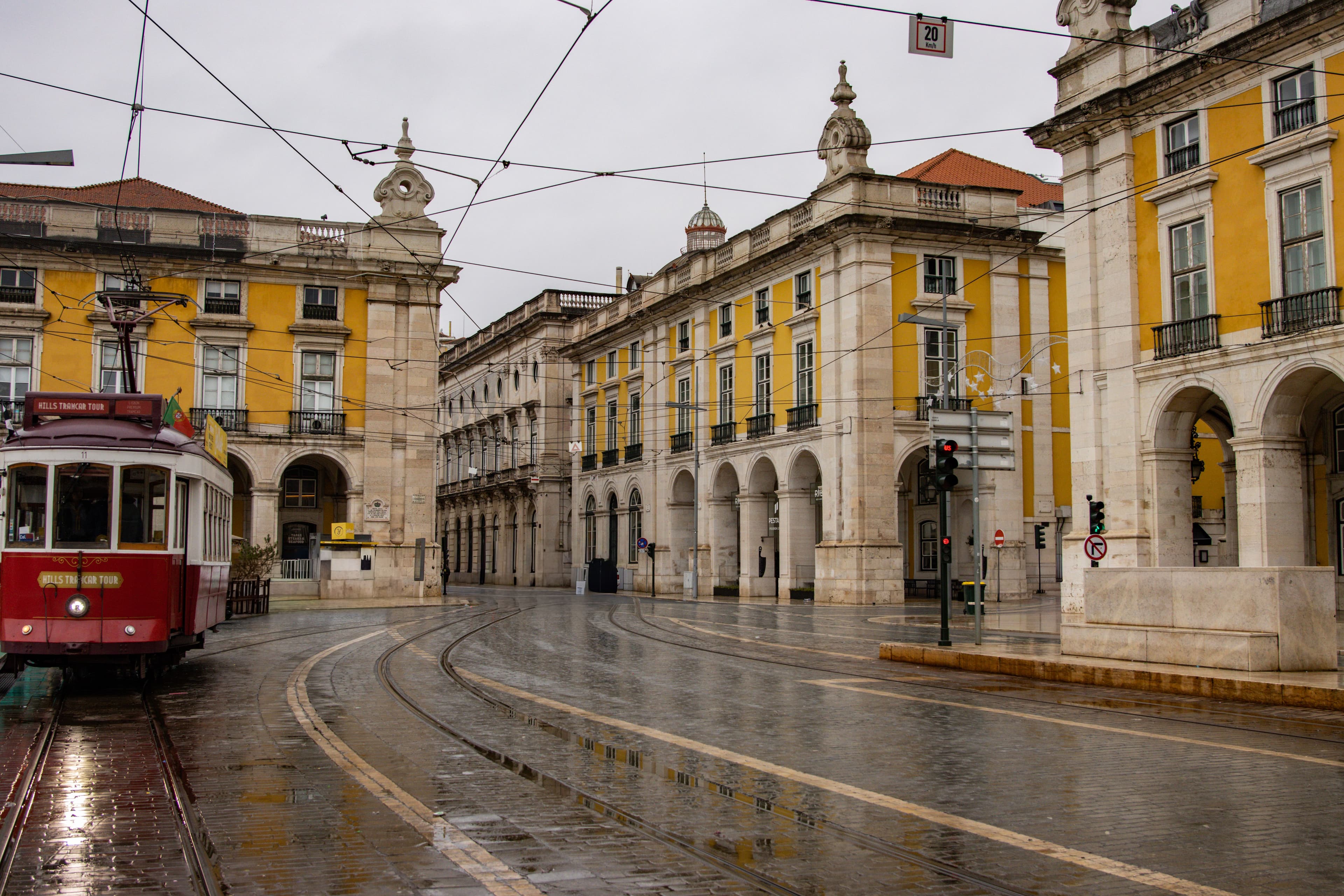
Praça do Comércio is one of the most dramatic marathon finishes in Europe. The 18th-century square faces the Tagus, framed on three sides by arcaded buildings and punctuated by the triumphal Arco da Rua Augusta. Follow the blue tangent line throughout the course. Timing is chip-based; non-elite official time is chip time.
Pacers
Official pacers are available. Confirm the full pacer list at the expo, as published details can vary between sources.
| Wave | Start time | Corrals | Pacers available |
|---|---|---|---|
| All | 08:00 | VIP / sub-3:00 / sub-3:30 / sub-4:00 / sub-4:30 / sub-5:00 / over-5:00 | Sub-3:00, 3:15, 3:30, 4:00, 4:30, 5:00 |
Course phases
The race begins on a wide coastal road in Carcavelos with sea air and October light. The first ten kilometres are the flattest and most open of the course. Settle into pace early; the scenery and the wide road invite overconfidence.
The coastal suburbs of Oeiras and Algés bring small but consistent undulations. Wind becomes relevant on these exposed sections: a westerly tailwind is a bonus, a crosswind is a problem. Adjust your effort by feel rather than by pace on the GPS.
The race's visual peak: Belém Tower, Jerónimos Monastery, and then the 25 de Abril Bridge. These landmarks arrive when energy is needed, not before it. Use them. The crowds thicken and the race lifts.
The final approach narrows into the historic city and ends on cobbled sections before Praça do Comércio. Shorten your stride on the uneven surface and keep your form together. The square is the finish: 18th-century arcades, the Tagus, the arch.
What to wear
Lisbon in October is mild but not predictable. At the 08:00 start in Carcavelos the temperature will typically be between 14°C and 18°C, which feels comfortable once moving but cold while waiting in a coastal breeze. A throwaway layer (an old long-sleeve top or a cheap poncho) is the standard answer for the start village wait.
Race-day highs in Lisbon can reach 22 to 23°C, and later waves finishing closer to midday may encounter genuinely warm conditions on the exposed riverfront. Runners in the sub-4:00 corrals are unlikely to feel the heat; runners starting in the over-5:00 box should plan for sun and take advantage of every water station.
The course is entirely exposed. There is no significant tree cover on the coastal road or riverfront sections. Running a vest rather than a T-shirt is a reasonable choice for faster runners. Slower runners should consider sun protection: an arm sleeve, a light cap, or sun cream applied before the start.
Atlantic October can also deliver rain. A disposable poncho handles the worst of it without taking up bag-drop space, and the bag is delivered to Praça do Comércio regardless.
Entry
| Places | Fee |
|---|---|
| First 2,000 places | €70 + €4 transaction fee |
| Places 2,001 to 5,000 | €95 + €4 transaction fee |
| From place 5,001 onwards | €130 + €4 transaction fee |
Entry into the EDP Lisbon Marathon is by general registration rather than ballot. The organiser opens places online and applies tiered pricing as spaces fill. The race has a published capacity of 15,000 marathon participants. Registration is personal and non-transferable. Lisbon is now inside the European Marathon Classics circuit, with growing international visibility, so waiting until spring to enter is a genuine risk rather than a theoretical one.
Standard registration includes the technical T-shirt, chip timing bib, runner bag, free race-day public transport, insurance, water and Powerade supply, gel stations, finisher medal, finisher diploma, and Olá ice cream at the finish. T-shirt size exchanges are not accepted at kit collection.
The organiser does not permit deferral or refund as a general rule. Exceptions for illness, injury or pregnancy require documentation and a formal request. Changes to personal registration details must be requested by email no later than one month before race day.
Athletes who have run faster than 2:16:00 (men) or 2:36:00 (women) in a certified marathon within the previous three years may apply for a VIP Start place, which gives access to the front of the race ahead of the general start boxes. Apply in writing to info@maratonaportugal.com at least 30 days before race day with proof of performance.
| Men | Faster than 2:16:00 |
|---|---|
| Women | Faster than 2:36:00 |
Race Weekend
Expo and kit collection
The 2026 participation kit is collected at Sport Expo (Sports and Leisure Fair) at FIL, the Feira Internacional de Lisboa, in the Parque das Nações district of eastern Lisbon. The venue is well served by the red Metro line; Oriente station is the most practical stop, giving access to both the expo hall and Gare do Oriente for onward connections.
Current official materials list collection on Thursday and Friday before race day, 10:00 to 20:00. Check the final athlete guide for any changes, as these details are updated closer to race day. There is no race-day kit collection; runners who miss the expo forfeit their bib.
Collect the kit in person or by authorised proxy. In person: bring the registration confirmation email and photo ID. Proxy: the nominee must present the runner's registration document and their own ID. The participation kit contains the chip-timing bib, technical T-shirt, runner bag (used for the bag drop on race morning), and sponsor materials. T-shirt stock is subject to availability and cannot be exchanged at the pickup desk.
Friday is the more practical collection day for most international travellers arriving Thursday. The expo doubles as a trade show, with running brands and nutrition suppliers alongside the bib collection.
Race morning
Race morning for the Lisbon Marathon is primarily a logistics problem: the start is in Carcavelos, and most runners are staying in central Lisbon. The solution is the CP (Comboios de Portugal) Cascais line from Cais do Sodré station. This train runs to Carcavelos in approximately 30 minutes. Carcavelos station is then about 1 km from the start on Estrada N6-7, a straightforward walk along the road. Runners staying in Cascais can travel the other direction: approximately 25 minutes to Carcavelos.
Public transport (trains, buses and Metro) is free for runners on race day. Show your bib or registration confirmation as proof of entitlement.
A conservative target for runners staying in Baixa or Chiado: aim to be at Cais do Sodré by 06:15 at the latest for an 08:00 start. The train journey is short, but thousands of runners are attempting the same corridor simultaneously, and both station access and platform capacity can bottleneck quickly. Add the 1 km walk from Carcavelos station, time to collect any last items, bag drop (which closes before the start), toilet queues and corral entry. Check the final runner guide for any dedicated early services for marathon runners.
Start boxes are VIP Start, sub-3:00, sub-3:30, sub-4:00, sub-4:30, sub-5:00 and over-5:00. Pacers should be visible in the start area, but confirm locations at the expo. Expect portable toilets, basic event infrastructure, and limited comfort at the start village. The October coast can feel cold and exposed before an 08:00 gun, particularly if there is wind or overnight rain. Wear a throwaway layer for the station and the wait.
Bag drop: the organiser provides a clothing collection service for marathon runners only. Use only the official bag supplied in the race kit, marked with the bib number. One bag per athlete. Bags are transported to the finish at Praça do Comércio and collected there. Do not put valuables, phone, payment card or hotel key in the bag.
Finishers collect their medal, refreshments and bag within the square. The square is large and immediately post-race crowded. Agree a meeting point with supporters before the start, ideally a specific arch on the northern colonnaded side or the Cais das Colunas jetty steps on the river side of the square. Terreiro do Paço Metro station is accessible nearby.
Nutrition on course
Thirteen aid stations cover the 42.195 km course. Water is available at every station from km 5 onward.
| Km | Water | Powerade | Gel | Fruit | Notes |
|---|---|---|---|---|---|
| 5 | Yes | — | — | — | First station |
| 10 | Yes | Yes | — | — | — |
| 15 | Yes | — | — | — | — |
| 17.9 | Yes | — | Yes | — | Gel station |
| 20 | Yes | Yes | — | — | — |
| 22.8 | Yes | — | — | — | — |
| 25 | Yes | — | — | Fruit | — |
| 27.5 | Yes | — | — | — | — |
| 30 | Yes | Yes | — | — | — |
| 32.5 | Yes | — | Yes | — | Gel station |
| 35 | Yes | — | — | Fruit | — |
| 37.5 | Yes | Yes | — | — | — |
| 40 | Yes | — | — | — | Final water point |
The race does not use distinctively Portuguese food on course. There are no pastéis de nata, no bacalhau. What it does have at the finish is ice cream, which counts for more after 42 km than it sounds.
Spectators
The Lisbon Marathon is a point-to-point race along a road closed to cars for the morning, which means spectators cannot chase runners by vehicle. The realistic plan is one or two sightings plus the finish. Supporters who try for three locations by train will spend most of their morning at station platforms.
The premium mid-race sighting is Belém. Spectators can take the Cascais line from Cais do Sodré westward to Belém station, watch runners pass the Tower of Belém and Jerónimos Monastery corridor, then return east to central Lisbon for the finish. The train journey takes roughly 15 to 20 minutes in each direction.
Praça do Comércio is the essential spectating location. The square is large, the arcades provide shade, and the finish line is visible from most of the northern and western edges. Agree on a post-race meeting point before the start: a specific arch or the Cais das Colunas steps on the river side.
- Depart Cais do Sodré on the Cascais line toward Cascais
- Disembark at Belém station, approx. 15 to 20 min
- Walk to riverside for sighting near Belém Tower (~5 min)
- Return to Cais do Sodré on the Cascais line (toward Lisbon)
- Walk or take Metro from Cais do Sodré to Praça do Comércio (~10 min on foot)
- Depart Cais do Sodré on the Cascais line
- Disembark at Algés station (~10 min) for approx. km 20 sighting
- Return Cascais line toward Lisbon to Cais do Sodré
- Walk to Praça do Comércio (~10 min)
- Walk or take Metro to Terreiro do Paço station (Yellow line: 1 stop from Cais do Sodré)
- Enter Praça do Comércio from the northern arcades and find a position
- No need to navigate race closures on the riverfront west of the square
Logistics map
Start, finish, expo, and key CP Cascais line stations. Click any pin for details.
Where to Stay
Post-race food
After collecting the medal and bag at Praça do Comércio, the most useful food decision is the nearest one. The square itself is framed by the Ala Pombalina arcade, where several cafés operate on race day. Café Martinho da Arcada, in the arcade overlooking the square, has been serving food since 1782, and its patio directly faces the finish area. The food is solid rather than exceptional, but the location, after 42 km on a coastal road, is hard to argue with.
For the more purposeful post-race meal, the walk to Time Out Market at Cais do Sodré takes about 10 minutes along the riverfront. The food hall covers enough ground that runners travelling in groups with different recovery appetites can all find something useful without negotiation.
A bifana from As Bifanas do Afonso on Rua da Madalena is the more specifically Lisbon option. The stewed pork sandwich costs around €3, requires no table, and represents exactly the kind of calorie-dense, easy-to-eat recovery food that marathon finishers actually need. It is a short walk from Praça do Comércio uphill into Baixa. Note: it is closed on Sundays, but the marathon is on a Saturday, so the timing works.
For caldo verde (the potato and kale soup that Portugal defaults to for comfort) any traditional tasca in Baixa will have it. It is the right call before the bifana, not after.
Neighbourhoods
The governing principle for the Lisbon Marathon is straightforward: stay near the finish, not the start. The 2026 marathon begins in Carcavelos, roughly 30 km from central Lisbon, and the organiser provides free trains to get runners there. The finish is at Praça do Comércio, in the heart of the city. At the end of 42 km, a five-minute walk to your hotel room is worth far more than a 30-minute walk to the start line.
Baixa/Chiado. This is the default choice and the right one. Baixa occupies the flat grid between Rossio and the river: practical, central, and about as close to Praça do Comércio as it is possible to get without sleeping in the square itself. Race-morning access is a five-minute walk to Cais do Sodré for the Cascais line train. Chiado sits just above Baixa with a slightly steeper terrain and a better restaurant scene; the trade-off is the uphill walk back from the river after the race. For first-time Lisbon runners, Baixa is the more reliable choice.
Alfama. The oldest quarter of the city and, visually, one of the most compelling places to stay in Portugal. The streets are narrow, the stairs are steep, and the Atlantic light comes off the terracotta rooftiles in a way that makes Alfama genuinely appealing. It is also a working maze. After a marathon, those same stairs and narrow lanes become a very practical problem. If the specific hotel is close to the river on the lower edge of the neighbourhood, it can work. If it is up near the castle, take a taxi.
Bairro Alto.Avoid it on the Friday night before the race. Bairro Alto is Lisbon's late-night district, and Saturday mornings begin very early. The noise runs until 3 or 4 in the morning in the narrower streets. Since the 2026 marathon runs on a Saturday, the critical pre-race night is Friday. Runners who need eight hours of sleep before a marathon should choose somewhere else.
Belém.Seven kilometres west of the finish along the river, Belém offers a quiet, monumental base for runners who want space rather than central convenience. Hotels here tend to be calmer than Baixa equivalents and the neighbourhood gives runners the experience of staying near the course's visual centrepiece. The practical cost is that getting to Praça do Comércio after finishing requires a train, tram or taxi. Belém works well for supporters or for runners on a second visit to Lisbon.
Príncipe Real. One of the more pleasant areas of central Lisbon: leafy, boutique, with restaurants that lean toward local rather than tourist. The terrain is hillier than Baixa, which matters on post-race legs. Transport to Cais do Sodré on race morning requires either a walk or a Metro connection. For runners who value a more polished neighbourhood feel over minimal friction, Príncipe Real is worth considering.
Intendente/Mouraria. Value-for-money options exist here that are genuinely good. The Metro connects to Cais do Sodré easily enough on race morning. Research individual hotel locations carefully before booking; the neighbourhood is improving unevenly.
Booking timeline
Entry for the EDP Lisbon Marathon opens on a rolling basis rather than a ballot release date. There is no single moment when thousands of runners simultaneously discover they have a place and scramble for hotels. The practical consequence is that runners who enter early face less hotel competition than runners who enter in the spring or summer. However, Lisbon is a popular European city for autumn travel regardless of the marathon, and the shortage of good, central hotels within walking distance of Praça do Comércio is structural rather than marathon-specific.
Book within a week of entering. Prices on marathon weekend are higher than a comparable October weekend without the race. Fully refundable rates are available at most Baixa and Chiado hotels and remain sensible while flights are still unbooked.
Flight prices to Lisbon from major European hubs are generally reasonable outside the peak summer months, but October is increasingly popular across Portugal. Booking flights at the same time as the hotel, rather than assuming they will be available later, avoids the scenario of a confirmed hotel and no affordable way to get there.
Hotel recommendations
Converted from a 19th-century government palace, this is the most conveniently positioned hotel for the Lisbon Marathon finish. Several rooms overlook Praça do Comércio directly. The combination of location and quality makes it the top choice if budget allows.
A short walk from Cais do Sodré station, which is the departure point for race-morning trains to Carcavelos. Practical for the morning logistics and reasonably positioned for the post-race walk back from Praça do Comércio along the riverfront.
Mid-range and central, with a straightforward walk to Praça do Comércio and easy access to Rua Augusta for post-race food. A solid first-marathon option for runners who want reliable location without the premium price.
Good central base with straightforward access to Praça do Comércio via the flat Baixa grid. On the Green Metro line for Cais do Sodré connections on race morning. Check for any Saturday-night noise from the nearby squares.
A late 19th-century hotel in the grand European railway-hotel tradition, positioned above Rossio station. Well-insulated rooms and a central location that covers both post-race food options and race-morning transport access.
See & Do
The finish at Praça do Comércio puts you at the edge of central Lisbon with the Tagus immediately in front. The Baixa grid and the Chiado are flat and navigable from the finish area.
Praça do Comércio and Arco da Rua Augusta
Finish area, 0 km
The marathon finishes inside one of Europe's most architecturally coherent city squares. The Arco da Rua Augusta at the northern edge of the square has an internal lift and stairway to a viewpoint above the keystones; the views over Baixa's grid and the Tagus are worth the visit for runners who are back on their feet the next day. The square itself is flat and accessible, and the Cais das Colunas jetty steps on the river side are a practical meeting point for supporters.
Belém Tower and Jerónimos Monastery
7 km from finish, Cascais line train to Belém station
Two of the defining monuments of Portugal's Age of Discoveries sit within a few hundred metres of each other in the Belém district, at approximately the km 27 to 30 mark of the course. The Tower of Belém is a 16th-century riverfront fortification; the Jerónimos Monastery is a Manueline structure funded by the wealth brought back from Vasco da Gama's first voyage to India. Runners who pass them during the race often want to return on foot the next day. The terrain around Belém is flat, which matters after a marathon.
Time Out Market
1 km from finish, riverside walk from Praça do Comércio
The food hall at Cais do Sodré is a straightforward post-race option: multiple counters, no reservations, flat terrain, and enough variety that a group of runners with differing appetites can each find something. It is also the starting point for the Cascais railway line, which makes it useful for trip planning as well as eating. Busy on weekends but large enough to absorb the crowds.
São Jorge Castle
1.5 km from finish, steep uphill into Alfama
The Moorish castle above the historic centre of Lisbon offers the most comprehensive views of the city and the Tagus. The walk up from Praça do Comércio is steep and involves uneven cobblestones. On the day after a marathon, most runners will find this more punishing than enjoyable; a taxi or tuk-tuk from the riverside is the practical option. The views from the battlements are excellent.
Pastéis de Belém
7.5 km from finish, Cascais line to Belém
The custard tart bakery on Rua de Belém, a few minutes' walk from the monastery, has been producing pastéis de nata to the original 19th-century recipe since 1837. The queue is long but moves quickly. Order them warm with cinnamon and powdered sugar and eat them standing at the counter. Going to Lisbon without visiting is technically optional, in the same way that going to Naples without eating pizza is technically optional.
Read Before you Run
Conquerors: How Portugal Forged the First Global Empire
Roger Crowley
Crowley covers the Portuguese voyages of discovery from the late 15th century onward, including Vasco da Gama's first route to India and the subsequent empire built on that knowledge. The Jerónimos Monastery was funded from the wealth those voyages returned. Runners who pass Belém with some understanding of what the monuments are commemorating will find the km 27 to 30 section a different experience.
The Book of Disquiet
Fernando Pessoa
Pessoa's fragmentary masterpiece is set almost entirely in the Baixa district, the same flat grid runners finish in and stay in for the race weekend. It is not a cheerful book, and it is not about running, but it gives the area around Praça do Comércio a weight and a melancholy that sits alongside the race weekend's mood. Best read in small passages on the evenings before and after the race.
After the Race
The Lisbon Marathon runs in October, which places the post-race days in the heart of Portuguese autumn. The Atlantic coast is quieter than summer, the Alentejo plain is mild by day, and Sintra in autumn mist has the specific quality the 19th-century Romantic palace-builders were working toward. Crowds at the major sites are a fraction of August levels.
Post-marathon legs recommend flat walks, trains that move while you sit, and restaurants without urgency. All seven itineraries are planned with that in mind.
The former royal fishing village on the Atlantic coast. Flat seafront promenade, Parque Marechal Carmona with resident peacocks, and fresh Atlantic fish on Rua Frederico Arouca. October finds it quieter than summer without being closed.
The UNESCO-listed hill town northwest of Lisbon. Pena Palace sits high on the Serra, accessible by shuttle or steep climb. The Palácio Nacional in the town centre and the Vila Sassetti valley gardens are the gentler post-marathon options. October mist on the Serra is specific.
The walled Alentejo city southeast of Lisbon: a Roman temple, the Chapel of Bones with the remains of 5,000 Franciscan monks, the Praça do Giraldo, and carne de porco à Alentejana with Alentejo red wine. The historic centre is largely flat, which matters after a marathon.
Portugal's university city on the Mondego River. The Parque Verde do Mondego riverfront and the lower-town streets are flat and substantial. The evening: Coimbra fado at Fado ao Centro, the academic tradition sung in capes, distinct from the Lisbon version.
One night in Cascais on the Atlantic, two nights in Sintra on the Serra. A car-free loop that exits at Rossio rather than Cais do Sodré. October is the right month: quiet roads, cooler walking temperatures, autumn light on the palaces.
The Templar fortress and UNESCO Convento de Cristo above Tomar, the vast flat esplanade of the Fátima sanctuary, and two nights in Nazaré for the Atlantic swells on the Praia do Norte. October brings good waves and smaller crowds than summer.
Three Portuguese cities by train across four nights. Read the routing honestly: Évora lies southeast of Lisbon, Coimbra lies north. There is no direct connection and Day Two requires a transit back through Lisbon Oriente. Four nights, three cities, no car.
Frequently asked questions
Should I stay near the start or the finish?
Stay near the finish at Praça do Comércio. The 2026 marathon starts in Carcavelos, outside central Lisbon, and runners get there by CP train from Cais do Sodré, a 30-minute ride that is free with the race bib. The finish is in the heart of the city. Choosing a hotel in Baixa or Chiado means a short walk back to your room after collecting your medal.
How far in advance should I book a hotel?
Book immediately when you confirm your race entry. Lisbon is a major European city with substantial autumn tourist demand regardless of the marathon, and hotels within walking distance of Praça do Comércio are in short supply. Fully refundable rates are available at most central hotels. Do not expect last-minute availability in the best-located areas.
Is there free public transport on race day?
Yes. Trains, buses and Metro are free for runners on race day with your bib or registration confirmation. The critical service is the CP Cascais line from Cais do Sodré to Carcavelos, approximately 30 minutes. Check the final race-week transport guide for any special schedules.
What is the best neighbourhood to stay in?
Baixa is the most practical choice. It is flat, central, within 10 to 15 minutes walk of Praça do Comércio, and a short walk from Cais do Sodré for race-morning trains. Chiado is a slightly more upmarket option but hillier on post-race legs. Avoid Bairro Alto if you are a light sleeper. Alfama looks close on a map but involves steep hills and uneven lanes after 42 km.
When does the expo open, and what do I need to bring?
The 2026 expo is at FIL (Feira Internacional de Lisboa) in Parque das Nações, on Thursday and Friday before race day. Bring your registration confirmation and photo ID. A proxy can collect on your behalf with the runner's registration document and their own ID. There is no race-day bib pickup.
What is the weather typically like on race day?
Lisbon in October is mild, with typical highs around 22 to 23°C and lows around 15°C. At the 08:00 coastal start in Carcavelos it will likely feel cooler, especially in wind. The course is entirely exposed along the Atlantic and Tagus. Rain and Atlantic systems are possible even in a generally fine forecast. Bring a throwaway layer for the start.
How do I get from the airport to the city centre?
Lisbon Airport has a Metro station on the red line. The airport's own transport information states the journey to the city centre takes approximately 20 minutes; you will usually change lines to reach Baixa or Cais do Sodré. Taxis and ride-hailing services are straightforward from arrivals, particularly useful with luggage.
Is there a bag drop at the race?
Yes, for marathon runners only. Use the official runner bag from your participation kit, marked with your bib number. One bag per runner. Bags are transported from the start in Carcavelos to the finish at Praça do Comércio by the organiser. Check the final race guide for the bag-drop location and timing at the start.
Should I bring a throwaway layer to the start?
Yes. The start is in Carcavelos at 08:00, on a coastal road exposed to Atlantic wind. October mornings can be cool before the sun establishes itself, and the wait between arriving by train and entering the start box takes time. An old long-sleeve top or a cheap disposable poncho will keep you warm and can be discarded at the start line.
How do I get back to my hotel after finishing?
If staying in Baixa or Chiado, most runners can walk back from Praça do Comércio in five to fifteen minutes on flat pavement. Terreiro do Paço Metro station is accessible from the square. Cais do Sodré is a ten-minute walk along the riverfront for connections to wider Lisbon. Agree a meeting point with supporters before the start.