The Race
| Next Race Date | 24 April 2027 |
|---|---|
| Course type | Point-to-point, net downhill ~33 m, largely flat |
| Certification | World Athletics Platinum Label · Abbott World Marathon Major · AIMS / UK Athletics certified |
| Start | Blackheath / Greenwich Park, south-east London |
| Finish | The Mall, Westminster |
| Total finishers | ~45,000 (single-day recent editions); ~100,000 across two days in 2027 |
| Avg race-day temp | 8 to 15°C (April; wide range, pack for both cold starts and warm later miles) |
| Cutoff time | 8 hours from the last wave start (The Mall closes 19:30; finish moves to St James's Park until midnight) |
| Free race-day transport | Yes: bib valid on Southeastern trains plus TfL (Underground, Overground, DLR, Elizabeth Line, buses) to the start; TfL free until 20:00 post-race; Southeastern does NOT offer free post-race travel |
| Course certification | AIMS / UK Athletics certified |
| Sleeper Train | Caledonian Sleeper from Scotland to London Euston; Night Riviera from Cornwall to London Paddington |
History
The London Marathon is the hardest major marathon to enter and the least likely to disappoint once you do. Those two facts are connected. Chris Brasher and John Disley founded the race in 1981 after Brasher ran New York and came back convinced that London could produce something equivalent: a race that belonged to the city as much as to the runners in it. The first edition, on 29 March 1981, drew 6,255 finishers. Within a decade, entries had outpaced supply so completely that the ballot became the race's defining characteristic: not the course, not the weather, not the elite field.
The course has always been built around landmarks rather than geography. Blackheath, the Cutty Sark, Tower Bridge, Canary Wharf, the Embankment, The Mall: the route was designed to feel like a crossing of London rather than a measured road loop, and it still does. That quality drew elite athletes and world records from the start. Ingrid Kristiansen ran 2:21:06 here in 1985. Paula Radcliffe ran 2:15:25 in 2003, a women's world record that stood for sixteen years. In April 2026, Sabastian Sawe crossed The Mall finish in 1:59:30, the first legal sub-two-hour marathon in competitive race conditions, while Tigst Assefa improved her own women-only world record to 2:15:41 in the same race. Two world records in a single morning is a thing that has happened at this event.
The 2027 edition is a one-off two-day format, with 100,000 participants across Saturday 24 and Sunday 25 April. It is the largest marathon in the event's history and a direct response to 1.33 million ballot applications for the 2026 race. The organiser describes it as a one-time experiment; it is also an acknowledgement that London's central problem has never been quality, only capacity.
This race suits runners who want crowd support sustained across 42 km, a fast certified course, and a finish corridor that feels genuinely ceremonial. It is not the race for those who want quiet roads or quick ballot odds.
The day two records fell
Sabastian Sawe of Kenya crossed The Mall finish in 1:59:30, becoming the first person in history to run a competitive marathon in under two hours. The time, ratification subject to World Athletics procedures at the time of writing, beat Kelvin Kiptum's previous world record of 2:00:35 by 65 seconds. In the same race, Tigst Assefa improved her own women-only world record to 2:15:41. Two world records set on the same morning on the same course. The blue line on the road is the same one Sawe followed.
The course
The TCS London Marathon is a point-to-point road course from south-east London to central London, beginning at Blackheath and Greenwich Park and finishing on The Mall near Buckingham Palace. The net elevation drop is approximately 33 metres: the start sits at around 39 m above sea level, the finish at roughly 6 m. Most of that drop happens in the first 5 km as the route descends from the Blackheath plateau toward the river-level streets of Deptford and Lewisham.
The remainder of the course is largely flat. Key landmarks with approximate kilometre positions: Cutty Sark around km 10, Tower Bridge around km 20, Canary Wharf business district between approximately km 24 and km 32, Victoria Embankment from around km 38, and the Queen Victoria Memorial outside Buckingham Palace just before the finish straight. Distance markers appear at every mile and every kilometre; timing clocks operate at every mile and every 5 km. A blue line painted on the road marks the shortest legal route throughout. Total elevation gain is approximately 85 m based on Strava route data for the 2026 course; no official organiser elevation table has been published.
Km 0–10: The Blackheath descent into Greenwich. London starts with an unusual advantage: the first 5 km run downhill. The route drops sharply from the elevated Blackheath plateau toward the river flats of Deptford, losing around 30 m of elevation over roughly 2 km. This feels like a gift. It is partly a trap. The legs are fresh, the hill helps, and the crowd noise from residential streets in Charlton and Woolwich encourages faster running than the plan allows. Keep the effort controlled, not the pace. GPS readings are generally reliable in this section. The fields converge around km 5, and by km 10 the course passes around the Cutty Sark in Greenwich, where the crowd density surges abruptly. This is the first real emotional moment of the race. Run through it without accelerating.
Km 10–20: Bermondsey, Rotherhithe, and the approach to Tower Bridge. The middle of the route between Greenwich and the bridge is the section most runners forget. Long, flat roads through Bermondsey and Rotherhithe offer little visual drama and plenty of time to settle into pace or drift off it. The course passes through residential streets where local support is warm but thinner than at the landmarks. This is the right place to eat and drink to schedule, keep cadence up, and resist the temptation to look at the watch. Around km 19, Tower Bridge Road begins and the noise changes. The bridge is coming.
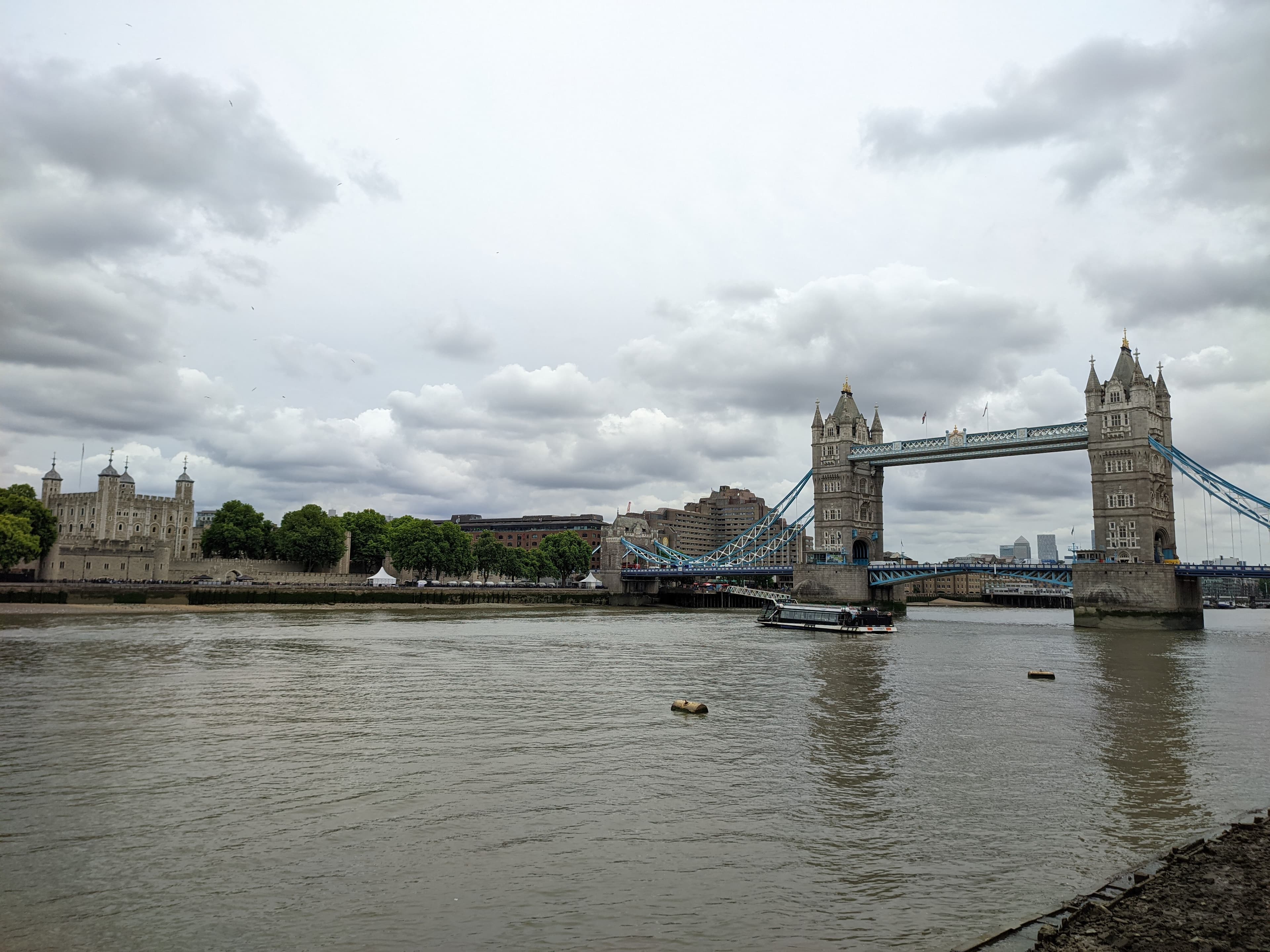
Km 20–32: Tower Bridge and Canary Wharf. Tower Bridge arrives around km 20 and is the race's defining moment for almost everyone running it. The crowd stands deep on both sides and the noise rolls down the approach road before the bridge is even visible. Take it in, but do not sprint. The bridge surface and the turn onto it can affect stride rhythm, and the excitement is genuine enough to lift pace without conscious effort. Immediately after the bridge, the course swings east into the Isle of Dogs and Canary Wharf, and the character of the race changes completely. Modern glass towers replace Georgian brick; the crowd support drops to pockets rather than walls. GPS watches can become unreliable between the high buildings. Use the blue line, the mile markers, and perceived effort rather than trusting every watch split. The course loops through the business district, which involves tighter turns and occasional wind tunnels between buildings. This section between km 20 and km 32 is where London asks the first serious question. Answer it patiently.
Km 32–42: The long road home. The return westward along the Thames corridor is where the race's emotional arithmetic changes. The crowd thickens again, but the legs now know the distance and the Embankment ahead is longer than it looks. Underpasses and small rises disproportionately affect tired quads. The London Eye appears, then Westminster Bridge, then the Houses of Parliament, yet these feel like they signal the end and they are not. Keep counting down in small increments. The final turn from Birdcage Walk onto The Mall opens onto a straight of perhaps 600 m to the finish. Buckingham Palace is directly ahead. The red tarmac and the timing gantry are visible from the turn. This is a finish corridor unlike almost anywhere else in marathon running.
Blue line and timing notes. The blue line painted on the road marks the shortest measured route and is worth following throughout the race: the difference between the line and wide cornering accumulates measurably over 42.195 km. The official timing mat is at the finish line on The Mall in standard operation; for runners who finish later in the day, the official 2026 guide stated the finish moves to St James's Park after The Mall closes at 19:30. Check the 2027 Participant Guide for how late finishers are handled under the two-day format.
Pacers
The 2026 participant guide confirms pacers covering 03:00 to 07:30, positioned near each Start Line with tall, bright flags showing the target finish time. They aim to finish within their stated time. London's large field makes it difficult to locate and stay with a pacer once the race is moving. Identify the target pacer before the start line, position nearby, and plan to pace independently for the first 5 km as congestion and GPS issues may cause the pacer flag to disappear temporarily.
| Wave / Start | Start time | Pacers available |
|---|---|---|
| Wave system (2026) | Waves 09:30–11:30 across Blue, Green, Pink, Red, Yellow starts | 03:00–07:30 in 30-minute increments |
The route descends around 30 m in the first 5 km from Blackheath toward the river flats, then flattens through Deptford into Greenwich. The Cutty Sark at km 10 brings the first crowd surge. Run the descent at planned effort, not planned pace; the legs are fresh and the hill makes everything feel easy, which is a problem.
Long, relatively featureless roads through Bermondsey and Rotherhithe give way to the rising noise of Tower Bridge Road. Eat and drink to schedule here. There is nothing to look at and no crowd to pull you along, which makes this the section where good runners build races and underfuelled runners begin to lose them.
The bridge at km 20 is London's loudest single moment. The Canary Wharf loop immediately after is its quietest. GPS becomes unreliable between the towers; use the blue line and physical markers. The turns are frequent and the wind can channel between buildings. Stay patient through the Docklands loop.
The route returns westward along the Thames, through the Embankment and past Westminster. This section is emotionally charged and physically hard. The final turn onto The Mall is unmistakable. Buckingham Palace frames the finish line. Do not kick too early; the straight is longer than it looks from the corner.
What to wear
London in late April runs from genuinely cold to surprisingly warm, sometimes within the same morning. Long-term April averages put the mean temperature around 10°C, with typical highs near 15°C and lows near 4°C, but actual race-day conditions vary widely from year to year. The 2018 race was unusually warm, catching runners who had trained through a cold winter; some years it rains steadily for most of the distance.
Bring a throwaway layer for the start. Waiting at Blackheath or Greenwich Park in shorts and vest for 30 to 60 minutes before your wave goes can be cold, even when the race itself later feels warm. The organiser confirms collection points near every start line for clean unwanted clothing, which is donated to the Salvation Army. Use an old sweatshirt or rain poncho rather than anything you intend to keep.
For race kit: a hat and gloves are worth carrying in a pocket for the first 10 km regardless of forecast. Sunscreen is sensible for later waves starting after 10:30, particularly on the exposed Embankment and Docklands sections when the sun is higher. The course has no significant shade from km 35 onward.
Non-noise-cancelling headphones or bone-conduction headphones are permitted. Noise-cancelling headphones are not allowed.
Entry
The 2027 TCS London Marathon Double runs across two days: Saturday 24 and Sunday 25 April 2027.
Field size is 100,000 participants across both days, up from approximately 56,000 in a standard year. The route is unchanged: Greenwich to Westminster on both days. This is a one-off format and not a permanent change.
Everyone who has already applied is entered into a ballot for both Saturday and Sunday. Places are allocated by completely random draw. Participants cannot run both days in person, but may run one day and complete TCS London Marathon MyWay (virtual) on the other.
Ballot results: early July 2026. Book your hotel within days of receiving your result.
The ballot opens for approximately one week in late April immediately after the previous year's race, and results are typically announced in July. For 2027, the ballot opened at 09:00 BST on 24 April 2026 and closed at 16:00 BST on 1 May 2026; results including day allocation are due July 2026. The draw is described by the organiser as fully random. With 1.33 million applications for the 2027 race and approximately 100,000 total places across both days, before subtracting charity, GFA, Championship, club and international allocations, the odds for a ballot place remain well under 10%.
Good For Age (GFA)
GFA gives fast UK-resident runners a performance-based entry route. The 6,000 GFA places (3,000 men, 3,000 women) are allocated fastest-first relative to each age bracket's qualifying standard; meeting the standard gets you into the application pool, not a guaranteed place. Runners typically need to be 2 to 5 minutes inside the published standard to secure a spot. The qualifying window for 2026 was 1 October 2024 to 30 September 2025; 2027 standards will be published in autumn 2026.
2026 GFA standards (2027 standards to be confirmed)
| Age | Women | Men |
|---|---|---|
| 18–39 | sub 3:38 | sub 2:52 |
| 40–44 | sub 3:43 | sub 2:57 |
| 45–49 | sub 3:46 | sub 3:02 |
| 50–54 | sub 3:53 | sub 3:07 |
| 55–59 | sub 3:58 | sub 3:12 |
| 60–64 | sub 4:23 | sub 3:34 |
| 65–69 | sub 4:53 | sub 3:52 |
| 70–74 | sub 5:53 | sub 4:52 |
| 75+ | sub 6:13 | sub 5:07 |
Other entry routes
Championship Entry is capped at 1,200 places (600 men, 600 women) and requires registered UK athletics club membership. For 2026, the qualifying times were sub 2:38:00 marathon or sub 1:11:30 half marathon for men; sub 3:10:00 marathon or sub 1:26:00 half marathon for women. 2027 standards are pending.
Charity places are the most accessible guaranteed route. Fundraising minimums typically range from £1,500 to over £2,750 depending on the charity, with major national charities often setting minimums of £2,300 to £2,750 plus a registration fee. Runners are personally liable for shortfalls under most charity contracts; read the terms before committing.
International entry via tour operator is the main route for overseas runners. Sports Tours International is the official operator for participants from the USA, Ireland and France. Other operators exist by territory. Packages bundle race entry with accommodation and typically carry a significant cost premium over a ballot place.
GFA and Championship places cannot be deferred except for pregnancy or postpartum, in which case a three-year deferral window applies. International ballot places can be deferred one year; mass-entry deferral terms should be checked in the 2027 guide.
The London Classics
The London Classics is a challenge run by London Marathon Events that awards a separate medal to anyone who completes all three of the organisation's flagship events: the TCS London Marathon, Ride London (a 100-mile cycling sportive), and the two-mile distance at Swim Serpentine in Hyde Park. The three events can be completed in any order and across any number of years.
The medal is engraved with the Latin phrase Et ego Londinium vici— “I too have conquered London” — and is noticeably larger than the standard marathon medal. Finishers receive it in a dedicated area after completing the third and final event, and are listed in a Hall of Fame on the London Classics website.
I collected mine after the marathon, having completed the cycling and swimming events first. Standing in the finisher funnel on The Mall, still in kit and still moving on legs that had stopped co-operating around Canary Wharf, getting a second medal from a volunteer felt like a reasonable trade for the year of training it had taken to get there.
Ride London is currently on indefinite pause. The event did not run in 2025, and in February 2026 London Marathon Events confirmed it had been placed on indefinite pause following a strategic review into its operational and financial future. No return date has been announced. The London Classics medal remains valid for anyone who already holds a qualifying Ride London result from a previous edition, and London Marathon Events has not announced any changes to existing Hall of Fame completions. Whether new participants can work toward the Classics while Ride London is suspended has not been formally addressed. Check londonmarathonevents.co.uk/london-classics for the current position before making plans around this challenge.
Race Weekend
Expo and number collection
Event packs are collected at the TCS London Marathon Running Show at ExCeL London, the exhibition centre in the Royal Docks area of east London. The Docklands Light Railway (DLR) from central London to Custom House or Prince Regent is the most direct route to ExCeL; allow 40 to 50 minutes from Westminster, less from Canary Wharf.
In 2026, the Running Show ran from Wednesday 22 to Saturday 25 April, with Thursday and Friday typically the least-crowded collection days; Saturday queues grow progressively from mid-morning. The organiser has not yet confirmed 2027 opening hours.
To collect a pack, runners need the unique QR code sent by email and accessible in the TCS London Marathon App under “My Marathon / Event Pass”, plus a valid photo ID. No pack is mailed; no bib can be collected at the start line on race morning. Proxy collection is available with the runner's QR code, a photocopy of the runner's photo ID, and the proxy's own photo ID. One person may collect for one other runner only.
The Running Show is a large commercial expo with kit, nutrition and footwear stands. Avoid buying new running shoes or socks here. Anything worn on race day should already be worn in; the expo is a well-documented location where otherwise sensible runners spend £150 on shoes they then wear for 42 km.
Getting to the start
The start is in south-east London, across the city from every hotel neighbourhood recommended in this guide. The standard route is by National Rail from central London stations. Your race bib serves as a free travel pass on Southeastern train services and TfL modes (Underground, Overground, DLR, Elizabeth Line, buses) to the start. Show the bib; do not tap in on Oyster or contactless.
From London Bridge or Charing Cross: take Southeastern services toward Greenwich, Maze Hill or Blackheath. Journey time from London Bridge to Blackheath is around 12 to 15 minutes; from Charing Cross, roughly 20 to 25 minutes to Blackheath or Maze Hill. In 2026, the wave system ran from approximately 09:30 to 11:30 across five colour-coded start areas (Blue, Green, Pink, Red, Yellow). Runners could join a later wave from their allocated start line but could not move to an earlier one.
Walk times from stations to start villages: Blackheath station to Blue/Green/Yellow villages is approximately 10 to 15 minutes. Maze Hill station to Pink is approximately 10 minutes. Greenwich station to Red is approximately 20 minutes uphill into Greenwich Park. Check your colour-coded start on the bib before choosing which station to aim for.
Allow more time than the journey appears to need. Marathon Sunday at London Bridge and Charing Cross stations is crowded from around 07:00. Trains fill quickly. Factor in queuing for trains, not just travelling on them.
Start village and bag drop
Facilities include bag drop lorries, portable toilets (including accessible toilets and PEEQUALS female urinals), information points and water refill stations. Toilet queues are notoriously long and begin building immediately when runners arrive. Queue early, before urgency forces it. Carry a small amount of tissues and hand gel.
Use the official clear plastic event kitbag provided at the Running Show expo. Write your bib number clearly on the number sticker and attach it to the bag. Match the lorry number to your bib. Hand the bag over before the lorry's closing time, usually 20 minutes before the relevant wave start. In 2026, the Green Assembly Area had no bag drop facility; runners registered in that category could drop a small bag at the Finish Area in St James's Park the day before race morning.
Nutrition on course
Note that sponsors and exact positions can change year to year; check the 2027 Participant Guide before race day.
| Approx marker | Available |
|---|---|
| Mile 3 / 4.8 km | Buxton water |
| Mile 5 / 8.0 km | Water refill station |
| Mile 6 / 9.7 km | Buxton water |
| Mile 7 / 11.3 km | Lucozade Sport |
| Mile 9 / 14.5 km | Buxton water |
| Mile 10 / 16.1 km | Water refill station |
| Mile 12 / 19.3 km | Buxton water |
| Mile 13 / 20.9 km | Lucozade Sport Gel |
| Mile 14 / 22.5 km | Buxton water + refill station + Vaseline |
| Mile 15 / 24.1 km | Lucozade Sport |
| Mile 16 / 25.7 km | Buxton water |
| Mile 17 / 27.4 km | Water refill station + Vaseline |
| Mile 18 / 29.0 km | Buxton water |
| Mile 19 / 30.6 km | Lucozade Sport Gel |
| Mile 20 / 32.2 km | Buxton water + refill station + Vaseline |
| Mile 21 / 33.8 km | Lucozade Sport |
| Mile 22 / 35.4 km | Buxton water + Vaseline |
| Mile 23 / 37.0 km | Lucozade Sport |
| Mile 24 / 38.6 km | Buxton water |
| Finish | Buxton water + Lucozade Sport + GetPRO yoghurt pouch |
There is no official personal bottle service for mass-participation runners. The jelly babies, orange slices and bananas commonly seen on the course come from spectators, not official stations.
At congested stations, particularly around Tower Bridge and early in the race when the field is tightest, bottles can run out on one side of the road before the other. If one side looks picked clean, cross to the other side before the station, not through it.
Spectating
London rewards spectator planning but punishes spectator improvisation. Crowd volumes across the course are consistently high, which means the race is visible at almost any point, but moving between positions without a plan leads to frustration, missed sightings and overcrowded station platforms.
Best single position: Tower Bridge (km 20).This is London's most dramatic spectator moment and its most crowded. Runners arrive in large numbers over an extended window, the noise carries down the approach road before the bridge is visible, and the visual drama of the stone towers and Thames view is unlike any other point on the course. Spectators wanting barrier position should arrive well before the first runners cross. Tower Hill, London Bridge and Bermondsey stations are all usable for access depending on road closure status. Do not promise a precise meeting point at the bridge; the crowds make it genuinely difficult to find a specific person unless both parties agree a very specific landmark in advance.
A practical two-sighting plan: Catch the runner at around km 10 to 11 near the Cutty Sark in Greenwich, then move to Tower Bridge. Take the Southeastern train from London Bridge or Charing Cross to Maze Hill or Greenwich for the Cutty Sark; after the sighting, reverse toward London Bridge and walk or take a short hop to get to the bridge area before your runner arrives.
A three-sighting plan for patient supporters: Cutty Sark (km 10), Canary Wharf (km 24 to 30), then Embankment/Westminster (km 38 to 40). Take the Jubilee Line from London Bridge to Canary Wharf; the course loops through the Docklands, making it possible to see a runner more than once from a single position. After Canary Wharf, take the Jubilee Line west to Westminster for the Embankment section. This plan is achievable for a runner targeting 4:00 to 6:00; for a sub-3:30 runner, the Canary Wharf sighting may be difficult to fit without very early positioning.
Download the TCS London Marathon App and record the runner's bib number offline. Mobile signal in the Westminster area is frequently overwhelmed on race day; do not rely on real-time text messages.
After the finish
Collect water, a GetPRO yoghurt pouch and Lucozade Sport in the finisher funnel; the medal and any optional race T-shirt are also distributed here. Bag collection is from the numbered lorries in the Finish Area. The Meet and Greet Area was up to 30 minutes' walk from the Finish Line in 2026, with lettered meeting points on Whitehall, Horse Guards Parade and Horse Guards Road. Agree a specific letter with supporters before race morning. Mobile signal in the St James's Park and Westminster area is often poor during the post-race period.
Post-race TfL travel (Underground, Overground, DLR, Elizabeth Line, buses) is free for participants until 20:00 when showing the bib. Southeastern trains do NOT offer free post-race travel. Westminster Underground station is typically exit-only immediately after the race; plan for Green Park or St James's Park alternatives if exiting by Tube.
Post-race food near the finish
The finish area on The Mall empties toward St James's Park, and the first food options that work for post-race legs are within a short, slow walk. Do not plan for anything that involves stairs, queuing standing up for more than five minutes, or a Tube journey while the roads are still closed.
Cafe in the Park(St James's Park cafe, just off the finish route) is the most immediately accessible option after collecting a bag and passing through the finisher funnel. The menu covers sandwiches, soup, hot drinks and cake. Queue times vary depending on wave position.
The Clarenceon Whitehall (approximately 700 m / 0.4 miles from the finish) is a Fuller's pub with a kitchen open most of the afternoon, accessible without crossing any closed road sections once the finishing funnel has been exited. Order something with carbohydrates and protein: the Sunday roast or a burger are both appropriate after 42 km. The main bar fills quickly once later-wave finishers arrive in numbers.
For runners staying near Waterloo or London Bridge, a slow walk across Westminster Bridge takes around 20 to 25 minutes and opens up the Borough Market area, which has a higher density of options but requires a longer recovery walk. Avoid restaurants that require booking or have a no-standing policy in the first two hours after finishing.
Where to Stay
Stay near the finish, not the start. This principle applies everywhere but matters especially in London, where the start is in south-east London and every recommended hotel neighbourhood is in central London, which means the start is a train journey regardless of where you are staying. The finish on The Mall is the correct anchor point for accommodation decisions.
Westminster / St James's
The closest a runner can get to the finish line without sleeping in the park. Hotels in this area are within 0.5 to 1.5 km of The Mall, which means the post-race walk back is manageable even on very tired legs. Charing Cross station is within easy walking distance for the race morning train. The area is generally quiet on Saturday nights. The downsides are price and availability: Westminster hotels book up quickly after ballot results are released in July and carry significant marathon-weekend premiums.
Southwark / London Bridge
The most practical runner neighbourhood. London Bridge is one of the main Southeastern departure points for Blackheath and Maze Hill, which means the race morning journey is a short walk to a platform rather than a transfer. Borough Market and the riverside offer good pre-race dinner options on Saturday evening. The finish is reachable by a short Jubilee Line hop or a 35 to 40 minute walk along the south bank if legs allow. Mid-range hotel prices are higher than many expect for this part of London, but generally better value than Westminster.
Waterloo / South Bank
Balances both sides of the equation reasonably well. Waterloo East gives access to Southeastern trains for the start; The Mall is approximately 2 to 2.5 km away, manageable on the Jubilee, Bakerloo or Northern lines from Waterloo Underground. The South Bank has strong food options for pre-race carbohydrate loading on Saturday evening. Mid-range to mid-high pricing.
Covent Garden / Strand / Charing Cross
An underrated central option. Charing Cross station is directly useful for Southeastern trains to the start. The Mall is walkable post-race (roughly 1 km from the Strand). The neighbourhood is lively on Saturday evening, which is fine if you can sleep through theatre crowds and pubs, and a problem if you cannot. Request a quieter room at the back of any hotel here. Pricing is high; availability decreases quickly after ballot results.
Victoria
Central and accessible but involves a transfer for the start. The finish is roughly 1.5 to 2 km from most Victoria hotels, manageable post-race. Victoria Coach Station is useful if arriving by National Express; Gatwick Express access is relevant for international runners using Gatwick. Choose Victoria if Gatwick access or budget flexibility across a wider hotel stock matters more than walking distance to the finish.
Greenwich
The unusual choice. If staying in Greenwich, the start morning is a short walk uphill into the park, eliminating the train journey entirely. The DLR and rail connections mean the post-race return from Westminster is manageable, but it is a longer journey than any of the central options. The 2026 guide confirmed that Southeastern trains do not offer free post-race travel, which affects the economics of this option. This neighbourhood suits runners whose primary anxiety is the start-morning journey, and who want a quieter Saturday night than anything central London provides.
Booking timeline
Book within days of receiving your ballot result. London's ballot results for 2027 are expected in July 2026, and hotels near The Mall sell out within hours of the announcement each year. The finish-adjacent neighbourhood (Westminster / St James's) typically hits capacity first; London Bridge and Waterloo follow within days.
For 2027, the two-day format adds a complicating variable. Successful ballot runners will be told their day (Saturday or Sunday) alongside the result. Book accommodation that covers both weekend nights regardless of which day you run; the race experience typically involves arriving on Friday for the Running Show and leaving on Monday. A Friday to Monday booking covering three nights is the standard package for international runners. Marathon weekend prices are substantially higher than standard rates. Refundable rates carry a premium but allow cancellation if 2027 operational details change significantly before race week.
Recommended hotels
Sits directly above Charing Cross station, which runs Southeastern services to Blackheath and Maze Hill for the start. Post-race, The Mall is a 10-minute walk through St James's Park. One of the few London hotels where the race morning journey and the post-race return are both straightforward without any additional transport.
Compact rooms and competitive pricing for a Westminster address. The finish is a 10 to 12 minute walk; Charing Cross for start trains is about 15 minutes on foot. Useful for runners who want finish proximity without the luxury pricing of neighbouring four-star properties.
Reliable mid-range choice close to Waterloo and Waterloo East stations, which cover both Southeastern start trains and Jubilee/Northern/Bakerloo lines back from the finish. Families appreciate the size consistency and the South Bank location for pre-race weekend exploring.
The course runs directly past the hotel at approximately km 22 and km 35, so supporters staying here can watch from the doorstep twice without any transport. Automated check-in, compact but well-designed rooms, and strong soundproofing make it a reasonable choice for runners who also have family watching the race.
Close to the finish and positioned to see the final kilometre of the course from upper river-view rooms. Waterloo East is nearby for start trains. Marathon weekend packages have historically included early breakfast service and post-race amenities; check current package availability at booking.
See & Do
The finish on The Mall places runners in the heart of Westminster and St James's, within straightforward walking distance of several of London's most significant buildings. All distances from The Mall finish.
Churchill War Rooms
0.6 km (0.4 miles) from the finish. The underground Cabinet War Rooms from which Churchill directed British operations during the Second World War, now an Imperial War Museum site. Weatherproof, requiring no significant walking once inside, and genuinely absorbing for a few hours on sore post-race legs. Book timed tickets in advance; the site is popular and marathon weekend coincides with school holiday periods. Open daily 09:00 to 18:00, last entry 17:00.
Westminster Abbey
1.0 km (0.6 miles) from the finish. The working church where British monarchs are crowned and where figures from Newton to Darwin are buried. The interior is compact enough to be manageable without extended walking; the cloister and nave cover real architectural history in a short route. Book ahead; it operates on timed entry for visitors and closes to tourists on Sunday mornings for services. Typical visiting hours Monday to Saturday 09:30 to 15:30.
Tower Bridge Exhibition
5.0 km (3.1 miles) from the finish. The bridge runners crossed at km 20 of the race, now viewable from above via the high-level walkways between the two towers. Visiting after the race puts the experience in context. Walking across the bridge itself is free; the exhibition requires a booked ticket. Open daily 09:30 to 18:00, last entry 17:00. Best reached by Tube (District or Circle Line to Tower Hill) rather than walking from the finish.
Sky Garden
~5.5 km (3.4 miles) from the finish, best by Tube. A public garden and viewing space at the top of 20 Fenchurch Street in the City, with views back over the Thames, Tower Bridge, Canary Wharf and Westminster, effectively an aerial map of the course just run. Public garden tickets are free but must be booked in advance and typically release three weeks ahead. This is a better option for the day before the race (city orientation) or two days after (when legs are less sore) than immediately post-finish.
St James's Park and the South Bank
0 km from the finish, begins at the finish line. St James's Park extends immediately from the finish line and is flat throughout, making it genuinely manageable in the first hour after the race. The walk through the park past the lake and toward Buckingham Palace is under 1 km. For those with enough in the legs on the following day, the South Bank route from Westminster Bridge to Tower Bridge (approximately 3.2 km / 2.0 miles) is flat along the river and passes the Tate Modern, Shakespeare's Globe and Borough Market. Save this for the day after, not the same afternoon.
Read Before you Run
The London Marathon: The History of the Greatest Race on Earth
John Bryant
The most directly relevant book for this race, covering the founding of the event by Brasher and Disley, its growth into a national institution and the evolution of the route and field. Useful reading before the race for understanding why the charity culture, the ballot and the crowd character developed the way they did.
London: The Biography
Peter Ackroyd
Not a running book, but a history of the specific geography the course crosses: Greenwich, the Thames, the City, Westminster and the ceremonial centre. Ackroyd's approach is associative and architectural rather than strictly chronological. For runners who want to see race weekend as a journey through London's layers, this gives those layers specific content.
After the Race
London Marathon runs in late April. The National Rail network places most of England within a comfortable half-day of the finish: Bath is 80 minutes from Paddington, Cambridge 50 minutes from King's Cross, Brighton 55 minutes from Victoria. Three of London's main terminus stations sit within walking distance of The Mall, which means departing the same afternoon requires no heroics beyond the race itself.
Maritime history, the Prime Meridian, and pie and mash at Goddards. Twenty minutes south by DLR from the heart of the city.
The Promenade, The Lanes, the Palace Pier, and Sussex oysters. Sea air 55 minutes south of Victoria.
Chauffeured punting on the Backs: someone else poles the boat. King's College Chapel. Chelsea buns at Fitzbillies.
Two nights on the Sussex coast. Day two: Seaford and the Seven Sisters chalk cliffs. Depart from Brighton direct to Gatwick: 30 minutes.
Not a single hill. Chauffeured punting in Cambridge, then north to Norwich: 36 pre-Reformation churches, Elm Hill, and the largest monastic cloisters in Britain.
Outlet shopping on entirely flat, bench-lined boulevards with a Hands-Free Shopping Service. Then 15 minutes to Oxford: chauffeured punting, Christ Church Meadow, dreaming spires.
Two nights in Bath: Roman Baths, Georgian crescents, and a rooftop thermal pool at 33.5°C. Two nights in Oxford: Christ Church Meadow, chauffeured punting, and a direct coach to Heathrow.
Honey-limestone villages, the Lygon Arms, Dover's Hill at its April best. Then Stratford-upon-Avon: the RSC, the flat Avon path, and a river cruise that requires nothing of your legs.
Frequently asked questions
Should I stay near the start or the finish?
Stay near the finish on The Mall. The start at Blackheath and Greenwich Park is in south-east London and reached by Southeastern train regardless of where you are staying in central London, so proximity to the start adds almost nothing. After 42 km, proximity to the finish matters enormously. Westminster, Charing Cross and London Bridge are the best bases.
How far in advance should I book a hotel?
Book within days of receiving your ballot result. London Marathon ballot results are expected in July; hotels near The Mall sell out within hours of the announcement. The 2027 two-day format increases demand across the full weekend. Use refundable rates while 2027 operational details are still pending.
Is there free public transport on race day?
Yes, for participants. In 2026, the race bib served as a free travel pass on Southeastern trains to the start, plus all TfL modes to and from the race. Post-race TfL travel was free until 20:00. Southeastern did not offer free post-race travel. The 2027 entitlement has not been confirmed.
What is the best area to stay?
Westminster or St James's gives the shortest post-race walk to your hotel. London Bridge gives the best race-morning transport to the Southeastern start trains. Waterloo balances both. Charing Cross or Strand is strong if you want walkability to the start and finish combined. Greenwich makes race morning easy but the post-race return longer.
When does the expo open?
The Running Show at ExCeL London is where bibs are collected. In 2026 it ran Wednesday to Saturday of race week; 2027 hours will be confirmed later. Go Thursday or Friday rather than Saturday, queues grow through the weekend. Bring your unique QR code and a valid photo ID. No bib can be collected on race morning.
What is the weather typically like?
London in late April can be cold, wet, sunny or warm, sometimes in the same morning. The long-term April mean is around 10°C with highs near 15°C and lows near 4°C, but the 2018 race was unusually warm and other years have seen cold wind and rain. Pack a throwaway layer for the Blackheath start and carry kit for both conditions.
How do I get from the airport?
From Heathrow, take the Elizabeth Line to central London (about 30 minutes) or the Piccadilly Line (about 50 minutes). From Gatwick, the Gatwick Express reaches Victoria in around 30 minutes. Stansted Express to Liverpool Street takes around 50 minutes. London City Airport connects via DLR and Elizabeth Line.
Is there a bag drop?
Yes. In 2026, runners used the official clear plastic event kitbag from the expo, attached their bib number sticker, and deposited it in the numbered lorry matching their bib at the start village. Bags were collected from matching lorries in the Finish Area. 2027 arrangements should be checked in the 2027 Participant Guide.
Should I bring a throwaway layer to the start?
Yes. The start at Blackheath is exposed and often cold in the morning even when race-day conditions later turn warm. Waiting in a wave for up to an hour in vest and shorts is a common mistake. Bring an old sweatshirt, lightweight jacket or rain poncho; collection points near every start line donate unwanted clothing to the Salvation Army.
How do I get back to my hotel after finishing?
Post-race TfL travel is free on your bib until 20:00 (Underground, Overground, DLR, Elizabeth Line, buses). Westminster station is typically exit-only immediately after the race; Green Park and St James's Park are the workable alternatives. Southeastern trains do not offer free post-race travel. Agree a lettered meeting point with supporters before race morning.