The Race
| Next Race Date | Sunday 8 November 2026 |
|---|---|
| Course type | Single loop: start and finish both at Paseo del Parque |
| Registration | Online via Rock the Sport, 30 December 2025 to 2 November 2026 at 20:00, or until the combined 12,000-bib cap (marathon and half marathon) is reached. Standard entry €110, VIP entry €260. |
| Ballot Opens | Not applicable: first-come entry with no ballot mechanism |
| Total finishers | ~7,497 (2025 edition), out of roughly 22,000 total participants across the marathon and half marathon combined |
| Avg race-day temp | Around 17°C typical race-morning temperature, warming toward 18-19°C by midday; November is Málaga's wettest month, with roughly a 1-in-4 chance of a passing shower |
| Cutoff time | 5 hours 30 minutes from the 08:30 start; the finish line closes at 14:00. Intermediate cutoffs apply at every 5 km from km 5 (00:39:05) through km 40 (05:12:40). |
| Free race-day transport | Not confirmed. Metro Málaga and EMT city buses are both official race partners, but no explicit free-travel offer has been confirmed. |
| Course certification | World Athletics Label, RFEA/WA certified |
| Sleeper Train | Not accessible |
Note the Date Change from December to November
This race historically ran in December. The 2026 edition and onward run in November instead. Runners who have researched this race from older sources, or who ran a previous December edition, should not assume the date has stayed the same.
History
The Generali Maratón de Málaga is organised by LASTLAP, S.L.U. under World Athletics and RFEA road race regulations, and it has built its identity around being one of Spain’s flattest certified marathon courses, a Boston-qualifying option on the Costa del Sol. The course record stood at 2:06:07 for men and 2:24:43 for women following the 2025 edition, both fast enough to place the race among Spain’s more competitive marathon fields relative to its size.
The event’s international draw is unusually high for a race of its scale: roughly two-thirds of the 2025 field travelled from outside Spain, with runners representing more than 90 countries, a profile closer to a major destination marathon than a typical mid-sized national race. The marathon and half marathon run on the same day, sharing a combined entry cap of 12,000 bibs, with the half marathon a popular parallel option for travelling groups where not every runner wants the full distance. Institutional backing from the city of Málaga and the port authority (Puerto Verde) sits alongside the Generali title sponsorship.
The course
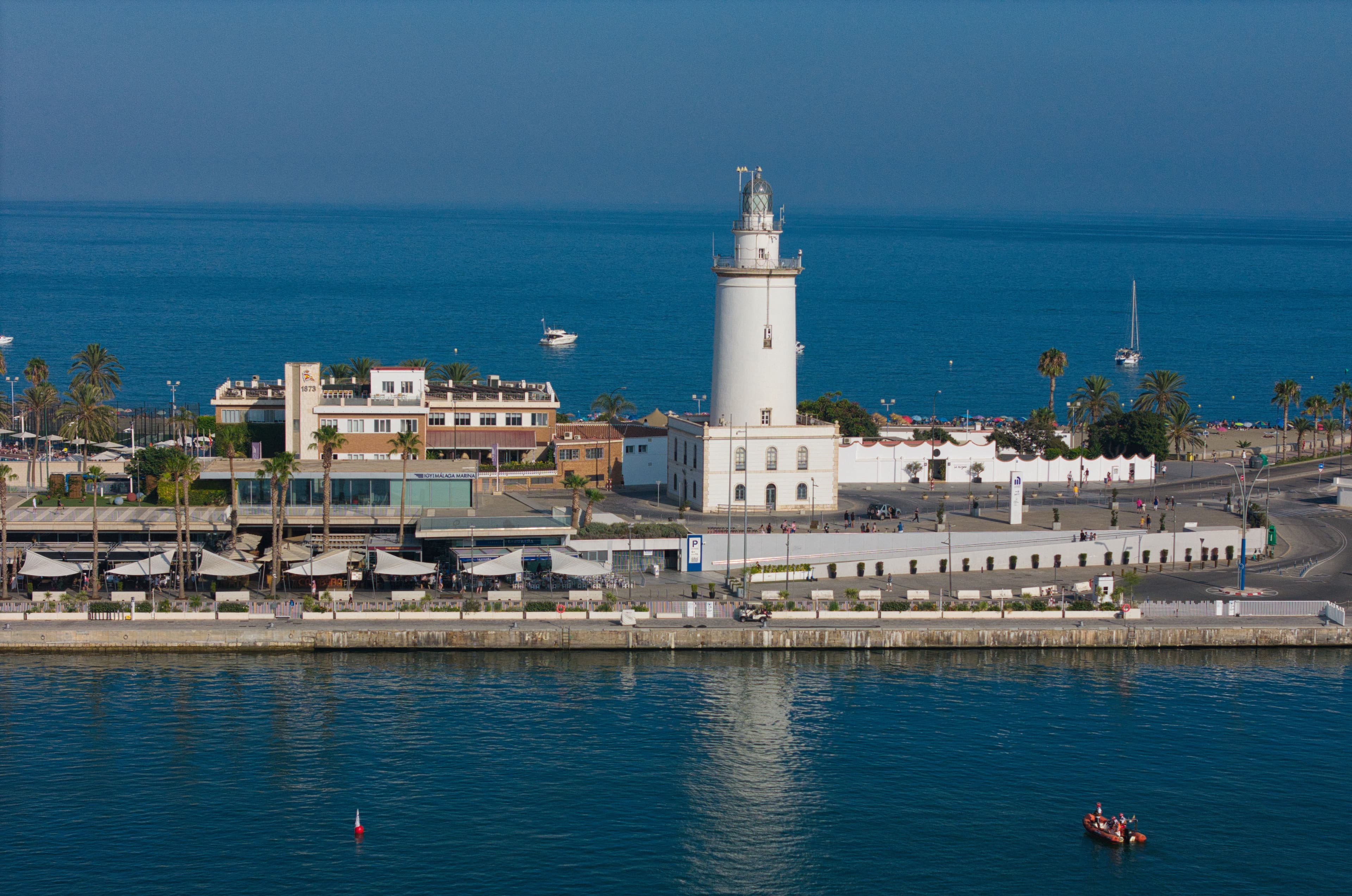
The course is a single loop starting and finishing at Paseo del Parque, the palm-lined boulevard beside Málaga’s historic centre and port, opposite the University of Málaga’s Rectorate building. Because start and finish share the same location, bag drop and cloakroom logistics are simpler than on a point-to-point course: runners leave belongings once and collect them from the same spot after finishing. The route loops west across the Guadalmedina river into El Perchel and back, runs out along the port breakwater, heads east along the seafront through La Malagueta and Pedregalejo almost to El Palo, returns through the centre, goes north up the Guadalmedina to La Palmilla, and finally runs south-west to the western beaches near Sacaba before coming back to Paseo del Parque. It stays close to sea level throughout: the whole course sits inside a 22 m band, making this one of the flatter certified marathon courses in Spain.
Km 0-5: Paseo del Parque and the opening seafront stretch. The race starts at Paseo del Parque opposite the University of Málaga’s Rectorate and loops west across the Guadalmedina river through El Perchel and La Trinidad before heading back towards the port. The first intermediate cutoff, at km 5, allows 39 minutes 5 seconds, a pace of roughly 7:49/km, giving a clear sense of how generously paced the early cutoffs are relative to the overall 5-hour-30 limit.
Km 5-21: The port, the eastern seafront and halfway. The course runs out along the port breakwater on Paseo de Levante, then east along La Malagueta and the Pablo Ruiz Picasso seafront through Pedregalejo to a turn near El Palo at about km 15.5, and back to the centre by halfway, with aid stations at km 10, 15, 18 and 21 (the halfway point, cutoff 2:36:00). Solid food is available from some stations from km 15 onwards, alongside water and isotonic drink at every station.
Km 21-35: La Palmilla and the western beaches. The route heads north up the Guadalmedina to La Palmilla, the highest ground of the day at about 20 m around km 25, then south-west through Huelin and along Calle Pacífico by the western beaches to a turn near Sacaba at about km 35. Aid stations continue at km 25, 27.5, 30, 32.5 and 35, a notably dense spacing (roughly every 2.5 km from km 25 onwards) compared with many marathons’ 5 km intervals, worth knowing for runners planning a specific hydration strategy around fixed station spacing.
Km 35-42.195: the return to Paseo del Parque. Final aid stations sit at km 37.5 and 40, with the km 40 cutoff at 5:12:40, leaving a generous final-2.195 km buffer within the overall 5:30 limit. The course returns north-east along the western seafront and across the Guadalmedina to close the loop at Paseo del Parque, where the same start-area cloakroom holds runners’ belongings for collection after finishing.
Follow the blue tangent line throughout; on a single-loop course with the 2026 edition’s described curve reduction, the measurable distance saving is real. The exact street-by-street sequence for the middle sections of the 2026 route is still pending final federation approval; check the official course map closer to race day for the confirmed routing.
Course Map
The map shows the single-loop route from Paseo del Parque: west across the Guadalmedina, out along the port breakwater, east along the seafront to El Palo, north to La Palmilla and south-west to Sacaba, back to the same start/finish location. Tap a marker for details, and scrub the slider or press play to move the orange marker along the course with the elevation profile beneath it.
Starts opposite the University of Málaga's Rectorate and loops west across the Guadalmedina before heading for the port. The generously paced early cutoff (7:49/km at km 5) reflects the overall 5:30 limit.
Out along the port breakwater and east along the seafront to El Palo and back. Aid stations at km 10, 15, 18 and 21; solid food appears from km 15 onward at some stations. Halfway cutoff sits at 2:36:00.
North up the Guadalmedina, then south-west to Sacaba, with stations every 2.5 km from km 25 onward, closer together than most marathons' standard spacing. Worth planning a specific hydration rhythm around this.
Final stations at km 37.5 and 40; the km 40 cutoff (5:12:40) leaves a generous buffer for the closing 2.195 km back to the same start/finish location.
Pacers
Seven official pace groups run from 3 hours to 4 hours 30 minutes, each led by an experienced pacer holding a steady, even pace. No sub-3-hour or slower-than-4:30 pace group is confirmed, so runners targeting either end of that spectrum should not expect an official balloon to follow.
| Target time | Approx. pace |
|---|---|
| 3:00 | roughly 4:15/km |
| 3:15 | roughly 4:37/km |
| 3:30 | roughly 4:59/km |
| 3:45 | roughly 5:20/km |
| 4:00 | roughly 5:41/km |
| 4:15 | roughly 6:02/km |
| 4:30 | roughly 6:23/km |
What to wear
November race mornings in Málaga typically sit around 17°C at the 08:30 start, warming toward 18 to 19°C by the time later finishers are still on course, with humidity commonly above 70% and light coastal breezes. This is mild Mediterranean autumn weather, and a singlet and shorts suit the conditions better than heavier kit; a cheap throwaway layer for the start corral is worth carrying for the wait before the gun.
November is Málaga’s wettest month, with roughly a 1-in-4 chance of a passing shower on any given race day, so a light packable rain shell is a sensible addition to race-morning kit even though outright cold is not the main risk. Given the course’s proximity to open water for long stretches, coastal wind is a more relevant factor than temperature for most runners; a wind speed in the range of 20+ km/h can meaningfully affect pace over the full distance, more so on any exposed seafront section than in the sheltered historic-centre streets.
Entry
Entry runs first-come, first-served through the official Rock the Sport registration platform, with no ballot or lottery mechanism. The registration window runs from 30 December to 2 November at 20:00, or until the combined marathon-and-half-marathon cap of 12,000 bibs is reached, whichever comes first. Standard marathon entry costs €110, with a €260 VIP tier; the half marathon, run the same day, costs €78. Prices typically rise as the field fills, so earlier registration is cheaper as well as more certain.
Runners may take out an optional cancellation guarantee at the time of registration (not addable later), refunding the registration fee in full, minus the guarantee’s own cost, if a cancellation request is submitted by 15 October; the entry fee itself is otherwise non-refundable under any circumstances and cannot be transferred to another runner.
No fast-runner or good-for-age entry route was confirmed for this race; entry is general first-come rather than a seeded category. Cash prizes are available to elite finishers under specific time thresholds (full payment under 2:16:00 men / 2:45:00 women, reduced payment up to 2:27:00 / 2:55:00, and a course-record bonus below 2:05:00 / 2:23:30), a detail more relevant to elite or sub-elite travelling runners than the general field.
Fast Runner / GFA Standards
Not applicable. No fast-runner or Good for Age route was confirmed for this race.
Race Weekend
Expo
The Runners’ Fair location for the 2026 edition had not been announced at the time of writing; check the official site’s Runners’ Fair page closer to race day for the confirmed venue and schedule. To collect a bib, runners must present their registration receipt or a copy of their registration along with photo ID; race numbers are not issued on race day itself, so in-person collection during the Runners’ Fair window is mandatory. Bib numbers carry a disposable timing chip and must be worn visibly on the front of the torso throughout the race.
Race Morning
The marathon starts at 08:30, with wave starts following the main gun in sequence. Because the course is a single loop starting and finishing at the same Paseo del Parque location, race-morning logistics are simpler than on a point-to-point course: there is no separate start-area transfer to plan, and runners can walk or take a short taxi from most central Málaga hotels directly to the start.
A cloakroom service is provided at the start/finish area for runners to leave belongings; organisers may ask to inspect bag contents before accepting them, and the organisers do not accept liability for items left in the cloakroom, so valuables are best left at the hotel. Runners who fail to meet an intermediate cutoff are withdrawn from the course by race officials and must leave the roadway.
Wheeled devices of any kind, including handbikes, are prohibited except for officially authorised and Federation-approved wheelchairs, which require advance arrangement with the organising committee. A physiotherapy and podiatry service is available on-site strictly for runners who have suffered a race injury.
Nutrition on Course
Refreshment stations run at km 5, 10, 15, 18, 21, 25, 27.5, 30, 32.5, 35, 37.5 and 40, a total of 12 stations across the course, with water and isotonic drink available at every one. This is notably denser spacing in the second half of the race than the first: stations sit every 5 km through the opening 21 km, then tighten to roughly every 2.5 km from km 25 through km 40. Solid food is available at some stations from km 15 onward, though which stations offer solid food versus liquids only has not been specified.
Spectating
Because the course is a single loop returning to its own start point at Paseo del Parque, spectating this race is more straightforward than a point-to-point course: supporters based centrally can realistically see a runner at more than one point along the route without a long transfer. Metro Málaga and EMT city buses are both listed as official race partners, though the specific lines and stops nearest the course have not been confirmed.
Itinerary A: Walk to Paseo del Parque for the start, and return later in the morning for the finish, given the loop course brings runners back to the same location. The simplest plan for supporters not wanting to move around the city on race morning.
Itinerary B: Position along the course’s historic-centre or port sections, reachable on foot from most central hotels.
Itinerary C: Return to Paseo del Parque ahead of the runner’s expected finish time. Straightforward given the same location serves as both start and finish.
Post-Race Food
El Pimpi, one of Málaga’s best-known traditional bodegas in the historic centre near the cathedral, is a plausible post-race option for a sit-down meal with a wine-and-tapas format, though its popularity with tourists means a same-day walk-in on marathon weekend may involve a wait. Casa Lola, a tapas bar in the centre, and La Deriva, also centrally located, are further leads worth checking for current hours. Given the course finishes at Paseo del Parque, all three sit within easy walking distance of the finish.
Where to Stay
Because this course is a single loop starting and finishing at the same Paseo del Parque location, the usual “finish over start” principle matters less here than on a point-to-point race: nearly every neighbourhood worth considering sits within a similar walking distance of both. The deciding factor becomes character and price.
Centro Histórico
Offers the strongest city-break feel of any option, walking distance to the start/finish and packed with the restaurants and historic sights that make a Málaga trip worthwhile beyond the race itself. It is also the busiest and noisiest choice, which matters more the night before a race than most other nights of a trip.
Soho and the Alameda district
Sit at a practical central edge, close enough to walk to the start/finish while trading a small amount of old-town charm for a calmer base.
La Malagueta
The beach neighbourhood immediately next to the city centre, offers good finish-area proximity and the option of a beach recovery day afterwards, at a more touristy and pricier level than Soho.
María Zambrano
Around the main train station, suits runners arriving by rail from elsewhere in Spain, or those prioritising straightforward transport links over old-town character.
Pedregalejo
A quieter beach neighbourhood further from the centre, suits runners building a longer seaside stay around the race rather than prioritising the simplest race-morning logistics; it requires a taxi or bus to reach the start/finish.
Recommended hotels
A well-known central hotel directly in the start/finish area, prioritising location over value.
A stylish, design-led hotel in the Soho district, close enough to walk to the start/finish while sitting at a lower price point than the top-tier Centro Histórico options.
A comfortable, well-located central option near the cathedral, similar in convenience to AC Hotel Málaga Palacio.
A practical choice for runners arriving by train, trading old-town character for straightforward transport links.
A value-focused, no-frills option still within walking range of the start/finish.
Booking timeline
Entry runs first-come rather than through a ballot, so there is no single results-announcement date driving a hotel-booking spike; the practical advice is to book as soon as entry is confirmed, particularly given prices rise as the bib cap fills and hotel availability in Centro Histórico tightens closer to race weekend. Flights into Málaga-Costa del Sol Airport are well served by both budget and full-service carriers from across Europe, so flight availability is rarely the binding constraint.
See & Do
The finish sits at Paseo del Parque, putting the historic centre, the port and La Malagueta beach all within easy walking distance.
Alcazaba
Walking distance from the finish, Centro Histórico. Málaga’s Moorish fortress, with real historical weight and views over the city and port, but a real number of steps and inclines involved in the climb. Better suited to the day after the race than the immediate post-finish afternoon.
Picasso Museum
Walking distance from the finish, Centro Histórico. An indoor, level-floored cultural option covering Málaga’s most famous native artist, a low-effort way to spend a couple of hours without asking anything of tired legs.
Muelle Uno
Adjacent to the start/finish area, port. A flat, open-air waterfront promenade and retail strip right by the port, an easy stroll immediately after the race with no gradient, though exposed to sun and wind.
Malagueta Beach
Short walk from the finish, La Malagueta. A central city beach directly next to the marathon finish area, good for a short, flat recovery walk along the sand. November swimming is not guaranteed given the season, but the beachfront walk itself works regardless of water temperature.
Read Before you Run
South from Granada
Gerald Brenan
A classic account of rural Andalusian life in the 1920s, set in the Alpujarras rather than Málaga itself, but the closest well-known literary match for the wider Andalusian landscape and culture surrounding the race. A useful companion for a trip extending inland to Granada.
After the Race
The Generali Málaga Marathon runs in November. These itineraries range from a same-day walk around the port and beach to a three-night extension to Seville.
A low-effort day around the port and central beach, staying in the same area as the race finish itself, suited to legs that want minimal further walking.
A cultural extension built around the Alhambra, requiring advance booking for entry given the site's timed-ticket system; inland Granada runs cooler than coastal Málaga in November.
A historic city extension built around the Mezquita-Catedral and Córdoba's old Jewish quarter, a good fit for November's mild inland weather.
The classic longer Andalusian extension, built around Seville's cathedral, Alcázar and old quarter, well suited to November's shoulder-season mild weather.
Frequently asked questions
Should I stay near the start or the finish?
It matters less here than on most marathons, since the course is a single loop starting and finishing at the same Paseo del Parque location. Choose based on neighbourhood character and price.
How far in advance should I book a hotel?
As soon as entry is confirmed, particularly for the most characterful Centro Histórico hotels, though Málaga's overall hotel supply is less constrained on marathon weekend than in some of Spain's larger marathon cities.
Is public transport free on race day?
This has not been confirmed. Metro Málaga and EMT buses are both listed as official race partners, but no explicit free-travel offer was found in the official regulations.
What is the best area to stay?
Centro Histórico for the strongest city-break feel, Soho or the Alameda for a calmer but still central base, or La Malagueta if a post-race beach walk matters to you.
When does the expo open?
The Runners' Fair venue and dates for the current edition are announced separately closer to race day; check the official site's Runners' Fair page before travelling.
What is the weather typically like on race day?
Mild Mediterranean autumn, typically around 17°C at the 08:30 start warming toward 18-19°C by midday, with roughly a 1-in-4 chance of a passing shower given November is Málaga's wettest month.
How do I get from the airport to the city centre?
Málaga-Costa del Sol Airport connects to the city centre by train (Cercanías line C1), bus and taxi.
Is there a bag drop at the race?
Yes, a cloakroom service is provided at the start/finish area, though organisers do not accept liability for items left there and may inspect bag contents before accepting them.
Should I bring a throwaway layer to the start?
A light layer helps for the wait before the 08:30 start, but sun and coastal wind protection matter more than cold once the race is underway.
How do I get back to my hotel after finishing?
Since the finish sits at Paseo del Parque in the city centre, most central hotels are within easy walking distance; pre-arranging a meeting point away from the immediate finish crowd works better than trying to meet supporters right at the line.