The Race
| Next Race Date | 31 January 2027 |
|---|---|
| Course type | Single loop (road) |
| Certification | AIMS full member; World Athletics results-listed |
| Start | Avenue de la Menara / Avenue Prince Moulay Rachid, Hivernage (behind the Sofitel, near La Mamounia) |
| Finish | Same, Avenue de la Menara, Hivernage |
| Total finishers | 12,000+ (event-wide) |
| Avg race-day temp | 6–20°C (January) |
| Cutoff time | 5 hours 30 minutes |
| Free race-day transport | No: Marrakech has no metro or tram |
| Course certification | FRMA / World Athletics / AIMS |
| Sleeper Train | Not accessible: Marrakech is reached by short-haul flight from Europe, not a sleeper network |
History
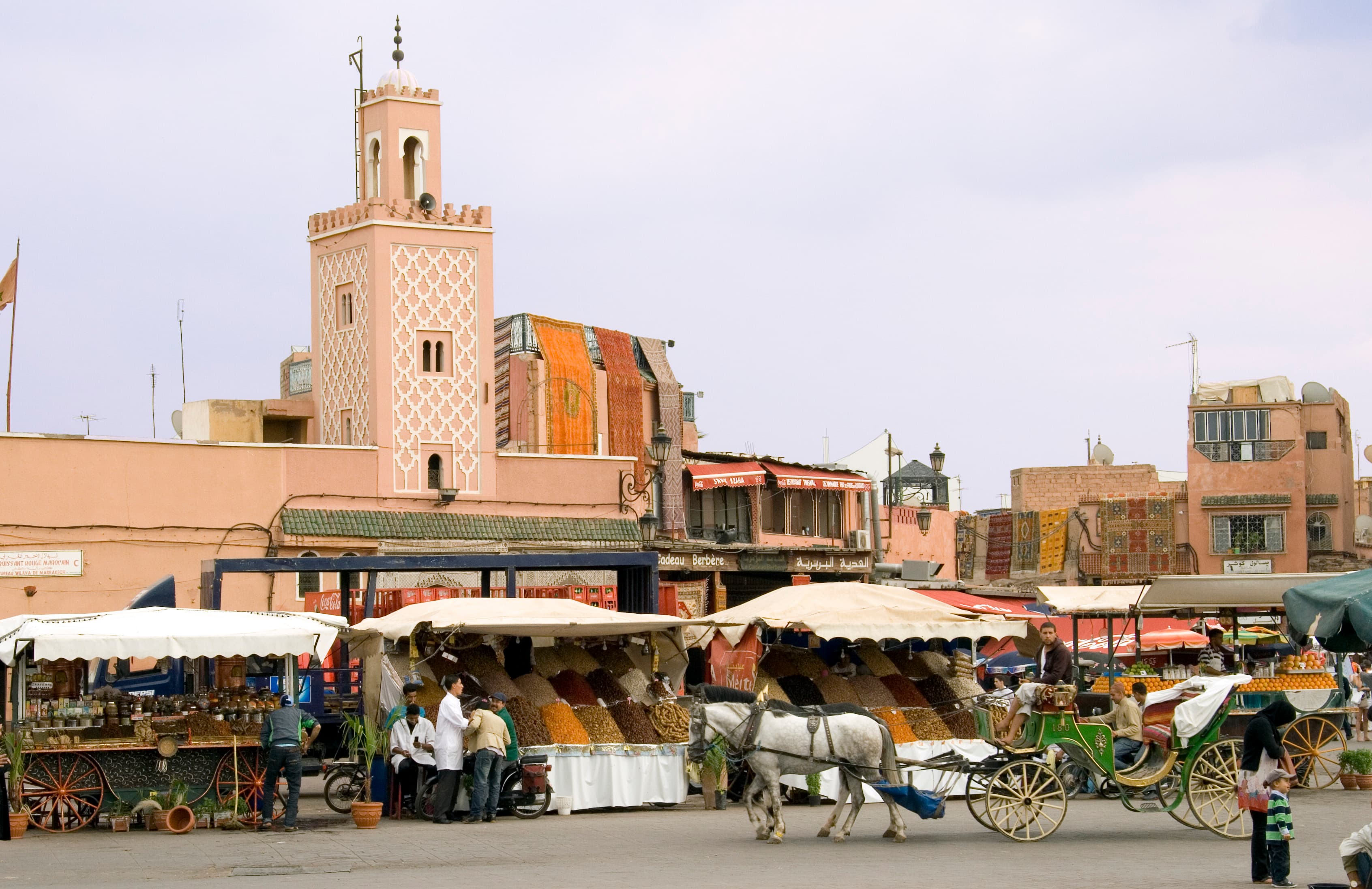
The first Marrakech Marathon took place in 1987, and 2027 marks its 37th edition. Association Grand Atlas has organised it throughout, long steered by the Marrakech sports figure Mohamed Knidiri, and it has always sold the same thing: a fast road race under a low winter sun, three hours from Europe. When it returned in 2022 after the pandemic, more than 13,700 runners lined up. The organisers still talk of recovering the standing the race held around 2013 among the winter internationals, and on recent form the sharp end is doing its part. In 2026 Morocco's Abdelhadi Labäli won in 2:07:34, with Hayat Benhima taking the women's title in 2:24:48, a time that beat the organiser's own record-bonus target and looks set to stand as a new course best once confirmed. Those are quick times, and they fit a course sold as flat and warm, run past ochre ramparts and out through the palm groves while most of Europe scrapes ice off a windscreen.
The course
The course starts and finishes on Avenue de la Menara in Hivernage, behind the Sofitel and a short walk from La Mamounia. It is a single certified loop of 42.195 km on mostly broad asphalt, with the marathon off at 07:45 and the half marathon following at 09:15. The first sixteen kilometres work through Hivernage, Guéliz and the Menara district on wide avenues, Boulevard Mohammed VI and Avenue de la Menara among them. From roughly km 16 the route swings north up Boulevard Abdelkrim el Khattabi towards the Palmeraie palm grove, losing about 60 m gently to its lowest point near km 25. It then turns back south along Boulevard Oued Issil, past the medina ramparts and through Sidi Youssef Ben Ali and the Agdal, climbing shallowly and steadily through the second half. The organiser calls the course flat and fast while admitting to "faux plats montants", rising false flats, in the palm grove. That is accurate: the elevation chart shows a cumulative back-half rise of about 80 m spread across km 25 to 38, then a downhill run of about four kilometres to the Avenue de la Menara arches. Timing splits are given at 10 km and 30 km.
Km 0–8: The cold loops. Nobody warns you that a race sold on African sun begins in the dark, half frozen. At 07:45 in late January the light is still grey and the air carries a dry, mineral chill that finds every gap in your kit, and the first task of the morning is less about pace than about persuading your fingers to work. One 2026 runner set off unable to feel his hands and spent the opening kilometres simply thawing. The course does not help you concentrate. It threads the broad avenues of Hivernage and Guéliz, up and down Boulevard Mohammed VI, and doubles back on itself more than once, so the field stays dense and the road keeps folding past runners you overtook ten minutes ago. The asphalt is smooth, flat and quietly seductive. Ignore it. Every second banked here is borrowed against a back half that will come collecting.
Km 8–16: West, and thinning out. The route works west into the Menara district and back along Avenue Hassan II, still inside the city and still barely tilting, with nothing underfoot steeper than the camber of a road bridge. The crowds fray. By the time the last spectators drop away you should have stopped racing the people around you and settled into the effort you actually came to hold. This stretch is dull in the best possible way. Use it.
Km 16–25: Down into the Palmeraie. Around km 16 the course turns north up Boulevard Abdelkrim el Khattabi and the city lets go. Towards the Palmeraie the palm groves open out, red earth and dust under a hard blue sky, thousands of date palms standing in loose ranks, and the road tips almost imperceptibly downhill to its lowest point near km 25. Here is the con. The descent is so gentle you will never clock it, only watch your splits improve and assume you are having a good day. Some of that is real. Some of it is the sixty-odd metres of height you are giving away now and will be asked to return with interest. Support out here barely exists, shade is a rumour, and the fine grit of the grove roads works its way into your shoes. Enjoy the strangeness of the place. Do the arithmetic anyway.
Km 25–38: The false flats. This is the honest difficulty of Marrakech, and it is not a hill. From the low point the road swings south down Boulevard Oued Issil and starts to climb, shallowly and without pause, about 80 metres of it smeared across the thirteen kilometres to km 38, past the medina ramparts at km 31 and through Sidi Youssef Ben Ali and the Agdal. The organisers call these the "faux plats montants", the false flats that rise, and they are precisely the gradient the eye refuses to see and the legs cannot ignore, the sort that nudges your effort up a few beats for twenty minutes at a stretch while telling you nothing is wrong. It arrives, naturally, at the cruellest moment: sun overhead, roads emptied of noise, the marathon's usual reckoning already waiting at 30. Run this by effort. The number on your watch will lie to you, and the runner who chases it across the false flats is writing a cheque the last 10 km will bounce.
Km 34–42: The high point, then home. The course tops out in the Agdal, at about 490 m around km 38, and only then does it finally point downhill and let you run. The last four kilometres fall about 24 m down Boulevard Mohammed VI toward the Avenue de la Menara arches. Claims that the closing 10 km are mainly downhill are wishful thinking. The real drop is only the final stretch, so treat km 34 to 38 as a climb to be survived and the run-in as wages, not charity.
Two housekeeping notes for anyone chasing a time. The organisers publish no shortest-route line, so cut your own tangents wherever the road is clear and stop weaving in the early crush, which is where most people quietly run an unwanted 43rd kilometre. And the marathon takes electronic splits at 10 km and 30 km only, with no mat at every marker, so anyone who likes frequent live checkpoints will be left guessing. The finish sits back on Avenue de la Menara, at the very spot where, hours earlier, you stood shivering and doubting the brochure.
Course Map
The map shows the route, from Avenue de la Menara through Guéliz and the Menara district, north towards the Palmeraie and back past the ramparts and through the Agdal, with the start and finish, the Koutoubia expo and Marrakech Menara Airport marked. Tap a marker for details, and scrub the slider or press play to move the orange marker along the course with the elevation profile beneath it.
Off at 07:45 into possible single-digit cold, with the field bunched through central avenues that double back on themselves. Warm up, hold back, and ignore how easy the smooth road feels.
Broad, lightly rolling avenues on the Menara side. Lock into goal effort as the crowds thin and the city starts to fall behind.
A gentle drop north into the palm grove to the course low near km 25. Support vanishes and dust can hang on the roads. Bank speed carefully; you give this height straight back.
A shallow, cumulative rise of about 80 m through the back half, the organiser's "faux plats montants", under a strengthening sun. Run it by effort. The genuine downhill is only the last four kilometres.
The false flats
The organiser calls the Marrakech course flat and fast, then admits, in French, to "faux plats montants" in the palm grove. Believe the second part. The elevation chart shows the race giving back height gently on the way north towards the Palmeraie, reaching its lowest ground near km 25, then clawing it back through a shallow, cumulative rise of about 80 m across km 25 to 38. None of it is a hill. All of it is the kind of incline that looks flat and runs uphill, and it arrives in the second half as the sun climbs and the roads empty. Run these kilometres by effort, not by pace, and the genuine downhill of the last four kilometres is there to be enjoyed.
Pacers
Official pacer details for 2027 have not been published. A 2026 runner reported a four-hour pace group on course, so informal pace groups may run, but times, bib or flag colours and coverage should be checked in the final race instructions before relying on them.
What to wear
Dress for the last 10 km, not the first. Marrakech in late January hands runners a cold dawn and a warm, sunny finish, and the gap between the two is the whole kit problem. At the 07:45 start, single-figure Celsius temperatures are common, and runners regularly report chilly hands in the opening kilometres. By the time slower marathoners reach the exposed back-half roads, the sun is high and the palm grove offers little shade. Racing kit should be chosen for that later heat: vest or short sleeves, shorts, and a cap or visor for the glare.
Bridge the cold start with a throwaway layer happily lost. An old long-sleeve top, cheap gloves and a disposable hat cover the wait and the first few kilometres, then get binned or handed to a supporter near the start. Sunglasses earn their place once the route turns into open country. Sunscreen matters more than the cool morning suggests, especially for anyone out beyond four hours on the shadeless northern and southern arcs. Dry January air and occasional dust on the Palmeraie roads can leave the throat rough, so plan to drink to a set schedule.
Entry
There is no ballot. Marrakech is open entry, and the main decision is which channel to book through, because the organiser, an official partner and several travel resellers all sell places and the prices differ.
For runners outside Morocco, the official partner Prêt à Partir lists online registration through the SPORT UP platform at €80 for the marathon and €60 for the half marathon, roughly £69 and £52 at recent exchange rates. Moroccan runners and foreign residents in Morocco pay far less: local rates of 300 MAD for the marathon and 250 MAD for the half, about £24 and £20, including bib and T-shirt, with a foreign-resident rate of €60 and €40. That local-versus-visitor gap is real and worth stating plainly. A separate reseller site shows different figures in its form fields against its own headline pricing, so it is worth checking the total carefully before paying through any partner channel.
Package entry is the other common route. Marathon Tours & Travel UK sells a four-night package from around £749 per person in double occupancy at the Kenzi Rose Garden in Hivernage, with marathon entry as an optional £80 add-on and the half at £60. Its price includes the hotel, breakfast, race-pack delivery when entry is booked through them, a half-day city tour, a pre-race dinner and post-race support. Other operators list three-night packages from around €325 for five-star and €229 for four-star including airport transfers and a city tour.
Fast-runner and elite information is better developed than mass-participation detail. The prize page lists money for the first fifteen men and women, with a winner's prize in the region of $12,000 to $15,000 depending on time, plus appearance bonuses tied to recent form such as men at 2:05 to 2:07 and women at 2:26 to 2:28. There is no simple published championship-entry standard, so runners at that level should contact Association Grand Atlas directly.
Documented deferral, transfer and refund rules are thin. A partner form offers a paid cancellation add-on, but no clear official refund policy is published, so it is sensible to treat entry as effectively non-refundable and confirm before paying. No medical certificate requirement appears in the current registration pages, worth noting since French-facing races often demand one, but bib collection does require a passport.
Fast-runner standards
No public good-for-age qualifying standards exist for mass entry, since the race is open. The figures below are elite appearance-bonus bands, not entry requirements.
| Category | Appearance-bonus band (not an entry standard) |
|---|---|
| Elite men | ~2:05–2:07 recent form referenced for bonuses |
| Elite women | ~2:26–2:28 recent form referenced for bonuses |
Race Weekend
The marathon shares race weekend with a half marathon starting later at 09:15 and a Race For All 5 km on the Saturday, both based near Koutoubia and Jemaa el-Fna. The half's later start reduces but does not remove shared congestion around the start and finish area.
Expo and Bib Collection
Bib collection is at the Marathon Village on Place de la Koutoubia, beside Jemaa el-Fna, which is one of the more convenient expo locations of any destination marathon: it sits in the heart of the medina, walkable from most riads and from the Hivernage and Gueliz edges if a 20 to 35 minute walk is acceptable. The official partner page gives opening hours as the Friday and Saturday before the race, 09:30 to 19:30 on both days.
Hours are the main point of conflict between sources. Aggregator listings quote a longer 09:00 to 22:00 window, and the organiser site mentions runners reporting to Marrakech train station from a week before the race, also 09:00 to 22:00, as well as to the Village in the two days before the race. Until the final instructions confirm otherwise, the safe plan is to collect at Koutoubia Square on the Friday or Saturday, build the trip around the 09:30 to 19:30 partner hours, and treat any later opening as a bonus.
Bring a passport. The partner page states the bib is issued on presentation of a passport, which is in any case obligatory for entry to Morocco, and it is worth carrying registration confirmation or a QR code alongside it. No medical certificate requirement has been published. The pack is described as bib plus T-shirt; proxy-collection rules and bag-storage arrangements at the Village are not published. Runners on operator packages may have documents delivered to their hotel instead.
Getting to the Start
Plan race morning around two facts: the marathon starts early, at 07:45, and Marrakech has no rail-based safety net to fall back on. The start is on Avenue de la Menara, in Hivernage, behind the Sofitel and near La Mamounia. The half marathon follows at 09:15. The organiser asks runners to gather about 30 minutes before their start.
The single best decision available is to sleep within walking distance. Marathon Tours puts its package hotel, the Kenzi Rose Garden, about ten minutes' walk from the line, and that is the model worth copying whether booking with an operator or independently. From most of Hivernage and the La Mamounia side, the start is a short walk. From Gueliz, allow roughly 20 to 35 minutes on foot depending on the exact hotel. From a Koutoubia-edge riad, allow roughly 25 to 35 minutes; a deep-medina riad may mean dark lanes and extra navigation before the race has even started.
For anyone who needs a taxi, arranging it the night before through the hotel is worth the effort, and road closures matter more than the fare on the morning itself. Marrakech's petit taxis are cheap and everywhere, but race morning is the wrong time to negotiate on the street, and the real risk is a driver simply unable to reach the start. Asking to be dropped a walkable distance out and finishing on foot is the safer plan. No metro, tram or official race shuttle exists.
Published start-village detail is thin. Bag drop, toilet counts, security layout and the pen or wave process are not covered in the accessible race instructions. It is sensible to assume basic facilities, build a time buffer into the morning, and arrive dressed to run, with no large indoor holding area to count on. Toilet queues at a field this size will be long, so using the hotel before leaving is the better plan.
Nutrition on Course
Run Marrakech as a self-supported race. The organiser's course page lists refreshment points every 5 km carrying water and orange slices, refreshments at the finish, and sponges every 5 km from the 7th kilometre. That is the full published provision. No source lists sports drink, gels, bananas, dates, cola or salt for the marathon, so international runners used to European-major aid stations should carry their own gels and electrolytes and use the on-course water to support that plan.
There is a documented history behind this advice. Moroccan reporting after the 2022 post-pandemic return specifically criticised a shortage of supplies, and more recent runner reviews mention occasional aid and finish-logistics problems. None of that makes the race unsafe, but it does make self-sufficiency the sensible default.
| Km marker | Water | Food | Other |
|---|---|---|---|
| 5 | Yes | Orange slices | — |
| 7 | — | — | Sponging begins, then every 5 km |
| 10 | Yes | Orange slices | Timing split |
| 15 | Yes | Orange slices | — |
| 20 | Yes | Orange slices | — |
| 25 | Yes | Orange slices | Course low point |
| 30 | Yes | Orange slices | Timing split |
| 35 | Yes | Orange slices | On the back-half climb |
| 40 | Yes | Orange slices | — |
| Finish | Yes | Not itemised | Medal for classified finishers |
Sports drink and gel provision is not published for any station. Practical strategy: carry enough gels for the whole race, take water at most stations given the dry air and building heat, and do not gamble on the finish spread. Medical and security cover is provided by the Wilaya of Marrakech and the Red Crescent.
Spectating
Spectating Marrakech needs a different plan from a metro-linked European race. There is no tram or metro to leapfrog the course, road closures make taxis unpredictable, and the route spends its middle third in the northern Palmeraie, where support is sparse and access is hard. The realistic choice is to pick one strong location and enjoy it, or to link two central points on foot.
The best single spot is the start and finish on Avenue de la Menara, especially for supporters staying in Hivernage. It gives the send-off, the finish and the easiest reunion, and it sits close enough to hotels like the Kenzi Rose Garden, the Sofitel-area properties and La Mamounia that spectators can skip taxis altogether.
For those wanting two sightings, walking is the way to do it: watch the start on Avenue de la Menara, head toward the Koutoubia and Jemaa el-Fna edge, a walk of roughly 20 to 30 minutes depending on closures, catch the race there once the final course map confirms the pass point, and return for the finish. The palm-grove sections are poor spectator ground unless a private car and knowledge of the closure plan are available; crowd density is highest around the central city and the start and finish, and thinnest on the exposed northern and southern arcs.
Live public tracking has not been confirmed; check the final runner app closer to race day. Because the finish area may have restricted zones, agree a meeting point in advance: a hotel lobby, a specific café, or a visible landmark.
The Finish
Finishers who are classified receive a medal. Finish refreshments are mentioned but not itemised, so it is worth carrying a plan for personal post-race food and fluid. The hardest logistical moment of the day is often getting back to the hotel: taxis are in heavy demand and roads around the finish may still be closed. Anyone staying in Hivernage should simply walk, which is the whole reason to base there. Anyone in the medina or the Palmeraie should agree a meeting point and transport plan with their group in advance, at a landmark a driver will recognise, so there is no hunting for a taxi on tired legs.
Where to Stay
The best bed in Marrakech on marathon weekend is not the prettiest one. It is the one that lets you walk to the start. The city has no metro and no tram, the petit taxis that swarm the place the rest of the year turn unreliable behind race-morning road closures, and a 07:45 gun does not forgive a driver who cannot reach it. Proximity to the Avenue de la Menara start beats almost everything else, including the riad of your daydreams. Sort out the walk first. Fall in love second.
Hivernage
Hivernage is the runner's answer, and the margin is not close. It is the modern hotel quarter on the start-and-finish side of the city, all broad pavements, big lobbies and calm nights. Marathon Tours bases its package at the Kenzi Rose Garden here and clocks it at ten minutes' walk to the line. What Hivernage buys is a boring, blessed morning: breakfast served early, a lift instead of a staircase, a quiet room, and a short shuffle home afterwards on ruined legs. It costs more on race weekend, particularly in the four- and five-star places. Skip it only if a courtyard in the old city matters more than a clean run to the start.
Gueliz / Ville Nouvelle
Gueliz is the sensible compromise, and the best place to eat. It is the French-built new town: supermarkets, proper coffee, restaurants that keep normal hours, and taxis that can actually reach you. Depending on the hotel, expect 20 to 40 minutes on foot from the start, or a short ride once outside the closures. It suits the independent runner who wants comfort and food without paying Hivernage rates. Avoid the far north and east of the district unless a warm-up walk bolted onto an already early morning sounds appealing.
Medina / Koutoubia edge
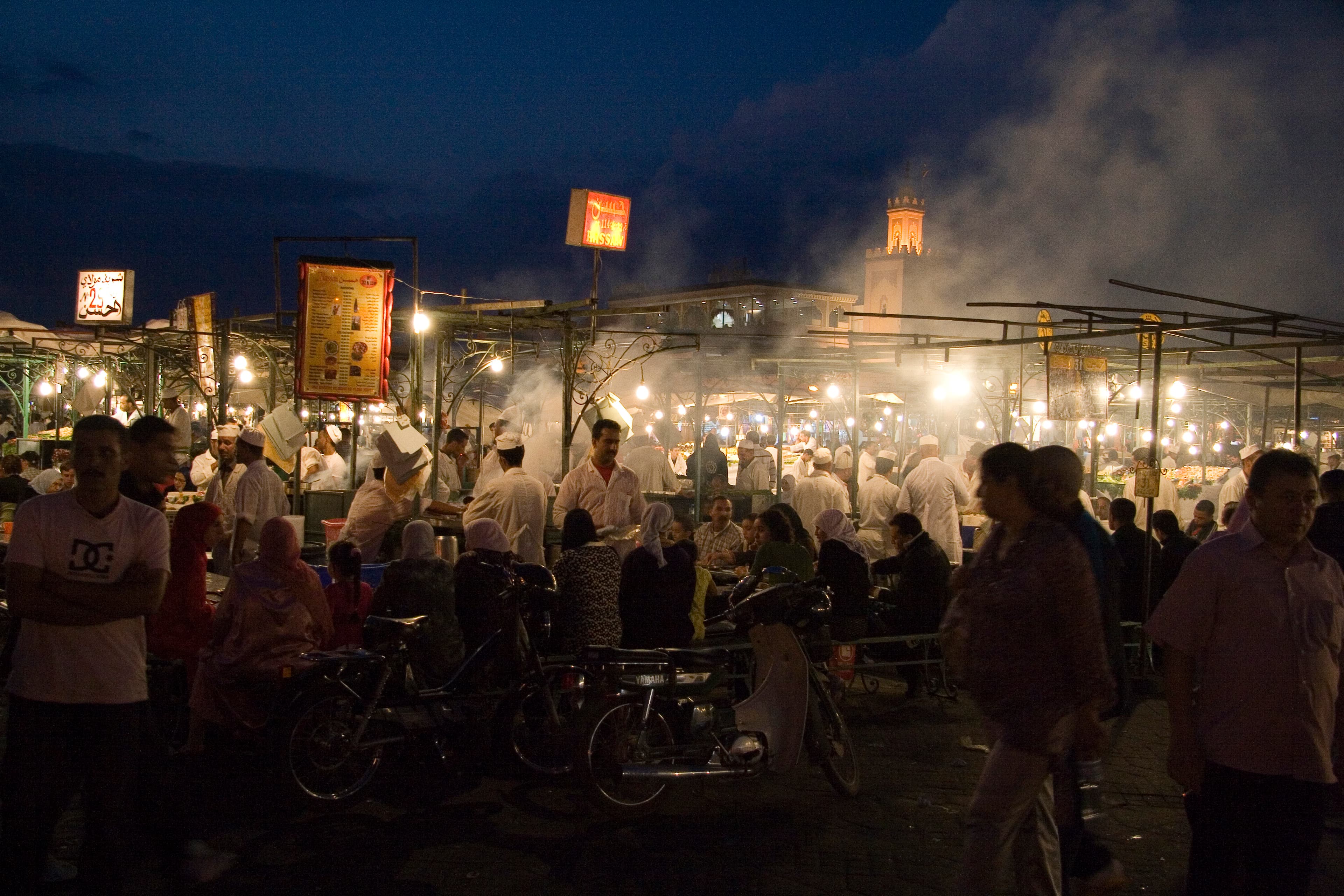
The medina is where the trip lives, and where the expo is. Bib collection sits at Koutoubia Square, on the western lip of the medina, so a riad near Jemaa el-Fna allows a runner to fetch their number on foot, eat in the old city and still walk to the start if a 25 to 35 minute pre-dawn navigation does not rattle them. That is the good version. The bad version is the deep medina, where taxis cannot reach the door, the lanes knot and unknot in the dark, the room sits up three flights of tiled stairs, and Jemaa el-Fna is still banging out drums and moped horns at midnight. Choose the edge, not the depths, and choose it for the Marrakech worth remembering rather than the sleep that will not come.
Kasbah / Mellah
South of the medina, quieter than the square, and handy for the Bahia Palace and the Saadian Tombs if half the weekend is sightseeing. The riads have character and the crowds thin out down here. The catch is race logistics: a longer walk or an early taxi over to Hivernage, and an awkward limp back afterwards. This is a base for the traveller first and the runner second.
Palmeraie
Date palms, private pools and silence, and the worst possible place to sleep the night before this race unless the hotel runs a transfer. The palm-grove resort belt sits well out of town, works poorly without a car, and turns both the pre-dawn journey in and the exhausted crawl back into a headache exactly when taxis are scarcest and the roads are shut. Save it for after. A couple of recovery nights out here, floating in a pool beneath the same palms cursed at km 25, makes a fine reward. Just not before the alarm goes off at five.
There is a version of this weekend where both are possible. Book Hivernage or the Gueliz edge for the race nights, collect the medal, then decamp to a medina riad or a Palmeraie pool for the recovery days, when a missed taxi costs nothing. Whatever the choice, book early. The walkable hotels are few, operators sell packages built around them well before race year, and the rooms nearest the Avenue de la Menara start are the first to vanish.
Booking Timeline
There is no ballot to wait on, which changes the timing logic: entry is open, so the constraint is hotels, not results. The rooms that matter, the walkable Hivernage properties near Avenue de la Menara, are the scarce resource, and operators sell packages built around them well before race year. If a short walk to the start is the priority, book the hotel as soon as the trip is decided.
Aim for several months ahead for an independent booking in Hivernage or the Gueliz edge. Late booking only works for anyone flexible about neighbourhood and willing to rely on race-morning taxis, which is exactly the uncertainty an early booking avoids. Flights from Europe to Marrakech Menara are short and frequent, so they are less of a bottleneck than the hotels, but January is peak winter-sun season and fares rise on the popular weekend, so pairing an early hotel booking with an early flight search is sensible.
Recommended hotels
The official Marathon Tours package hotel, and the easiest logistics on the list. A large property with gardens and breakfast, close enough that race morning is a short walk. Package rates can run higher than a direct booking, and it is a big hotel rather than an intimate riad. Confirm this hotel exists and check current availability and rates before booking.
The official rules locate the start and finish behind the Sofitel, which makes it about as close to the line as it is possible to sleep. Expensive, and availability tightens on race weekend, but unbeatable for a lie-in before a 07:45 start and a walk of a couple of minutes home afterwards. Confirm this hotel exists and check current availability and rates before booking.
A landmark luxury hotel poised between the medina and the race area, which makes both the expo and the finish an easy walk. The obvious choice for a special-occasion race trip, with a very short post-race return. Very expensive, and the formal luxury may feel like a lot for a weekend spent mostly in running kit. Confirm this hotel exists and check current availability and rates before booking.
A modern hotel in the practical band between Gueliz and Hivernage, with easier food and taxi logistics than a deep-medina riad. Not as close to the line as the Hivernage hotels, so build a longer walk or a short taxi into race morning and check that breakfast is served early enough. Confirm this hotel exists and check current availability and rates before booking.
A genuine riad experience listed at roughly an eight-minute walk from Jemaa el-Fna, which puts the Koutoubia expo on the doorstep and the old city underfoot. The trade is classic deep-medina logistics: stairs, possible late-night noise and navigation in the dark, so it suits the traveller over the nervous first-timer chasing a time. Confirm this hotel exists and check current availability and rates before booking.
See & Do
Jemaa el-Fna and the souks
~1.5–2 km (1–1.25 miles) from finish. The set-piece square of Marrakech and its surrounding souks, right beside the Marathon Village at Koutoubia Square. Best explored before the race for the full effect, with wandering time capped so you are not on your feet for hours. After the race, keep it to a short, seated visit.
Koutoubia Mosque and gardens
~1.2–1.7 km (0.75–1 mile) from finish. The twelfth-century minaret that anchors the city skyline, and the reference point for the whole race weekend since bib collection sits at its foot. Non-Muslims cannot enter the mosque, but the exterior, minaret and surrounding gardens are easy on tired legs and central to any first visit.
Bahia Palace
~2.5–3 km (1.5–1.9 miles) from finish. A nineteenth-century palace of courtyards, carved cedar and shaded rooms, best visited on the Friday before or the Monday after. It involves a fair amount of standing and slow walking, so go early in the day and keep the visit short if you are still stiff. Hours are commonly listed around 09:00 to 17:00.
Jardin Majorelle and Musée Yves Saint Laurent
~3–4 km (2–2.5 miles) from finish. The cobalt-blue garden that Yves Saint Laurent restored, paired with the museum next door. Book a timed ticket online to skip the queue, and go early. It is recovery-friendly if you take a taxi both ways, since the walking inside is gentle. The official garden hours run roughly 08:00 to 18:30 with last entry at 18:00.
Menara Gardens
~1.5–2 km (1–1.25 miles) from finish. The olive groves and reflecting pool on the finish side of the city, thematically tied to the course, which runs the same western ground. A gentle stroll is possible the day after if legs allow, but the open layout means full sun exposure, so it works better as a relaxed Monday visit than an immediate post-finish walk.
Read Before you Run
A Year in Marrakesh
Peter Mayne
Mayne's account of settling into the back streets of the medina in the 1950s, learning the language and the rhythms of a neighbourhood that most visitors only pass through. Not a practical guide, but the best single read for understanding the old city beyond the race route, particularly for runners staying in or near the medina.
Hideous Kinky
Esther Freud
A novel drawn from Freud's own 1960s childhood, following a young English family adrift in Morocco and Marrakech, told through a child's sharp, disorienting eye. Read it for mood and texture; it captures the outsider's first, unsteady encounter with the city.
After the Race
Marrakech in late January rewards a slower second half of the trip. The heat that troubles the back half of the marathon is exactly the mild winter warmth that makes the surrounding country worth a few extra days, from the Atlantic coast to the High Atlas passes and beyond.
The low-effort option for wrecked legs: a slow Koutoubia and Jemaa el-Fna loop, a hammam, or a café-and-garden morning in Hivernage. Keeps you close to the hotel and treats recovery as recovery.
The Atlantic port town, cooler, breezier and flatter than Marrakech, with a compact walled medina and a working harbour. A gentle change of pace for tired legs if you base near the medina or port. January is windy but bright.
The mud-brick ksar of Aït Benhaddou and the film studios of Ouarzazate, reached over the High Atlas pass. Dramatic and a genuine break from the city. January means cold at altitude and the chance of snow or road delays on the pass, so leave a buffer.
The full desert circuit via Ouarzazate, the Dadès and Todra gorges and the dunes at Erg Chebbi, returning to Marrakech. Long drive days and winter road delays are a real possibility. Spectacular, but an adventure rather than a rest.
Frequently asked questions
Should I stay near the start or the finish?
They are the same place: the start and finish share the Avenue de la Menara line in Hivernage, behind the Sofitel. Stay in Hivernage and you can walk to the start and walk home after finishing, which matters in a city with no metro or tram. The further out you book, the more race morning depends on a taxi that road closures may block.
How far in advance should I book a hotel?
Several months ahead if you want a walkable Hivernage hotel near the start. There is no ballot to wait on, so hotels, not entry, are the constraint, and the closest properties are limited and marketed early through operator packages. Late booking only works if you are relaxed about neighbourhood and willing to rely on race-morning taxis.
Is there free transport to the start?
No. Marrakech has no metro, tram or official race shuttle. Access is on foot, by petit taxi arranged the night before, or by a hotel or package transfer. The simplest answer is to stay within walking distance of Avenue de la Menara, since closures can stop a taxi reaching the start anyway.
What is the best area to stay?
Hivernage, for the race. It is the modern hotel district on the start-and-finish side, with a short walk to the line and easier logistics than the old city. Gueliz is the value compromise, 20 to 40 minutes walk out. The medina is best for the expo and the trip itself, but weaker for sleep and taxis, so many runners book Hivernage for the race and move into a riad afterwards.
When does the expo open?
The Marathon Village at Place de la Koutoubia, beside Jemaa el-Fna, is listed for the Friday and Saturday before the race, 09:30 to 19:30 both days, on the official partner page. Some sources quote longer hours, so confirm in the final instructions. Bring your passport and registration confirmation to collect your bib.
What is the weather typically like?
A cold start and a warm finish. Late-January mornings can sit in single-figure Celsius at the 07:45 gun, while the day climbs toward the high teens or low twenties under strong sun. Dress for the last 10 km, use a throwaway layer for the cold wait, and pack sunscreen for the shadeless back half.
How do I get from the airport?
Marrakech Menara (RAK) sits close to the city. Options are an airport taxi, a pre-booked hotel transfer, or the ALSA bus line 19. The bus fare is around 30 MAD; taxis run roughly 70 to 150 MAD depending on time and negotiation. With luggage on marathon weekend, a booked hotel or package transfer is the least hassle.
Is there a bag drop?
Probably, but the details were not published for 2027 at the time of writing. Layout, opening time and collection rules do not appear in the accessible official pages. Treat bag drop as unconfirmed, check the final runner guide, and in the meantime choose a hotel close enough to the start that you can carry as little as possible.
Should I bring a throwaway layer?
Yes. The 07:45 start in late January can feel genuinely cold, and runners regularly report chilly hands early on. An old long-sleeve top, cheap gloves and a disposable hat cover the wait and the first kilometres, then get binned or handed off. Do not overdress for the race itself, because the sun strengthens fast.
How do I get back to my hotel after finishing?
If you are in Hivernage, walk, which is the main reason to base there. From Gueliz or the Koutoubia edge, a slow walk or a later taxi works once the immediate crowds ease. From the deep medina or the Palmeraie, agree a meeting point and transport plan in advance, because taxis are in heavy demand and roads near the finish may still be closed.