The Race
| Next Race Date | Sunday 10 October 2027 (provisional, following the 2026 weekend pattern; not yet officially confirmed) |
|---|---|
| Course type | Point-to-point loop: starts on Batman Avenue near Rod Laver Arena, runs south through Albert Park and along Port Phillip Bay, returns via the Royal Botanic Gardens to finish inside the MCG |
| Certification | AIMS/World Athletics certification status pending confirmation; not an Abbott World Marathon Major |
| Start | Batman Avenue, approximately 150 m north of Rod Laver Arena |
| Finish | Melbourne Cricket Ground (lap of honour finish) |
| Total finishers | ~7,000 (marathon-specific) |
| Avg race-day temp | October in Melbourne is genuinely unpredictable: single-digit mornings, warm afternoons, and wind or rain are all plausible in the same week |
| Cutoff time | Not published |
| Free race-day transport | Likely given the scale of road closures, but not confirmed for 2027 |
| Course certification | AIMS/World Athletics certified or national body (pending confirmation) |
| Sleeper Train | Not applicable (no overnight domestic rail sleeper service operates in this part of Australia) |
The MCG Finish
What separates this race from most city marathons is not the course, it is the last 400 metres. Runners enter the Melbourne Cricket Ground through the players’ race and finish on the same turf used for Test cricket and AFL Grand Finals, with the Great Southern Stand and members’ pavilion rising on both sides. The National Sports Museum, housed inside the ground itself, is the single lowest-effort recovery-day attraction available to any marathon finisher anywhere: it requires no travel at all beyond the finish line the runner has already crossed.
History
Melbourne staged its first marathon on 5 November 1978, sponsored by the milk brand Big M and announced barely five months before the gun went off. Runners caught a special early train to Frankston for a point-to-point course up the Nepean Highway, finishing outside the Melbourne Town Hall. Bill Scott, an Olympic 10,000m runner, won the men’s race; Sydney’s Liz Hassall won the women’s. Ted Paulin, the race’s first director, ran it himself and finished eighth.
The field grew fast. By 1983, the year Robert de Castella won the world championship marathon in Helsinki, more than 6,000 runners were entering. The 1990s were leaner: as with several southern-hemisphere spring marathons, interest sagged through the decade and the event needed rebuilding.
The turning point came in 2007, the race’s 30th year, when organisers redesigned the course to finish inside the Melbourne Cricket Ground. It changed what the race was selling. A start-line photo and a finisher’s medal are one thing; a lap of honour around Australia’s most storied sporting ground, on the same turf as Test cricket and AFL grand finals, is another. Entries climbed steadily afterwards, and the race that used to fight for relevance became the country’s largest marathon festival, drawing a record 50,000 participants across all distances in 2025 and expanding to a two-day format for 2026.
The race has also produced its own culture of endurance: Spartans are runners who have completed ten or more Melbourne Marathons, identified by coloured singlets tied to their milestone count, and a small group of Spartan Legends have run every edition since 1978.
The course
The organiser has announced a faster, flatter course for 2026 onward, with roughly 20% less elevation gain and 30% fewer turns than the route described below. The new course map has not yet been published, so the course guide, elevation chart and phase cards on this page describe the 2025 course. Treat every course-specific figure here as pending confirmation once the organiser publishes the current route.
On the 2025 course, the marathon started on Batman Avenue, close to Rod Laver Arena, and finished with a lap of the Melbourne Cricket Ground. In between it ran south down St Kilda Road to Albert Park Lake, lapped the lake on the Grand Prix roads, then ran two out-and-backs along the Port Phillip Bay foreshore, west to Port Melbourne and south to Elwood, before returning up St Kilda Road and through the Domain beside the Royal Botanic Gardens to the MCG. Elevation stayed within a narrow band, from close to sea level on the foreshore to about 36m on the final approach, with no climb longer than about 16m.
The chip timing mat sits at the finish line inside the MCG itself, not at the stadium’s outer gates, so runners should not stop their watches until they are on the turf.
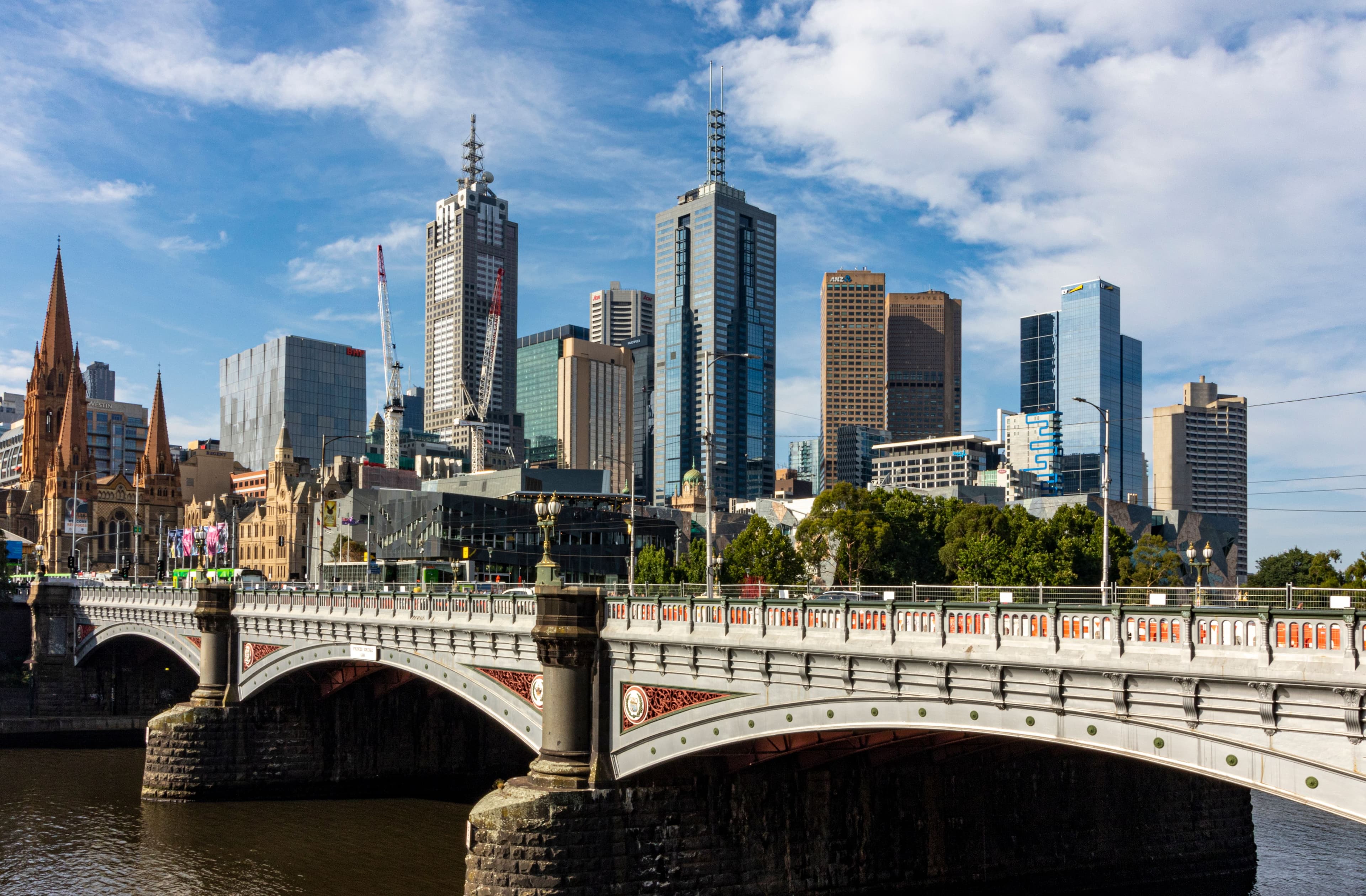
Km 0-6: Out of the sporting precinct and down St Kilda Road. The race leaves Batman Avenue, runs west past Federation Square and crosses the Yarra, then heads south down the broad boulevard of St Kilda Road past the Arts Centre and the Shrine of Remembrance, rising gently to about 26m by 5km. Legs are fresh and the temptation, especially for first-timers who have heard how flat this course is, is to go out several seconds per kilometre quicker than race pace. Nothing about the first 5 km demands that pace; the reward for patience here comes at 38 km, not at 3 km.
Km 6-14: Albert Park. The route drops about 19m onto Lakeside Drive and circles Albert Park Lake, including a back-and-forth on Aughtie Drive, the same roads used by Melbourne’s Formula 1 Grand Prix each March. Flat, open, and often exposed to whatever wind is coming off the bay that morning. Runners who have raced here before, or watched the Grand Prix on television, may recognise the shape of the road even without recognising every turn.
Km 14-27: The bay road. The course reaches the foreshore at St Kilda West and runs west along Beaconsfield Parade to a turn at Port Melbourne around 18km, back east along the Bay Trail, then south along Marine Parade and Ormond Esplanade to a second turn at Elwood around 26km. This is the section runner-experience sources describe as the psychological test of the race: long, straight stretches beside Port Phillip Bay, all within a few metres of sea level. Spring weather in Melbourne can swing from a cool onshore breeze to a warm northerly within the same morning, and this exposed stretch is where that swing is felt most directly. Crowd support thins here compared with the MCG-adjacent sections, which makes personal pacing discipline more important than reading the crowd for cues.
Km 27-35: The turn for home. The route comes back through St Kilda along Jacka Boulevard and climbs about 16m over 4km up Fitzroy Street to St Kilda Road, then runs north back towards the city, gently downhill. Fatigue and the accumulated effect of the bay-road wind tend to surface here regardless of how the morning started. This is the section where runners who over-paced the opening kilometres typically pay the bill.
Km 35-39: The Domain and the Botanic Gardens. From Southbank the course turns up Linlithgow Avenue, a 16m climb, and along Birdwood Avenue on the edge of the Royal Botanic Gardens, a shaded, tree-lined stretch that offers a psychological lift after the exposed bay road, before dropping back down Domain Road to St Kilda Road. It is deceptively late in the race to still be running through parkland, and pacing here should account for the final kilometres still to come.
Km 39-42.195: Into the MCG. The last climb of the day is the sharpest: about 19m in under a kilometre from Princes Bridge up past Flinders Street to Wellington Parade, the course’s high point at about 36m around 40.7km. It then drops through Yarra Park and into the ground itself for the finish lap. Entering the MCG through the players’ race and onto the turf, with the stands rising on both sides, is the payoff the entire course has been built around, and race reports consistently describe it as the strongest single moment of the event regardless of finishing time.
The blue tangent line marks the shortest legal route between the start and finish banners; following it closely across 42.195 km makes a measurable difference to total distance covered, typically 100-200 m over a full marathon for runners who don’t.
Course Map
The map shows the 2025 course: down St Kilda Road to Albert Park Lake, out and back along Port Phillip Bay to Port Melbourne and Elwood, and back through the Domain to the MCG finish, plus the key transport stations serving the precinct. Tap a marker for details, and scrub the slider or press play to move the orange marker along the course with the elevation profile beneath it.
The race leaves the sporting precinct and heads down St Kilda Road on fresh legs. The flat opening tempts an early over-pace; there is no course feature here that rewards it.
A lap of the lake: flat, open, and exposed to whatever wind is moving off Port Phillip Bay that morning. The same lake circuit used by the city’s Formula 1 Grand Prix.
Out-and-backs to Port Melbourne and Elwood, long straight sections with the water in view. Support thins here; this is where personal pacing discipline matters more than crowd energy.
Shade beside the Royal Botanic Gardens, then the sharpest climb of the day, 19 m up from Princes Bridge, before the drop into the Melbourne Cricket Ground for a finish lap on the turf.
What to wear
October in Melbourne does not settle into one kind of race morning, and the honest advice is to check the forecast in the final week before packing. Race starts have run anywhere from cool and still to windy with rain moving through, and a genuinely warm northerly is not unusual by afternoon even if the start was cold. A throwaway layer for the start village is worth carrying regardless of the forecast: even a mild morning in Melbourne can feel sharp while standing still in a start corral before dawn light.
Because the bay-road section between roughly 13 km and 25 km is the most wind-exposed part of the course, runners prone to feeling the cold should think about wind resistance in kit choice for that stretch specifically, not just for the start line. Sunscreen is worth applying before the race even on an overcast forecast: Melbourne’s UV index climbs quickly through October regardless of cloud cover, and runners on the course for four-plus hours are exposed longer than the forecast’s “mostly cloudy” summary might suggest.
Entry
Entry details for 2027 have not been published at the time of writing. What can be said with confidence: this is not a ballot race in the London or New York sense. Entry has historically been a straightforward open sale, but demand has grown to the point that the 2026 festival, across all distances combined, reached capacity within 48 hours of entries opening, with more than 46,000 runners on a waitlist. That figure covers the marathon, half marathon, 10 km and shorter events together, not the marathon alone, but it is a strong signal that this is now a race to enter the day registration opens rather than a race to leave for later in the year.
Price tiers, transfer and deferral rules, and any charity or tour-operator entry routes are not yet confirmed for 2027. Wave seeding method and any expo-based wave-change policy are also unconfirmed. No fast-runner or Good For Age seeding table has been published for this race.
Race Weekend
Expo
Expo venue, address, opening hours, and bib collection requirements for the 2027 event have not been published. International runners should, as a general principle for a race of this size, collect race packs as early as the expo allows rather than relying on late or race-morning pickup, but the specific collection window, any proxy-pickup policy, and merchandise details cannot be published without a current-year source.
Race Morning
Wave start times, corral letters, and the transport plan for race morning are not yet confirmed for 2027. What is confirmed: the start sits on Batman Avenue, close to Rod Laver Arena and the broader Melbourne Park and MCG precinct, an area already well served by the city’s tram network and by Jolimont and Richmond train stations on race mornings when road closures are in effect. Runners staying anywhere in the inner city or inner east should expect to walk or use a short tram hop.
Toilet queues, bag-drop versus poncho procedure, start-village facilities, headphone policy, on-course massage points, and finish-line provisions are all unconfirmed for 2027. Given the precinct is used for major events year-round (the MCG hosts AFL finals and Test cricket; Rod Laver Arena hosts the Australian Open), the venue infrastructure for large crowds exists, but the marathon-specific application of it for 2027 needs confirming closer to the date.
Nutrition on Course
Aid station locations, sports nutrition brand, cup type, and personal bottle service procedure are not yet confirmed for 2027. The official marathon page states aid station locations will be announced closer to the event, so no km-by-km table can be published honestly ahead of that announcement.
Spectating
The single best spectating position for this race is inside or immediately outside the MCG itself: the finish lap is visible from the stands for anyone who can get a seat or a spot pressed against the fence line, and it is the one point on the course where the emotional payoff of the event is concentrated. Because the course runs a loop south to Albert Park and the bay before returning through the Botanic Gardens, a spectator based near the MCG or Jolimont can realistically manage a double sighting: once as the field passes the start/finish precinct in the opening kilometres, and again for the finish itself, without a difficult transport connection in between.
Train lines, tram routes and stop names for reaching the Albert Park and bay-road sections as a spectator have not been published; plan them from the final course map. Melbourne’s tram network almost certainly serves the Albert Park and St Kilda Road corridor well, but check stop-by-stop routing against the 2027 road closures.
Post-Race Food
Richmond, immediately across the river from the MCG, is the easiest post-race food option for anyone who does not want a long walk on tired legs. Top Paddock on Wellington Street is a long-standing Richmond brunch spot with a seasonal, produce-driven menu; it fills quickly on weekend mornings, so runners with a large finisher group should expect a wait or consider splitting up. My Oh My on Swan Street, a short walk from the ground, does a more indulgent brunch menu, including a croissant French toast, and sits directly on the route back towards Richmond station for anyone heading straight to accommodation afterwards. Both are normal sit-down cafes rather than post-race recovery specialists, which is the point: after four-plus hours on the bay road, a proper coffee and a hot meal at a table does more than another gel ever will.
Where to Stay
The finish is the MCG, and for this race that recommendation carries unusual weight: the ground sits inside Yarra Park, wedged between the Richmond and East Melbourne train stations and a short tram ride from the CBD, so “stay near the finish” here means staying in one of two genuinely different neighbourhoods rather than one obvious hotel strip.
East Melbourne
Immediately north of the MCG across Brunton Avenue and Wellington Parade, this is the quieter of the two. Wide tree-lined streets, Victorian terraces, and a walk to the ground under 15 minutes make it the pick for runners who want proximity without noise the night before a 6am start. Pullman Melbourne on the Park sits directly on Wellington Parade facing the ground.
Richmond
Across the Yarra to the south and east, Richmond is livelier and cheaper, with Swan Street and Bridge Road both a short walk from the stadium precinct and well served by trams back into the city. Race weekend noise is a real consideration here on Saturday night, since Richmond’s pub and restaurant strip does not quiet down for a Sunday-morning marathon, so light sleepers should weigh proximity against a quieter East Melbourne base.
Southbank and the CBD
Across the river again, Southbank and the CBD add roughly 15-25 minutes of walking or a short tram hop to the start and finish but open up the widest range of hotel price points and the largest choice of pre-race dinner options. The Langham sits directly on the Southbank promenade with river views towards the MCG precinct.
South Yarra
A few stops further out on the tram network, South Yarra is a reasonable middle ground for runners who want a residential, restaurant-dense base without the Richmond pub noise, at the cost of a slightly longer race-morning transfer.
Recommended hotels
Sits directly on Wellington Parade facing Yarra Park and the MCG. About as close to the finish line as a full-service hotel gets, which matters more on marathon morning than any amenity list.
Positioned in the sporting precinct itself, close to Jolimont station, with a straightforward walk to the start and finish that avoids any tram or train connection on race morning.
A riverside position on the Southbank promenade, with a walk or short tram ride to the MCG. Suits runners who want a wider choice of pre-race dining within the hotel’s own precinct.
Apartment-style rooms a short walk from the ground, on the livelier side of the river. Good value, but Saturday-night noise from Richmond’s pub strip is a real factor for light sleepers before a dawn start.
Serviced apartments with kitchen facilities, useful for runners staying multiple nights who want to self-cater a pre-race dinner or a recovery breakfast.
Booking timeline
Entry results and confirmation timing for 2027 are not yet published, but the 2026 festival selling out within 48 hours of entries opening is the clearest available signal: hotels near the MCG and in East Melbourne and Richmond should be booked at the same time as race entry, not after. Melbourne in October also coincides with the AFL Grand Final in most years and a general uptick in domestic tourism as spring arrives, both of which push accommodation prices up independently of the marathon. Flights should be booked with the same urgency; Melbourne is a major domestic and international hub, so availability is rarely the constraint, but marathon-weekend pricing on popular routes does climb as the date approaches.
See & Do
The finish sits inside the MCG itself, with the Royal Botanic Gardens and the Yarra River within easy reach on foot.
National Sports Museum
Housed within the Melbourne Cricket Ground, covering the history of the ground and Australian sport more broadly. The lowest-effort attraction on this list by a wide margin: runners are already standing in the building at the finish line.
Royal Botanic Gardens Victoria
The same gardens the course runs through in its final kilometres, on Birdwood Avenue. Flat, shaded paths make it a genuinely restful recovery walk rather than a sightseeing chore, and runners get to revisit a stretch of the course without the fatigue this time.
Yarra River promenade, Southbank to Federation Square
A flat riverside walk connecting the MCG precinct to the CBD’s main square, with cafes and bars along the Southbank side. Suitable for a slow recovery stroll, with plenty of seating along the way.
Queen Victoria Market
A working produce and general market dating to the 1870s, reachable by tram from the MCG precinct. Worth saving for a rest day, given the walking involved once inside.
Read Before you Run
The Fatal Shore
Robert Hughes
Not a Melbourne book specifically, but the essential account of the convict transportation system that shaped colonial Victoria and the wider country the runner has just crossed a small slice of on foot. Dense but rewarding for the flight home.
After the Race
The Melbourne Marathon Festival runs in October, Australia’s spring shoulder season. These itineraries range from a same-day trip to the Yarra Valley to a four-night extension across the strait to Tasmania.
Victoria’s best-known wine region, roughly an hour northeast of the city. October is early spring: vines are only budding, but cellar doors and restaurants operate as normal year-round.
A quieter, more manageable coastal overnight than the Great Ocean Road proper, with flat foreshore walks and a historic lighthouse township at the end of the line.
The signature Victorian coastal drive, reachable without a car via train and connecting coach, though the honest version of this itinerary flags the long transfer alongside the cliff-road scenery.
A genuine change of pace and place: Tasmania’s compact capital, MONA, and a day trip to Bruny Island for anyone willing to add a short flight to their post-marathon plans.
Frequently asked questions
Should I stay near the start or the finish?
Stay near the finish. The Melbourne Marathon starts and finishes within about 500 m of each other around the MCG and Yarra Park, so East Melbourne, Jolimont or Richmond put a runner within easy walking distance of both ends of the race.
How far in advance should I book a hotel?
As soon as entry is confirmed, ideally six to nine months out. The festival now sells out across all distances within roughly 48 hours of entries opening, and October also overlaps with the AFL Grand Final period, which pushes accommodation demand up independently.
Is there free transport to the start?
Not confirmed for 2027. Given the scale of road closures a race this size requires, some free or included transport arrangement is plausible, but nothing specific is confirmed ahead of the official athlete guide.
What is the best area to stay?
East Melbourne, immediately north of the MCG, is the quietest option within walking distance of the finish. Richmond, just across the Yarra, is livelier and slightly cheaper but noisier on Saturday night. Southbank and South Yarra add a short tram ride but open up more hotel choice.
When does the expo open?
Not confirmed for 2027.
What is the weather typically like?
Genuinely variable. October sits in Melbourne’s spring shoulder season, and race mornings have ranged from cool and still to windy with rain within the same week in past years. Checking the forecast in the final days is more useful than any seasonal average.
How do I get from the airport?
SkyBus runs an express coach service between Melbourne Airport and Southern Cross Station roughly every 10-15 minutes, taking about 30 minutes. From Southern Cross, trams and a short taxi or rideshare connect to East Melbourne, Richmond or the CBD.
Is there a bag drop?
Not confirmed for 2027.
Should I bring a throwaway layer?
Worth carrying regardless of forecast. Even a mild October morning in Melbourne can feel sharp while standing still in a start corral before sunrise.
How do I get back to my hotel after finishing?
Anyone staying in East Melbourne, Jolimont or Richmond can walk back directly once through the finish precinct. From further out, the Richmond and Jolimont train stations and the CBD tram network resume normal service once road closures lift.