The Race
| Next Race Date | To be Confirmed |
|---|---|
| Course Type | Loop (two laps) |
| Registration | Open entry, staged prices |
| Ballot Opens | Not applicable (open entry) |
| Total Finishers | 819 (2026) |
| Average Race Day Temperature | 10 to 19°C (May) |
| Cutoff Time | 6 hours |
| Free Race Day Transport | No |
| Course Certification | AIMS |
History
The South Australian Road Runners Club was founded in 1980 by people who wanted to run the Adelaide Marathon, which tells you the race came first and the club grew up around it. By 2013 the club was staging its 35th edition, putting the race's roots at the end of the 1970s.
It has never stood still for long. In the 2010s the marathon ran two laps of the park lands and finished at Elder Park on the south bank of the River Torrens. The start and finish have since moved a few hundred metres upstream to Pinky Flat, the riverside lawn opposite Adelaide Oval, where the event village now sits. The two-lap format survived the move.
Brooks is the current title sponsor, and the event has grown into a festival with a half marathon, 10 km and 5 km alongside the marathon. More than 5,000 runners took part across all distances in 2026, and the marathon sold out. It had 819 finishers that year: Fraser Darcy won the men's race in 2:29:21 and Leanne Szeto the women's in 2:45:14.
The course is certified by AIMS, and SARRC markets it as a Boston qualifier. It carries no World Athletics Label. SARRC also runs an elite programme that offers complimentary entry to qualifying athletes and, for some from outside Adelaide, help with travel and an official hotel.
The course
The Adelaide Marathon is two identical laps of 21.1 km from Pinky Flat, on the north bank of the River Torrens opposite Adelaide Oval. Most of each lap stays on the North Adelaide side of the river: War Memorial Drive out of Pinky Flat gives way to Jeffcott Road and Park Terrace, North Adelaide's own ring of parkland roads, out to Port Road in the west near Bonython Park, the lap's low point. The route swings back east along Montefiore Road, then further out past the zoo and the Adelaide Botanic Garden on Victoria Drive, Plane Tree Drive and Hackney Road, before a longer stretch of North Adelaide on Bundeys Road and Sir Edwin Smith Avenue. Only in the last two kilometres of each lap does the course cross the river, dropping down George Street to North Terrace and Festival Drive by the Adelaide Festival Centre before returning to Pinky Flat.
Almost all of it runs on park paths and sealed roads inside Adelaide's ring of park lands, the green belt laid out around the city in 1837. The course stays within a 28 m band of height, climbing gently out of the river valley on both the western and eastern sides of each lap and again on the short rise to North Terrace near the crossing. Seven drink stations serve each lap, the last at the halfway point.
Km 0–5: Pinky Flat and the western loop.The start is compact and dark in early May, with the lights of Adelaide Oval across the water. War Memorial Drive carries the field west into North Adelaide, then Jeffcott Road and Park Terrace climb gently to about 50 m before dropping to the lap's low point near Port Road and Bonython Park, around 23 m. Hold back here: a two-lap race punishes a fast first 5 km twice.
Km 5–11: Past the zoo and the Botanic Garden. Montefiore Road brings the route back east, then it climbs steadily over 5.6 km, gaining about 22 m at an average 0.4%, out along Victoria Drive, Plane Tree Drive and Hackney Road, tracing the roads that border Adelaide Zoo and the Botanic Garden without entering either.
Km 11–18: Back through North Adelaide. The course returns to War Memorial Drive, then Bundeys Road and Sir Edwin Smith Avenue carry it through the interior of North Adelaide, the section with the most turns. Runners who learn them on lap one are less surprised on lap two.
Km 18–21: The one river crossing and halfway.A short, sharper climb, 21 m over 1.4 km at 1.5%, carries the route up George Street to North Terrace, the day's high point at 52 m near the Adelaide Festival Centre, before a fast descent back down Festival Drive to Pinky Flat. Halfway comes right beside the start, which is both a lift and a temptation to stop.
Km 21–42: The second lap. The same circuit again, with the same climbs in the same order, this time in warmer sun and past half-marathon runners on parts of the course. The western loop near Port Road, around 24 to 27 km, is where organisers and runners describe the second-lap fade usually starting. The finish is back on Pinky Flat, 11 m from where the race began.
There is no published blue line and no public map of the timing mats. Follow the marshals and the course markings rather than a GPS watch, particularly through the North Adelaide turns.
Course Map
The route shown is the 2026 course; it must be re-checked when SARRC publishes the next edition's map. Tap a marker for details, and scrub the slider or press play to move the orange marker along the course with the elevation profile beneath it.
Pacers
The marathon starts at 06:30 with official pacers at 3:15, 3:30, 3:45, 4:00 and 4:13. The 4:13 group runs at 6:00 min/km, just inside the six-hour cutoff.
What to wear
Early May in Adelaide is late autumn. Mornings are usually cool, around 10°C at the 06:30 start, and the day often reaches the high teens by the time slower runners finish. The start is before sunrise, so runners stand in the event village in the dark for up to an hour.
An old long-sleeve top for the wait is enough for most people. SARRC does not advertise a clothing-donation scheme, so either use the bag drop or wear something you are happy to lose.
On the course, shorts and a singlet or T-shirt suit most runners. The river corridor is sheltered, but North Adelaide's open sections can feel cold in a breeze in the first hour. Arm sleeves or light gloves that can be pushed into a pocket are more useful than a jacket.
Runners on course after 09:30 will be in full sun on the second lap. A cap and sunscreen applied before the start are sensible even on a cool morning. Rain is possible in May but rarely heavy for long.
Entry
Entry to the Adelaide Marathon is open and sold at rising prices. There is no ballot and no qualifying time. The marathon sold out in 2026, so the practical advice is to enter as soon as the date is known and travel is settled.
| Tier | 2026 adult price | Approx. GBP |
|---|---|---|
| Tier 1 | A$140 | £74 |
| Tier 2 | A$155 | £82 |
| Tier 3 | A$170 | £90 |
| Late | A$180 | £96 |
SARRC members paid less in the early tiers. Entry includes a personalised bib, bag drop, a finisher's medal and a finisher's tee. Online entries closed at midnight on the Wednesday before the race, and there are no race-day entries.
The refund policy is strict. SARRC does not refund entries. Members can withdraw for credit, and anyone else can ask to move to another event at the same festival until the Wednesday before the race. Replacement bibs issued after changes are not personalised.
There is no good-for-age route and no public charity allocation. The Indigenous Marathon Foundation was the charity partner in 2026. Fast runners should look at SARRC's elite programme instead, which offers complimentary entry to athletes meeting its standards and, for qualifying marathoners from outside Adelaide, help with an official hotel and travel. Standards and contacts are on the official elite page and change each year.
The course is AIMS certified and SARRC describes it as usable as a Boston qualifier. Runners relying on a time for Boston should confirm that the certification covers the next edition's course.
Fast Runner / GFA Standards
Not applicable. The Adelaide Marathon has no good-for-age entry route.
Race Weekend
Expo
Bib collection and the Brooks Race Expo were held at the InterContinental Adelaide on North Terrace in 2026: Friday 10:00 to 18:00 and Saturday 10:00 to 16:00. There is no race-day collection. International and interstate runners who cannot make either session need to contact the SARRC office in advance.
The InterContinental sits on the south bank of the Torrens, a short walk across the river from Pinky Flat and a few minutes from Adelaide Railway Station, so for anyone staying in the CBD the expo is a walk, not a journey.
Bring the confirmation email with your bib number. Someone else can collect for you if they have access to that email. Bibs are personalised if entries are finalised before printing; changes made late produce a plain bib.
The expo is modest compared with a capital-city major: bib collection, Brooks merchandise and a few stands. An hour is plenty.
Getting to the Start
The marathon starts at 06:30 from Pinky Flat, on the north bank of the River Torrens opposite Adelaide Oval. The event village and bag drop opened at 05:30 in 2026, and SARRC asks runners to arrive an hour before their start.
| Marathon | 06:30 |
| Half marathon | 07:15 |
| 10 km | 09:45 (starts on Morphett Street) |
| 5 km | 10:15 (starts on Morphett Street) |
The simplest plan is to stay in the CBD or on North Terrace and walk. From North Terrace, the footbridges and the Morphett Street and King William Street bridges cross the river to the Adelaide Oval side in a few minutes. There is no free race-day transport. Adelaide Metro trains, trams and buses run on Sunday timetables and at normal fares, and early-morning Sunday services are thin, so a hotel within walking distance is worth more here than at most city marathons.
Bag drop uses the tag attached to your bib. SARRC accepts no responsibility for lost items, so leave valuables at the hotel. Toilets in the event village are busiest in the last 20 minutes before the start; use them early. There is space on the riverside paths for a short warm-up jog.
After the finish, runners collect their medal and tee and pick up bags in the same village. Pinky Flat is a few minutes' walk from North Terrace hotels, the railway station and the tram stops on King William Street. Supporters can wait on the lawns of Pinky Flat itself; agree a meeting point away from the finish chute. Taxis and rideshare near the river are slow while the course is closed; walking is quicker for any hotel in the CBD or North Adelaide.
Nutrition on Course
Seven drink stations serve the marathon, and runners pass six of them twice. Water is available at all of them and Blue PURE Hydration electrolyte at all but the first.
| Lap 1 km | Lap 2 km | Electrolyte | Notes |
|---|---|---|---|
| 3.2 | 24.3 | No | Marathon special drinks |
| 7.0 | 28.1 | Yes | Toilets |
| 9.8 | 31.0 | Yes | Toilets |
| 12.5 | 33.6 | Yes | Toilets |
| 15.6 | 36.7 | Yes | Toilets |
| 18.4 | 39.5 | Yes | Toilets |
| 21.2 | — | Yes | Toilets; halfway |
Gels are not listed. Carry your own for the whole race and plan to take them at the stations, where there is water to wash them down. The spacing is roughly every 3 km, generous enough that a handheld bottle is unnecessary for most runners. The first station is marked as the special-drinks point for marathon runners; the procedure for handing in personal bottles was not published in 2026, so ask at bib collection.
Spectating
Adelaide is one of the easiest marathons in Australia to watch on foot. The course is two laps, and most of it stays within a couple of kilometres of Pinky Flat on the North Adelaide side of the river, so a supporter can see a runner several times without using transport at all.
The best single place is Pinky Flat itself. Runners start there, reach halfway there and finish there, and it has toilets and space on the lawn, with Adelaide Oval's riverside next door. War Memorial Drive, close to the start, catches runners at both ends of each lap.
Spectator itinerary A: stay at Pinky Flat
Watch the 06:30 start, then wait for halfway around 21 km and the finish at 42 km. All from the same spot, on foot.
Spectator itinerary B: North Adelaide loop
From Pinky Flat, walk into North Adelaide towards War Memorial Drive and Sir Edwin Smith Avenue for around km 15 and km 36, then back to Pinky Flat for the finish.
Spectator itinerary C: the halfway crossing
Cross to North Terrace near the Festival Centre for around km 19 and km 40, when the course makes its one crossing to the south bank each lap, then walk back to Pinky Flat for the finish.
Every itinerary here is on foot. Public transport is not needed and roads near the course are closed. Tracking arrangements for the next edition had not been published.
Post-Race Food
The finish is on the edge of the CBD, so food is a short walk away, but a 06:30 marathon start means many runners finish before Sunday lunch service begins. Plan for a shower first and brunch second.
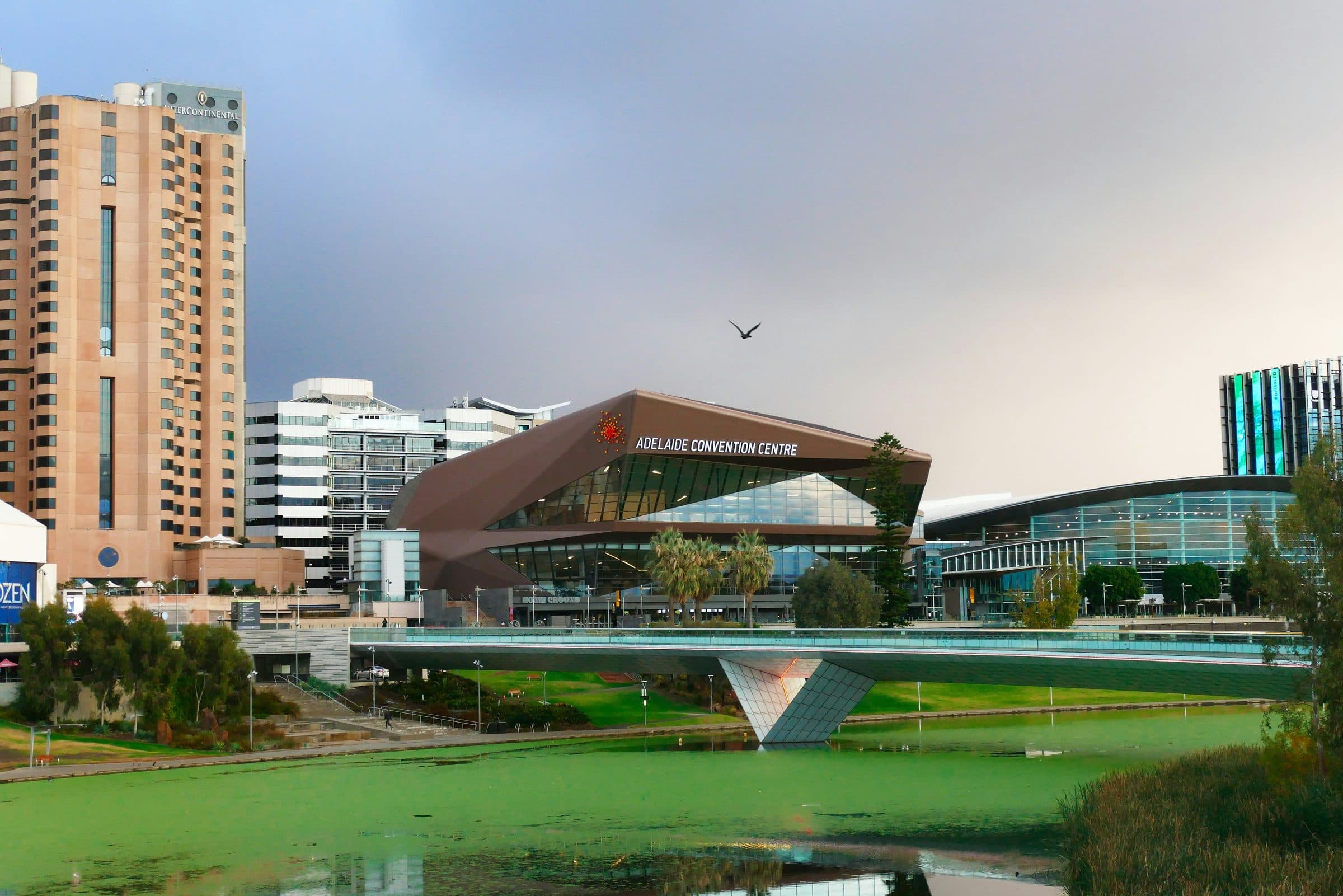
The Riverbank precinct on the south side of the Torrens, around SkyCity and the Adelaide Convention Centre, is the nearest cluster of restaurants to Pinky Flat. The Kitchen at SkyCity is a steak-and-seafood lunch within a few minutes' walk of the finish.
For brunch, North Adelaide's O'Connell Street and Melbourne Street are a short walk up the hill from Adelaide Oval and have cafés open on Sunday mornings. Rundle Street in the East End is the other obvious choice, closer to hotels on the eastern side of the CBD. Adelaide Central Market, the city's best-known food destination, is closed on Sundays; save it for Saturday before the race, or Tuesday after it.
Where to Stay
Stay within walking distance of the finish. The Adelaide Marathon starts and finishes on Pinky Flat, so there is no start-versus-finish trade-off: the closer to the river, the shorter the walk on race morning and again after 42 km. With a 06:30 start, thin early Sunday transport and closed roads, a hotel within 25 minutes' walk is worth more than a cheaper room further out.
North Terrace and the Riverbank
North Terrace and the Riverbank are the closest hotel strip to Pinky Flat. The InterContinental, which held the 2026 expo, Eos by SkyCity and Adelaide Railway Station all sit on the south bank of the Torrens, about 0.4 km from the finish in a straight line, with a footbridge across the river to the Oval side. Prices here are the highest in the city on race weekend. Choose it if race morning matters more than anything else.
Adelaide CBD
The Adelaide CBD, the grid south of North Terrace, has the widest range of hotels and apartments, from budget to premium, most of them 15 to 25 minutes on foot from Pinky Flat. Mantra on Hindmarsh Square is 1.2 km away in a straight line. Saturday nights are quiet away from Hindley Street, which makes the CBD the default choice for most visitors.
North Adelaide
North Adelaide sits on the hill above the river on the Oval side, and its roads are the course itself: War Memorial Drive, Jeffcott Road, Park Terrace and Bundeys Road carry most of each lap. The Oval Hotel is 0.3 km from the finish without crossing the river, and O'Connell Street has cafés and restaurants. The walk back up from the Torrens after 42 km is uphill, and Saturday nights are calm.
East End
The East End, around Rundle Street and East Terrace, has good restaurants, several mid-range hotels and the Botanic Garden at the end of the street, 1.3 to 1.5 km from Pinky Flat in a straight line and 20 to 30 minutes on foot. The bars on Rundle Street are busy on Saturday night, so ask for a room on a side street.
West End
The West End, around Hindley Street and Currie Street, has value hotels close to the railway station and the river. Hindley Street is the city's nightlife strip, so check which way a room faces before booking.
Glenelg
Glenelg, the beach suburb at the end of the tram line, suits a longer holiday. It is about 30 minutes from the city by tram, and the first Sunday service may not reach the city in time for a 06:30 start, so it works better for the nights after the race than the night before.
Recommended hotels
The 2026 expo hotel, so bib collection is in the lobby. A short walk across the river to Pinky Flat on race morning and back afterwards.
Built into Adelaide Oval, on the same side of the river as the start and finish, so there is no bridge to cross. Rates rise sharply if there is a match at the Oval that weekend.
A newer luxury hotel on the south bank beside SkyCity, with restaurants downstairs for a post-race lunch. Walk across the river to the start.
Apartment-style rooms with kitchens, useful for a pre-race breakfast before a 06:30 start. About 20 minutes' walk to Pinky Flat.
On a quieter street off Rundle Street, close to the Botanic Garden for a gentle walk the day after. Allow about 25 minutes on foot to the start.
Booking timeline
There is no ballot, so the trigger for booking is the date announcement from SARRC. The race has been held in early May (the 2026 edition was on 3 May), but wait for the announcement before booking anything non-refundable.
Once the date is out, book a refundable room near the river at the same time as entering. The marathon sold out in 2026 and the festival draws more than 5,000 runners across four distances, most of them wanting the same North Terrace and CBD hotels. Adelaide Oval also hosts football on autumn weekends, which can tighten the city's rooms further.
International runners should arrive by Friday. Bib collection in 2026 closed at 16:00 on Saturday with no race-day collection, and a delayed flight on Saturday leaves no margin. Adelaide Airport is about 7 km from the CBD, so landing on Friday evening still gives a full Saturday.
See & Do
Everything below is within 1.5 km of Pinky Flat and the hotels on North Terrace and in the CBD, and all of it is walkable on tired legs. Distances are measured in a straight line from the finish.
Adelaide Oval
0.3 km (0.2 miles) from the finish. The ground across the river from the start offers a stadium tour and the RoofClimb over the stands. Take the tour after the race and leave the climb for another trip.
River Torrens and Elder Park
0.3 km (0.2 miles) from the finish. The flat riverside paths that the course uses, with the Festival Centre and Elder Park's rotunda on the south bank. A slow walk here is the obvious way to loosen the legs on race afternoon.
North Terrace cultural strip
0.9 km (0.6 miles) from the finish. The Art Gallery of South Australia, the South Australian Museum and the State Library sit side by side on North Terrace, all free to enter. Everything is indoors and level, with seating, which suits a cool or wet May afternoon.
Adelaide Botanic Garden
1.5 km (0.9 miles) from the finish. About 50 hectares of glasshouses, lawns and avenues at the east end of North Terrace, free to enter. The paths are flat and there are benches everywhere, which makes it the right pace for the Monday after the race. The course passes along the roads beside it on each lap.
After the Race
May is late autumn in South Australia: the vines of the Barossa and the Adelaide Hills are turning, the beaches are empty and the ferries to Kangaroo Island run year-round. The Glenelg tram and the Hahndorf drive ask little of legs that have just run 42 km, while the Barossa and Kangaroo Island suit a longer stay once the stiffness has gone.
The heritage tram line from the city centre to the beach at Moseley Square, with a flat seafront, a jetty and Jetty Road for lunch. The easiest recovery day in Adelaide.
The German-settled village in the hills behind the city, with autumn colour in the avenues and cellar doors along the ridges. A slow night away without a long drive.
Two nights in Tanunda, with cellar doors and bakeries within a few minutes of each other, and the vineyards in their autumn colours after the harvest.
Australia's third-largest island, with sea lions at Seal Bay, the Remarkable Rocks in Flinders Chase and roads empty enough in May to drive slowly and stop often.
Frequently asked questions
Should I stay near the start or the finish?
They are the same place: Pinky Flat, on the north bank of the River Torrens opposite Adelaide Oval. A hotel on North Terrace or in the CBD puts both within a short walk. With a 06:30 start, thin early Sunday transport and closed roads, walking is the most reliable way to reach the start.
How far in advance should I book a hotel?
As soon as the date is announced and you have entered. The marathon sold out in 2026 and the festival draws more than 5,000 runners, most wanting rooms near the river. Book a refundable rate early; Adelaide Oval events on the same weekend can tighten availability further.
Is there free transport to the start on race day?
No. SARRC does not provide race-day transport and Adelaide Metro charges normal fares. Most runners staying in the CBD or on North Terrace walk to Pinky Flat in 5 to 20 minutes.
What is the best area to stay?
North Terrace and the Riverbank, closest to Pinky Flat and the 2026 expo hotel. The wider CBD has more choice within 25 minutes' walk. North Adelaide is on the same side of the river as the start. Avoid Glenelg for race night: the tram may not reach the city early enough.
When does the expo open?
In 2026 bib collection was at the InterContinental Adelaide on North Terrace, Friday 10:00 to 18:00 and Saturday 10:00 to 16:00. There is no race-day collection. Bring your confirmation email; a friend can collect with it. Check the next edition's hours when they are published.
What is the weather typically like on race day?
Cool at the start and mild later. Early May in Adelaide usually means about 10°C at 06:30, rising into the high teens by late morning. Stand in a light layer before the start, and wear a cap and sunscreen if you expect to be running after 09:30.
How do I get from the airport?
Adelaide Airport is about 7 km from the city. Adelaide Metro's J-route buses run between the terminal and the CBD at normal fares, and taxis and rideshare take about 15 to 20 minutes. From a CBD hotel you can walk to the race.
Is there a bag drop?
Yes. It opened at 05:30 at Pinky Flat in 2026, using the tag on your bib, and your bag is collected in the same village after the finish. SARRC takes no responsibility for lost items.
Should I bring a throwaway layer?
A light one, yes. You wait in the dark for up to an hour at around 10°C. No clothing-donation scheme is advertised, so either put the layer in your bag drop or wear something you are happy to leave behind.
How do I get back to my hotel after finishing?
Walk. The finish is at Pinky Flat, a few minutes from North Terrace and 15 to 25 minutes from most of the CBD. Taxis are slow while roads are closed, and walking is quicker for any central hotel.