The Race
| Next Race Date | To be Confirmed. The 2026 race ran on Sunday 5 April |
|---|---|
| Course Type | Loop: two identical out-and-back laps from central Ajaccio to a turnaround near La Parata, starting and finishing at the same point |
| Registration | Open, online through Sports’n’Connect. No ballot and no qualifying time |
| Ballot Opens | Not applicable: open registration |
| Total Finishers | 148 (2026, marathon distance) |
| Average Race Day Temperature | About 8°C to 19°C (April normals) |
| Cutoff Time | 5 hours overall, with intermediate limits of 2 hours 30 minutes at halfway and 3 hours 45 minutes after the second La Parata turnaround |
| Free Race Day Transport | None announced. The start is walkable from central hotels |
| Course Certification | FFA-measured course (homologation COR020/06622/2023/A), FFA Bronze Label for 2026. No World Athletics or AIMS label |
A marathon shared with three shorter races
The marathon does not run alone. The half marathon starts from the same point an hour later and runs exactly the marathon’s first lap, and the 10 km and 5 km follow later still, so for much of the morning the marathon shares the coast road with far bigger fields. Across all four distances the 2026 race classified 1,956 finishers; only 148 of them ran the marathon. Runners who have done it describe the second lap as the lonely part: once the shorter races finish, the marathon field is strung out alone along an exposed road. Plan for running the last stretch largely on your own.
History
ASPTT Ajaccio Athlétisme has run the Marathon d’Ajaccio for decades on Corsica’s west coast, though no founding year has been published. The organiser billed 2026 as the 35th edition, and local reporting called 2025 the 34th; the numbering points to a long-running race with a gap somewhere in its history, and neither figure should be used to work back to a founding date.
The course has moved around the same corridor more than once. For the 22nd edition, in 2011, the route shifted away from Place Miot towards La Parata, the headland at the western end of the Route des Sanguinaires. A 2023 listing still put the start, finish and village around Place Miot and the Marcaggi statue; for 2026 the start and finish moved to Cité Grossetti, opposite the Rectorat, while the village and bib collection stayed at Place Miot. Plan from the current race information, not an old race report.
The field has grown without ever getting large. A 2010 report called 406 entrants across the whole day a record; a 2014 preview put it at about 500; by 2025 the Journal de la Corse counted more than 1,000 entries across the marathon, half marathon and 10 km. The 2026 FFA results list 148 marathon finishers among 1,956 classified across every distance.
The men’s course record is 2:28:38, by Alain Aubrion in 2001; the women’s is 3:10:30, by Juliet Champion of England in 2014. In 2026 Arnauld de Contades won the men’s race in 2:53:30 and Manon Forat the women’s in 3:15:27. The race holds an FFA Bronze Label and a current FFA course measurement: a nationally certified regional marathon, whose appeal is the coast road towards the Îles Sanguinaires, not its size or its elite field.
The course
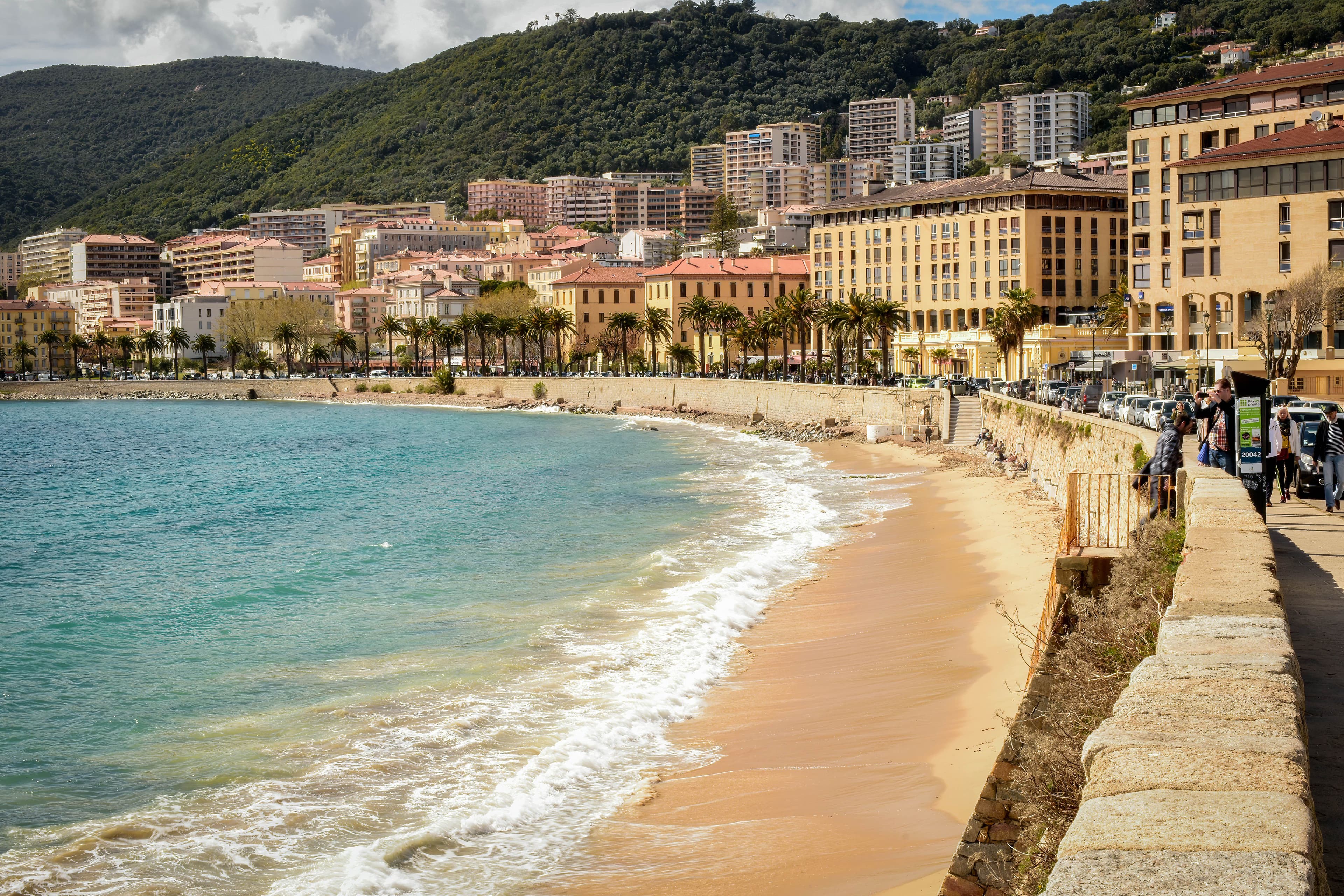
The marathon starts and finishes on Boulevard Pascal Rossini, on Ajaccio’s western seafront opposite the Rectorat, the Académie de Corse, at Cité Grossetti. The route runs west along Boulevard Albert 1er and then the Route des Sanguinaires, the coast road towards La Parata, to a turnaround at about km 10.5, roughly 160 m past Parking N°4 and in sight of the Îles Sanguinaires. It then comes back the same way to the start line at km 21.1, and does the whole out-and-back a second time. The half marathon is the first lap on its own.
The surface is asphalt throughout. The FFA calls the course “slightly hilly”, and runners who have done it several times describe the seafront as a succession of false flats with no proper climbs; the road never rises much above 20 m over the sea. The bigger factor is wind: the Route des Sanguinaires has little shelter, and a calm morning can turn into a blustery second lap.
Km 0 to 10.5: out to La Parata. The race leaves Boulevard Pascal Rossini at 08:30 and heads west along Boulevard Albert 1er onto the Route des Sanguinaires, passing the Rond-Point du Sun and running behind the town’s water treatment station. The shorter races share this stretch later in the morning, and the 10 km turns back early, near the Tino Rossi property. The road stays close to the water for most of the way. Expect wind, not climbing.
Km 10.5 to 21.1: the first return. The turnaround sits about 160 m past Parking N°4 at La Parata, facing the Îles Sanguinaires, and the route heads back the way it came. At the start line the half marathon finishes and the marathon carries straight on. The 2 hour 30 minute intermediate limit applies at halfway.
Km 21.1 to 31.6: the quiet lap. With the shorter races over, the road empties. Runners describe this second trip out as the hardest part of the race, less for the gradient than for how few people are left in sight on a road that was crowded an hour earlier. The false flats and the wind are the same as on the first lap, without the company.
Km 31.6 to 42.195: back to Ajaccio. A second turn at La Parata starts the last return along the coast. A 3 hour 45 minute limit applies after that second turnaround, and the overall 5-hour limit at the finish, after which the broom wagon takes your bib. One runner described fading noticeably from about km 36; this course rewards even pacing more than a late kick. No blue line or intermediate timing mats have been published.
Course Map
The out-and-back from Boulevard Pascal Rossini to the La Parata turnaround, run twice, with the race village at Place Miot. Tap a marker for details.
No elevation chart is shown for this race. The road runs so close to the shoreline that satellite elevation data along it keeps reading the sea instead of the road, which produces a false profile. The organiser publishes no total climb.
Pacers
None announced. Neither the organiser’s pages nor the 2026 regulations mention pacers or pace groups, and with 148 finishers you should plan to run your own pace.
What to wear
April in Ajaccio is mild: 1991–2020 climate normals give an average daily minimum of 8.4°C and an average maximum of 18.5°C. An 08:30 start sits near the cool end of that range, so a throwaway layer makes sense on a cool morning. No clothing-collection scheme has been announced, so anything you drop is simply discarded; handing it to a supporter is the better plan.
Wind decides the kit here more than temperature. The Route des Sanguinaires gives little shelter, and later finishers out at the western turnaround feel the onshore breeze more than runners still near the city. Arm warmers or light gloves earn their place on a cool, breezy morning; a vest and shorts are enough on a calm, sunny one. Check the race-week forecast, not the monthly average.
Entry
Entry is direct and online through Sports’n’Connect: no ballot, no lottery and no qualifying time. Registration opens once the organiser confirms each year’s date. The race has never been known to sell out and publishes no entrant cap, so early entry is sensible but not essential.
For 2026 the fees were €59 for the marathon, €39 for the half marathon, €25 for the 10 km and €10 for the 5 km. The marathon fee is about £51 at September 2026 exchange rates. Entrants need either an FFA competition licence or a PPS, the French health-prevention course for unlicensed runners, and must meet the minimum age for their distance. French rules on medical documentation have changed in recent years, so confirm the current requirement before travelling. Club and group entries are accepted.
There is no charity-place programme, tour-operator allocation or elite entry process, and no cancellation, deferral or transfer policy has been published. Confirm cancellation terms with Sports’n’Connect or the organiser before booking non-refundable travel around the race.
Fast Runner / GFA Standards
Not applicable. Entry is first come, first served, with no guaranteed-entry or fast-runner route.
Race Weekend
Expo
Bib collection and the race village are at Place Miot, about 300 m from the start and finish on Boulevard Pascal Rossini. In 2026, collection ran under a tent there on the Saturday, 4 April, from 10:00 to 19:00, alongside the first Salon du Running de Corse, a running expo open the same Saturday hours and again on the Sunday from 10:00 to 14:00.
The organiser emails registered runners the list of documents to bring; it is not published. Keep your registration confirmation and photo ID to hand, and re-read that final email: the checklist may differ from other French races. There is no routine race-morning pick-up, so arrive by Saturday.
Getting to the Start
The start is on Boulevard Pascal Rossini, opposite the Rectorat, and the organiser’s site and 2026 regulations both give the marathon start as 08:30. The FFA’s results records list it at 09:00. The two organiser sources are the stronger evidence, but check the final runner instructions, and if the conflict is still live, plan to be there for 08:30. In 2026 the half marathon started at 09:30, the 10 km at 10:30 and the 5 km at 10:45.
A central hotel means walking to the start, with no dependence on Sunday buses or road closures. Muvistrada buses cost around €2 on board, or roughly €1 with a pre-purchased card, and no free travel for entrants has been announced. No bag drop, warm-up area or clothing collection has been published, so leave belongings at your hotel. After the finish, a central hotel is a short walk away; medal, finish food and family meeting points have not been described in advance.
Nutrition on Course
The 2026 regulations list refreshment points in three places: at the 10 km turnaround, at the La Parata turnaround (passed on both laps), and at the finish. That is sparse for a marathon, roughly one aid point per lap plus the finish, so carry your own fluids and fuel, especially for the exposed return legs.
The regulations also say plainly that medical posts are not refreshment points, so do not expect the nearest aid table to double as first aid. No drinks brand, gel provision or personal-bottle service has been published.
Spectating
An out-and-back run twice is good for supporters: one spot on the Route des Sanguinaires sees a runner four times, twice on each lap. The simplest plan is to stay around the start and finish on Boulevard Pascal Rossini, which the field passes at the start, at halfway and at the finish. No live tracking has been announced.
On foot from the centre. Watch the 08:30 start, then walk west along Boulevard Albert 1er onto the first stretch of the coast road and wait there for runners coming back. Walk back to the start line for the halfway pass and the finish.
Out towards La Parata. Muvistrada line 5 runs out along the Route des Sanguinaires towards La Parata, but the road is closed for the race, so check the closure map and plan to get off where the bus stops and walk to a legal viewing point. Leave enough time to get back for the finish.
Post-Race Food
La Mostra, at 13 boulevard Roi Jérôme, serves Mediterranean and local cooking and lists Sunday lunch from 12:00 to 14:30, the easiest sit-down meal if you finish in good time. Le Bosco, at 5 rue Conventionnel Chiappe, does traditional and seafood cooking with Sunday service from 11:00 to 14:00, the earliest lunch of the three, so book ahead. Le 20123, at 2 rue Roi de Rome, serves traditional Corsican food with Sunday evening service in its April to October season, better for a celebration dinner. Check current hours for all three before race weekend.
Where to Stay
Stay near the finish. Here that is easy, because the finish is the start: Boulevard Pascal Rossini on the western seafront, with bib collection at Place Miot about 300 m away. Everything in central Ajaccio is within walking distance of all three.
The Quartier des Étrangers and Cours Général Leclerc
The Quartier des Étrangers, the seafront district around the start, and the streets up to Cours Général Leclerc give the shortest walk to the start line and to Place Miot. They are residential and quieter on a Saturday night than the old town, with fewer hotels to choose from.
The old town and Cours Napoléon
The old town, around Rue Cardinal Fesch, and Cours Napoléon are 10 to 15 minutes’ walk from the start and hold most of Ajaccio’s restaurants, the port, the Maison Bonaparte and the Fesch museum. This is the best base for a city break around the race. Saturday night is livelier near the bars, so ask for a quiet room on a side street if the early start matters.
Place de Gaulle and the waterfront
Place de Gaulle is on the airport bus route, line 11 since October 2025, which makes it practical for anyone arriving the day before. Seafront rooms here can be noisier and windier, and often cost more than a comparable room a street back.
Saint-Joseph and Ricanto
Saint-Joseph, on the eastern waterfront, has larger modern hotels with pools and parking, served by bus line 1, but it is too far to walk to the start. Ricanto, near the airport, suits a short trip built around a hire car. For the marathon itself, the centre is the better choice.
Race weekend carries no published price premium. Tourist-office listings for 2026 showed about €60 to €180 at central three-star hotels and €99 to €239 at larger four-star properties, as standard rates, not race-weekend prices.
Recommended hotels
Rooms and studios on the Sanguinaires side of the centre, the closest of these to the start. Listed 2026 doubles ran about €70 to €145. A little further from the port and the railway station than a Cours Napoléon address.
A straightforward 62-room three-star between the old town and the seafront, with the Préfecture as its nearest bus stop. No race rate or room block has been published.
Open all year, with a rooftop and a spa, on the old town’s main street and closest to Ajaccio’s evening life. Listed 2026 doubles ran broadly €60 to €180. Ask for a quiet room if you want an early night before an 08:30 start.
A historic central hotel near the railway station and the port, useful for the Corte train afterwards. Its 2026 listing showed an April to October season, and the marathon falls in early April, so confirm it is open for the race weekend before counting on it.
A year-round four-star with a pool, jacuzzi and parking. Too far to walk to the start on race morning, so it suits a runner with a car who values facilities over a short walk.
Booking timeline
There is no ballot to wait for; the trigger is the organiser publishing the date and opening entry. Until then, avoid non-refundable travel booked on a third-party calendar’s projected date. Once the date is out, book a cancellable central room early: Ajaccio is an island with limited spring flights and hotel rooms, Easter or school holidays can overlap race weekend, and no organiser hotel block exists. Flights from the UK may need a connection outside the summer timetable, so check current schedules.
See & Do
All of these start from central Ajaccio, around the finish and the central hotels. Distances are from the finish on Boulevard Pascal Rossini.
Maison Bonaparte
About 800 m (0.5 miles) from the finish, in the old town. Napoleon’s birthplace, now a national museum. It involves standing more than walking, which makes it realistic the day after the race. Check opening hours and any timed entry before you go.
Central Ajaccio and the port
Between about 500 m and 1 km (0.3 to 0.6 miles) from the finish. The compact centre around Cours Napoléon and the port is the easiest recovery wander: cafés every few doors, and a short visit to the Maison Bonaparte or the Fesch museum area, with no day-long circuit.
Ajaccio Vision sightseeing circuit
From Place Campinchi, about 1 km (0.6 miles) from the finish. A 90-minute guided circuit of the city with a stop at La Parata. Its 2026 season ran from 5 April, the marathon’s own date, to 31 October, which makes it a low-walking recovery option on race weekend.
La Parata and the Grand Site des Îles Sanguinaires
About 10 km (6 miles) west of the finish, the headland the course turns at, reached by bus line 5. The Maison du Grand Site is open all year; the short loop near the Genoese tower is a reasonable recovery walk, while the full 7.6 km (4.7 miles) Sentier des Douaniers, rocky in places, is better left for a later day.
Îles Sanguinaires boat trip
From Ajaccio’s harbour, about 1 km (0.6 miles) from the finish. A view of the islands from the sea, with Mezu Mare among the operators. April sailings are fewer and depend on the weather, so check the timetable before planning around one.
Read Before you Run
Granite Island: A Portrait of Corsica
Dorothy Carrington
A long portrait of Corsica’s landscape, villages and history, and the classic English-language book on the island. It gives a travelling runner the context the coast road alone does not, from Ajaccio’s Genoese past to the interior you glimpse from the course.
After the Race
Early April is a good time to see Corsica: warm enough for the coast, cool enough for walking, and before the summer crowds on the island’s narrow roads. Buses and boats run less often than in summer, so check timetables. La Parata and Porticcio suit the day after the race; save Corte’s citadel steps and Bonifacio’s cliff paths for later in the week.
The headland the marathon turns at twice, on foot this time: a Genoese watchtower, a coastal reserve and a boat option out to the islands. April boat sailings are fewer and weather-dependent.
A short crossing to a sand-beach resort on the south side of the Gulf of Ajaccio. Agosta beach is the flattest, easiest recovery walk of any trip on this list.
The red granite cliffs of the UNESCO-listed Calanche de Piana, reached by a bus that runs outside summer too. April walking beats a summer afternoon at the same viewpoints.
A car-free train ride to Corsica’s former capital, a citadel town on a rock outcrop. Better for day two or three, once the legs can handle the citadel steps.
A limestone citadel at Corsica’s southern tip, with Sardinia visible across the strait. Three nights covers the citadel and a beach day; a fourth adds a boat day to the Lavezzi Islands.
Frequently asked questions
Should I stay near the start or the finish?
They are the same point, on Boulevard Pascal Rossini opposite the Rectorat, and bib collection at Place Miot is about 300 m away. Any central hotel covers all three on foot.
How far in advance should I book a hotel?
Once the organiser confirms the date. There is no ballot, but island flights and hotels are limited in spring, and Easter can fall on race weekend. Book cancellable.
Is there free transport to the start on race day?
None announced. Buses cost around €2 on board, but the start is walkable from central Ajaccio, so most runners will not need one.
What is the best area to stay?
Central Ajaccio: the Quartier des Étrangers for the shortest walk to the start, or the old town and Cours Napoléon, 10 to 15 minutes away, for restaurants.
When does the expo open?
In 2026, bib collection ran on the Saturday, 10:00 to 19:00, at Place Miot, with a running expo there on Saturday and Sunday morning. No race-morning pick-up.
What is the weather typically like on race day?
Mild: April normals run from about 8°C to 19°C. Wind on the exposed coast road matters more than the temperature, so check the race-week forecast.
How do I get from the airport?
Muvistrada line 11 runs from the airport to Place de Gaulle via Sainte-Lucie, a short walk from most central hotels. Take a taxi for a late arrival.
Is there a bag drop?
None published. The start is walkable from central hotels, so leave everything in your room and walk down.
Should I bring a throwaway layer?
On a cool or breezy morning, yes. No clothing-collection scheme has been announced, so hand it to a supporter.
How do I get back to my hotel after finishing?
Walk: the finish is where you started, in central Ajaccio. From Saint-Joseph or the airport area, check Sunday buses and road closures first.