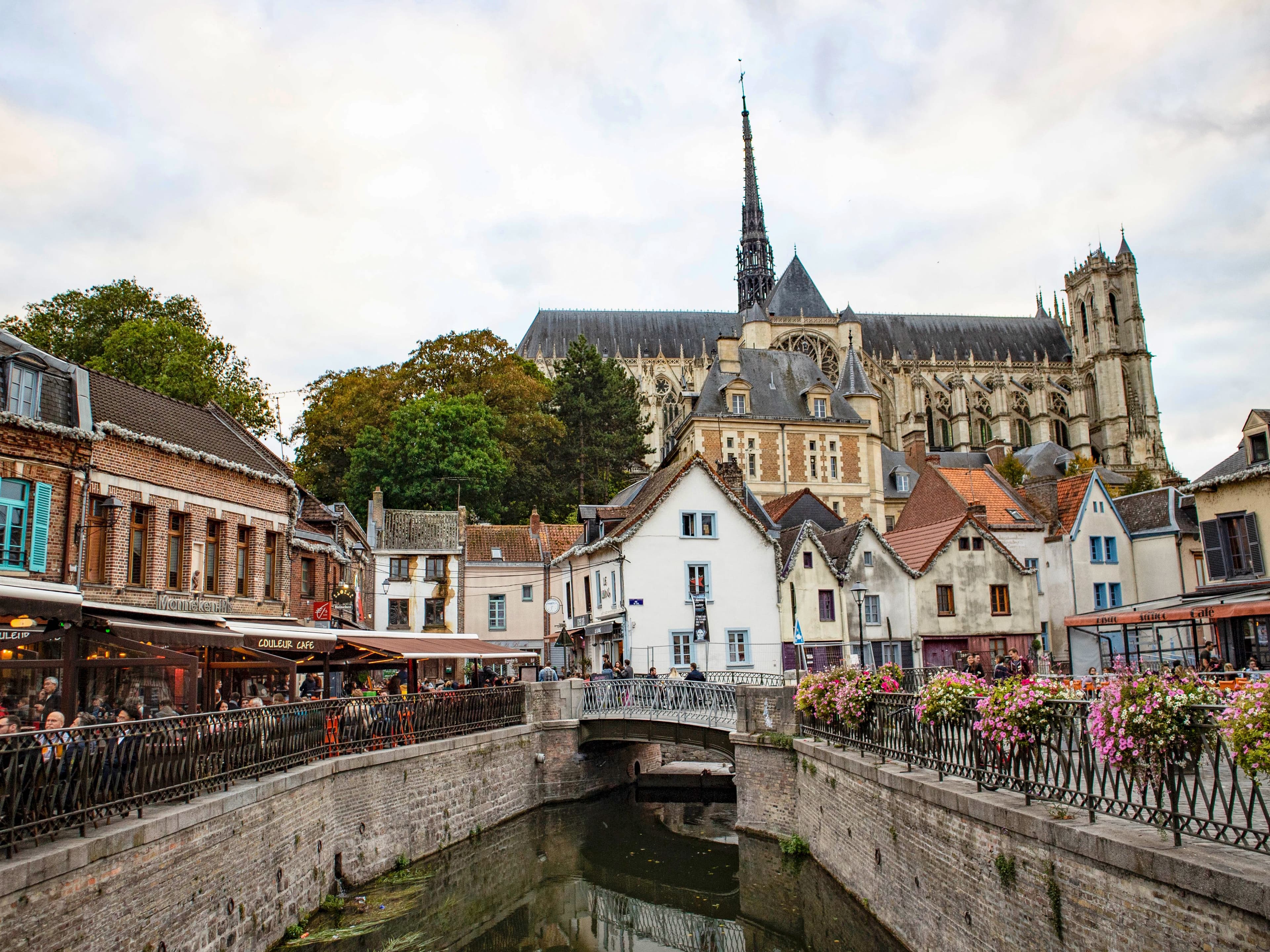
The Race
| Next Race Date | Saturday 2 October 2027 (provisional; the organiser has not yet published the 2027 date) |
|---|---|
| Course Type | Loop: an out-and-back along the Somme from Parc du Grand Marais to a turnaround at La Breilloire, near Flixecourt, and back |
| Registration | Online only, no on-site entry. No ballot and no qualifying time. Capped at 600 |
| Ballot Opens | Not applicable: open registration |
| Total Finishers | Not published for the marathon alone. 919 finished across all four races in 2024 |
| Average Race Day Temperature | About 8°C to 16°C (October normals) |
| Cutoff Time | 6 hours, with a 3-hour limit at km 22, La Breilloire, which you must reach before 17:30 |
| Free Race Day Transport | Yes. Buses in Amiens are free on Saturdays, the race day. There is no dedicated race shuttle |
| Course Certification | FFA Bronze Label, qualifying for the French Championships. No World Athletics or AIMS label |
An afternoon marathon, not a morning one
The Marathon du Val de Somme starts at 14:30 on a Saturday. No pre-dawn alarm, no cold start village, but a different set of problems: a long morning to fill, a lunch to time, and a start near the warmest part of an October day. A light lunch about three hours before the gun, then familiar snacks in the last hour or so, works better than treating it as a morning race pushed back. The cutoff is six hours, so the slowest finishers arrive around 20:30. Sunset in early October is around 19:30, so the last hour of a slow race runs in fading light and falling temperatures.
History
The marathon is the young part of an old weekend. The 100 km de la Somme, the event’s original race, was created in 1979 by the departmental athletics committee to grow road running in Picardy. After about a decade, organisation passed to the Amicale du Val de Somme, which still runs the weekend with some 200 volunteers, mostly from local clubs. The marathon came much later: local reporting in December 2011 described plans for one the following October, and the modern Val de Somme marathon dates from 2012. The 1979 date belongs to the 100 km, not the marathon.
By 2013 the race was in French athletics federation records as the Marathon du Val de Somme, and that year Antoine Dubreucq set the men’s course record of 2:21:57. Anaïs Quemener set the women’s record, 2:50:18, in 2018. Some listings still call it the Marathon d’Amiens Métropole; the organiser uses Marathon du Val de Somme.
The route has changed more than once. In 2024 it ran between Amiens and Flixecourt-La Breilloire; in 2025, with works around the event site, it went via Camon and Picquigny instead; for 2026 it returns to the La Breilloire out-and-back. Read any old race report against its year. Julien Nison won in 2025 in 2:32:53 and Virginie Cochereau led the women in 3:16:02: a competitive regional field, capped at 600 for 2026, running alongside a 100 km, a half marathon and a four-person relay. In 2024 the whole weekend drew a record 1,500 entries; 919 finished across the four races.
The course
A flat, single out-and-back. The race starts and finishes at Parc du Grand Marais, on rue du Grand Marais in north-western Amiens, and follows the Somme west on its towpath and the Véloroute Vallée de Somme cycle route, through Dreuil-lès-Amiens, Ailly-sur-Somme, La Chaussée-Tirancourt, Picquigny, Belloy-sur-Somme, Yzeux and Bourdon, to a turnaround at the hamlet of La Breilloire near Flixecourt at km 22. It then comes back the same way. The organiser’s own route shows 42.23 km with 75 m of ascent and 76 m of descent.
The surface is a mix of paved road and hard-packed stabilised path, and the mix can change between editions. This is not a tour of central Amiens: the course is the river corridor itself, long and open, with water, trees and small riverside villages rather than squares and monuments. The towpath has little shelter, so wind is the main variable. The Grand Marais hub holds the start, finish, bib collection and bag drop, with changing rooms at the neighbouring Stade des Spartiates.
Km 0 to 5: leaving Amiens. The race leaves Parc du Grand Marais for the towpath, the Chemin de Halage, and heads west past Dreuil-lès-Amiens. The much larger 100 km field has been on the same corridor since the morning. With 600 marathon entries and a straight route, there is no reason to fight for position; settle into your pace.
Km 5 to 22: out along the Somme. The course runs through Ailly-sur-Somme and Picquigny, the two villages the organiser names as aid points on the shared corridor, then on through Belloy-sur-Somme, Yzeux and Bourdon on the Véloroute. Aid stations come roughly every 5 km, shared with the 100 km runners. You must reach the km 22 control at La Breilloire before 17:30, three hours after the start. An even six-hour pace leaves little margin there, so runners near the back of the field should run a slightly stronger first half.
Km 22: the turn at La Breilloire. The turnaround sits at the hamlet of La Breilloire near Flixecourt. From here the rest of the course is known, and the field starts passing runners still heading out.
Km 22 to 42.195: back to Grand Marais. The return retraces the same corridor, and its long straight stretches with few landmarks can feel more exposed than the way out, especially if the wind has picked up through the afternoon. Count down the aid stations rather than the villages. The finish is back at Grand Marais, beside the bag drop, changing rooms and food trucks. Awards are at 19:00, while some marathon runners are still on course. No blue line, intermediate timing mats or kilometre-by-kilometre elevation table have been published.
Course Map
The out-and-back from Parc du Grand Marais along the Somme to La Breilloire, with the two named aid villages and Amiens station. Tap a marker for details, and scrub the slider or press play to move the orange marker along the course with the elevation profile beneath it.
Pacers
None announced. The 2026 race sheet lists no pace groups, and with 600 places and a small field on the return leg, plan to run your own pace.
What to wear
October in Amiens is cool: 1991–2020 normals give an average daily maximum of 15.6°C, a mean of 11.8°C and a minimum of 8.0°C, with 57.7 mm of rain in the month. The 14:30 start changes the usual advice. You set off close to the day’s high, not in a cold dawn, so a thin throwaway layer is enough for the wait. No clothing collection is documented, so hand it to a supporter.
Wind matters more than temperature on an open towpath, and a still morning can turn into a breezy afternoon. Arm warmers earn their place on a cool, breezy day; a vest and shorts are enough on a calm, sunny one. Runners heading for five or six hours should carry a light layer for the last hour, which runs past sunset and into the evening chill.
Entry
Entry is online only, with no on-site registration and no ballot. The race is capped at 600 and closes at 23:00 on 27 September 2026, or earlier if the cap is reached. From 1 September the fee is €55 for FFA-licensed runners and €59 for others, up from €45 and €49 in the early tier: about £47 and £51 at September 2026 exchange rates. Every entrant gets a gift and every finisher a medal; a race T-shirt is an optional extra.
FFA licence holders enter with their licence. Everyone else needs a PPS, the French health-prevention course for unlicensed runners, valid for the race date; the rules on this have changed in recent years, so follow the organiser’s current instructions. An optional cancellation insurance gives a full refund, less options and fees, for withdrawals up to 18 September 2026, and 50% up to 2 October.
There is no charity-entry programme, tour-operator allocation or transfer policy published, so confirm terms with the organiser before booking non-refundable travel.
Fast Runner / GFA Standards
Not applicable. Entry is first come, first served, until the cap or the deadline.
Race Weekend
Bib collection
There is no expo, only bib collection across several sessions. For 2026 the organiser lists a partner location in Amiens on the Wednesday and Thursday, venue still to be announced, then Parc du Grand Marais on Friday 2 October from 15:00 to 20:00 and on race day from 12:30 to 14:15. An Amiens Métropole listing gives Saturday as 13:00 to 14:20; the organiser’s own sheet is the one to follow until the final runner guide.
Collect on the Friday if you can, which keeps the last half hour before the start free. The registration platform, Klikego, says someone else can collect your bib with proof of identity. Bag drop opens at 13:30 at Grand Marais. Showers and changing rooms are at the neighbouring Stade des Spartiates, but the organiser warns they are unguarded, so valuables go in the bag drop.
Getting to the Start
The start and finish are at Parc du Grand Marais, rue du Grand Marais, 80000 Amiens, about 4 km north-west of the station and the cathedral. The organiser encourages car-sharing and public transport, and says buses in Amiens are free on Saturdays, which is race day. No race-specific bus lines are published, so plan the Ametis route from your hotel in advance, or take a taxi. There is parking around Grand Marais, but capacity and closure times are not published.
With a 14:30 start there is no dawn rush. Aim to arrive 60 to 75 minutes before the gun: bag drop from 13:30, toilets, a short warm-up. The organiser says toilets are placed regularly along the course. Supporters who do not want to travel along the route can stay at Grand Marais all afternoon; it is the finish too, and food trucks make the wait easier.
Nutrition on Course
Aid stations come roughly every 5 km, shared with the 100 km field on the same corridor, and serve cold drinks, sweet and savoury snacks, and dried and fresh fruit. Ailly-sur-Somme and Picquigny are the two named on the shared route; a full kilometre-by-kilometre list has not been published.
No gel or sports-drink brand, cup type or personal-bottle service is documented. With stations serving three or four races at once, carry your own gels if you depend on a particular carbohydrate plan, especially for the exposed return.
Spectating
Most of this marathon is on a rural towpath, so the usual city-centre spectator plan does not work. The easiest is to watch the start at Grand Marais, stay on site or pop back into Amiens, and return for the finish. The out-and-back helps: one accessible spot on the course sees a runner twice, going out and coming back. No spectator shuttle or closure map has been published, and the free Saturday buses do not reach the course villages.
Start and finish. Watch the 14:30 start at Grand Marais, spend the afternoon on site or in central Amiens, and come back for the finish. The lowest-stress option, and the right one with children.
A village on the course. With a car or taxi, head to Ailly-sur-Somme or Picquigny, both on the course and both aid points, to see your runner going out and, depending on pace, coming back. Check road access on the day before committing to a parking spot, then return to Grand Marais for the finish.
Post-Race Food
Finishers arrive between late afternoon and about 20:30 on a Saturday, so plan for dinner rather than lunch. The food trucks at Grand Marais are the immediate option. For a sit-down meal, head back into central Amiens after the showers: the cathedral quarter and the canal-side Saint-Leu hold the widest choice. If you expect to finish near the cutoff, book a table with confirmed late seating, because a French kitchen may stop taking orders by 21:00.
Where to Stay
Stay near the finish, which here is also the start: Parc du Grand Marais. The catch is that Grand Marais is about 4 km from the centre and has almost no hotels around it, so for most runners staying near the finish means staying in central Amiens and taking a bus or taxi out on race afternoon.
The station district
The station district is the best all-round base for most visitors: direct trains from Paris Nord, the widest hotel choice, and a short walk to the cathedral and restaurants. Grand Marais is about 4.5 km away, but on a Saturday the buses are free.
The cathedral and Saint-Leu
The cathedral and Saint-Leu, the canal-side old quarter below it, suit a race-plus-weekend trip best, with the cathedral, the canals and most restaurants on foot. At about 3.7 to 4 km, it is also the part of the centre closest to Grand Marais, and a good place to be for a late Saturday dinner after the race.
Near Grand Marais
Staying beside Grand Marais would cut race-day travel to nothing, but there are very few hotels nearby and far less to do in the evening. This guide does not name one.
The afternoon start means you do not need a hotel that serves breakfast at 05:30. Prioritise the transport to Grand Marais, a flexible late breakfast and early lunch, restaurants open late on Saturday, and the station if you are leaving on Sunday. Amiens has no documented marathon-weekend price premium.
Recommended hotels
Beside the cathedral, the closest of these to Grand Marais and the best base for the sightseeing side of the weekend. Saint-Leu’s canal-side restaurants are a short walk for a Saturday-evening finish.
A higher-end independent hotel between the cathedral and the station, convenient for the Maison de Jules Verne and the cathedral on either side of the race.
Close to the station, a straightforward choice for runners arriving by train from Paris Nord.
An international-brand option by the station, useful for rail travellers from Paris or Lille.
The budget option near the station, where getting to and from the race matters more than the room.
Booking timeline
There is no ballot to wait for. The field fills or it does not, against a 600-runner cap and a late-September deadline, so the entry is the tighter constraint here, not the hotel. Enter first, then book a cancellable central room and your train. A month or two out, recheck the PPS requirement, the bib-collection venues and the Saturday transport plan. In race week, confirm the collection hours, the weather and your Saturday-evening dinner booking.
See & Do
All of these are in central Amiens, around the hotels, and about 3.5 to 5 km (2 to 3 miles) from the Grand Marais finish.
Cathédrale Notre-Dame d’Amiens
About 4 km (2.5 miles) from the finish. Amiens’ UNESCO-listed Gothic cathedral, the city’s defining monument. From September to December the tourist office runs 90-minute guided visits on Friday at 16:00, Saturday at 11:00 and Sunday at 15:00; the Friday slot suits an early arrival, and Sunday afternoon suits a recovery day if you can stand for an hour and a half.
The Hortillonnages by boat
About 4.3 km (2.7 miles) from the finish; the pier is at 54 boulevard Beauvillé, near the station. A 45-minute ride in a traditional flat boat through Amiens’ floating market gardens, sitting down the whole way, which makes it a very good post-marathon outing. October departures run daily, 10:15 to 11:45 and 13:30 to 16:30; book by 18:00 the day before.
International Garden Festival
In the same Hortillonnages, about 4.5 km (2.8 miles) from the finish. The 2026 festival runs until 11 October, so race weekend falls inside it. In September and October the Amiens walking route is open Wednesday to Sunday, 12:30 to 19:00, and the Camon boat route at weekends, 10:00 to 19:00. Sunday 4 October is the obvious slot for anyone staying on.
Maison de Jules Verne
At 2 rue Charles Dubois, about 4.5 km (2.8 miles) from the finish. The house where Jules Verne lived for many years, now a museum. It is indoors and compact, a realistic recovery-day visit. Check the opening days for race weekend.
Saint-Leu
About 3.7 km (2.3 miles) from the finish, below the cathedral. The canal-side old quarter is the easiest way to combine a slow walk with food after the race, taken in short stretches rather than as a set route.
Read Before you Run
Around the World in Eighty Days
Jules Verne
Jules Verne lived in Amiens for much of his life and is buried there; his house is now a museum a short walk from the cathedral. A travel novel is a fitting read for a race weekend, and editions and translations vary, so pick whichever you like.
After the Race
A Saturday race leaves the whole Sunday for recovery. Early October is late enough for the summer crowds to have gone and early enough for the garden festival and the coast’s season to still be open. Amiens’ rail links do the rest: Albert and the Somme battlefields in about 20 minutes, the Baie de Somme in about half an hour, Paris and Lille in about an hour.
The First World War memorials around Albert, Thiepval and Beaumont-Hamel. The train reaches Albert; the wider memorial network needs a car, a taxi or a guided circuit from Amiens.
For runners who want no travel day: the Hortillonnages by boat, the International Garden Festival (open to 11 October 2026) and the cathedral, all kind to tired legs.
The Somme estuary, its coastal villages and birdlife, reached by train and a connecting heritage railway or bus rather than a car. October is inside the coast’s season.
Flemish architecture, the Méert waffle house and Vieux Lille’s estaminets, with an easy onward train to Brussels for anyone continuing into Belgium.
An easy extension rather than a separate trip, especially for runners flying home from a Paris airport.
Frequently asked questions
Should I stay near the start or the finish?
They are the same place, Parc du Grand Marais, but it is about 4 km from the centre with almost no hotels beside it. Stay centrally and take a bus or taxi out.
How far in advance should I book a hotel?
Once your dates are firm. There is no ballot, but the race is capped at 600 and can close early, so secure the entry first.
Is there free transport to the start on race day?
Buses in Amiens are free on Saturdays, the organiser says, and this is a Saturday race. No line numbers are published, so plan the route from your hotel.
What is the best area to stay?
Central Amiens: the station district for rail arrivals, or the cathedral and Saint-Leu for restaurants. Both are about 4 km from Grand Marais.
When does the expo open?
Bib collection only: Friday 15:00 to 20:00 and Saturday 12:30 to 14:15 at Grand Marais, plus a Wednesday and Thursday partner venue still to be named.
What is the weather typically like on race day?
Cool: October normals run from about 8°C to 16°C. The 14:30 start puts you out in the warmest part of the day; wind on the towpath matters more.
How do I get from the airport?
Fly into Paris and take the train from Paris Nord, as little as 1 hour 5 minutes. Amiens has no major airport of its own.
Is there a bag drop?
Yes, from 13:30 at Grand Marais. Changing rooms and showers at the Stade des Spartiates are unguarded, so leave valuables in the bag drop.
Should I bring a throwaway layer?
A light one for the wait. Slower runners should carry something for the last hour, which runs into the evening as the temperature drops.
How do I get back to my hotel after finishing?
The same bus or taxi that took you out; buses are free on Saturdays. Book a taxi ahead if you expect a late finish.