The Race
The marathon starts across the harbour in Devonport at 06:00. There is no way to walk there in time from the finish side of the city, so the practical options are the organiser's chartered ferries, buses and early trains, which begin at 04:00. Transport costs extra, is bought through My Registration and is printed on the bib. Buy it when you enter.
| Next Race Date | Sunday 1 November 2026 |
|---|---|
| Course type | Point-to-point: Devonport to Victoria Park |
| Registration | Open entry, price rises as each allocation sells |
| Ballot opens | No ballot |
| Start | King Edward Parade, Devonport, 06:00 |
| Finish | Victoria Park, Fanshawe Street |
| Total finishers | ~2,800 (2025) |
| Avg race-day temp | 12 to 17°C (November) |
| Cutoff time | 7 hours |
| Free race-day transport | No: ferries, buses and trains to the start are bought separately |
| Course certification | AIMS |
History
Auckland ran a marathon as early as June 1936, on a waterfront course, but the modern race exists because of a bridge. In the early 1990s Rendell McIntosh and race director Paul Ryken set out to win permission to run across the Auckland Harbour Bridge, which is closed to pedestrians. On 25 October 1992 the first Citibank Auckland International Marathon became the first sports event to cross it. The field was capped at 4,000 as a condition of approval, and 2,542 finished. Mark Hutchison won the men's race in 2:16:32 and Anne Roden the women's in 2:39:53.
The bridge was not guaranteed. Rights to the race passed to the Auckland YMCA, and in 1994 the marathon moved to two laps of Tamaki Drive with a half marathon added. The bridge crossing returned in 2000 and has been the signature ever since.
The fastest times in the event's history, Phil Costley's 2:14:03 in 1997 and Gabrielle O'Rourke's 2:38:47 in 1999, came on earlier layouts. On the current certified course the organiser's records are Dale Warrander's 2:17:43 from 2006 and Brigid Dennehy's 2:38:10 from 2025.
IRONMAN New Zealand now runs the event under Barfoot & Thompson's title sponsorship. More than 250,000 people had taken part by its 30th anniversary, and about 17,000 took part across all distances in 2025, the biggest field since 2014. The course is AIMS certified. It is not a World Athletics Label race.
The course
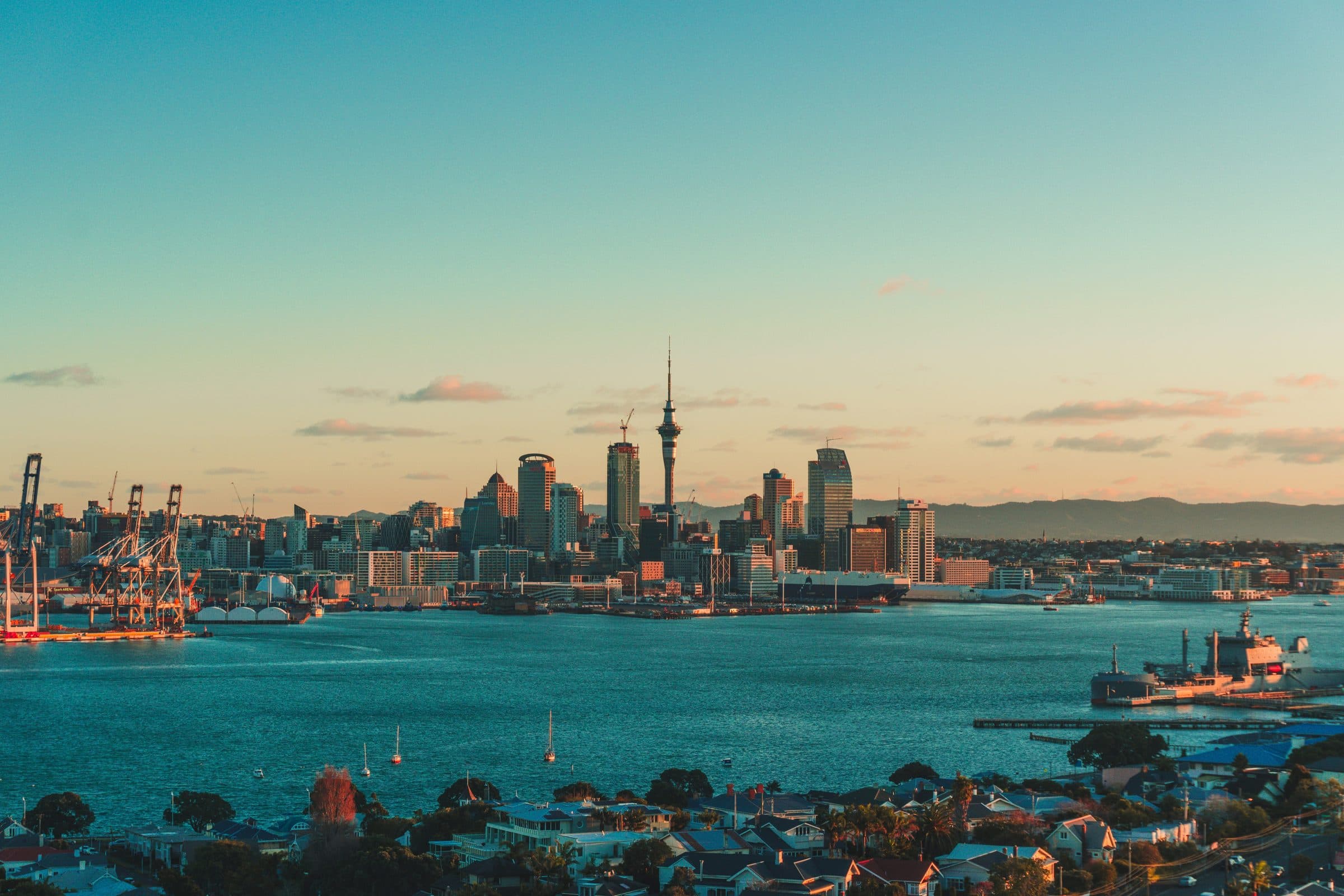
The Auckland Marathon is point-to-point. It starts on King Edward Parade in Devonport, on the North Shore, and finishes at Victoria Park on Fanshawe Street in the city centre, 4.4 km away across the water.
The first half runs north out of Devonport by Vauxhall Road and Narrow Neck, then through Belmont and Hauraki to Takapuna, and turns at Smales Farm at 9.9 km. The return south uses the Northern Busway, a bus road closed for the race, to the Onewa Road on-ramp at about 14 km. The course then climbs onto the Auckland Harbour Bridge and crosses it between about 15 and 17 km. On the city side it loops through St Marys Bay on Sarsfield and Curran Streets, runs along Westhaven Drive and Beaumont Street, and passes within 450 m of the finish at about 21 km.
The second half is the waterfront. Quay Street leads onto Tamaki Drive, which the course follows east through Parnell, Orakei, Mission Bay and Kohimarama to a turnaround at St Heliers at 31.3 km, then back the same way to Quay Street at 40 km, Lower Hobson Street and Victoria Park. The organiser describes the terrain as rolling in the first half and flat and fast in the second, with two small bridge rises on Tamaki Drive. The main land climb of the first half is about 25 m in 1.2 km through Narrow Neck, between about 2.3 and 3.5 km, followed by a long easing descent towards Takapuna.
Kilometre by kilometre
Km 0 to 5: Devonport to Belmont. The start on King Edward Parade faces the harbour, with the city skyline across the water in the dark. The road leaves the shore by Vauxhall Road and turns inland through Narrow Neck. It is rolling from the gun, and the temptation after a long wait for the ferry is to go too fast. Don't.
Km 5 to 14: Takapuna and the Busway. The course heads north through Hauraki and Takapuna to the turnaround at Smales Farm at 9.9 km, the first official cutoff point, then comes south on the Northern Busway. It is wide, exposed and quiet, and crowds are thin. Hold goal pace or slightly slower and save the legs for the bridge.
Km 14 to 17: The Harbour Bridge. From the Onewa Road on-ramp at about 14 km the course climbs onto the bridge, roughly 33 m above the approach, with the top at about 16 km. Runners who write about Auckland say the same thing: it is steeper than it looks. Run it by effort, accept losing 20 or 30 seconds, and look left towards Rangitoto. The descent into St Marys Bay is fast, so keep the stride short to spare the quads.
Km 17 to 22: St Marys Bay, Westhaven and the Viaduct. The course loops through St Marys Bay, runs along Westhaven Drive and Beaumont Street and reaches the city centre, where the crowds thicken. At about 21 km it passes within 450 m of the finish at Victoria Park, which is not a pleasant thing to know with 21 km left.
Km 22 to 31: Tamaki Drive east. Quay Street leads onto Tamaki Drive, the harbour-edge road to the eastern bays. It is flat and open, and a headwind is common. Groups help. Orakei, Mission Bay and Kohimarama bring crowds, and the turnaround at St Heliers comes at 31.3 km, next to the 31 km cutoff.
Km 31 to 42.2: back along the waterfront. The long return to the city is the defining stretch. It is flat, the harbour is on the left and the finish is visible long before it arrives. Intermediate cutoffs fall at 34 km (Mission Bay), 37 km (Ngapipi Road) and 40 km (Quay Street), and two small bridge rises on Tamaki Drive feel larger than they are. The last kilometres run up Lower Hobson Street to Victoria Park.
No blue line is advertised. Stay alert on the Tamaki Drive out-and-back, where faster runners come the other way, and follow the marshals at the turnaround.
Rolling roads from Devonport to Takapuna and back down the Northern Busway. Run conservatively: the bridge is still to come.
The biggest climb of the race and the reason it exists. Run it by effort and keep the stride short on the way down to St Marys Bay.
Flat through the city and east along the bays to St Heliers, often into the wind. Find a group.
Back along Tamaki Drive with the city ahead. Cutoffs at 34, 37 and 40 km for the back of the field.
Course Map
A point-to-point course: north from Devonport to Smales Farm, south down the Busway and over the Harbour Bridge, through the city and east along Tamaki Drive to St Heliers, then back to Victoria Park. Tap a marker for the turnarounds, the bridge, check-in and the ferry terminals, and scrub the slider or press play to move the orange marker along the course.
No elevation chart is drawn for this course. Satellite terrain data reads the water under the Harbour Bridge and along the Tamaki Drive shoreline, so the bridge, the one big climb of the race, would show as a valley and the waterfront as false dips. The line is the 2025 route.
Pacers
Pace team leaders carry helium balloons and wear their target time on their shirts, for targets between 3:00 and 5:00. Not every time in that range is covered, and start groups are seeded by predicted finish time, so check that your group has the pacer you want. The individual times were not listed on the 2026 event-day page.
Early November is late spring in Auckland, and the weather changes. The 06:00 start is usually in the low teens, the day rarely climbs past the high teens by the time most runners finish, and the waterfront can be windy and showery in the same hour.
The wait is the cold part. Runners reach Devonport by ferry, bus or train from about 04:00 and stand by the harbour before sunrise, so a disposable layer or a plastic poncho helps. Gear bags are not stored under cover, so pack a dry bag or liner inside yours if rain is forecast.
On the course, a singlet or T-shirt and shorts suit most people. Arm warmers are useful on the North Shore and the bridge, where the wind can be strong, and are easy to remove on Tamaki Drive. New Zealand's UV is strong even on cloudy spring days, so runners out beyond four hours should wear sunscreen and a cap.
Entry
Entry is open and there is no ballot. The full marathon cost NZ$271, about £116, in the allocation on sale five weeks before the race, and the price rises as each allocation sells. Online entries close at 14:00 on Saturday 31 October 2026, with late entries at Athlete Check-in if the race has not sold out.
Entry includes a timed bib, an official gear bag and tag, aid stations, the finish recovery area, a finisher's medal and a hat or visor while stocks last. Race-morning transport to Devonport is extra and closes for online sales a few days before the race.
The withdrawal rules are strict. Partial refunds were available only until 20 September 2026, about six weeks before the race. A place can be transferred to another person through the official scheme: the new runner pays the current price and the original runner is refunded less NZ$27. There is no deferral and no switch to another distance. Charity fundraising runs through the event, and no separate charity entry allocation is advertised.
Fast runner standards
There is no good-for-age route. Elite applications close in September, with published standards of 2:30 for men and 2:55 for women. Accepted elites get free entry, free transport and a priority start.
Auckland Marathon entry information →Race Weekend
Athlete Check-in
Athlete Check-in and the expo are at The Cloud, 89 Quay Street on Queens Wharf, on the Friday (08:00 to 19:00) and the Saturday (08:00 to 17:00) before the race. Collect the official gear bag and tag here: they are the only bags accepted at the start. Runners who bought race transport should confirm it is printed on the bib.
The Cloud is beside the Downtown Ferry Terminal, where many of the race-morning ferries leave, so check-in doubles as a rehearsal: walk to the ferry pier on Saturday and it will be familiar at 04:30 the next morning.
Someone else can check in for you with your photo ID and proof of entry. Late entries are sold at check-in if the race has not sold out, and transport tickets can be bought there once online sales have closed.
Getting to the start
The marathon starts at 06:00 on King Edward Parade, Devonport, with the wheelchair start at 05:55. Devonport is on a peninsula across the harbour from the city, so race-morning transport is the most important thing to plan.
Getting there. Chartered ferries to Devonport begin at 04:00 from five terminals: Downtown, Birkenhead, Bayswater, Hobsonville and Half Moon Bay. Chartered buses begin at 04:40 from Albany, Constellation and Takapuna, and early trains run into Waitematā (Britomart) station between about 05:00 and 05:30. For most visitors staying in the city centre the Downtown ferry is simplest: walk to the terminal, ride about 12 minutes across the harbour, and walk under 0.5 km to the start.
Cost. Transport is bought through My Registration and printed on the bib. Elite runners travel free. The organiser warned that some 2026 timings were carried over from 2025 and would be confirmed nearer the day.
Bag drop. Hand in the official gear bag at the start with its tag attached. Bags travel to Victoria Park and are not kept under cover, so use a waterproof liner if rain is forecast, and collect it by 13:00.
Start groups and headphones. Start groups are seeded by predicted finish time. Headphones are discouraged, and if worn, active noise cancelling must be off so marshals can be heard.
The finish. Runners enter the Event Hub at Victoria Park, with food vendors, a recovery area and space for supporters. Wynyard Quarter and the Viaduct hotels are a short walk from Victoria Park, and the city centre is 10 to 15 minutes on foot.
Nutrition on course
Thirteen aid stations serve the marathon, roughly every 3 km. Every station has water, PURE Electrolyte Hydration, toilets and first aid. Eight also serve flat cola, and Red Bull is on offer at 18 km, just after the bridge.
Gels were not listed on the 2026 event-day page, so carry your own and take them at the stations. Many runners find flat cola easier to take than another gel in the last 15 km. Only elite runners can submit personal drinks, by 17:00 on the Saturday.
Spectating
Skip Devonport. The start is at 06:00 across the harbour, and a supporter who goes there will struggle to see a runner again until the finish. The city side gives three or four sightings within walking distance, plus buses along Tamaki Drive.
The best two-for-one is Quay Street and the Viaduct, which runners pass at about 22 km heading east and again at about 40 km heading home. Victoria Park, the finish, is a few minutes' walk away. Road closures change the normal bus routes, so check the organiser's spectator map and Auckland Transport's race-day notices. The event app offers live tracking.
- Waitematā (Britomart) station or a hotel in the centre; walk to Quay Street for about km 22
- Stay on the waterfront or walk to the Viaduct
- Return to Quay Street for km 40, then walk to Victoria Park for the finish
- Quay Street for km 22
- Bus or walk east along Tamaki Drive to Mission Bay for about km 28 and km 34
- Bus back to the city for the finish at Victoria Park
- Westhaven Drive or Wynyard Quarter for about km 19, as runners come off the bridge and round St Marys Bay
- Walk to the city centre for km 21
- Walk to Victoria Park for the finish
Post-race food
Victoria Park sits beside Wynyard Quarter and the Viaduct Harbour, the two densest restaurant areas on the waterfront, both within ten minutes' walk of the finish. The Event Hub at the finish also has food vendors, which is enough for most runners before a shower.
For a proper meal, the waterfront restaurants and the Viaduct's bars open for Sunday brunch and lunch, and Commercial Bay, the food hall and shopping centre above the Downtown Ferry Terminal, has a wide range of counters under one roof. A 06:00 start means most runners finish before noon. Book lunch for a group: on marathon Sunday the waterfront fills with runners and supporters at once.
Where to Stay
Stay near the finish, not the start. The marathon starts in Devonport but finishes at Victoria Park in the city, and the organiser runs ferries, buses and trains to the start. A city base near Victoria Park and the ferry terminals gives one short trip at dawn and a walk to the hotel afterwards.
Britomart and Quay Street
Britomart, around Waitematā station and Quay Street, is next to both The Cloud (check-in) and the Downtown Ferry Terminal. Most hotels are a 5 minute walk from the ferry and about 1 km from the finish. Prices are high on race weekend. It is the best all-round base.
Wynyard Quarter and the Viaduct
Wynyard Quarter and the Viaduct Harbour are the closest areas to Victoria Park, 0.4 to 0.6 km from the finish, with restaurants on the water. The Downtown ferry is about 15 minutes away on foot. Saturday nights around the Viaduct bars can be loud.
Auckland CBD
The city grid up from Queen Street offers the widest range of rooms and prices, within 10 to 20 minutes of the ferry and the finish, and direct access to Waitematā station for the early trains.
Ponsonby
Ponsonby, west of the centre on the ridge, has Auckland's best restaurant strip and smaller hotels. It is a 20 to 30 minute walk or a short ride to the ferry, and uphill from the finish, so it works better after the race than before it.
Devonport
Devonport, at the start, has cottages and bed and breakfasts in a quiet Victorian village and gives the easiest race morning. Check-in is across the harbour, and after the finish you need a ferry back. Choose it only if the start matters more than the return.
Booking advice is in the timeline below.
Recommended hotels
On the waterfront between the Downtown Ferry Terminal and Wynyard Quarter, so the race-morning ferry and the finish are both walkable. Rooms facing the harbour look across to Devonport.
A design hotel at the Viaduct, a short walk from Victoria Park. The bars nearby are lively on Saturday night.
The closest mid-range option to Victoria Park, so the walk back after 42 km is minutes. The ferry is about 15 minutes away.
Central, with Waitematā station and the ferry within reach for the pre-dawn start.
Booking timeline
There is no ballot, so book when you enter. The event draws about 17,000 people across all distances, and the hotels near Britomart, the Viaduct and Wynyard Quarter are the ones everyone wants. Entry prices rise through the allocations as well, so early entry saves on both.
Race transport is a separate purchase with its own deadline a few days before the race, so buy it when you enter to avoid a pre-dawn scramble. The ferry is the recommended option for visitors staying in the city. International runners should arrive by Friday: check-in closes at 17:00 on Saturday, and New Zealand is a long flight from almost everywhere. Auckland Airport is about 20 km south of the city.
See & Do
These four sit around the finish and the ferry terminals, within about a kilometre of Victoria Park apart from the two boat trips.
Wynyard Quarter and the Viaduct
The regenerated waterfront beside Victoria Park, with a flat promenade, a lifting bridge and restaurants on the water. It is the easiest walk in the city on race afternoon.
Auckland Art Gallery Toi o Tāmaki
New Zealand's largest art collection, on the edge of Albert Park, with extensive Māori and Pacific works. Indoors, level and seated, for a wet spring day.
Devonport by ferry
Go back to the start without the nerves. The ferry crosses to the Victorian village, where the flat seafront along King Edward Parade leads to cafés. The volcanic cones of Mount Victoria and North Head are for a later day.
Rangitoto Island
The youngest of Auckland's volcanoes, about 600 years old, visible from the Harbour Bridge on race day. The summit track is a steady climb over lava fields, so save it for the second or third day.
After the Race
November is late spring in the North Island: longer days, lambs on the farms and changeable weather on the coast. The trips below start gently, with the longer drives kept for the days when the legs have recovered.
A ferry across the Hauraki Gulf to vineyards, beaches and Oneroa's village, with a hop-on bus so the legs do not have to.
A boat drifting through a limestone grotto lit by thousands of glowworms, the rare cave visit that suits legs that cannot manage steps.
Geysers, mud pools and Māori culture at Whakarewarewa, with the lakefront hot pools of the Polynesian Spa for sore legs.
The Waitangi Treaty Grounds, the ferry to old Russell and a subtropical bay dotted with islands, three hours north of the city.