The Race
| Next Race Date | Saturday 31 July 2027 |
|---|---|
| Course type | Loop: trail and dirt-road loops around Yulara |
| Registration | Travel package only |
| Ballot opens | Not applicable |
| Start | Near Yulara, 07:45 |
| Finish | Near the start, on the edge of Yulara |
| Total finishers | To be Confirmed |
| Avg race-day temp | 5 to 21°C (July) |
| Cutoff time | 8 hours |
| Free race-day transport | Yes: coach transfers from the hotels are included in every package |
| Course certification | None |
History
The Australian Outback Marathon is run by Travelling Fit, a running-travel company, as a destination race, not a city one: a small international field flies into the desert, stays at Ayers Rock Resort in Yulara and runs on red earth with Uluṟu on the horizon. Results are archived back to at least 2014.
The model has not changed. There is no entry-only option for visitors. Every runner books a package that bundles accommodation, airport and race transfers, breakfasts and a carbo-load dinner, and the race sits on the last Saturday of July, in the cold, clear middle of the Central Australian winter.
The event is small. Just over 500 people took part across all distances in 2026, and every package sold out. Paul Pratt won the 2026 marathon in 3:18:31 and Rachel Balding the women's race in 3:52:12. Times like these reflect the ground more than the field: sand, graded dirt and small dunes make this a slow course.
It is not certified by AIMS and carries no World Athletics Label, so times here cannot be used to qualify for road marathons such as Boston. Runners come for the setting, the scale of the desert and a race run on the traditional lands of the Anangu, whose country includes Uluṟu and Kata Tjuṯa.
The course
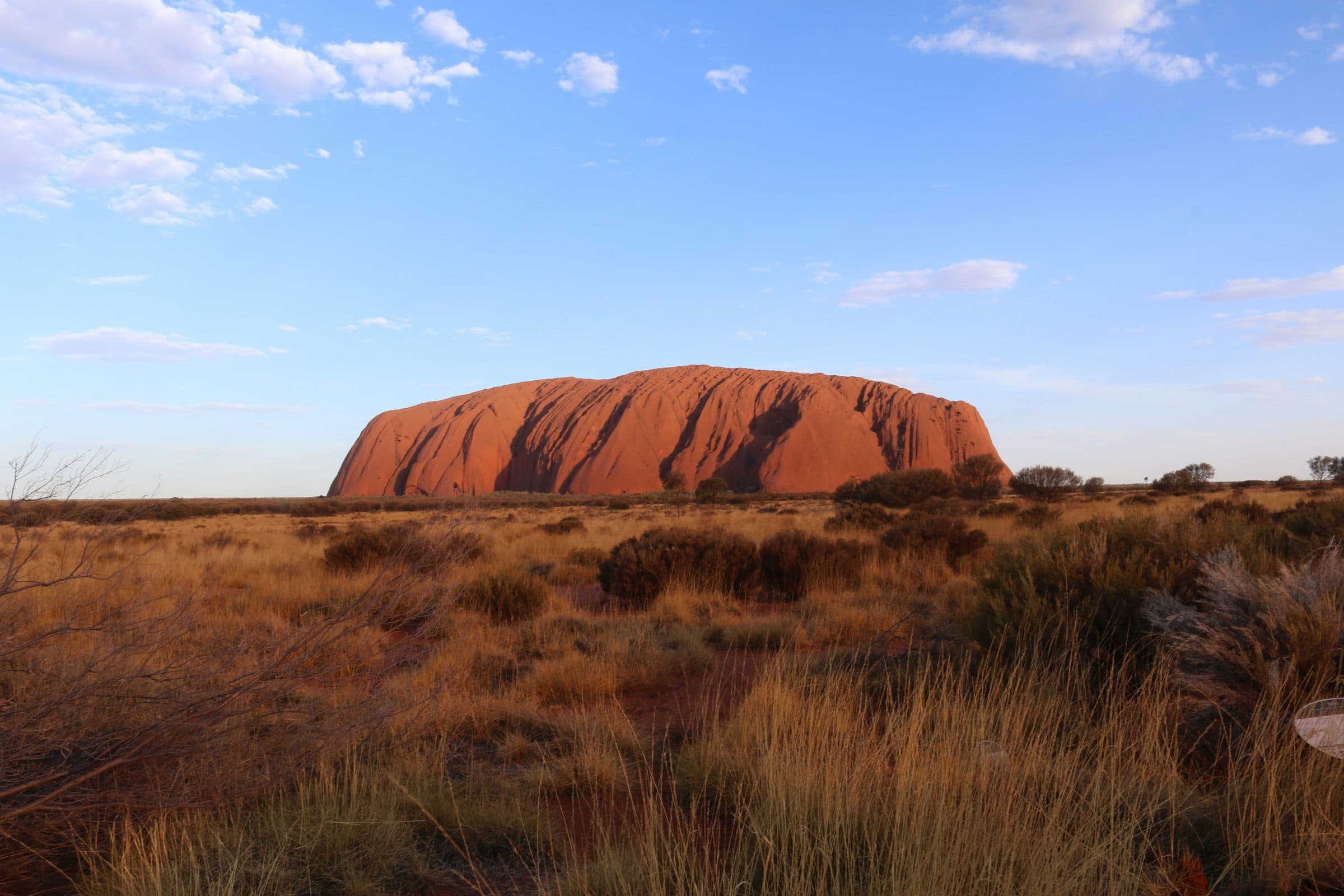
The Australian Outback Marathon is run on tracks around Yulara, the resort township about 18 km from Uluṟu by road, and it never enters the national park. The course stays within 4 km of its start, and Uluṟu lies about 10 km to the south, visible across the dunes on the horizon but not close.
It is a series of loops on graded dirt roads, fire trails, soft sand and a short stretch of sealed road. The organiser names points that runners pass, among them Camel Corner, Lisa's Corner, Dead Tree Corner, the Power Station and the Triangle. The first loop comes back within 150 m of the start at about 7 km. The route then heads north towards the Lasseter Highway, the furthest point of the course, 3.8 km from the start at about 12 km, and east to Petermann at about 15 km. The organiser places the Longitude Loop around 12 km and the Cable Track around 17 km, with a dune viewpoint on the way, and the second half retraces much of the northern loops of the first.
The course is flat, with small dunes, but the sand changes the effort. After rain it packs hard, and in a dry year it can be soft and slow. The organiser warns that the route can change from year to year in this environmentally and culturally sensitive area.
Kilometre by kilometre
Km 0 to 7: the first loop. The race starts at 07:45 in cold, dry air, often only a few degrees above freezing an hour earlier. The first loop runs south-west and then north-west along Uluru Road and returns close to the start at about 7 km, on a mix of graded road and firm track. Treat it as a warm-up: the field spreads quickly, and there is a long way to go on unfamiliar surfaces.
Km 7 to 12: north to the Longitude Loop. The route heads north past the Power Station and the Triangle towards the Longitude Loop, which the organiser places around 12 km, and reaches the Lasseter Highway side of the course at about 12 km. This is where the sand starts to matter. Shorten the stride on soft patches, keep the cadence up and let the pace drop instead of forcing it.
Km 12 to 21: the dunes and the Cable Track. The course reaches its northern and eastern edges, with a viewpoint on a small dune and the Cable Track at around 17 km. Small dunes break the rhythm. The desert is at its most open, spectators are almost absent and the sun is up, so this is the stretch where sunscreen and water at every station earn their keep.
Km 21 to 42: the northern loops again. The second half retraces much of the northern loops in the opposite direction, which means familiar landmarks and a clear sense of how far is left. It also means the soft sections come again on tired legs. By late morning the temperature is well into the teens or low 20s under a cloudless sky, and dehydration comes on quickly in air this dry. The finish is near the start, on the edge of Yulara.
There is no blue line and no chip-mat plan to follow. Pace by effort, not by watch: a runner who holds road-marathon splits here will pay for it after halfway.
Frosty air, firm tracks and a first loop that comes back near the start. Keep it easy and warm up into the day.
North past the Power Station and the Triangle towards the Longitude Loop. Shorter strides on soft ground, and accept slower kilometres.
Dunes, the Cable Track and almost no spectators. Drink at every station and reapply sunscreen when it is offered.
Familiar landmarks in the other direction, warmer and softer. Pace by effort to the finish on the edge of Yulara.
Course Map
Loops on tracks around Yulara, starting and finishing about 300 m apart, never more than 4 km from the start. Tap a marker for the start, the finish and the Town Square, and scrub the slider or press play to move the orange marker along the course with the elevation profile beneath it.
Pacers
None announced. The organiser's pages do not mention pacers or pace groups, and on this surface most runners settle to effort in any case.
Uluṟu and Kata Tjuṯa are sacred to the Anangu, the traditional owners, who manage the national park jointly with Parks Australia. Visitors have not been allowed to climb Uluṟu since October 2019, and some sites around the rock must not be photographed. Signs in the park explain where.
The Red Centre in late July is cold at night and warm by day. The organiser gives an average daytime high of 21°C and a night-time low of 5°C, with humidity under 10 per cent, and the 07:45 start comes after a clear, cold night. Expect single figures on the start line and something close to 20°C in full sun by the time most runners finish.
Plan for both. A warm top, hat and gloves for the coach transfer and the wait, removed before the start or handed to a supporter, and a singlet or T-shirt for the race itself. Arm sleeves that push down are useful for the first hour.
Sun and dry air are the real hazards. There is almost no shade on the course, so wear a cap or visor, sunglasses and sunscreen, and use the sunscreen offered at the drink stations. In humidity this low sweat evaporates before you notice it, so drink regularly even when not thirsty. Trail shoes, or road shoes with a grippy outsole, suit the mix of dirt, gravel and sand, and the organiser recommends training on sand if possible. Gaiters stop sand getting into shoes on the soft sections. Bushflies can be persistent in warmer weather, so a fly net over a cap is worth packing for days out after the race.
Entry
The Australian Outback Marathon cannot be entered on its own. Every visiting runner books a package from Travelling Fit that includes accommodation at Ayers Rock Resort, or a no-accommodation option, airport transfers, race-morning coach transfers, daily breakfast and a carbo-load dinner on the Friday. Some packages add a Sunday dinner in the desert. Flights are extra.
There are five packages, from two nights to five: Red Earth, Silver, Gold, Diamond and Platinum. Prices depend on the package, the hotel and whether a room is shared. For 2026 the Diamond package without accommodation was A$1,850, about £983, per adult, and hotel packages with single occupancy ran well above A$4,000.
The 2026 race sold out across all distances. Packages for the next year open once the organiser publishes them, and the limit is set by the resort's rooms as much as by the field size, so book as soon as they are released. Once final payment is made a booking cannot be transferred to another person. Read the cancellation terms and consider travel insurance, because a package is a larger commitment than a normal race entry.
Residents of Yulara, Alice Springs and surrounding communities can enter without a package with proof of residency, or volunteer, and should contact the organiser. There is no good-for-age route or charity allocation.
Fast runner standards
There is no good-for-age route and no qualifying standard.
Australian Outback Marathon (Travelling Fit) →Race Weekend
Registration and briefings
There is no expo in the usual sense. Race registration, bib collection and briefings are built into the package itinerary at Ayers Rock Resort, run by Travelling Fit staff on site in the days before the race, and the itinerary sets the times.
Runners who want personal drinks on the course must hand them in on the Friday between 16:00 and 17:00, and there is no other window. The Friday carbo-load dinner, included in every package, doubles as the race's social gathering and is the place to ask about the course, the forecast and transfer times.
Getting to the start
Race morning is organised for you. Private coaches collect runners from outside each hotel at Ayers Rock Resort and take them to the start, about 2.4 km south-east of the hotels in a straight line, which is not reachable on the resort's free shuttle. The package itinerary gives the pickup time for the 07:45 start.
Cold. Clear desert nights in late July can fall to freezing or close to it, and the start area is open ground. Dress warmly for the transfer and the wait, and put anything you need afterwards in a small bag.
No driving. Do not plan to drive to the start. There is no public transport outside the resort, the free Yulara shuttle runs only between the hotels, the Town Square and the camel farm, and the organiser controls access to the course area.
The finish. The finish is near the start. After finishing, coaches return runners to their hotels. The rest of the day is free, and most packages leave the Sunday for sightseeing.
Nutrition on course
Drink stations are placed about every 3 km, so there are roughly 13 or 14 on the marathon. Each has water and electrolyte, plus lollies, sunscreen and Vaseline. Personal drinks can be left at designated stations, and must be handed in on the Friday afternoon between 16:00 and 17:00.
Gels are not listed, so carry your own. On a course this slow and warm most runners are out for four to six hours, so plan more fuel than a road marathon would need and take it with water at the stations. The dry air makes fluid loss easy to miss: drink at every station, even early, when it is cold.
Spectating
The Australian Outback Marathon is not a race for leapfrogging. The course is on restricted tracks outside Yulara with no public transport, and supporters travel with the organiser. The start and finish area is the reliable place to watch.
Because the first loop returns within 150 m of the start at about 7 km, supporters at the start can see runners twice early on and again at the finish. Ask on arrival whether any supporter transport to viewing points is planned. Supporters can join the packages at a reduced price, and many run the shorter races held the same morning.
- Start area near Yulara for the 07:45 start and the return at about 7 km
- Coach back to the resort, or wait at the start and finish area
- The finish
- Take part in a shorter race the same morning, then wait at the finish
- Organiser-run viewing, if the package itinerary offers it
Post-race food
Everything is at Ayers Rock Resort. Yulara has a handful of restaurants and cafés across its hotels and the Town Square, where there is also a supermarket for snacks and drinks, and there is nowhere else within hours.
Breakfast is included in every package, and some packages include the Sunday dinner in the desert. For the Saturday afternoon book a table in advance: the resort's restaurants fill when every hotel is full of runners, and walk-ins may wait. Self-catering apartments at Emu Walk give the most control over post-race food, with a kitchen and the supermarket nearby.
Where to Stay
There is one place to stay: Ayers Rock Resort, the hotels, apartments and campground that make up the township of Yulara. There is no accommodation inside Uluṟu–Kata Tjuṯa National Park. All the package hotels sit within a few minutes of each other on the resort's ring road, about 2 to 3 km from the start, and race transfers collect from each, so the choice is about budget and comfort and not about distance to the finish.
Sails in the Desert
Sails in the Desert is the resort's most expensive standard hotel, with a pool under shade sails and the largest rooms. Choose it for comfort after the race.
Desert Gardens Hotel
Desert Gardens Hotel is a mid-to-upper range hotel set among native gardens, with some rooms looking towards Uluṟu.
Emu Walk Apartments
Emu Walk Apartments has one- and two-bedroom apartments with kitchens, useful for pre-race breakfasts on your own schedule and for groups.
The Lost Camel
The Lost Camel has compact rooms close to the Town Square, with the restaurants and supermarket a short walk away.
Outback Hotel & Lodge
Outback Hotel & Lodge is the budget end of the resort, with hotel rooms and shared lodge rooms. It suits runners who want to spend the money on tours.
The campground is an option on some packages for anyone prepared for sub-zero nights under canvas. Booking advice is in the timeline below.
Recommended hotels
The premium package hotel, with the resort's largest rooms and a shaded pool for the afternoon after the race. Coaches collect from the door on race morning.
Set in native gardens near the resort centre, with some rooms looking towards Uluṟu. A comfortable middle choice.
Apartments with full kitchens, so pre-race breakfast and post-race meals are on your terms. Good for groups sharing.
Compact rooms a short walk from the Town Square's cafés and supermarket.
The lowest-priced package option, with hotel rooms and shared lodge rooms. Enough for a race weekend spent mostly outdoors.
Booking timeline
Book the package as soon as it is released. The race sold out across all distances in 2026, and because the package includes the hotel, a sold-out race means there is no fallback room to book separately at the resort on race weekend.
Flights to Ayers Rock Airport (Connellan), about 9 km from the start and 10 minutes from the resort by road, are limited and the next biggest obstacle. Book them once the package is confirmed, and check that arrival and departure times match the package transfers. The alternative is flying to Alice Springs and driving about four and a half hours, which adds a day each way. Arrive by the Thursday or Friday: the personal-drinks window is on the Friday afternoon and the carbo-load dinner is that evening.
See & Do
Distances are by road from Yulara. The national park has a paid entry pass, and the short walks suit the day after a marathon.
Uluṟu
The sandstone monolith at the heart of the Anangu's country. The Kuniya walk to Mutitjulu Waterhole is short and flat, the right scale for the day after the race, and the full 10 km base walk can wait.
Uluṟu–Kata Tjuṯa Cultural Centre
Near the base of Uluṟu, run with Anangu, explaining Tjukurpa, the law and stories behind the landscape, and why visitors no longer climb the rock. Indoors and level.
Kata Tjuṯa
The 36 domed rocks west of Uluṟu. The Walpa Gorge walk is short but rocky, and the Valley of the Winds is for recovered legs.
Sunrise and sunset viewing areas
Designated car parks and platforms where Uluṟu changes colour at dawn and dusk. The easiest sightseeing there is: arrive, stand, watch.
After the Race
Late July is the middle of the Red Centre's dry winter: clear skies, cold nights and days warm enough for walking. Most packages leave the Sunday free, and the park's short walks suit tired legs. Save the Kings Canyon rim walk for when the stairs no longer hurt.
The flat Kuniya walk to Mutitjulu Waterhole, the Cultural Centre and sunset at the rock, all within a slow afternoon.
Thirty-six domes of conglomerate west of Uluṟu, with the short Walpa Gorge walk and the dune viewing area at sunrise.
A sandstone canyon in Watarrka National Park, with the flat Kings Creek walk on day one and the rim walk only if the legs have recovered.
The outback town at the centre of the continent, with the Flying Doctor base, the Desert Park and the gaps and gorges of the West MacDonnells.