The Race
| Next Race Date | Sunday 26 September 2027 (provisional; the organiser has not yet published the 2027 date) |
|---|---|
| Course Type | Loop: a single lap from Boulevard Saint-Roch to Île de la Barthelasse, the two points about 1.3 km apart |
| Registration | Online through Finishers only. No ballot. Both the marathon and half marathon sold out for 2026 |
| Ballot Opens | Not applicable: direct entry until sold out |
| Total Finishers | Not applicable: 2026 is the first edition |
| Average Race Day Temperature | 13.9°C to 26.0°C (September normals, mean 19.9°C) |
| Cutoff Time | 5 hours 45 minutes, with intermediate cutoffs from 5 km onward |
| Free Race Day Transport | None published. The start is walkable from central Avignon |
| Course Certification | On the FFA competition calendar (code 311065) but not FFA-labelled for 2026. No AIMS measurement found |
A first edition, not a proven course
Sunday 27 September 2026 is the first running of this race. There is no course record, no finisher history and no runner report to draw on, and nothing is yet known about how the walled city’s narrower streets hold a field of several thousand or how the open island section runs in wind. The organiser’s positioning, a flat route of roughly 80 m of ascent finishing on a Rhône island, is a claim about design, not a result. Treat “built to be fast” and “proven fast” as different statements, and expect this page to change once the race has actually been run.
History
Vaucluse had a full calendar of trail and road races and no marathon of its own. That gap is the reason this race exists. Co-organiser Bertrand Delhomme described the ambition in a spring 2026 interview as establishing an Avignon marathon as a fixture on the regional calendar, built on a fast course through a city that needs no help selling itself to visitors. Provence Sport Organisation runs it, and its own material calls 2026 the première édition throughout. The FFA competition calendar lists it as a new 2026 fixture under code 311065.
There is no earlier Marathon d’Avignon to reconstruct. No prior course, no previous winner, no finisher total. The race launches with two road distances, a marathon and a half, over a single-lap course from Boulevard Saint-Roch to Île de la Barthelasse.
Demand ran ahead of the untested reputation. Both distances show as sold out on the organiser’s own registration page, with an official Finishers resale route offered. The rules do not recognise private transfers. How many runners that represents is not settled: the organiser’s homepage states 3,500 bibs and its own registration page and the Finishers listing state 4,000, both figures covering the marathon and half marathon together. Those numbers come from the same organiser and have not been reconciled, so both are given here.
The governance position is precise. The event sits on the FFA calendar, but Article 9 of the 2026 regulations states directly that the inaugural course will not carry an FFA road-race label, and no AIMS measurement certificate has been found. Those are two different facts and worth keeping apart: listed, not labelled.
The course
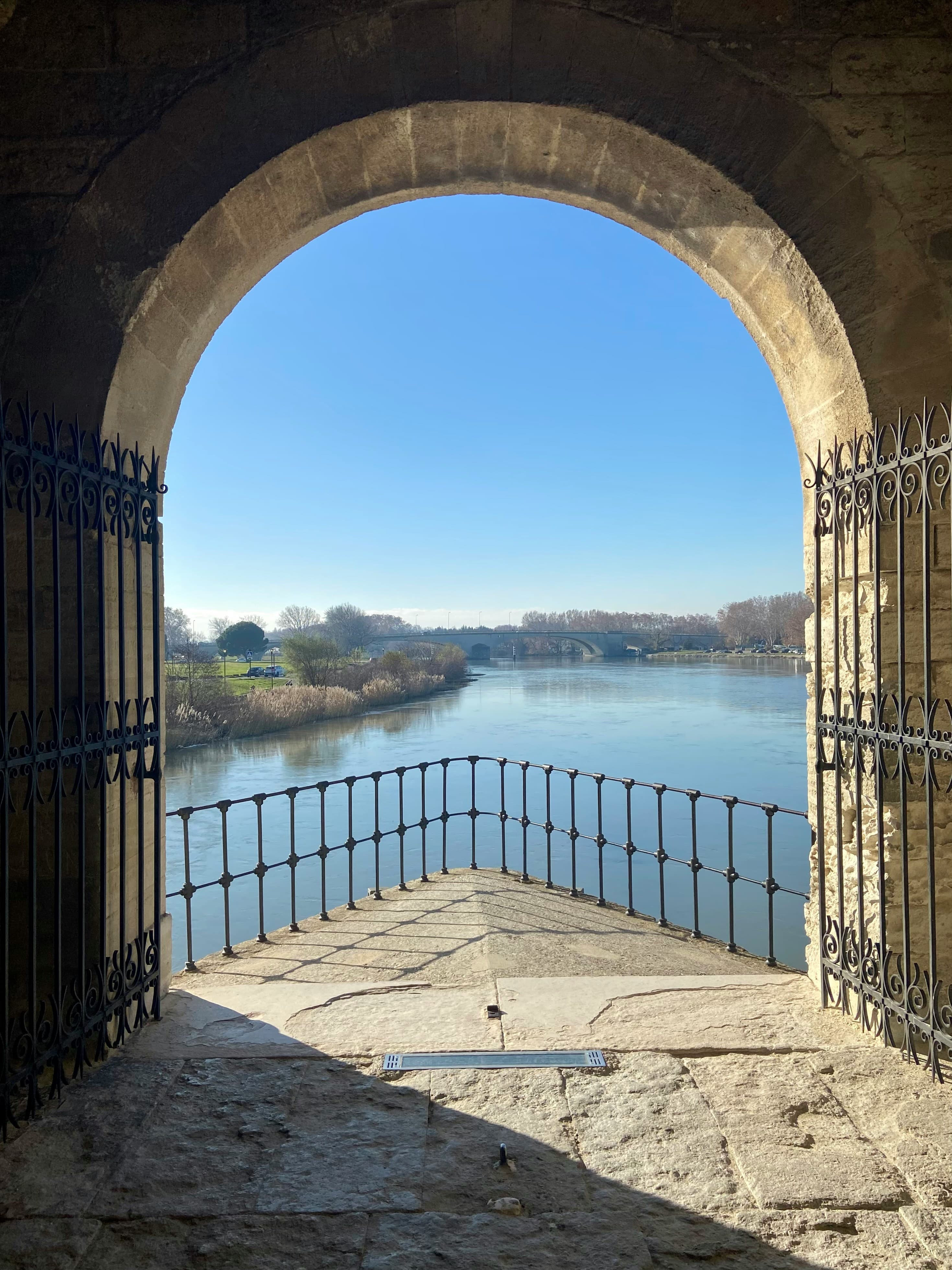
A single lap starting on Boulevard Saint-Roch, directly in front of Avignon Centre station, and finishing on Île de la Barthelasse. The two points sit about 1.3 km apart, so this is a loop in name but not a course that returns you to where you left your bag.
The first eight kilometres are all city, working through the walled centre, past Rue de la Carreterie, Place Saint-Didier and out to Boulevard de l’Oulle on the western ramparts, with the Palais des Papes and the Pont d’Avignon along the way. The only rise on the course is here, about 10 m up toward the Palais to the high point of 37 m near km 5.8. After that the race leaves the city for good, and from km 7 to the finish the road stays between 17 and 25 m above sea level. It crosses to the Rhône islands around km 10, runs north up the Route de l’Islon into the Gard as far as Villeneuve-lès-Avignon and Sauveterre by about km 18, then turns back and spends the last twenty kilometres on the farm lanes of Île de la Barthelasse before finishing there.
Km 0 to 8: inside the walls. The gun goes at 08:30 outside the station and the course is into the old city almost at once. This is the part of the race people will have entered for, and the part where a field of several thousand across two distances meets medieval street widths. How it copes with that is untested. The first checkpoint, 45 minutes at 5 km, gives an early read on whether the field is clearing as the corral system intended.
Km 8 to 15: out to the islands. The route leaves the ramparts near Boulevard de l’Oulle and crosses to the Rhône islands, through Saint-Jean and onto the Barthelasse road system by about km 12. The change is abrupt: walled city one moment, open riverside the next. Checkpoints fall at 1:25 for 10 km and 2:05 for 15 km.
Km 15 to 21: north into the Gard. The course crosses the département boundary and runs up through Villeneuve-lès-Avignon, reaching its northern limit around Sauveterre at about km 18 before turning back south. This is the quietest and most rural part of the race, a long way in spirit from the Palais des Papes. The 21 km checkpoint at 2:55 sits at the end of it.
Km 21 to 35: the Barthelasse lanes. The second half belongs almost entirely to the island: Chemin de Rhodes, Chemin des Vignes, Chemin de Bellegarde, agricultural lanes across flat, open ground. Île de la Barthelasse is Europe’s largest river island and it is farmland, not parkland, so there is little shelter from sun or from the mistral if it is blowing. The last published checkpoint is 4:05 at 30 km, which leaves 1 hour 40 minutes for the remaining 12.195 km inside the overall limit.
Km 35 to 42.195: the island finish. More of the same ground before the finish on the Barthelasse. Because the finish is across the water from the start, getting back to a central hotel is its own problem, and not one the organiser has published a solution to yet. Timing is by chip in the bib, with both official and chip times recorded. No painted racing line has been documented.
Cutoffs
The overall limit is 5 hours 45 minutes, a minimum pace of 8:10/km, with five intermediate checkpoints along the way. They are worth knowing in advance: the 5 km and 10 km gates are tight enough to matter if the walled-city start bunches up.
| Checkpoint | Cutoff |
|---|---|
| 5 km | 0:45 |
| 10 km | 1:25 |
| 15 km | 2:05 |
| 21 km | 2:55 |
| 30 km | 4:05 |
| 42.195 km | 5:45 |
Course Map
The official route: the walled city, then the Rhône islands and the turn north into the Gard, then the Barthelasse. Tap a marker for details, and scrub the slider or press play to move the orange marker along the course with the elevation profile beneath it.
Pacers
None confirmed. Neither the regulations nor the organiser’s pages list a pacer programme for the first edition. The performance corrals described under Entry seed the start line; they are not pace groups, and the two should not be confused.
What to wear
Late September in Avignon still runs warm. Station normals give a mean daily minimum of 13.9°C, a mean of 19.9°C and a mean daily maximum of 26.0°C, with about 91 mm of rain across the month. The 08:30 start sits nearer the cool end of that, so a throwaway layer for the wait is reasonable, but the direction of travel through the morning is warmer. Anyone still out at four or five hours will be covering the exposed island in the hottest part of their race, not the coolest. No clothing-collection scheme is documented, so pass anything you discard to a supporter.
Wind deserves separate thought. The mistral funnels down the Rhône valley and is a feature of the region in any season, and the second half of this course is open farmland on a river island with nothing to break it. That is not a forecast for any particular year, just a reason to check the race-week outlook. A vest and shorts suit a typical late-September morning here.
Entry
Entry is online through Finishers, with no ballot and no on-site registration. The 2026 marathon priced in three tiers at €58, €70 and €81, with a €2 reduction for FFA-licensed runners. Both distances show as sold out on the organiser’s registration page. A runner still after a place should use the official Finishers resale route: private transfers are not recognised under the rules, and buying a bib from someone else risks the entry being void.
Health documentation follows the current FFA framework: an accepted competition licence, or the Parcours Prévention Santé route for runners without one. Foreign entrants are directed to the PPS framework as well, even holding a licence from another federation. These requirements have changed more than once in recent years, so check the organiser’s current instructions, not another French race’s rules. Entry is open from the FFA Espoir category upward, meaning runners born in 2007 or earlier for 2026.
A charity route exists through the official registration page, benefiting the Fonds de Dotation AV’ENCE, which supports projects at Avignon’s public hospital. The charity marathon bib is €201, made up of the €81 standard entry plus a €120 donation. Deferral, cancellation and refund conditions beyond the Finishers resale route have not been published, which is worth settling before booking non-refundable travel.
Fast Runner / GFA Standards
No guaranteed-entry or good-for-age route exists. There are two controlled front corrals, an elite corral for men under 2:40 and women under 3:00, and a preferential corral for men under 3:00 and women under 3:20, both needing proof of a 2024 or 2025 result. These seed the start line for runners who already hold a bib. They are not a way into a sold-out field.
Race Weekend
Expo
Bib collection runs Friday and Saturday only, at the Village Partenaires in central Avignon. There is no Sunday collection and bibs are not posted. For anyone travelling in, that single rule shapes the trip: arriving Friday is materially safer than a late Saturday arrival, which leaves no margin at all if a train or flight goes wrong. Bring photo identification. Someone else can collect for you with valid ID and your collection card.
Exact opening hours go to registered runners by email closer to race week, and the precise village address has not been confirmed by the organiser either. No large commercial expo, merchandise detail or bag-size restriction is documented. The organiser said a full runner guide would follow in early September; it had not appeared by the middle of the month, and when it does it should settle several of the gaps on this page at once.
Getting to the Start
The start is on Boulevard Saint-Roch, directly in front of Avignon Centre station, at 08:30. This is about as easy as a destination marathon start gets: from a hotel inside the walls or along Cours Jean Jaurès you walk, and no shuttle or transfer exists or is needed.
One thing to get right in advance: Avignon has two stations. Avignon TGV sits outside the centre and is not the start. Avignon Centre is. Arriving high-speed services land at the former, so build the local connection between the two into your plans.
Because this is a first edition, nothing is known about how quickly bag drop, toilets or corral loading actually run. No bag-drop procedure has been published at all, which matters more here than at most races: the finish is on the far side of the Rhône from the start, so where a bag is handed in and where it comes back are not details to leave to race morning. The regulations confirm toilets on course but give no start-area count. Beyond the two performance corrals, no wave assembly times have been published.
Nutrition on Course
Article 10 of the regulations confirms several refreshment points with both liquid and solid food, plus medical staff, toilets and sponge zones, with positions to be given in the runner guide. No station positions, brands, gel detail or personal-bottle policy has been published.
With so little published, anyone with a specific carbohydrate plan should carry their own. The second half is the part to plan for: twenty kilometres of open island with no published station map.
Spectating
The first eight kilometres are the good part for supporters, and they are all in the walled city where walking between points is easy. After that the course leaves for the islands and the Gard, and following it without a car becomes difficult.
The city plan. Watch the 08:30 start on Boulevard Saint-Roch, then walk into the centre for a second sighting near the Palais des Papes or the ramparts while your runner is still inside the first few kilometres. Both sightings come within about half an hour of each other, after which there is a long wait.
The finish plan. Make for Île de la Barthelasse for the finish, checking the runner guide for confirmed pedestrian and bridge access first. This is the part of the day with the least published information, so check the crossing before race day.
Exact passage times and a road-closure map have not been published, so allow a wide window either side of any pace-based estimate.
Post-Race Food
Les Halles d’Avignon, the covered market at Place Pie, is the most practical first stop: around forty traders under one roof, open on Sunday morning, with listed hours to 14:00. For a runner who finishes in reasonable time and can manage the trip back from the island, it works as a late breakfast or early lunch without hunting for a single open restaurant.
For a sit-down meal, the streets around Place de l’Horloge and Rue de la République hold the widest choice in the old town. September can still be warm enough that shade and water matter as much as the food. No restaurant has been confirmed for race-Sunday service, and with no previous edition there is no local precedent for how the city handles a marathon Sunday, so check hours before counting on a table.
Where to Stay
Stay near the start, not the finish
This page normally recommends proximity to the finish. Here that advice is reversed, and the reason is specific. The finish is on Île de la Barthelasse, across the Rhône from the old town, and no race-day bridge or pedestrian access plan has been published. The start, by contrast, is directly outside Avignon Centre station, inside the city, and walkable from almost anywhere central with no transfer at all. Until a runner guide or a completed first edition shows how straightforward the Barthelasse crossing is, the start is the safer thing to be near.
Inside the walls, around Cours Jean Jaurès
Cours Jean Jaurès is the strongest overall base. It runs down to Boulevard Saint-Roch and the station, so race morning is a short walk, and it keeps the old town’s restaurants and the Palais des Papes close for the rest of the trip. The trade-off is old-city geometry: a hotel that looks close on a map can be awkward by taxi once roads close, so assume you are walking on Sunday morning.
Around Avignon Centre station
The station district is the purest logistics choice. Direct rail arrival, the shortest possible walk to the start, and the historic centre still a few minutes away once the race is over. It gives up some old-town character in exchange, which is a fair trade for anyone who values a simple race morning.
The historic core around Place de l’Horloge
Place de l’Horloge and the streets under the Palais des Papes give the best of the city itself while staying walkable to the start. Light sleepers should check where a room sits: not every old-town street is quiet in the evening.
Île de la Barthelasse and Villeneuve-lès-Avignon
The island is where the race finishes, which makes it tempting, but without a published race-morning access plan across the river it is a hard base to recommend for the race itself. Villeneuve-lès-Avignon, across the Rhône, is a quieter historic town with Fort Saint-André and works well for the nights either side of the race or for companions. For race night specifically it adds a river crossing before an 08:30 start that has not been confirmed as straightforward.
Recommended hotels
Walking distances to Boulevard Saint-Roch are not published, so these are placed by street and district. Confirm current operation and cancellation terms before booking.
A four-star at 44 Cours Jean Jaurès, on the same axis that runs down to Boulevard Saint-Roch and the station. The most direct race-morning walk of these five without giving up an old-city address.
A former 16th-century cloister close to the same corridor between the old town and the start. Race-week breakfast timing is not published, worth confirming directly if you want to eat before an 08:30 gun.
A modern chain option positioned for exactly this race: rail arrival, a short walk to the start, and no old-town navigation to work out the night before.
Better for the Palais des Papes and the river than for the start line. Worth it if the trip matters more than the shortest race-morning walk.
The shortest walk to Boulevard Saint-Roch of any of these, trading old-town character for the simplest possible race morning.
Booking timeline
Both distances sold out ahead of race week in the first edition, which settles the main question before the race has run: this is not one to leave late. For a future edition, secure a bib as soon as registration opens. Book a cancellable central room six to nine months out, ideally inside the walls or along Cours Jean Jaurès. Three to four months out, sort the TGV or flights, remembering that Avignon TGV and Avignon Centre are different stations. In race month, watch for the runner guide, which should close several of the operational gaps on this page. In race week, check the actual forecast, because late September here can still be warm.
See & Do
All of these sit in or beside the walled city, which is where the recommended hotels are and where the race starts. No exact distances from the finish are published, and the finish is across the river anyway, so these are placed relative to the old town.
Palais des Papes
In the walled centre, on the race’s own opening kilometres. The 14th-century papal residence is UNESCO-listed and, at roughly 15,000 m², the largest Gothic palace in the world by Avignon Tourisme’s description, with 25 rooms plus the Papal Gardens on the standard ticket. It takes a couple of hours and a fair amount of walking, so Friday or Saturday suits most runners better than the afternoon after a marathon. Monday works too if you are staying on.
Pont Saint-Bénézet
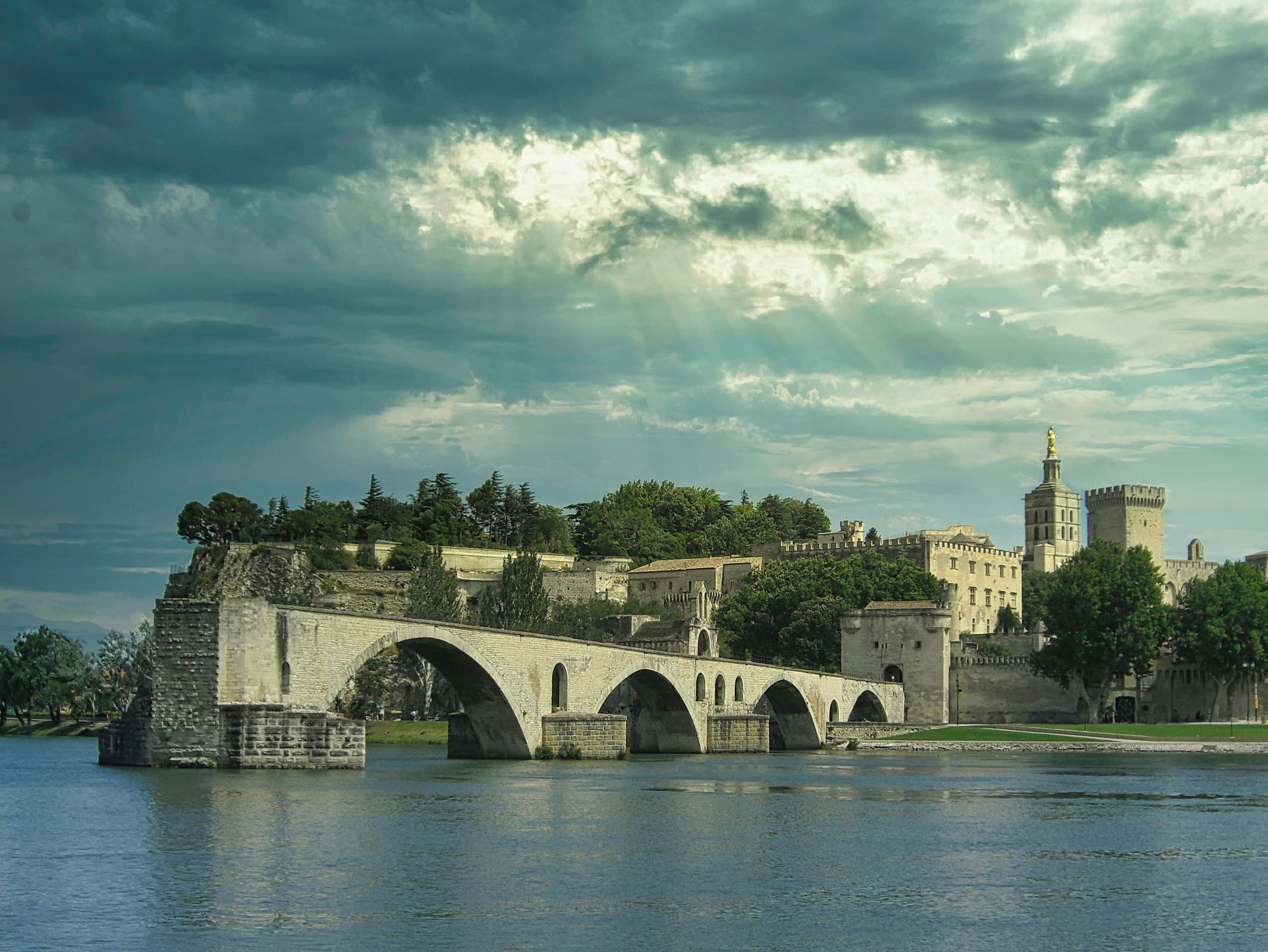
In the walled centre, a few minutes from the Palais des Papes. The bridge of the song, four surviving arches reaching out into the Rhône and stopping. It pairs naturally with the palace on the same ticket-buying trip and needs little time on its feet.
Les Halles d’Avignon
Place Pie, in the centre, about 500 m (0.3 miles) from the start. Around forty traders under one roof, open Sunday mornings to 14:00, which makes it useful on race day itself.
Île de la Barthelasse
Across the Rhône, and the race’s own finish, so you will see a good deal of it whether you plan to or not. Europe’s largest river island is farmland and riverside paths. A longer walk there suits the day after the race, when access is normal again.
Villeneuve-lès-Avignon and Fort Saint-André
Across the river, and on the course at about km 15. A 14th-century royal fort with views over the Rhône valley, Avignon and, on a clear day, toward Mont Ventoux. The climb up to it is real, so it is a better day-after outing than a same-day one.
Read Before you Run
A Year in Provence
Peter Mayle
A companion for the wider Provence trip, not a book about Avignon itself, good on the region’s food and rhythms. Anyone wanting the history of the papal city should look for a dedicated Avignon history instead.
After the Race
Late September is a good time to stay on. The heat has eased from August without the season having closed, and Avignon sits inside an unusually dense set of short rail connections: Arles in about twenty minutes, Nîmes in about thirty. On marathon legs, the difference between a twenty-minute train and a two-hour drive decides whether a trip happens at all. Lavender season is over by now, so the Luberon is sold on stone villages and landscape.
A quieter historic town across the river, built around Fort Saint-André and its views back over Avignon and the Rhône valley. The course itself passes through it at about km 15.
A compact Roman city built around its amphitheatre and ancient theatre, with a second identity tied to Van Gogh. A realistic day out with no car needed.
More Roman heritage west of Avignon: the amphitheatre and Maison Carrée in Nîmes, with the Pont du Gard aqueduct added if transport allows both in a day.
Vineyards and the ruined papal château, with tastings that need booking in advance. Harvest timing varies by estate and by year.
Gordes and the ochre cliffs of Roussillon at the slower pace an overnight allows. Late September falls outside lavender season, so this is about stone villages and landscape.
Frequently asked questions
Should I stay near the start or the finish?
Near the start, reversing this site’s usual advice. The finish is on Île de la Barthelasse across the Rhône, with no published race-day access plan; the start is walkable from anywhere central.
How far in advance should I book a hotel?
As soon as your dates are set. Both races sold out ahead of race week in the first edition, and central rooms inside the walls are limited.
Is there free transport to the start?
None published, and it matters little here. The start is directly outside Avignon Centre station, walkable from most central hotels.
What is the best area to stay?
Inside the walls around Cours Jean Jaurès, which leads straight to the start. The station district is the purest logistics choice.
When does the expo open?
Friday and Saturday only, at the Village Partenaires in central Avignon. No Sunday collection, and bibs are not posted. Hours go to registered runners by email.
What is the weather typically like on race day?
Warm for late September: normals run 13.9°C to 26.0°C. The 08:30 start is near the cool end. The mistral is a real regional wind risk.
How do I get from the airport?
Via Paris and the TGV, about 2h33 to 2h38. Avignon TGV and Avignon Centre are different stations, and the race starts at the latter.
Is there a bag drop?
Not confirmed in the regulations. It matters here because the finish is across the river from the start; check the runner guide.
Should I bring a throwaway layer?
A light one for the wait before 08:30. No clothing-collection scheme is documented, so pass anything discarded to a supporter.
How do I get back to my hotel after finishing?
The least-documented part of race day. No confirmed pedestrian route back from the Barthelasse, so plan a taxi or a supporter with a car.