The Race
| Next Race Date | 18 April 2027 (40th running, coinciding with the European Running Championships) |
|---|---|
| Course type | Loop: start and finish on Republic Square, central Belgrade (2027 championship course; earlier editions started on Bulevar Kralja Aleksandra and finished on Terazije) |
| Registration | Open, online only, one participant per account/email; no ballot or GFA route identified |
| Ballot Opens | Not applicable, open entry, no ballot |
| Total finishers | ~1,544 (2025 marathon: 1,288 men, 256 women) |
| Avg race-day temp | Not confirmed. April in Belgrade is generally cool at an 08:00 start with rain risk |
| Cutoff time | 6 hours (2025 figure); an intermediate cutoff required marathon runners to clear the New Belgrade second-loop entry point by 10:30 or be pulled from the course |
| Free race-day transport | Not confirmed |
| Course certification | Not confirmed |
The 2027 European Running Championships
The 2027 Belgrade Marathon is also the 40th running of the race, and it shares its weekend with the European Running Championships. Registration for this specific edition opened on 4 June 2026, earlier than the organiser’s typical timeline, and hotel demand should be expected to run higher than in a routine year, from both the marathon field and the separate Championships programme.
History
Belgrade’s marathon tradition predates the current race by nearly eight decades. On 2 May 1910, “The Great Walking Race” ran from Obrenovac into the city, finishing at Košutnjak, but the marathon Belgrade now runs traces its direct line to 8 May 1988, when the first modern Belgrade Marathon took place. The organiser, Beogradski maraton d.o.o., built the event into what is now the centrepiece of a full running weekend that also includes a half marathon, a half marathon relay, a 10 km race, a women’s race and children’s events.
The race carries a title sponsor in its name, currently run as the Powerade Belgrade Marathon, and the 2026 edition was billed as the 39th running. The 2027 edition, the 40th, coincides with the European Running Championships, and the organiser opened registration for it on 4 June 2026, earlier than a routine year.
Course records stand at 2:10:54 for men, set by Japhet Kosgei in 2006, and 2:26:48 for women, set by Deborah Sang in 2025. The course itself has shifted over the years and the organiser explicitly reserves the right to change the route and the start and finish points from one edition to the next, so runners training from an old course map risk preparing for the wrong race. The most recently documented full route ran from central Belgrade across the Sava into New Belgrade and back, a shape that gives the race a genuine two-city character.
The course
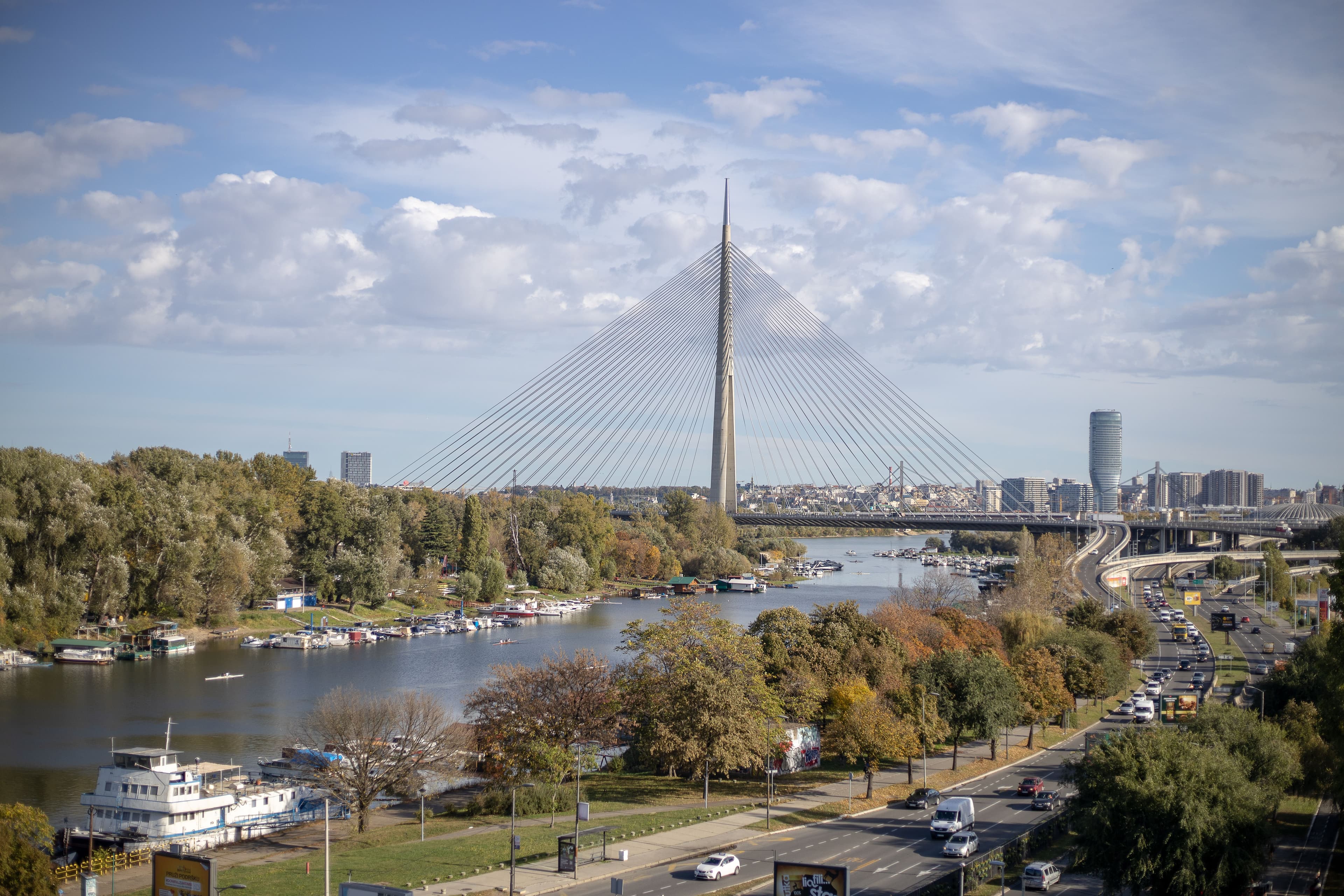
The 2027 course, which doubles as the European Running Championships marathon route, starts and finishes on Republic Square (Trg republike) in the old town, a few minutes’ walk from Terazije. Earlier editions started on Bulevar Kralja Aleksandra at Resavska and finished on Terazije in front of Hotel Moskva, and the organiser reserves the right to move the start and finish between editions, so check the final 2027 course map in race week. From Republic Square the route runs east along Takovska and Kraljice Marije, climbing about 25 m to the day’s high point on Bulevar Kralja Aleksandra at km 3, then drops 62 m in 3 km down Nemanjina to Karađorđeva and the Sava. It follows the river south past the Belgrade Fair, crosses to New Belgrade on Most na Adi, the cable-stayed bridge that is now one of the city’s defining pieces of modern infrastructure, at about km 9, and spends the next 27 km on New Belgrade’s wide, flat boulevards, among them Bulevar Mihajla Pupina, Bulevar Nikole Tesle and Bulevar Milutina Milankovića, with a loop north into Zemun at km 20 to 23 and another west to Bežanijska kosa at km 28 to 30. It recrosses the Sava on Brankov most at about km 36.5, runs below Kalemegdan on Bulevar vojvode Bojovića, and climbs 47 m over the last 3 km, up Cara Dušana, back to Republic Square.
Km 0-6: up to Kralja Aleksandra, then down to the river. The gun goes on Republic Square, and the first 3 km climb about 25 m east to Bulevar Kralja Aleksandra, the highest point of the course. Then the field drops 62 m in 3 km down Nemanjina to the Sava, nearly 4 per cent between km 3 and km 5, the steepest ground of the day. Anyone who has trained on a flat treadmill will feel this in the quads before the 5 km mark.
Km 6-9: along the Sava and over Most na Adi.The route follows the river south on Bulevar Vudroa Vilsona and Bulevar vojvode Mišića, past the Belgrade Fair, and crosses Most na Adi, Belgrade’s cable-stayed Sava bridge, opened in 2012, at about km 9. On the far side Stari Grad’s narrower streets give way to New Belgrade’s much wider, straighter boulevards. This is where pacing discipline matters: the road opens up and it is easy to bank time that the closing climb will take back.
Km 9-20: the New Belgrade boulevards. A long, flat stretch on Bulevar Mihajla Pupina, Bulevar Nikole Tesle, Bulevar Milutina Milankovića and their cross streets. These roads are wide, largely straight and exposed to whatever wind is moving off the rivers; there is little shade and the crowd thins compared with the old-town sections. Marathon entrants had to clear the Mihajlo Pupin Boulevard/Nikola Tesla Boulevard junction by 10:30 in 2025 or be withdrawn from the course, so this is where the intermediate cutoff bites hardest for anyone running close to the limit.
Km 20-36: Zemun and the second loop. The course loops north into Zemun between km 20 and km 23, comes back down Bulevar Mihajla Pupina, and heads west to Bežanijska kosa, the furthest point from the start, at about km 29, before working back east through New Belgrade. All of it sits within a few metres of the same height. This is the psychological low point for most marathon fields: the boulevards look alike, the finish is still a long way off, and there is no major landmark to mark progress until the river.
Km 36-42.195: over Brankov most and up to Republic Square. The course recrosses the Sava on Brankov most at about km 36.5 and runs below Kalemegdan on Bulevar vojvode Bojovića, then climbs 47 m over the last 3 km, the steepest of it about 3 per cent up Cara Dušana, back to Republic Square. A course that gave height back early now asks for it back at the point runners are least equipped to give it.
Course Map
The map shows the course: the loop from Republic Square over Most na Adi into New Belgrade and Zemun, and back over Brankov most, with the expo at the Belgrade Fair. Tap a marker for details, and scrub the slider or press play to move the orange marker along the course with the elevation profile beneath it.
A 25 m climb to Bulevar Kralja Aleksandra, then a 62 m drop in 3 km to the Sava. Resist the urge to bank time on the descent; this course asks for it back in the final kilometres.
Along the Sava past the Belgrade Fair, over Most na Adi at km 9, and onto New Belgrade's wide, straight boulevards. Little shade, little turning, and the widest roads on the course.
A loop north into Zemun and another west to Bežanijska kosa, all of it flat. The 2025 intermediate cutoff applied at the Mihajlo Pupin/Nikola Tesla boulevard junction.
Back over Brankov most, then 47 m of climbing in the last 3 km to the Republic Square finish. Save something for it.
Pacers
Not confirmed. No evidence of a pacer programme was found on the official site or in third-party race guides. Do not assume one exists for the target edition.
What to wear
No specific race-morning temperature range or reliable April climatology figure for an 08:00 Belgrade start has been sourced. What can be said with confidence from the course itself: the New Belgrade boulevard sections, roughly km 9-36, are wide and largely unshaded, so direct sun exposure is a bigger factor there than in the narrower central-Belgrade streets at the start and finish. April in Belgrade carries a real chance of rain, so a throwaway layer that also functions as light waterproofing is a reasonable hedge.
Entry
Entry to the Belgrade Marathon is open online registration with no ballot and no identified good-for-age qualifying route; one email address may register one participant, and registration is confirmed only once payment clears. For the 2026 edition, registration detail changes were permitted up to 13 March 2026 for a 600 RSD (approximately €5) fee, and no race-day registration or payment was possible.
Entry pricing for a typical year could not be confirmed. The only figures found were a relay-team fee of 21,600 RSD plus VAT for 2026, and a tiered individual range of roughly €45 (early bird) to €100 (race-week/expo pricing) reported for the 2027 fortieth edition, which coincides with the European Running Championships and may carry a different pricing structure from a standard year. Treat the 2027 figures as illustrative only, not as a confirmed standing price list.
There is no evidence of a fast-runner or good-for-age entry pathway. Charity entry, tour-operator allocation and team-entry mechanics have not been published and should be checked against the current official registration page.
Fast Runner / GFA Standards
Not applicable. No evidence of a GFA or fast-runner entry pathway was found for this race.
Race Weekend
Expo
Packet pickup is not held on race day. For the 2026 marathon, collection ran at the Belgrade Fair (Beogradski sajam), Hall 4, Bulevar vojvode Mišića 14, across three days: Thursday 16 April, Friday 17 April and Saturday 18 April 2026, each day from 12:00 to 22:00. Runners had to collect their own packet in person with valid photo ID; the official instructions did not permit collection by a third party or on the morning of the race.
The expo venue sits about 3 km south-west of the Republic Square finish, along the Sava, so runners staying in the historic centre should budget for a tram or short taxi ride. Bag size restrictions, athlete wristband requirements, storage options and cost, and any expo merchandise details have not been published.
Race Morning
The 2026 race zone was centred on Republic Square, with runners instructed to be in their start zone at least 15 minutes before their wave’s gun time. Elite athletes line up immediately behind the start line; other runners assemble behind a marshalled “human wall” with no numbered corrals. The marathon itself started at 08:00 on Sunday 19 April 2026.
Wave start times and corral letters for a typical marathon field have not been published; the “human wall” system suggests this race does not use a UK/US-style lettered corral structure, but this is not confirmed.
Bag drop uses designated tents: runners are issued an official participant bag carrying a sticker matching their race number, hand it to volunteers before the start, and collect it from the same tent location in the Race Zone after finishing. Officials require the race bib to be worn on the lower front torso; incorrect bib placement risks disqualification.
Transport ticket details, named metro/tram lines and stops serving the start, start-village facilities, changing rooms and showers, on-course and finish massage, and pregnancy/medical deferral policy have not been published; ask the organiser directly if any of them matter to your plans. The 2025 marathon had 13 refreshment stations on course.
Nutrition on Course
Research confirmed only the total number of refreshment stations for the 2025 marathon (13), with no km-by-km breakdown of what each station offers, no confirmed sports-nutrition sponsor or brand, no cup-type detail, and no personal-bottle-service procedure. Check the current official race-day guide before travelling if this detail matters to your race plan.
Spectating
The New Belgrade section, roughly km 9-36, gives spectators on the New Belgrade boulevards a genuine chance to see the field pass more than once, since the course threads back and forth across the same district before recrossing to the old city.
Named public transport lines and stop-by-stop spectator itineraries have not been published. Belgrade’s tram and bus network connects the Terazije/Republic Square area to New Belgrade, but spectator line numbers, journey times and walk distances have not been published; plan them with GSP Beograd, the city transport operator. Finish grandstand detail, a named post-race meeting point, and app-based runner tracking have not been published either.
Post-Race Food
The Republic Square finish sits within easy walking distance of central Belgrade’s main café and restaurant streets, including Knez Mihailova. Aurelio, on Republic Square itself, serves traditional Serbian dishes from an English-language menu and opens for breakfast, making it a straightforward first stop for a runner still in kit. Red Bread, tucked behind Republic Square on the corner of Jevremova and Dositejeva, is a café and juice bar with a breakfast menu built around pancakes and scones, a lighter option than a full Serbian breakfast for a stomach that has just run 42 km. For something more substantial once appetite returns later in the day, Mala Gostionica offers a build-your-own small-plates breakfast board, egg dishes, ajvar and kajmak among the options, close enough to the finish for a short walk.
Where to Stay
Republic Square, where the 2027 course starts and finishes, is the right anchor for a hotel search: it puts a finisher within a few minutes’ walk of a bed.
Terazije and Republic Square (Stari Grad)
The start and finish. The race zone is on Republic Square, and Hotel Moskva sits on Terazije, a 5-minute walk away and 2 minutes from the top of Knez Mihailova, the pedestrian spine of the old town. This is the highest-convenience, highest-price option, and Saturday-night noise is a real factor: Knez Mihailova and the surrounding squares are the busiest nightlife corridor in the city on any weekend, marathon or not.
Skadarlija and the wider Stari Grad core
A short walk further from the finish, this bohemian quarter trades a little convenience for a quieter, more characterful base with its own concentration of traditional restaurants. Useful for runners who want to be within walking distance of the finish without paying Terazije’s premium.
Savamala
Home to the Belgrade Fair expo venue, Savamala sits on the Sava below the old town, so a stay here trades a longer walk to the finish for proximity to packet pickup. Worth considering only if expo access matters more than a short post-race walk.
New Belgrade and Zemun
New Belgrade offers modern hotel stock and easier access to the boulevards the course itself uses, but road closures for the double-loop New Belgrade section make race-morning movement around this district unpredictable; runners based here should plan to reach the start well ahead of the closure window. Zemun, Belgrade’s historic riverside quarter, is connected to the centre by bus routes 78, 83 and 84 and by tram in around 20 minutes, and suits a runner extending their stay for the Danube promenade and Gardoš hill.
Recommended areas
A Belgrade landmark in its own right, a few minutes on foot from the finish. The obvious first choice for anyone prioritising a minimal post-race walk over price.
Named in third-party hotel listings as one of the closest properties to Hotel Moskva and Republic Square.
Skadarlija, Savamala and New Belgrade are all viable neighbourhood alternatives to Terazije; this guide does not yet name a hotel in any of the three. Rather than invent a property, check current listings in each district directly when booking.
Booking timeline
Because entry is open registration with no ballot, there is no results-announcement date that triggers a booking rush the way a ballot-based race does; runners can book as soon as they have entered. The 2027 edition is the exception: it is the 40th running and coincides with the European Running Championships, and registration opened earlier than usual, on 4 June 2026. Runners targeting that specific edition should book well ahead of a normal year’s timeline, since the Championships will draw additional visiting spectators and officials into the same hotel stock the marathon field is competing for. A general spring city-break premium should be expected on marathon weekend even in a routine year.
See & Do
These sit on or close to the course itself, within walking distance of the Republic Square finish, or a short trip further into the city.
Kalemegdan Fortress and Park
Approximately 1.2 km (0.7 miles) from the finish. Belgrade’s fortress complex sits at the confluence of the Sava and Danube, a flat, paved park setting rather than a climb, with the Military Museum and the Zindan Gate among its sights. Close enough to reach on foot even on tired legs, provided the runner takes the walk slowly.
Knez Mihailova
0.1 km (0.1 miles) from the finish. The pedestrian spine connecting Republic Square to Kalemegdan, lined with shops, cafés and street performers. The most obvious short walk for a finisher who wants to be among people without covering real distance.
Skadarlija
Approximately 0.8 km (0.5 miles) from the finish. Belgrade’s old bohemian quarter, a cobbled street of traditional restaurants and live folk music. Worth noting the cobblestones specifically for anyone on sore legs the evening after the race; the surface is uneven compared with the paved squares nearer the finish.
Zemun and the Danube Promenade
Approximately 8 km (5 miles) from the finish by road, reachable by bus 78, 83 or 84, or by tram in around 20 minutes. The Zemun quay, officially Kej Oslobođenja, runs flat and paved for 2.5 km along the Danube below Gardoš hill, a recovery-pace walking option, with the Gardoš Millennium Tower viewpoint above it for anyone whose legs will still take stairs.
After the Race
Belgrade Marathon runs in April. These itineraries stay close to the city, or extend further into Serbia’s countryside and second city, Novi Sad.
Belgrade's historic riverside district, with a flat Danube promenade below Gardoš hill and the option of a short climb to the Millennium Tower for a view back over the city. A half-day trip that keeps the legs largely flat.
A small baroque wine town on the edge of the Fruška Gora wine region, with cellars for Bermet, its distinctive local dessert wine, within walking distance of the train station.
The largest lowland fortress in Europe, built as the last capital of medieval Serbia before the Ottoman conquest. The bus station sits two minutes from the fortress gate, and the flat riverside setting makes it a manageable walk on recovering legs.
Serbia's second city, built around a baroque old town and, across the Danube, the Petrovaradin Fortress, with enough on both sides of the river to justify staying over.
Frequently asked questions
Should I stay near the start or the finish?
Stay in the old-town core around Republic Square and Terazije. The 2027 course starts and finishes on Republic Square, so a hotel there puts both a short walk away, and a finisher on tired legs benefits most from a short walk to bed.
How far in advance should I book a hotel?
As soon as you have registered. Entry is open online with no ballot, so there's no fixed results date that triggers a booking window. Book earlier still for the 2027 fortieth edition, which coincides with the European Running Championships.
Is there free transport to the start?
Not confirmed. Check the current official race-day guide at bgdmarathon.org before travelling.
What is the best area to stay?
Terazije or the wider Stari Grad old-town core, both within easy walking distance of the Republic Square finish. Terazije itself, where Hotel Moskva sits about 400 m from the finish, is the highest-convenience option; Skadarlija trades some convenience for a quieter base.
When does the expo open?
For the 2026 edition, packet pickup ran at the Belgrade Fair, Hall 4, over three days, Thursday to Saturday before race day, each day from 12:00 to 22:00. There was no race-day collection.
What is the weather typically like?
Not confirmed. April in Belgrade generally carries a real chance of rain at an 08:00 start, but a specific, sourced temperature range has not been published.
How do I get from the airport?
The A1 minibus/shuttle runs from outside arrivals to central Belgrade in around 30 minutes, calling at Slavija Square, the main railway station and Fontana in New Belgrade, for approximately 400 RSD (around €3.50).
Is there a bag drop?
Yes. Runners are issued an official participant bag with a sticker matching their race number, hand it to volunteers at a designated tent before the start, and collect it from the Race Zone after finishing.
Should I bring a throwaway layer?
A layer that also offers some rain protection is a reasonable choice given April's rain risk in Belgrade, though a confirmed race-morning temperature range wasn't available to size this more precisely.
How do I get back to my hotel after finishing?
If staying on or near Republic Square or Terazije, on foot. The finish is on Republic Square, so runners based in the immediate old-town core should need no onward transport at all.