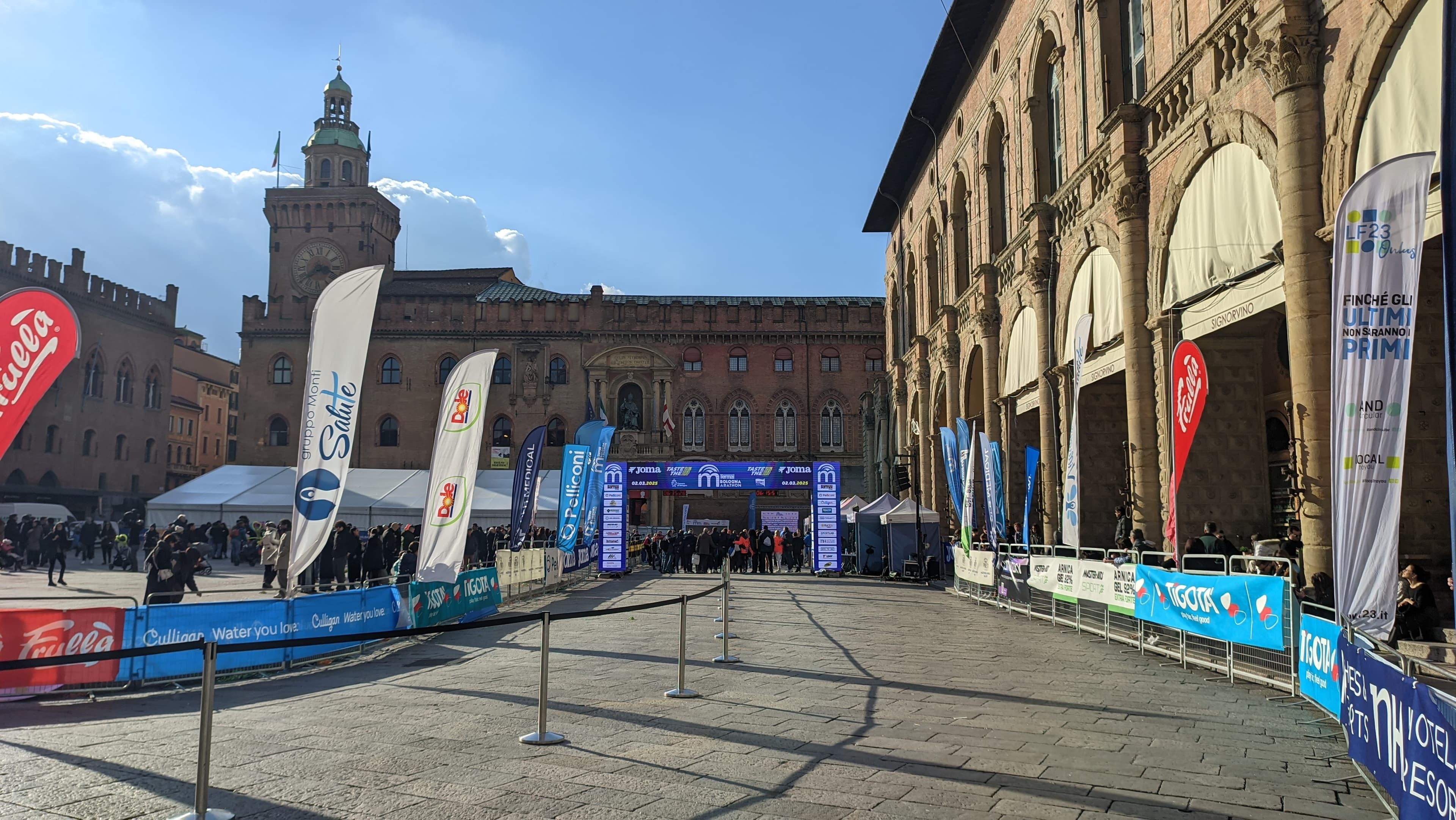
The Race
| Next Race Date | 7 March 2027 |
|---|---|
| Course type | Loop. Start on Via Irnerio, finish at Piazza Maggiore, about 0.8km apart. |
| Certification | FIDAL Bronze Category A · World Athletics Global Calendar |
| Start | Via Irnerio, Historic Centre |
| Finish | Piazza Maggiore, Historic Centre |
| Total finishers | ~3,000 (estimated finishers, distinct from the 3,600-place entry cap) |
| Avg race-day temp | 3 to 13°C (March) |
| Cutoff time | Not published by the organiser |
| Free race-day transport | Not confirmed; central Bologna is walkable from most race-weekend hotels |
| Course certification | FIDAL / World Athletics |
| Sleeper Train | Not accessible |
History
Bologna spent decades watching other Italian cities run marathons before deciding to have a go itself. Rome had been at it since the 1980s; Florence and Venice had each built their own quieter mythologies. By the sixth edition, set for 2027, the Termal Bologna Marathon was still, by Italian marathon standards, the new arrival, with no old course records to point to and no long institutional memory behind it. What it had instead was porticoes: roughly 38 km of covered arcades threading through the historic centre, inscribed on UNESCO’s World Heritage list in 2021. The organisers built the race around that.
That decision shows up in the naming. The companion 30 Km dei Portici, run the same weekend, wears its inspiration in the title. The full marathon does not actually duck beneath the arcades itself; runners pass alongside the porticoes rather than under their roofs, but the colonnades sit at the edge of nearly every kilometre regardless, a constant architectural frame around a race that never quite leaves the city’s own stonework behind.
The organisers also did something unusual for a race hoping to build a following: they kept it small. A cap of 3,600 for the marathon is a fraction of Rome’s or Valencia’s field, and by 2026 every distance on offer, down to the children’s race, had sold out. What Bologna sells instead of scale is proximity: a monorail that gets a runner from arrivals to the historic centre in around seven minutes, and a post-race meal built on tortellini, mortadella and genuine Parmigiano Reggiano.
Course records and the precise founding story are not covered here in detail. Bologna’s case for 2027 rests on food, architecture and a refusal to be enormous, not on elite times.
The course
The Bologna Marathon starts on Via Irnerio and finishes at Piazza Maggiore, both within the historic centre and about 0.8km apart. The route runs past the city’s arcaded porticoes, keeping the covered walkways at the edge of the field of view for much of the race. From the centre the course moves out into quieter, less scenic outskirts, south-east to Monte Donato and Savena, then north through San Sisto and Dozza to Corticella, before returning on a closed main road, with one notable exposed stretch around the 32 km mark where the road opens up and offers little shade. None of it is steep: the course rises about 25 m in the first 12 km to its high point of 82 m near Monte Donato, descends almost imperceptibly for 22 km to 24 m at Corticella, and climbs gradually, about 50 m, over the last 8 km back into the centre. Crowd support is concentrated in the historic centre and thins noticeably in the outer sections. The marathon shares its start line with the half marathon field, with the two distances diverging via course signage early in the race and merging again in the closing kilometres.
Marathon and half marathon runners start together on Via Irnerio with no visible split, making the opening kilometres feel like a much bigger field than the marathon’s own 3,600-runner cap. Course signage divides the two distances within the first few kilometres; hold position in the historic centre’s narrower streets.
The least scenic section of the course, running through quieter ground away from the historic centre. Support thins noticeably here. Treat it as a section for managing rhythm.
A short pedestrian ramp spiralling off a main road, then an exposed closed-road stretch on Via Cristoforo Colombo around 32 km with little shelter from sun or wind. This is the lowest ground of the race; from km 34 the road climbs gently all the way back to the centre. Conserve effort before this point; it arrives when reserves are already low.
The marathon course rejoins the half marathon route with roughly 5 km to go, meaning faster marathon finishers must overtake through the half marathon’s back-of-pack runners. Expect more weaving than a standalone marathon finish normally demands, right through to Piazza Maggiore, and a rise of about 35 m over the last 3 km past the station into the centre.
Blue tangent line, where marked, is worth following as closely as the road allows; over 42.195 km, small deviations add up to real distance. Chip timing mat location at the finish was not confirmed from accessible official sources.
Course Map
The map shows the course, the Via Irnerio start, the Piazza Maggiore finish and expo, and Bologna Centrale station. Tap a marker for details, and scrub the slider or press play to move the orange marker along the course with the elevation profile beneath it.
Pacers
The organiser confirmed official pacers for the 2026 race, but the 2027 wave times, corrals and named pacers had not been published at the time of writing. The marathon and half marathon start together, so runners following a pacer should confirm which distance their pacer is running before the gun; the two fields are not visually distinct until course signage splits them.
What to wear
Early March in Bologna sits in an awkward middle ground: cool enough at the start that a throwaway layer is sensible, but not reliably cold enough to need heavy kit throughout. March averages around 9°C with a typical range of 3 to 13°C. Conditions vary noticeably by section, particularly the open closed-road stretch around 32 km, where there is little shelter from either sun or wind.
Standard cool-weather marathon kit is the safer default: a vest or short-sleeved top with the option to add arm warmers or gloves depending on the specific forecast. Given the exposed 32 km section, runners prone to sunburn on long exposure should not assume March in northern Italy makes sunscreen unnecessary, particularly for later finish times. Bring a disposable top for the pre-race wait regardless of forecast; conditions at the Via Irnerio start can differ from conditions three hours later on the exposed road.
Entry
| Registration type | Open, first-come-first-served via ENDU (no ballot) |
|---|---|
| 2027 price tiers | €55 to 31 Jul 2026 · €65 to 20 Oct 2026 · €75 to 10 Jan 2027 · €85 to 21 Feb 2027 close |
| Entry cap | 3,600 marathon places (every distance sold out for 2026) |
| Fast runner / GFA entry | Not applicable; open entry only, no qualifying standard |
Entry to the Termal Bologna Marathon is open and first-come-first-served through ENDU, with no ballot.
The single most important entry fact is the cap: 3,600 places for the marathon distance. The organiser’s own news archive recorded every distance selling out for the 2026 event, so a reader planning 2027 should not assume late availability simply because the field is smaller than Italy’s larger marathons. The practical advice is to register within the first or second price tier if the trip is confirmed, particularly for anyone who also wants first pick of central accommodation.
Online registration was described as straightforward by a UK club runner who entered for the 2025 edition, with no runcard or federation-membership complications encountered at either registration or expo collection. This is a single data point, not a confirmed policy: Italian road races frequently require some form of federation affiliation, a Runcard, or a medical certificate from international entrants without club affiliation, and full eligibility requirements for unaffiliated entrants should be checked directly with the organiser before travelling.
No official charity-entry or tour-operator programme has been confirmed for this race. Deferral, cancellation, transfer and insurance policies were likewise not visible in accessible official pages.
Race Weekend
Expo and Number Collection
The Expo Village runs at Piazza Maggiore, the same location as the finish. For 2027, hours are listed as Friday 5 March 15:30 to 19:00, Saturday 6 March 09:00 to 19:00, and Sunday 7 March 08:00 to 17:00. Race Office hours for number and chip collection run Friday 15:30 to 19:00, Saturday 10:00 to 19:00, and a narrow Sunday morning window of 06:30 to 08:15 for the 42K, 30K and 21K distances.
A UK club runner collecting for the 2025 edition described the expo as good for a race of this size, helped by the fact that several distances, the marathon, the 30 Km dei Portici, the Run Tune Up 21K, and shorter events, share the same weekend and venue, giving the village more scale than the marathon field alone would generate.
International runners should plan to collect on Friday or Saturday; the narrow Sunday morning window is better treated as a fallback than a default. The venue’s location in the historic centre makes it exceptionally convenient for anyone staying in the old town, along Via dell’Indipendenza, or near Bologna Centrale station. Bag-drop for the marathon runs Sunday 07:00 to 15:00; specific bag-size restrictions and merchandise availability at the expo were not confirmed in accessible sources.
The Shared Start, and the Merge
The Bologna Marathon starts on Via Irnerio alongside its own half marathon, with both fields running as a single crowd until course signage divides them a few kilometres in. That shared start does real work: the opening kilometres feel like a bigger event than the marathon’s 3,600-runner cap would suggest on its own. The trade-off arrives later. With roughly 5 km to go, the marathon route rejoins the half marathon course, and for anyone finishing the marathon in around 3 hours 15 minutes, that means arriving into the back of the half marathon field just as the legs have the least left to give for overtaking. One 2025 finisher described noticeably more weaving and passing through this section than a standalone marathon finish would demand. Faster marathon runners in particular should expect this, and should treat the final kilometres as a section requiring active course navigation, not just endurance.
Race Morning
Runners staying in the historic centre or near Bologna Centrale will have no trouble walking, or gently jogging, to the Via Irnerio start; a UK club runner staying centrally in 2025 covered it on foot without incident. Runners staying near the station should allow a little extra time and check for road closures on the approach.
The official Race Office morning window runs 06:30 to 08:15 for the marathon, half marathon and 30K distances, with bag drop opening at 07:00. On the ground, waiting-area facilities included portable toilets, and a nearby park appeared to be used informally by runners as an additional pre-race space. Exact wave pen locations, security procedures and warm-up areas have not been published; check the runner guide.
At the finish, Piazza Maggiore functions as both finish line and reunion point, in keeping with its role as finish, expo village and race office all in one location. Specific finish provisions, changing facilities, and on-course or finish-line massage were not confirmed from accessible sources.
Nutrition on Course
Aid station and nutrition details are yet to be confirmed for the 2027 edition. Culligan is listed as the official water partner, and ProAction appears among race sponsors, suggesting sports-nutrition provision on course, but no confirmed cup type or personal-bottle-service procedure has been published. Runners should check the official 2027 race guide closer to race day.
Spectating
Bologna suits a relaxed, single-sighting spectator plan. Our runner’s own spectator enjoyed a leisurely breakfast in the historic centre while he ran, then still made it in time to cheer him on with roughly 1 km left to the finish.
The realistic spectator strategy is to prioritise one strong, reliable sighting over an ambitious multi-point plan. The Piazza Maggiore finish is the most dependable location: watch the Via Irnerio start, have breakfast or coffee in the historic centre while the field is out on course, then head to Piazza Maggiore for the finish. The course’s route out through quieter, less central sections between roughly 15 km and 32 km makes intercepting the race mid-course a harder proposition than in cities where the route loops repeatedly through a compact centre. A spectator without a car at least benefits from the historic centre’s compact footprint keeping the start and finish close together on foot, and Bologna’s porticoes make waiting through changeable March weather more comfortable than an exposed street corner would be.
Where to Stay
Stay near the finish, as with most races: the Via Irnerio start and Piazza Maggiore finish sit under a kilometre apart, so a hotel that works for one usually works well enough for the other. The more useful question is how close a hotel sits to Piazza Maggiore itself, and how that trades off against price and noise.
Historic centre, around Piazza Maggiore
The highest-convenience choice: finish, expo and a short walk to the Via Irnerio start, with the least to think about on race morning. It suits a first-time visitor to Bologna who wants transport anxiety removed entirely. Expect premium pricing and a Saturday night that carries genuine street noise into the small hours, since this is the same square hosting the race’s own event weekend.
Via dell’Indipendenza corridor
A practical middle ground between the old centre and Bologna Centrale station, an easy walk to Piazza Maggiore in one direction and the station in the other. It can be lively on Saturday night, busy with ordinary city traffic, but is generally a more workable base than either extreme.
Bologna Centrale station area
The best choice for anyone arriving by rail or connecting onward through Emilia-Romagna after the race, and well placed for the Marconi Express airport monorail. It swaps the porticoed old-town streets that draw people to Bologna in the first place for a functional, business-district feel, better suited to a practical stay than a romantic one.
University district, around Via Zamboni
Characterful and strong for food and drink, with a genuinely local feel. Saturday night noise is a real consideration here, driven by the district’s own nightlife. Better suited to runners prioritising cheap food and student-district energy over guaranteed sleep the night before.
Recommended hotels
A three-star hotel in a former Gessi family palazzo, close enough to the finish and a short walk from the Via Irnerio start to remove most race-morning logistics thinking. Skip the hotel breakfast: Green Bar, directly across the street at Via Monte Grappa 12, does better coffee and pastries.
A reasonable balance between the station and the old centre, workable for runners who want a shorter walk to Piazza Maggiore without old-town pricing.
Convenient for anyone arriving by train or via the Marconi Express from the airport, with a walkable, if not short, route to the finish.
The strongest option for runners prioritising rail connections over proximity to the finish, particularly those extending the trip onward through Emilia-Romagna.
A practical central base at a lower price point than the square’s luxury options, trading some room size and polish for location.
Booking timeline
Bologna does not run a ballot, so there is no single results-announcement date that triggers a hotel rush the way ballot-based majors do. Instead, the driver is the race’s own price-tier structure and its small cap: with the marathon capped at 3,600 and every distance selling out for 2026, the practical booking window opens as soon as a runner has entered, not once accommodation searches begin closer to race weekend. Flights into Bologna Guglielmo Marconi Airport are well served by the Marconi Express monorail connection into the city centre, and should be booked with the same urgency as accommodation once travel dates are fixed.
See & Do
Bologna rewards slow walking. The historic centre is compact, the streets sit under arcades for much of their length, and almost everything worth seeing is within 20 minutes of Piazza Maggiore.
Piazza Maggiore and Basilica di San Petronio
0 km (0 miles) from the finish. The race’s own start, finish and expo venue doubles as Bologna’s principal square and its largest church. Low-effort sightseeing for tired legs, better suited to Friday or Saturday before the expo, or a gentle Monday wander once the race is done.
The Two Towers
0.7 km (0.4 miles) from the finish. Bologna’s best-known landmark pair. Climbing access to the Garisenda tower has been restricted at times over structural concerns; the view from street level works well regardless for anyone not keen on stairs the day after a marathon.
Quadrilatero market district
0.3 km (0.2 miles) from the finish. A compact, food-focused market quarter close to Piazza Maggiore, the most recovery-friendly attraction on this list. Built for grazing rather than a formal sit-down meal, which suits a body that has just run 42.195 km.
MAMbo, Museo d’Arte Moderna di Bologna
2 km (1.2 miles) from the finish. Bologna’s modern art museum, on the station side of the city. A useful option in wet March weather, and manageable on tired legs since most of the visit is spent standing rather than walking distance.
Portico di San Luca
3.8 km (2.4 miles) from the finish. The city’s longest and most memorable portico walk, but long and uphill. Better suited to a day either side of the race than an immediate post-marathon outing, unless treated deliberately as a slow recovery pilgrimage.
Read Before you Run
The Splendid Table
Lynne Rossetto Kasper
Focused on Emilia-Romagna’s food culture specifically rather than Italian cooking in general, which makes it a closer match for Bologna than a broader Italy title. Useful reading for a trip built as much around tortellini and Parmigiano Reggiano as around the race itself.
After the Race
Bologna Centrale is 15 minutes from the finish line and has high-speed connections to Florence (37 min), Modena (20 min), Ferrara (30 min), Venice (35 min), and Milan (65 min). Few marathon cities offer this much post-race travel range. These itineraries make the most of it.
Long Read
Bologna: The City That Puts Half of Italy Within Reach
Florence is 37 minutes by Frecciarossa. Venice is 75. Verona is under an hour. One hotel room, four cities: the full travel story on the Destinations desk.
The Enzo Ferrari Museum, a UNESCO Romanesque cathedral, and the world's best traditional balsamic vinegar. The most efficient food-and-culture day trip from Bologna.
The Uffizi in March with no queues. The Piazza del Duomo before the coach parties arrive. The Oltrarno cold and navigable.
A Roman amphitheatre that has seated 22,000 people since the first century AD. Compact, flat, entirely walkable. Pastissada de Caval and Valpolicella for lunch.
1,500-year-old Byzantine mosaics in an uncrowded city. The Mausoleum of Galla Placidia, the imperial portraits at San Vitale, and Dante's tomb, all flat, all within ten minutes of each other.
The train terminates at the water's edge. Grand Canal by Vaporetto, San Marco in March without the crowds, bacaro lunch near the Rialto. The bridges are the only problem on post-marathon legs.
Nine kilometres of flat Renaissance city walls, walkable as a circuit. The Este castle on its original moat. One of the least-known UNESCO cities in Italy.
The Enzo Ferrari Museum, the world's best traditional balsamic vinegar, a 12th-century Romanesque cathedral, and Osteria Francescana three streets away.
Peschiera del Garda in its Venetian star-fort walls, then Sirmione, a medieval castle over the water, Roman ruins in olive groves, and thermal springs at 37°C. Low season, no crowds.
South Tyrol's capital: the Ötzi the Iceman museum, medieval arcades, a riverside walk to a castle of 14th-century frescoes. Day two: the Renon plateau by cable car above the Dolomite peaks.
Two nights with 1,500-year-old Byzantine mosaics in Ravenna. Two nights in the world capital of Prosciutto di Parma and Parmigiano-Reggiano. Flies out from Bologna Airport in 7 minutes from the Centrale.
Frequently asked questions
Should I stay near the start or the finish?
The Bologna Marathon starts on Via Irnerio and finishes at Piazza Maggiore, less than a kilometre apart, so prioritise the finish as you would for most races. The historic centre or Via dell’Indipendenza keeps both the start, the finish and the expo within an easy walk.
How far in advance should I book a hotel?
As soon as entry is confirmed. The marathon caps at 3,600 places, and every distance sold out for the 2026 edition, which means central hotel availability disappears well before race weekend itself.
Is there free transport to the start?
No confirmed free race-day transport entitlement was found. In practice this matters less than at larger events, since central Bologna is compact enough to reach the start on foot from most race-weekend accommodation.
What is the best area to stay?
The historic centre around Piazza Maggiore offers maximum convenience at a price premium. Via dell’Indipendenza is a workable, less expensive compromise between the old town and Bologna Centrale station.
When does the expo open?
The Expo Village at Piazza Maggiore runs Friday 15:30 to 19:00, Saturday 09:00 to 19:00 and Sunday 08:00 to 17:00. Race number collection has narrower hours, particularly on Sunday morning, so collecting Friday or Saturday is the more reliable plan.
What is the weather typically like?
Early March in Bologna is typically cool, with mornings often in the single digits Celsius rising to the low teens by the day’s warmest point, and rain a genuine possibility. Conditions vary noticeably between sheltered central streets and the more exposed sections of the course.
How do I get from the airport?
The Marconi Express monorail connects Bologna Guglielmo Marconi Airport to Bologna Centrale station in around seven minutes, running at high frequency through the day.
Is there a bag drop?
Yes, bag drop for the marathon, half marathon and 30K runs Sunday 07:00 to 15:00 at the race village.
Should I bring a throwaway layer?
It’s sensible, though not always necessary. One 2025 finisher found the start warm enough to skip a throwaway layer entirely, but March mornings can run cooler than that in a given year, and the exposed 32 km stretch offers little shelter.
How do I get back to my hotel after finishing?
Anyone staying in the historic centre or along Via dell’Indipendenza can walk back from Piazza Maggiore. Runners based near the station should allow roughly 20 minutes on foot and check for any lingering road closures.