The Race
| Next Race Date | Sunday 3 October 2027 |
|---|---|
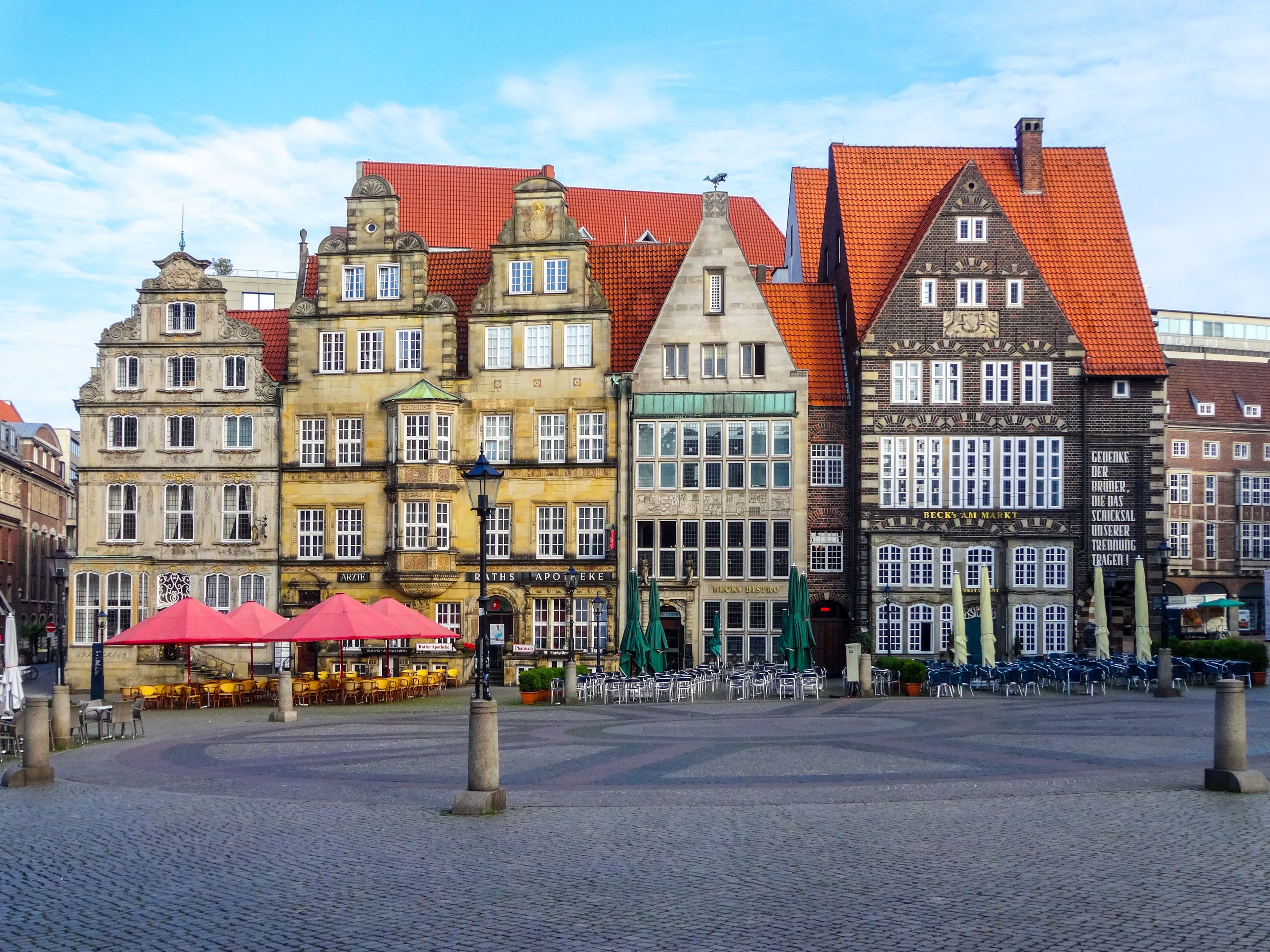
| Course Type | Loop: a single lap, starting and finishing on the Marktplatz beside the Rathaus and the Roland |
| Registration | Open via Davengo, no ballot. Six pricing tiers rising with the calendar, from €59 to €99 for 2026 |
| Ballot Opens | Not applicable, open entry |
| Total Finishers | 1,635 over the marathon distance in 2025. The organiser’s 15,000 figure for 2026 covers the whole programme, not the marathon alone |
| Average Race Day Temperature | 12 to 20°C in September |
| Cutoff Time | 6 hours |
| Free Race Day Transport | Not advertised as included. Tram lines 4, 6 and 8 or buses 24 and 25 serve Schüsselkorb, near the start |
| Course Certification | Officially measured and best-list eligible, registered with the Bremer Leichtathletik-Verband and the DLV |
2026 runs three weeks early, for one year only
The 21st edition falls on 13 September 2026, not the first weekend of October, where this race normally sits. Bremen is hosting the national German Unity Day celebrations on 3 October that year, and the marathon has moved out of the way. This is a one-year shift, not a new permanent slot, so anyone planning a future trip around a mid-September date should wait for the organiser to publish 2027.
History
Bremen has two marathon histories, and they should not be merged. An earlier city marathon ran from 1983 and produced fast times, including a 2:12:38 winner in its first year, before folding in the early 1990s. The current swb-Marathon Bremen is a separate revival that launched on 25 September 2005, after a thirteen-year gap, starting and finishing at the AWD Dome with just over 1,200 pre-registered runners.
The new race briefly experimented with elite incentives. The Polish runner Jarosław Cichocki took an appearance fee in 2006 and won in 2:22:56, a time swb’s own sponsor history still lists as the modern event’s course record. Inga Ruhl set the women’s record of 2:48:03 the following year. From 2007 the organiser dropped appearance money and prize funds altogether, settling the race into mass participation.
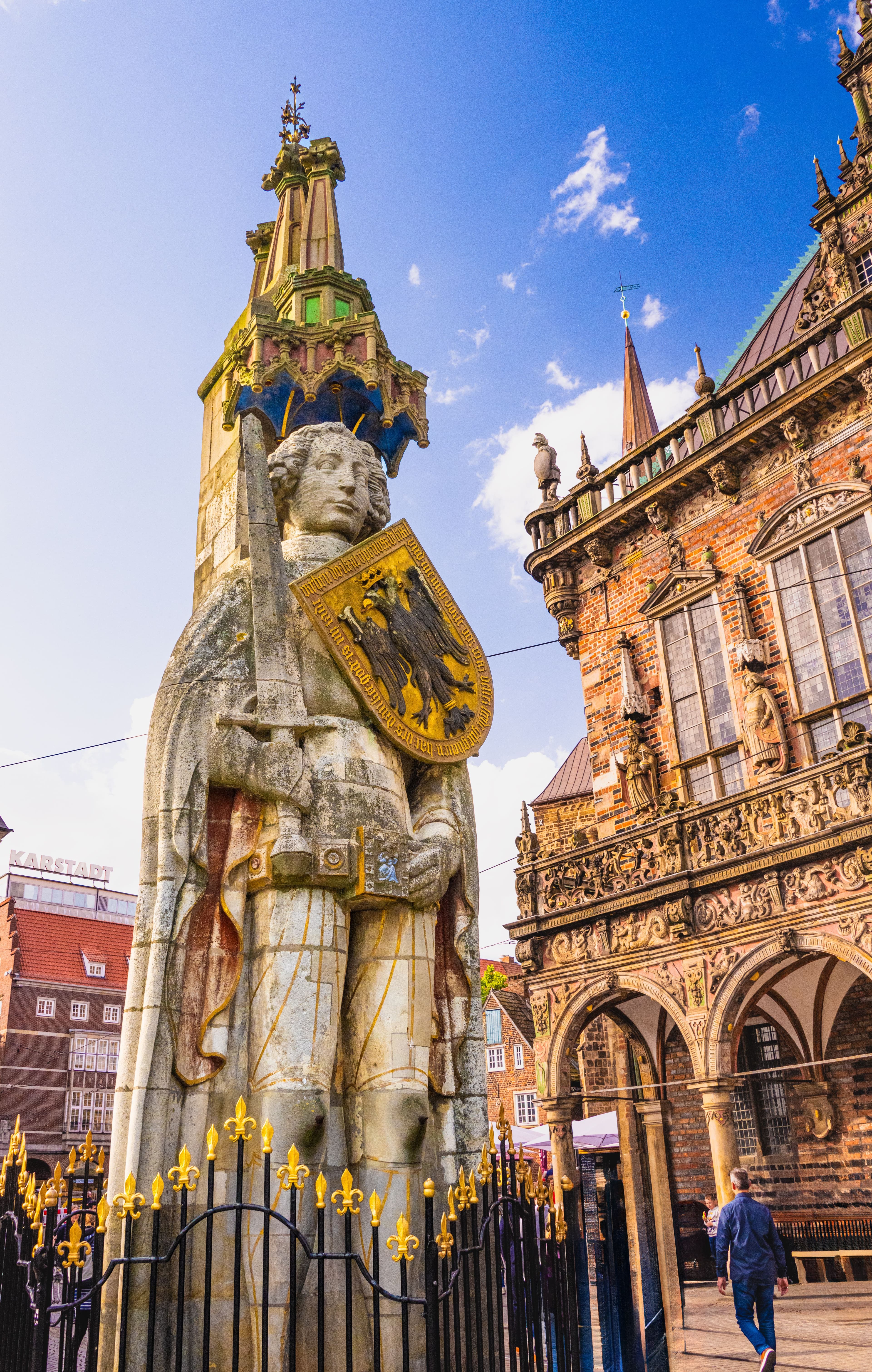
2010 brought the change that gives the race its present shape: the finish moved from the AWD Dome to the Marktplatz, beside the Rathaus and the Roland statue, both UNESCO World Heritage listed. The course grew into a fuller city tour at the same time, picking up the Werdersee, the Botanical Garden and university district, Bürgerpark, the Überseestadt harbour redevelopment, and a late passage through the Weserstadion.
The 2020 edition was cancelled outright, which is why the organiser’s numbering, 2025 as the 20th and 2026 as the 21st, should not be read as twenty consecutive years of racing. Growth since has been steady: roughly 11,000 participants across all distances in 2025, of whom 1,635 finished the marathon, rising to an announced record of 15,000 across the full programme for 2026. The race’s reputation rests on the completeness of that city tour, not on fast times.
The course
The marathon is a single 42.195km loop starting and finishing on the Marktplatz, beside the Rathaus and the Roland. From the centre the route reaches the Weser within 3 km, runs the Schlachte promenade, then crosses to the southern side of the river through the Neustadt to the Werdersee. It works east to the Weserwehr, turns north through the eastern districts to the Botanical Garden and the University of Bremen, comes back west through Bürgerpark and Findorff to the edge of the Überseestadt harbour district, then returns to the centre and heads out along Osterdeich to the Weserstadion before the run home.
Total elevation change is modest, around 22m across the whole loop, and the chart spans only 19 m. The one rise worth knowing about is the last kilometre: the Marktplatz sits about 10 m above the riverside, so the course drops toward the Weser at the start and climbs back up from Tiefer to finish. Bridge crossings add small ramps, and the historic-centre paving near the start and finish changes the footing underfoot. The course is officially measured and best-list eligible, registered with the Bremen athletics federation and the DLV.
Km 0 to 7: Marktplatz, the Schlachte and out to the Werdersee. The 09:30 start sits between the Rathaus and the Roland, which looks superb and runs tighter underfoot than a suburban boulevard would. Paving and cobbles give way to smoother asphalt inside the first kilometre or two. The route reaches the Schlachte riverside by about 3.4km, crosses the Weser into the Neustadt by km 4, and reaches the Werdersee around km 7. Resist weaving through the field on the uneven ground at the start; there is a long way to make up places.
Km 7 to 14: the southern river corridor. This is where Bremen stops feeling like a compact centre-only marathon. The Werdersee and the riverside deich landscape replace shopfronts with long open views, water and trees, and the course runs east along the Habenhauser Deich to the Weserwehr at about 14km, crossing back to the north bank there. Nothing on this section rises more than 5 m.
Km 14 to 25: north and east to the university. The longest sustained stretch away from the centre, turning north through Hemelingen and Schwachhausen to Horn-Lehe, the furthest point from the start at about km 21, then reaching the Botanical Garden at about 24km and the University of Bremen and the Universum science centre at about 25km. Support thins here and the landmarks sit further apart, which is exactly where the official pacers, spaced every fifteen minutes from 3:00 to 5:00, earn their keep.
Km 25 to 33: Bürgerpark, Findorff and the harbour. The route comes back west along Parkallee past Bürgerpark at around 28.5km, passes Torfhafen and Findorff at about 30km, and reaches the eastern edge of the Überseestadt harbour redevelopment through Walle at roughly 32.5km. Parkland gives way to warehouses and open waterfront, crowds are thin, and the wind has more room.
Km 33 to 38: back to the centre and out along Osterdeich. The course returns along the Schlachte at km 35, passes close to the Marktplatz at about 36km without finishing there, then turns out along Osterdeich beside the Weser. Wind is the recurring complaint in finisher accounts of these river sections. On a windy day, run by effort here and let the exact split go. High water has previously forced a diversion above part of the promenade near Tiefer and Osterdeich, so check the current-year route close to race day.
Km 38 to 42.195: the Weserstadion and the finish. The course enters the Weserstadion at about 38.3km, then comes back along Osterdeich to Tiefer. The last kilometre climbs about 10 m from the riverside up to the Marktplatz, the only rise of any size on the course, and finishes over historic-centre paving that is worth a controlled approach if wet.
No official blue line or shortest-route marking has been documented for this course; following the tangents is still worth a measurable amount over 42.195km. Timing uses a shoe-mounted disposable RFID chip, not a bib-integrated one, which matters for anyone used to fitting a bib and forgetting about it.
Running through the Weserstadion
At about 38.3km the course enters the Weserstadion, home of Werder Bremen, one of the more memorable late-race landmarks on the German marathon calendar. With only a few kilometres left after emerging back onto Osterdeich, the temptation to spend everything on the lift of running through a football stadium is real. Save that surge for the final approach to the Marktplatz.
Course Map
The map shows the course: a single loop from the Marktplatz to the Werdersee, north to the university, back through Bürgerpark and the harbour district, then out along Osterdeich to the Weserstadion and home. Tap a marker for details, and scrub the slider or press play to move the orange marker along the course with the elevation profile beneath it.
Out of the UNESCO-listed civic centre, along the Schlachte and across the Weser into the greener southern side. Settle into pace on the historic paving before easing into rhythm on the riverside.
The longest stretch away from the centre, reaching the Botanical Garden and the university around km 24 to 25. Support thins, which is where the 3:00 to 5:00 pacer bands are most useful.
Back west through Bürgerpark and Findorff to the edge of Überseestadt. Runner reports flag this as the hardest psychological stretch: thin crowds, open road, exposed to the wind.
Past the centre at km 36 without finishing, out along the river, through Werder Bremen’s stadium at km 38.3, then back to the Marktplatz. Save the surge for the last approach.
Pacers
Nine official pace groups run a fifteen-minute ladder from 3:00 to 5:00, provided by PacerTeam and identified by target-time flags worn on the back. The marathon goes off in a single wave at 09:30 with no corralling by target time, so find the flag in the field yourself.
What to wear
The 2026 race falls on 13 September, three weeks earlier than this race normally runs, so expect a wider range of conditions than its usual autumn slot would suggest. Mornings can be cool with a fresh northerly off the Weser, but a warm, calm September day is realistic at this date in a way it rarely is in early October.
Wind is the more consistent factor. Several finisher accounts describe a persistent headwind along the river sections in the closing third, so a light wind-resistant layer is worth considering even if the morning starts mild. No official clothing-donation or disposal scheme has been documented, so anyone planning a throwaway layer should check the current participant guide for collection points.
Entry
Registration runs through Davengo with no ballot. Entries are accepted first come, first served across six pricing tiers that step up as the race approaches. The 2026 marathon ran from €59 for entries booked by 31 October 2025 to €99 by 30 August 2026, and the marathon entry includes the finisher shirt as standard, unlike the shorter distances where it is a paid add-on.
The formal online deadline of 30 August has passed for 2026, but the organiser states that on-site late registration remains possible at bib collection if places are still available. Anyone hoping to enter this close to race day should treat that as a possibility, not a plan.
There is no Good for Age or guaranteed-entry pathway, and no confirmed charity entry system or international tour-operator allocation. Distance changes down to a shorter race were free before the registration deadline; afterwards they are handled at bib collection for €10, while moving up to a longer distance means paying the difference to the current late-entry price.
Place transfers are permitted through a private marketplace before the deadline, with the conditions that seller and buyer already know each other and that resale cannot exceed the original price, plus a €10 processing fee. After the deadline a transfer is handled at bib collection with written authorisation and the original confirmation, also for €10. New participant details must be entered by the day before race day. There is no statutory withdrawal right and no general deferral route documented.
Fast Runner / GFA Standards
Not applicable. No time-qualification entry route is published for this race, and the single marathon wave is not corralled by target time.
Race Weekend
Expo
Bib collection runs at GALERIA Bremen, Obernstraße 5 to 33, in the city centre: Thursday 12:00 to 18:30, Friday 10:00 to 18:30, Saturday 10:00 to 17:30, and a race-morning window from 07:30 on Sunday. Children’s race collection runs until 14:00 around the Lloydpassage. Runners need the emailed registration confirmation with their bib number plus a passport, ID card or driving licence, and proxy collection is possible with written authorisation.
This is a race-centre pickup point, not a large commercial expo, so do not expect Berlin-scale stands. Ordered shirts and pasta-party tokens for the Saturday charity dinner are collected here too. The central location suits anyone staying around the Marktplatz or the Hauptbahnhof, and makes Saturday collection possible without a separate cross-city trip.
Getting to the Start
The marathon starts at 09:30 on the Marktplatz, next to the Rathaus, the Roland and Domshof, which puts most race-day services within walking distance of central hotels. Public transport is not advertised as included in the entry fee. The organiser recommends tram lines 4, 6 and 8 or buses 24 and 25 to Schüsselkorb, followed by a short walk, though race-day service changes should be checked with BSAG closer to the date.
Runners staying at Bremen Hauptbahnhof can walk to the Marktplatz in roughly fifteen minutes under normal conditions, which removes any dependence on race-morning tram changes. From a hotel in the old centre it is simpler still.
Separate men’s and women’s changing areas are provided on Domshof. Marathon and half marathon bag drop is at the Blumenmarkt and accepts only the official starter bag issued with the race bib, with the organiser explicit that it takes no liability for valuables. Showers afterwards are at Verein Vorwärts, Violenstraße 27, within walking distance of the finish.
The timing chip is a shoe-mounted disposable RFID tag, not a bib-integrated system, so fit it according to the instructions in the race pack. After finishing, runners receive a medal and food in the target area, with the marathon finisher shirt, online results, a certificate and a finish video all included in the entry.
Nutrition on Course
Aid on this course is unusually well documented. Water-only points appear at 5km, 28km and 32.5km. Full stations offering water, apple and banana run at 10km, 14.5km and 19.5km. From 25km the full stations add isotonic drink; from 34.5km cola joins them, with a further cola-only point at 38.5km before the last full station at 40.5km.
No gel product or personal-bottle drop-off service is documented, so runners who rely on a particular nutrition brand should plan to carry it.
Spectating
A single-loop course means one sighting per location, but the route passes the Schlachte at km 3 and km 35 and returns close to the centre at km 36 and km 41, so several sightings are realistic. The Marktplatz is the best single spot, combining the start, the finish and the civic centre in one place. The most dramatic late sighting is the Weserstadion at about 38.3km, though for a fast runner that means choosing between the stadium and the finish.
Start, university, finish. Watch the 09:30 start on the Marktplatz, take a tram out toward the university or Bürgerpark for a sighting somewhere around km 25 to 29, then return to the centre for the finish.
Start, Überseestadt, Schlachte. Start at the Marktplatz, travel to Überseestadt for a sighting at about km 32.5, then work back toward the river on foot or by tram as the runner returns through the centre, and walk to the finish.
Weserstadion and the finish. Skip the start and go straight to the stadium for the km 38.3 passage, then move quickly back toward the Marktplatz by tram or on foot. For a fast runner, plan to see one or the other.
Check BSAG race-day diversions before relying on any specific tram route.
Post-Race Food
The Marktplatz finish sits directly beside Bremen’s Altstadt restaurant core, and official target-area catering supplies the first recovery food, so there is no need for a long walk immediately after finishing. The Schlachte riverside, a few minutes away, holds a dense concentration of restaurants and beer halls for a proper meal later in the day, though Sunday opening hours vary by venue and are worth checking.
The organiser also runs a charity pasta party the evening before at Restaurant Frölichs, with three pasta options, booked time slots and a price around €8. That is a pre-race carb-load, not recovery, and it is the only officially named dining partner in the current race material.
Where to Stay
Choose a hotel by its distance to the finish. On this course the finish is also the start, both on the Marktplatz, so one decision covers the whole of race day.
Altstadt and the Marktplatz
The Altstadt is the strongest location available: start, finish, bib collection and much of the city’s restaurant scene all within walking distance, which removes race-morning transport uncertainty entirely. The area can be noisy on a Saturday night, so ask for a room away from the street.
Hauptbahnhof and Bahnhofsvorstadt
The Hauptbahnhof area is the best choice for rail arrivals, with a wider hotel price range than the old centre and the Marktplatz an easy fifteen-minute walk away. Some streets immediately around the station feel less appealing than the historic core.
Bürgerpark and Stadtwald
Bürgerpark and Stadtwald are quieter and greener, with good access to the course itself around km 29, and are notable for two official race-organiser hotel packages. Getting to the start needs a tram or a longer walk.
Viertel and Ostertor
The Viertel and Ostertor have the strongest restaurant and bar scene, and sit close to Osterdeich and the closing stages of the race, which makes them excellent for anyone spectating. Saturday-night noise makes careful hotel selection worthwhile here too.
Überseestadt
Überseestadt has modern waterfront hotels sitting close to the course at about km 32.5, useful for families wanting contemporary rooms and easy spectator access, though less convenient than the Altstadt for reaching the start.
Neustadt
Neustadt sits across the Weser from the centre, with a residential feel, local cafés and proximity to the early part of the course. The Marktplatz is reachable by tram or a moderate walk, which means slightly more race-morning planning than staying centrally.
Recommended hotels
About as close to the Marktplatz start and finish as a premium hotel gets in Bremen. The trade-off for that is the highest price tier on this list.
A reliable mid-range option inside walking distance of both ends of the race, on the edge of the busy Schlachte riverside.
Built around exactly this kind of trip, with strong rail and airport links and a straightforward fifteen-minute walk to the Marktplatz. Less characterful than an old-town hotel.
One of the organiser’s own official runner packages, in a quieter, greener setting close to the Bürgerpark section of the course. Reaching the start needs a tram or a long walk.
The organiser’s value-tier official runner package, close to the university stretch of the course. Further from the evening pull of the Altstadt than a central hotel.
Booking timeline
Book a cancellable room as soon as entry is confirmed, ideally four to six months ahead for the Altstadt or Bürgerpark. The 2026 record of 15,000 participants across all distances puts real pressure on a hotel stock that is modest compared with a larger German city, and the organiser’s own MUNTE and 7THINGS packages are worth checking first, since they are race-specific and limited in number.
The unusual September date also means Bremen’s normal autumn conference and tourism patterns do not fully apply this year, so October pricing history is not a reliable guide. Bremen Airport is close to the city and tram 6 links it directly to the centre and the Hauptbahnhof corridor. Rail from Hamburg or Hannover is straightforward, and UK travellers should compare a direct or connecting flight against rail via a larger German airport before booking.
See & Do
All of these sit at or within a short walk of the Marktplatz finish and the Altstadt hotels.
Rathaus, Roland and Marktplatz
At the finish line, 0 km (0 miles). Both UNESCO World Heritage listed, and already the start and finish of the race itself, which makes the essential sightseeing stop also the one demanding the least extra walking of anything here.
Schnoor
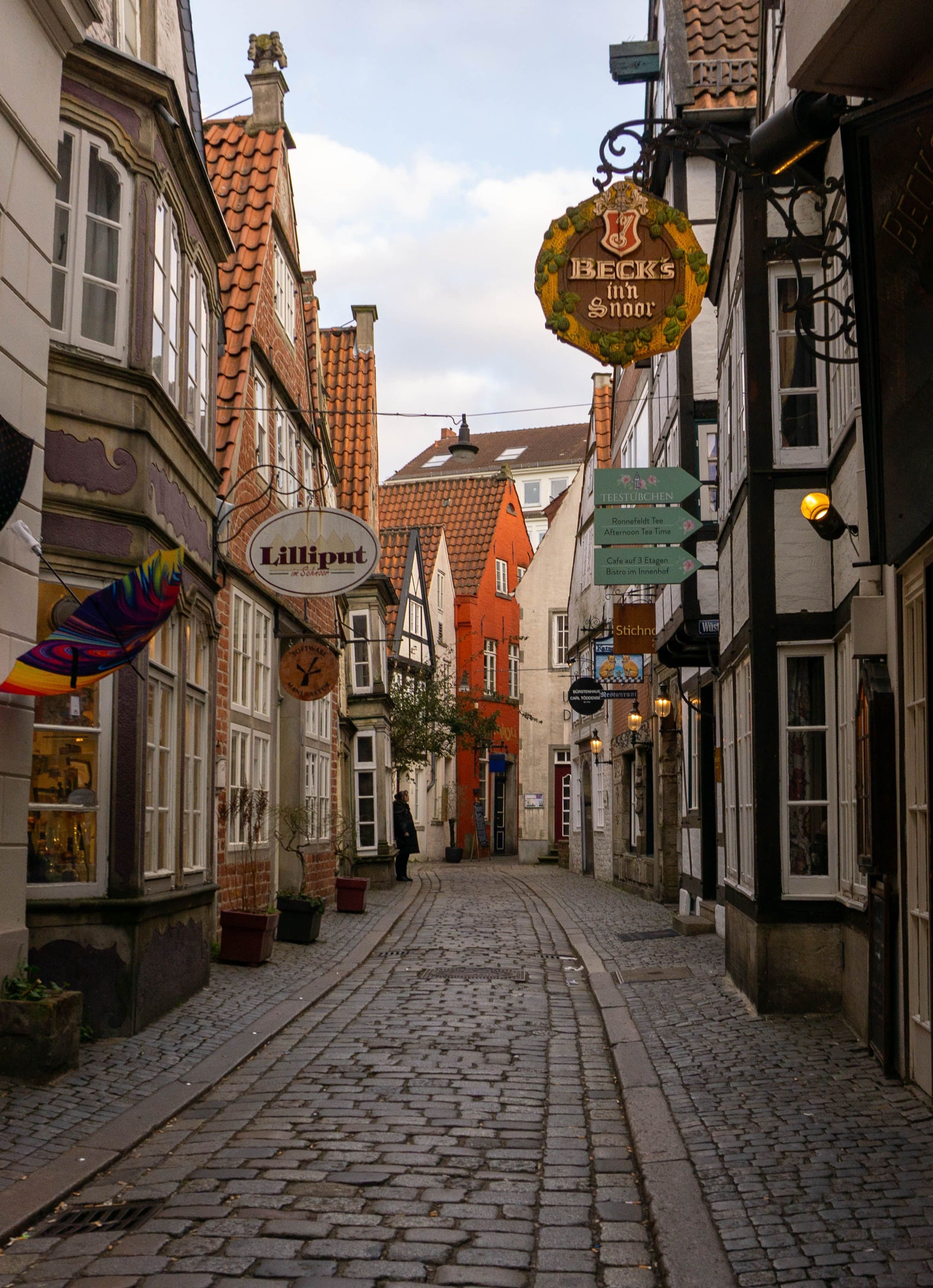
0.3 km (0.2 miles) from the finish. A compact quarter of medieval lanes just off the Marktplatz, good for a slow recovery stroll. The cobbles underfoot are worth knowing about on legs that have just covered 42.195km.
Schlachte waterfront
0.4 km (0.3 miles) from the finish. Bremen’s riverside promenade, with a dense run of restaurants and bars looking over the Weser, and part of the course itself at about 3.4km. Brewery tours tied to the city’s maritime and brewing history should be booked in advance for a race weekend.
Bürgerpark
3.0 km (1.9 miles) from the finish. A landmark on the course at about km 29 and free to enter. Runners who want to revisit it on foot the next day should keep the visit short, having already covered its paths once at speed.
Universum Bremen
3.5 km (2.2 miles) from the finish. A weatherproof science centre sitting directly on the course near the university district at about km 25, and a sensible low-walking option for families or for a wet recovery day.
Worth reading
The Bremen Town Musicians, by the Brothers Grimm. A short fairy tale tied directly to the bronze statue runners pass at both the start and the finish. Not a substantial read, but a specific connection to the exact spot where the race begins and ends.
After the Race
The swb-Marathon Bremen runs in September, and Bremen sits at the centre of a dense northern rail network. Every itinerary below is chosen for short journeys and flat walking, because a cobbled old town is a poor choice for the morning after 42.195km, and two of Bremen’s best day trips involve a great deal of cobble.
Germany’s North Sea port city, with maritime museums and harbour attractions reachable on modest walking from the station. Trades city sightseeing for open water and ship history.
An artists’ village north-east of Bremen, known for its early twentieth-century painters’ colony. Plan around the bus timetable, and check gallery opening days before travelling on a Sunday or Monday.
A fast, frequent rail link and an enormous hotel choice make Hamburg a simple one-night extension, with no car needed at any point. A sensible base for anyone flying home from Hamburg Airport.
Combine Hamburg with a further rail hop to Lübeck’s UNESCO-listed old town. Both centres are walkable but cobbled throughout, so pace the sightseeing accordingly on recovering legs.
September still works for the East Frisian Islands, though ferry schedules and wind depend on the weather. Pick one island; several transfers on tired legs is too many.
Frequently asked questions
Should I stay near the start or the finish?
They are the same place. The marathon starts and finishes on the Marktplatz, so any Altstadt hotel covers both ends of race day without a single extra transport decision.
How far in advance should I book a hotel?
As soon as entry is confirmed, ideally four to six months ahead. The 2026 record of 15,000 participants across all distances puts real pressure on Bremen’s comparatively modest hotel stock.
Is there free transport to the start?
No free race-day transport for bib holders is advertised. Buy a normal BSAG or VBN ticket. The organiser points runners to tram lines 4, 6 and 8, or buses 24 and 25, to Schüsselkorb.
What is the best area to stay?
The Altstadt, for the shortest distance to the start, the finish and bib collection. The Hauptbahnhof area is a close second for rail arrivals, and Bürgerpark suits runners who want a quieter base with an official race-hotel package.
When does bib collection open?
At GALERIA Bremen on Obernstraße: Thursday 12:00 to 18:30, Friday 10:00 to 18:30, Saturday 10:00 to 17:30, and a race-morning window from 07:30 on Sunday. Bring the registration confirmation and photo ID.
What is the weather typically like?
The 2026 race falls on 13 September, three weeks earlier than the usual first-October date, so conditions run from mild and warm to cool and breezy. The exposed river sections make wind a bigger factor than temperature.
How do I get from the airport?
Bremen Airport sits close to the city, with tram 6 running directly into the centre and the Hauptbahnhof corridor. Check for race-weekend service changes closer to the date.
Is there a bag drop?
Yes, at the Blumenmarkt. Only the official starter bag issued with the race bib is accepted, and the organiser takes no liability for valuables left inside.
Should I bring a throwaway layer?
Only if the forecast calls for it. September mornings in Bremen can be mild. No official clothing-donation scheme has been documented, so check the current participant guide for collection points before discarding one.
How do I get back to my hotel after finishing?
A central Altstadt hotel is walkable from the finish. From further out, the BSAG tram and bus network is simplest once race-day diversions lift.