The Race
| Next Race Date | 4 April 2027 (provisional, VERIFY ANNUALLY) |
|---|---|
| Course type | Point-to-point (Preston Park to Hove Lawns, roughly 2.1 km apart by direct line) |
| Registration | Open entry via Let’s Do This, no ballot. The 2026 edition sold out ahead of race day. |
| Ballot Opens | Not applicable: standard open entry. 2027 entries opened 12 April 2026. |
| Total finishers | ~14,000 (2026) |
| Avg race-day temp | Cool to mild, April south-coast conditions with sea-breeze wind exposure. No specific °C range published. |
| Cutoff time | 7 hours |
| Free race-day transport | No confirmed free public transport. Paid Park & Ride operates from a stewarded site off the A23; rail to Brighton or Preston Park stations is the practical option. |
| Course certification | Not confirmed: no AIMS or World Athletics label found for Brighton Marathon specifically. Do not confuse with the separate, AIMS-certified "Brighton Beach Marathon" in a different country. |
| Sleeper Train | Not accessible |
A Sustainable Finish
Since 2026, London Marathon Events has run an opt-in scheme for the finisher medal and T-shirt as part of its sustainability programme. Runners who decline the T-shirt trigger a tree planted in the UK through the Trees Not Tees partnership, and receive a digital certificate showing the tree’s what3words location. Runners who decline the medal instead get a keepsake finish-line photo using a dedicated selfie frame reserved for that choice. Both opt-ins are set during entry and can be changed up to six weeks before race day via the participant dashboard.
History
Brighton Marathon began in 2010 as an independently organised event and quickly established itself as one of England’s largest spring marathons outside London, drawing runners who wanted a big-city marathon experience without the London Marathon ballot. The race changed ownership over the following decade, and London Marathon Events now delivers it as the marathon leg of Brighton Marathon Weekend, alongside the Brighton & Hove 10K and the mass-participation Brighton Miles. That ownership change matters for anyone researching the race second-hand: older race reports and forum threads describe an earlier organiser’s operations, and current logistics, from expo location to pacing bands, reflect LME’s current delivery.
The course has been adjusted across editions, but its identity has stayed consistent: a Preston Park start, a run through central Brighton past the Royal Pavilion, an out-and-back stretch along the clifftops toward Rottingdean and Ovingdean, and a return along Madeira Drive and the seafront to a Hove Lawns finish. The 2026 edition drew more than 14,000 marathon finishers and over 20,000 participants across the full weekend, and the same year saw the debut of the Brighton Trail Marathon, a 36 km off-road South Downs route that joins the standard course for its final 6 km, run alongside the road race.
Brighton’s identity on the UK marathon calendar is as the credible seaside alternative to London: a genuinely large field, a certified-scale operation, and a finish line a runner can walk to from a hotel.
The course
Brighton Marathon starts in Preston Park, north of the city centre, and finishes at Hove Lawns on the seafront, a point-to-point course of roughly 2.1 km between start and finish as the crow flies, considerably longer as run. The first six miles run south through central Brighton, passing the Theatre Royal and the Royal Pavilion before circling The Level. From mile 7 the course climbs onto Marine Parade and Marine Drive and heads east along the clifftops above Brighton Marina toward an out-and-back turn at Ovingdean, reached around mile 11, the last of four climbs the official course notes place “out of the way by Mile 11.” The route then drops back through the city, joins Madeira Drive at mile 15 for a flat out-and-back beside the historic Volk’s Electric Railway, and returns to Aquarium Junction for a second pass through the city centre. The final six miles run west through Hove along Grand Avenue, Church Road, Kingsway and Hove Promenade, finishing at Hove Lawns. Total elevation gain is 477 ft (145 m), concentrated in the first eleven miles; the closing stages are flat but exposed to the sea breeze.
Miles 1-6: the city warm-up.The course leaves Preston Park flat, then climbs 20 m over 700 m up Preston Park Avenue before dropping down Preston Drove. Miles 2 to 5 run broadly flat north along London Road before turning back into the city, passing the Theatre Royal and the Royal Pavilion, circling The Level, and taking on a 12-metre climb at St James’s Street.
Miles 7-13: the clifftop out-and-back.Lower Rock Gardens leads onto Marine Parade, a flat, elevated stretch, before a gentle rise onto Marine Drive toward the cliffs. The rolling section between miles 9 and 10 is where the race settles into its rhythm, followed by a steady 14-metre climb into the Ovingdean turn, the last of the course’s four climbs. The return leg passes above Brighton Marina and descends back onto Marine Drive, carrying runners through halfway.
Miles 14-19: Cheer Zones and the city centre.Aquarium Junction brings a wall of noise from the crowds packed along the streets. The course joins Madeira Drive at mile 15 through the Charity Cheer Avenue and the Brooks Cheer Zone, then runs a flat out-and-back beside the Volk’s Electric Railway, in operation since 1883, before returning to Aquarium Junction for a second look at the Palace Pier, the i360, the Grand Hotel and the Peace Statue.
Miles 20-23: Hove’s community stretch.Grand Avenue and Church Road are where the race gets harder and the crowd support tends to matter most, with Hove’s residents out along the route offering sweets and homemade signs.
Miles 23-26.2: the finish. The course turns onto Kingsway and then Hove Promenade, passing the coloured beach huts at mile 25, before finishing past Hove Plinth on Hove Lawns.
Follow the blue tangent line throughout: on a course with this many direction changes along the seafront and clifftop, running the widest legal line adds real, measurable distance over 26.2 miles. Chip timing starts and finishes at the marked mats in the start and finish areas at Preston Park and Hove Lawns respectively; there is no separate finish-line landmark to watch for beyond the mat itself.
Course Map
The map shows the point-to-point route from Preston Park through central Brighton, out along the clifftops to the Ovingdean turn, back along Madeira Drive, and finishing at Hove Lawns, plus pack collection and the three railway stations serving the race. Tap a marker for details, and scrub the slider or press play to move the orange marker along the course with the elevation profile beneath it.
Flat out of Preston Park before a short, sharp climb up Preston Park Avenue, then broadly flat running north and back through the city centre past the Royal Pavilion. Settle in and let early pace come to you.
The course’s four climbs are concentrated here, finishing with the Ovingdean turn around mile 11. Treat the climbs as effort-based, not pace-based, and expect the sea breeze to bite on the exposed clifftop sections.
The loudest section of the course, running Madeira Drive’s Cheer Avenue and back past Brighton’s seafront landmarks. Easy to go out too hard on the crowd noise alone.
Flat but exposed, with Hove’s residents providing the closing crowd support along Grand Avenue and Church Road before the final stretch along Hove Promenade to Hove Lawns.
Pacers
RunBrighton provides the official pace team, covering thirteen goal times from 3:00 to 7:00 across eight staggered waves.
| Wave | Start time | Corrals | Pacers available |
|---|---|---|---|
| Wave 1 | From 9:45am | Wave 1 | 3:00, 3:15, 3:30 |
| Wave 2 | Staggered after Wave 1 | Wave 2 | 3:30, 3:45 |
| Wave 3 | Staggered after Wave 2 | Wave 3 | 3:45 |
| Wave 4 | Staggered after Wave 3 | Wave 4 | 4:00 |
| Wave 5 | Staggered after Wave 4 | Wave 5 | 4:00, 4:15, 4:30 |
| Wave 6 | Staggered after Wave 5 | Wave 6 | 4:30 |
| Wave 7 | Staggered after Wave 6 | Wave 7 | 4:45, 5:00 |
| Wave 8 | Staggered after Wave 7 | Wave 8 | 5:00, 5:15, 5:30, 5:45, 6:00, 6:15, 6:30, 6:45, 7:00 |
Runners can move back to a later wave on the day without notifying the organiser in advance, but cannot move to an earlier wave. Exact wave clock times are confirmed roughly five weeks before race day.
What to wear
Brighton runs in April on the English south coast, which means cool starting temperatures, a real chance of rain, and near-certain wind exposure once the course reaches the seafront and clifftops. Preston Park is an open, unsheltered start venue, so a throwaway layer is worth bringing; LME’s bag-drop and start-area facilities make this straightforward. The clifftop miles between 7 and 13 are the most wind-exposed section of the course, and a light wind-resistant layer is worth carrying even if temperatures elsewhere feel mild. Sea fog is an occasional April feature on this stretch of coast and can affect visibility without necessarily meaning cold conditions, so dress for wind before dressing for rain. Sun protection is still worth considering for the later waves finishing into late morning, since the seafront offers no shade at all.
Entry
Brighton Marathon runs on open, first-come entry through Let’s Do This, with no ballot or qualifying time. The 2026 edition sold out before race day, so entering promptly once registration opens matters more than for a ballot race, where timing makes no difference to the odds. 2027 entries opened on Sunday 12 April 2026. Entry prices reported by third-party listings for the 2027 event ranged roughly £20–£80, but these should be confirmed against the official price bands before publishing a specific figure.
There is no confirmed fast-runner or Good for Age entry route for Brighton Marathon; entry is open to anyone aged 18 or over on event day, with no qualifying time required. Charity entry is available through LME’s partner-charity scheme for runners who do not want to rely on open entry alone, and the event offers no deferral, transfer or refund on a confirmed place under its general conditions of entry, which is worth flagging clearly to runners weighing up whether to enter early.
Participants can start in a later wave than the one they were assigned without notifying the organiser, useful for runners wanting to start alongside a slower friend, though moving to an earlier wave is not permitted.
Fast Runner / GFA Standards
Not applicable. Brighton Marathon has no confirmed fast-runner or Good for Age entry route: entry is open to anyone aged 18 or over, checked against the official FAQ and entry pages, which describe only standard open entry and charity places.
Race Weekend
Expo
Event packs are posted to UK-based entrants ahead of the race (by early April in past years); there is no conventional expo. Runners who do not receive their pack by post, and all international entrants, collect it in person from one of two locations: the DoubleTree by Hilton Brighton Metropole on Kings Road (10:00-18:00 on the Friday before race day) or an information point in Preston Park itself (from mid-morning on the Saturday before race day, exact hours confirmed closer to the event). Bring a copy of your booking confirmation and photo ID if collecting your own pack; someone collecting on your behalf needs your written consent, a copy of your ID and their own ID. There is no separate ticketed expo hall with a trade show in the way some larger marathons run one; the Saturday Preston Park collection point doubles as the closest thing to an expo, alongside the wider Brighton Marathon Weekend festival activity in the park.
Race Morning
The race starts and finishes at different venues, Preston Park and Hove Lawns respectively, so plan the morning around getting to Preston Park. Brighton and Preston Park railway stations both serve the start; runners staying centrally can walk or take a short bus ride, while those parking further out should use the stewarded Park & Ride site off the A23, since there is no parking at Hove Lawns and road closures begin around 07:00 on race day.
Waves start from 09:45, and runners can move back to a later wave without telling the organiser but cannot move earlier. Toilets, including accessible toilets, are available in both the start and finish areas and at regular points on the course; runners with a bladder or bowel condition can register in advance for a Just Can’t Wait card, and bladder pads and tampons are stocked at information points and drinks stations throughout. Preston Park has a Parent and Child Space and a Multi Faith Prayer Space at the start; Hove Lawns adds a Sensory Calm Space at the finish for anyone who needs a moment away from the finish-line crowds.
Bag drop operates at the start. A dedicated Disability Support Hub sits at mile 15, and three accessible spectator areas are marked by what3words locations along the route. On finishing, runners collect their chosen combination of medal, T-shirt and water before making their way to the family reunion point, and should expect the Hove Lawns finish area to be busy and worth pre-arranging a specific meeting spot for, given the seafront crowds after a 14,000-strong field comes through. The cutoff time is seven hours from the start.
Nutrition on Course
Water is available at miles 2, 4, 6, 8, 10, 12.5, 14, 16, 18, 20, 22 and 24, and again in the finish area, twelve stations across the course. HIGH5 Zero electrolyte drink is served in cups at miles 7, 15, 21 and 23, and HIGH5 Energy Gel Aqua, a liquid gel format, is available at miles 15 and 21 only. Runners who prefer to carry their own bottle or hydration pack can use dedicated refill points at miles 4, 7.5, 12, 16.5 and 20, separate from the main drinks stations. All drinks stations are wheelchair-accessible and staffed by volunteers who hand out drinks. Given the two HIGH5 gel stations sit relatively late in the race, at miles 15 and 21, runners who rely on gels earlier than that should plan to carry their own for the first half.
Spectating
Brighton’s out-and-back sections on the clifftops (miles 7-13) and along Madeira Drive (miles 15-19) give spectators a genuine two-for-one opportunity: a single spot near Marine Drive or the Aquarium Junction area can produce two sightings of the same runner within a realistic window on foot. Three official accessible spectator areas are marked by what3words locations; non-accessible spectating is unrestricted along the rest of the route except where road closures apply. The Hove Lawns finish area has the densest crowds on the day and is the best single spot for a guaranteed sighting, but arranging a specific meeting point in advance matters here more than almost anywhere on the course, given the scale of the crowd converging on a relatively compact seafront lawn.
Post-Race Food
Shelter Hall, a food hall on the seafront near the finish, works well for a group with different appetites, since everyone can choose from a different stall. Fatto a Mano, a Neapolitan pizza restaurant with a central Brighton branch, is a reliable carb-heavy option that takes bookings. Bill’s Brighton offers an all-day breakfast menu that suits a finish time landing anywhere from late morning to early afternoon, useful given how spread out marathon finish times are across a seven-hour cutoff. Book ahead for any of the three on race day itself; central Brighton and the seafront are already busy on a normal spring Sunday, and marathon weekend adds several thousand hungry runners and their supporters on top of that.
Where to Stay
Choose a neighbourhood based on proximity to Hove Lawns, the finish, rather than Preston Park, the start: getting to a park start on fresh legs by bus, rail or a short walk is straightforward from almost anywhere in the city, but getting away from a crowded seafront finish on tired legs is the harder logistical problem, and that should drive the choice of base.
North Laine and Brighton station
Offers the best all-round logistics: a short rail or walk connection to Preston Park in the morning, and a walkable or short-transit route down to the seafront finish afterward, with Brighton’s densest concentration of independent cafés and restaurants on the doorstep. It is busy and noisy on a weekend, which suits runners who want to be in the middle of the marathon weekend crowds and noise.
The Lanes and Old Town
Sits closer to the seafront and offers the most direct finish access of any central option, alongside Brighton’s best concentration of restaurants for a post-race meal. It runs noisy and expensive, and is worth avoiding for anyone particularly sensitive to weekend city noise the night before racing.
Hove
West of the finish along the seafront, calmer than central Brighton while often sitting closer to the actual finish line depending on the year’s exact route, at the cost of a slightly longer trip out to Preston Park in the morning. It suits runners prioritising a quiet night before the race and an easy recovery walk home afterward.
Preston Park
The start neighbourhood itself is quieter and more residential than the seafront, and removes any morning transport stress entirely. Its drawback is the finish: getting back from Hove Lawns to a Preston Park hotel on marathon-tired legs means a bus, taxi or rail connection rather than a walk, the opposite trade-off to a seafront base.
Kemptown
East of the centre, offers characterful independent hotels and a different feel from the main seafront strip, though finish access depends on the exact route each year and it typically needs a taxi or bus to reach Preston Park in the morning.
Recommended hotels
A large, central seafront hotel that suits groups and families needing multiple rooms close to the finish. Expect it to be busy and noisy on marathon weekend given the scale of the property and its seafront position.
A modern, mid-range central base within easy reach of both North Laine’s restaurants and the seafront finish. As a newer hotel, marathon-weekend rates and availability are worth confirming early.
A practical, no-frills option for runners arriving by train, given its position close to Brighton station and the rail connection out to Preston Park.
A boutique option in the heart of The Lanes, close to both the finish and Brighton’s strongest restaurant cluster, suited to a runner prioritising post-race comfort over budget.
A budget-leaning seafront option with mixed private and shared-room formats, useful for runners travelling solo or on a tighter budget who still want to be near the finish.
Booking timeline
Book accommodation as soon as an entry is confirmed; wave assignments and start times are only released about five weeks before race day. Brighton is a popular weekend-break destination independent of the marathon, so hotel supply is naturally tighter than in a city that depends entirely on the race for its weekend trade, and prices on marathon weekend routinely run above a normal spring Sunday even before the race-specific premium is added. Book refundable rates where available, since wave times and exact road closures are only confirmed a few weeks out and might affect which neighbourhood makes the most sense. Flights are less relevant for a UK-based race reachable easily by train from London, but overseas entrants flying into Gatwick should book early: Gatwick’s direct rail link to Brighton is fast and frequent, and last-minute fares into London Heathrow followed by a rail or coach transfer cost more in both time and money.
See & Do
The finish sits at Hove Lawns, with central Brighton and the seafront landmarks within easy walking distance.
Royal Pavilion
George IV’s Regency-era Indo-Saracenic palace sits in the centre of Brighton and the marathon route runs directly past it around mile 5. Its indoor state rooms make it a sound pre-race or wet-weather option, and standing for a full self-guided visit is manageable on tired legs the day after if paced with a sit-down break in the gardens.
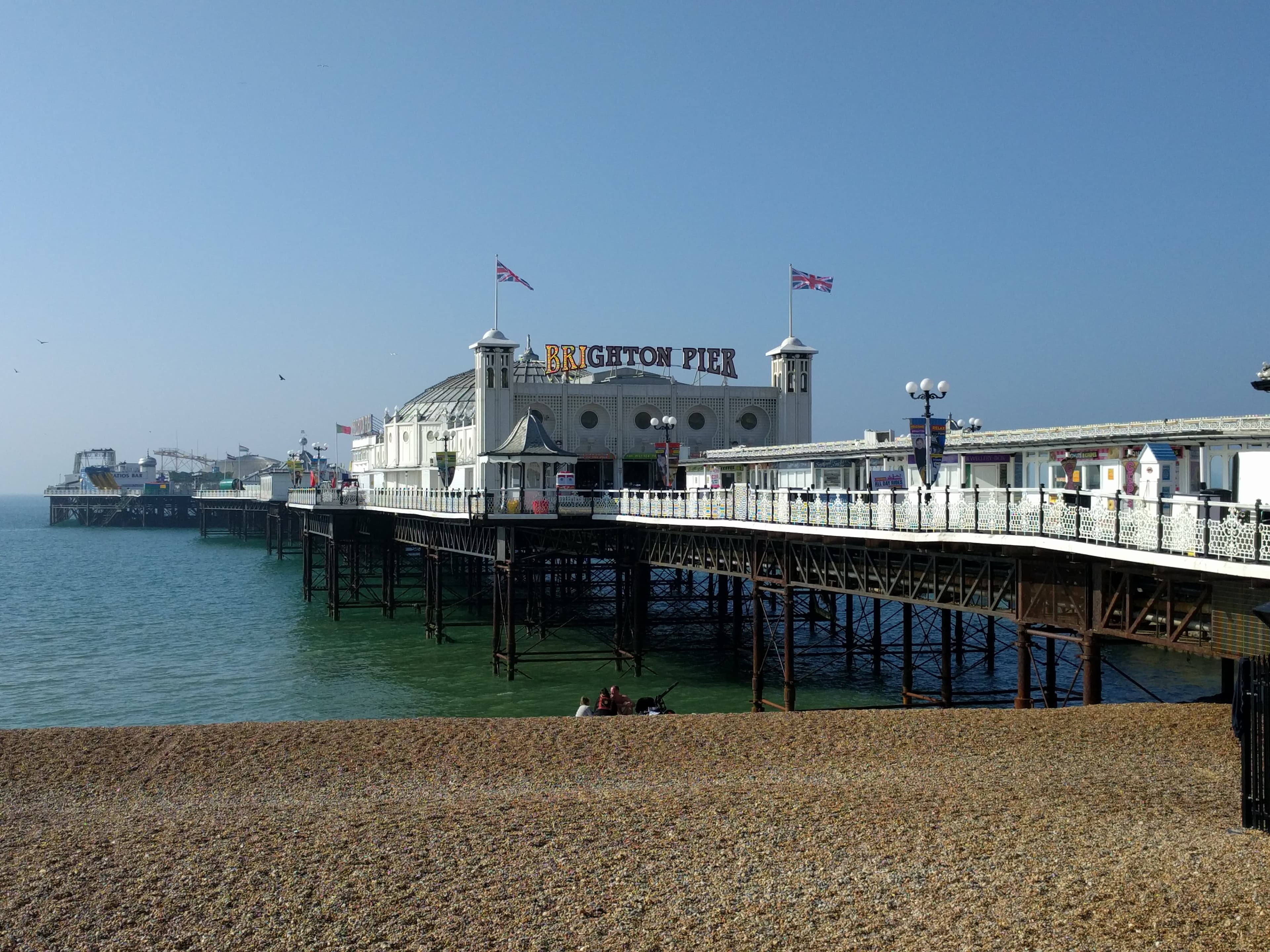
Brighton Palace Pier
The Victorian pleasure pier is the low-effort, zero-booking option: free to walk, open late, and visible from most of the seafront finish area. It is exposed to wind, so it suits a short visit on the evening of the race, when a cool breeze off the Channel is the norm in April.
The Lanes and North Laine
Brighton’s two historic shopping and dining quarters sit back-to-back in the centre, one a maze of narrow lanes with independent jewellers and antique shops, the other a livelier stretch of cafés, record shops and vintage clothing. Both are flat, easy walking distances between hotels and restaurants without requiring a specific plan.
South Downs and Devil’s Dyke
The chalk ridge above the city gives sweeping South Downs views and genuine countryside within a short bus ride, though the terrain, unpaved paths with real elevation change, makes it a better plan for the day before the race than immediately after it. April conditions on the Downs can be windy and, following wet weather, muddy underfoot.
Read Before you Run
Brighton Rock
Graham Greene
Greene’s 1938 novel is set among Brighton’s seafront gangs and racecourse rackets, and its Brighton, seedy and specific about the geography of the pier and the Lanes, still maps closely enough onto the modern city that a runner walking the same streets the day after finishing will recognise them.
After the Race
Brighton Marathon runs in April. These itineraries range from a same-day trip around Brighton’s own seafront to a three-night extension to London.
A low-effort option for runners not travelling further: the Royal Pavilion’s indoor state rooms, the Lanes’ flat shopping streets, and a short pier walk, all reachable without a train ticket. April’s wind means keeping the outdoor portions brief and flexible.
A compact county town built around a Norman castle and a warren of medieval lanes, with a strong independent food and brewing scene. Close enough for an easy single night without a demanding onward journey.
A South Downs base built around a flat riverside walk through the Cuckmere Valley to the sea, with the Seven Sisters cliffs available as a harder optional extension once the legs recover. Genuinely rural, a contrast to the seafront city the marathon itself is run in.
The obvious add-on for runners flying in from overseas, with direct rail from Brighton removing any need for a second short-haul flight or long transfer. Works in any April weather, given how much of London’s appeal sits indoors.
Frequently asked questions
Should I stay near the start or the finish?
Base yourself near the finish at Hove Lawns rather than the Preston Park start. Getting to a park start on fresh legs is easy from almost anywhere in Brighton by bus or rail; getting away from a crowded seafront finish on tired legs afterward is the harder problem, so let that drive your choice of hotel.
How far in advance should I book a hotel?
Book as soon as your entry is confirmed. Brighton is a popular independent weekend-break destination, so marathon-weekend hotel supply tightens earlier than in a city that relies solely on race weekend for its trade, and central and seafront options sell out or rise in price well ahead of race day.
Is there free transport to the start?
No confirmed free public transport exists for Brighton Marathon. A stewarded Park & Ride operates from a site off the A23 for a fee; walking, cycling or taking a normal rail or bus service to Brighton or Preston Park station is the practical alternative, since there is no parking at Hove Lawns and road closures begin around 07:00.
What is the best area to stay?
North Laine and the area around Brighton station offer the best balance: a short rail or walk connection to the Preston Park start, walkable or short-transit access to the Hove Lawns finish, and the densest concentration of independent restaurants and cafés in the city.
When does the expo open?
There is no conventional expo hall. Event packs are posted to UK entrants ahead of race day; anyone who doesn’t receive theirs, plus all international entrants, collects from the DoubleTree by Hilton Brighton Metropole on the Friday before the race or from an information point in Preston Park on the Saturday. Exact hours are confirmed closer to each event.
What is the weather typically like?
April on the south coast means cool-to-mild temperatures with a real chance of rain and near-certain wind exposure once the course reaches the seafront and clifftops between miles 7 and 19. Dress for wind first, then for rain or sun depending on the forecast.
How do I get from the airport?
Gatwick Airport has a direct, fast rail link to Brighton and is the easiest option for overseas entrants. Heathrow requires a rail or coach connection into London followed by a further train south, so Gatwick is worth prioritising when booking flights if there’s a choice.
Is there a bag drop?
Yes, bag drop operates at the start in Preston Park.
Should I bring a throwaway layer?
Yes. Preston Park is an open, unsheltered start venue, and April mornings on the south coast are cool enough that a throwaway layer is worth bringing.
How do I get back to my hotel after finishing?
Walk away from the densest crowds around Hove Lawns before trying to use rail, bus or taxi services, which will be under heavy demand immediately around the finish. Agreeing a specific meeting point with anyone supporting you, away from the finish chute itself, makes reconnecting considerably easier given the scale of the crowd.