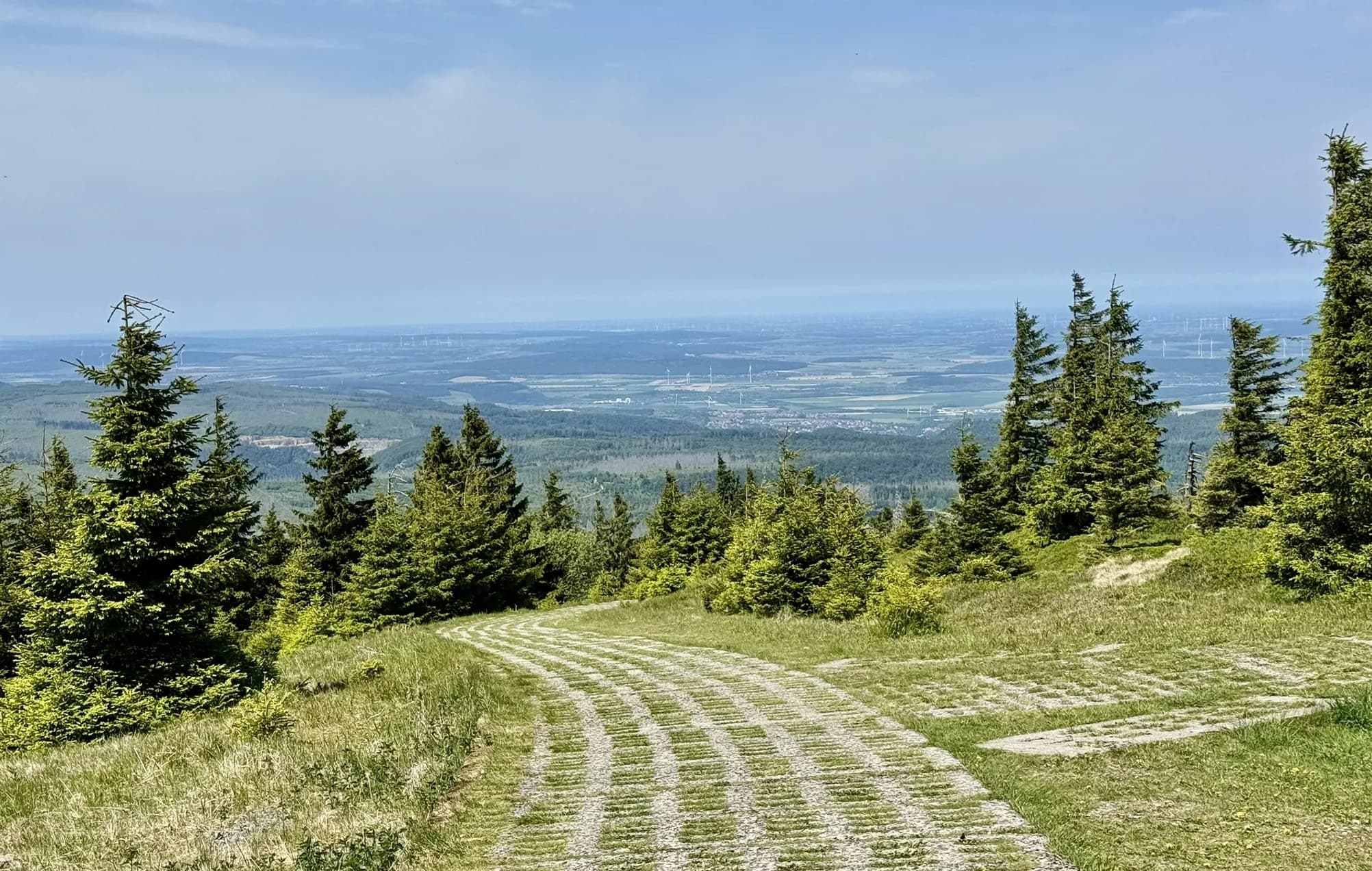
The Race
| Next Race Date | 10 October 2026 (Saturday), the 48th Harz-Gebirgslauf, 09:00 start |
|---|---|
| Course Type | Mountain trail. Start and finish at Himmelpforte, Wernigerode-Hasserode, over the 1,141m Brocken summit and back |
| Registration | Open, no ballot, capped at 1,000 marathon runners for nature conservation. Tiered pricing from €42 |
| Ballot Opens | Not applicable, open entry until the cap is reached |
| Total Finishers | 3,169 across the whole event programme in 2025. A marathon-only figure is not published |
| Average Race Day Temperature | Highly variable. Summit conditions can be near-freezing and windy while Wernigerode itself is mild |
| Cutoff Time | 6 hours overall, a 15:00 finish. Mandatory intermediate cutoff of 3 hours to clear the summit by 12:00 |
| Free Race Day Transport | Overnight visitors receive a WERNIGERODE-ticket (HATIX) for free Harz-district bus travel, tied to accommodation, not the race bib |
| Course Certification | DLV-approved Volkslauf. Not a World Athletics Label race and not a measured road course |
The 12:00 summit cutoff decides your race
Runners must clear the Brocken summit by 12:00, three hours after the 09:00 start, or be removed from classification. That is materially stricter than the six-hour overall cutoff, and it means the first 19km of this race are run against a different clock from the last 23km. Anyone whose realistic uphill split is close to three hours should plan the climb around this checkpoint from the first kilometre.
History
The Harz-Gebirgslauf was founded in January 1978 as a hiking section of the then BSG Einheit Wernigerode, with Herbert Pohl as its founding figure. The first race ran on 14 October 1978, and its politics were shaped directly by the GDR’s inner-German border regime: the course ran close enough to the sensitive border zone that only 300 of roughly 1,200 written applications could be authorised. The original event used 10km, 26km and 39km distances, not today’s fixed set, and it quickly became one of East Germany’s most significant mass-participation endurance events, second in the Volkssport calendar only to the Rennsteiglauf.
The race evolved over subsequent decades into its current form, with the Brocken-Marathon as its defining event. The Brocken’s exposure sets it apart from lowland road marathons: the organiser explicitly reserves the right to alter the route if summit conditions turn dangerous, and it is a working part of the event’s operation.
The course records, Steven Lambeck’s 2:39:05 in 2000 and Diana Lehmann’s 3:15:01 in 2004, both date from earlier in the race’s history and should be read in that context, not as recent form. The marathon field is capped at 1,000 runners for nature-conservation reasons, a real constraint given the route’s passage through protected Harz terrain. The wider event, spanning a half marathon, 11km, 5km, children’s race and hiking and Nordic walking options alongside the marathon, is considerably larger: 3,169 finishers across the full 2025 programme. The 2026 edition carries the number 48, marking 48 years since that first race through Cold War-era border restrictions.
The course
The Brocken-Marathon starts and finishes at Himmelpforte in Wernigerode-Hasserode and climbs from the northern Harz foothills to the 1,141m Brocken summit, the highest point in the Harz, before descending back to Wernigerode. Total ascent runs to more than 1,000m. It carries DLV Volkslauf approval, not a World Athletics Label, and the organiser explicitly reserves the right to reroute if summit weather becomes dangerous.
The route crosses the Brockenbahn narrow-gauge railway close to the summit. Marshals stop runners if a train is approaching, and ignoring that instruction can mean disqualification. It costs time through no fault of the runner, and it is simply part of the event.
The first eight kilometres are not the climb. The course rolls between roughly 280m and 355m, with short rises of 35 to 40m, and drops 71m to its lowest point at the Ilsetal around km 8. From there it gains about 840m in eleven kilometres to the summit at km 19, an average of 7.6%, and the steepest part comes last: roughly 235m between km 17 and 19, at 12 to 14%. The descent is not continuous either. After losing about 560m to km 32, the course climbs 43m on the Ellenbogen-Chaussee and another 28m around km 36 to 37, then drops 235m in the last 5km.
Km 0 to 9: Himmelpforte to the Ilsetal. The 09:00 start sits inside a full event village at Himmelpforte, with toilets, changing rooms, showers, wardrobe and medical support all on site. The opening kilometres leave the event area and roll through Harz forest, climbing 40m in the first 2km and dropping 71m into the Ilsetal by km 8. Effort matters more than pace from the outset: this is trail running, not road racing, and the first aid station at Ilsetal marks the point where the sustained climbing properly begins.
Km 9 to 17: Stempelsbuche to Eiserner Tisch. The real climb. The course gains roughly 550m between Ilsetal and Eiserner Tisch, passing Stempelsbuche at 15km; the gradient steepens from about 5% to 7% through this section. Eiserner Tisch has unusual significance: in poor conditions the organiser distributes yellow protective jackets here for the summit passage. That detail alone says how seriously to treat the Brocken’s microclimate. October can bring strong wind and near-winter temperatures on the summit while Wernigerode itself feels unremarkable.
Km 17 to 21: the summit and the cutoff. The steepest ground of the race is the final push from Eiserner Tisch: roughly 235m in 2km, at 12 to 14%, on the Hirtenstieg. The high point comes at about km 19, at 1,141m. Runners must be past it by 12:00 or be pulled from classification. The course crosses the Brockenbahn tracks around here, and a passing steam train can stop the race temporarily.
Km 21 to 30: Knochenbrecher, Brockenbett and the long descent. After the high point the course turns predominantly downhill, but downhill here does not mean easy. The Brockenstraße and Glashüttenweg lose about 560m between the summit and km 32, averaging 4.4% with stretches near 8% around km 29, and forest surfaces demand concentration over speed. Aid at Knochenbrecher and Brockenbett breaks up the transition off the summit, with Skihütte Hohnekopf at 30km.
Km 30 to 39: Steinerne Renne to Kastanienplatz. By this point the field has spread dramatically across the mountain. The descent is interrupted by two climbs, 43m on the Ellenbogen-Chaussee around km 32 and 28m around km 36 to 37, which hurt on legs that have been braking for 13km. Support concentrates around the accessible aid stations, so expect long, quiet forest sections between Steinerne Renne at 34km, Mönchsbuche at 37km and Kastanienplatz at 39km.
Km 39 to 42.2: the final descent into Hasserode. The closing 5km drop 235m back into Hasserode, nearly 5% on average and around 6% in the last kilometre, to the Himmelpforte event area, with finish closure at 15:00 and the site staying active until 16:00 for warm showers, wardrobe retrieval and finish catering.
There is no blue tangent line to follow here. The route is fixed single-track for much of its length, and pacing should be managed by effort against the 12:00 summit cutoff, not kilometre splits. No official kilometre-by-kilometre elevation table has been published, and the organiser’s own total of more than 1,000m of ascent is the figure to work from.
Course Map
The map shows the route: out from Himmelpforte, up to the Brocken summit at about km 19, then the long descent back through the Harz forest to Hasserode. Tap a marker for details, and scrub the slider or press play to move the orange marker along the course with the elevation profile beneath it.
Out of Himmelpforte into Harz forest, undulating between about 280m and 360m to Ilsetal. The climb has not started yet, and running this section as though it has is the classic mistake here.
Roughly 550m of ascent in eight kilometres, through Stempelsbuche. The yellow protective jackets sometimes issued at km 17 signal exactly how seriously the organiser treats summit weather.
The race’s defining test: past the 1,141m summit by 12:00 or out of classification. The course crosses the Brockenbahn here, and marshals may briefly stop runners for a passing train.
Over 800m of descent on forest surfaces that demand concentration, broken by two short climbs at km 32 and 36. Quads that have climbed for two hours will complain. The field spreads widely and support thins between aid stations.
Pacers
None. Fixed-time pacers are atypical on a mountain trail course of this kind, and no organiser-confirmed pacer programme was found. Pace by effort, measured against the 12:00 summit cutoff, not a target finish time.
What to wear
Standard marathon throwaway-layer advice does not go far enough here. The organiser warns explicitly of high-mountain weather on the Brocken, including strong wind and sudden temperature changes, even though 1,141m is modest by Alpine standards. October in Wernigerode can feel entirely reasonable while the summit is near-freezing and genuinely exposed.
Carry or wear kit suited to cold, windy conditions; a single disposable layer discarded at the start is not enough. In severe conditions the organiser distributes yellow protective jackets at the Eiserner Tisch aid station at 17km specifically for the summit passage; follow marshal instructions and take the kit. Layers that can be added or removed through the race suit the temperature swing between the forested lower slopes and the exposed top far better than a single fixed choice.
Entry
Registration for 2026 opened on 1 March and normal entries close on 4 October, though the marathon’s 1,000-runner conservation cap means the race can sell out well before that nominal deadline. Pricing rises in three steps: €42 to 30 June, €50 from 1 July to 31 August, and €55 from 1 September to 4 October. A final cash-only late entry at €60 is available exclusively on the Friday before the race, 14:00 to 20:30, at the Remise in central Wernigerode. There is no race-day entry.
There is no ballot and no guaranteed-entry pathway for fast runners; entry is open until the cap is reached. No charity-bib allocation or tour-operator entry route has been identified. Entry changes are possible by email through 20 September, after which they are handled only at Friday bib collection for a €5 processing fee.
Given the firm cap and the event’s strong regional following, registering as soon as the March opening arrives is the sensible approach for anyone set on this specific race.
Fast Runner / GFA Standards
Not applicable. No time-qualification entry route exists for this race, and a mountain trail course of this profile is not one where qualifying standards would mean much in any case.
Race Weekend
Expo
This is not a large commercial expo. Bib collection runs on the Friday, 14:00 to 20:30, at the Remise, Marktstraße 1, in central Wernigerode, with a further race-morning window from 07:30 at the Himmelpforte start and finish area. The organiser recommends Friday collection specifically to remove pressure from race morning, when access to Hasserode can be affected by road restrictions. No merchandise stand or bag-size restriction detail was found beyond the standard wardrobe service included in entry.
Getting to the Start
The organiser recommends arriving in Wernigerode on the Friday, since race-day traffic restrictions, particularly in Hasserode, can be substantial. The marathon starts at 09:00 from Himmelpforte, where the full event village is concentrated in one place: toilets, changing rooms, warm showers, wardrobe, medical support, massage and finish catering.
Published public transport options include city buses 201 and 204 and regional bus 264 toward the Hochschule Harz area. Runners staying overnight in Wernigerode receive a WERNIGERODE-ticket with a HATIX component, entitling them to free bus travel across the Harz district for the duration of their stay. That benefit comes from accommodation registration, not the race bib, so day-trippers without a local overnight stay should not assume it applies to them.
Wardrobe service is included in the entry fee, with changing rooms and warm showers at the start and finish area. Both are worth more here than at a road marathon, given how cold and wet a runner can get on the descent from the Brocken.
Nutrition on Course
Nine aid stations cover the course, each with a published service window, reflecting how widely the field spreads over more than 1,000m of climbing.
| Station | Distance | Open |
|---|---|---|
| Ilsetal | 9 km | 09:00 to 10:30 |
| Stempelsbuche | 15 km | 09:30 to 11:30 |
| Eiserner Tisch | 17 km | 10:00 to 12:00 |
| Knochenbrecher | 21 km | 10:15 to 12:30 |
| Brockenbett | 24 km | 10:30 to 13:00 |
| Skihütte Hohnekopf | 30 km | 10:30 to 13:30 |
| Steinerne Renne | 34 km | 10:45 to 14:00 |
| Mönchsbuche | 37 km | 11:00 to 14:15 |
| Kastanienplatz | 39 km | 11:00 to 14:30 |
Exact drink and food products are not specified in the organiser’s material. Given the long gaps between the early stations and the demands of mountain weather, runners with specific nutrition needs should plan to carry their own fuel and fluid.
Spectating
Spectating here is fundamentally different from a road marathon. Chasing a runner up to the Brocken summit is impractical by road and undesirable given the route’s passage through protected mountain terrain. The realistic strategy is to treat Himmelpforte, the shared start and finish, as the anchor for the whole day.
Start and finish only. Watch the 09:00 start at Himmelpforte, spend the middle hours in Wernigerode or Hasserode, then return for a finish that will be spread over several hours given the terrain.
Wernigerode centre. Watch the start, take a local bus into the old town for the middle of the day, and return to Himmelpforte in good time for the finish.
The Brockenbahn as its own excursion. A companion can ride the Harz narrow-gauge railway toward the Brocken while the race is on. Timetables, summit access and the runner’s actual crossing time are not predictable enough to promise a sighting from the train, so treat it as an excursion in its own right.
Post-Race Food
The event provides finish food at Himmelpforte, so immediate recovery calories are covered without travelling anywhere. Wernigerode’s old town, a short bus or taxi ride from Hasserode, holds extensive restaurant choice for a proper meal later, though Saturday opening hours and reservation availability are worth checking directly. Given the toll of more than 1,000m of descent on top of the climb, a hot meal reasonably close by, in Hasserode itself or reached by bus or taxi, beats a long walk into the centre.
Where to Stay
Stay in Hasserode, as close to Himmelpforte as possible. This race shares its start and finish, so the usual finish-first principle simplifies to a single recommendation: proximity to Himmelpforte above everything else.
Hasserode
Hasserode is the best race base by a wide margin. The organiser specifically lists accommodation within around 500m of Himmelpforte, which removes any race-morning transport question entirely on a day when Hasserode road access is restricted.
Wernigerode Altstadt
The Altstadt is the best choice for restaurants and sightseeing, but sits 2 to 3km from the race zone, close enough for a bus but not a comfortable walk on race morning or immediately after finishing.
Around Hochschule Harz
The Hochschule Harz area is a reasonable compromise between Hasserode and the centre, with published race-day bus access on line 264.
Schierke
Schierke offers mountain surroundings closer to the Brocken itself, but weaker start-day logistics than staying in Wernigerode. It suits an extension stay before or after the race.
Ilsenburg
Ilsenburg is a good base for a wider Harz stay, but not recommended for race morning unless a car or taxi arrangement is already secured, since it sits further from Himmelpforte than the other options here.
Recommended hotels
One of the organiser’s own recommended properties, with apartment-style accommodation, a pool and sauna. Popular enough that minimum-stay requirements may apply on race weekend.
The organiser’s other directly recommended property, similarly close to Himmelpforte. A themed hotel, so check event-weekend pricing before booking.
A characterful central hotel in Wernigerode’s old town, though it needs a bus or taxi to reach Himmelpforte.
A reliable central option requiring a short local transfer to Himmelpforte on race morning.
Quality and availability vary considerably between individual properties. Book early: the stock this close to Himmelpforte is limited.
Booking timeline
Book Hasserode accommodation as early as possible, ideally around the same time entry opens on 1 March. The 1,000-runner cap means demand for the closest accommodation can outpace even the race’s own entry numbers, and Wernigerode carries genuine independent tourist demand as a Harz mountain town regardless of the race.
There is no major airport near Wernigerode. International travellers typically arrive by rail via a larger German hub and continue by regional train, and the organiser’s own advice to arrive on Friday is worth building directly into the travel plan.
See & Do
Wernigerode’s old town is the natural base for anything after the race. Distances below are from the Himmelpforte finish.
Wernigerode Altstadt and Rathaus
2.5 km (1.6 miles) from the finish. A compact, largely flat old town with a distinctive half-timbered town hall, well suited to gentle post-race sightseeing with plenty of cafés to break up the walking.
Harz narrow-gauge railway
Departs from Wernigerode Westerntor station, 3 km (1.9 miles) from the finish. Directly relevant to the race, since the marathon crosses these same tracks near the summit. Riding the line after running over the mountain gives a different, seated perspective on the same terrain. Book ahead and check the current timetable.
The Brocken summit, by train
Reached by the Brockenbahn from Wernigerode. Worth doing only if the weather is genuinely good, since the organiser’s race-day warnings about summit conditions apply to sightseers too. After running over it once, most runners find the train a more appealing way to see it a second time.
Wernigerode Castle
3 km (1.9 miles) from the finish. A worthwhile hilltop castle, but the climb up to it makes it better suited to the day before the race, or a second recovery day, than the afternoon immediately after finishing 1,000m of descent.
Worth reading
Faust, by Johann Wolfgang von Goethe. The Brocken is the setting for the Walpurgis Night scene, which gives the mountain runners have just crossed a specific literary association. Choose a current, accessible English translation.
After the Race
The Brocken-Marathon runs in October, and the day after 1,000m of climbing and the same again of descent is not the day for a hike. Everything below is chosen so the trains do the climbing: half-timbered old towns on the flat, and a narrow-gauge railway that goes up the mountain so your quadriceps do not have to.
A UNESCO-listed old town of over a thousand half-timbered buildings, compact enough for a gentle day on legs still recovering from more than 1,000m of climbing and descending.
Another historic Harz town, with a well-preserved old town and former imperial palace, reachable by regional transport for a low-intensity cultural day.
A smaller mountain village closer to the Brocken itself, where the steam railway does the climbing this time instead of your legs. A quiet, low-effort night in the heart of the Harz.
Combine Quedlinburg and Thale with one narrow-gauge mountain railway journey, letting the trains do the climbing. Save any serious hiking for a later trip.
A substantial rail journey rewarded with a proper city stay, minimal physical demand on the first recovery day, and every onward flight option a major capital offers.
Frequently asked questions
Should I stay near the start or the finish?
They are the same place. Hasserode, ideally within about 500m of the Himmelpforte start and finish, is the strongest choice for race weekend.
How far in advance should I book a hotel?
As early as possible, ideally around the March entry-opening date. The 1,000-runner conservation cap and Wernigerode’s standing as a Harz tourist town both squeeze the limited accommodation near Himmelpforte.
Is there free transport to the start?
Overnight visitors to Wernigerode receive a WERNIGERODE-ticket with a HATIX component for free Harz-district bus travel. It comes from accommodation registration, not the race bib, so day visitors should not assume it applies.
What is the best area to stay?
Hasserode for race-day convenience. Wernigerode’s Altstadt is better for restaurants and sightseeing but sits 2 to 3km away, a bus ride on race morning.
When does bib collection open?
Friday 14:00 to 20:30 at the Remise in central Wernigerode, plus a race-morning window from 07:30 at Himmelpforte. The organiser recommends collecting on Friday to avoid race-morning pressure.
What is the weather typically like?
Highly variable and potentially severe on the summit. The organiser warns of strong wind and sudden temperature changes on the Brocken even in October, when Wernigerode itself may feel mild.
How do I get from the airport?
There is no major airport near Wernigerode. Most international travellers arrive via a larger German hub and continue by regional rail, ideally on the Friday as the organiser recommends.
Is there a bag drop?
Yes. Wardrobe service is included in the entry, with changing rooms and warm showers at the Himmelpforte start and finish area.
Should I bring a throwaway layer?
A single disposable layer is not enough here. Carry or wear kit suited to cold, windy summit conditions, and take the protective jackets if they are issued at Eiserner Tisch.
What is the summit cutoff?
Runners must clear the Brocken summit by 12:00, three hours after the 09:00 start, or be removed from classification. It is stricter than the six-hour overall cutoff and should shape pacing from the first kilometre.