The Race
| Next Race Date | Sunday 13 June 2027, 09:10 |
|---|---|
| Course Type | Point-to-point, Courseulles-sur-Mer to Stade Hélitas in Caen |
| Registration | Open, direct online entry against a fixed cap of 5,000 for 2027, opening November 2026. No ballot |
| Ballot Opens | Not applicable: this race has no ballot |
| Total Finishers | Not confirmed. The 5,000 figure is an entrant cap, not a finisher count |
| Average Race Day Temperature | 11.2°C to 20.5°C (Caen-Carpiquet June normals, mean 15.9°C) |
| Cutoff Time | 5 hours 30 minutes, with intermediate checkpoints from 10 km onward |
| Free Race Day Transport | Yes, to the start only: a free shuttle from Cours Général Koenig, 06:30 to 07:30. No return shuttle |
| Course Certification | FFA Bronze Label, French Championship-qualifying. No World Athletics label and no AIMS listing found |
The course is the point
This race was built around the 1944 landings from the start. It starts in the Juno sector at Courseulles-sur-Mer, runs the coast through Sword, turns inland at Pegasus Bridge, and finishes in the city the Battle of Normandy was fought for. The organiser’s English-language name for it is the D-Day Landings Marathon. Run it for the flat coastal opening and the 110 m of climbing and you will have a reasonable day out. Run it knowing what the ground is, and it is a different race.
History
The Marathon de la Liberté began in 1988, created by Jean-Louis de Mourgues, then mayor of Courseulles-sur-Mer. A retrospective gives 11 September 1988 as the first edition: a 15:00 start, around 200 marathon finishers, and roughly 500 more in an accompanying 14 km race. That first running coincided with the opening period of the Mémorial de Caen, which put the race inside the region’s remembrance calendar from the start.
The festival grew in stages. The Pegasus race launched in 1989, a children’s event followed in the early 1990s, and the 50th-anniversary edition in 1994 drew New York City Marathon co-founder Fred Lebow, according to the organiser’s own history. La Rochambelle, the women’s event, began in 2002. A 10 km arrived and Pegasus became a half marathon in 2006. A four-person relay followed in 2013.
The big editions line up with D-Day anniversaries: the 70th in 2014, the 75th in 2019, and the 80th in 2024, when the marathon field was expanded from a typical 2,000 entrants to 5,000, sold out within five days, and left 3,500 people on a standby list. The 2025 weekend also coincided with Caen’s millennium. The organiser calls 2027 its 40th edition, running 10 to 13 June with the marathon on the Sunday.
The course records stand at 2:12:37 for men and 2:35:23 for women: quick, without being the kind of times a genuinely flat course produces.
The course
A point-to-point from Courseulles-sur-Mer to Stade Hélitas in Caen, the two ends 17.5 km apart, with 110 m of climbing published for 2027. The first 16 km run along the coast through the seaside communes to Ouistreham. The route then follows the Caen to Ouistreham greenway beside the Orne canal to Pegasus Bridge at about km 21.5, and climbs gently south through Blainville-sur-Orne and the villages north of Caen to its 63 m high point at km 38. The last 4 km descend into the city on rue d’Épron and rue de Mâlon, cross boulevard Juin, and work through rue Saint-Sauveur, place Saint-Sauveur, place Fontette and place Louis Guillouard before finishing inside the stadium on avenue Albert Sorel.
Km 0 to 13: Juno Beach and the coast. The start is at Courseulles-sur-Mer, in the sector tied directly to the Canadian landings of 6 June 1944. The course runs east along the seafront promenades through Bernières-sur-Mer, Saint-Aubin-sur-Mer, Langrune-sur-Mer, Luc-sur-Mer, Lion-sur-Mer and Hermanville-sur-Mer, never more than 10 m above the sea. It is the fastest-feeling part of the race, and coastal wind changes the effective pace whatever the watch shows. Time banked here is rarely time kept.
Km 13 to 18: Colleville-Montgomery and Ouistreham. Past Colleville-Montgomery, the route reaches the Ouistreham seafront on Boulevard Aristide Briand around km 14 to 15, where the organiser names the casino as a landmark, and turns inland through the town by km 17. Still flat, and the seaside communes give the most continuous support anywhere on the route.
Km 18 to 25: the canal and Pegasus Bridge. From Ouistreham the course follows the Caen to Ouistreham greenway beside the Orne canal, flat and traffic-free, to Pegasus Bridge at Bénouville at about km 21.5, the central historical point of the race. Leaving the canal at about km 23, it climbs 21 m in two kilometres to Blainville-sur-Orne, the first rise of the day, with one kilometre at about 1.4%.
Km 25 to 38: the long drag to Épron. After a short dip to Biéville-Beuville at km 27, the course climbs steadily for 11 km through Périers-sur-le-Dan, Mathieu and Cambes-en-Plaine to Épron, gaining 42 m at an average of 0.4%. No single kilometre rises more than about 7 m, and there is no hill to name, but there is also no flat ground to recover on. The high point, 63 m, comes at km 38 on the edge of Caen. Support thins out here, and after two hours of flat running the drag costs more than its gradient suggests.
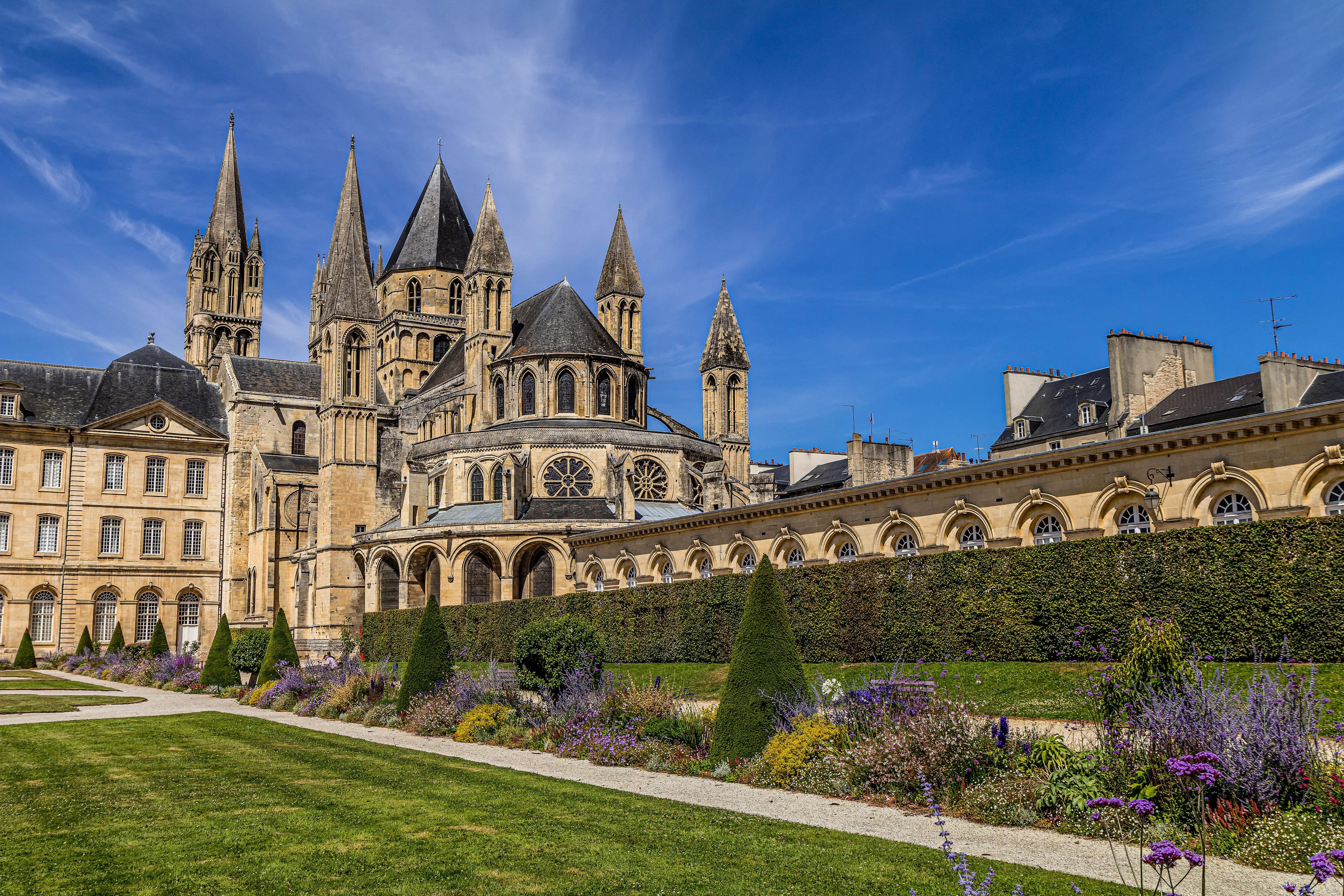
Km 38 to 42.195: down into Caen. From the high point on rue de Mâlon the course loses 55 m in the last 4 km, the steepest kilometre at about 2% on avenue de Courseulles around km 39, then flattens through increasingly urban streets past the Abbaye aux Hommes and the Hôtel de Ville before avenue Albert Sorel and a stadium finish inside Stade Hélitas. No painted tangent line has been documented on this course, so judge the cornering by eye. The timing mat is at the stadium finish itself.
Cutoffs
The overall limit is 5 hours 30 minutes, with six intermediate checkpoints. They tighten slightly as the race goes on, and the 25 km and 30 km gates land in the rolling section where most people lose time.
| Checkpoint | Cutoff |
|---|---|
| 10 km | 1:20 |
| 15 km | 2:00 |
| 20 km | 2:40 |
| 25 km | 3:18 |
| 30 km | 3:56 |
| 35 km | 4:35 |
| 42.195 km | 5:30 |
Course Map
The point-to-point from Courseulles-sur-Mer along the coast to Ouistreham, beside the canal to Pegasus Bridge, and south to the stadium finish in Caen. Tap a marker for details, and scrub the slider or press play to move the orange marker along the course with the elevation profile beneath it.
Pacers
A single 09:10 start with corrals by target time, and pacers at 15-minute steps. The slowest target is 4:45, which leaves 45 minutes of the cutoff unpaced: anyone aiming between 4:45 and 5:30 will be running the last stretch without a group.
What to wear
A 09:10 start on an exposed coastal site. Caen-Carpiquet’s June 1991 to 2020 normals run from about 11.2°C to 20.5°C with a monthly mean of 15.9°C, which is a climate average, not a forecast. Mid-June mornings on this coast can sit in the low teens even when the day warms up later, and a four to five hour finisher may meet noticeably warmer and more sheltered conditions inland than the start suggested.
A removable outer layer is worth carrying, particularly because the free shuttle lands you at the coast well before the gun. No clothing-donation scheme has been confirmed, so treat anything you shed as gone. June at Caen-Carpiquet also produces roughly 3.5 days a year above 25°C and about 0.9 above 30°C, so heat is possible without being likely, and rain is equally plausible given the exposure. Wind on the opening kilometres adds real effort whatever the temperature reads.
Entry
Registration for 2027 opens in November 2026, direct and online, with no ballot stage. The marathon is capped at 5,000 places. The 2027 fee table has not been published.
The organiser runs a formal resale and transfer platform, which matters because off-platform resale is explicitly prohibited. A seller who successfully resells is reimbursed the entry fee less a €2 administration charge, and direct transfers to a named person are planned from the first quarter of 2027, with the incoming runner paying the current fee. Bib personalisation is available for runners registered by 13 May 2027.
French documentation rules apply: a valid FFA competition licence, or the Pass Prévention Santé route for non-licensed adults. The individual deadline is 9 June 2027, with team entries facing an earlier 13 May cutoff. Miss it and the bib does not get collected.
Fast Runner / GFA Standards
No guaranteed-entry pathway exists. The organiser runs a preferential corral request for runners who can evidence a recent performance under 2:55 for men or 3:30 for women, with requests due by 13 May 2027. That buys a start position, not a place in the race, and should not be read as a London-style good-for-age route.
Race Weekend
Expo
Bib collection is at the Parc des Expositions de Caen on Rue Joseph Philippon, with free car and bicycle parking advertised for the event period. Published 2027 hours are Friday 11 June from 14:00 to 20:00 and Saturday 12 June from 10:00 to 19:00.
Collection is in person only, with no third-party collection permitted, which is stricter than most French races and worth planning around if your travel is tight. Bring a complete registration dossier, your original identity document and your bib number. A participant bracelet is issued and has to stay visible for the whole event. Pins are not supplied, so bring your own.
The Parc des Expositions and Stade Hélitas are both walkable from central Caen, with the railway station around 2.5 km from the expo. For a runner without a car that makes central accommodation the practical choice: no separate transport plan is needed beyond a walk or a short bus ride.
Getting to the Start
Stay in Caen and take the shuttle. It boards at Cours Général Koenig and runs to Courseulles-sur-Mer between 06:30 and 07:30, free to marathon entrants, with free parking at the Parc des Expositions for anyone driving. The organiser recommends this over staying on the coast, and the reasoning holds: the shuttle solves the outbound leg, and the finish is already in the city where you are sleeping.
The gun is at 09:10. Take the early shuttle and you face a long wait at an exposed coastal site, so factor in toilet queues, bag handling and corral access, and carry a layer you can lose. Exact toilet provision for 2027 has not been published. Corrals are organised by target time, with an elite and preferential area ahead of the standard groups.
A baggage truck operates at the start, taking bags up to 45 by 35 by 20 cm. No bag is provided, and you attach the detachable coupon from your bib before handing it over. Bags come back in the finish area near avenue Albert Sorel, which is the whole point of a truck on a point-to-point course.
Nutrition on Course
Aid roughly every 5 km, with 25 cl water bottles and the option to refill a personal flask or hydration pack. The detail that shapes a fuelling plan: the first 20 km are water only. Food appears from km 21 onward, with bananas, oranges, sugar cubes, dried apricots and salted crackers.
Carry your own early-race nutrition. Nothing solid is on offer until halfway, and no branded sports drink or gel supplier has been confirmed for 2027, so anyone who relies on gels should plan to carry them for the full distance. The switch to solid food at km 21 lines up almost exactly with the turn inland toward the rolling villages, which is where steady intake matters most. The finish offers a fuller feed and a Normandy-flavours buffet, but that is no reason to under-fuel before it.
Spectating
This is a hard course to spectate properly. The route runs from the coast to Caen through a string of small communes with limited transit, and closes roads substantially. For most supporters without a car the realistic plan is one location.
The finish, and only the finish. Stay in central Caen and take a position along the closing streets, around place Saint-Sauveur, place Fontette or avenue Albert Sorel. It guarantees the sighting that matters and avoids every closure the coastal and inland sections create. No live-tracking app has been confirmed for this race, so agree a rough timing window with your runner in advance.
Pegasus Bridge, with a car. Bénouville sits where the course turns inland, around quarter distance, and is worth visiting as a D-Day site regardless of the race. Driving there directly, avoiding the coastal road the runners use, allows one sighting before returning to Caen for the finish. Check it against the final 2027 traffic order first.
The runners’ own shuttle is reserved for participants, so a coastal start sighting needs independent transport and a very early departure. It is the highest-effort option on a day that already has a guaranteed one.
Post-Race Food
The stadium finish sits on the western edge of the historic centre, so nobody is dependent on the finish-zone buffet for a proper meal. Le Bouchon du Vaugueux, in the Vaugueux quarter, is built around Norman classics including foie gras mi-cuit with a blackberry and black-garlic condiment, and a snail cassoulet: the right choice for a sit-down meal once appetite returns. Crêperie Gaby, near the château, does modernised galettes and crêpes alongside more than 30 local ciders by the glass, which suits eating soon after finishing, without booking. Confirm Sunday hours for either before relying on it.
Anyone who worked through the Normandy-flavours buffet at the line may find a lighter meal sits better than a second regional spread on top of it.
Where to Stay
Stay near the finish, which means Caen. The race starts on the coast and finishes in the city, the free shuttle handles the outbound leg, and there is no organiser shuttle back afterwards. Staying at Courseulles-sur-Mer solves the easy half of the journey and creates the hard one.
Historic centre and Hôtel de Ville
The historic centre is the strongest all-round base. It sits close to Stade Hélitas, walks to the finish, and stays within reach of both the shuttle boarding point and the expo. The organiser itself points runners without a car here. Expect it to be the busiest and most contested area, because the D-Day commemorative programme shares the same weekend.
The port and marina
The marina sits slightly further from the finish than the historic centre while staying practical, with good access to the restaurants around the château and Vaugueux and to bus and tram links. It suits supporters as much as runners, and anyone who would rather have the evening than the shortest walk home.
Gare de Caen
The station district is the obvious choice arriving from Paris by train, because it removes the luggage problem on arrival. It is less convenient for the finish than the historic centre and around 2.5 km from the expo by the organiser’s own figure, though tram, bus or a moderate walk all cover it.
Parc Expo and Zénith
Parc Expo works for drivers, since the race village and the free event parking are both here and Stade Hélitas is not far by local standards. The cost is being away from the restaurants and the sightseeing.
Courseulles-sur-Mer
Courseulles-sur-Mer has the appeal of being the start itself, and it is the weaker choice for most runners. It removes the pre-race shuttle journey and replaces it with a harder problem afterwards, because nothing runs back from Caen. Unless you have supporters and a car, central Caen is materially easier.
Recommended hotels
Distances are approximate, placed by district and by each hotel’s own listing.
The closest of this shortlist to the finish, which is the whole argument for it: you can walk home immediately after the race. Breakfast is included under the current product. A small central footprint means rooms sell early during the commemorative period.
Central and close to the finish corridor, with 24-hour reception. That last detail is worth more than it sounds on a race weekend when arrival and departure times run unpredictably.
A 13-room independent in the heart of the old town for anyone who would rather not stay in a chain. Reception currently closes at 22:00 and inventory is very limited, so book early and arrive before then.
A large central property close to the restaurants around the château and Vaugueux. The walk back after finishing is longer than from a finish-side hotel, which is the trade for the evening.
The strongest choice if you arrive by train and want to drop luggage immediately, and the least convenient of the five for walking straight back from Stade Hélitas afterwards.
Booking timeline
Book earlier than you would for an ordinary regional marathon, and the reason has nothing to do with the race. The 2027 weekend sits inside Normandy’s official 83rd D-Day anniversary programme, running 29 May to 13 June, which the organiser flags as a period of unusually high visitor demand on its own account. There is no ballot result to wait for, so the trigger is simply your own entry: book a cancellable central room as soon as it is secured. The organiser partners with Revolugo for runner rates, though 2027 inventory and pricing were not confirmed at the time of writing. For international visitors the rail booking is often the more time-sensitive one: the fastest direct Paris to Caen service runs around 1 hour 54 minutes with lead fares from about €17, and the cheapest bands go first.
See & Do
The first two are within a short walk of the finish. The last two are on the course itself, which is the argument for going back to them without a clock running.
Abbaye aux Hommes
A few minutes from the finish, on the marathon’s own closing stretch. The abbey and Hôtel de Ville complex is about the lowest-effort post-race visit available, and you will have run past it already. Caen la Mer Tourism lists April to June 2027 opening as generally 09:00 to 18:00 Monday to Thursday and 09:00 to 17:00 on Friday, with split weekend hours.
Château de Caen
In the historic centre, a short walk from the finish. The medieval castle connects directly to William the Conqueror and pairs with a gentle central walk. Cobbles, slopes and the scale of the site make it less recovery-friendly on race day itself than the abbey, so save it for the Monday.
Mémorial de Caen
North of the centre, with bus access from the station. The city’s major museum of twentieth-century conflict, D-Day and the Cold War. Caen la Mer Tourism suggests allowing about four hours, which makes it a job for the day before the expo or a full recovery day, not a tired afternoon.
Juno Beach Centre, Courseulles-sur-Mer
At the marathon’s own start, so not a walkable finish-area site. It deserves a second visit without a race clock running. There is a car-free option on the NOMAD 101 bus from Caen followed by a short walk. The obvious drawback is retracing kilometres you covered on race morning.
Pegasus Memorial and Pegasus Bridge
At Bénouville, reached by regional bus or car from Caen. Another landmark you run past mid-race and are in no state to take in properly at the time. Check schedules for the specific weekday before travelling.
Read Before you Run
D-Day: The Battle for Normandy
Antony Beevor
The marathon crosses the landscape this book describes: Juno, Sword, Pegasus Bridge and the approach to Caen. It is specific to the ground the race covers.
Pegasus Bridge
Stephen E. Ambrose
A tightly focused account of one landmark on the course, and why it carries so much weight in the race’s own identity.
After the Race
Mid-June is the busiest fortnight of the Normandy year, because the commemorative programme runs through it. That cuts both ways: the D-Day sites are fully open and fully attended, and anything you want to book needs booking. Bayeux is fifteen minutes away by train, which makes it the easiest recovery day on this list. Everything further west needs a car, and the Côte Fleurie needs one to be worth doing properly.
A short direct train to a compact cathedral town that survived the Battle of Normandy largely intact, home to the 11th-century embroidered chronicle of the Norman Conquest. No long walk required of tired legs.
One night in Bayeux as a base for the Gold and Omaha sectors further west, the stretch of coast the marathon never reaches. Book museums and tours well ahead in June.
A change of register from battlefield sites: the Belle Époque seafronts of Cabourg, Deauville and Honfleur. A hire car links the three far more easily than the bus alone.
West through Arromanches, Omaha Beach, Pointe du Hoc and Sainte-Mère-Église. The most coherent longer trip for anyone wanting to understand the landscape the race only skims.
West through Normandy to the tidal abbey, deliberately paced with a full recovery day first: the steps and the crowds are not a day-after proposition.
Frequently asked questions
Should I stay near the start or the finish?
The finish, which means Caen. A free shuttle handles the outbound trip to the coast; there is no shuttle back afterwards.
How far in advance should I book a hotel?
Earlier than usual. The weekend falls inside Normandy’s official D-Day commemorative programme, 29 May to 13 June 2027, which fills rooms on its own.
Is there free transport to the start?
Yes, to the start only: Cours Général Koenig to Courseulles-sur-Mer, 06:30 to 07:30, free to entrants. Nothing back from the finish.
What is the best area to stay?
The historic centre around the Hôtel de Ville, close to Stade Hélitas and walkable to the finish, shuttle and expo.
When does the expo open?
Parc des Expositions, Friday 11 June 14:00 to 20:00 and Saturday 12 June 10:00 to 19:00. In person only, no proxy collection, and bring your own pins.
What is the weather typically like on race day?
June normals run 11.2°C to 20.5°C. The coastal start is exposed and can sit in the low teens; inland later is warmer.
How do I get from the airport?
Usually via Paris and rail, about 1h54 direct. Caen-Carpiquet and Deauville both have airports but limited routes.
Is there a bag drop?
Yes, a baggage truck at the start taking bags up to 45 by 35 by 20 cm. Bags come back near Avenue Albert Sorel at the finish.
Should I bring a throwaway layer?
Yes, and expect to lose it. The shuttle lands well before the 09:10 gun and no collection scheme is confirmed.
How do I get back to my hotel after finishing?
Walk, if you are central: the finish is on the western edge of the historic centre. Showers are listed at the Halle des Granges.