The Race
| Next Race Date | Sunday 11 April 2027 |
|---|---|
| Course type | Loop: start and finish about 0.3 km apart in Parkes |
| Registration | Open entry, staged prices |
| Ballot opens | No ballot |
| Start | King George Terrace, Parkes, from 06:15 in waves |
| Finish | John Dunmore Lang Place, Parkes (event village) |
| Total finishers | 1,353 (2023) |
| Avg race-day temp | 7 to 20°C (April) |
| Cutoff time | Course closes at 14:00, about 7 hours 35 minutes after the last wave |
| Free race-day transport | No: an A$15 shuttle runs from Braddon |
| Course certification | AIMS |
History
The Canberra Marathon was first run in 1976. John Harding, who founded and directed it, also won it, in 2:36:39, against a field of 30. Three years later it moved from November to April, where it has stayed, and over the following decades it grew into one of the longest-running marathons in the country.
Its course has always been built around the capital's set pieces: Lake Burley Griffin, the Parliamentary Triangle and the long ceremonial axis from Parliament House to the Australian War Memorial. The fastest times commonly cited for the race, 2:15:02 by John Andrews in 1995 and 2:32:57 by Sue Hobson in 1994, were run on earlier versions of the course.
Sole Motive now organises the event as the Canberra Times Marathon Festival, with a half marathon, a 10 km, a 5 km and other races over the weekend. The marathon is AIMS certified, and the organiser presents it within the Abbott World Marathon Majors Age Group ranking and qualification programme. In 2023 it had 1,353 finishers, and the men's and women's winners ran 2:28:24 and 2:45:00.
The course
The Canberra Marathon starts on King George Terrace in Parkes, beside Old Parliament House, and finishes a few hundred metres away at the event village on John Dunmore Lang Place.
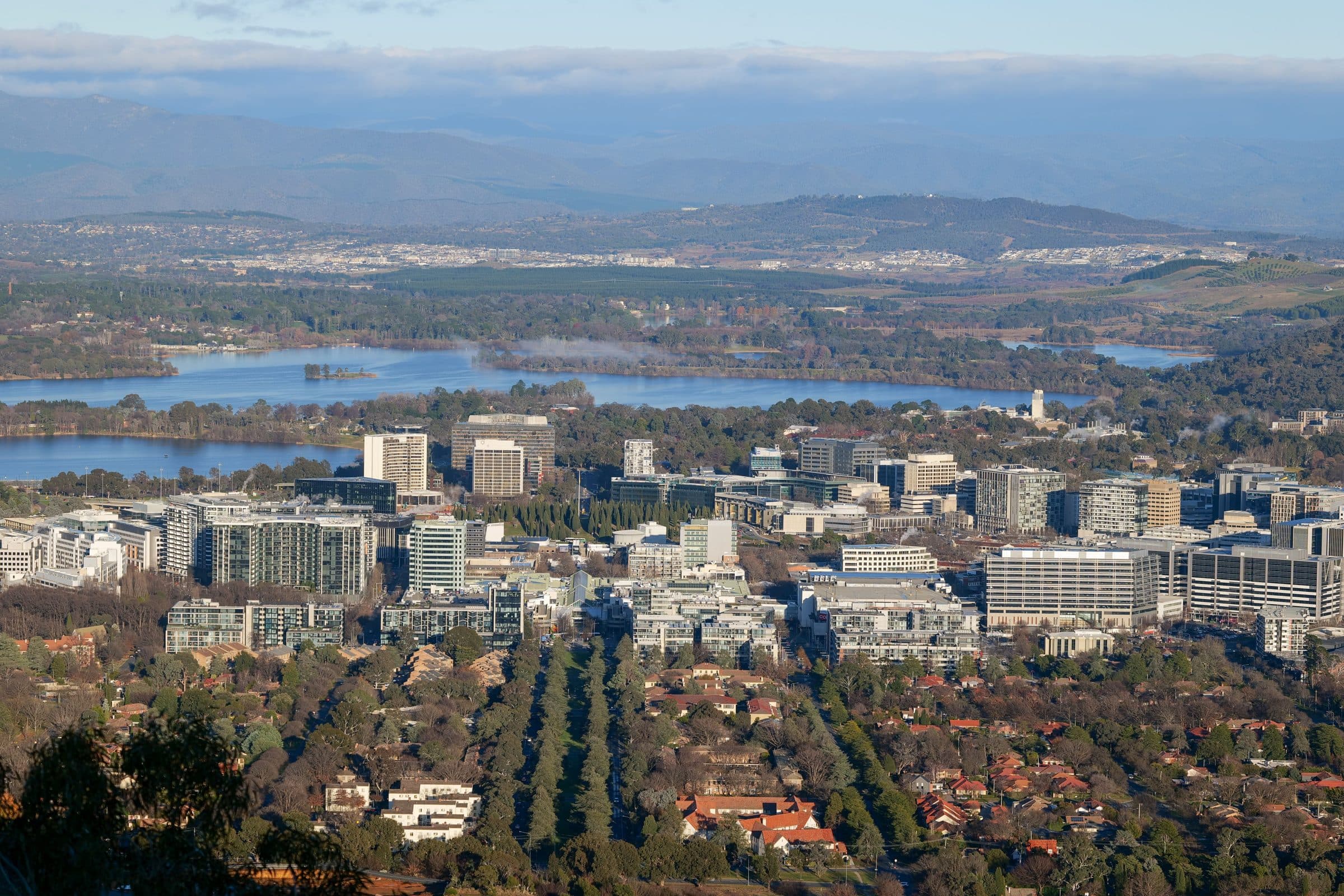
It opens with a loop of Capital Hill around Parliament House by Federation Mall and Parliament Drive, comes back through Parkes and drops south into Telopea Park and Bowen Drive. The route then runs along Kings Avenue and east on Morshead Drive towards Campbell, turns at 11.8 km and crosses Lake Burley Griffin to Parkes Way. It climbs Anzac Parade to a turnaround at 15.4 km, about 250 m short of the Australian War Memorial, and returns down the avenue. A spur west along Parkes Way to 17.6 km follows, then the run back over the lake to Barton and Kings Avenue for halfway.
The second half goes west. Brisbane Avenue and State Circle climb Capital Hill again from about 22 km to the course's high point near 25 km, then Adelaide Avenue and Hopetoun Circuit lead down through Yarralumla to Alexandrina Drive on the lake shore and a turnaround at Weston Park at 29.8 km, the furthest point from the start at 3.6 km. The return along Alexandrina Drive and Flynn Drive leads to the last climb, State Circle from about 36 to 39 km, then down Brisbane Avenue and King Edward Terrace to the finish.
The chart shows three climbs over Capital Hill: 18 m over the first 2 km, 34 m over 3.5 km from about 22 to 25 km and 27 m over 2.5 km from about 36 to 39 km. The rest of the course is flat or descending, at about 560 to 600 m above sea level. The organiser publishes no total climb.
Kilometre by kilometre
Km 0 to 3: Parliament House. The race starts in waves from 06:15, before sunrise in mid-April, and climbs straight up and around Capital Hill and Parliament House. It is the first climb of the day, 18 m in 2 km, and it comes while the field is packed. Run it easy.
Km 3 to 10: Parkes and Telopea Park. The course drops back through Parkes and south into the leafy inner streets of Telopea Park and Bowen Drive, on the flattest, most sheltered kilometres of the race. The first aid stations are at 3.5 and 6 km. The 6 km checkpoint closes at 07:25 and the 10 km checkpoint at 08:10, generous for anyone on course for under six hours.
Km 10 to 19: Campbell, Anzac Parade and Parkes Way. The course runs east on Morshead Drive to a turn at 11.8 km, crosses the lake and climbs Anzac Parade to its turnaround at 15.4 km. The view back down the axis to Parliament House is the one the race is known for. It comes down the avenue and runs a spur west along Parkes Way before turning back.
Km 19 to 24: back through Barton. A flat return over the lake to Barton and Kings Avenue. Halfway comes in this section, with the 20 km checkpoint closing at 10:00.
Km 22 to 28: State Circle and Adelaide Avenue. The second climb goes up Brisbane Avenue and State Circle, 34 m over 3.5 km, to the high point near 25 km, then drops through Yarralumla. It is steady more than steep, but it is where tired legs first notice the course. The 25 km checkpoint closes at 10:50.
Km 28 to 36: Weston Park and the lake. The course reaches the lake shore at Alexandrina Drive, turns at Weston Park at 29.8 km and runs back east along the water. This is the quietest and most exposed section, with wind possible off the lake.
Km 36 to 42.2: the last climb and home. The last big effort is State Circle again from about 36 to 39 km, 27 m in 2.5 km with a steeper kilometre of about 2 per cent at 37 to 38 km, before a descent down Brisbane Avenue and King Edward Terrace to John Dunmore Lang Place. Save something for it. The 36 km checkpoint closes at 12:45 and the finish at 14:00.
No blue line is advertised. Follow the marshals at the many turns around the Parliamentary Triangle.
A climb round Parliament House straight from the start, then flat streets through Parkes and Telopea Park. Keep the first climb easy.
East to Campbell, across the lake and up Anzac Parade to the turnaround below the War Memorial, then back to halfway.
Up State Circle, down through Yarralumla and along the lake to Weston Park, then back east. Wind is possible.
State Circle again from about 36 km, then down Brisbane Avenue to Parkes. The race is won or lost on this hill.
Course Map
A loop through the Parliamentary Triangle: around Capital Hill, south through Telopea Park, east to Campbell and up Anzac Parade, west through Yarralumla to Weston Park and home over State Circle. Tap a marker for the start, the finish village and the turnarounds, and scrub the slider or press play to move the orange marker along the course with the elevation profile beneath it.
Pacers
Pacers wear event gear and carry a flag, and the target time is also shown on their bib. Groups run at 2:50, 3:00, 3:15, 3:30, 3:45, 4:00, 4:15, 4:30 and 5:00.
Waves are set by target time, and racing wheelchairs start at 06:05. The Priority and Wave A start at 06:15 and Wave B at 06:25, and the start line closes at 06:40. Check which wave your target puts you in before counting on a particular pacer.
The start line closes at 06:40 and the course closes at 14:00. Checkpoints close at 6 km (07:25), 10 km (08:10), 20 km (10:00), 25 km (10:50) and 36 km (12:45).
Canberra in mid-April is autumn, and at about 580 m above sea level its mornings are cold. The 06:15 start comes before sunrise, often in single figures and sometimes close to freezing after a clear night. Afternoons can reach the high teens or low 20s.
A throwaway layer, gloves and a hat are worth having for the wait in Parkes, and arm warmers help for the first hour. Most runners race in shorts and a T-shirt or singlet.
The course is open, with little shade on Parkes Way and Anzac Parade. Runners in Wave B, starting at 06:25 and running for more than four hours, will finish in full sun, so wear sunscreen and a cap. Canberra's autumn is usually dry, but wind off the lake is possible in the Weston Park section.
Entry
Entry is open through Race Roster with prices that rise in stages. The early-bird marathon price is A$210, about £112, until 3 December 2026. There is no ballot. Registration closes on 23 March 2027, subject to the race selling out, and runners must be 18 or older on race day.
Runners choose their wave by target time. The Priority wave is for men expecting to run under 3:15 and women under 3:30 and needs proof of a recent result, Wave A covers 3:16 to 4:00, and Wave B is everyone slower.
There is prize money for the first three overall, A$2,000, A$1,000 and A$750, and age-group medals for the top three in 15 categories from 18 to 19 up to 85 and over, posted two to three weeks after the race. The course is AIMS certified, and Sole Motive presents the race within the Abbott World Marathon Majors Age Group programme, so check its current status if a qualifying time is the goal. Refund and transfer terms are set in Race Roster: read them before entering.
Fast runner standards
There is no good-for-age route. The Priority wave standards above are the only time-based entry criteria.
Canberra Marathon (Sole Motive) →Race Weekend
Expo and event village
The expo and event village are at John Dunmore Lang Place in Parkes, beside the finish, from Friday to race morning: Friday 12:00 to 18:00, Saturday 06:00 to 16:00 and Sunday 05:00 to 13:00. The village is in the Parliamentary Triangle, a short walk from hotels in Barton and a short ride from Civic, and it is the place you finish.
Personal refreshments for the course are handed in at the information marquee on the Saturday between 08:00 and 14:00. Bring the registration confirmation and photo ID, and check the final athlete guide for any bib-specific collection rules.
Getting to the start
The marathon starts on King George Terrace in Parkes, beside Old Parliament House, in waves: racing wheelchairs at 06:05, the Priority wave and Wave A at 06:15 and Wave B at 06:25. The start line closes at 06:40. The roads around the Parliamentary Triangle are closed on race morning, so plan the journey the night before.
Stay close. Hotels in Barton and Parkes are within walking distance of the start.
Take the shuttle. Sole Motive runs a shuttle from Braddon, north of Civic, at 04:45 for A$15 each way. It stops about 700 m from the event village. Return shuttles leave at 10:30 and 11:45, and bookings close on 23 March 2027.
Taxi or rideshare. Possible, but road closures limit drop-off points, so allow extra time. Wear a layer you can discard or put in the bag: it will be cold in the dark.
The finish. The event village at John Dunmore Lang Place has food, toilets and space for supporters. Runners finishing after the last return shuttle at 11:45 will need a taxi or a walk back.
Nutrition on course
Eleven aid stations serve the course, every 2.5 to 4 km. All have water, FIXX Nutrition electrolyte is at most, and GU gels are at 9, 22 and 32.5 km. Personal refreshments can be left for four stations, handed in at the information marquee on the Saturday and labelled with your bib number and station.
Only three stations have gels, so most runners will want to carry their own. The gap between 32.5 and 38.5 km is the longest on the course and includes the last climb, so drink well at 32.5.
| Km | Drinks | Gels | Toilets | First aid | Personal refreshments |
|---|---|---|---|---|---|
| 3.5 | Water | No | Yes | No | No |
| 6 | Water, FIXX | No | Yes | Yes | No |
| 9 | Water | GU | Yes | Yes | Yes |
| 12 | Water | No | No | Yes | No |
| 14 | Water, FIXX | No | Yes | Yes | No |
| 18 | Water, FIXX | No | Yes | Yes | Yes |
| 22 | Water | GU | Yes | Yes | Yes |
| 24.5 | Water, FIXX | No | Yes | Yes | No |
| 28.5 | Water, FIXX | No | Yes | Yes | No |
| 32.5 | Water, FIXX | GU | Yes | Yes | Yes |
| 38.5 | Water, FIXX | No | Yes | Yes | No |
Spectating
The course loops through the Parliamentary Triangle and the inner south, so supporters staying central can see a runner three or four times on foot or by bike, though Canberra's distances are larger than they look on a map. The best single spot is the event village at John Dunmore Lang Place, near the start and the finish.
The best second spot is Anzac Parade, where runners climb towards the War Memorial between about 14 and 16 km with Parliament House behind them and come back down within minutes. Traffic plans and tracking for the next edition have not been published, and bicycles are the most practical way to move around the course.
- Start on King George Terrace at 06:15
- Walk to Kings Avenue in Barton for about km 10 and again for the halfway pass near km 21
- Return to John Dunmore Lang Place for the finish
- Watch the start
- Walk or cycle across the lake to the foot of Anzac Parade, about 40 minutes on foot, for km 14 to 16
- Return to Parkes for the finish
- Watch the start, then cycle west to the lake shore near Weston Park or Alexandrina Drive, following closures, for about km 28 to 34
- Return to Parkes for the last kilometres and the finish
Post-race food
The finish is in the Parliamentary Triangle, where there are few restaurants, and the event village has food stalls. For a sit-down meal, Kingston's Green Square and the Kingston Foreshore are a short taxi ride south-east, and Civic, Braddon and NewActon are across the lake to the north.
Braddon's Lonsdale Street is the city's densest run of cafés and brunch spots, and Sunday mornings there are busy, so book for a group. NewActon, by the lake, has restaurants in and around the Nishi building.
Where to Stay
Stay close to the finish in Parkes, or somewhere with an easy route to it. Canberra is a spread-out, planned city and the Parliamentary Triangle has few hotels, so the neighbourhoods around it each trade distance against restaurants.
Barton
Barton, south-east of Old Parliament House, is the closest hotel district to the start and finish, 1 to 1.5 km and 10 to 20 minutes on foot. Hotel Realm is 1.4 km from the finish. It is quiet at night, with a few restaurants, and the best choice for race morning.
Kingston
Kingston, south-east of Barton, has cafés, restaurants and apartment hotels around Green Square and the lake foreshore, about 2 km and 25 to 35 minutes' walk from the start. It is close to the course, so check road access on race morning.
Civic
Civic, the city centre north of the lake, has the widest range of hotels, including the official partner, and restaurants. The start is 2 to 3 km away across the lake, so use the Braddon shuttle, a taxi or a bike.
NewActon
NewActon, on the lake's northern shore next to Civic, has design hotels and restaurants in a small precinct, including Ovolo Nishi 1.8 km from the finish. It is quieter on Saturday nights than Braddon.
Braddon
Braddon, just north of Civic and about 2.6 km from the finish, has the city's best-known café and bar strip on Lonsdale Street and is where the race shuttle leaves. It is lively on a Saturday night.
Booking advice is in the timeline below.
Recommended hotels
In the parliamentary precinct, a walk to the start and back from the finish. Quiet at night.
The official accommodation partner, with marathon packages subject to availability. Across the lake from the start, so use the shuttle or a taxi.
A design hotel by the lake with restaurants below. It needs a shuttle or a taxi on race morning.
Booking timeline
There is no ballot, so book a room when you enter. Canberra's hotel market is built around weekday government business, which can make weekend rooms good value, but the festival weekend fills the hotels closest to Parkes. The official accommodation partner, Crowne Plaza Canberra, has offered marathon packages, so check those first.
Canberra Airport is about 15 minutes by taxi from Civic and Barton. Many runners from Sydney drive, about three hours, or take the coach. Arrive by Saturday to collect a bib and hand in personal drinks.
See & Do
The first four are within about 1.2 km of the finish on the lakeshore side of the Parliamentary Triangle, and the War Memorial is a short taxi or bike ride up Anzac Parade.
Museum of Australian Democracy at Old Parliament House
The white building beside the start line, Australia's parliament from 1927 to 1988 and now a museum of its politics. Everything is on two floors with lifts.
National Portrait Gallery and National Gallery of Australia
Side by side beside the lake in Parkes, a short walk from the finish. Indoors, level and seated, for race afternoon.
National Museum of Australia
On the Acton Peninsula across the lake, with the country's history told through objects. Take a taxi or a bike.
Australian War Memorial
At the top of Anzac Parade, which the course climbs. Free, largely indoors and level, and the Last Post ceremony at the end of each day is worth staying for.
After the Race
Mid-April is autumn in the Australian Capital Territory: frosty mornings, clear days and the city's exotic trees turning red and gold. The trips below head for wildlife, wine, the mountains and the harbour city.
Wetland boardwalks with platypus and water birds, koalas in the trees and kangaroos at dusk, in a valley south-west of the city.
Cool-climate shiraz and riesling cellar doors just over the New South Wales border, with a smokehouse lunch on the way.
A lake town below Kosciuszko National Park in the quiet weeks between summer and ski season, with a flat foreshore path and alpine views.
Three nights in the harbour city, with flat walks from Circular Quay to the Opera House and the ferry to Manly.