The Race
| Next Race Date | 23 May 2027 (Sunday), race weekend 22-23 May |
|---|---|
| Course type | City Circuit / Loop. ~230m total elevation gain. |
| Certification | Abbott World Marathon Major · World Athletics Gold Label |
| Start | Fritz Sonnenberg Road, Green Point (adjacent to Cape Town Stadium) |
| Finish | Green Point Common, Cape Town Stadium precinct |
| Total finishers | ~25,000 (capacity) |
| Avg race-day temp | 12–18°C (May) |
| Cutoff time | 6 hours 30 minutes |
| Free race-day transport | Yes: race bib grants free travel on all MyCiTi bus routes on race Sunday, including event shuttles from Civic Centre Hub from 04:30 |
| Course certification | World Athletics / AIMS certified |
| Sleeper Train | Not accessible; fly into Cape Town International Airport (CPT) |
History
The Cape Town Marathon has just done something no African race has done before: it joined the Abbott World Marathon Majors. From 2027, it takes its place alongside Tokyo, Boston, London, Berlin, Chicago, and New York as one of eight races that define the upper tier of the global marathon calendar. For a race that is barely two decades old in its current form, this is a remarkable trajectory.
The story behind it is more complicated than the headline suggests. A Celtic Harriers club race called the Cape Town Marathon was first run in 1994, but it remained local and modest for years. The current event traces its lineage to 2007, when the race was relaunched as a city-centre showcase. That version struggled too, lacking the infrastructure and international profile to compete with the established African ultra-marathon calendar, where the Comrades and Two Oceans had held the public imagination for generations.
The decisive break came in 2014. A new management team, with South African rugby World Cup-winning captain Francois Pienaar and distance running legend Elana Meyer among its architects, restructured the event from the ground up. World Athletics Gold Label certification followed in 2017. By 2021 the race had formally entered the evaluation process for Major status.
What the course itself carries is harder to quantify. The route threads through the Bo-Kaap, past the edges of District Six, where over 60,000 residents were forcibly removed under the Group Areas Act, and along the Atlantic Seaboard. The annual act of running a single certified line through those histories is not incidental to the race's identity; it is, for many South African participants, the point.
The 2025 edition was cancelled on race morning due to extreme winds. In response, organisers shifted the race from September to May, when Cape Town's autumn weather is considerably more stable. The 2026 race went ahead. 2027 will be the first edition contested as a Major.
The course
The Cape Town Marathon is a city circuit starting and finishing at Green Point, adjacent to Cape Town Stadium on Fritz Sonnenberg Road. The course heads southeast into the Central Business District, climbs briefly through the Bo-Kaap at around km 5 (26 metres of gain over 1.6km), then loops east into the industrial and residential corridors of Woodstock and Salt River before arcing back through the southern suburbs of Rondebosch and Mowbray. The mid-race return passes through the V&A Waterfront at km 28, then turns north onto the Atlantic Seaboard, running exposed along the Sea Point Promenade from approximately km 35 to km 41.
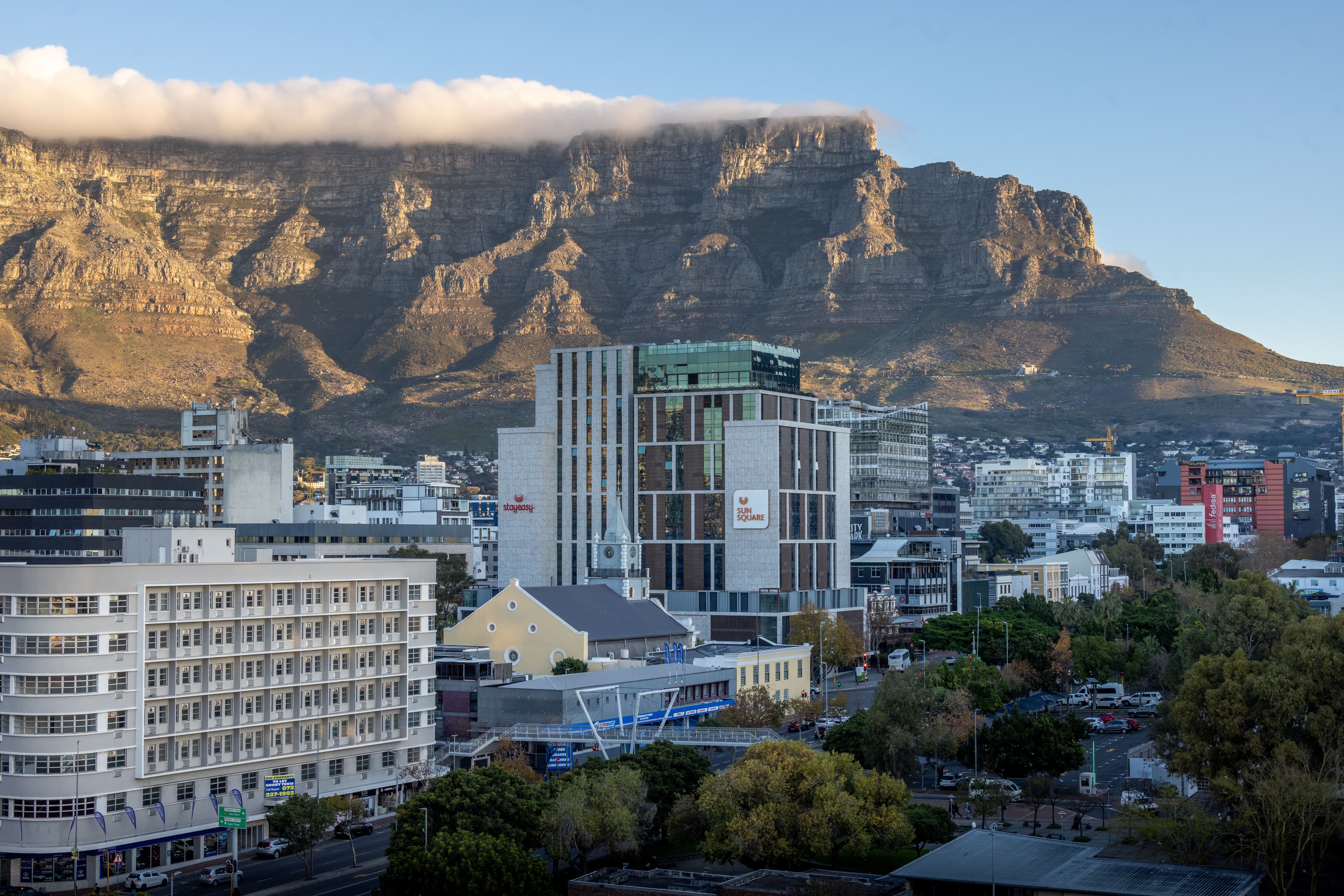
Total elevation gain is approximately 230 metres; total loss is also approximately 230 metres, making this a net-flat loop. Table Mountain sits directly south of the start and is visible for much of the first half. The critical variable is the Cape Doctor, a south-easterly wind that can deliver a sustained headwind for the final 7 km of the Atlantic Seaboard section. The finish is on the synthetic track surface at Green Point Common.
Km 0–5: Green Point to the City Bowl. The start sits at roughly 12 metres above sea level on Fritz Sonnenberg Road, with Cape Town Stadium rising immediately behind the corrals. In early May the light is already good by 06:00: Cape Town in autumn gets a clean, low dawn, and Table Mountain sits at the end of Buitenkant Street, visible from the first minute of running. This opening section is flat and fast. Crowds in the CBD streets are sparse at this hour, but what is there is vocal.
Km 5–10: The Bo-Kaap. Around the 5 km mark the road rises. This is the most significant climb of the race: approximately 26 metres over 1.6 km from the lower City Bowl up into the Bo-Kaap, the predominantly Muslim neighbourhood whose pastel-coloured houses have stood here since the 18th century. The gradient is short but punchy enough to disturb pace. Shorten stride length and keep cadence up rather than pushing through the climb on effort. The descent back to the lower city grid from km 6.5 is quick and recoverable. Residents and family groups line these narrow streets and the noise carries.
Km 11–25: The Eastern Loop. The route heads east into Woodstock and Salt River: an industrial and working-class zone of warehouses, rail lines, and open avenues where the crowds thin considerably. Wide, unsheltered roads can carry a crosswind; stay in a pack if you find one. The course loops back through Rondebosch and Mowbray, where university groups and community cheer stations lift the noise level at km 18-22. A second climb arrives here: a gradual 19-metre gain between km 18 and km 21, which catches runners who have banked too heavily on the flat opening.
Km 26–34: The Waterfront Return.Heading back west toward the Atlantic, the course passes through the V&A Waterfront at approximately km 28. Crowd density spikes sharply; this is a heavily tourist-trafficked zone and spectators who have walked from the start congregate here. The emotional lift is real and useful. The terrain is mostly flat, but note the 90-degree turns and brick paving near the commercial plazas at km 29–30. These surfaces are unforgiving underfoot and runners tend to overcorrect stride on them.
Km 35–42.195: The Atlantic Seaboard. At km 35 the course turns onto the Sea Point Promenade and runs directly alongside the Atlantic Ocean for just over 6 km. In May, the Cape Doctor is less active than in September, but less active is not the same as absent. If any wind is blowing, it will be here, and it will be in your face. Keep your chin down, shorten your arm drive, and do not try to reclaim time through pace. At km 41 the road turns inland into Green Point Common. The headwind stops. The grandstand noise from the finish track comes in fast and most runners find a final gear here that they thought had been spent somewhere around km 37.
The finish is on a synthetic athletics track surface. The blue painted tangent line marking the certified shortest path runs the entire course; follow it throughout, particularly through the Waterfront turns, and it makes a measurable difference over 42.195 km. Race bibs carry integrated timing chips, so there is no separate mat to step over at the finish line.
Course highlights
Three moments on the Cape Town Marathon course are genuinely distinct from anything on the other seven Majors.
The first is the Bo-Kaap, reached at around km 5. The neighbourhood has sat above the city since the 18th century, populated originally by enslaved people brought to the Cape Colony from Malaysia, Indonesia, and elsewhere in the Indian Ocean world. The brightly painted houses, pink, yellow, turquoise, reflect a decades-long tradition of residents painting their homes after the end of apartheid-era laws that had previously restricted them from owning the properties they lived in. Running up the cobbled incline at race pace, with residents at their gates and the mosque at the top of Wale Street visible against the mountain, is a short and distinctive interlude in what is otherwise a city-circuit marathon.
The second is the V&A Waterfront at km 28, where the course passes the historic dry docks, the Nelson Mandela Gateway ferry terminal, from which boats leave for Robben Island, 12 minutes offshore, and the converted grain silo housing the Zeitz MOCAA. The crowd is the largest outside the start and finish.
The third is Table Mountain itself, which is visible from the start line and for much of the first 20km. At 1,086 metres, it is one of the oldest landmasses on earth, composed of sandstone laid down over 500 million years ago. It does not become background; you keep finding it above the rooflines as the course winds through the city grid.
About the Cape Doctor
The Cape Doctor is a strong south-easterly wind driven by the pressure gradient between the South Atlantic anticyclone and low-pressure systems over the South African interior. For marathon runners, it is a headwind of 30–50 km/h that arrives with little notice and operates on the Atlantic Seaboard (km 35–41 of the course) at full strength.
The 2025 Cape Town Marathon was cancelled on race morning because of wind speeds that exceeded safe event operation limits. It was the direct cause of the race moving from September to May.
In May, the Cape Doctor is less frequent than in September, but not absent. The race organisers implement a colour-coded flag warning system at every aid station: white (normal), yellow (elevated heat or wind risk), red (medical advisory, slow down). If a yellow or red flag is flying at the km 35 aid station, treat the Atlantic Seaboard section as a conservation exercise rather than a pacing one. The wind does not negotiate. The race has a formal weather contingency plan including deployment of additional misting tunnels and ice stations along the Promenade if required.
The opening kilometres through the CBD are fast and flat. The Bo-Kaap climb arrives at km 5: 26 metres over 1.6km. Run the hill on cadence, not effort, and use the descent from km 6.5 to reset your pace rather than accelerating.
The industrial corridor of Woodstock and Salt River has the thinnest crowd cover. The road opens up and the wind, if present, is most exposed here. Stay in a group, bank energy, and treat the gradual climb through Rondebosch at km 18–21 as a controlled effort.
The return through the V&A Waterfront is the emotional midpoint. Crowd density is the highest outside of the start and finish. Check splits here and recalibrate: if you have been conservative in the eastern loop, you have runway left.
Six kilometres along the Atlantic Seaboard with the ocean to your left and, on most mornings, a headwind in your face. Shorten stride, drop shoulders, keep chin down. At km 41 the road turns inland, the wind drops, and the finish track comes into range.
Pacers
Official pacers carry tall coloured flags and are pre-positioned in their seeded corrals. South African pacers frequently lead call-and-response chanting in Zulu or Xhosa through the middle kilometres, standard South African road running culture. Verify the pacer structure annually after the transition to Major status.
| Target time | Wave |
|---|---|
| Sub-3:00 | Wave A |
| 3:15 | Wave A/B |
| 3:30 | Wave B |
| 3:45 | Wave B/C |
| 4:00 | Wave C |
| 4:15 | Wave C/D |
| 4:30 | Wave D |
| 5:00 | Wave D/E |
| 5:30 | Wave E |
Entry
| Registration type | Ballot |
|---|---|
| Ballot opens | Historically early February. Check capetownmarathon.com. |
| Corral seeding | Verified result from an officially timed event within the previous 12 months |
| Charity entry | Available: Southern African Wildlife College, Children's Hospital Trust (min. ~R3,000 ZAR fundraising) |
| Tour operator entry | Marathon Tours & Travel and 2:09 Events listed as official partners |
| Transfers | Permitted via official online portal until late July, administrative fee applies |
| Medical deferral | Assessed individually |
The Sanlam Cape Town Marathon operates a ballot entry system. Registration typically opens in early February; check the official race website (capetownmarathon.com) in the September to October window prior to the race year for the latest entry process, as the structure may evolve following the transition to World Marathon Major status.
Pricing has been tiered by geography. Pre-Major figures: South African residents approximately R450–R600 ZAR; African continent runners approximately R800–R1,000 ZAR; international runners approximately R1,500–R1,800 ZAR (roughly £65–£80 at standard exchange rates). These figures are from the pre-Major era and are likely to increase from 2027.
Corral seeding (A–E)
Corrals are assigned based on a verifiable recent finishing time from an officially timed event within the previous 12 months. Submit times during registration by uploading a race results certificate from the original timing provider. Runners without an official qualifying time are placed in the final corrals automatically.
| Corral | Men | Women |
|---|---|---|
| A | Sub-2:45 marathon / Sub-1:18 half | Sub-3:15 marathon / Sub-1:30 half |
| B | Sub-3:15 marathon / Sub-1:32 half | Sub-3:45 marathon / Sub-1:45 half |
| C | Sub-3:45 marathon | Sub-4:15 marathon |
| D–E | General field | General field |
Guaranteed entry routes
International runners who cannot secure a general entry place can access spots via certified tour operators. Marathon Tours & Travel and 2:09 Events have been listed as official partners. Charity entry is also available through organisations including the Southern African Wildlife College and the Children's Hospital Trust, with minimum fundraising commitments typically around R3,000 ZAR. Entries are non-refundable.
Race Weekend
Expo and Race Pack Collection
The expo runs Thursday (12:00–19:00), Friday (09:00–19:00), and Saturday (09:00–17:00). No race pack collection is available on Sunday morning without exception. Verify the venue annually at capetownmarathon.com before travelling.
To collect your bib, bring the digital QR code from your race confirmation email and a valid passport or South African ID document. Third-party collection is permitted: the representative must carry your printed ID, your QR code, and a signed authorisation letter.
Race packs contain: bib with integrated timing chip, safety pins, official athlete technical shirt, and a clear numbered plastic kit-bag for bag drop. Do not bring your own bag for drop; only the official clear kit-bag is accepted. The expo functions as a race market as well as a bib hall. Allow an hour if you intend to browse. Saturday is the busiest session.
Getting to the Start
Wave start times: Elite field and Corral A at 06:00; Corrals B through E at staggered intervals between 06:10 and 06:30. Corral gates close at 05:45; not a soft deadline. Runners who miss their corral gate are assigned to the rear of the last wave. Aim to be at your corral by 05:30.
The MyCiTi bus network runs dedicated race-morning shuttles from Civic Centre Station and from the standard V&A Waterfront stops directly to the Green Point Stadium precinct. Shuttles start at 04:30 and run continuously through to wave starts. Your race bib grants free travel on all MyCiTi routes on race Sunday; carry your bib visibly.
Uber and Bolt operate widely in Cape Town and surge pricing begins well before 05:00 on race Sunday. Road closures around the CBD perimeter create unpredictable routing. If using a ride-hailing app, instruct the driver to drop at Civic Centre and walk the remaining distance toward the stadium. Do not ask a driver to reach the stadium itself from the city side; the roads will be closed.
If you are staying in Green Point, De Waterkant, or along Somerset Road, walk. The start village is within 10 minutes on foot from most accommodation in this area.
The start village on Green Point Common has portaloo banks (queues build from 05:15, go earlier), hydration stations, and medical tents. May mornings are typically 12–14°C at 05:00. A throwaway layer is recommended. Charity collection bins are at the corral entrance gates.
Traditional headphones and earbuds that block ambient sound are prohibited under Athletics South Africa rules and can result in disqualification. Bone-conduction headphones are generally tolerated; verify at the expo. International entrants receive temporary dual race numbers that must be worn on both front and back of the running vest.
Nutrition on Course
There are eleven aid stations between km 3.5 and km 40.5. Water is provided in sachets throughout; tear the corner off with your teeth and squeeze rather than attempting to drink from the open end at pace. Sachets are a South African endurance racing standard; practise the technique before race day.
| Km | Water | Sports drink | Gel | Food | Other |
|---|---|---|---|---|---|
| 3.5 | Sachet | — | — | — | — |
| 7.0 | Sachet | Cup | — | — | — |
| 10.5 | Sachet | — | Yes | Bananas | — |
| 14.0 | Sachet | Cup | — | — | — |
| 17.5 | Sachet | — | — | — | Coca-Cola |
| 21.0 | Sachet | Cup | Yes | Bananas, oranges | — |
| 24.5 | Sachet | — | — | — | — |
| 28.0 | Sachet | Cup | — | Jellies/sweets | Coca-Cola |
| 31.5 | Sachet | — | Yes | — | — |
| 35.0 | Sachet | Cup | — | Bananas | — |
| 38.5 | Sachet | Cup | — | Jellies | Coca-Cola |
| 40.5 | Sachet | — | — | — | — |
Flat Coca-Cola is provided from km 17.5 onwards at designated stations, a fixture of South African endurance racing used at Comrades and Two Oceans for decades. Gels at km 31.5 are well-positioned for the Seaboard section, which is the hardest part of the course. Personal bottle service is available to the elite field only.
Spectating
A spectator with a good morning and working legs can realistically see their runner three times. The architecture of the course makes this possible without a car, though it requires moving early.
Vantage Point 1: CBD, km 3 and km 8. Position at the intersection of Adderley Street and Riebeeck Street. At km 3 runners are heading southeast into the city; at km 8 they are looping back toward the Woodstock turn. The window between catching a runner at both points is 20 to 45 minutes depending on pace, enough for a coffee from cafes on Buitenkant Street that open early.
Vantage Point 2: V&A Waterfront, km 28. Take a MyCiTi bus from the city centre. This is the highest-energy spectator zone outside the start and finish: live music, high crowd density, a festive crowd out for the whole morning. The technical turns near the shopping plazas at km 29-30 create natural bottlenecks where runners slow and are easier to spot.
Vantage Point 3: Sea Point Promenade, km 38. Walk west from the Waterfront (approximately 35 minutes). At km 38 runners are deep into the hardest section. Vocal support here has a different quality than at the Waterfront: it is what the runner needs rather than what makes a good photo.
The official Sanlam Cape Town Marathon mobile app provides live split tracking at 5km, 10km, 21.1km, 30km, and 40km timing mats.
Itinerary A(sub-4:00 runners): Start at Fritz Sonnenberg Road for the 06:00 gun. Walk to Adderley/Riebeeck for km 3 and km 8. MyCiTi bus to V&A Waterfront for km 28. Walk west along the promenade for km 38.
Itinerary B (4:00–5:00 runners): Watch the start. Walk to CBD for km 3/8, with time for a sit-down breakfast. MyCiTi bus to Waterfront for km 28. Walk to Sea Point Promenade for km 38, then return to Green Point Common for the finish.
Itinerary C(minimal effort): Watch the start. Take free MyCiTi shuttle to V&A Waterfront for km 28. Return to Green Point Common for the finish. Three sightings with a single bus journey.
The Finish
After crossing the finish line on the Green Point Common track, runners pass through a funnel collecting: finisher medal, insulated space blanket, and recovery drinks. The bag collection area is adjacent to the exit gates, organised by bib number series.
A dedicated international hospitality zone is on the grassy lawn of the Green Point Common. The family and supporter meeting point is clearly signposted from the finish exit. The gates of the Fan Walk on Fritz Sonnenberg Road are the clearest landmark, accessible to both runners and non-runners.
On-course massage is available at km 25, km 32, and km 37. Post-finish massage is at the Green Point Common recovery area.
Where to Stay
The start and finish are at the same location, Green Point Common, adjacent to Cape Town Stadium, so the accommodation decision is simpler than most Major marathons. There is no trade-off between start proximity and finish proximity. The practical questions are security, budget, and how far you want to walk at 06:00.
Green Point / Mouille Point
Green Point and Mouille Point offer the closest accommodation to the start/finish village. Green Point is a residential strip of boutique hotels, sidewalk cafes, and apartment-style properties running from Somerset Road to the sea. Mouille Point sits at its western edge, directly on the promenade. From most of these properties, the start corrals are a 5–10 minute walk. The area is calm on Saturday night. Price range approximately R3,000–R5,500 ZAR per night for mid-range options; higher for seafront properties.
V&A Waterfront
The Waterfront is a secure, enclosed precinct of hotels, restaurants, and shops built around a working harbour. It is 10–15 minutes' walk from the start. Hotels here are uniformly well-insulated and quiet on Saturday night. This is the most convenient option for international runners who want to combine marathon logistics with city tourism: the Waterfront has direct access to the Nelson Mandela Gateway (Robben Island ferries), the Zeitz MOCAA, and a concentration of restaurants that open reliably and early. Premium pricing: approximately R4,500–R8,000 ZAR per night.
De Waterkant
A 15-minute walk from the finish, De Waterkant is a small, semi-cobbled neighbourhood of former cottages, design hotels, and independent cafes running between Somerset Road and the base of Signal Hill. Quieter and more contained than either the Waterfront or Sea Point. Price approximately R2,500–R4,500 ZAR per night.
Sea Point
Sea Point runs along the Atlantic Seaboard from Mouille Point west toward Bantry Bay. Busier, higher-density, and considerably cheaper than the Waterfront. The trade-off is a 20–40 minute walk to the finish or a short MyCiTi bus ride. Sea Point has the best independent restaurant and cafe density in the Atlantic Seaboard area, and the promenade path allows a pre-race shakeout run directly on the course itself. Price approximately R1,800–R3,500 ZAR per night.
Cape Town CBD
The CBD is the most affordable zone within reasonable reach. Choose accommodation in the quieter corporate sector away from the Long Street and Bree Street bar corridor, which runs late on weekend nights. Race-morning transport is straightforward via free MyCiTi shuttles from Civic Centre. Price approximately R1,200–R2,500 ZAR per night.
Booking timeline
Cape Town marathon weekend accommodation, particularly in Green Point and the V&A Waterfront, should be secured six to eight months before race day. Now that the race is confirmed as a Major from 2027, international demand is likely to increase. The first Major year in particular: book as soon as you have entry confirmation. May is a reasonable value month: autumn sits outside the peak December to February summer season. Flights from the UK take approximately 11–12 hours direct; book six months ahead for competitive fares.
Recommended hotels
Sits directly on the harbour, 800 metres from the start line on Fritz Sonnenberg Road. Race morning is uncomplicated: walk from the hotel to the corrals in under 10 minutes. Early athlete breakfasts are available from the restaurant. The Waterfront's enclosed security perimeter means Saturday night is quiet regardless of where the race countdown crowds gather.
Sits on Convention Square in the CBD with easy access to the city centre. Early athlete breakfast service starts from 04:00 on race Sunday. The free MyCiTi shuttle from Civic Centre Station to Green Point runs from 04:30, with Civic Centre a short walk from the hotel.
On Somerset Road in the heart of Green Point, the clearest moderate-tier option for pure logistics. The start corrals are a flat, 6-minute walk. After finishing, you are walking in the right direction from the moment you leave the Green Point Common gates.
Sea Point's Atlantic Seaboard location places this hotel directly beside km 38-39 of the race course, useful if spectators are staying with you. The in-house spa and hydrotherapy facilities are practical for immediate post-race recovery; book treatments in advance for race Sunday afternoon.
See & Do
The finish at Green Point Common leaves you 10 minutes' walk from the V&A Waterfront ferry terminal, with Robben Island 12 minutes offshore and Table Mountain the view south. The practical radius for post-race tourism is among the best of any Major.
Robben Island Museum
1.2 km (0.75 miles) from the finish; ferry departs from the V&A Waterfront Nelson Mandela Gateway. Nelson Mandela spent 18 of his 27 years in prison on this island. The 3.5-hour guided tour covers the isolation wing, the lime quarry where prisoners were forced to work, and the cell where Mandela was held. For runners who have just covered a course that passes the edges of District Six and through Bo-Kaap, the island adds the third dimension to what the race geography has already outlined. Book in advance: tours sell out weeks ahead.
Table Mountain Aerial Cableway
6.5 km (4.0 miles) from the finish. At 1,086 metres, Table Mountain offers a direct view of the entire race course from above. The revolving cable car takes roughly five minutes to ascend; the summit plateau is flat and walkable, with 360-degree views across Cape Town, the Cape Peninsula, and Robben Island. Operations are weather-dependent and the cable car closes when wind speeds exceed safe operating limits, which happens unpredictably in May. Check the official cableway website on the morning you plan to visit and book online in advance.
Zeitz Museum of Contemporary Art Africa (MOCAA)
1.0 km (0.6 miles) from the finish. Housed in a converted grain silo at the V&A Waterfront, the same building visible from the km 28 section of the course, this museum holds the largest collection of contemporary art from Africa and its diaspora. The conversion of the silo's cylindrical grain tubes into gallery spaces is itself worth seeing. Opens from 10:00, Tuesdays through Sundays. Friday or Saturday afternoon before the race is the practical window.
Read Before you Run
Long Walk to Freedom
Nelson Mandela
Mandela's autobiography covers his childhood in the Transkei, his legal career in Johannesburg, his arrest and imprisonment, and the negotiations that ended apartheid. The Cape Town Marathon course runs directly through the District Six area from which over 60,000 people were forcibly removed under apartheid, geography that Long Walk to Freedom gives context and weight to. Reading it after the race adds a layer to what you have just run through.
Diamonds, Gold and War: The Making of South Africa
Martin Meredith
A ground-level account of the late 19th-century scramble for South African resources that defined the country's political geography. Meredith covers the arc of colonial and settler history that produced the spatial segregation the Cape Town Marathon course runs through. More accessible than an academic text; more rigorous than a travel summary. Good reading for the long flight to CPT.
After the Race
The Cape Town Marathon runs in May, early autumn on the Cape Peninsula. The summer crowds have thinned, the Winelands harvest is finished, and vine leaves are turning. On the southern coast, southern right whales are sometimes still offshore. The excursions below are planned for post-marathon leg tolerance: all depart directly from Cape Town and none require significant walking in the first two days.
Drive south via Chapman's Peak Drive, 114 turns cut into a near-vertical cliff face above the sea. Stop at Boulders Beach in Simon's Town for the African penguin colony, then continue to Cape Point Nature Reserve. In May, southern right whales are sometimes visible from the coastal roads. Most of the day is done from a vehicle or via short walks on level paths.
Two adjacent wine towns at the base of the Hottentots Holland mountains. Stellenbosch has the better street-level food and accommodation; Franschhoek has the Wine Tram, an open-air hop-on hop-off tram connecting estates across the valley. May is early autumn in the Winelands: harvest finished, vine leaves turning, tourist volume down from the summer peak.
Knysna sits at the mouth of a lagoon flanked by indigenous yellowwood forest and the Knysna Heads. Lagoon boat trips are calm and unhurried. The Afro-montane forests have walking trails suitable for post-marathon movement. In May the southern coast is in autumn and southern right whales are sometimes still visible offshore.
Drive the full Garden Route through Wilderness, Knysna, and Plettenberg Bay, ending at one of the malaria-free private game reserves near the eastern end. Shamwari and Amakhala are both within reach of Gqeberha. The Big Five are present at considerably lower cost than Kruger equivalents, and the malaria-free status makes the trip practical immediately after a major race.
Frequently asked questions
Should I stay near the start or the finish?
The start and finish are at the same location, Green Point Common, adjacent to Cape Town Stadium, so this question does not apply. Stay as close to Green Point as your budget allows. Hotels on Somerset Road and along the V&A Waterfront are all within 15 minutes' walk of the start corrals.
How far in advance should I book a hotel?
From 2027, Cape Town is a World Marathon Major. Book accommodation as soon as you have ballot confirmation, ideally within 24 to 48 hours. Green Point and V&A Waterfront hotels will fill within days of ballot results. The first year of Major status, 2027, is likely to see the strongest demand spike.
Is there free transport to the start?
Yes. Your race bib grants free travel on all MyCiTi bus routes across Cape Town on race Sunday. Dedicated event shuttles run from Civic Centre Station and the V&A Waterfront stops to Green Point from 04:30. If you are staying in Green Point, De Waterkant, or along Somerset Road, the start is a straightforward walk.
What is the best area to stay?
Green Point is the most practical for runners: start corrals walkable, finish walkable, quiet on Saturday night. The V&A Waterfront offers higher security and more hotel choice at a premium. Sea Point is a cheaper alternative with good restaurants and direct access to the late-stage course promenade, but adds 20–40 minutes or a bus ride to the start.
When does the expo open?
Thursday 12:00–19:00, Friday 09:00–19:00, Saturday 09:00–17:00. No race packs on Sunday morning. Bring your registration QR code and passport or South African ID. Verify the venue annually at capetownmarathon.com.
What is the weather typically like?
The race runs in May, early autumn in Cape Town. Expect 12–14°C at the 06:00 start, rising to 16–18°C by mid-morning. May is considerably calmer than the former September slot. Some wind exposure remains possible on the Sea Point Promenade section (km 35–41), but the Cape Doctor is less frequent in autumn.
How do I get from the airport?
Cape Town International Airport (CPT) is approximately 20–30 minutes from Green Point by car. Uber and Bolt both operate from the airport. MyCiTi Route N1 connects the airport to the city but requires a transfer and takes considerably longer. A prebooked private transfer is the most stress-free option for late arrivals.
Is there a bag drop?
Yes. Bag drop is in the Green Point Common start village, organised by bib number series. You must use the official clear numbered plastic kit-bag issued at the expo; no personal bags accepted. Bags are accessible from the finish area exit gates after you cross the line.
Should I bring a throwaway layer?
Yes. The start is at 06:00 and May mornings in Cape Town are typically 12–14°C with some moisture in the air. The wait in the start corrals can last 15–30 minutes for later waves. A lightweight long-sleeved top or old windbreaker to discard at the corral gates is recommended. Charity collection bins are at the gate.
How do I get back to my hotel after finishing?
Green Point, De Waterkant, and V&A Waterfront accommodation is walkable from the finish exit. For accommodation further out, free MyCiTi recovery shuttles run from the stadium gate to city hubs on race Sunday. Uber and Bolt also operate from the finish but queues build between 10:00 and 12:00.