The Race
| Next Race Date | Sunday 19 September 2027 (provisional; the organiser has not yet published the 2027 date) |
|---|---|
| Course Type | Loop: a bretzel shape, with start and finish both at Place Rapp |
| Registration | Open, tiered online entry with no ballot. €64 for the first 700 places, €75 for 701 to 1,500 |
| Ballot Opens | Not applicable: direct open entry |
| Total Finishers | About 990 (2025 marathon) |
| Average Race Day Temperature | 11.6°C to 20.1°C (September normals for Colmar) |
| Cutoff Time | 6 hours, finishing by 14:30, with intermediate cutoffs at 22 km and 34 km |
| Free Race Day Transport | No. Shuttles serve only the 10 km and Escadrille fields and need a purchased ticket |
| Course Certification | FFA-listed at departmental level. No AIMS or World Athletics label found |
Check the bib pickup rule before you rely on someone else
The organiser’s own pages disagree with each other on this. The practical-information page states plainly that third-party collection is not permitted. A separate FAQ passage says it is allowed, provided the person brings your pickup ticket, a copy of your identification and your PPS or licence documentation. Both statements are live on the same site, and this page is not going to pretend one of them settles it. If you are depending on someone else to collect your bib, confirm directly with the organiser before you travel.
History
The Marathon de Colmar began in 2015, founded by Courir Solidaire, an association created that April with an explicitly charitable purpose. The format has not changed since: a full marathon, a half marathon, and the Escadrille, in which a team of relay runners joins a single marathon entrant partway through the course and finishes alongside them. The route’s identity was set at the same time, leaving Colmar for the wine villages and returning through the city before heading out again, a shape everyone involved calls a bretzel.
That first edition sold out its full programme of 4,000 bibs, a figure covering the marathon, half marathon and Escadrille fields together, not 4,000 marathon runners. By the third edition in 2017 a municipal record put total weekend participation at 3,416. The event paused during the pandemic, and the organiser’s results archive shows continuous editions from 2019 onward including 2021 through 2025.
The charitable model has stayed central: Courir Solidaire states that more than €415,000 has gone to associations working on health and disability causes over the race’s history. In 2025 Sébastien Spehler won in 2:25:40, reported as breaking his own course record by more than four minutes, and Farahnaz Fierstone won the women’s race in 3:07:05. The route through Ingersheim, Katzenthal, Ammerschwihr, Sigolsheim, Wintzenheim, Wettolsheim and Eguisheim has stayed consistent across every edition checked.
The course
The marathon starts on Avenue de la République beside Place Rapp at 08:30 and finishes at Place Rapp, 191 m from where it began. The route runs as two connected loops. The northern half passes through Ingersheim, Katzenthal, Ammerschwihr and Sigolsheim before returning to central Colmar around 22 km; the southern half continues through Wintzenheim, Wettolsheim and Eguisheim before turning back along the Lauch and through the city’s market-gardening district to the finish.
The climbing is unevenly spread. Most of it lands in one place: the road out of Ingersheim up to Katzenthal, between 5 km and 8 km, which gains about 55 m and reaches the day’s high point of 274 m. The rest arrives as a long shallow rise from 22 km to 29 km. Everything else is descent or flat ground. The organiser publishes about 210 m of total ascent. Two intermediate cutoffs apply, at 22 km by 11:38 and 34 km by 13:30, ahead of the overall 14:30 finish limit.
Km 0 to 5: into the vineyard belt. The race leaves Avenue de la République close enough to Place Rapp that baggage, toilets and the village stay within a short walk of the line. City streets give way to open country quickly. The ground rises 17 m across these five kilometres, which you will barely register. The first aid station is at Ingersheim. The half marathon has already gone at 08:00, so the marathon field has the road to itself.
Km 5 to 11: the climb, then the drop. This is the hard part of the course and it comes early. The road tilts up out of Ingersheim and keeps climbing to Katzenthal: 55 m of gain in three kilometres, topping out at 274 m just before 8 km. The sixth kilometre takes 36 m of that on its own, around 3.6 per cent, which is the steepest stretch of the day. It is short, and it arrives while you still feel fresh, which is exactly why it is easy to run too hard. From the top the road falls away through Ammerschwihr and gives back 44 m by 11 km. The station there is the first full-service stop, adding cola, fruit and savoury food to the water and sports drink, with medical assistance on hand.
Km 11 to 22: downhill, then flat. The descent continues through Sigolsheim, losing another 33 m by 15 km. After that the profile goes quiet and stays quiet: 192 to 197 m all the way back into Colmar, the flattest seven kilometres so far. There is a station at Colmar Waldeslust at 17 km, and the first cutoff at Val St Grégoire at 22 km, by 11:38. Coming back into the city at halfway is the best single spectating point on the course, because supporters can see the field without leaving town.
Km 22 to 34: the long shallow rise. The southern loop climbs again, 43 m between 22 km and 29 km, out through Wintzenheim at 25 km and past Turckheim at 27 km. Spread over seven kilometres that averages about 0.6 per cent, a sixth of the gradient of the Katzenthal climb, so no part of it is steep. It simply does not stop, and it starts with 22 km already in the legs. From the high point the road drops 47 m through Wettolsheim to Eguisheim at 34 km, where the second cutoff is 13:30. Eguisheim is one of the officially designated plus beaux villages de France, which most runners notice properly only on a return visit.
Km 34 to 42.195: the flat run home. The climbing is done. From Eguisheim the route turns for Colmar along the Lauch and through the market-gardening district, dropping to 187 m, the lowest ground of the race, and staying within a few metres of it to the line. The last feed is at Colmar Maraîcher at 40 km. The finish is at Place Rapp beside Bartholdi’s monument to General Rapp, by 14:30. No official tangent-line map was published, so where a blue line exists on the day, follow it: over this many turns the alternative is several hundred extra metres.
Course Map
The bretzel: north through Ingersheim and Ammerschwihr, back through Colmar at 22 km, then south through Wintzenheim and Eguisheim before the finish at Place Rapp. Tap a marker for the start, the aid points and the wine villages, and scrub the slider to move the orange marker along the course with the elevation profile beneath it.
Pacers
Unconfirmed for 2026. Pacers have existed in some past editions, coordinated through a local club instead of the organiser. No current dated pace-group table exists. Plan to run your own race and treat a group as a bonus if one appears.
What to wear
September mornings in Colmar start near the seasonal low, with long-run averages around 11.6°C at low and 20.1°C at high through the month. An 08:30 start means the coolest part of the day has passed for most runners, but the course spends long stretches outside the city among open vineyards with no building cover, so wind exposure and direct sun both matter more here than on an urban loop.
Carry a light throwaway layer to the line and drop it there. No organiser clothing-donation point was found, so treat anything you shed as gone. The later kilometres around Wintzenheim, Wettolsheim and Eguisheim run through open countryside with little shade, so put sunscreen on before the start. September in Alsace is changeable. Cool damp mornings and warm sunny afternoons happen in the same week, so check the forecast before you pack.
Entry
Registration is direct and online, with no ballot. Anyone can enter until the field fills or the deadline passes. Pricing rises by registration count, not by date: €64 covers the first 700 entrants and €75 covers entrants 701 to 1,500, with online registration closing on 16 September 2026. Enter early and you save €11. Leave it too long and there may be no place at 1,500.
Runners who can no longer take part have an official transfer route through the organiser’s entrant dashboard and the Sporkrono exchange. The outgoing runner is refunded automatically once a replacement registers and pays, and from 15 days before the race a personalised bib may still carry the original entrant’s first name. Any add-on options bought by the original runner do not transfer. When the event sells out, the organiser also runs a verified exchange board matching outgoing and incoming runners directly. No deferral-to-next-year policy was found.
The organiser’s own materials disagree on whether a third party can collect a runner’s bib. The practical-information page states plainly that this is not permitted; a separate FAQ passage says it is allowed with the original runner’s pickup ticket, a copy of their identification, and their PPS or FFA licence documentation. Confirm directly with the organiser before relying on either version.
Fast Runner / GFA Standards
Not applicable. No good-for-age or qualifying-standard entry route exists, and there is no separate charity-place system in the London or Chicago sense. The event exists for charitable purposes through Courir Solidaire, but individual runners register through the same open process regardless of cause.
Race Weekend
Expo
Bib collection runs across three days at the Village du Marathon on Place Rapp: Friday 18 September 14:00 to 18:00, Saturday 19 September 10:00 to 18:00, and race morning Sunday 20 September 06:30 to 08:30. Because the village sits at the start and finish line itself, there is no separate expo venue or transport question to solve: anyone staying near central Colmar can walk to whichever window suits.
Bring identification. If your medical or eligibility file is incomplete at registration, a valid PPS certificate or a current FFA competition licence is required at collection. The third-party pickup contradiction described under Entry applies here too, so confirm before relying on someone else.
The village is a small festival as much as a collection point, with partner organisations and the charities Courir Solidaire supports alongside food trucks and a bar. Saturday adds a 09:00 shakeout run and children’s races in the afternoon, which makes it the more sociable of the two full collection windows if your timing allows either.
Getting to the Start
Place Rapp and Avenue de la République are the entire operational hub: start, finish, baggage and village all in the same small area. Anyone staying centrally or around the Champ de Mars walks to the start, which removes most of the usual race-morning risk. There is no marathon shuttle because none is needed; the buses that do run, at 08:45 toward Sigolsheim and 09:00 toward Eguisheim, serve the 10 km and Escadrille fields and require a ticket bought at registration.
The village opens at 06:30. Marathon runners have a narrower race-morning collection window than the shorter distances, because the half marathon starts at 08:00 and the marathon follows at 08:30 alongside the relay and Escadrille fields. Security arrangements and any warm-up zone were not published, so allow the buffer you would for any village start: enough time to queue for baggage and toilets. Do not count on walking up at 08:29.
Baggage runs 07:15 to 15:00 at the village. Bags are labelled with the detachable strip built into the race bib, so there is no separate tag to keep hold of as long as you have the bib at drop-off. No headphone rule or wheelchair and pushchair policy was published for 2026; the organiser’s regulations page says these are still to follow.
After the finish at Place Rapp runners move into a reserved refreshment zone and collect a medal, with live results through the timing partner Sporkrono. Showers are available 10:00 to 15:00 at the Gymnase du Château d’Eau on avenue Joffre, roughly 600 m from the finish.
Nutrition on Course
Eight support points, at 5, 11, 17, 22, 29, 34 and 40 km plus the finish, which works out at roughly one every 5 km. Water and sports drink from the first station at Ingersheim; from 11 km at Ammerschwihr onward every station adds cola, fresh and dried fruit and savoury food. The 11 km and 22 km stations carry medical support.
The menu is regional: the organiser names Elsass Cola and an energy drink for the liquids, and pain d’épice and salted pretzels for the solids. No official gel sponsor or personal-bottle service was found. If you depend on a specific brand, carry it.
| Point | Location | Provision |
|---|---|---|
| 5 km | Ingersheim | Water, sports drink |
| 11 km | Ammerschwihr | Full service, medical |
| 17 km | Colmar Waldeslust | Full service |
| 22 km | Val St Grégoire | Full service, toilets, medical. Cutoff 11:38 |
| 29 km | Wintzenheim | Full service, toilets |
| 34 km | Eguisheim | Full service, toilets. Cutoff 13:30 |
| 40 km | Colmar Maraîcher | Full service |
| Finish | Place Rapp | Refreshment zone, toilets, medical |
Spectating
The bretzel shape makes this easy to spectate for a race that spends most of its distance in open countryside. Because the route returns through central Colmar around halfway before heading out again, a supporter who never leaves town sees a runner twice: once passing Val St Grégoire around 22 km, and again at the finish.
Place Rapp and central Colmar. The best single position, covering the start, the mid-race return and the finish with no transport at all. Which roads are walkable between them depends on the day’s closures, but this plan carries the lowest risk of missing a sighting.
Eguisheim, late in the race. Eguisheim at 34 km is a strong late sighting before the final push back to Colmar. Regional bus line 68R030 connects the two in normal service, and the seasonal Kut’zig open-top bus also serves it through September. Check both for race-day diversions.
Live results run through Sporkrono, so supporters can time their movements off actual splits. No dedicated spectator app beyond results tracking was found.
Post-Race Food
Immediate calories do not depend on finding a restaurant: the Marathon Village on Place Rapp runs its own food service right where runners collect the medal. For a proper sit-down meal, central Colmar is walkable from the finish, though Sunday hours are worth confirming before building a plan around any one place. Restaurant JY’S on Allée du Champ de Mars sits very close to the finish and serves lunch from 12:00 to 13:30, though it is fine dining: book it as a celebration, because you will not walk up in race kit. The brasseries through the historic centre handle tired legs and simpler appetites.
Where to Stay
The finish should decide where you stay. At Colmar that is an easy call, because the start and finish are the same place, so almost anywhere central serves both ends of race day.
Champ de Mars and Place Rapp
The Champ de Mars offers the best pure logistics available. Start, finish, the Marathon Village and baggage are all here or immediately adjacent, so race morning and the walk after finishing both shrink to a few minutes. The trade-off is noise and disruption: this is the part of town that road closures and event infrastructure affect most, on the Saturday as well as through Sunday.
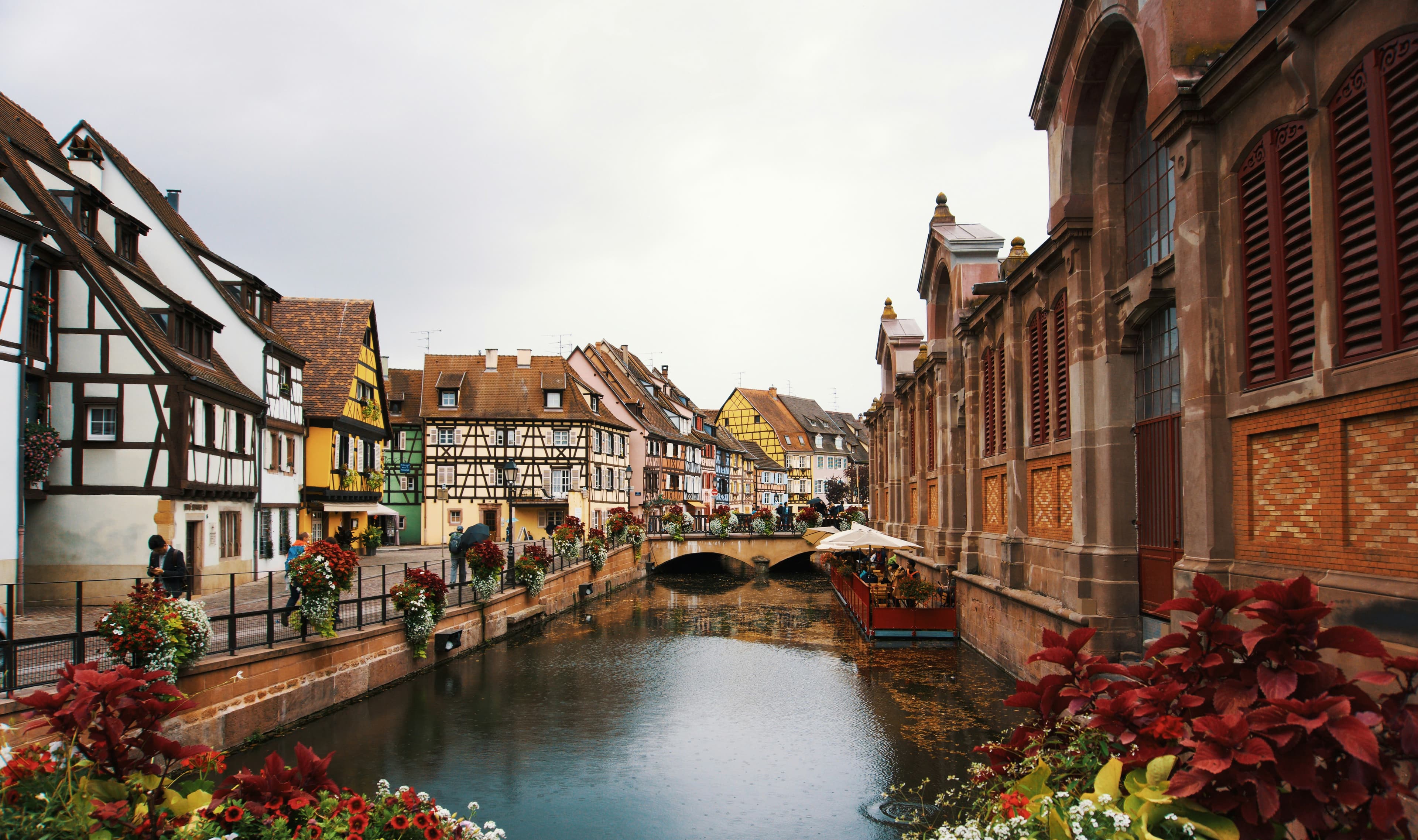
The historic centre and Petite Venise
The historic centre sits a short walk from Place Rapp and offers considerably more to look at and eat than the Champ de Mars does. The cobbled lanes are uncomfortable on tired legs the day after finishing, so weigh how far a hotel sits from the smoother streets, not only how far it sits from the start.
Colmar station
The station district suits rail travellers best. It is close enough to reach the Champ de Mars on foot and simplifies onward connections toward Strasbourg or Basel-Mulhouse, at some cost to the half-timbered streets and canal views of staying in the old town.
Unterlinden and the north-central streets
Unterlinden works as a compromise between full old-town immersion and a quieter night before race morning. It stays walkable to Place Rapp and sits well for the museum district.
Eguisheim and the wine villages
Eguisheim is directly on the route at 34 km and is one of the most attractive bases in the region for a travelling companion who is not running. It is a poor choice for the runner: start and finish are both in Colmar, and race-day closures complicate getting back into town in the morning. The villages further north around Kaysersberg and Riquewihr work far better as a post-race extension than as a race-weekend base.
Recommended hotels
No official marathon hotel block exists. Exact walking distances were not published, so these are placed by district; confirm current operation before booking.
Immediately by the Champ de Mars, inside the same small area as the start, finish and Marathon Village. Breakfast from 06:00 suits an 08:30 gun directly. The trade-off is sitting inside the zone road closures affect most.
A spa hotel inside the same zone, with recovery facilities that suit the day after a marathon better than a standard city hotel. Expect high demand and pricing for the weekend.
A three-star the tourist office places close to the centre. Further from Place Rapp than the Champ de Mars options while keeping the walk to the finish reasonable for the price.
A character hotel inside Petite Venise with considerably more to look at than the Champ de Mars options. Weigh the cobbled approach against how your legs will feel the morning after.
A reasonable budget option with parking on site, which makes it better suited to arriving by car than by rail, at some cost to race-hub convenience.
Booking timeline
There is no ballot here, so no results date triggers a booking rush. Pricing rises with registration count instead, which means the practical trigger is simply securing your own entry early. September is already a popular month for Alsace wine tourism independent of the race, so rooms near Place Rapp and the Champ de Mars can fill from general regional demand before marathon pressure adds to it. Book something refundable once entry is confirmed. For international travellers Strasbourg is the practical rail gateway, with around 43 trains a day and a fastest journey near 27 minutes; treat flights into Strasbourg or Basel-Mulhouse with the same early-booking logic, since both serve a wider tourist season rather than the marathon alone.
See & Do
The first three are walkable from the finish. The last two need transport, and both remove more walking than they add.
Place Rapp and the Bartholdi monument
At the finish itself. The square carries its own piece of the city’s history: a monument by Auguste Bartholdi, the Colmar-born sculptor of the Statue of Liberty, honouring General Jean Rapp. You finish the race standing in it without travelling anywhere.
Petite Venise
A few minutes from the finish, and flat. Colmar’s canal district, best approached on the lightest possible legs the afternoon after the race: the appeal is slow wandering rather than covering ground.
Unterlinden Museum
In the centre, a short walk from the finish. Colmar’s major indoor collection, and the right answer if the weather turns: standing and slow indoor walking suits sore legs better than an outdoor itinerary. Confirm current opening hours before going.
Eguisheim
About 7 km (4.3 miles) from Colmar by road, and the marathon’s own 34 km point. One of the villages officially recognised among France’s plus beaux villages. Regional bus line 68R030 and the seasonal Kut’zig open-top bus both connect it to Colmar through September, which makes it a low-effort outing the day after finishing. Keep the on-foot portion modest.
The Wine Route by Kut’zig
Departs central Colmar. The open-top tourist bus runs from early April to mid-October, Tuesday to Sunday in September, on a loop taking in Ribeauvillé, Riquewihr, Kaysersberg, Turckheim and Eguisheim. It is the most recovery-friendly way to see the villages the race runs through, because it removes both the driving and the walking a self-guided visit would need.
After the Race
September is harvest season in Alsace, which is the best possible timing for staying on and the worst for expecting quiet villages. The marathon has already shown you Ingersheim, Ammerschwihr and Eguisheim at racing speed; the point of the trips below is seeing them at a pace where you can stop. Strasbourg is under half an hour by train, and Basel is close enough to make a third country a reasonable extension rather than a stretch.
The village at the marathon’s own 34 km cutoff, and one of the officially recognised plus beaux villages de France. Low effort, high return, and you will already have seen it at speed.
The regional capital, close enough that the train barely counts as travel: the cathedral, the Grande Île and a great deal more eating than Colmar can offer.
Ribeauvillé, Riquewihr, Kaysersberg and Turckheim at a pace that suits tired legs, on the open-top tourist bus that removes both the driving and most of the walking.
Up into the mountains west of the vineyards for forest, lakes and the Route des Crêtes, a complete change of register from the wine route below.
Across the Swiss border for a city built around its art museums and the Rhine, close enough to reach without another flight.
Frequently asked questions
Should I stay near the start or the finish?
Both are Place Rapp, so the usual trade-off disappears. The Champ de Mars gives the best logistics; anywhere central works.
How far in advance should I book a hotel?
As soon as entry is confirmed. September is busy for Alsace wine tourism regardless of the race, and the central area is small.
Is there free transport to the start?
No marathon shuttle, and none needed. The shuttles that run serve the 10 km and Escadrille fields only, and need a ticket.
What is the best area to stay?
Champ de Mars and Place Rapp for logistics; the historic centre and Petite Venise for everything else; the station for rail.
When does the expo open?
Three windows at the Village du Marathon on Place Rapp: Friday 14:00 to 18:00, Saturday 10:00 to 18:00, race morning 06:30 to 08:30.
What is the weather typically like on race day?
September averages run about 11.6°C to 20.1°C. Long stretches among open vineyards mean wind and sun matter more than on a city loop.
How do I get from the airport?
Via Strasbourg, about 27 minutes by train with roughly 43 services a day, or Basel-Mulhouse as the other regional option.
Is there a bag drop?
Yes, 07:15 to 15:00 at the Marathon Village. Bags are labelled with the detachable strip on your own bib.
Should I bring a throwaway layer?
Yes, for the start line. No donation point was found, so treat it as gone. Sunscreen matters on the open village roads.
How do I get back to my hotel after finishing?
Walk: the finish is in the middle of town. Showers run 10:00 to 15:00 at the Gymnase du Château d’Eau, about 600 m away.