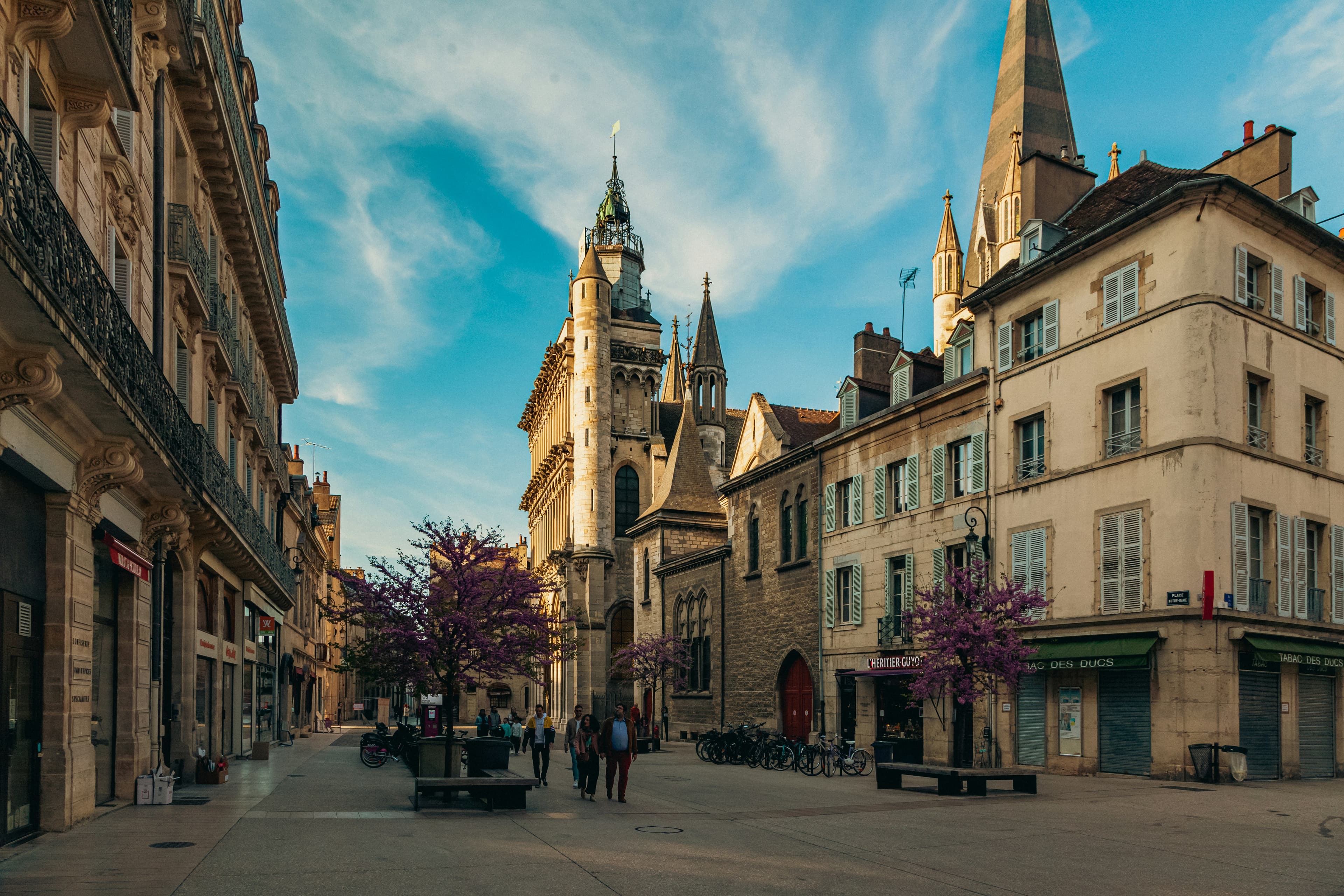
The Race
| Next Race Date | Sunday 11 October 2026, 08:30 |
|---|---|
| Course Type | Loop: an out-and-back on the Route des Grands Crus, starting and finishing at the Allées du Parc |
| Registration | Open, direct online entry with no ballot. 1,620 bibs for 2026 |
| Ballot Opens | Not applicable: this race has no ballot |
| Total Finishers | About 1,217 (2025 marathon) |
| Average Race Day Temperature | 8.2°C to 16°C (October averages for Dijon) |
| Cutoff Time | 6 hours, with a checkpoint at Chambolle-Musigny by 11:00 and a sweep bus at 11:18 |
| Free Race Day Transport | Not for marathon runners. Divia lines L5, L6, L8 and B12 serve the start area |
| Course Certification | FFA departmental listing, Course Hors Stade non officielle. No World Athletics or AIMS certification |
Decide what kind of day you want before the gun
The aid stations here carry cheese, charcuterie, gingerbread, pound cake and organised wine tastings alongside the isotonic drink and gels. That is the event’s defining feature and it cuts both ways. A runner chasing a time should treat all of it as scenery and stick to the conventional stations for anything that needs absorbing mid-race. A runner treating the marathon as the day out the organiser clearly intends may plan a stop or two deliberately. Neither is wrong here. What does not work is drifting between the two and discovering at 30 km that you have had three tastings and no gels.
History
The Marathon des Grands Crus did not begin as a running race. AM Sports, the Dijon association behind it, formed in 2000 to organise the Roller Marathon de Dijon, whose first edition took place in 2001 on the broad Allées du Parc circuit that still hosts the start and finish. The roller marathon went on to host World Cup-level competition and built the operational base the running event would later depend on: the closed-road permits, the volunteer network.
Running arrived later and by a specific route. In 2018 AM Sports began looking for a way past the closed park circuit and found it in the Route des Grands Crus, a corridor first laid out in 1937 that links Dijon to Beaune through 37 named wine villages. Closing that road for a day opened the event to runners, and running has been part of the programme from 2019. The 2026 edition is the organiser’s seventh Marathon des Grands Crus.
The result sits outside the usual pattern for a French city marathon. Dijon is only the start and finish. The middle of the race belongs to the Côte de Nuits, through Chenôve, Marsannay-la-Côte, Couchey, Fixin, Brochon, Gevrey-Chambertin, Morey-Saint-Denis and Chambolle-Musigny, villages better known on a wine list than a race bib. The roller identity has never been dropped either: the weekend still runs roller events alongside the marathon, half marathon and 10 km.
The course
The race starts at 08:30 from the village around Cours du Général de Gaulle and the Allées du Parc, and finishes at the same venue: the two points measure a metre apart, which makes this a loop in classification even though it runs as a straightforward out-and-back. From Dijon the route heads south-west onto the Route des Grands Crus through the Côte de Nuits, passing Chenôve, Marsannay-la-Côte, Couchey, Fixin, Brochon, Gevrey-Chambertin, Morey-Saint-Denis and Chambolle-Musigny before returning north along the same road.
The road is closed to ordinary traffic and predominantly paved throughout. The organiser publishes no elevation total, so none is given here, but the course has a clear shape: a steady climb of about 60 m over the first 12 km from Dijon to the high point of 297 m at Fixin, a 21 m drop into Gevrey-Chambertin, two short rises on the way back, and the same 60 m descent spread over the last 12 km. The average gradient on both long sections is about 0.5%, and no single kilometre exceeds 1.4%. Chambolle-Musigny is the operationally significant point: marathon runners must pass it by 11:00, with a sweep bus leaving at 11:18 for anyone behind.
Km 0 to 6: out of Dijon. The race leaves the Allées du Parc heading south-west past the Port du Canal and down Boulevard Bernard Palissy into Chenôve. The climbing starts almost at once: from the low point of 233 m at km 2 the road gains about 23 m by km 6, too gradually to notice as a hill. This is the closest the course comes to a conventional city-marathon feel, and it is over quickly.
Km 6 to 13: into the Côte de Nuits. The steepest kilometre of the outbound leg, about 14 m at 1.4%, lifts the course onto the Route des Grands Crus at Marsannay-la-Côte by km 7. From there it keeps climbing at about 0.5% through Couchey to the high point of 297 m at Fixin around km 12. Instead of street corners and shopfronts you are moving between vine rows on an open road, with the village centres providing the crowd support and aid-station activity.
Km 13 to 21: Gevrey-Chambertin to Chambolle-Musigny. The course drops 21 m through Brochon into Gevrey-Chambertin by km 16, the most recognisable name on the outbound leg, then runs roughly level through Morey-Saint-Denis to the turn near Chambolle-Musigny at about km 20. That is the point to reach by 11:00, two and a half hours in, or risk the sweep.
Km 21 to 30: the return climbs. Back north along the same corridor, and the drop into Gevrey now has to be climbed: 15 m out of Chambolle-Musigny by km 23, then 21 m in two kilometres through Gevrey-Chambertin to km 27, with one kilometre at about 1.4%. These are the only real climbs of the second half. The open sections between the vines feel exposed in any headwind, and crowd support clusters around the village centres.
Km 30 to 42.195: downhill to Dijon. From Fixin the course gives back the whole outbound climb, 60 m over the last 12 km, steepest between km 34 and 36 as it leaves the Route des Grands Crus at Marsannay-la-Côte. It is a gentle descent, about 0.5% on average, but it helps a tired runner. The final kilometres return through Chenôve to the Allées du Parc, a broad venue that gives the finish more of an open festival feel than a narrow city-centre street would. No marked tangent line has been published, so judge the racing line through village bends by feel.
Course Map
Out from the Allées du Parc through the Côte de Nuits villages to Chambolle-Musigny and back along the same corridor. Tap a marker for details, and scrub the slider or press play to move the orange marker along the course with the elevation profile beneath it.
Pacers
A single 08:30 start with no corral system, and pacers carrying purple flags. The slowest published target is 4:30 against a 6-hour cutoff, so anyone aiming beyond that will be running the back half unpaced.
What to wear
An 08:30 October start in cool conditions: Dijon’s October averages run from a morning low near 8.2°C to a daytime high near 16°C. No official race-day weather archive exists, so treat that as a seasonal guide and check a short-range forecast in race week.
A throwaway layer is sensible for the start-line wait, particularly given the open vineyard sections later, where wind on the Route des Grands Crus can make an already cool morning feel colder. The organiser publishes no clothing-donation process, so do not assume shed clothing is collected. Sun exposure is a smaller concern than at a big-city marathon with a long finishing window, since most runners will be off the open roads well before the 6-hour cutoff pushes into the warmer part of the day, though sunscreen still makes sense toward the back of the field on a clear morning.
Entry
Entry is direct and online through the organiser’s Njuko checkout, with no ballot stage and a published 2026 capacity of 1,620 bibs. Pricing is tiered and rises through the registration cycle. A starting price around €49 rising to roughly €73 in later bands was recorded, though the live checkout could not be read as a stable source, so confirm the current band directly before committing.
Registrations are nominative and normally non-refundable. A refund is available only where you bought optional cancellation insurance at registration and meet the insurer’s conditions, which usually means medical or employer evidence. Non-licensed runners follow the organiser’s current PPS health-declaration workflow inside the registration portal; licensed runners supply a competition licence instead.
One useful piece of timing intelligence: marathon capacity has historically run out later than the half marathon, and for 2026 the half sold out while marathon places remained. Entry does not need the urgency of a Major ballot, but October remains a busy Burgundy travel month whatever the entry pressure, so the accommodation clock runs faster than the entry one.
Fast Runner / GFA Standards
Not applicable. No good-for-age or qualifying standard is published for this race; entry is open to any registrant regardless of predicted finishing time. The rules publish prize money for leading finishers but no ordinary-runner qualifying route. No charity-place programme or tour-operator allocation was found.
Wheelchair and handisport athletes are welcomed, and the organiser asks these entrants to make contact directly before registering, with preferential rates and specific rules offered on request.
Race Weekend
Expo
Bib collection is unusually spread out and starts days before race weekend, across two venues: Thursday 16:00 to 19:00 and Friday 09:00 to 19:00 at Décathlon Quétigny, then Saturday 14:00 to 19:00 and race morning from 07:00 at the village on Cours du Général de Gaulle. The organiser specifically advises against leaving collection until Sunday if it can be avoided.
Bring the bib collection card emailed to you and available in your online account from late September, digital or printed. The organiser is explicit: no card means no bib. A third party can collect on your behalf if they present your card. The village also houses the official event shop and partner stands; there is no separate convention-centre expo. Décathlon Quétigny sits outside central Dijon, so anyone without a car should weigh the trip out against collecting on Saturday afternoon at the village itself.
Getting to the Start
The marathon starts at 08:30 from the race village. The 10 km goes in staggered waves from 09:00 to 09:15, and the half marathon runs two waves at 10:30 and 11:30, both starting from Chambolle-Musigny and reached by mandatory organiser shuttle. None of that affects marathon runners directly, but it explains why the Chambolle-Musigny corridor carries two separate waves of shuttle traffic during your race.
The organiser is explicit that parking near the village is difficult and recommends public transport: Divia lines L5, L6, L8 and B12 serve the start area on both morning and afternoon schedules. Dijon’s SNCF station is about 1.6 km from the race site, connected by local bus. Several public car parks sit between roughly 600 m and 1.1 km away, though closures complicate the final approach.
There are three toilet areas at the start plus toilets in most course villages, and two changing tents at the village. Baggage storage accepts one small cabin-size bag per runner, tagged and retrieved at the same venue afterwards. Headphone policy, chip placement and pushchair rules are not published anywhere and should be confirmed from the current règlement.
Afterwards there is a genuinely unusual recovery option: a partnership with the Piscine du Carrousel, about five minutes’ walk from the finish, gives free Sunday entry for showers and the pool on presentation of a race bib. A swimming cap is required, so pack one if that appeals. Every finisher gets a medal and the organiser advertises a specially bottled Chardonnay, the Cuvée Marathon des Grands Crus, for adult finishers.
Nutrition on Course
Aid stations sit roughly every 2 to 5 km, at the start and finish and in each village the course passes: Chenôve, Marsannay-la-Côte, Fixin, Brochon, Gevrey-Chambertin, Morey-Saint-Denis and Chambolle-Musigny, plus a water-only point at Pont Kennedy on the return. Exact kilometre positions are not published in text, so check the current course map if you are planning a precise fuelling strategy.
Water is served in cups. The isotonic drink is APTONIA, alongside APTONIA gels and bars. The wider list is longer than a typical marathon’s: cereal bars, gels, fruit jellies, bananas, oranges, dates, chocolate, gingerbread, pound cake, cheese and charcuterie, with wine and regional-product tastings promoted at the stations too. Alcohol is prohibited for minors. The organiser designates rubbish zones and states that littering outside them can carry a penalty or disqualification.
Spectating
This is not an easy course for chasing repeated sightings by public transport. The route leaves Dijon entirely for the vineyard corridor, much of which closes to traffic, so the realistic plan is one location, not leapfrogging along the Route des Grands Crus.
The Dijon village. Cours du Général de Gaulle and the Allées du Parc guarantee both a start and a finish sighting, have spectator facilities on site, and avoid the road closures entirely. This is the default.
One vineyard sighting. Watch the 08:30 start, then use transport toward a village such as Gevrey-Chambertin before closures restrict movement, for one mid-race sighting before returning for the finish. Race-day timetables for that connection have not been published, so confirm options in race week.
No official live-tracking app or spectator tool has been announced. Agree a meeting point and a rough timing window with your runner in advance.
Post-Race Food
Central Dijon is close enough to the finish that nobody is dependent on the race village for a proper meal. Three areas are worth planning around, with Sunday hours checked before you rely on any of them: the Les Halles covered-market area for straightforward Burgundy dishes without a long walk; the Cité Internationale de la Gastronomie et du Vin on the south-west side of the centre, useful for a group with different preferences under one roof; and the brasserie streets around Place de la Libération and Rue des Forges for boeuf bourguignon or oeufs en meurette, or something plainer if a rich Burgundian dish sounds like too much straight after finishing. Anyone who worked through the course’s cheese, charcuterie and wine stations will probably find a lighter meal sits better than another tasting menu on top.
Where to Stay
Start and finish share the Cours du Général de Gaulle and Allées du Parc venue, so there is no separate finish-side neighbourhood to weigh against a start-side one. The choice is how close to that single venue you want to be, traded against restaurants, sightseeing and arrival logistics.
Allées du Parc and Place Wilson
Place Wilson and the Allées du Parc make the most race-specific base, minimising race-morning walking and keeping the finish simple in both directions. It suits runners who put logistics ahead of being inside the old-town core. Saturday-night noise tends to run lower here than the central restaurant streets, though race-village setup can begin early on the Saturday.
The historic centre and Place de la Libération
The historic centre is the strongest choice for a first visit that wants restaurants and Dijon sightseeing alongside the race. The start stays walkable, or a short bus or taxi ride. Expect a livelier Saturday evening and higher demand for rooms.
Darcy and the station
The Darcy and station area is useful for TGV arrivals, with Dijon’s SNCF station roughly 1.6 km from the race site and workable without a car. It suits a one or two-night trip where minimising walking with luggage matters more than being inside the old town.
Quétigny and Marsannay-la-Côte
Quétigny is worth prioritising only if you are collecting a bib at Décathlon on the Thursday or Friday, or travelling by car: it is less convenient for race morning and sits away from the finish-village crowds afterwards. Marsannay-la-Côte is a vineyard-edge option that puts the race route on your doorstep, at the cost of a more complicated trip into Dijon for the start once closures are in effect. Confirm access before booking there.
Recommended hotels
No official marathon hotel block was located for 2026, and the organiser publishes no walking distances, so these are placed by district. Reconfirm operation and race-weekend availability before booking.
The most race-specific pick here, in the neighbourhood built around race-morning convenience. A smaller property, so availability runs out earlier than the larger chains.
A landmark central property, chosen for comfort over race-morning proximity. The choice if a premium stay matters more than minimising the walk to the start.
Strong for sightseeing and restaurants inside the old town. Further from the Wilson-area start than a logistics-first booking would pick, and the better base if this is a city break with a marathon in it.
Modern and central, and well suited to a group booking several rooms together. Weekend noise is possible given the bar and restaurant on site.
The simplest option arriving by TGV without a car, trading a slightly longer race-morning walk for minimal friction on arrival.
Booking timeline
There is no ballot result to plan around: entry is open and direct. What creates urgency is the calendar, because October is a strong Burgundy travel month on its own merits and central Dijon hotels tighten well ahead of race weekend regardless of marathon demand. For 2026 the half marathon sold out while marathon places remained, which tells you the accommodation side moves faster than the entry side. Book something refundable as soon as travel plans are firm, several months out for the Wilson area or the historic centre. For international visitors the TGV often matters more than a flight: Dijon is roughly 1 hour 36 minutes from Paris Gare de Lyon, and SNCF releases inventory on a rolling schedule worth checking as soon as dates are set.
See & Do
Distances are from the finish at the Allées du Parc, and approximate.
Palais des Ducs and the Musée des Beaux-Arts
About 1.5 km (0.9 miles) from the finish. The former ducal palace, now housing the fine arts museum, suits the day before the race or a recovery day when legs prefer indoor walking to distance. Check Monday opening specifically if you are planning it for after the race.
Parcours de la Chouette
Starts about 1.3 km (0.8 miles) from the finish, in the old town. A self-guided walking route marked by small owl symbols set into the pavement. It works better in the days before the marathon, or on a second recovery day, than immediately after: it covers ground on foot with no seated recovery points built in.
Cité Internationale de la Gastronomie et du Vin
About 2 km (1.2 miles) from the finish. A concentrated food-and-wine complex with exhibitions, food outlets and indoor space on one site, which is exactly what makes it a practical recovery-day choice: it does not demand much walking between things.
The Route des Grands Crus by vehicle
Departing Dijon. The marathon gives you a compressed, on-foot view of this corridor; a guided vehicle-based tour afterwards is a far more recovery-friendly way to see it properly, with cellar visits and tastings that reward seated time. October colour on the vines can be good, but book cellar visits ahead, and do not plan around the harvest: timing varies by vintage and is usually finished well before mid-October.
Read Before you Run
The Road from the Past: Traveling through History in France
Ina Caro
Caro understands France through specific places and their history, which suits a region where a wine village’s name carries thirteenth-century monastic history as often as it carries a vintage. Good reading for the train legs as much as the planning.
After the Race
You will have run through the Côte de Nuits at racing pace and taken in almost none of it. That is the argument for staying on. Beaune is eighteen minutes away by direct train and gives you the Côte de Beaune at a pace where cellar doors and lunch are the point. Further out, both Lyon and Paris sit inside an hour and forty minutes by TGV, which makes either an easy extension.
The direct regional train makes Beaune the lowest-effort extension from Dijon. The Hospices and a long lunch, with no walking through the vineyards required.
One night in Beaune with a taxi or private tour handling the nearby villages instead of a bike. Far gentler on post-marathon legs than cycling the wine route.
Two nights working through the Côte de Beaune at a pace that suits legs which have already run the Côte de Nuits at speed.
South to France’s other food capital, close enough by train to add without losing a day either side to travel.
Dijon to Gare de Lyon in well under two hours, which makes Paris an easy extension.
Frequently asked questions
Should I stay near the start or the finish?
They are the same venue at the Allées du Parc, so the choice is simply how close you want to be to that one point.
How far in advance should I book a hotel?
Once entry is secured, months ahead for Wilson or the old town. October is a busy Burgundy month regardless of the race.
Is there free transport to the start?
Not for marathon runners. The organiser recommends Divia lines L5, L6, L8 and B12; parking near the village is difficult.
What is the best area to stay?
Place Wilson for logistics, the historic centre for everything else, the station area for TGV arrivals.
When does the expo open?
Thursday and Friday at Décathlon Quétigny, then Saturday afternoon and race morning at the village. No collection card means no bib.
What is the weather typically like on race day?
Cool: October averages run about 8.2°C to 16°C, with wind the real factor on the open vineyard roads.
How do I get from the airport?
By TGV for most: about 1h36 from Paris Gare de Lyon, 1h37 from Lyon. The station is 1.6 km from the village.
Is there a bag drop?
Yes, one small cabin-size bag per runner at the village, retrieved at the same venue. Three toilet areas and two changing tents on site.
Should I bring a throwaway layer?
Yes. No clothing-donation process is published, so treat it as gone. The vineyard sections are exposed to wind.
How do I get back to my hotel after finishing?
Walk or take a Divia bus. The Piscine du Carrousel also gives free Sunday entry on a race bib, though you need a swimming cap.