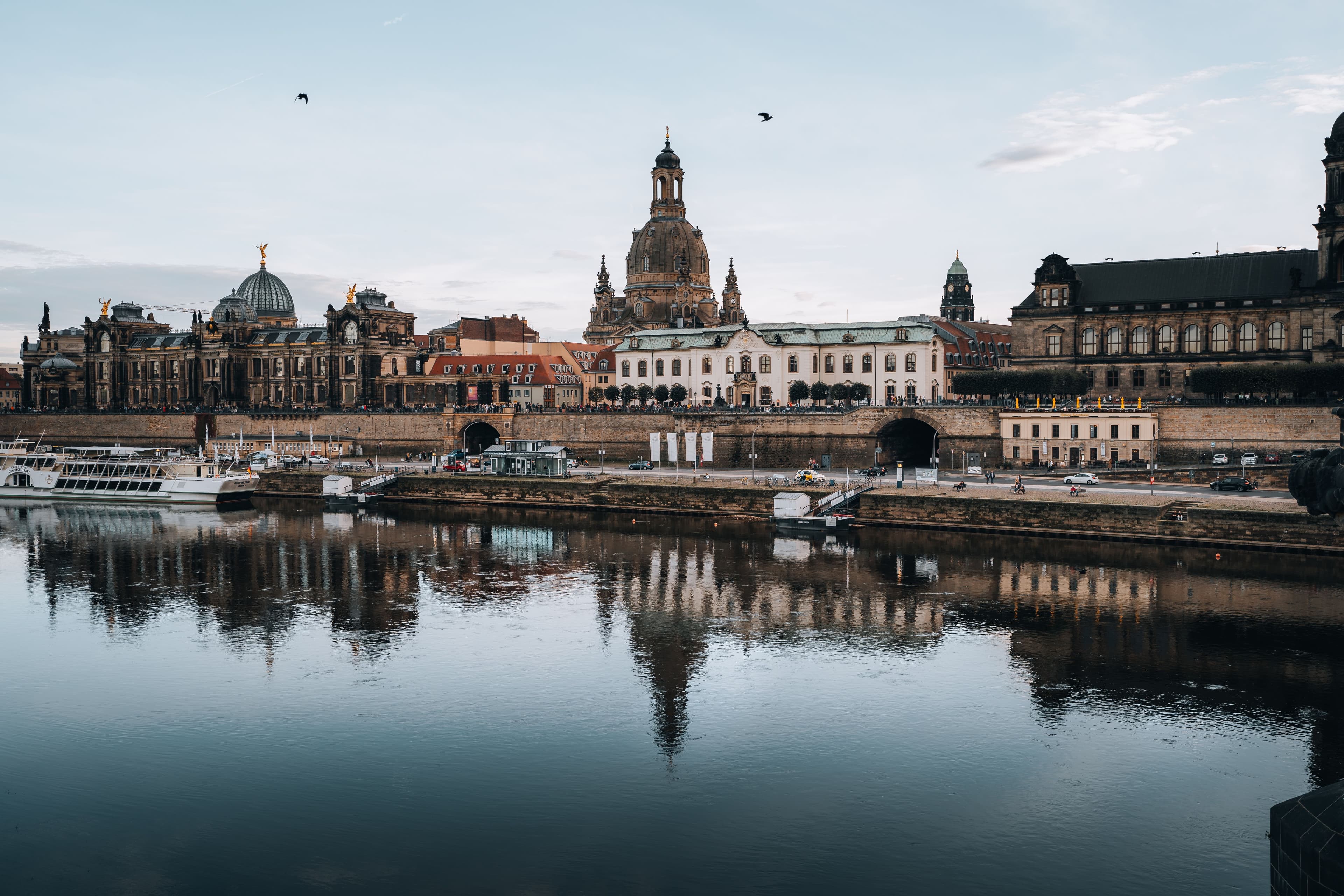
The Race
| Next Race Date | 25 October 2026 (Sunday), 10:30 start |
|---|---|
| Course Type | Flat road course. Start on Ostra-Allee, finish inside Heinz-Steyer-Stadion about 800m away, out to Blasewitz and back beside the Elbe |
| Registration | Open online registration, no ballot. Standard deadline mid-October, online late registration through the week before, then on-site at the expo subject to availability |
| Ballot Opens | Not applicable, open registration |
| Total Finishers | 2,084 over the marathon distance at the most recent edition |
| Average Race Day Temperature | Around 9°C mean, 13°C high, 6°C low, with humidity high enough that rain feels colder than it reads |
| Cutoff Time | 16:30 finish close, six hours from the start. Intermediate cutoff at km 17 by 12:50 |
| Free Race Day Transport | Yes. The bib is valid as a public transport ticket within Tarifzone Dresden on race day, excluding special transport |
| Course Certification | DLV-permitted road marathon. No current World Athletics Label or AIMS measurement certificate located |
Kilometre 17 by 12:50, or you are running the half
The single most important operational fact about this race is not the finish cutoff. It is the mat at the half-marathon split at Thomas-Müntzer-Platz, kilometre 17, which must be reached by 12:50, two hours and twenty minutes after the 10:30 start. Runners who miss it are removed from the marathon or redirected onto the half-marathon route. That works out at roughly 8:14 per kilometre, which sounds generous until a cold, wet October morning and a conservative start eat into it. Anyone whose realistic marathon pace sits near six hours should treat the first 17km as the race that decides whether they get to run the other 25.
History
The event traces its opening to a conversation that had nothing to do with race logistics. On New Year’s Eve 1997, Dresden runners gathered at the Babisnauer Pappel, a lone poplar on high ground above the city, and raised the idea of restoring a city marathon. Dresden had run one before: the Dresdner Friedenslauf covered the marathon distance between 1985 and 1990 but was not carried through reunification. A trial run followed in November 1998, and the first modern Dresden Marathon started on 24 October 1999 with 335 finishers.
Dresden Marathon e.V. built the club structure behind the event, which grew into a multi-distance weekend carrying sponsor names, Morgenpost and Piepenbrock among them, at different points without losing its identity. By the 20th edition in 2018, roughly 7,800 runners took part across the full programme. Ezekiel Koech of Kenya lowered the men’s course record to 2:10:00 in 2019, and Teclah Chebet, also of Kenya, ran 2:30:30 for the women’s record in 2022. Both still stand. The pandemic broke the sequence, and the results archive jumps from the 21st edition in 2019 to the 22nd in 2022.
The route itself is not fixed, and that matters more here than at most races. In 2024 organisers redrew it at short notice after the collapse of Dresden’s Carola Bridge, and for the 25th anniversary in 2025 it was reworked again, removing earlier out-and-back sections and cutting cobblestone underfoot to under 200 metres across the full distance. That anniversary edition drew more than 10,000 registrations across all distances, with 2,084 finishers over the marathon itself. Anyone comparing an older course description against the current one should expect real differences.
The course
The marathon starts on Ostra-Allee and finishes inside Heinz-Steyer-Stadion, about 800 metres away, after roughly half a lap of the stadium track. In between it strings together the reconstructed baroque centre, Neustadt across the river, the Elbe corridor, the Großer Garten and the residential streets east of the centre, with hundreds of musicians and bands along the way. It is flat apart from one feature in the first 7km: a gentle 31m rise from Neustadt up to the Albertstadt, peaking at 140m around km 6, then a 33m drop in about a kilometre down to the Waldschlösschenbrücke. From km 7 to the finish the course stays within about 12m.
It is not a single loop. The stretch from about km 8 to km 17, through Johannstadt, Striesen and the Großer Garten, is run again from about km 27 to km 38, and there is a short out-and-back around the Blasewitz turn. The closing third is therefore a road you have already run once that morning, which helps with pacing and gives spectators two sightings from one spot.
Km 0 to 7: the baroque centre and the first river crossing. The start on Ostra-Allee heads straight into central Dresden, past the Zwinger inside the first kilometre and the Frauenkirche shortly after, the densest concentration of spectators on the course outside the finish. The route crosses into Neustadt by about 2.8km and climbs gently, about 31m over 5km, through the Äußere Neustadt to the Albertstadt, the highest point of the course at 140m around km 6. It then drops 33m in about a kilometre down Stauffenbergallee to the Waldschlösschenbrücke at 6.7km, the only real gradient of the day. There is no reason to push here. Flat pavement, big crowds, and the decision point still ten kilometres away.
Km 7 to 17: the Großer Garten and the cutoff. The course works south and east through Johannstadt and Striesen into the Großer Garten, Dresden’s largest central park, at about km 12, then back toward Thomas-Müntzer-Platz. The road barely moves, staying between 116 and 119m. Aid stations at 9.0km and 13.8km carry the same core menu. This section ends at the half-marathon split at kilometre 17, and at 12:50 the mat closes. Everything before this point is, in effect, a qualifying run for the rest of the race.
Km 17 to 27: past the split, out to Blasewitz. Beyond the cutoff the field thins sharply as the half-marathon runners peel away, and the course carries the bulk of the marathon-only distance. It crosses the Elbe twice more, north over the Albertbrücke around km 18 and back south over the Waldschlösschenbrücke around km 20.5, and reaches Blasewitz, the furthest point from the centre, at about 24km, with views up toward the hillside villas above Loschwitz and along the tree-lined Goetheallee. One independent runner account described sections after the split as constrained onto narrower pavement and cycle lane, with harder overtaking. Check the current course before relying on it.
Km 27 to 38: the second pass. This is the repeated ground, covering the same route as roughly km 8 to 17 for a second time. The fullest aid station on the course sits at 34.9km, with gel, bar, cola and salt alongside the standard menu, which is useful positioning for the stretch where fatigue bites hardest. Water-only points at 30.8km and 38.5km bracket it.
Km 38 to 42.195: back along the Elbe to the stadium. The closing kilometres turn back toward the centre along the Elberadweg, dipping to the riverside at km 39, passing near Brühl’s Terrace and the Semperoper again around 40.5km, before turning into Heinz-Steyer-Stadion for roughly half a lap of the track. Where the timing mat sits inside that half-lap is not confirmed in published information, so treat the marathon gate as the point of entry and the finish line as somewhere on the back half of the track.
This is not a course with long sweeping curves that reward aggressive tangent-running, but the Waldschlösschen crossing and the perimeter of the Großer Garten both carry gentle bends where holding the shortest line saves a handful of metres over the full distance.
Course Map
The map shows the 2026 course. Note that a substantial middle section is run twice, so parts of the line below carry the field on two separate passes. Tap a marker for details, and scrub the slider or press play to move the orange marker along the course with the elevation profile beneath it.
Past the Zwinger inside the first kilometre and the Frauenkirche shortly after, into Neustadt, then the Waldschlösschen crossing at about 6.7km. The biggest crowds of the day, and no reason at all to push.
Through Dresden’s largest central park and out to Thomas-Müntzer-Platz. The half-marathon split at km 17 closes at 12:50. Everything to here is a qualifying run for the rest of the race.
The field thins sharply as the half peels away. The furthest point from the centre at about 24km, along the villa-lined Goetheallee, carrying most of the marathon-only distance.
Roughly ten kilometres of already-familiar ground, the fullest aid station at 34.9km, then back along the Elbe past Brühl’s Terrace into Heinz-Steyer-Stadion for half a lap of the track.
Pacers
Not confirmed. No official pacer programme was found, and no pace-group table should be assumed. Check current race-week runner information before planning around pace bands used at other German marathons, since there is no evidence Dresden runs one at all.
What to wear
Late October in Dresden averages around 9°C, with a typical high near 13°C and a low near 6°C, and humidity sits high enough, around 81%, that rain feels colder than the forecast number suggests. The 10:30 start avoids the coldest part of the day but does not remove the risk of a wet, windy morning. Plan for the forecast, not the average.
A cheap disposable outer layer for the start pen makes sense on any forecast below about 10°C, with thin gloves and a cap if rain looks likely. All three can be discarded once the body warms up, provided a collection point exists on the day: no official throwaway-clothing scheme has been published. Underneath, standard layering applies, a technical top, not cotton, and shorts or tights depending on cold tolerance, since 6 to 13°C sits in the range where runners disagree. A clothing bag is part of the entry package, so pack a dry change including a proper coat for the walk back. Free hot showers and pool access after the finish are worth building into the plan on a genuinely cold, wet edition.
Entry
Entry is open online registration with no ballot, no guaranteed-entry qualifying time and no official charity-place mechanism. The fee sits in a price band, not a fixed figure, since the organiser runs a countdown to the next price increase, so treat any quoted euro figure as provisional and check the current price before registering.
The standard deadline falls in mid-October, followed by an online late-registration window through the week before race day, and finally in-person late registration at the expo across the Friday, Saturday and Sunday of race weekend, subject to availability. International runners should register in the standard window.
The minimum age is 18 on race day. Start blocks are assigned A through F by predicted finish time, from a fastest band through to a final block for runners entering no target time, and the exact bands shift slightly year to year.
Cancellation terms are strict, and worth reading before committing: once registered, non-participation for any reason, illness included, forfeits the entry fee and any booked extras, with no refund and no voucher toward a future edition. No deferral mechanism is advertised, and the bib is expressly non-transferable, so confirm any name-change process directly with the registration service.
Fast Runner / GFA Standards
Not applicable. No good-for-age or qualifying-time entry route is published for this race, and no elite qualifying standards table exists, though named elite athletes are recruited through organiser channels.
Race Weekend
Expo
The expo and bib collection run at BallsportARENA Dresden, Weißeritzstraße 4, immediately next to the Heinz-Steyer-Stadion finish complex. In the most recent published schedule the expo itself runs Friday and Saturday only; Sunday morning is bib-collection with no expo trading, so anyone hoping to browse stands needs to arrive before race day. Organisers explicitly recommend collecting on Friday or Saturday.
Runners need their registration confirmation to collect a bib. Whether photo ID is also required, and what the proxy-collection procedure is, is not clearly stated, so bring both the confirmation and photo ID. No medical certificate is required. Dresden-Mitte S-Bahn and Postplatz are each about five minutes’ walk away, and trams 6 and 11 serve the Kongresszentrum stop. Collecting on foot gives a useful preview of the finish-line layout.
Getting to the Start
The start, expo and finish all sit within the same central district, which simplifies race morning considerably. The marathon starts at 10:30 on Ostra-Allee, and the finish roughly 800 metres away is reachable on foot from most Altstadt, Postplatz and western-centre accommodation. Runners staying further out can use the S-Bahn to Dresden-Mitte or trams to Postplatz or Kongresszentrum.
The bib is valid as a public transport ticket within Tarifzone Dresden on race day only, a city-zone entitlement, not a wider regional pass. Start blocks run A through F by predicted finish time; line up in the block matching an honest expected pace.
The late start removes the pre-dawn journey many European marathons demand and shifts the planning question onto breakfast: a normal meal around 06:30 to 07:00 leaves comfortable digestion time. A clothing bag is part of the entry package, though the exact hand-in lane and closing time are not published this far ahead. The field is smaller than at the largest German marathons, so start-area congestion is unlikely to be the main source of delay: the km 17 cutoff and the weather are the two factors that actually shape a Dresden race morning.
After finishing, runners receive a medal, with engraving available for a small charge if prebooked, along with refreshments, massage, free showers and pool access, and medical support. Road closures affect tram and bus routes on race day, so check live Dresdner Verkehrsbetriebe information, not a normal journey plan, when heading back to a hotel further out.
Nutrition on Course
Ten refreshment points alternate between full stations and water-only points, with the menu growing more substantial in the second half. Personal nutrition can be handed in at the Help Desk during expo hours and again until 08:00 on race morning; that deposit system does not extend to the water-only points.
| Distance | Provision |
|---|---|
| 4.8 km | Still water only |
| 9.0 km | Water, XENOFIT isotonic, tea, banana, raisin bread |
| 13.8 km | Water, XENOFIT isotonic, tea, banana, raisin bread |
| 18.8 km | Water, XENOFIT isotonic, tea, banana, raisin bread |
| 22.0 km | Adds XENOFIT bar, with tea, cola and salt appearing progressively through this range |
| 24.7 km | As above |
| 27.3 km | As above |
| 30.8 km | Still water only |
| 34.9 km | The fullest station on the course: water, isotonic, gel, bar, banana, raisin bread, cola, salt |
| 38.5 km | Still water only |
| Finish | Water, tea, apples, watermelon, alcohol-free Erdinger |
Runners who want a specific gel or a caffeine source earlier than 34.9km should carry their own or use the Help Desk deposit, since the course’s own gel provision arrives relatively late. The three water-only points at 4.8km, 30.8km and 38.5km are useful mental waypoints for tracking a fuelling plan against the course’s fixed menu.
Spectating
The course repeatedly returns to the central district it starts and finishes in, which makes it genuinely workable without a car. A determined spectator can manage three or four sightings of one runner without much travel, provided they plan around the repeated section between km 8 and 17 and km 27 and 38. Public transport is the practical way to move between vantage points, since the course closes several central streets while runners are passing.
Central, low risk. Watch the start on Ostra-Allee, walk east toward Postplatz for an early sighting through the baroque centre, stay central until the marathon returns beside the Elbe near the Semperoper, then walk to the stadium for the finish. The safest option if you would rather not rely on tram diversions holding up.
Großer Garten. Watch the start, then use public transport east once the field has cleared. Watch the runners through the park, return toward Dresden-Mitte or Postplatz for a second sighting in the old town, then move to the stadium.
Blasewitz and the eastern course. Skip or briefly watch the start and travel out toward Blasewitz or Goetheallee, where the marathon extends beyond the shared loop the half marathon uses. Crowds are thinner here precisely because it is furthest from the centre. Allow real time on the return, since it is the furthest point from the finish.
The organiser links a RaceMap live-tracking tool from the event site, which is the reliable way to time a move between vantage points. Whether stadium finish-area access is ticketed is not confirmed, so arrive with time to spare. Layer up: standing still in October is considerably colder than moving.
Post-Race Food
The finish covers immediate recovery: warm tea, apples, watermelon and alcohol-free Erdinger are all part of the standard provision. For a proper sit-down meal, Dresden’s central layout means transport is unnecessary from most race-weekend accommodation. Sophienkeller im Taschenbergpalais, near the Zwinger, serves a substantial Saxon menu about fifteen minutes’ walk from the stadium. Watzke am Ring is a central brewpub-style option with carbohydrate-heavy regional food. For something lighter, the vegan cafés in Neustadt are worth checking.
Sunday opening hours for any of these should be confirmed before setting out. A sensible timing strategy is early evening: a shower and a couple of hours’ rest restore appetite far more than trying to eat a full meal within the first hour.
Where to Stay
Choose by distance to the finish, though the trade-off is gentler here than at most races: the start, expo and finish all sit within the same small central district, so a hotel that works for one works for all three.
Ostra and western Innere Neustadt
The area around Ostra-Allee, Kongresszentrum and Dresden-Mitte offers the best pure logistics on the whole course, with start and finish both walkable in minutes. It is more an event and transport district than the postcard version of Dresden, and prices rise here on marathon weekend as demand concentrates. It suits runners who want the shortest possible walk at both ends and will trade some character for it.
Altstadt and Postplatz
The Altstadt and Postplatz make the strongest all-round choice for most runners: 10 to 20 minutes’ walk from the race area, with the Zwinger, Semperoper, Residenzschloss and a good spread of restaurants on the doorstep, and quieter on Saturday night than Neustadt across the river. Prices run mid to high, but for anyone combining a short city break with the race this is the neighbourhood built for both halves of the trip.
Seevorstadt and Hauptbahnhof
The Prager Straße and main station area carries the largest accommodation supply in the city and excellent transport links, with the race area roughly 2km away. It runs busier around the shopping corridors than the Altstadt, but often has better-value chain hotels for the same standard of room. The natural choice for rail travellers and for anyone planning onward trips to Prague, Leipzig or Berlin.
Innere Neustadt
Innere Neustadt, around Neustädter Markt and Albertplatz, puts Dresden-Neustadt station roughly a kilometre from the event area, with a good concentration of restaurants and solid tram links. Noise rises as hotels get closer to the nightlife streets nearby, so it suits runners who want the dining and transport without booking on top of the busiest bar strip.
Äußere Neustadt
Äußere Neustadt is the livelier bar and independent-café district, and can offer good value alongside more evening character than the Altstadt. That comes with a real drawback the night before a marathon: Saturday-night noise here is a common complaint. It suits a longer, more social weekend better than a runner prioritising sleep.
Friedrichstadt
Friedrichstadt, immediately west and south-west of the race complex, puts some parts of the neighbourhood within 10 to 20 minutes’ walk of the stadium. It is less tourist-driven than the Altstadt, with a more residential feel, but it rewards value-oriented runners who want to walk to the race without needing nightlife on the doorstep.
Recommended hotels
An official partner hotel with exceptional race-morning convenience. The trade-off is a more functional location than the deep historic centre.
A comfortable, full-service hotel within walking distance of both ends of the race, usually priced above the station-area chains.
A substantial, quieter hotel that remains walkable to the race area, at the cost of a longer post-race walk than the Ostra-Allee options.
Good value for rail arrivals, with a flat walk or short tram ride to the event area, though less convenient for a quick return to the room after finishing.
An official partner listing noting runner breakfast and after-marathon shower facilities. Expect a hostel-style budget setting with variable quietness.
Booking timeline
Because entry is open with no ballot, demand builds gradually through the year. Even so, the weekend has passed 10,000 registrations across all distances, and central accommodation narrows as race weekend approaches. Reserve a refundable central hotel four to six months ahead if the trip is firm, particularly any of the organiser’s official partner hotels within about a kilometre of the stadium, since budget inventory near the Altstadt and Dresden-Mitte goes first.
Flights are less straightforward than to a major hub, since Dresden’s own airport is comparatively small; rail via Berlin, Leipzig or Prague can be competitive depending on where the trip starts. Book onward transport once registration is confirmed but keep some flexibility, since late-October rail engineering works and flight schedule changes are both realistic risks.
See & Do
All of these sit within reach of the finish and the central hotel areas, and several are on the course itself.
Zwinger
Around 1 km (0.6 miles) from the finish. A baroque palace complex, and one of the easiest high-value visits given how close it sits to both the route and the finish. The courtyards are recovery-friendly for tired legs. Book timed museum tickets in advance where required.
Semperoper and Theaterplatz
Around 1 km (0.6 miles) from the finish. Exterior sightseeing is easy on sore legs. An interior tour or a performance involves a fixed booking time and long seated or standing periods, better scheduled before the race than immediately after it.
Residenzschloss and the Historic Green Vault
Under 1 km (0.6 miles) from the finish. A strong bad-weather option for the Monday after the race. Timed admission is advisable for the Historic Green Vault specifically.
Brühl’s Terrace and the Elbe waterfront
Under 1 km (0.6 miles) from the finish, and directly on the closing stretch of the course. Free to visit and easy to see in short sections, though the exposed riverfront can be windy, which makes it less recovery-friendly in wet weather.
Großer Garten
Around 2 km (1.2 miles) from the finish. A course landmark, with flat paths suited to a gentle walk if the legs tolerate it the day after. Autumn colour here depends on the weather.
Worth reading
Slaughterhouse-Five, by Kurt Vonnegut. Vonnegut was a prisoner of war in Dresden during the February 1945 bombing, and the city is central to the novel. For a straight historical account, Sinclair McKay’s Dresden: The Fire and the Darkness explains why the baroque cityscape along the course looks the way it does: historic in design, but substantially reconstructed after 1945.
After the Race
Dresden runs in late October, which shapes what is worth doing afterwards: the boat services along the Elbe have stopped for the season, and the sandstone trails of Saxon Switzerland are better on the second recovery day than the first. Everything below is reachable by rail, and Prague sits close enough to make a direct train a better idea than a flight home.
A compact old town, the Albrechtsburg and cathedral skyline above the river, and the porcelain manufactory, all manageable on legs still recovering.
Palace grounds and gardens beside the river for a low-intensity half day, without relying on the seasonal boat services that stop before late October.
A compact centre built around Bach and the Thomaskirche, with a different character from Dresden and an easy transfer with a rolling bag.
Sandstone plateaus and river-valley walking, paced across two days so a full day of flat walking comes before any attempt on the Bastei.
A no-flying transfer from Dresden’s centre to Prague’s, with a full extra day in Dresden first to let stairs and cobbles feel less punishing.
Frequently asked questions
Should I stay near the start or the finish?
The same question here. The start on Ostra-Allee and the finish at Heinz-Steyer-Stadion sit about 800m apart in the same district. Ostra-Allee or Dresden-Mitte for the shortest walk, Altstadt or Postplatz for a better balance with sightseeing.
Is there a ballot, and how far ahead should I book?
No ballot, open online registration. The weekend has passed 10,000 registrations across all distances, so book a refundable central hotel four to six months ahead if the trip is firm, and check the partner hotel page first.
Does my race bib work as a public transport ticket?
Yes, on race day only, within Tarifzone Dresden. It is a city-zone entitlement, not a regional Saxony pass, so it will not cover a journey from further afield.
What is the kilometre 17 cutoff?
Marathon runners must reach the half-marathon split at Thomas-Müntzer-Platz by 12:50, two hours twenty after the start, or be redirected onto the half marathon. It should shape pacing from the first kilometre.
Where and when is the expo?
BallsportARENA Dresden on Weißeritzstraße, next to the finish stadium. Expo trading typically runs Friday and Saturday, with Sunday reserved for bib collection only. Bring the registration confirmation and photo ID.
What is the weather likely to be like?
Late October averages around 9°C, with a high near 13 and a low near 6, and humidity high enough that rain feels colder than it reads. Cold rain and wind are realistic.
How do I get to Dresden, and how far is the airport?
Dresden Airport is around 8km from the race area with public transport links. Hauptbahnhof and Dresden-Neustadt are well connected, and rail via Berlin, Leipzig or Prague is often competitive with flying.
Is there baggage storage during the race?
Yes, a clothing bag is part of the standard entry package. The exact hand-in location and closing time are not published far in advance, so check the final race-week guide.
Can I throw away old clothes before the start?
Possibly, on a cold or wet forecast, but no donation or disposal scheme has been published. Wear only what you are prepared to keep until baggage drop-off unless race-week information says otherwise.
How do I get back to my accommodation after finishing?
The stadium finish is central, so Ostra-Allee, Altstadt and Postplatz are all walkable. From further out use Dresden-Mitte, Postplatz or Kongresszentrum, and check live DVB information: road closures affect normal routes.