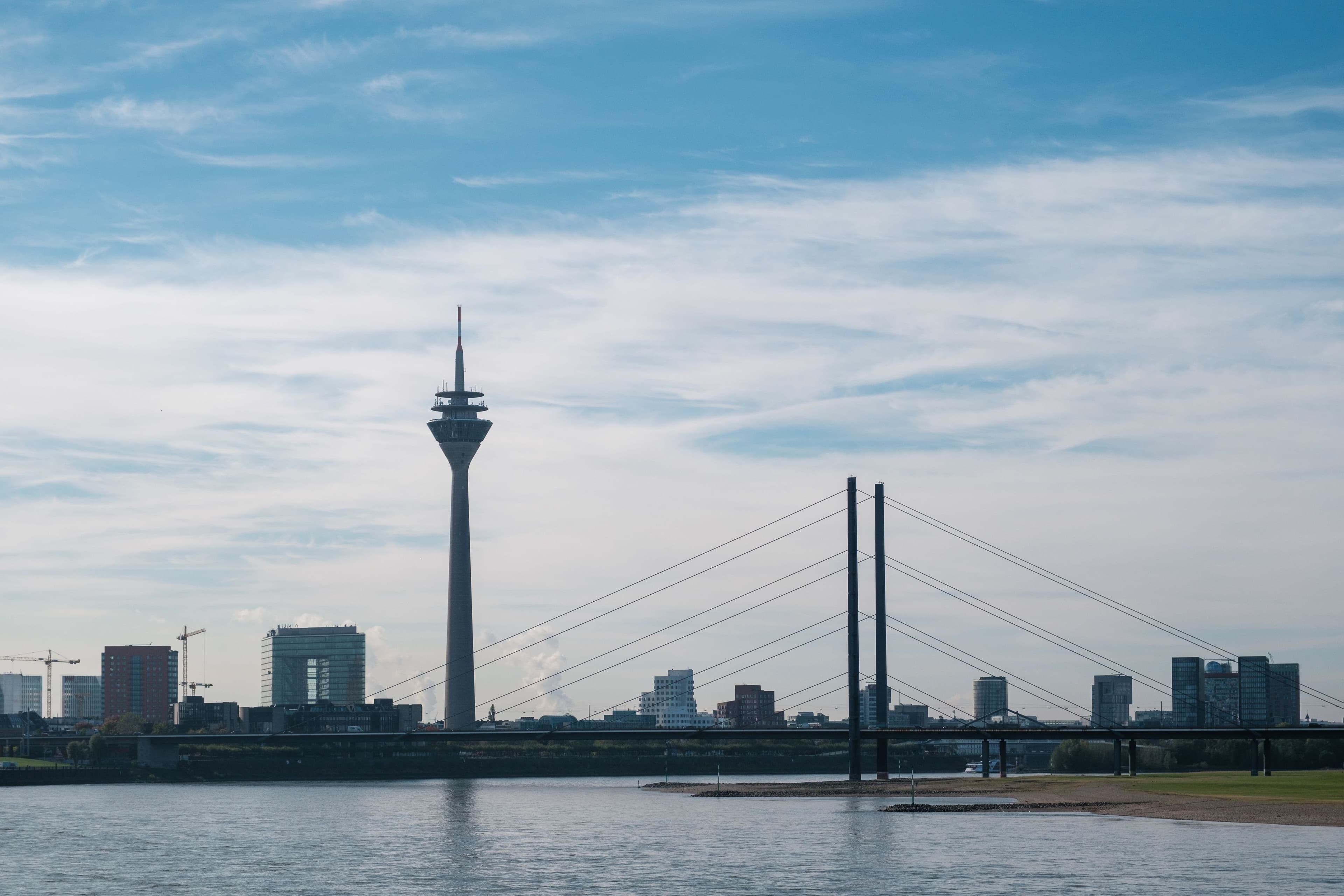
The Race
| Next Race Date | 18 April 2027 |
|---|---|
| Course Type | Loop: both banks of the Rhine, largely flat with two bridge crossings. Start and finish about 1.4 km apart on the same riverside |
| Registration | Open registration, no ballot. Tiered pricing by place number, not by calendar date |
| Ballot Opens | No ballot |
| Total Finishers | About 4,200 in the marathon (2025). Not to be confused with the ~24,000 across the whole 2026 programme |
| Average Race Day Temperature | April mean about 10°C, with a high near 16°C and a low near 5°C. Wind off the Rhine matters more than the number |
| Cutoff Time | 6 hours. The most recent edition closed the finish at 15:45 from a 09:45 start |
| Free Race Day Transport | Free travel in fare zone A3 with the bib in the most recent edition. Not yet confirmed for this one |
| Course Certification | DLV competition rules apply. World Athletics Road Race Label status for this edition is not confirmed |
History
The Düsseldorf Marathon began in 2003, founded by Jan-Henning Winschermann through the Rhein-Marathon-Düsseldorf association he had set up two years earlier. Under METRO Group sponsorship it built a reputation as one of Germany’s faster city courses: Dereje Debele’s 2:07:48 in 2013 and Volha Mazuronak’s 2:25:25 in 2018 are the recognised records, both predating the later relaunch. From 2005 the race carried a unicycle marathon championship alongside its handcycle field, which ran until 2014, and the German Marathon Championships were staged here in 2018 and 2019. Golazo took over the organisation in 2016, and by 2018 the founding team had gone.
Then the race went dark for six years. The 2020 and 2021 editions fell to the pandemic, a planned 2022 return was cancelled, and there was nothing in 2023 or 2024. The City of Düsseldorf announced a comeback for 2025, with D.LIVE and D.SPORTS taking over the organisation outright and the Düsseldorf energy company Uniper signing as title sponsor for an initial three years.
The relaunch, on 27 April 2025, drew 16,127 participants across the full weekend programme and around 250,000 spectators, with roughly 4,200 completing the marathon and 6,300 the half. Alex Maier of the United States won the men’s race in 2:08:33 and Leah Jeruto of Kenya the women’s in 2:25:23. The new organisers built a music concept called Run to the Beat into the route itself, with DJs stationed along the course as well as at the start and finish.
The second revival edition, in April 2026, grew again: reporting put the full programme close to 24,000 participants, more than 40 percent up on 2025. Dmitriy Nedelin won the men’s race in 2:08:54, a time German media reported as a Russian national record, though that specific claim has not been checked against the relevant federation here; the result itself is confirmed by World Athletics. What the race is now is Düsseldorf’s restored large-city marathon: a flat, largely urban course on both banks of the Rhine, run alongside a much larger half-marathon and relay field.
The course
The marathon starts at Joseph-Beuys-Ufer, on the Rhine just north of the Altstadt, and finishes at Untere Rheinwerft, on the river below the old town. The two are about 1.4 km apart on the same waterfront, which is close enough that where to stay is not a start-versus-finish decision. The organiser calls the route varied but largely flat, and that holds up: there is no trail section anywhere, and the only real gradient is the ramps at the two Rhine crossings.
The shape of the course is clear. North first, to a turn near the Nordpark at about km 4, then back south towards the centre. The Oberkasseler Brücke carries the field onto the left bank at about km 13.4, into a loop through Oberkassel where halfway falls, before recrossing at about km 22. The second half threads through the centre, taking the Königsallee at about km 24 and again at about km 40, out east through the Zoopark district to the furthest point from the river at about km 30, then south through MedienHafen at about km 38 and back to the Rhine.
The organiser publishes no gain figure, and the chart spans just 19 m, with no climb anywhere longer than a few hundred metres. With almost no hills, the variables that decide the day are the bridge ramps, the repeated changes of direction, and wind. The course spends real distance on open riverside road with little building cover, and a gusty year on the Rhine costs more here than any climb does.
Km 0 to 5: north from Joseph-Beuys-Ufer. The start sits on the Rhine promenade near the Rheinterrasse and the Ehrenhof museum quarter, and the route heads north on streets far wider and more open than the Altstadt lanes. This is the most wind-exposed running of the whole race, with nothing to break a headwind this early. Treat whatever you feel here as a preview of the return leg on the same bank. The first refreshment point in the most recent aid plan sat at 4.7 km.
Km 5 to 13: back towards the centre. The course curves south past the Nordpark and Aquazoo area and tightens as it nears the northern edge of the Altstadt. Roadside support becomes noticeable here for the first time, a real contrast with the open, water-facing kilometres before it. The approach to the Oberkasseler Brücke is a useful pacing checkpoint: the ramp is short, but the shift from flat riverside road to an elevated crossing unsettles a metronomic stride if you have not planned for it.
Km 13.4 to 22: across the river and back. The bridge carries the field onto the left bank into Oberkassel, a residential quarter quieter and more shaded than the commercial streets opposite. Halfway falls inside this loop, just before the course turns back to the bridge and recrosses at about km 22. Two crossings in fairly quick succession is the closest this course comes to a defining physical test, and the wind returns on both.
Km 22 to 30: the Königsallee and the Zoopark. Back on the right bank the race becomes properly central. The route takes the Königsallee, Düsseldorf’s main shopping boulevard, at about km 24, then works east through the Zoopark district to its furthest point from the river at about km 30. The Run to the Beat DJ positions concentrate through these kilometres, so noise runs heavier than on the outward northern leg. Some runners have described quieter gaps between the music points here, so pace by feel.
Km 30 to 42.195: MedienHafen and the finish. The closing third runs south through MedienHafen, the glass-and-steel harbour district below the Altstadt, reached at about km 38, then takes the Königsallee a second time at about km 40 before the final approach to the river. The most recent aid plan put its most closely spaced refreshment points through exactly this stretch, at 30.5, 32.5, 35.4, 37.5 and 40.2 km, adding cola and gels. The finish at Untere Rheinwerft is on the same waterfront the race started beside.
One tactical note worth acting on: the two Rhine crossings are the only points where the racing line matters more than habit. Taking the shortest path through the turns onto and off the bridge saves real distance on a course that is otherwise a series of long straight city blocks. The exact turn geometry depends on the final course map.
Course Map
North along the Rhine, across to Oberkassel and back, then through the centre and MedienHafen to a finish 1.4 km down the riverside from the start. Tap a marker for details, and scrub the slider or press play to move the orange marker along the course with the elevation profile beneath it.
Open riverside road from Joseph-Beuys-Ufer to a turn near the Nordpark at km 4, then back towards the centre. The most wind-exposed running of the race, and the first aid point is not until 4.7 km.
Across the Oberkasseler Brücke to the left bank, a loop through Oberkassel where halfway falls, then back over. The ramps and the wind on them are the closest this course comes to a physical test.
Central Düsseldorf, the first Königsallee pass at about km 24, then east to the furthest point from the river at km 30. The DJ positions concentrate here and the noise picks up.
South through the harbour district at about km 38, a second Königsallee pass at km 40, and back to Untere Rheinwerft. Aid is at its densest through here.
Pacers
The most recent edition ran pacers at 3:00, 3:15, 3:30, 3:45, 4:00, 4:15 and 4:30, in 15-minute increments, with nothing slower than 4:30 reported. Start blocks were assigned by expected finish time at registration and marked with a coloured circle on the bib. No pacer list has been published for this edition, so treat that range as a likely shape, not a plan, and confirm it against the participant briefing before building a race around a specific group.
What to wear
April in Düsseldorf runs cool and unpredictable at a 09:45 start. The monthly average low is around 5°C and the high around 16°C, but that describes the whole month, not one morning, and both a cold showery start and an unexpectedly warm one are plausible. The start sits directly beside the Rhine, and open water feels colder than a sheltered street, so a disposable top or an old sweatshirt is sensible for the wait even on a mild forecast.
The specific thing to dress for is wind. Rain and moderate wind are both realistic, particularly on the exposed riverside kilometres at the start and on the two bridge crossings, so a lightweight wind-resistant layer that can be discarded is worth carrying. In a genuinely cold year, gloves earn their place at an exposed start.
For anyone expecting four hours or more, sun protection still matters in a cool month: a clear mid-April sky can catch a slower finisher without shade through the later kilometres. The organiser has previously provided donation bins for layers discarded before the start, and gave the collected clothing away, which makes bringing an inexpensive throwaway worth the effort. Check the current arrangement before leaving clothing anywhere other than a designated point.
Entry
Entry is open, with no ballot and no qualifying time. The pricing structure is the part worth understanding: it rises as places fill, not on a fixed calendar. The cheapest band covers places 1 to 1,000, a middle band covers 1,001 to 2,002, and every place from 2,003 onward sits at the top tier. On a race that grew by more than 40 percent in a single year, entering early in the cycle is worth more here than at an event with flat pricing.
The regular deadline falls in early April, close to race day. A late window then reopens a few days afterwards if capacity remains, carrying a fixed surcharge, and bibs issued through it may not carry your name printed on them. There is no Good for Age route and none is expected: this is an open-entry race by design.
Transfers to another runner are free up to the standard deadline, after which a fee applies if the organiser can still accommodate one. Downgrading from the marathon to the half is free. Upgrading from the half to the full means paying the difference plus a processing charge, and only while the standard window is open and capacity allows. That cutoff has shifted before, so confirm it.
Cancellation is stricter than transfer, and this is the clause to read before booking travel. A runner who cancels by 31 December of the year before the race, with a medical certificate, can claim a 50 percent refund. After that date the published rules offer no refund at all. If you are booking flights and accommodation well ahead of entering, independent travel insurance covering both injury and non-refundable bookings is a useful purchase here.
Fast Runner / GFA Standards
Not applicable. No Good for Age or time-qualification route exists. No public elite-entry standard or elite-application contact has been published for this edition either, and no official charity-bib programme with a fundraising minimum has been found: the race’s charity element runs through a separate mechanism, not guaranteed entry.
Race Weekend
Expo
Everything below is prior-edition precedent. No schedule has been published for this edition, so treat the times and the location as pending confirmation.
The expo ran as the Run & Beat Village at Rheinterrasse Düsseldorf, Joseph-Beuys-Ufer 33, directly beside the marathon start. Hours were Friday 12:00 to 20:00 and Saturday 09:00 to 19:00, with a limited emergency collection window on Sunday morning for runners who could not attend earlier. Collection used a QR code generated at registration, and proxy collection was possible provided the person collecting had that code. The bib and participant bag were issued together, and the bib itself doubled as the race-day transport pass within fare zone A3.
International visitors should bring the QR code, photo identification and the same identity details used at registration. No mandatory medical certificate has been required for ordinary bib collection on the race’s current entry pages. The location on the central Rhine waterfront is convenient from the Altstadt, Pempelfort, Stadtmitte and the main station, all reachable on foot or by a short U-Bahn or tram ride. The organiser also ran a free, capacity-limited shakeout of around 5 km from Rheinterrasse on the Saturday morning; whether that repeats has not been announced.
Getting to the Start
The marathon starts at Joseph-Beuys-Ufer at 09:45, directly on the Rhine just north of the Altstadt. A central start makes race morning considerably simpler than an edge-of-city one: from Düsseldorf Hauptbahnhof, U-Bahn and tram services towards Heinrich-Heine-Allee and the Tonhalle bring you within an easy walk, and the most recent start map highlighted the U70, U74, U75, U76 and U77 lines specifically. Road closures alter the normal service pattern, so check the current transport plan.
Registered runners in the most recent edition travelled free within fare zone A3 on race Sunday, using the bib as a ticket. That entitlement has not been confirmed for this edition, and it is worth separating two things: a free ticket is not a guarantee of a normal timetable. The briefing warned that only certain tram operations would run as usual around the closures.
Bag drop was a tent on the Reuterkaserne meadow near the Düsseldorfer Sonnenuhr, opening for marathon runners at 07:45. Runners used the official bag issued with the bib, so do not assume your own bag can be checked in: carry only what the organiser’s bag holds. Discarded clothing could be left in designated collection points or over the barriers and was donated on, which is a good reason to bring an inexpensive layer for the wait. Exact bag size, drop location and opening time are unconfirmed for this edition.
With the full programme now approaching 24,000 participants across all distances, arriving with enough time to use the toilets, drop the bag and reach the right block matters more than it did in the smaller 2025 comeback field. A last-minute walk from the station on race morning is not a safe assumption given how much of the surrounding street network closes.
The finish is at Untere Rheinwerft, on the lower Rhine promenade below the Altstadt: a controlled finisher area with no re-entry once you leave it. Showers and changing were at Reuterkaserne, roughly 200 m from the finish. Because the finish is so central, onward travel is easy once roads reopen, with the Altstadt and Heinrich-Heine-Allee walkable and the Hauptbahnhof a short U-Bahn ride or a 25 to 30 minute walk. For meeting people afterwards, agree a landmark away from the secured chute: the riverside gets extremely busy and mobile networks struggle with the volume.
Nutrition on Course
The table below is the most recent published aid plan, carried forward as precedent, not confirmed for this edition. Every distance and product should be checked against the current participant briefing.
| Km | Available |
|---|---|
| 4.7 | Water, isotonic, sponges |
| 10.0 | Water, isotonic, sponges |
| 12.5 | Water, isotonic, sponges |
| 14.9 | Water, isotonic, banana, sponges |
| 16.5 | Water, isotonic, sponges |
| 20.0 | Water, isotonic, bar, gel, banana, sponges |
| 22.0 | Water, isotonic, sponges |
| 24.8 | Water, isotonic, bar, banana, sponges |
| 27.1 | Water, isotonic, sponges |
| 30.5 | Water, isotonic, cola, bar, gel, banana, sponges |
| 32.5 | Water, isotonic, cola, sponges |
| 35.4 | Water, isotonic, cola, bar, gel, banana, sponges |
| 37.5 | Water, isotonic, cola, sponges |
| 40.2 | Water, isotonic, cola, bar, sponges |
The pattern to plan around is that solid food and gels start at 20 km and cluster heavily from 30 km. Nothing but water, isotonic and sponges is available before then, and the first station is at 4.7 km, so a runner carrying their own early fuel and relying on course support from the midpoint onward would have matched the layout well.
The briefing also described private-supply tables at the main refreshment points for runners bringing their own nutrition, and blood-glucose check points at 19 km and 31.2 km. Eligibility and procedure for both need confirming. Nutrixxion was among the nutrition partners and ERDINGER Alkoholfrei was associated with the finish; product sponsorship for this edition is unconfirmed.
Spectating
Three or four sightings are realistic here, and the reason is the Rhine. Because the U-Bahn crosses the river independently of the runners’ route, a supporter can get from the left-bank Oberkassel section to the central city sections without following a closed road on foot or getting stuck on a diverted bus. That is a structural advantage most city marathons do not offer.
Plan A: start, Oberkassel, finish. See the start at Joseph-Beuys-Ufer, walk to Tonhalle or Heinrich-Heine-Allee and take the U-Bahn across the river towards Luegplatz or Belsenplatz for the Oberkassel sector, roughly km 14 to 21. Return by U-Bahn and walk to Untere Rheinwerft. The most reliable of the three, because it uses a fast cross-river rail corridor that road closures cannot trap.
Plan B: Königsallee, Zoopark, finish. Skip the crowded start and take up a position on the Königsallee for the first pass at about km 24, then use central rail or tram wherever it is still running to reach the Zoopark area for the later sector, and walk back to the river. Which lines are running depends on the final transport plan, so check it.
Plan C: walk everything. Watch near the Oberkasseler Brücke or the Altstadt approach for one early sighting, walk through the centre to a later point on the Königsallee or in MedienHafen, and walk back to Untere Rheinwerft. This depends on no altered surface transport at all. It is several kilometres of walking across the morning, but it works well with children, since nothing hinges on catching a specific train.
The strongest single location is the Altstadt, Königsallee and Rhine corridor, where central footfall overlaps with the densest concentration of DJ positions. The northern sections out towards Nordpark are much quieter. No ticket is needed for roadside viewing; access immediately beside the finish chute is controlled. Runner tracking used the TRACX platform most recently, but the provider for this edition is unconfirmed.
Post-Race Food
The central finish puts the Altstadt and Carlsplatz within an easy walk. Uerige, on Berger Straße, is a traditional Altbier brewery with a large informal setting close to the line; a substantial plate with potatoes there is a better recovery choice than treating the house beer as a hydration strategy.
The better answer, though, is Little Tokyo around Immermannstraße, where Düsseldorf has a dense cluster of ramen restaurants. Takumi and Naniwa are the names that come up most. A salty broth with carbohydrate-heavy noodles and a choice of egg, meat or tofu is about as well-matched to a post-marathon stomach as restaurant food gets; queues at peak times are the trade. Carlsplatz market, near the Altstadt, gathers multiple food counters in one compact space, which suits a group wanting different meals without another long walk, though Sunday hours vary by stall.
If you are staying near the Hauptbahnhof, the more comfortable sequence is to go back, shower, and walk into Little Tokyo afterwards.
Where to Stay
The single most useful fact here is that the start and finish are not really a trade-off. Joseph-Beuys-Ufer and Untere Rheinwerft sit about 1.4 km apart on the same stretch of the Rhine, a short walk between them, so a hotel chosen for a quiet night’s sleep beats one chosen to shave a few hundred metres off either walk.
Pempelfort and Golzheim
Pempelfort, immediately north of the Altstadt, sits close to the start with many streets considerably quieter than the old-town nightlife. The walk to the start runs 10 to 25 minutes depending on the hotel, and the walk back after finishing is manageable on tired legs. This is the strongest balanced choice for anyone who values a calm night before over having bars on the doorstep.
Altstadt and Carlstadt
The Altstadt sits closest to the finish, with Untere Rheinwerft immediately below it and Heinrich-Heine-Allee nearby for the short trip out to the start. The catch is that this is Düsseldorf’s brewery and bar district, and Saturday-night noise is a genuine problem for pre-race sleep unless the hotel has quiet rooms away from the street. Maximum convenience for the finish, and best avoided by light sleepers.
Stadtmitte and Little Tokyo
Between the Hauptbahnhof and the centre, Stadtmitte gives the best combination of airport access, rail, restaurants and central transport. The start is 2 to 3 km away and easily covered by U-Bahn; the finish is a 20 to 30 minute walk or a short ride once services return to normal. Immermannstraße’s Japanese quarter is a real asset in both directions, for the carbohydrate meal the night before and the ramen afterwards. The most practical base for international arrivals.
Hauptbahnhof and Friedrichstadt
The station area has the widest price range and the simplest luggage logistics, with the airport directly rail-connected and easy onward day trips from the same platforms. Race morning needs a short U-Bahn or tram transfer, and the finish is less convenient from here than from the Altstadt or Pempelfort. Some streets immediately around the station feel less polished late at night. The value choice.
Oberkassel
Oberkassel, on the left bank, is where the marathon spends its middle third. It is attractive and quiet on a Saturday night, and the U-Bahn under the Rhine makes the start reachable, but race-day closures and the need to cross a bridge add transport dependence that the right bank does not have, and you have to cross back after finishing. Better for a family or a quiet stay than for minimising post-race friction.
MedienHafen and Unterbilk
The modern southern waterfront sits near a later section of the course, with design hotels, restaurants and views of the Rheinturm. Race morning means moving north to the start by tram or U-Bahn plus some walking, and getting back from the finish is a comfortable 1 to 2 km walk. Good for a contemporary city-break feel, poor if proximity to the start is the priority.
Recommended hotels
The strongest start-and-finish balance on this list, which on a course whose two ends are 1.4 km apart is the thing worth optimising. Event-weekend rates run high.
The most convenient for the finish and for sightseeing. Ask for a quiet room: this is the brewery-and-bar quarter, and Saturday night is not designed around pre-race sleep.
Near the station and the Japanese restaurants, which makes both the night-before carbohydrate meal and the post-race ramen easy. A busy urban setting.
Strong on food and rail access, close to Little Tokyo and the Hauptbahnhof. Not a doorstep hotel for the finish.
Simple, practical rail and airport logistics at the lowest price on this list. Less attractive surroundings and the longest walk back after finishing.
Booking timeline
With no ballot, the sequence is simple: enter first, then book a cancellable room immediately, because prices rise as place-number tiers fill. The event’s growth is the reason to move early. The 2025 comeback drew over 16,000 across the full programme and 2026 reporting put it near 24,000, which is a substantial jump even against Düsseldorf’s large business-hotel inventory. Six to nine months ahead is a reasonable target for the best central rooms.
Düsseldorf Airport has extensive European service and a direct rail connection into the city, which makes it the straightforward option; flying into Cologne/Bonn and continuing by long-distance rail is worth comparing but rarely wins. One thing worth checking is the Messe Düsseldorf trade-fair calendar. A large fair moves hotel prices in this city more than the marathon does, and an April date can collide with one.
See & Do
Three of these four sit on or beside the course, so you will have run past them before you look at them. Distances are practical estimates from the Untere Rheinwerft finish.
Rheinturm
About 2 km (1.2 miles) from the finish, beside MedienHafen. A 240.5 m tower with an observation deck reached by lift, which makes it one of the few high viewpoints that is genuinely easy on tired legs. Standing about and queuing at the top is the part that wears. Confirm race-weekend opening hours before going.
MedienHafen
About 2 km (1.2 miles) south of the finish, around the Rheinturm. A flat waterfront walk through contemporary harbour architecture, easy underfoot and the right scale for the day after. The marathon runs through it at about km 38, so walking it afterwards gives that closing stretch some context.
Little Tokyo
About 2 km (1.2 miles) from the finish, around Immermannstraße. Germany’s largest Japanese community by the city’s own description, with ramen restaurants, izakaya, supermarkets and bookshops packed into a few streets. Treat it as a food destination; the popular ramen places queue.
Königsallee
Under 1 km (0.6 miles) from the finish, and part of the course itself: you pass it at about km 24 and again at about km 40. The city’s principal shopping boulevard, with the old moat and its plane trees down the middle, easy to fold into a short recovery walk from the Altstadt. Better kept brief the day after than turned into a long circuit.
After the Race
Düsseldorf’s real strength as a race base is what sits within an hour and a half of its main station: Cologne, Aachen, the Ruhr and the Middle Rhine, none of them needing a car. Mid-April has the daylight but not the reliable warmth, so the trips below lean on towns, spas and industrial-heritage sites. They are ordered by how much walking they ask of legs that have just covered a flat, windy 42 km.
A historic Rhine-side quarter reached without leaving the city or catching a train. The lowest-effort recovery half-day on this list.
The cathedral stands beside Köln Hbf, so this needs no overnight bag and no hotel change. The obvious Monday.
The unhurried version: move hotels after breakfast and take a slow day around the cathedral, the Altstadt and the Belgian Quarter without watching for a return train.
Carolingian history and a real thermal-spa culture, which is a more useful combination after a marathon than it sounds.
Zollverein at Essen and the Landschaftspark at Duisburg, a sharp contrast with Düsseldorf’s polished riverfront and all reachable on public transport.
The Rhine and Moselle confluence and the Rhine Gorge, an easy extension for anyone with spare days before flying home.
Frequently asked questions
Should I stay near the start or the finish?
Not really a trade-off. Joseph-Beuys-Ufer and Untere Rheinwerft are about 1.4 km apart on the same riverside. Pempelfort, Altstadt or Carlstadt keeps both walkable; prioritise a quiet room instead.
How far in advance should I book a hotel?
As soon as you enter, and make it cancellable. The event went from 16,000 participants in 2025 to close to 24,000 in 2026. Six to nine months is a sensible target.
Is there free transport to the start on race day?
In the most recent edition the bib gave free travel in fare zone A3 on race Sunday. Not yet confirmed for the coming edition, and a free ticket is not a normal timetable given the closures.
What is the best area to stay?
Pempelfort for pure race logistics, Stadtmitte and Little Tokyo for airport and station connections plus restaurants. In the Altstadt, ask for a room away from the bar streets.
When does the expo open?
The most recent one ran at Rheinterrasse, beside the start, on the Friday and Saturday, with a limited Sunday-morning emergency slot. Collection is by QR code; proxy pickup allowed with it.
What is the weather typically like on race day?
April here is variable: mean near 10°C, high around 16°C, low around 5°C, with rain and wind both realistic. Wind matters more than temperature on this course.
How do I get from the airport?
Düsseldorf Airport is directly on the rail network, with regional and S-Bahn services to the Hauptbahnhof. No hire car is needed for this trip.
Is there a bag drop?
Yes. The most recent edition used a tent on the Reuterkaserne meadow, opening 07:45, and runners used the official bag issued with the bib. Details unconfirmed for the coming edition.
Should I bring a throwaway layer?
Probably. April mornings can sit in single figures and the start is right on the Rhine. The organiser has previously collected discarded clothing and donated it.
How do I get back to my hotel after finishing?
The finish is central. The Altstadt and parts of Pempelfort are walkable, Heinrich-Heine-Allee reaches the rail network, and station hotels are a short U-Bahn ride or a 25 to 30 minute walk.