The Race
| Next Race Date | 11 October 2026 |
|---|---|
| Course Type | Loop: two circuits of Lake Baldeney, start and finish at Seaside Beach |
| Registration | Open entry online, capped at 1,200 marathon places |
| Ballot Opens | No ballot |
| Total Finishers | 679 (2025) |
| Average Race Day Temperature | Cool, with wind and rain off the open lake a real prospect |
| Cutoff Time | 5 hours 30 minutes. 10:00 start, timing closes 15:30 |
| Free Race Day Transport | Yes. Return travel in VRR fare level C, second class, on race day; the emailed confirmation is the ticket |
| Course Certification | Measured to AIMS/IAAF guidelines per the organiser, under DLV rules supervised by the Leichtathletik-Verband Nordrhein. No World Athletics label |
History
The race began in 1963 as a club comparison event on the Hardenbergufer beside Lake Baldeney, with around 50 runners and a winning time of 2:40:55 from Bruno Nießer of Barmer TV. For its first two decades it was a competitive fixture, not a mass-participation city event, which is why its claim to be Germany’s oldest continuously staged marathon is usually made with that qualification attached. By 1980 the field had reached about 600 and the narrow out-and-back on the Hardenbergufer had run out of room.
The 1981 edition brought the change that still defines the race: a route built on two full circuits of the lake. Competitive depth followed. Jürgen Dächert ran 2:15:52 in 1983, and Werner Grommisch’s 2:14:36 in 1987 remains the men’s course record in the established marathon chronicles. The women’s mark is far more recent, Kristina Hendel’s 2:27:31 in 2021 according to the organiser’s own account, though some independent results tables give 2:27:30. A one-second gap of that kind almost always reflects gross-versus-net timing, not a dispute about the record.
Finisher numbers passed 1,000 in the early 1980s and kept climbing, with more than 3,000 registrations in 2004 prompting the organiser to introduce a cap. As Germany’s big-city marathons expanded and absorbed the mass-participation market, the field here settled back down; the 2026 marathon is capped at 1,200. The naming sponsor has changed more than once, from RWE to Westenergie since 2020, but the volunteer organisation under TUSEM Essen and the lake-loop route have proved far more durable than the branding.
2020 tested that continuity directly. Instead of skipping an edition, TUSEM and Westenergie staged a scaled-down “Extrarunde” with 11 marathon runners, five Seerunde runners and six relay teams under distancing rules, and still count it as the 58th edition, keeping the sequence unbroken. Number collection moved to the Regattahaus area in 2021, and in 2024 both start and finish moved to the current Seaside Beach site. Recent winners have been regional: Christoph Uphues took 2024 in 2:24:55 and 2025 in 2:24:01, with Deborah Schöneborn winning the 2025 women’s race in 2:37:46 as the organiser recorded 679 marathon finishers, the highest total in a decade.
The course
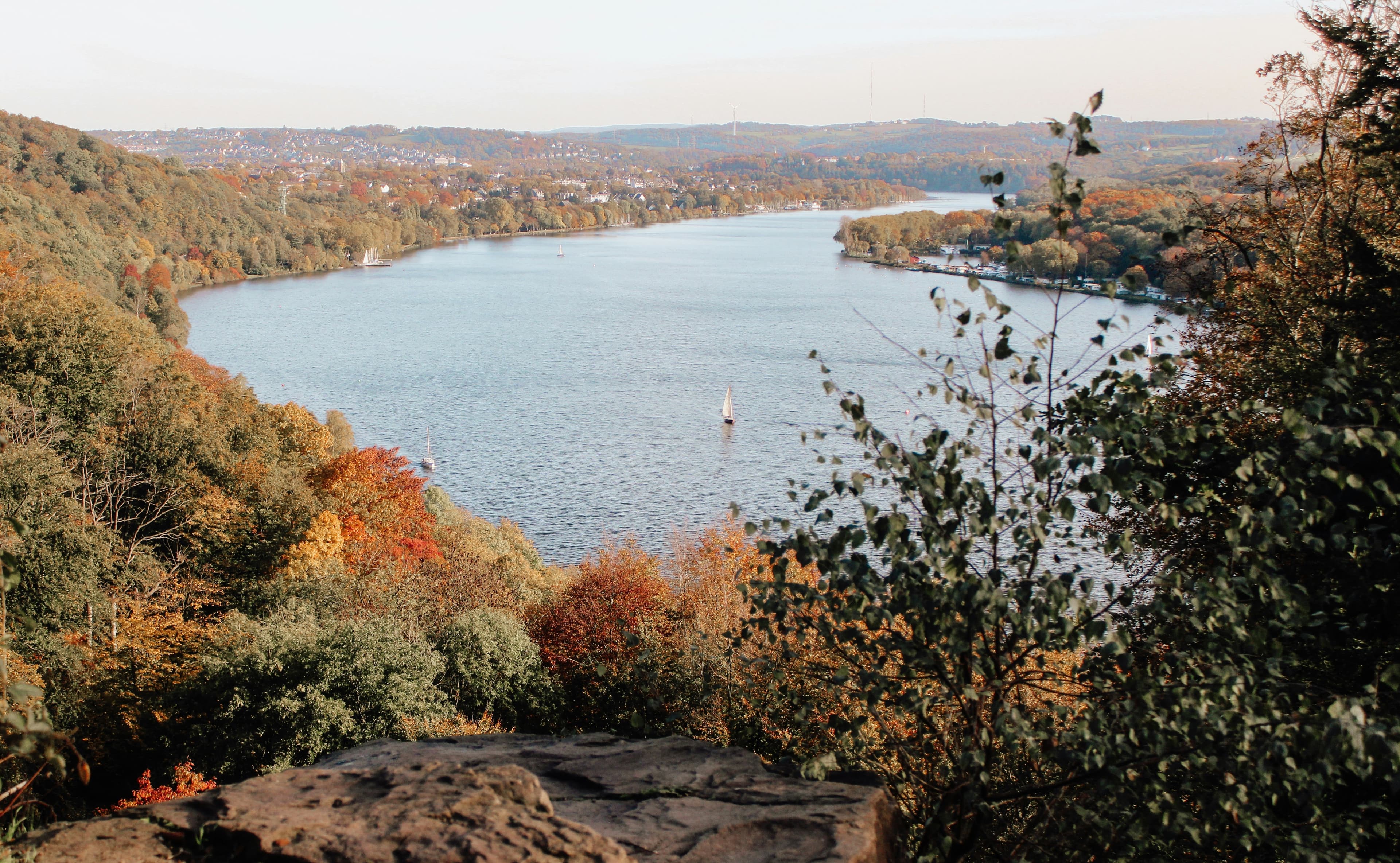
The marathon starts and finishes at Seaside Beach Baldeney on the north-western shore of the lake, and reaches 42.195 km through a short introductory out-and-back followed by two full circuits of the water. Each circuit measures 18.8 km, run anti-clockwise: out along the southern side, around the eastern head of the lake, and back west along the northern shore road to the start and finish site. Two short pendulum out-and-backs, one at each end of the lake, are what bring the total to the exact distance.
The surface is asphalt throughout, with no trail sections and no cobbles, and the organiser states the course is measured to international AIMS/IAAF guidelines with every kilometre marked. Elevation is modest but not entirely absent: the route sits between roughly 46 and 83 metres on SRTM data, with the low ground beside the water and the higher readings on the road sections that pull away from the shore. The organiser publishes no gain figure and describes the course simply as flat. Final route approval rests with the City of Essen each year, so minor adjustments between editions are possible.
Km 0 to 3.9: the introductory out-and-back. The 10:00 start sits directly beside the Seaside Beach grounds. The field runs roughly 2 km east along the north shore, turns, and comes back past the start before the lake circuit proper begins. It is an unusual opening, and a useful one: with 1,200 runners on a shoreline road, four kilometres of straightforward running lets the field sort itself out before the course narrows into its first turn.
Km 3.9 to 7.2: down to the turn below the lake. The circuit heads west along the northern shore road to the lake’s narrow western end and on to Werden, where the course turns at about km 7.2, a few hundred metres from Werden Abbey, and crosses the Ruhr. This western turn recurs at km 26 on the second lap. The northern shore road here drops gently, about 20 m over 5 km.
Km 7.2 to 12: the southern side. Back up to the lake and east along its southern side, the part of the course that most resembles what the race is known for. The Hardenbergufer is gently rolling, with rises of up to about 18 m, the first between km 8.5 and 10. The relay exchange sits at about km 12, reached by the organiser’s own ferry shuttle for relay teams, which makes it the one point on the course other than the start and finish where anything resembling a crowd gathers.
Km 12 to 17.8: the eastern head. The course continues along the Hardenbergufer to Kupferdreh, crosses the Kampmannbrücke at the eastern head of the lake around km 16, then runs the organiser’s out-and-back on Wuppertaler Straße behind the bridge, turning at about km 16.7. This is the quietest part of the lap and the furthest from any transport, so a supporter here needs a plan to reach it.
Km 17.8 to 22.7: the northern shore, and lap one closes. The return leg runs west through Heisingen and along the northern shore road with the water on the left for most of it. The one noticeable climb of the lap comes just before the start area, about 23 m in 700 m around km 22, the same stretch as the introductory out-and-back. The lap closes back at Seaside Beach at about km 22.7, which is worth knowing precisely: the halfway point at 21.1 km falls a kilometre and a half before the start and finish area, not at it. Supporters waiting at the base will see runners come past just after they have gone through halfway.
Km 22.7 to 42.195: the second lap and the run-in. The second circuit repeats the first exactly, which is the defining feature of racing here. Everything learned about wind direction, the feel of each straight and the spacing of the aid stations on lap one becomes usable pacing information on lap two. The shoreline that looked pleasant at km 10 looks identical at km 30, so the risk is lost concentration. The last circuit closes at about km 41.5 and a short run-in of roughly 700 metres brings runners to the finish inside the Seaside Beach site, where the timing line stays live until 15:30.
Course Map
The course runs two anti-clockwise circuits of Lake Baldeney from a shared start and finish at Seaside Beach, with a pendulum out-and-back at each end of the lake. Tap a marker for details, and scrub the slider or press play to move the orange marker along the course with the elevation profile beneath it.
Two kilometres east along the north shore and back past the start before the lake circuit begins. With 1,200 runners, the opening is calm enough to run at the intended pace from the gun.
The course leaves the lake and drops south down the Ruhr valley to a turn a few hundred metres from Werden Abbey. Repeated at km 26. This is the out-and-back that makes the distance exact.
The circuit returns past the start and finish site about 1.5 km after the halfway point. The natural place to reassess pace, and the best single spot for supporters.
The second circuit closes and a short run of roughly 700 metres brings runners into the finish inside the Seaside Beach site. Timing closes at 15:30.
Pacers
Pacers are provided by PacerTeam across eight bands at 15-minute intervals, from 3:00 to 4:45. That is unusually fine-grained for a field of 1,200, and it is one of the practical reasons this race suits a target time. There are no waves and no corrals: the marathon starts as a single group at 10:00, and pacers identify themselves within it.
| Start time | 10:00, single wave, no corrals |
|---|---|
| Pace groups | 3:00, 3:15, 3:30, 3:45, 4:00, 4:15, 4:30, 4:45 |
| Provider | PacerTeam |
| Cutoff | 5:30, timing closes 15:30 |
What to wear
October at Lake Baldeney is cool as a matter of course, and the organiser’s own account of the 2023 edition records wind with rain showers. A flat profile is not the same as an easy day when the course spends most of its distance on an open shoreline. Wind protection matters more here than it would on a course threaded through a city centre, where buildings break the worst of it.
The practical answer is a light windproof carried through the race. On the exposed western and eastern ends of the lake, a shell that can go on and come off twice is worth its weight, particularly on the second lap when pace has dropped and the same wind bites harder. A disposable warm layer for the wait before a 10:00 start is still sensible, but no official clothing-donation scheme has been published, so check the current participant guide for collection arrangements. Underneath, standard autumn kit applies: a technical top, not cotton, and shorts or tights according to cold tolerance. A dry change of clothes in the bag tent is worth the effort given the walk back to Essen-Hügel afterwards.
Entry
Entry is direct online registration with no ballot, capped at 1,200 marathon places. That cap is the single thing to plan around: it is a fraction of the race’s historic fields, and a race that took more than 3,000 registrations in 2004 has no obligation to leave places open into October.
Pricing climbs through five bands across the year: €45 until 15 February, €50 from 16 February to 15 May, €55 from 16 May to 31 July, €65 from 1 August to 4 October, and €75 for the final window from 5 to 11 October. Entering by 4 October also gets your first name printed on the bib, which matters more on a quiet course than it does in a city crowd. Late registration is unusually accessible for a race of this size, available on site near the start and finish on Saturday 10 October between 13:00 and 17:30 and on Sunday 11 October between 07:30 and 09:30, handled by QR code with a paper fallback, at the top €75 band.
Entry changes and transfers are permitted online until the Sunday before the race, either through the link in the confirmation email or via Cologne Timing support, for a €5 fee. After that point, changes go through the service desk on site. The organiser is explicit that a no-show carries no right to a refund, and that cancellations arising from force majeure or safety grounds are excluded from reimbursement. No deferral system to a following year was found.
One point to check directly with the organiser: the age-eligibility rule. The organiser’s published wording still carries a birth-year table written for the 2025 edition, and a birth-year table does not roll forward correctly by itself. Confirm the 2026 minimum age against the organiser’s final participant information before entering on behalf of a younger runner.
Fast Runner / GFA Standards
There is none. No Good for Age route, no qualifying-time entry, and no confirmed charity-bib or tour-operator allocation. Everyone enters through the same open registration at whichever price band is current, which on a capped field means the only advantage available is entering early.
Race Weekend
Expo
There is no expo. Number collection happens in a tent beside the start and finish at Seaside Beach, open Saturday 10 October from 13:00 to 17:30 and Sunday 11 October from 07:30 to 09:30, and the organiser recommends the Saturday slot to keep race morning clear. For anyone travelling in from outside Essen, that recommendation is worth following for a second reason: the Saturday visit is also the only chance to see the site, the bag tent and the walk in from Essen-Hügel before running to a schedule.
A preordered event shirt costs €22 and is collected with the bib, with preorders closing 15 August; after that, shirts are available at collection only while stocks last. Medal engraving can be pre-booked for €12, or bought after the finish for €14 in cash. Personal race nutrition is handed in at the same tent, including on Sunday morning up to 09:00.
No specific identification requirement or proxy-collection procedure has been published. International runners should bring both the emailed registration confirmation and photo identification, and anyone hoping to collect a friend’s number should contact the organiser in advance instead of turning up and hoping.
Getting to the Start
The S6 to Essen-Hügel is the answer, and race-day travel is included in the entry fee. The journey from Essen Hauptbahnhof takes about seven minutes, and Essen-Hügel is roughly 800 metres from the start and finish. Entry covers return travel in VRR fare level C, second class, on 11 October, with the participation confirmation emailed in race week serving as the ticket. Nothing needs to be bought and nothing needs to be validated.
A 10:00 start makes this one of the more civilised German marathon mornings. A 09:00 train from the Hauptbahnhof still leaves time to walk in, use the toilets and drop a bag without hurrying. Runners collecting a number on the morning need to be at the tent by 09:30, which brings that comfortable margin down considerably and is the strongest argument for collecting on the Saturday.
Driving is the weaker plan. Free spaces exist near the start and finish and along Lerchenstraße, but Lerchenstraße becomes one-way from 09:15, local information warns explicitly that illegal parking can lead to fines or towing, and the free travel already included in entry removes the cost argument entirely.
Bags and valuables go in a designated tent behind the finish area, identified by a detachable strip from the race bib, so nothing needs labelling in advance. The organiser accepts no liability for valuables left inside, which is the standard position and should be treated as meaning it. Changing tents are provided at Seaside Beach, but there are no showers on the beach site itself: women’s showers are in the Regattahaus sports hall and men’s in the City of Essen Regattahaus, a short walk from the finish. Toilets are available in the start and finish area, with portable toilets on the course, concentrated around the relay exchange points.
After finishing, runners receive the medal and refreshments at the finish area. Timing stays live until 15:30. Anyone finishing after that may not receive an electronic result, but can still collect a medal and refreshments, which is a more humane arrangement than a hard course closure.
Nutrition on Course
Aid stations sit at roughly 5 km intervals, offering water, Sponser Competition sports drink, organic apples and bananas from BioTropic, and cola. On a two-lap course that spacing is easy to learn: whatever the aid pattern feels like on lap one repeats exactly on lap two, so a runner who misjudges a station in the first 20 km gets a second chance at the identical point later.
The finish adds Sponser Isotonic and alcohol-free Stauder beer alongside the standard refreshments. Medical support along the route and at the finish is provided by Johanniter-Unfall-Hilfe Essen, with mobile toilets on course, mainly around the relay exchange points.
Any entrant, not only invited athletes, can deposit their own food and drink in allocated boxes at number collection for placement at the course aid points: Saturday until 17:30, or Sunday morning until 09:00. Very few marathons of this size offer a personal-nutrition service at all, and on a two-lap course it is worth more than usual, because a bottle left at one station is passed twice. Runners on a specific fuelling plan should build the weekend around the Saturday drop-off.
Spectating
Seaside Beach is the answer for almost everyone. Two laps mean the start, a mid-race pass at about km 22.7 and the finish all happen at the same site, which no single-loop city marathon can offer, and it needs no transport planning at all. The trade-off is that Lake Baldeney is long, thin and thinly served by public transport away from the S6 corridor, so moving around the course during the race is harder here than it would be in central Essen.
Plan A: stay put. Watch the 10:00 start, stay at the event base, and catch runners again as the first circuit closes past the site at around km 22.7. Note that this is not the halfway point: the 21.1 km mark falls about 1.5 km earlier, out on the north shore road, so runners arrive at the base having already gone through halfway. Then wait for the finish. Total transport required: none.
Plan B: add Essen-Werden. Watch the start, then take local rail or bus toward Essen-Werden for a sighting on the south-western part of the course, where runners pass at roughly km 6 and km 8 on the first lap and again around km 25 and km 27 on the second. Return toward Essen-Hügel in good time for the finish, allowing more margin than the timetable suggests, because road closures reduce flexibility on race day.
Plan C: the relay exchange. Haus Scheppen serves as the formal relay-exchange access point at around km 12 and km 31, reached by the organiser’s ferry shuttle for relay logistics. Spectators should not assume they can use that shuttle. Reached independently, the point gives two widely separated sightings of the same runner from one position, which is the best ratio on the course outside the event base, but confirm independent access before building a morning around it.
Away from those three, the lake shore gives close-up viewing with almost no crowd, which some supporters prefer and some find bleak. There is no wrong answer, but a first-time supporter here should default to Seaside Beach and treat anything else as a bonus.
Post-Race Food
The finish area covers the first hour: carbohydrates, fluids, Sponser Isotonic and alcohol-free Stauder beer, with no need to travel anywhere for the immediate recovery calories. For a proper meal afterwards, Essen-Werden’s historic centre sits close to the south-western part of the course and offers a real choice of restaurants and cafés without a long walk around the shore.
The alternative is the S6 back to Essen Hauptbahnhof and the Innenstadt, which gives the widest choice in the city with minimal extra walking and is covered by the same race-day travel benefit. Rüttenscheid, a short further hop, has the strongest concentration of restaurants in Essen and is the better plan if the group includes people who have not just run a marathon. Sunday opening hours in Germany vary and mid-October is outside the summer pattern, so check specific venues directly and book ahead.
Where to Stay
Start and finish are the same site here, so the usual choice between the two does not arise: judge everything by distance to Seaside Beach. That said, the entry fee includes race-day travel across VRR fare level C, which changes the calculation. Staying beside the lake buys a short walk; staying near Essen Hauptbahnhof buys a seven-minute train that costs nothing, plus a far wider choice of hotels and restaurants. For most visiting runners the station is the better trade.
Bredeney
Bredeney is the organiser’s own recommended area, and Hotel Bredeney holds a limited allocation of marathon-rate rooms bookable with the keyword “Westenergie Marathon” until 11 September 2026. It is the first option to check for anyone whose priority is being close to the lake on race morning, and the only place on this page where a race-specific rate exists at all.
Essen-Hügel and the lake shore
Essen-Hügel is closest in spirit to the race itself, a quiet lakeside pocket with almost no Sunday travel required. Accommodation supply here is genuinely thin, though, and the area is weak for restaurants and awkward for anyone arriving by mainline rail with luggage. Good for a couple who want a quiet weekend by the water; poor as a default.
Essen-Werden
Essen-Werden is a historic district south-west of the lake with good S-Bahn access and more character than a business-hotel district can manage. It suits travelling couples and families, and it is where most runners end up eating after the race anyway. Check race-morning train frequency before relying on it, since Sunday service is thinner than the weekday timetable.
Rüttenscheid and Messe Essen
Rüttenscheid is the compromise that works for most groups: further from the lake than Bredeney, but with considerably more restaurants and a livelier Saturday evening. Connections to the Hauptbahnhof and onward to the S6 are straightforward, at the cost of one extra change on race morning compared with a station hotel.
Hauptbahnhof and Innenstadt
The Hauptbahnhof area is the lowest-risk choice for international visitors and the widest hotel market in the city. The S6 reaches Essen-Hügel in about seven minutes, included in the entry fee, so the whole race weekend can be run without a taxi. It is not scenic, and nobody stays here for the setting, but it removes more things that can go wrong than any other option.
Margarethenhöhe
Margarethenhöhe is one of Essen’s most distinctive residential districts, a planned garden suburb from 1909 that is quiet and pleasant to walk. It is not on the S6 lake line, so race-morning transit needs more planning than the other options here, and that is the only real mark against it.
One structural point about this weekend: with the marathon capped at 1,200, accommodation pressure comes as much from Essen’s ordinary convention and trade-fair calendar as from the race. Check the city’s wider events schedule before assuming October rooms will be cheap simply because the field is small.
Recommended hotels
The organiser’s own recommended hotel, holding a limited allocation of marathon-rate rooms bookable with the keyword "Westenergie Marathon" until 11 September 2026. The first place to check, and the only race-specific rate on this list.
The lowest-risk option for anyone flying into Düsseldorf and continuing by rail. Steps from the Hauptbahnhof concourse, which removes taxis from race morning entirely.
The same straightforward S6 access as the other station hotels at a more modest price. A sensible default when the Bredeney allocation has gone.
Comfortable, with Rüttenscheid’s restaurants close by for the night before. It sits off the direct S6 line, so race morning needs one more connection than a station hotel.
Set in Essen’s garden-suburb of Margarethenhöhe, quieter and more characterful than a business hotel, at the cost of a connection insther than a single train on race morning.
Booking timeline
The hard deadline on this weekend is 11 September 2026, when the organiser’s Hotel Bredeney allocation closes. That is earlier than the three to six months of general guidance that applies to most races, and the allocation is small, so anyone who wants it should treat entry and that booking as a single decision.
Entry itself is worth completing before the price steps at 31 July and again at 4 October, and the 1,200-place cap means late entry, while available on site, cannot be relied on if demand is strong. For UK travellers, Düsseldorf Airport is the natural gateway, roughly 20 minutes from Essen by car according to official tourism material, with Essen Hauptbahnhof also served by ICE, IC and EC services. Rail from London via Brussels and Cologne is competitive on price depending on the schedule, and it lands you at a station seven minutes from the race site.
See & Do
Everything below is judged from Seaside Beach and the hotel areas that serve it. Two of the four are within sight of the course; the other two are a short ride from the Hauptbahnhof, which is where most visiting runners will be sleeping.
Villa Hügel
The Krupp family’s 269-room former residence stands on the slope above the north-western corner of the lake, directly over the ground the race circles twice, and it is the one cultural site here that connects directly to the course. Walking distance from the finish has not been published, but the S6 station that serves it, Essen-Hügel, is the same one runners use to reach the start. Confirm October opening hours before planning a post-race visit.
UNESCO World Heritage Zollverein
Zollverein is the Ruhr’s only UNESCO World Heritage Site and the essential stop for anyone who wants to understand what built the city they have just run through the edge of. It sits north of the race area, roughly 12 km (7.5 miles) from Seaside Beach, reached by tram 107 from Essen Hauptbahnhof. The visitor centre opens daily.
Museum Folkwang
Museum Folkwang sits near Rüttenscheid, about 6 km (3.7 miles) from the lake and a short ride from the Hauptbahnhof, with a free permanent collection covering nineteenth and twentieth-century art alongside photography and graphic design. It is the right choice for a wet, windy October afternoon when nobody in the group wants to walk any further.
Essen-Werden
Essen-Werden is a compact historic district on the south-western side of the lake, close enough to the course that runners will have passed its edge four times. The abbey church and the small centre make an easy hour on legs that have run a marathon, which the 26 km ZollvereinSteig or the BaldeneySteig trail emphatically do not.
After the Race
Mid-October in the Ruhr means short daylight, real rain and legs that have just covered two laps of a lake. Everything below is built on rail and on indoor destinations. Essen Hauptbahnhof is seven minutes from the race site and connects to most of the western half of Germany, which makes the Monday after this race unusually easy to use.
Low-effort access to the Ruhr’s only UNESCO World Heritage Site. Stay among the preserved colliery buildings and the Ruhr Museum and skip the 26 km ZollvereinSteig on legs that have just run two laps of the lake.
A flat city-centre outing with straightforward luggage handling at the main station, which makes it the obvious Monday if you fly home from Düsseldorf Airport.
The cathedral and the Rhine embankment are walkable from Köln Hauptbahnhof, so a single-night stop needs no transport planning beyond the train itself.
Duisburg’s Landschaftspark, Bochum’s industrial and cultural sites and a second look at Zollverein, all on regional rail. October weather makes indoor heritage sites a safer plan than an itinerary built around walking.
South through Cologne toward Koblenz and Mainz. Mid-October brings short daylight and thinner river-cruise schedules, so check seasonal service levels before building days around the boats.
Frequently asked questions
Should I stay near the start or the finish?
They are the same place, Seaside Beach Baldeney. Bredeney is closest and holds the organiser’s hotel rate; Essen Hauptbahnhof suits rail arrivals, with the S6 reaching Essen-Hügel in about seven minutes.
How far in advance should I book a hotel?
As soon as you enter, if you want the Hotel Bredeney marathon allocation, which is limited and held only until 11 September 2026. Essen’s trade-fair calendar moves October prices independently of the race.
Is there free transport to the start on race day?
Yes. Entry includes return travel in VRR fare level C, second class, on 11 October. The participation confirmation emailed in race week is the ticket, so nothing extra needs buying.
What is the best area to stay?
Bredeney for proximity, the Hauptbahnhof or Innenstadt for the simplest travel, Rüttenscheid for a better choice of restaurants on the Saturday night with one more connection on race morning.
When does the expo open?
There is no expo. Number collection runs in a tent at Seaside Beach on Saturday 10 October, 13:00 to 17:30, and Sunday 11 October, 07:30 to 09:30. Saturday is the organiser’s recommendation.
What is the weather typically like on race day?
Cool, and often windy. The course runs beside open water for most of its distance, and the organiser’s own account of 2023 records wind with rain showers. Check wind as carefully as temperature.
How do I get from the airport?
Düsseldorf Airport is the practical gateway, about 20 minutes from Essen by car with direct rail to Essen Hauptbahnhof. From there the S6 reaches Essen-Hügel in roughly seven minutes.
Is there a bag drop?
Yes, a tent behind the finish, using a detachable strip from the race bib to identify each bag. The organiser accepts no liability for valuables, so leave anything important at the hotel.
Should I bring a throwaway layer?
Worth it for the wait on an exposed lakeside site before a 10:00 start. No official clothing-collection scheme has been published, so check the participant information.
How do I get back to my hotel after finishing?
Walk the 800 m to Essen-Hügel and take the S6 back into the city. The return leg is covered by the same race-day VRR benefit that gets you out to the lake in the morning.