The Race
| Next Race Date | Sunday 25 April 2027, 7:00am start |
|---|---|
| Course type | Loop: start and finish both at Hayward Field |
| Registration | Open entry via the official site, first-come until sold out |
| Ballot Opens | Not applicable: standard open entry. A deferral window (historically 10 January-5 April for a $30 fee) allows entered runners to push their place to the following year. |
| Total finishers | 4,536 (2026 marathon); the half marathon added a further 4,674 on the same course for the first 10 miles |
| Avg race-day temp | Cool Pacific Northwest spring conditions, rain possible; no specific range has been published |
| Cutoff time | 7 hours (finish line stays open 7 hours after the final starter crosses the start line; a 16-minute-per-mile pace must be maintained or runners are moved to the sidewalk) |
| Free race-day transport | Not confirmed either way; a dedicated Transportation & Parking page covers shuttle and parking information |
| Course certification | USATF Certification OR23017JH; World Athletics Certification USA-2023-058 |
| Sleeper Train | Not accessible |
A Finish on the Hayward Field Track
Eugene Marathon is one of the few American road marathons that finishes on an actual competition running track rather than a street-level chute. Hayward Field has hosted US Olympic Trials and World Athletics Championships events, and finishing on the same surface gives the race a distinctive closing few hundred metres unavailable at almost any other marathon on the continent. The official pace team builds its target times directly around Boston Marathon qualifying standards rather than round numbers, reflecting how many runners choose Eugene specifically as a BQ attempt.
History
Eugene Marathon draws its identity from a city that calls itself TrackTown USA, home to the University of Oregon’s track and field programme, Hayward Field, and a run of Olympic Trials hosting that few American cities can match. The race uses that heritage directly: rather than finishing in a generic downtown chute, runners finish on the actual Hayward Field track, the same surface that has hosted US Olympic Trials and World Athletics Championships events.
The current course starts on Agate Street in the shadow of Hayward Field, runs south through the university neighbourhoods and the Amazon district before looping north onto the Ruth Bascom Riverbank Trail along the Willamette River, through Alton Baker Park, and back to a finish on the Hayward Field track. The race has grown substantially in recent years, according to the organiser’s own transportation guidance, doubling in size over the previous three years by the 2026 edition, with more than 9,000 combined marathon and half marathon finishers that year drawn from all 50 US states and 27 countries. The race carries both USATF and World Athletics certification, and is widely used by American runners as a Boston Marathon qualifying attempt given its certified, largely flat profile and reliable spring weather window.
The course
Eugene Marathon starts and finishes at Hayward Field, a loop course through Eugene and Springfield. The opening six miles run south through the University of Oregon neighbourhoods and the Amazon district, where the course’s steepest climbs sit at miles 4 and 5 before a sharp descent at mile 6. Mile 9 brings the last significant climb of the race, a rise on Franklin Boulevard crossing toward Springfield, after which the course flattens for more than 13 miles of river-path running along the Ruth Bascom Riverbank Trail. The route passes through Alton Baker Park between roughly miles 17 and 22 before returning to the Eugene riverfront and finishing on the Hayward Field track itself. Total elevation gain is 487 ft (148 m), concentrated in the first nine miles, with the closing four miles essentially flat.
Miles 0-6: the University and Amazon district. The course starts on Agate Street beside Hayward Field and heads south through the university neighbourhoods before running the length of the Amazon district. Miles 4 and 5 deliver the stiffest climbing on the course, and mile 6 drops sharply back down. Miles 7 and 8 continue gently downhill through South Eugene as the route loops back north.
Mile 9: the last climb. A 17-foot rise on Franklin Boulevard, crossing toward Springfield, is the final significant climb of the entire race. Once past it, the course flattens dramatically for more than 13 miles of river-path running.
Miles 10-16: the Ruth Bascom Riverbank Trail. The course joins the riverside path after the Franklin Boulevard crossing, smooth, wide, and shaded for much of its length by tall cottonwood and oak trees, with the Willamette River running alongside for most of the stretch. Miles 10 through 12 descend gradually as the path dips slightly toward the water.
Miles 17-22: Alton Baker Park. The course enters Alton Baker Park with a slight descent at mile 17. Mile 18 rises gently near the Valley River loop, mile 19 drops back toward the Owosso footbridge crossing, and miles 20 and 21 run close to dead flat.
Miles 22-26.2: back to Hayward Field. The course exits Alton Baker Park with a slight rise at mile 22, the last elevation change before the finish, moving back toward the Eugene riverfront. A runner on target at mile 22 has the Hayward Field finish within reach. The final stretch brings runners onto the Hayward Field track itself for the finish.
Follow the blue tangent line throughout the Amazon district’s turns in the opening six miles, where the route changes direction most sharply; the river-path miles from 10 to 22 run largely straight, so tangent management matters far less there than pacing discipline. Chip timing starts at Hayward Field and finishes on the track itself, a distinctive finish surface rather than a road-level mat.
The course’s entire elevation profile is front-loaded here: climbs at miles 4, 5 and a final rise at mile 9 on Franklin Boulevard. Run these by effort rather than pace, since everything after mile 9 is flat.
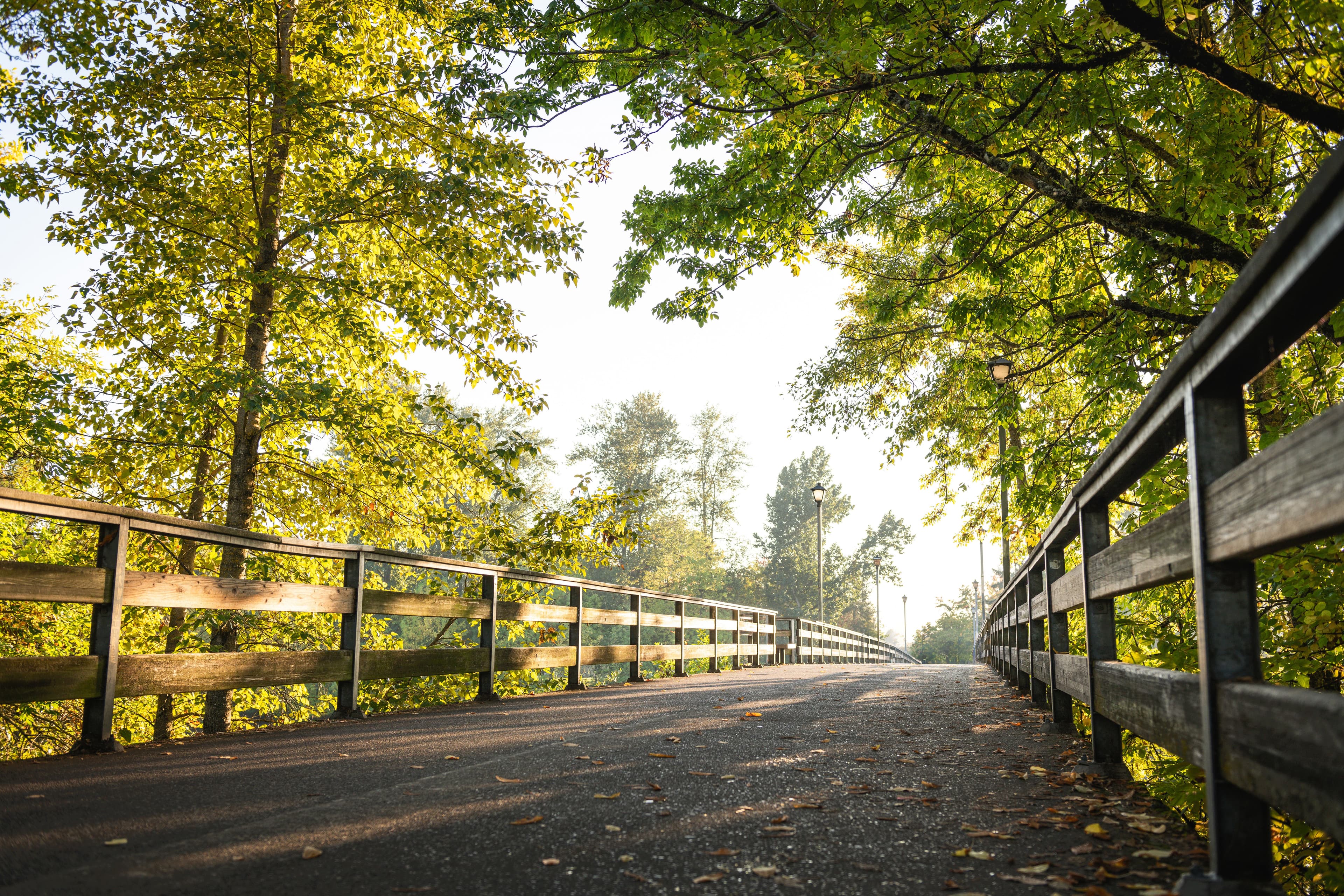
A long, shaded, flat stretch along the Ruth Bascom Riverbank Trail beside the Willamette River. A disciplined, even pace pays off most here, with over 13 miles of largely uninterrupted flat running ahead.
Small, gentle undulations through the park rather than any defining climb. Mentally, this is the section where the finish starts to feel achievable rather than distant.
A final slight rise at mile 22 is the last elevation change of the race before a flat run back to the Eugene riverfront and a finish on the Hayward Field track itself.
Pacers
The On Pace Eugene Marathon Pace Team assigns corrals by predicted finish time, with pace group targets built around Boston Marathon qualifying times rather than round numbers.
| Corral | Predicted finish | Pacers available |
|---|---|---|
| Corral A | 3:19 and under | 2:55, 3:00, 3:05, 3:15 |
| Corral B | 3:20-3:49 | 3:20, 3:25, 3:30, 3:35, 3:45 |
| Corral C | 3:50-4:19 | 3:50, 4:00, 4:05 |
| Corral D | 4:20-4:49 | 4:20, 4:35 |
| Corral E | 4:50+ | 4:50, 5:05, 5:20, 5:30, 6:00, Sweeper |
The marathon and half marathon start together and share the same course for the first 10 miles, so pacers and runners from both races are visible on course together through that stretch. Corral assignment is based on predicted finish time entered at registration; runners may move back a corral freely but must visit the Registration Troubleshoot desk at the expo to move up.
What to wear
Eugene runs in late April, which in the Pacific Northwest means widely variable conditions: a dry, mild morning is possible, but so is steady rain, and the race’s river-path miles offer little shelter either way. No official average race-day temperature range has been published. A 7:00am start means cool starting temperatures regardless of how the day develops, so a throwaway layer is worth bringing to the Hayward Field start area. The Ruth Bascom Riverbank Trail section, shaded by tall cottonwood and oak trees for much of its length, offers some relief if the day turns warm and sunny, but equally holds dampness longer than open sections if the morning starts wet.
Entry
Registration is via the official site, first-come rather than a ballot, and the race has grown enough in recent years, doubling in size over the three years to 2026 per the organiser’s own transportation guidance, that entering promptly is worth taking seriously. Entry fees are non-refundable and bibs are not transferable to another runner. A deferral option exists for entered runners who cannot take part: historically open from 10 January to 5 April for a $30 fee, though the exact window and fee should be confirmed for the current year.
There is no confirmed fast-runner or qualifying-time entry route; standard entry is open to anyone meeting the minimum age of 16 on race day. Because the course is USATF and World Athletics certified, it is a legitimate, well-used Boston Marathon qualifying attempt course, and the official pace team builds its target times directly around BAA qualifying standards rather than round numbers, worth flagging for any runner entering specifically to chase a BQ.
Fast Runner / GFA Standards
Not applicable. Eugene Marathon has no confirmed fast-runner or Good for Age entry route; entry is open to all runners meeting the minimum age requirement.
Race Weekend
Expo
The Health & Wellness Expo runs at Graduate Eugene, a hotel near the University of Oregon campus, from 10:00am to 6:00pm on both the Friday and Saturday before race day. All participants must collect their packet in person at the expo unless race-day packet pickup was specifically purchased during registration. Runners should write their bib number on their gear-check bag at packet pickup, since the bag is used again on race morning for the Finisher Field gear-check tent. The On Pace Eugene Marathon Pace Team has representatives available during expo hours for runners wanting to discuss pacing strategy directly. A separate clear bag handed out at the expo is used for collecting free expo goodies and any purchases, distinct from the gear-check bag used on race morning.
Race Morning
The race starts and finishes at Hayward Field, so unlike a point-to-point course, race morning logistics are simple: walk, bike, taxi or rideshare to the Hayward Field area, with a dedicated Transportation & Parking page covering shuttle information, parking and designated rideshare drop-off points. The organiser specifically flags nearby construction west of the University of Oregon campus as a factor to check before race day, along with growing pre-race traffic as the event has expanded in recent years.
Corrals are assigned by predicted finish time: Corral A for 3:19 and under, B for 3:20-3:49, C for 3:50-4:19, D for 4:20-4:49, and E for 4:50 and slower. Runners may move back a corral without formality but must visit the Registration Troubleshoot desk at the expo to move up. Gear check is located on Finisher Field, west of Hayward Field, and opens at 5:45am; bags are checked by corral letter at matching tents, so preparing the bag with the gear-check tag attached before arrival speeds up the drop-off.
The 16-minute-per-mile pace requirement means traffic protection and aid stations begin shutting down for anyone falling behind that pace, with runners moved to the sidewalk; the finish line itself stays open a full 7 hours after the last starter crosses the start line. Non-medical transport is available on request from medical and aid stations after mile 16, returning runners directly to Hayward Field if needed. After finishing, runners receive a reusable finisher bag pre-packed with food and a water bottle at the finish itself, and should plan a meeting point away from the immediate Hayward Field congestion given the venue’s capacity constraints on race day.
Logistics Map
The map below shows the loop route starting and finishing at Hayward Field, running south through the Amazon district, crossing Franklin Boulevard at mile 9, and along the Ruth Bascom Riverbank Trail through Alton Baker Park, plus the Graduate Eugene expo venue. Tap any marker for details.
Nutrition on Course
Twelve aid stations are spaced roughly every 2 miles across the course, all offering both water and Gatorade Endurance Lemon-Lime. Bananas are available at miles 14 and 22. Gu Energy Gels, in strawberry banana, chocolate outrage and vanilla flavours, are available at miles 8, 20 and 25, spaced to cover the race’s early climbing, the approach to Alton Baker Park, and the final push to the finish. Portable restrooms are positioned at the start, finish and at regular points along the course. Runners planning to rely on caffeinated gels should note the mile 8 station sits before the course’s flattest, longest stretch, useful for pacing a caffeine strategy around the harder early climbing rather than only the closing miles.
Spectating
Because Eugene Marathon is a loop starting and finishing at Hayward Field, spectators based near the venue can see both the start and the finish without travelling, and the marathon and half marathon share the same course for the first 10 miles, meaning a spot along that shared stretch offers sightings of a larger combined field. Alton Baker Park, reached late in the race around miles 17-22, is a pleasant place to watch from and easy to combine with the finish given its proximity to Hayward Field.
Itinerary A:Start at Hayward Field for the start itself, walk into the Amazon district for a sighting around miles 4-6, the course’s steepest climbing section, then return to Hayward Field on foot or by local transit ahead of the leaders’ finish.
Itinerary B: Base along the Ruth Bascom Riverbank Trail, reachable from central Eugene, for a sighting around miles 10-16, then move to Alton Baker Park for a second sighting around miles 17-22, before walking or taking local transit back to Hayward Field for the finish.
Itinerary C: Go directly to Hayward Field and stay there for the entire event, watching both the start and, later, the finish on the actual Hayward Field track, using the area around Finisher Field, away from the immediate finish chute, as a pre-agreed meeting point.
Post-Race Food
Track Town Pizza, close to campus, is a reliable, no-fuss carb option for a group with mixed appetites after the race. Falling Sky Brewing, a Eugene brewery with a food menu alongside its beer, suits runners wanting a sit-down meal with a wider drinks selection than a pizza place offers. Marché, a more polished downtown option, works for a proper sit-down finish-day meal if the budget and patience allow for slower service than the other two. Given Eugene Marathon’s own finisher bag already includes food and a water bottle handed out at the finish line itself, some runners may not need a large meal immediately, making these three better suited to later in the day than straight off the Hayward Field track.
Where to Stay
Because Eugene Marathon starts and finishes at the same venue, Hayward Field, the usual start-versus-finish trade-off that shapes most marathon neighbourhood advice does not really apply here: choosing a base close to Hayward Field simplifies both ends of race day equally.
University of Oregon and Hayward Field
The most race-specific base, offering the simplest possible race-morning and post-race logistics, walkable to both the start and finish. It can be busy and carries a price premium on race weekend, and offers less evening character than downtown.
Downtown Eugene
Offers a stronger restaurant and bar scene than the campus area, with an easy short trip to Hayward Field by foot, bike or taxi. It runs a little noisier than the campus area on weekend nights but rewards runners who want food options beyond what’s immediately around the stadium.
Whiteaker
Eugene’s local food-and-beer district, has real character and a stronger independent scene than downtown, at the cost of needing a taxi or bike ride to reach Hayward Field rather than a walk. It suits runners prioritising the evening before or after the race over race-morning simplicity.
Springfield
Across the Willamette from central Eugene, offers better value and is directly on the course route, though it needs a car or careful attention to road closures on race day itself given the course runs through it. It suits runners with a car who don’t need a walkable race-morning base.
The airport corridor
North of the city centre, is a functional-only choice, useful mainly for runners with an early flight out and no interest in staying near the race itself.
Recommended hotels
Doubles as the official expo venue, so staying here removes a separate trip for packet pickup entirely, with a strong running and campus-culture theme throughout.
The most race-morning-convenient option on this list, a straightforward walk to the start and finish, though rooms are limited and sell out fast on race weekend.
A wellness-oriented chain hotel positioned between downtown and the river path the course itself runs along, a reasonable middle-ground choice.
A reliable chain option away from the campus premium, at the cost of needing a taxi or car on race morning rather than walking.
A budget-leaning option still close enough to walk to both the start and finish, useful for runners prioritising value without sacrificing race-morning simplicity.
Booking timeline
Book accommodation as soon as entry is confirmed, particularly if targeting a campus-area hotel, since Eugene’s supply of rooms close to Hayward Field is limited compared with the size the race has grown to in recent editions. Refundable rates are worth prioritising given Pacific Northwest spring weather’s unpredictability, which can affect travel plans at short notice. Eugene Airport (EUG) is small and serves fewer direct routes than Portland International (PDX); overseas entrants should compare a direct-to-Eugene flight against flying into Portland and either driving or taking a bus or train the roughly two hours south, since Portland often has more competitive international fares despite the longer ground transfer.
See & Do
The finish sits at Hayward Field, putting the University of Oregon campus and Eugene’s river-path attractions within easy reach.
Hayward Field
At the finish itself. The venue that gives the race its finish line is worth a slower look once the immediate post-race crowds thin out, with a public plaza and museum-style displays on the University of Oregon’s track and field history. Public access around race weekend may be restricted during the event build, so a return visit later in the day or the day after is more reliable than trying to explore it straight after finishing.
Pre’s Trail and Alton Baker Park
2.5 km (1.6 miles) from Hayward Field. A soft-surface running and walking trail named for Steve Prefontaine, running through Alton Baker Park along the Willamette River, largely flat with a forgiving bark-mulch surface that suits a recovery walk better than pavement. Spring weather here can turn wet quickly, so check conditions before heading out.
Museum of Natural and Cultural History
1.2 km (0.7 miles) from Hayward Field. A University of Oregon campus museum covering Pacific Northwest natural history and Indigenous cultural heritage, entirely indoors and flat, a sound option if the weather turns or the legs need a low-effort activity.
Willamette Valley wineries
20-40 km (12-25 miles) from Hayward Field, car or tour required. Oregon’s best-known wine region sits within easy driving distance north of Eugene, better suited to a post-race day when a car or organised tour is available than a spontaneous same-day visit, given the driving required and the standing involved in most tasting-room visits.
Read Before you Run
Bowerman and the Men of Oregon
Kenny Moore
Moore’s biography of legendary Oregon coach Bill Bowerman, who helped build the University of Oregon’s track programme and co-founded Nike, gives direct context to the TrackTown USA identity the marathon’s Hayward Field finish draws on, written by a former Bowerman athlete and Olympian himself.
After the Race
Eugene Marathon runs in April. These itineraries range from a same-day walk around Alton Baker Park and campus to a three-night extension to Portland.
A very low-effort option for runners not travelling further: Pre’s Trail through Alton Baker Park, the Museum of Natural and Cultural History, and a slower look at Hayward Field once race-day crowds have cleared. April rain is possible, so keep the day flexible.
Oregon’s best-known wine region, best explored with a car or an organised tour rather than attempted without one. Spring brings new vine growth to the valley, with weather variable enough to check ahead.
A change of scenery from Eugene’s inland valley, with dramatic dune and headland scenery reachable by a straightforward drive. April on the Oregon Coast can be cool and wet, so pack for it rather than expecting a beach holiday.
Oregon’s largest city, reachable without a car via Amtrak or bus, and a natural add-on for overseas runners who flew into Portland International before travelling south to Eugene. Works comfortably in spring weather given how much of the city’s appeal sits indoors.
Frequently asked questions
Should I stay near the start or the finish?
It makes no difference here: Eugene Marathon starts and finishes at the same venue, Hayward Field, so any hotel close to campus serves both ends of race day equally.
How far in advance should I book a hotel?
Book as soon as your entry is confirmed, particularly if targeting a campus-area hotel. Rooms close to Hayward Field are limited, and the race has grown substantially in recent editions.
Is there free transport to the start?
This has not been confirmed either way. The organiser publishes a dedicated Transportation and Parking page covering shuttle information, parking and rideshare drop-off points; check it closer to race day.
What is the best neighbourhood to stay in?
The University of Oregon and Hayward Field area offers the simplest race-day logistics, walkable to both the start and finish, though downtown Eugene offers a stronger restaurant scene at only a short trip further away.
When does the expo open?
The Health & Wellness Expo runs at Graduate Eugene, near campus, from 10:00am to 6:00pm on both the Friday and Saturday before race day. All runners must collect their packet there unless race-day pickup was purchased during registration.
What is the weather typically like on race day?
Late April in Eugene brings cool, changeable Pacific Northwest spring conditions with a real chance of rain. The 7:00am start means cool temperatures regardless of how the day develops later.
How do I get from the airport to the city centre?
Eugene Airport is small with limited direct routes; many overseas entrants instead fly into Portland International and drive, bus or take Amtrak roughly two hours south to Eugene, often for a more competitive international fare despite the longer transfer.
Is there a bag drop at the race?
Yes. Gear check is located on Finisher Field, west of Hayward Field, opening at 5:45am on race morning, with bags checked by corral letter at matching tents.
Should I bring a throwaway layer to the start?
Yes. The 7:00am start is cool regardless of how the day later develops, and rain is a real possibility this time of year.
How do I get back to my hotel after finishing?
Since the race starts and finishes at Hayward Field, most hotels close to campus involve only a short walk back. Runners should still set a specific meeting point away from the immediate finish chute, given the venue’s capacity constraints on race day.