The Race
| Next Race Date | 4 April 2027 |
|---|---|
| Course Type | Loop: two counterclockwise laps of a 21 km circuit from Messe Freiburg |
| Registration | Open entry online, no ballot and no waiting list. €80, with on-site late entry over race weekend for a €13 supplement if places remain |
| Ballot Opens | No ballot |
| Total Finishers | Not confirmed for the marathon alone. About 13,200 started across all Sunday events in 2026 |
| Average Race Day Temperature | Cool and changeable in early April. The 2026 edition ran cool with light drizzle |
| Cutoff Time | 5 hours 45 minutes |
| Free Race Day Transport | Yes. The confirmation or bib is an RVF ticket for one outward and one return journey, valid from three hours before your own start |
| Course Certification | No current World Athletics label. Measurement and certification status is not documented on the organiser’s public pages |
History
The half marathon became the event’s centre of gravity almost immediately, and it has stayed there. A 2007 report recorded 11,011 registered runners across the weekend, of whom 2,172 were entered for the marathon and 8,839 for the half. That ratio has broadly held ever since, and it shapes what a marathon entrant actually experiences here: a medium-sized full marathon running inside a very large city running festival.
The course has not stayed frozen. Start width, road allocation and the relationship between the half-marathon loop and the marathon’s second lap have all been reworked as the event grew. The race is now run by Freiburg Wirtschaft Touristik und Messe, which ties it directly to Messe Freiburg and the city’s tourism operation, and the live-music idea that has always defined it has kept expanding: 37 bands were on the 2026 course, historically working out at roughly one every half kilometre.
The 2027 edition arrives with a numbering discrepancy. The City of Freiburg’s own event listing calls it the 20th marathon staged in the city; the organiser described the 2026 race as the 21st MEIN FREIBURG MARATHON. The two counts most likely reflect actual marathon editions run against branded event editions, given the 2020 and 2021 interruption, but the organiser has not said which number it will use, so this page does not pick one.
For a travelling marathoner the appeal is not prestige. It is a two-lap course that spends its distance on green space, ordinary residential districts, the Dreisam and a genuinely fine old town, all run from a single Messe campus that handles start, finish and number collection without asking anyone to move a bag across the city. About 13,200 people started something on the Sunday in 2026, and the marathon was a modest share of that.
The course
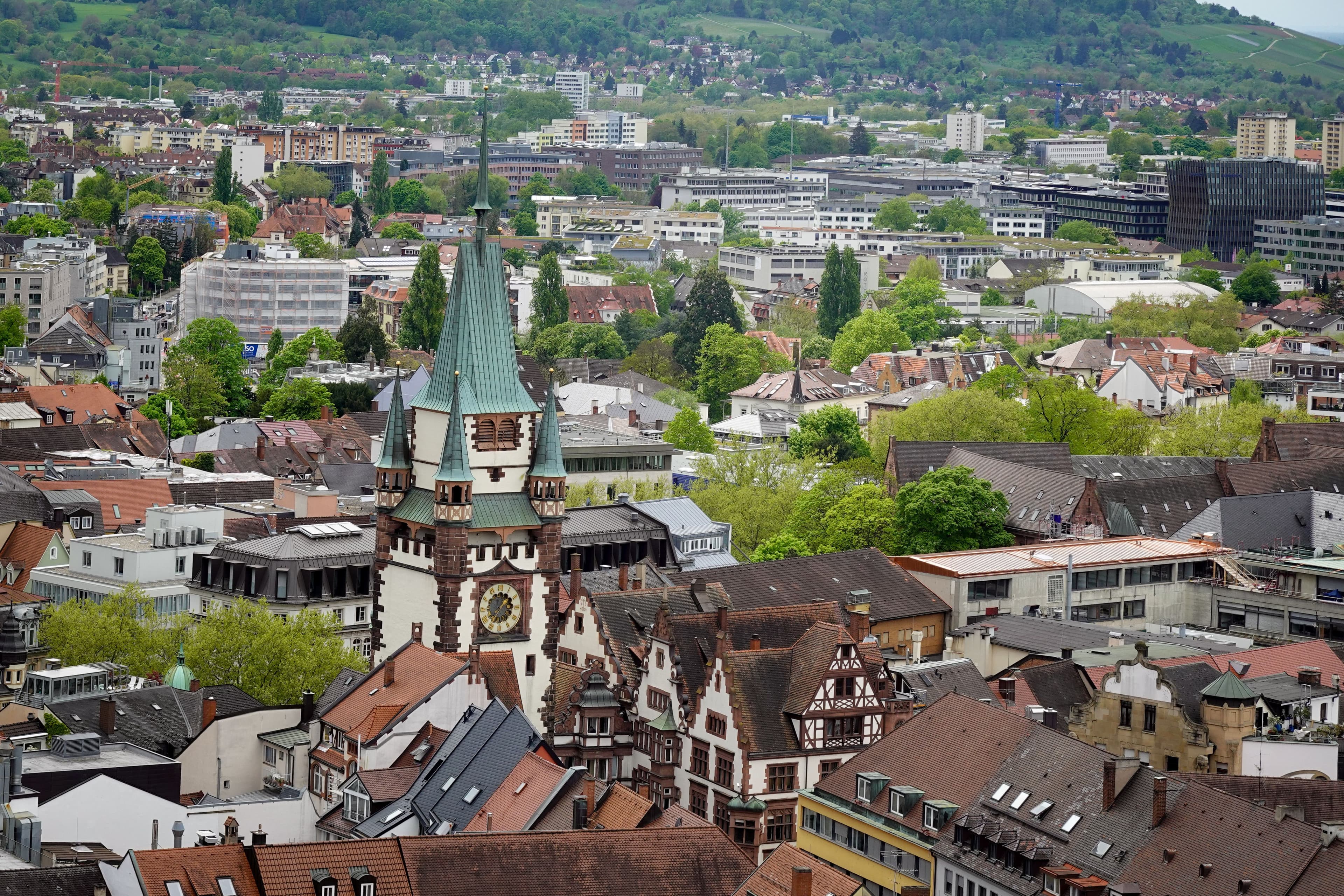
The marathon starts at Messe Freiburg in two waves, 09:00 and 09:10, and runs two counterclockwise laps of a 21 km circuit before finishing back at the Messe, with the finish food inside Hall 1. Each lap heads west past Seepark and the Flückigersee, runs south through Mooswald, Betzenhausen, Weingarten and Haslach to St. Georgen, then turns east along the southern edge of the city through Wiehre, follows the Dreisam corridor to the eastern turn, and comes back west through the Altstadt and the Wiwilibrücke corridor past the Hauptfriedhof to the Messe.
The organiser publishes approximately 200 m of total ascent. The chart puts the low point at about km 3 beside Seepark, a gentle 15 m rise to km 7, then a steadier climb of about 42 m from km 8 to km 13 through St. Georgen and Wiehre, never steeper than about 1.3%. The course holds high ground through the eastern Dreisam corridor to the day’s high point of 297 m at about km 16, then descends about 40 m over 5 km through the Altstadt and Stühlinger back to the Messe. The whole lap repeats, with the second climb from km 29 to 34.
Surface matters more here than at most city marathons. The organiser’s own FAQ confirms asphalt, cobblestones and paving stones, and the old-town section is where the cobbles arrive. In the dry that is a rhythm problem; in the rain it is a footing problem, and early April in Freiburg makes rain a live possibility.
Km 0 to 3: the Messe and Seepark. Two waves ten minutes apart, blocks B and C, on a course that has already absorbed the day’s other events. The opening kilometres run west toward Seepark and the Flückigersee on broad roads, and this is where the course drops to its lowest ground at about km 3. Easy running, and easy to run too fast.
Km 3 to 8: the western districts. South through Betzenhausen, Weingarten and Haslach toward St. Georgen, rising only about 15 m in five kilometres. These are the quietest kilometres of the lap: crowd support thins out considerably here, and the band roughly every half kilometre is doing more work than the spectators are.
Km 8 to 13: the climb through Wiehre. The course turns east along the southern edge of the city and climbs about 42 m in five kilometres, averaging under 1% with its steepest kilometres at about 1.2% between km 9 and 11. It is gradual enough that most runners will not name it as a climb on the first lap, so the effort spent here shows up on the second pass at km 29 to 34.
Km 13 to 16: the Dreisam and the high ground. The eastern turn, up the Dreisam corridor past Oberau toward Waldsee and back. The high point of the lap sits at about km 15.8, roughly 60 m above the low point at km 3. Greener and more open than anything before it, and the last quiet stretch before the crowds.
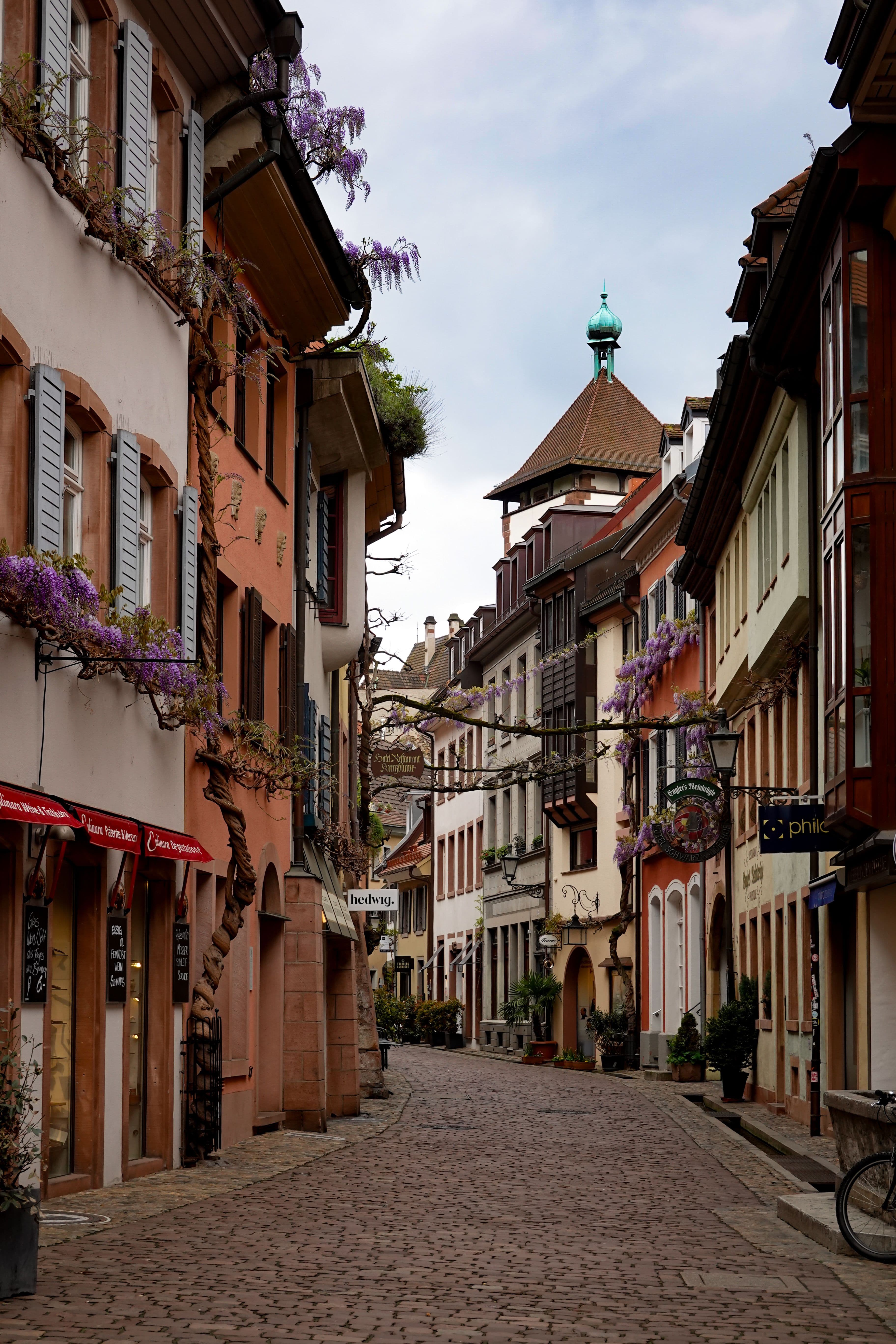
Km 16 to 19: the Altstadt. Past the Münster at about km 15.9 and through the old town into the Wiwilibrücke corridor at km 17.3. This is the best-supported part of the course and the section people come back for. It is also where the cobbles and paving are, and where the descent starts, 13 m in the kilometre after the Münster, so ease the stride here.
Km 19 to 42.195: past the Hauptfriedhof, and round again. The route runs north-west past the Hauptfriedhof at about km 19.4 and closes the lap at the Messe at km 20.7, a little before the halfway mark. Then the whole thing repeats: the climb at km 29 to 34, the high point at about km 37, the Münster at km 37.1 and the Wiwilibrücke at km 38.5, before the final run back to Hall 1. The 5:45 cutoff is generous for most recreational marathoners but tighter than a six-hour race, so anyone close to it should keep second-lap stops short.
Course Map
One counterclockwise circuit of the city, run twice, from a start and finish at Messe Freiburg. Tap a marker for details, and scrub the slider or press play to move the orange marker along the course with the elevation profile beneath it.
West past Seepark to the lowest ground at km 3, then south through Betzenhausen, Weingarten and Haslach. The quietest running of the lap, with the bands carrying it.
East along the southern edge, rising about 45 m over five kilometres. Gradual enough to miss on lap one, which is exactly why it decides lap two.
Past the Münster and through the Wiwilibrücke corridor. The best support on the course, and the paving the organiser warns about. Ease the stride on the cobbles.
The lap closes at the Messe just before halfway and repeats: climb at km 29 to 34, old town at km 37, finish inside Hall 1. Cutoff is 5:45.
Pacers
Not confirmed for 2027. The organiser’s pacer page lists marathon targets of 3:00, 3:15, 3:30, 3:45, 4:00, 4:15, 4:30 and 5:00, but that content dates from the 2018 edition and has not been reissued for the current race. The structure may well come back unchanged; treat those bands as a likely shape, not a plan, and check the March runner handbook before relying on a group.
What to wear
Early April in Freiburg is changeable. The city’s reputation for sunshine says very little about one morning in spring, and the 2026 edition ran cool with light drizzle. A 09:00 or 09:10 start puts you past the coldest hour but leaves the second lap exposed to whatever the day turns into.
A thin disposable layer for the wait on the Messe campus is sensible on a cold or wet forecast. No clothing-donation or collection procedure has been published for 2027, so plan to carry it, hand it to a supporter, or dispose of it properly. The more common mistake here is the opposite one: overdressing for a chilly start and then carrying the extra warmth through 200 m of climbing spread over two laps. Wet cobbles in the old town are worth a thought on shoe choice, since the grippiest racing outsole is not always the one on the fastest shoe.
Entry
Entry is open registration with no ballot. Registration for 2027 opened on 1 September 2026 and the marathon is priced at €80. The organiser states plainly that there is no waiting list, and on-site late entry is possible across race weekend, 2 to 4 April 2027, for a €13 supplement if places remain. This has not historically been a hard race to get into, but late entry depends on availability, which makes entering early the cheaper and safer route.
Transfers to another person are allowed online until 1 April 2027 at 23:59 for €13. After that a name change is possible only on site, for the same fee. One detail worth reading twice: the organiser warns that booked extras can be forfeited during a transfer, so anyone taking over a place should check what actually comes with it. Distance changes are possible subject to availability, with the runner paying the price difference plus the €13 processing fee.
Start-block target times can be changed until 21 March 2027, after which the block is fixed. The marathon uses blocks B and C, starting at 09:00 and 09:10. No general deferral entitlement, refund policy or cancellation-insurance detail was found in the public FAQ, so treat the entry fee as committed once paid unless the terms say otherwise.
Fast Runner / GFA Standards
There is none. No Good for Age route, no qualifying-time entry, no elite qualifying table, and no confirmed charity programme or tour-operator allocation for 2027. Everyone enters the same way at the same price.
Race Weekend
Expo
Number collection is in Hall 3 at Messe Freiburg. Current 2027 information gives Friday 2 April from 16:00 to 20:00, Saturday 3 April from 10:00 to 18:00, and Sunday 4 April from 07:00. Treat those hours as provisional until the March runner handbook confirms them.
Collect against your participation confirmation or photo identification. Proxy collection is allowed, and the organiser accepts a written authorisation on the confirmation, which makes it practical for a group travelling together to send one person. From Freiburg Hauptbahnhof the Messe is reached by the Breisgau S-Bahn toward Breisach to Messe/Universität, or by Stadtbahn line 4 toward the Messe. An early collection window is advertised for school-marathon participants at the organiser’s administrative building; there is no confirmation that it extends to ordinary marathon entrants, so do not plan around it.
Getting to the Start
The marathon starts at Messe Freiburg in two waves, 09:00 for block B and 09:10 for block C. From Freiburg Hauptbahnhof the organiser recommends the Breisgau S-Bahn toward Breisach to Messe/Universität, or Stadtbahn line 4 toward Messe/Technische Fakultät followed by a short walk. Line 4 is the useful one for anyone staying in the Altstadt corridor, Stühlinger or Vauban.
Race-day travel is free, and the arrangement is more specific than most. The participation confirmation or bib functions as an RVF ticket for one outward and one return journey on marathon Sunday, with outward validity starting no earlier than three hours before your own start time. A runner in block C is covered from 06:10, not from first light, so an unusually early start on race morning still needs a ticket.
Runners based near the Messe, in Brühl or by the university hospital can walk or take a short tram. Anyone in the Altstadt should allow noticeably more time: Sunday road closures and altered tram services affect the city centre from roughly 09:00 to 15:00, and that window covers the whole race.
The Messe campus provides indoor space, toilets and collection facilities, but the exact bag-drop location, any security screening and the changing-room arrangements have not been published for 2027. Do not assume a particular hall until the March handbook appears, and leave anything valuable at the hotel.
At the finish, runners come back into Messe Freiburg with the finish food in Hall 1. The organiser is explicit that there is no re-entry once you leave that area toward Hall 2, so collect everything you want before moving on. Free physiotherapy massage is advertised in Hall 2 from 10:30 to 16:00, with runners asked to shower first.
Nutrition on Course
Full aid stations sit at km 5, 10, 15 and 20 on each lap, with water-only points at km 7.5, 12.5 and 17.5, giving something on the road roughly every 2.5 km. Those positions are not in the organiser’s own published text, but they match its confirmed statement of regular aid and water stations throughout the course, but check them against the March handbook if the fuelling plan depends on exact spacing.
Full stations offer water, bananas and an isotonic drink, currently Dextro Energy IsoFast in red orange according to the organiser’s nutrition FAQ. The finish in Hall 1 adds further sponsor drinks and recovery food. Cup type, whether a personal-bottle service exists, gel availability and exact medical-station positions have not been confirmed for 2027 beyond the German Red Cross providing medical support along the route and at the finish. On a two-lap course that uncertainty is easier to manage than it sounds: whatever the first lap turns out to offer is exactly what the second will.
Spectating
Two laps make repeat sightings straightforward. A supporter who stays at the Messe sees the start, the lap return just before halfway, and the finish, with no transport at all. A more mobile one can add an old-town sighting on Stadtbahn line 4, which the organiser itself recommends toward Stadttheater for spectators heading into the centre after the start.
Plan A: the Messe anchor. Start, lap return at about km 20.7, finish. It avoids any dependence on disrupted city-centre transit and is the right plan for anyone with limited mobility or a pushchair.
Plan B: start, then the Altstadt. Watch the 09:00 or 09:10 start, take line 4 toward Stadttheater, and pick up the runner in the old town at about km 16 to 17.3. Return on line 4 toward the Messe for the finish, allowing for temporary race-day service changes to the printed timetable.
Plan C: the old town, twice. Skip the start and go straight to the Münster or the Wiwilibrücke corridor. Because the circuit repeats, one position gives two sightings, at about km 16 to 17.3 and again at km 37 to 38.5, with the best crowd on the course in between. Check tram alterations before relying on them; central services run disrupted from roughly 09:00 to 15:00.
The western residential sections through Dietenbachpark, Weingarten, Haslach and St. Georgen are considerably quieter, which is worth knowing in both directions: fewer people, but also easier to find your runner and easier to be heard. No ticket is needed for ordinary finish-area spectating. Live-tracking arrangements for 2027 have not been announced.
Post-Race Food
The Hall 1 finish catering is built for runners and removes any need to travel immediately. Independent reporting on the 2026 race noted Taifun tofu products, Heitzmann baked goods, Ganter drinks and Schwarzwaldmilch dairy among the finish offerings; partners change, so treat that as an indication, not a menu. Take what you want before leaving the hall, because there is no way back in.
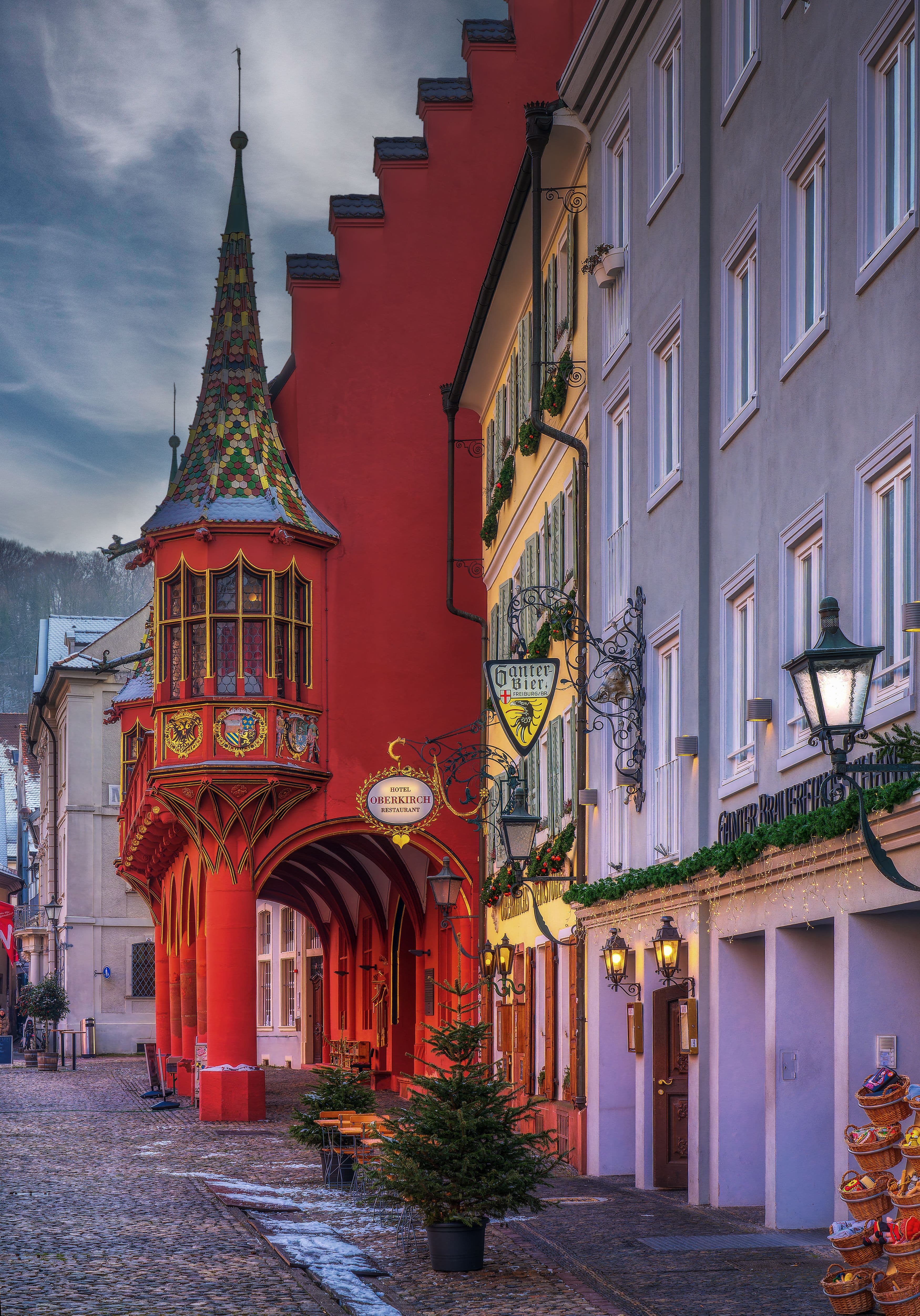
For a proper meal later, the Altstadt around Münsterplatz, Rathausplatz and Augustinerplatz has the densest concentration of restaurants in the city, a tram ride from the Messe. A substantial Baden plate, pasta or potatoes with bread and some protein, does more for recovery than treating the region’s wine as the main event. Sunday hours vary by venue and April is outside the summer pattern, so check the specific restaurant close to the weekend and book.
Where to Stay
Start and finish are both at Messe Freiburg, so judge every option by distance to the Messe. Freiburg’s tram and S-Bahn network is good enough that several districts work, and the free RVF journey included in entry takes the cost argument out of staying further away.
Messe and Brühl
Messe and Brühl are the pure logistics choice: the shortest possible race morning and the simplest return after finishing. It suits runners who value sleep and low stress over old-town character, and the trade-off is exactly that. There is far less outside the hotel door here than in the Altstadt, so the Saturday meal needs planning.
Stühlinger and the Hauptbahnhof
Stühlinger and the station area are probably the best all-round base for international visitors: direct rail arrival, quick onward transport to the Messe, and an easy walk into the Altstadt. It particularly suits anyone coming in from Basel, Frankfurt or Zurich. Saturday-night noise varies street by street but is manageable away from the busiest bars.
Altstadt
The Altstadt is the most appealing place to spend a weekend, with the Münster, Rathausplatz and the historic lanes on the doorstep, and the marathon runs through it twice. Race morning needs a tram or train to the Messe, and Sunday disruption means leaving early. Choose it for a city break wrapped around a marathon, not if frictionless start logistics come first.
University hospital and the Mooswald edge
The hospital district is still practical on foot or with a short tram or bus connection, and it holds full-service hotels without putting you directly beside the start line. Quieter than the Altstadt, and a reasonable compromise for anyone who wants hotel facilities more than character on the doorstep.
Neuburg and Herdern
Neuburg and Herdern sit north and north-east of the old centre: residential, calmer on a Saturday night, close enough to the centre to walk in and reasonably connected toward the Messe. A good fit for runners travelling with family who would rather have neighbourhood cafés than nightlife.
Wiehre
Wiehre is an attractive district that the course itself runs through on the climb, which makes it a strong base for a supporter and an awkward one for a runner: you have to cross the city to reach the start. Race-day closures make taxis unreliable, so plan on public transport and leave early.
Freiburg draws visitors as a Black Forest gateway regardless of the marathon, and the half-marathon field is several times the size of the marathon’s. Book a refundable room as soon as entry is confirmed, without waiting for the March runner information.
Recommended hotels
The shortest race morning available. You give up old-town restaurants outside the door for the ability to walk to the start and walk back from Hall 1 afterwards.
A full-service four-star that official Freiburg tourism material notes for its proximity to the Messe. Quieter than the Altstadt and a sensible middle ground.
Predictable chain logistics, which matters for a 09:00 start when you want breakfast at a known hour. The district has a business feel.
The best pick for rail arrivals: off the platform, into the hotel, and a short walk into the old town. Race morning is a longer journey than from Brühl.
The choice if the weekend is a city break with a marathon in it. Central demand and noise are real trade-offs, and it is not a walk-to-start hotel.
Booking timeline
Book as soon as entry is confirmed. Registration opened on 1 September 2026 with no ballot, so there is no results day around which demand suddenly spikes; the trigger is the entry itself. Four to eight months out is a safe window for the best choice around the Messe, the Hauptbahnhof and the Altstadt.
No official 2027 marathon hotel block was found. If one appears closer to April, compare it against independent refundable rates. For UK travellers the realistic routes are EuroAirport Basel-Mulhouse-Freiburg, Zurich, Frankfurt or Karlsruhe/Baden-Baden plus onward rail or bus, and a through-ticket rail comparison is worth running: Freiburg sits on the Rhine valley main line and the train often wins on total door-to-door time once airport transfers are counted.
See & Do
The finish is at the Messe, but almost everything worth seeing is in the Altstadt a tram ride away, which is also where the marathon runs on both laps. Distances below are from the old town, not the finish line, since that is where anyone with a Sunday afternoon to spend will actually be.
Freiburg Münster and Münsterplatz
The cathedral is the centre of the city in every sense, with a 116 m west tower and a market on the square most mornings. The course passes it at about km 16 and again at km 37, so you will have seen it twice before you visit it. Stay at ground level on a marathon day, and check Sunday service times before planning to go inside.
Augustinermuseum
On Augustinerplatz, about 0.3 km (0.2 miles) from the Münster, the Augustinermuseum is the strongest low-walking option in the city: medieval to Baroque collections plus material on Freiburg and the Black Forest, and fully barrier-free since a refurbishment completed in February 2026. Standard hours run Tuesday to Sunday, generally 10:00 to 17:00 with later Friday opening. Check for Easter-period exceptions in April.
Schlossberg
The wooded hill rises straight out of the eastern edge of the Altstadt, about 0.5 km (0.3 miles) from Münsterplatz, and it is freely accessible. The climb is not what tired legs want the day after 200 m of race ascent, so use the Schlossbergbahn funicular from Stadtgarten if it is running. The payoff is a full view over the city to the Black Forest.
Schauinsland
Freiburg’s local mountain, reached by public transport plus a 20-minute cable-car ride to a summit around 1,284 m. It is a scenic excursion with no hike, which suits the day after a marathon. Summit weather in early April can be considerably colder than in the city, so check it on the morning.
After the Race
Early April in the Upper Rhine is the awkward season: long enough days to use, but snow and mud still possible above about 1,000 m. Everything below leans on rail and cable cars, and on the fact that Freiburg sits within an hour of Switzerland, France and the Black Forest. The cobbles you have just run on are a preview of most of these old towns, so pack shoes accordingly.
The cable car does the climbing, which makes Freiburg’s local mountain a realistic recovery day with no hike. Early-April weather at 1,284 m decides it on the day.
The volcanic wine country north-west of the city. Keep it to one town and a short vineyard viewpoint on legs that have run two laps.
A straightforward international extension, and the obvious plan if you fly home from EuroAirport. One night takes the airport dash off marathon day.
Two nights covers Strasbourg and one smaller Alsace stop without a car. The cobbled centres are the same surface the marathon warns you about, so pack comfortable shoes.
Base a night or two around Titisee or Hinterzarten and continue by regional rail. Early April is not high-hiking season, so build the trip around lake towns, viewpoints, spas and short low walks.
Frequently asked questions
Should I stay near the start or the finish?
They are the same place, Messe Freiburg, with the finish food in Hall 1. Messe and Brühl for the shortest morning; Stühlinger or the Hauptbahnhof for the best balance.
How far in advance should I book a hotel?
Book once entered. Registration opened 1 September 2026 with no ballot, and four to eight months out gives far better choice. The much larger half-marathon field competes for the same rooms.
Is there free transport to the start on race day?
Yes. The confirmation or bib is an RVF ticket for one outward and one return journey on marathon Sunday, valid from no earlier than three hours before your own start time.
What is the best area to stay?
Messe or Brühl for logistics, Stühlinger or the Hauptbahnhof for the best all-round balance, the Altstadt if the weekend is a city break with a race attached.
When does the expo open?
Hall 3 at Messe Freiburg: Friday 2 April 16:00 to 20:00, Saturday 3 April 10:00 to 18:00, Sunday 4 April from 07:00. Bring the confirmation or photo ID; proxy pickup allowed with written authorisation.
What is the weather typically like on race day?
Changeable. Early April in Freiburg can be cool and wet despite the city’s sunny reputation; the 2026 race ran cool with light drizzle. Check rain as carefully as temperature.
How do I get from the airport?
Freiburg has no useful airport. Use EuroAirport Basel-Mulhouse-Freiburg, Zurich, Frankfurt or Karlsruhe/Baden-Baden and continue by rail or bus to Freiburg Hauptbahnhof.
Is there a bag drop?
The Messe campus provides indoor space and facilities, but the exact 2027 bag-drop location and procedure have not been published. Do not assume a hall until the March handbook is out.
Should I bring a throwaway layer?
Yes if it looks cold or wet, which is realistic in early April. No clothing-collection procedure has been published, so plan to carry it or hand it over.
How do I get back to my hotel after finishing?
The return half of the RVF benefit covers it. Take everything you want from Hall 1 first, because there is no re-entry once you move toward Hall 2. Central trams run altered until about 15:00.