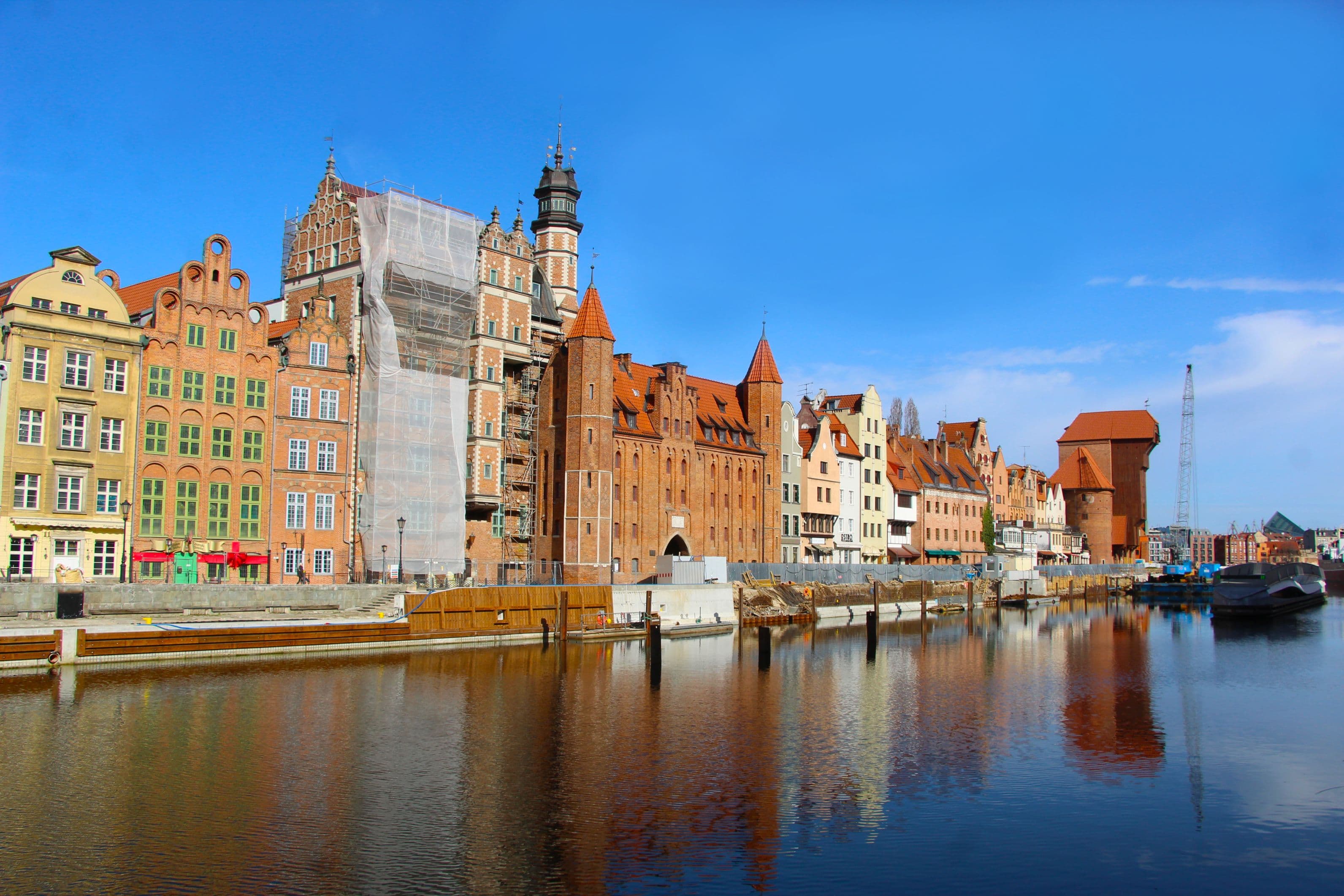
The Race
| Next Race Date | 25 April 2027 |
|---|---|
| Course type | Loop (single lap, stadium start and finish) |
| Certification | Polish Athletics Association (PZLA), certified on race day |
| Start | Polsat Plus Arena Gdańsk, Letnica |
| Finish | Polsat Plus Arena Gdańsk, Letnica |
| Total finishers | ~2,500 (2026, including relay teams) |
| Avg race-day temp | 2 to 12°C (April), mean around 7°C |
| Cutoff time | 5 hours 30 minutes |
| Free race-day transport | No |
| Course certification | PZLA (national body); no AIMS or World Athletics Label |
| Sleeper Train | Not accessible |
History
The Gdańsk Marathon first ran in May 2015, giving Poland's Baltic port city a full 42.195 km event of its own. The organisers built the race around Gdańsk's own story from the outset: a city defined by maritime trade, the outbreak of the Second World War at nearby Westerplatte, the Gdańsk Shipyard, and the Solidarity movement that helped end communist rule across Central and Eastern Europe. By 2017, attendance reached a pre-hiatus record of 2,375 marathon finishers, and across its first six editions more than 11,000 runners crossed the line.
A four-person marathon relay joined the programme from the third edition, and the event grew into a broader festival alongside a 5 km race and a junior marathon for children. That family structure still holds: junior races and the 5 km run on the Saturday at Polsat Plus Arena Gdańsk, with the marathon itself on Sunday morning.
The race then paused for two years before its 2025 return, marketed under the slogan "Biegnij w mieście wolności", run in the city of freedom, tightening the link between the route and Gdańsk's civic history. Almost 3,000 runners from 19 countries took part across the 2025 weekend, roughly 1,800 of them in the marathon itself, and Florian Pyszel won in 2:20:25, improving the previous men's record by close to three minutes. Katarzyna Chojnacka won the women's race in 2:57:35; the fastest women's time in the race's history remains Lidia Czarnecka's 2:49:05, set in 2019 before the race's two-year hiatus.
The 2026 edition, its eighth, drew runners from nearly 50 countries and produced almost 2,500 finishers including relay teams. Arkadiusz Gardzielewski won in 2:22:14 and Aneta Jarosz Karwowska in 2:51:03, on a route the organisers described as smoother and PZLA-certified, taking in the Shakespeare Theatre, the Baltic Philharmonic, a new Ołowianka footbridge and an extended beach section. The 2027 edition, its ninth, runs on Sunday 25 April.
The course
The marathon starts and finishes on the grounds of Polsat Plus Arena Gdańsk, on ul. Pokoleń Lechii Gdańsk in the Letnica district north of the city centre. It runs as a single loop, with a wave start sorted by declared predicted finish time: sectors open at 08:20, warm-up runs at 08:40 and the marathon starts at 09:00 on the Sunday. The 2026 route left the stadium with a short out-and-back to Nowy Port, then ran south through the Gdańsk Shipyard and the Solidarity Square area into the historic centre and along the Motława waterfront to Ołowianka Island, passing the Baltic Philharmonic and the Gdańsk Shakespeare Theatre, by about km 13. From there it ran north-west up the long straight of Aleja Grunwaldzka through Wrzeszcz and Oliwa to the ERGO Arena on the Gdańsk-Sopot border at about km 25, doubled back through Przymorze, and finished with a seaside stretch from Jelitkowo to Brzeźno before returning to the stadium. The organiser's published profile for 2026 gave a maximum elevation of 25 m and total gain of 111 m, and the highest ground is the Aleja Grunwaldzka section around Oliwa. Kilometre markers are placed every 1 km. Surfaces are mostly road, though official regulations flag cobbled and gravel fragments, which is also why wheelchair entries are restricted to active-propulsion chairs only.
Course Map
The map shows the 2026 route (the 2027 route is confirmed about 30 days before race day), the start and finish at Polsat Plus Arena Gdańsk, the AmberExpo race office, and the two main rail stations. Tap a marker for details, and scrub the slider or press play to move the orange marker along the course with the elevation profile beneath it.
The Route Is Announced Late, Plan Around It
Unlike most races on this site, the Gdańsk Marathon does not publish a fixed, multi-year-stable course. The organiser has told competitors directly that the 2027 route will be confirmed roughly 30 days before the race, because ongoing roadworks and civic investment projects around the city mean the safest path through central Gdańsk cannot be finalised earlier. What is already confirmed is the landmark set the route will include: the European Solidarity Centre, the drawbridge onto Ołowianka Island, the Baltic Philharmonic, the Neptune Monument, the Gdańsk Shakespeare Theatre and the ERGO Arena. The course will be certified by the Polish Athletics Association on race day itself, as in previous years. Treat the kilometre-by-kilometre guide below as built from the most recent confirmed route, not a guarantee of the exact 2027 path, and check the organiser's own site again once the route is announced.
Runners from the 2026 edition describe a long, dead-straight stretch from roughly km 14 to km 24, in a lane alongside a busy road with only partial road closure given the field size. On the 2026 map that is Aleja Zwycięstwa and Aleja Grunwaldzka, from the city centre north-west to Oliwa.
A stadium start gives space and order but not much crowd noise. Treat the opening kilometres as a controlled release, not a place to chase target pace, especially in a cold Baltic morning.
The route’s historical and visual heart, through Solidarity Square and across to the Baltic Philharmonic and Shakespeare Theatre. Watch for cobbled and gravel fragments through this section.
Aleja Grunwaldzka through Wrzeszcz and Oliwa to the ERGO Arena, then back through Przymorze. Runner reports describe a long, straight, partially closed stretch alongside a busy road, rising gently to the course’s highest ground around Oliwa. Rhythm is the challenge, and it pays to stay alert near junctions.
An exposed run along the coast from Jelitkowo to Brzeźno, where wind is the defining risk, followed by a reported short ramp up to a dual-carriageway exit around 41km before the functional final approach back to the stadium.
Km 30-38: The seaside stretch.The run along the coast from Jelitkowo to Brzeźno is the race's signature risk-reward section. In calm weather it opens the course up to sea air and proper daylight after the city's narrower streets. In a headwind, which the Baltic produces often enough to plan for, it is where careless runners lose time without noticing, over-striding into the wind when they should shorten their stride and stay relaxed through the shoulders.
Km 38-finish: Back to Letnica. The intermediate cutoffs bite here, both counted from the last starter signal, so the field needs to keep moving. After the coastal section, the return toward the stadium is functional, and for slower finishers the arena can look closer on a map than it feels underfoot. One first-hand 2026 account describes the course as mostly flat but not pancake flat, with a few long gradual rises earlier on, and a short, unwelcome climb up to an exit off a dual carriageway at around the 41km mark, arriving at a point in the race where any incline feels disproportionate to its size.
Follow the blue tangent line where marked; over 42.195 km it is a measurable difference in distance actually run. Electronic timing mats sit on course and non-returnable chips are fixed to the bib; official time is net for the field, with the first three men and women classified by gun time.
Pacers
No 2027 pacer information has been published in the regulations, programme or starter-pack pages. The 2025 official race report mentions the women's winner running alongside "3:00 pacemakers", which suggests pacers exist in some form, but wave allocation and confirmed paces were not published for 2027. Do not plan a race around a specific pace group until the final runner guide confirms one, likely released alongside the route announcement roughly 30 days before race day.
What to wear
Late April in Gdańsk sits firmly in cool, changeable Baltic spring, with an April mean of around 7°C, a typical high near 12°C and lows close to 2°C. At a 09:00 start, standing in a wave pen will usually feel colder than the daytime average suggests, and average wind speeds around 25 km/h mean the coastal and seaside sections carry a genuine wind-chill factor. A throwaway top over the vest, light gloves and a disposable hat are sensible even for experienced runners; the race pens at Polsat Plus Arena are exposed. If rain is forecast, a cheap poncho or bin-bag layer for the wait beforehand is worth the minor indignity. Once moving, most runners will be comfortable in normal marathon kit, since the pace generates enough heat to offset the air temperature for the bulk of the field; the real risk period is the 40 minutes before the gun.
Entry
Entry to the 2027 Energa Gdańsk Maraton is by general online registration through the organiser's own system, with no ballot, lottery or charity-only allocation. Registration opened on 1 June 2026. Pricing rises in bands as the race approaches: the first 200 packages cost 169 PLN (about £34), rising to 199 PLN (about £40) by 30 October 2026, 229 PLN (about £46) by 31 December 2026, 259 PLN (about £52) by 31 January 2027 and 289 PLN (about £58) by 28 February 2027, then continuing to rise in further bands in the final weeks before the race. Sterling conversions use a rate of roughly £1 = 5.0 PLN and should be treated as indicative.
Gdańsk resident card holders get a 10% discount, of limited relevance to travelling runners. Optional paid add-ons at registration include home delivery of the race pack, medal engraving, an official Brooks shirt, a long-sleeve top, a backpack and a withdrawal option priced at 40 PLN, which must be purchased at the time of registration.
Entry fees are non-refundable by default. Runners who bought the withdrawal option can cancel by email from their registration address: a full refund applies up to 6 April 2027, a 50% voucher toward the 2028 race applies from 7 to 21 April 2027, and a 25% voucher applies from 22 to 23 April 2027. Bib transfers to another runner are possible only through the organiser, by email to info@gdanskmaraton.com, and must be requested by 4 April 2027; unauthorised resale can disqualify both parties.
Wave assignment follows the predicted finish time declared at registration, and runners who misrepresent their ability risk being moved to the final start sector. Sector changes are possible until 11 April 2027.
No guaranteed-entry fast-runner or GFA standard, elite qualifying procedure, mass charity programme or official tour-operator allocation was found for this race. This is not a race with ballot-level sell-out pressure, but travelling runners should register ahead of the year-end and January price increases, and should book accommodation earlier than local entrants, since hotel stock close to the stadium and AmberExpo is limited and prices move on event weekends.
Race Weekend
Expo and Bib Collection
The 2027 race office and expo are at AmberExpo, Hall A, ul. Żaglowa 11, in Letnica, a short tram or bus ride from central Gdańsk and within easy reach of the stadium. On Friday 23 April 2027, packet collection and the expo run 14:00 to 21:00 for all races and distances. On Saturday 24 April, marathon and relay collection runs 10:00 to 21:00, alongside an expo open the same hours; junior collection runs 10:00 to 15:30 and 5 km collection 10:00 to 18:00. On Sunday, the expo is listed as open 07:00 to 15:00, but the regulations state there is no packet collection once the race office closes, so marathon runners should treat Friday or Saturday as the only reliable collection window.
Runners staying near the arena, Brzeźno or Wrzeszcz can reach AmberExpo without much friction; those based in the Old Town should plan a short tram or taxi journey. Collection requires photo ID. Proxy collection is possible only with the QR code the organiser sends in race week, shown alongside the registered runner's ID, which may be a phone photo.
The marathon pack includes the bib with timing chip, professional timing, medical and course security cover, licensed-judge supervision, aid-station access, the finisher medal, a hot meal at the finish and partner gifts. Shirts, medal engraving and a backpack are paid add-ons.
Worth setting expectations honestly: at least one 2026 finisher described the expo itself as underwhelming, a hall to collect a bib from. The same runner rated the finisher medal highly, a compass-shaped design, and noted that official race photos cost around 8 euros, cheap by the standards of most city marathons.
Getting to the Start
Race morning centres entirely on Polsat Plus Arena Gdańsk, ul. Pokoleń Lechii Gdańsk 1. Baggage and deposit tents open at 07:30 and close at 15:30 on the arena grounds. Start sectors open at 08:20, warm-up activity runs from around then with an official session at 08:40, and the marathon starts at 09:00. The start line closes five minutes after the final starter signal, so aim to be on site by 07:45 to 08:00.
Public transport is the practical route in unless staying within walking distance. Tram lines 7 and 10 run to the "Polsat Plus Arena Gdańsk" stop; bus lines 158, 258, 658 and N12 stop there too, and bus 283 serves both "Żaglowa AmberExpo" and the arena stop. An SKM service to "Gdańsk Stadion Expo" may run on event days only, so check race-week transport updates. From the Old Town, plan on tram or taxi rather than walking; from Wrzeszcz, tram or bus connections are generally quick but should be checked for Sunday frequencies and road closures; from Sopot, Oliwa or Jelitkowo, SKM to Gdańsk Wrzeszcz plus a tram or bus onward, or a taxi, tends to be more realistic than trying to reach Letnica directly. Free race-day transport should not be assumed: the 2027 regulations do not confirm it, and 2026 runners had none.
Baggage uses an organiser-provided bag and number sticker, deposited in a marked tent on the arena grounds; collection afterwards is by bib number, with photo ID required if the bib is lost. The organiser states it is not responsible for valuables left in changing areas, so leave anything of value with a non-running companion instead. Headphones are not banned outright, but the organiser recommends against them so runners can hear announcements from officials and judges.
After finishing, runners receive the medal and a hot meal, both at the arena. Agree a meeting point with supporters away from the immediate finish chute, since stadium sites can be disorientating once crowds build. Runners staying in the Old Town should expect the return journey to take longer than the outbound one, given fatigue, crowding and possible road diversions.
Nutrition on Course
Eleven aid stations are placed along the course, with water at every one. Isotonic sports drink and a banana are typically available from around the 10 km mark onward, with gels added at three of the later stations.
| Km marker | Water | Sports drink | Gel | Food |
|---|---|---|---|---|
| 5.3 | Yes | No | No | No |
| 10.1 | Yes | Isotonic | No | Banana |
| 15.5 | Yes | No | No | No |
| 20.9 | Yes | Isotonic | Yes | Banana, bars |
| 25.2 | Yes | Isotonic | No | Banana |
| 28.2 | Yes | Isotonic | Yes | Banana, bars |
| 30.9 | Yes | No | No | No |
| 33.4 | Yes | Isotonic | No | Banana |
| 35.9 | Yes | Isotonic | Yes | Banana |
| 38.1 | Yes | No | No | No |
| 40.7 | Yes | Isotonic | No | Banana |
Runners used to warmer-race aid stations should plan their own gel strategy around the gaps between km 15.5 and 20.9 and between km 30.9 and 33.4, where nothing beyond water is offered.
Spectating
A spectator using public transport and a reasonable amount of walking can realistically see a runner two or three times. The strongest single spot is the historic centre and Motława/Ołowianka waterfront, not the stadium: it carries the Old Town landmarks, the Ołowianka drawbridge, the Baltic Philharmonic and the Shakespeare Theatre, and it should be the loudest, busiest section of the route.
Itinerary A, simple two-sighting: start at Polsat Plus Arena Gdańsk, take a tram into central Gdańsk and position near the Old Town/Motława waterfront section, then return to Polsat Plus Arena for the finish.
Itinerary B, three-sighting, ambitious:start at Polsat Plus Arena Gdańsk, move to the European Solidarity Centre/shipyard area for the runner's mid-race pass, head toward the seaside or ERGO Arena section if the 2027 map confirms it and transport allows, then return to the arena for the finish.
Itinerary C, family-friendly, single base:watch the start and finish both at Polsat Plus Arena Gdańsk, using the gap between to visit AmberExpo, get breakfast, or walk to nearby Brzeźno seafront. Suits supporters unfamiliar with Gdańsk's tram network or travelling with children.
Crowd density should be strongest at the start, finish and Old Town/waterfront sections, and thinner through the residential and coastal stretches, particularly if the weather turns wet or windy. Live tracking runs through the STS Timing results platform used in recent editions; no dedicated spectator app was confirmed for 2027.
What Runners Actually Say
Runner reports from the 2026 edition describe a small, friendly race. One finisher called it "quite friendly", with a field of under 2,000 solo finishers plus relay teams, crowd support described as patchy but loud where it exists, an expo most runners treat as a formality, and a finisher medal, a compass design, that came in for particular praise. Official race photography was reported at around 8 euros, notably cheap. Runners also flagged two things worth knowing in advance: a long, straight, partially closed stretch alongside a busy road roughly a third of the way through the course, and a short, unwelcome climb to a dual-carriageway exit around the 41km mark that catches tired legs off guard.
Where to Stay
Because the 2027 marathon starts and finishes at the same venue, the usual choice between a start-side and finish-side hotel does not apply here: the only real decision is between race-morning convenience and everything else Gdańsk has to offer.
Letnica
Polsat Plus Arena and the surrounding Letnica district are the most convenient choice for pure logistics, putting runners within walking distance of the start, finish, baggage and the AmberExpo expo. The trade-off is character: Letnica is a practical, stadium-district base with limited hotel stock and few evening options, better suited to runners who want minimum morning stress than to those hoping for a classic Gdańsk weekend. Expect event-weekend pricing to move sharply given how few rooms sit this close.
Brzeźno
Brzeźno offers the best seaside compromise: close to the beach, Brzeźno Pier and Ronald Reagan Park, with Saturday nights generally quieter than the Old Town, and still a workable tram, bus or taxi journey to the stadium. It suits runners who want sea air and a calm recovery base without giving up on race-morning practicality entirely.
Wrzeszcz
Wrzeszcz is the strongest all-round option for runners who want a genuine neighbourhood: shops, cafés, rail connections and airport access via Wrzeszcz station, with a short tram or taxi hop to the stadium. It lacks the postcard appeal of the Old Town but works well for anyone prioritising balance over sightseeing convenience.
Główne Miasto (the Old Town)
Główne Miasto, the Old Town, is the best base for a proper city-break weekend: Długi Targ, the Neptune Fountain, the Motława waterfront, restaurants and museums are all on the doorstep. The stadium sits several kilometres away, so a tram or taxi is needed on race morning, and Saturday nights can be noisy, so a side-street hotel or a well-insulated room is worth choosing over one facing the bar strip.
Śródmieście and Granary Island
Śródmieście and Granary Island give a more modern, waterfront version of the Old Town experience, generally in newer hotels with river views, but at a further remove from the start and typically at a higher price than the Old Town proper.
Oliwa, Jelitkowo and the Sopot edge
Oliwa, Jelitkowo and the Sopot edge suit runners treating the marathon as one part of a longer coastal stay: quieter, closer to beaches and parks, but with the most complex race-morning logistics of any area covered here, usually SKM plus tram or bus, or a taxi. Book as soon as a place in the race is confirmed if a room near the stadium or AmberExpo matters: that stock is small and moves early relative to the far larger supply in the Old Town.
Recommended hotels
The most direct race-logistics choice, close enough to walk to both Polsat Plus Arena and AmberExpo. Expect limited neighbourhood charm and rooms to sell early given how few options sit this close.
Listed as an official race partner in past editions, and sits close to the Neptune Fountain and Długi Targ. Requires a tram or taxi on race morning, and Old Town rooms can be noisy on Saturday night.
A practical transport base with airport and rail connections and more everyday services than Letnica, at the cost of Old Town charm.
Suits runners prioritising sea air and a quiet recovery evening over Old Town nightlife; transport to the stadium depends on exact road closures.
A modern, waterfront city-break base close to Old Town attractions, best for runners who value the surrounding weekend as much as the race; not close to the start and priced accordingly on event weekends.
See & Do
European Solidarity Centre
3-4 km (1.9-2.5 miles) from the finish. The museum most directly tied to the marathon's own story, covering the Solidarity movement, the shipyard and the "city of freedom" identity the race trades on. Best visited the Friday afternoon or Saturday before the race, since the exhibition involves a good deal of standing and slow walking.
Gdańsk Old Town: Długi Targ and the Neptune Fountain
5-6 km (3-3.7 miles) from the finish. The classic Gdańsk walk, past the reconstructed merchant houses of Długi Targ, the Neptune Fountain, Artus Court and the Motława waterfront. No booking required for the outdoor route itself, and short enough to manage on tired legs the day after the race.
Museum of the Second World War
4-5 km (2.5-3.1 miles) from the finish. One of Poland's major modern history museums, directly connected to Gdańsk's wartime significance. The exhibition is substantial, so allow several hours and book ahead on a busy weekend; better suited to the Friday or Saturday than immediately post-race.
Westerplatte
6-8 km (3.7-5 miles) from the finish, transport-dependent. The site of the first battle of the Second World War, on 1 September 1939. Best treated as a low-intensity half-day using taxi, bus or a seasonal boat rather than a walking trip, since the site itself is exposed to wind and rain.
Brzeźno Pier and Ronald Reagan Park
2-3 km (1.2-1.9 miles) from the finish. The most recovery-friendly option on this list: flat seafront promenades, sea views and cafés, walkable for exactly as far as tired legs allow. No booking required; bring a layer, since the Baltic can feel considerably colder here than in the city centre.
Stutthof Museum
About 50 km (31 miles) from Gdańsk, not from the finish; a half-day trip. The former Nazi concentration camp at Sztutowo, the first established outside Germany's own borders and one of the last to be liberated, is a sober but significant addition to a Gdańsk trip. The hourly 870 bus runs from Gdańsk's bus station behind the main train station, a journey of roughly 70 to 80 minutes each way; a taxi or private transfer covers the same distance in under an hour. Entry is free, and three to four hours is enough to see the preserved barracks, the gas chamber and the museum's exhibits properly. Best kept to a day with settled weather, since a meaningful part of the site is outdoors, and better suited to a Friday or Monday than squeezed alongside sightseeing in central Gdańsk.
Read Before you Run
Gdańsk: National Identity in the Polish-German Borderlands
Carl Tighe
A history of why Gdańsk, formerly Danzig, carries such political and cultural weight in the wider story of Polish-German-Baltic identity. It gives useful context for the marathon’s own city of freedom framing.
The Captive Mind
Czesław Miłosz
Not a Gdańsk book specifically, but a landmark Polish text on intellectual life under totalitarian pressure. It pairs naturally with a visit to the European Solidarity Centre and with a route that runs directly through spaces tied to Solidarity and Poland’s democratic transition.
After the Race
The Gdańsk Marathon runs in late April, the start of the Baltic shoulder season: cool, often windy, and quiet compared with the summer crowds that fill the coast from June onward. All excursions below depart from Gdańsk Główny or connect through it, and are planned for post-marathon leg tolerance.
Sopot is the right base: compact, flat and built around Europe’s longest wooden pier. Gdynia’s real sights reward a separate day with fresher legs; the nearby Orłowo pier and cliff path are the one extension worth making straight after the race.
The cleanest cultural extension from Gdańsk: a short journey, manageable luggage, and one of northern Poland’s headline sights.
Gothic brick architecture, a compact UNESCO-listed old town, gingerbread and Copernicus history, at a calmer pace than Warsaw.
One further night in Gdańsk, two in Toruń, one in Warsaw. Keeps luggage mostly on trains and mixes Baltic, medieval and capital-city Poland without needing a car.
Frequently asked questions
Should I stay near the start or the finish?
For 2027 they are the same place: the marathon starts and finishes at Polsat Plus Arena Gdańsk in Letnica. Stay there if race-morning logistics matter most. Stay in the Old Town or on Granary Island for the best city-break experience and accept a tram or taxi to the start. Wrzeszcz is the strongest compromise, with good transport, everyday services and airport access.
How far in advance should I book a hotel?
Book as soon as your place in the race is confirmed, especially for the small number of hotels near Polsat Plus Arena or AmberExpo. Gdańsk has plenty of accommodation overall, but the most convenient race-area rooms are limited and move early. Six to nine months ahead is sensible for international runners.
Is there free transport to the start?
Do not assume it. The 2027 regulations do not state that race-day public transport is included, and 2026 runners received none. Buy a normal tram, bus or SKM ticket unless a later runner guide explicitly says otherwise.
What is the best area to stay?
For pure race convenience, Letnica, near the arena. For the best overall visitor experience, the Old Town or Granary Island. For a balanced base with good transport and everyday services, Wrzeszcz. For a quieter seaside stay, Brzeźno.
When does the expo open?
At AmberExpo, Hall A, ul. Żaglowa 11. Friday 23 April 2027, 14:00 to 21:00 for all races. Saturday 24 April, 10:00 to 21:00 for the marathon and relay. Sunday’s expo runs 07:00 to 15:00, but there is no packet collection once the race office closes, so treat Friday or Saturday as your real window.
What is the weather typically like?
Cool and often windy. April averages in Gdańsk sit around 7°C mean, 12°C high and 2°C low, with average wind near 25 km/h. At a 09:00 start, the wait in the pen will usually feel colder than the daytime figure suggests, particularly near the exposed stadium and coastal sections.
How do I get from the airport?
Gdańsk Lech Wałęsa Airport has rail access via the airport station, with onward connections toward Gdańsk Wrzeszcz. Bus 110 also runs from the airport toward the city centre in around 40 minutes. A taxi to AmberExpo takes roughly 25 minutes, traffic dependent.
Is there a bag drop?
Yes. Deposit and changing tents open from 07:30 to 15:30 on the Polsat Plus Arena grounds. Use the organiser-provided bag and number sticker; collection afterwards is by bib number, with photo ID required if the bib is lost.
Should I bring a throwaway layer?
Yes. Late April mornings on the Baltic coast can feel cold and windy while waiting in the start sector, even if the forecast looks reasonable. A disposable top, light gloves and perhaps a hat are worth the small cost, with a cheap poncho added if rain is forecast.
How do I get back to my hotel after finishing?
If staying in Letnica, Brzeźno or near the arena, walking is often simplest once you have your bag. For Wrzeszcz or the Old Town, use the same tram or bus stops once roads reopen, though the return trip typically takes longer than the outbound one owing to crowds and fatigue. Agree a meeting point with supporters away from the immediate finish chute.