The Race
| Next Race Date | Sunday 18 July 2027 |
|---|---|
| Course type | Loop (four laps of about 10.5 km) |
| Registration | Open entry |
| Ballot opens | Not applicable |
| Start | Wandin Estate Cricket Pavilion, Lovedale, 06:30 |
| Finish | Wandin Estate Cricket Pavilion, Lovedale |
| Total finishers | 80 (2026) |
| Avg race-day temp | 4 to 18°C (July) |
| Cutoff time | To be Confirmed |
| Free race-day transport | No |
| Course certification | Measured course (World Athletics Rule 31.21) |
History
The Hunter Valley marathon has been run for well over a decade as part of a winter running festival in the wine country around Lovedale. The organiser does not give a founding year. Archived result summaries show a full marathon in 2012 with 131 finishers, followed by 122 in 2013, 74 in 2016, 81 in 2017, 79 in 2018 and 54 in 2019.
It is organised today by H Events, the Newcastle company behind the Newcastle Marathon, and held at Wandin Estate in Lovedale, with the marathon, half marathon, 10.5 km, 5 km and children's race all starting and finishing at the estate's cricket pavilion. An early-morning marathon start gives way to coffee, a warm lunch and wine from late morning.
The marathon is four laps of about 10.5 km, which the 2026 timing splits at 5.3, 10.5, 15.8, 21.1, 26.4, 31.6 and 36.9 km confirm. Each lap is an out-and-back from the estate, so runners meet the same climbs, turns and wind on every circuit. World Athletics' course documents list the marathon as compliant with Competition Rule 31.21 through 2026, though the event carries no World Athletics Label.
The latest results are from 19 July 2026, when 80 runners finished. Brett Hallam won in 2:53:15 and Michelle Crawford in 3:29:00. Those are winning times for that edition and not course records.
The course
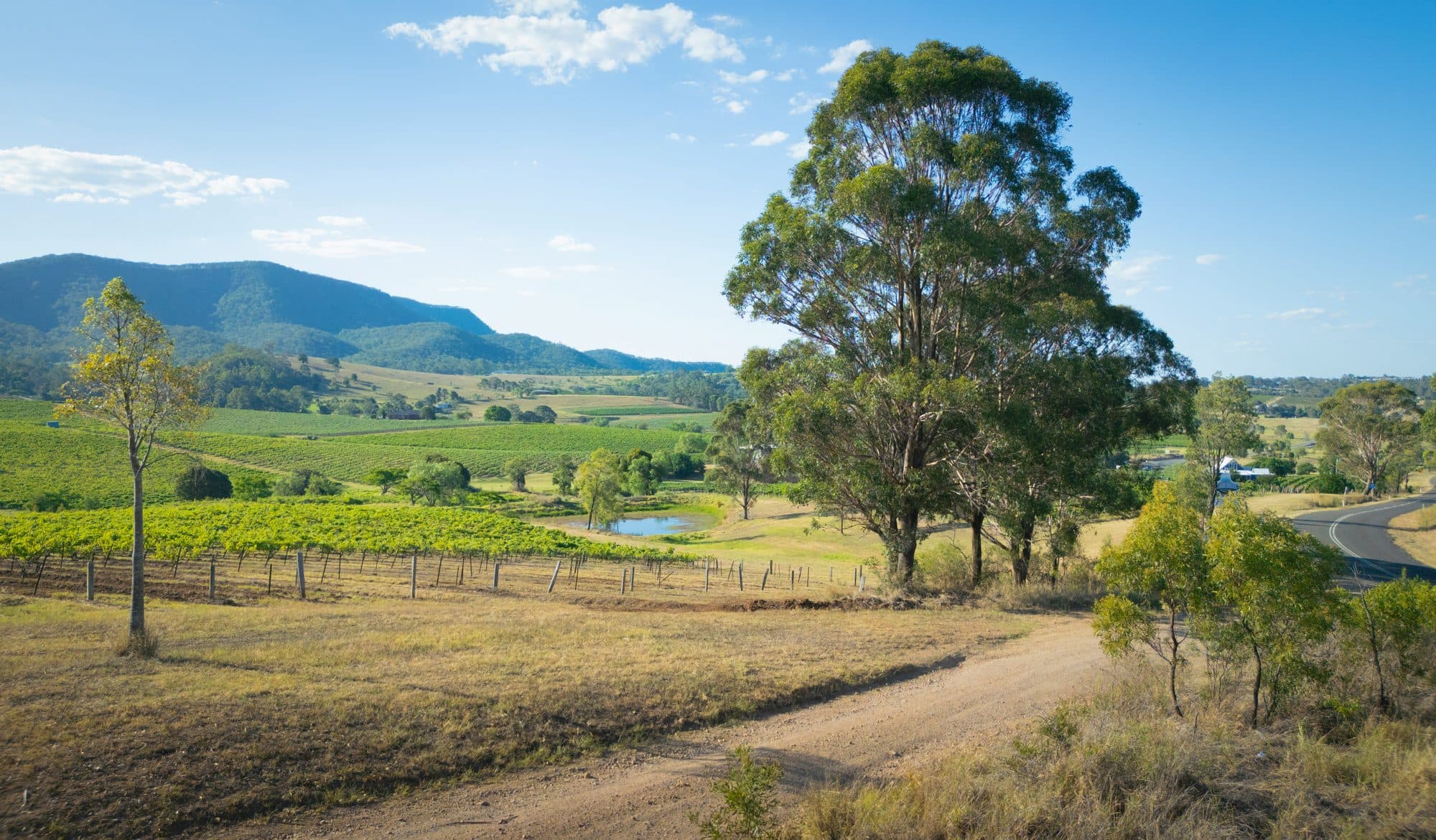
The marathon starts and finishes at the Cricket Pavilion at Wandin Estate on Wilderness Road, Lovedale. The course is four laps of about 10.5 km, and each lap is an out-and-back on Talga Road. From the pavilion at about 109 m the road climbs 26 m to a crest of about 135 m near the 1 km mark, then falls about 80 m over 5 km to a turnaround at about 5.3 km, where the road is near 55 m. The return climbs about 60 m back to the pavilion level by the end of the lap.
Surfaces are a mix of estate roads, public rural roads and vineyard edges. Independent descriptions mention sealed road, gravel and grass in places, and the exact 2027 breakdown is unpublished. There is no official elevation figure. The organiser has used two aid stations per lap in recent editions.
The route is from a previous edition, and the elevation profile is SRTM along that line. Check the final race guide for any change.
Kilometre by kilometre
Km 0 to 1: the pavilion hill. The lap starts with a climb of about 26 m at 2.6 per cent to a crest of about 135 m close to the 1 km mark. It arrives before the legs are warm. Leave it alone, do not chase it, and settle onto an easy rhythm.
Km 1 to 5.3: the long drop. From the crest the road falls about 80 m over 5 km, an average of 1.6 per cent and nearly 3 per cent on the first kilometre, to a turnaround at about 5.3 km. It feels like free speed. On the first lap it is. On the later laps it is a warning, because everything gained here is paid back on the return.
Km 5.3 to 9.5: the long climb. After the turnaround the same road climbs about 60 m over 4 km, with the steepest stretch of roughly 3 per cent in the middle. Aid stations on this stretch and the exposed road together define the race. Wind on the open sections can matter as much as the slope.
Km 9.5 to 10.5: the pavilion return. The lap ends on a flat run to the pavilion, where the hub, the crowd and the coffee are. On laps one to three you run past the finish and out again. On lap four you stop.
Laps two to four. The same hills, with fewer runners and more wind. By the third lap the field has thinned, and later starters from the half marathon may share parts of the road, so the density changes. Split the race by laps and not by kilometres: one lap of recon, one settling, one working and one to finish. The halfway mark comes at the pavilion at about 21.1 km.
No blue line or equivalent was documented, and timing is by MultiSport Australia with mats at the splits listed above. Expect the course to read a little long on GPS from turns.
A gentle downhill through vineyards that invites a fast first lap. Hold back, because the return is uphill.
About 4 km of steady climbing back towards the pavilion, then a flat finish to the lap. This half of every lap decides the race.
The same hills, less company, more wind. Run to effort and take drinks at every station.
The legs feel the climb most on the final lap. Keep form and use the last stretch to the pavilion.
Course Map
Four laps of the same out-and-back from the Cricket Pavilion west along Talga Road to a turnaround at about 5.3 km. The line overlays itself. Tap a marker for the pavilion, the turnaround and halfway, and scrub the slider or press play to move the orange marker along the course with the elevation profile beneath it.
The marathon, half marathon, 10.5 km, 5 km and children's race all start and finish at Wandin Estate. The estate has served coffee and food from early morning, a warm lunch from around 11:00 and drinks from late morning, with live music. Every finisher receives a commemorative medal, and the venue gives a small field a proper post-race scene.
July in the Hunter Valley is cold at the start. Cessnock Airport's long-term July averages give a mean minimum of 4.2°C, a mean 9am temperature of 10.1°C and a mean maximum of 17.6°C. A 06:30 start in the dark is close to the coldest of the day, and frost is realistic. Gloves, a hat and an old sweatshirt for the pavilion are worth having, and a disposable layer can be dropped at the start. No official clothing-donation arrangement was found.
The wind matters as much as the temperature. July mean winds are about 11.5 km/h at 9am and 15.3 km/h at 3pm, and the vineyard roads are open. Wear a thin windproof over a base layer for the first lap and be ready to take it off. Rain is possible, with a July mean of about 36 mm.
Later laps are warmer than the first, so dress for the second half of the race. A cap helps in low winter sun. Carry gels, because official on-course food and gel provision was not documented. Road shoes are usual, but a shoe with a little grip is better on wet gravel.
Entry
Entry is open through H Events and the Crowdcatcher portal. There is no ballot and no qualifying time. H Events lists the 2027 event for 18 July and says entries open in late 2026. The 2027 marathon fee was not published at the research date, so check the H Events page.
The official 2026 page stated that entries stay open until the day before the event unless the race sells out, with a late-entry surcharge from two weeks before race day. The marathon field was 80 finishers in 2026, so gaining a bib is not the problem. Accommodation is. Wine country weekends in July can fill lodgings independently of the race.
The general H Events refund schedule is 70 per cent up to six weeks before the event, 40 per cent from six weeks to 14 days before, and none inside 14 days. Entries can be transferred to another person through Crowdcatcher for A$10, only within the same event and not between H Events races.
No fast-runner or guaranteed-entry route exists, and no marathon-specific charity entry, tour-operator allocation or elite standard was found. There is no evidence of formal corrals or proof-of-time waves. Enter when 2027 registration opens if the race is part of a destination weekend, and book accommodation close to Lovedale at the same time.
Fast runner standards
There is no good-for-age route and no qualifying standard.
H Events: Winery Run Hunter Valley →Race Weekend
Kit collection
This is a regional event and not a convention-centre expo. In the last detailed schedule, race-kit collection was at the Wandin Estate Cricket Pavilion, 12 Wilderness Road, Lovedale, the same place as the start and finish. It ran on Saturday from 10:00 to 17:00 and again on race morning from 05:30, closing 30 minutes before each race start. Those are the 2025 hours and must be checked for 2027.
Collect on Saturday if you can. Wandin is rural, there is no train station at the estate, and a taxi or rideshare is not guaranteed at 05:30 or 06:00. A pre-dawn drive, followed by parking, a toilet stop and a walk to the pavilion, is a lot to add to race morning.
Visit NSW's listing describes a Saturday evening dinner with guest speakers as part of the weekend. Check with H Events whether it runs in 2027 and how to book. Carry photo ID and your confirmation email, because the 2027 ID and proxy-collection rules are not yet published.
Getting to the start
The latest detailed timetable starts the marathon at 06:30, with the half marathon at 07:30, the 10.5 km at 09:30 and the 5 km at 10:05. In July that means arriving in darkness or first light.
Getting there. There is no practical train or metro route to Wandin Estate. Visit NSW says visitors to the Hunter Valley generally drive themselves or use organised tours, and Newcastle Airport is about 50 minutes by road from Cessnock. A hire car is the most robust choice for overseas runners. No race shuttle was found. Paddock parking has been signposted from Wilderness Road, and traffic staff direct you into the event car park.
At the start. The Cricket Pavilion is the hub, with toilets and a central event area. Toilets are also on the course near the lap's halfway point, around Talga Road. No bag drop was found, so leave spare kit in the car.
Clothing. Expect a near-freezing start. An old top or gloves can be dropped at the pavilion. No clothing-donation scheme was identified.
Rules. No current headphone, pushchair or wheelchair rule was found. Dogs are not permitted.
Finish. Every finisher receives a commemorative medal. The estate advertises coffee and food from early morning, a warm lunch from around 11:00, and wine, beer and soft drinks from late morning, with live music. Because start and finish are at the same place, runners simply return to their parked car or accommodation transfer. Book a driver if you plan to taste wine, and do not rely on rideshare in rural Lovedale.
Nutrition on course
Recent H Events operational material describes two aid-station locations on each lap, so marathoners pass the same support repeatedly. Because each lap is an out-and-back, the stations are met on both the outward and return legs. Water and an electrolyte drink are listed at each.
Toilets have been placed at the start and finish and near the halfway point of the lap around Talga Road. Exact 2027 positions, drink brand, cup type, medical-post locations and personal-bottle arrangements are unpublished.
The lap format helps. Gaps are short and the same, so you learn where support comes. If you use a specific gel or drink, carry your own, because official gel and food provision was not documented. A soft flask in a shorts pocket is enough on a course with a station every 2.5 to 3 km.
Do not run each lap the same way. The first 5 km drop needs a small drink, and the 4 km climb back is where you should take fluid at both stations. A cold morning hides sweat loss, so drink at every station even when it does not feel necessary.
Spectating
This is one of the easiest marathons for a spectator who does not want to travel. The four-lap format brings runners back to the Wandin Estate Cricket Pavilion every 10.5 km, so a supporter who stays put sees the runner at the start, at about 10.5, 21.1 and 31.6 km, and at the finish, for up to five sightings.
There is no metro or race-day public transport for leapfrogging, and a car chase around narrow vineyard roads is more likely to cause frustration than extra sightings. Exact spectator zones and road closures are unpublished. No live tracking app was identified, and MultiSport Australia publishes timing and results.
The best single location is the pavilion. It has coffee, toilets, food and the estate's warm lunch, and the runner comes to you.
- Watch the 06:30 start
- See each lap return at about 10.5, 21.1 and 31.6 km
- Wait at the pavilion for the finish
- Start at Wandin
- If the 2027 access plan allows, go to the public-road side near Talga Road for a mid-lap sighting
- Return to Wandin for the finish, and do not try this without the final traffic guide
- Stay at the pavilion for the later half marathon, 10.5 km and 5 km starts as well
- Use the coffee, food and toilets on site
- This is the safest option for families
Post-race food
The easiest post-race option is Wandin Estate itself. Recent H Events programming has included coffee and food from early morning, a warm lunch service from around 11:00, and wine, beer and soft drinks from late morning, with live music. Wandin Kitchen at 12 Wilderness Road is the on-site restaurant and, on Visit NSW's listing, serves lunch Friday to Sunday.
Because this is wine country, anyone planning a tasting should name a driver or book a transfer. Food, water and a warm shower come first. Check Sunday opening hours before travelling.
Where to Stay
Stay as close to the finish as budget allows. At the Winery Run the start and finish are the same place, Wandin Estate in Lovedale, so the finish recommendation and the start recommendation are the same. Every option below needs a car, unless the property is within walking distance of the pavilion.
Lovedale
The best race-first base. Wandin Estate itself is in Lovedale, and nearby vineyard accommodation can reduce race morning to a short drive. Inventory is limited and weekend prices are high. It suits runners who prefer logistics to nightlife and does not suit anyone who wants shops within walking distance.
Pokolbin
The widest choice of resorts and cellar doors and the valley's best-known visitor hub, with Hunter Valley Gardens about 10 km from Wandin. It suits couples and families building a wine weekend around the race. It is not walkable and can be expensive at peak weekends.
Cessnock
The practical value option, with supermarkets, pubs, motels and everyday restaurants. It has less vineyard setting but more predictability. Town-centre pubs are the most likely source of Saturday-night noise.
Nulkaba
Sits between Cessnock and Pokolbin, with guesthouses and holiday parks near the Hunter Valley Wildlife Park. It works for families with a car and has fewer evening options on foot.
Rothbury and The Vintage
Higher-end villas and resorts with golf and spa facilities, about 6 km west of Wandin. It suits runners who want a quiet recovery stay and are happy to drive to the start.
Maitland
A fallback for value and rail access, on the Hunter Line to Newcastle. A car is still required on race morning and the drive is materially longer, so use it only when vineyard accommodation is full.
Check every booking for weddings and minimum stays. Booking advice is in the timeline below.
Recommended hotels
The best possible race-morning convenience. Inventory is limited and can be blocked by weddings and events.
Spa, golf and spacious rooms. The furthest of the resort options and car-dependent on race morning.
Booking timeline
There is no ballot, so accommodation is the constraint and not the bib. The Hunter Valley has limited weekend inventory, and weddings, school holidays and winery weekends can fill properties regardless of the marathon. Book a cancellable room six to nine months ahead if you want to stay in Lovedale or Pokolbin.
Entries open in late 2026. Once they do, enter and recheck the room's cancellation policy. Resorts and vineyard properties often hold blocks for group bookings, which can remove capacity even with a small race field.
Newcastle Airport is closest, around 50 minutes by road, and Sydney offers far more international connections, roughly two hours by car in normal traffic. Overseas runners can fly into Sydney, hire a car and treat the valley as a road trip. The race is on a Sunday and kit collection is on the Saturday, so arriving on Friday removes pressure from a same-day drive.
See & Do
The cellar doors of Lovedale are next to the start, and the gardens and wildlife park sit south of Pokolbin and Nulkaba.
Lovedale cellar doors
Wandin and other small producers cluster close to the venue. A seated tasting is much kinder than a long walking attraction, but arrange a driver.
Hunter Valley Gardens
Eight kilometres of paths across 14 hectares, which is a lot after a marathon. The gardens run winter programming that has overlapped race weekend in past years, and 2027 dates are unpublished. Better on Monday than straight after finishing.
Hunter Valley Wildlife Park
An open-daily attraction in Nulkaba that suits families. It still means several hours on foot, and winter school holidays can coincide with the race.
Hunter Valley Visitor Centre
At 455 Wine Country Drive, a useful first stop for opening times, road conditions and booking help. A gentle scenic drive through Lovedale and Pokolbin is a low-effort option.
Maitland Regional Art Gallery
An indoor alternative if July weather is wet, and a natural stop on the way back to Newcastle.
After the Race
July is winter in New South Wales. Sunday finishers can recover in Maitland or Newcastle, or drive on to Port Stephens and Sydney.
Heritage towns on the Hunter River with an art gallery and historic streets, and no strenuous walking.
A compact harbour city with beaches, museums and an airport, an easy step from wine country to the coast.
Dolphin cruises year-round and humpback whales on their winter migration, with boat-based sightseeing that suits tired legs.
An easy drive south for an international flight, with museums and ferries first and coastal walks later.