The Race
| Next Race Date | Sunday 22 August 2027 |
|---|---|
| Course type | Out-and-back (start and finish under 1 km apart) |
| Registration | Open entry, sold out in 2026 |
| Ballot opens | Not applicable |
| Start | Flinders Chase National Park entrance, 07:30 |
| Finish | Flinders Chase Visitor Centre |
| Total finishers | 279 (all distances, 2026) |
| Avg race-day temp | 7 to 17°C (August) |
| Cutoff time | 6 hours 30 minutes |
| Free race-day transport | No, shuttle buses run from Kingscote and American River |
| Course certification | None |
History
The Kangaroo Island Marathon began in 2015 as a destination event built around Flinders Chase National Park in the island's south-west. It does not use the streets of Kingscote or Penneshaw. The park itself, with its rolling roads, exposed coastline and wildlife, is the course.
Most of the park burned in the 2019 to 2020 bushfires, and the marathon became closely tied to the island's recovery. Runners now pass through regenerating bushland. According to current event material, the recovery was recognised with a bronze medal at the 2021 South Australian Tourism Awards.
Marathon Tours & Travel acquired the race before the 2025 edition. SeaLink, which had supported it for around a decade, announced a two-year sponsorship renewal in April 2025. Entry remains available, but the organiser now sells accommodation, Adelaide transfers, ferry travel, sightseeing and pre-race meals as packages.
The field has grown. The 2025 festival had 221 registered and 187 participants, and the 2026 festival had 299 registered and 279 finishers from 20 nationalities, with more than 500 accompanying guests. A 50 km event, KI50, was added in 2026.
Independent accounts call the course hard more bluntly than the organiser, who calls it challenging: persistent hills, strong wind and long exposed stretches. No course records or winners' table was found.
The course
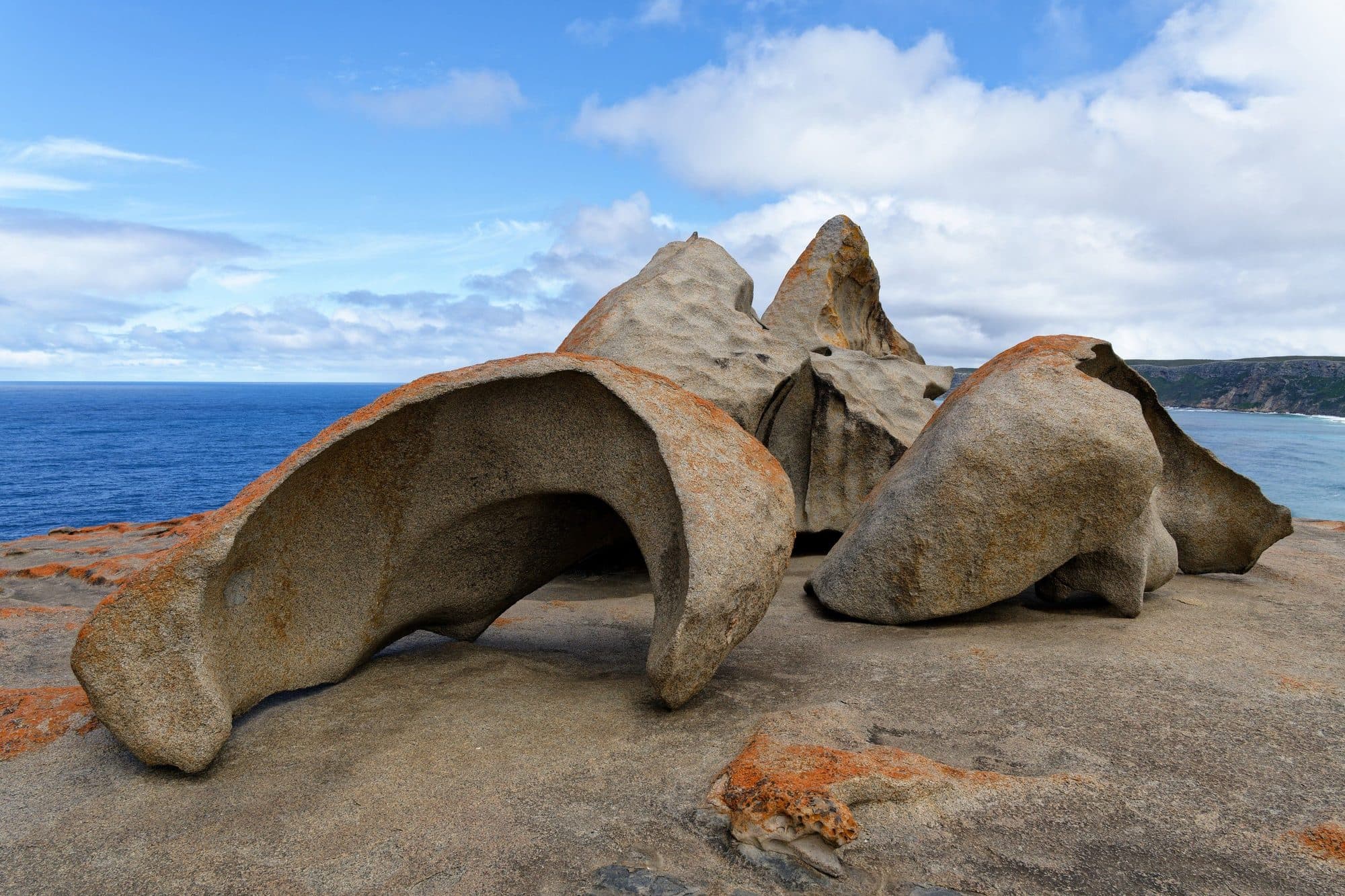
The marathon starts at the entrance to Flinders Chase National Park, about 900 m from the race village at the Flinders Chase Visitor Centre, and finishes at the Visitor Centre. In between it runs out and back to Remarkable Rocks on the park's roads, with the turnaround at about 21 km.
From the entrance the route follows South Coast Road west, turns south onto Cape Du Couedic Road at about 4 km and follows it to about 16 km, then takes Boxer Drive east to Remarkable Rocks, where a boardwalk approach leads to the granite formations. The return repeats the road in reverse. The organiser describes undulating roads and trails through a shut-down park, and surfaces mainly sealed park road with some unsealed and dusty sections.
There is no official elevation profile. The SRTM profile along the route spans 98 m, from about 54 m near Remarkable Rocks to about 153 m at 15.5 km, with no flat kilometres of any length and a 96 m climb out of the turnaround. Wind on the coast and the open post-fire landscape is the second difficulty. Confirm the 2027 route against the organiser's map, because the 50 km course adds a section beyond the marathon route.
Kilometre by kilometre
Km 0 to 4: out of the gate. The race starts at the park entrance and follows South Coast Road west, falling about 24 m over 4 km at 0.6 per cent. It is the easiest running of the day, and the wind is at its least. Hold back.
Km 4 to 9: the first climb. The route turns south onto Cape Du Couedic Road and climbs about 70 m over 5 km, with a steep pitch of about 4 per cent around km 7 to 8, to a high point near 143 m at km 9. It is long enough to break a rhythm. Accept a slower pace and eat early.
Km 9 to 16: rolling road. The road falls about 50 m into a valley near km 13, then climbs about 58 m over 2.6 km to the day's high point of about 153 m near km 15.5. The out-and-back means runners meet the leaders coming the other way. Do not spend energy on the descents.
Km 16 to 21: down to Remarkable Rocks. The route leaves Cape Du Couedic Road onto Boxer Drive and drops about 96 m over 3.7 km, the steepest kilometre being 5.4 per cent, to about 58 m, and finishes the leg on the walk to Remarkable Rocks at about 21 km. Toilets are at the Rocks. The descent is a trap, because every metre dropped here is a metre to climb on the way back.
Km 21 to 27: the climb out. The return climbs about 96 m over 4.7 km, at 2.0 per cent on average and above 5 per cent on the steepest kilometre near km 22 to 23. It is the hardest sustained effort of the race and arrives just after halfway, when the legs are already tired.
Km 27 to 42.2: the return. The same rolling road in reverse: a 57 m drop, a 51 m climb to about 145 m at km 32, and a 70 m descent towards the park. Wind on the exposed coastal sections can turn a modest gradient into a struggle. The last kilometres run east on South Coast Road and finish at the Visitor Centre, about 800 m from the start.
No blue line was documented, and timing details for 2027 are unpublished. Expect the GPS to read close to the marathon distance.
A gentle fall, then a long climb to the first high point. Keep the first 4 km easy and eat before the hill.
Rolling park road, a second climb to the high point, then a 96 m drop to Remarkable Rocks and the turnaround. Do not chase the descent.
The steepest sustained climb of the race, straight after halfway. Walk if you must, but keep moving.
The same rolling road in reverse, often into the wind. Save something for the last climb and finish at the Visitor Centre.
Course Map
An out-and-back line inside Flinders Chase National Park from the park entrance to Remarkable Rocks and back to the Visitor Centre. The line overlays itself for most of its length. Tap a marker for the start, the finish and the turnaround, and scrub the slider or press play to move the orange marker along the course with the elevation profile beneath it.
Flinders Chase National Park is shut to the public for the event, which is why the roads are the course. That also sets the cutoff: the park must reopen at 14:30, so every race ends at 14:00. Pets are not allowed in the park. Remarkable Rocks and Admirals Arch can close in damaging winds, and the organiser's last message before race day is the authority on any route change.
August on Kangaroo Island is cold and changeable. The organiser gives 10 to 17°C for the running day, and Kingscote Aero's August mean was 6.8°C minimum and 16.7°C maximum. The park is inland and exposed, so a 07:30 start can be colder than the town, and the Southern Ocean wind cuts through thin kit.
Wear a base layer and a light windproof you can tie round the waist, and gloves that fit in a pocket. Rain is realistic in winter. A cap keeps rain off the face and doubles as sun protection on open road on a clear day.
Because this is a national park, do not discard clothing on the course unless the organiser provides a collection point. Use the official bag system if one is offered, or carry the layer. No clothing-donation arrangement was found.
Carry your own gels, because the organiser says aid stations provide water, electrolytes and locally produced honey and does not list gels or food. Hydration packs and refillable cups are encouraged. Shoes should suit sealed road and dusty gravel, and road shoes with a decent tread are enough.
Entry
Entry is open through Marathon Tours & Travel Australia, with no ballot and no qualifying time. In 2026 the Australian page published standalone marathon entry of A$140 early bird and A$155 after 31 March, roughly £74 and £82. The UK page listed optional race entries of £75 when booked with a travel package. 2027 pricing was described as coming soon at the research date. A general pre-registration product from A$300 appears on the Australian site and is not the standalone entry fee.
Marathon Tours & Travel also sells packages: in 2026 the three-night package with a double room started at £779 per person, five nights at £1,049 and seven nights at £2,015, based at the Aurora Ozone Hotel in Kingscote and, for longer stays, the Pullman Adelaide. Packages include ferry transfers and race-day transport. Read the travel-booking terms separately from the entry terms.
The 2026 event sold out, so enter early. The bib is one constraint, and ferry vehicle spaces, Kingscote rooms and package places run out at the same time. The 22 August 2027 date comes from Marathon Tours & Travel. The organiser's own site had not published a 2027 date at the research date, and a third-party listing said early September, so confirm before booking travel.
Entries were refundable until 23 July in 2026, less a 25 per cent administration retention. Standalone cancellation and transfer rules for 2027 were not found. The minimum age is 18 on race day. No fast-runner route, charity entry or elite standard was found.
Fast runner standards
There is no good-for-age route and no qualifying standard.
Kangaroo Island Marathon: official site →Race Weekend
Bib collection and race village
There is no conventional city expo. Race administration is part of the Marathon Tours & Travel programme, with staff on site for package guests. The organiser's FAQ says bib collection details will be confirmed in the official event guide, and the 2027 guide was not published at the research date.
Package guests get a Saturday sightseeing and course-recon day and a pre-race dinner. Previous editions used the Flinders Chase event area for race administration, but do not assume this for 2027.
Self-drive runners should confirm where and when the bib is collected before deciding where to stay. A second 70 to 90 minute drive to Flinders Chase on Saturday is a real cost. Overseas runners should plan to be on the island by Friday.
The Saturday recon can add walking the day before the race, including the Remarkable Rocks boardwalk. National Parks SA warns that damaging winds can close Remarkable Rocks and Admirals Arch, so the recon may be shortened by weather.
Getting to the start
The marathon starts at 07:30. The half marathon starts at 08:00, and its runners must arrive by 07:00 for buses at 07:15 to Remarkable Rocks, the half marathon's start line. The 10 km starts at 08:30.
Getting there. There is no ordinary public transport to Flinders Chase. The organiser says race-day shuttle buses depart from American River and Kingscote, or you can drive. Package guests in Kingscote are transferred by coach in roughly 70 to 80 minutes, and guests at American River should allow about 90 minutes. Self-drivers need a very early departure. Dawn is a peak time for kangaroos and other wildlife on the roads, so drive carefully. The ferry arrives at Penneshaw, which is far from the start, so do not arrive on the island on race morning.
At the start. The start is at the park entrance, about 900 m from the race village at the Flinders Chase Visitor Centre. Toilets are at the Visitor Centre and at Remarkable Rocks. Bag drop arrangements were not published.
Time limit. The park must reopen at 14:30, so all races have a 14:00 cutoff. For marathoners from 07:30 that is 6 hours 30 minutes. Marathon Tours & Travel's page says seven hours. Use the organiser's figure and check the 2027 guide.
Clothing. A warm layer for the coach or the wait is worth having. Do not discard clothing in the park unless the organiser provides a collection point.
Finish. The marathon finishes at the Flinders Chase Visitor Centre. Package guests return by coach to their accommodation and attend a post-race function later in the day. Self-drive runners return in their own car, and the drive to Kingscote is more than an hour, so do not book a tight restaurant table. Pack dry clothes and snacks for the journey.
Nutrition on course
The organiser's FAQ says aid stations are positioned about every 4 km, staffed by volunteers, and provide water, electrolytes and locally produced honey for energy. Hydration packs and refillable cups are encouraged. Toilets are at the Visitor Centre and at Remarkable Rocks, and other services will be confirmed in the event guide.
With stations about every 4 km, gaps are longer than at a city marathon, and the wind and the hills make people drink less than they should. Carry a soft flask or a small pack, especially for the spur to Remarkable Rocks, where the return climb comes straight after the turnaround.
Bring the gels you trust. The organiser does not list gels, and edition-specific extras cannot be relied on. Take a gel before the first long climb near km 4 to 9 and another before the climb out near km 21. The honey is a local touch and works as a quick sugar hit, but it is sticky.
| Item | Current status |
|---|---|
| Water | About every 4 km |
| Electrolyte | Yes, brand not published |
| Honey | Locally produced honey, per the organiser |
| Toilets | Visitor Centre and Remarkable Rocks |
| Personal bottles | Hydration packs and refillable cups encouraged |
Spectating
Spectating is limited because the race is inside a closed national park. There are no trains or buses for jumping between kilometres, and access to Remarkable Rocks and other coastal sites is controlled during the race and can be closed for weather.
The best single place is the race village at the Flinders Chase Visitor Centre, where the marathon finishes. If spectator vehicles are allowed, the final traffic plan will say where to park. Do not assume access to Remarkable Rocks or any point along the course. No official live tracking app was identified.
Bring warm layers and food. The park has few facilities away from the Visitor Centre, and winter rain is likely. If the runner is on a package, ask the organiser whether guests can travel on the same coach.
- Travel with the organiser's approved race-day transport from Kingscote or American River to the race village
- Wait at the village for the start and the finish
- Return with the group
- Drive to the designated parking and race village if the traffic plan permits it
- Stay at the village for the start and finish
- Do not drive to Remarkable Rocks or the coast during closures
- Stay in Kingscote or American River while the runner races
- Meet the runner after the organiser's transfer, or at the post-race function if you are on the package
- This suits families or anyone who cannot stand for hours in winter weather
Post-race food
Package guests return to Kingscote and attend a post-race function. In Kingscote, the restaurant at the Ozone Hotel, at 67 Chapman Terrace, is the simplest host-hotel option. Cactus Kangaroo Island, at 59 Dauncey Street, is a recovery brunch and lunch option that the local visitor centre lists as open daily from 07:30 to 14:30, so it will be closed by the time most runners return.
Timing matters more than choice. The drive back from Flinders Chase takes more than an hour, and with a 14:00 course cutoff, many runners return in the late afternoon. Do not plan a tightly timed restaurant reservation straight after the finish, and pack food for the coach.
Where to Stay
Stay where the transfer or the drive suits you. Neither the start nor the finish has meaningful accommodation, and the two are within 1 km of each other in Flinders Chase, so the finish recommendation is the same as the start. Distances on this island are easy to underestimate, and being near the ferry does not mean being near the race.
Kingscote
The best overall base. It is the island's largest town and has the airport, a supermarket, cafés and the host hotel for the organiser's packages. The trade-off is a 70 to 80 minute transfer to Flinders Chase.
American River
Quieter and scenic. The organiser has used the Mercure Kangaroo Island Lodge for self-drive packages, but race morning can involve about 90 minutes in the car. It suits travellers who want a resort feel and have their own vehicle.
Penneshaw
The ferry-port town and the second-largest concentration of accommodation and dining, about 107 km in a straight line from the finish. It is convenient for arrival and departure but poor for race morning.
Parndana and the central island
Reduces the distance to Flinders Chase compared with Penneshaw and can work for self-drivers. It has much less hotel and dining choice than Kingscote.
Karatta and the west end
Geographically closest to the park. Inventory is very limited, often cabins, farm stays or camping. It can minimise race-morning driving but makes the rest of the island harder to reach.
Emu Bay and the north coast
Holiday homes that suit a longer family trip but add race-morning driving and require self-catering and a vehicle. Better as a holiday extension than a race base.
Booking advice is in the timeline below.
Recommended hotels
The host hotel for the organiser's packages, with the race-day coach leaving from it. The transfer to Flinders Chase is 70 to 80 minutes, and package rooms come with room-block rules.
A simpler Kingscote base close to services, used in organiser packages and self-drive history. Availability is limited.
A quiet resort base used in self-drive packages. Allow about 90 minutes to the race, the longest of the options.
Much closer to Flinders Chase, which cuts race morning to a short drive. It is remote, with limited dining and services.
Booking timeline
Book earlier than the field size suggests. The 2026 event sold out, and the pressure comes from ferry vehicle spaces, Kingscote rooms and package places and not from the race bib alone.
For an overseas trip, reserve a cancellable room or a package nine to twelve months ahead where possible. If you are self-driving, book the SeaLink vehicle ferry at the same time. Foot-passenger space is easier, but a car is very useful on the island.
SeaLink runs multiple crossings a day between Cape Jervis and Penneshaw, about 45 minutes, and the road from Adelaide to Cape Jervis is roughly 90 minutes. Timetables vary by day and season. Flying from Adelaide to Kingscote saves time but still leaves a need for a hire car or transfer. Race packages solve most of these dependencies, and for a first visit they can be worth the premium. The race is on a Sunday, so arrive by Friday.
See & Do
Distances below are straight-line from the finish. Kangaroo Island is large, so most of what follows is a drive.
Flinders Chase National Park
Package itineraries often include a Saturday recon of Remarkable Rocks and Admirals Arch. It is useful, but it adds walking the day before the race. National Parks SA warns that damaging winds can close the coastal sites.
Kelly Hill Caves
Reopened experiences include a guided above-ground component and cave visits. Stairs and uneven ground make it better later in the trip.
Seal Bay Conservation Park
The accessible boardwalk is a 900 m return walk, which suits post-marathon legs better than a hike. The park is open 9am to 5pm daily in current information.
Kingscote foreshore and local producers
A low-effort recovery outing with short waterfront walks, local honey and food, and no hiking.
Dudley Peninsula and Penneshaw
Best paired with the ferry on arrival or departure. Dudley Wines and coastal views make a natural bookend.
After the Race
August is winter on Kangaroo Island. The trips below stay short and level, from a Seal Bay boardwalk to a return through Adelaide.
A boardwalk of 900 m return to see Australian sea lions on the beach, a short and level walk that suits tired legs.
The ferry-port town with cellar doors, lighthouse and penguin viewing, and an easy departure the next day.
Quiet beaches, farm gates and short wildlife stops, a slower way to see the island.
The organiser builds Adelaide and wine-region touring into its packages, and the return is simple after the ferry.