The Race
| Next Race Date | 18 April 2027 |
|---|---|
| Course Type | Loop: two laps of a 21.1 km city circuit, start and finish at Am Sportforum |
| Registration | Open entry online, no ballot. Four price bands from €70 to €99. No race-day entry for the marathon |
| Ballot Opens | No ballot |
| Total Finishers | 1,677 marathon participants in 2026, from 14,351 runners across all distances that weekend |
| Average Race Day Temperature | April normals: 9 to 10°C mean, mid-teens high, 4 to 5°C low. The 2026 edition ran wet |
| Cutoff Time | 6 hours gross, finish open to 16:00. First lap by 12:40, and a checkpoint at Schleußiger Weg closes at 15:00 |
| Free Race Day Transport | Yes. The bib is a valid MDV Zone 110 ticket from 05:30 to 19:30 on race day |
| Course Certification | Measured under DLV and AIMS rules by certified measurers. The organiser states it meets Boston qualification standards. No World Athletics label identified |
History
Leipzig’s marathon history runs deeper than the current series: the city staged a roughly 40 km race in 1897, inspired by the newly revived Olympic marathon. The modern event began on 18 June 1977, organised by runners from HSG KMU Leipzig under Heinrich Hagenloch, with 183 starters and 100 finishers. That attrition rate says a good deal about how different early mass-participation marathon culture was from the race Leipzig runs now.
Through the late 1970s and 1980s it became an important East German venue and hosted the final DDR marathon championships in 1990. Uta Pippig, later a Boston and Berlin champion, won here in both 1986 and 1987. After reunification the race repositioned itself inside a much larger national calendar and settled into its April date from 2000. A strong 2004 elite field produced the recognised records, Christopher Cheboiboch’s 2:10:16 and Tegla Loroupe’s 2:29:40, though no current organiser page republishes these as standing course records, so treat them as historical marks. That same year the Stadtsportbund Leipzig took over the organisation with Leipzig Marathon e.V. and the race deliberately stopped paying elite appearance fees, repositioning itself as a large regional participation event. The start and finish moved to the Sportforum in 2007 and have stayed there.
Recent editions have grown substantially. The 2025 race recorded 12,657 registrations from 87 nations, and the 48th edition in April 2026 saw 14,351 runners start across the weekend programme, more than 6,500 of them in the half marathon and 1,677 in the marathon itself. Jakob Lange won the 2026 men’s race in 2:17:43 on his Leipzig debut, and Antonia Müller of LG eXa Leipzig took the women’s race in 2:43:07, a personal best and her second Leipzig win since 2024. Heavy rain arrived shortly after Lange finished and turned most of the rest of the day into a wet-weather race.
The case for travelling here is not elite depth or international billing. It is a long-running, DLV and AIMS-measured city marathon that meets Boston qualification standards, with a substantial local field, a central start and finish reached by tram, and a two-lap route that puts the monumental city and the green, industrial west on the same circuit. 2027 is the 49th running, one year short of the 50th.
The course
The marathon starts at 10:00 on Am Sportforum, beside Red Bull Arena and Quarterback Immobilien Arena, and runs two laps of a 21.1 km circuit before finishing back on the same street. The 10:00 gun is unusually civilised for a spring marathon and takes most of the early-morning cold out of the day.
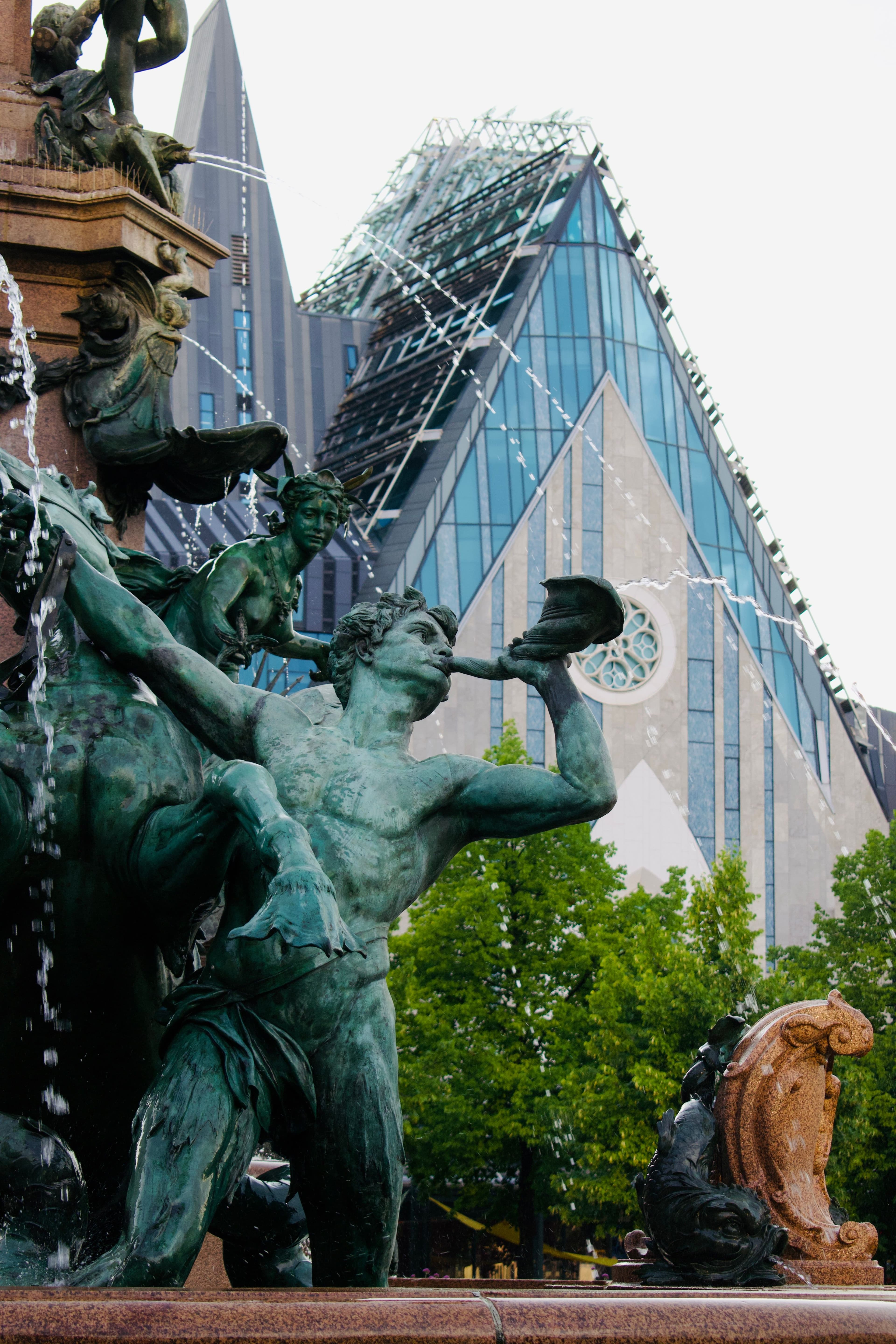
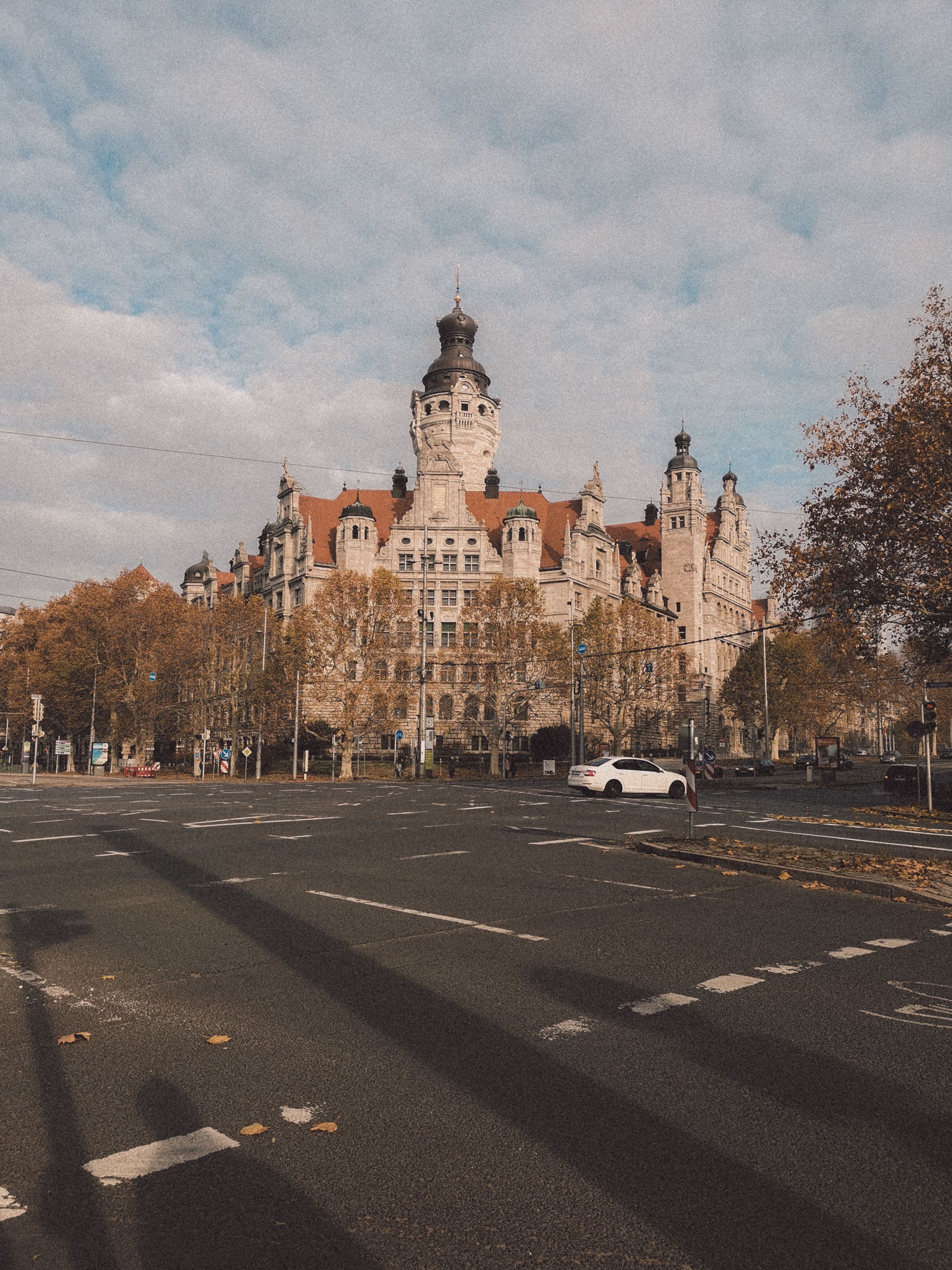
Each lap runs south-east through the centre, out along Prager Straße to the Monument to the Battle of the Nations, west through the Deutscher Platz university and library district, then back through the southern parks and Plagwitz to the Sportforum. The organiser’s course puts the New Town Hall at km 1.8, Augustusplatz at km 2.3, the Völkerschlachtdenkmal at km 6.2, the German National Library at km 9.9, Bayerischer Bahnhof at km 11.7 and Plagwitz at km 18.2, with everything repeating exactly 21.1 km later.
No total-ascent figure is published. The organiser presents no significant climbs, and the chart agrees: the whole course sits inside 39 m. Each lap has one gentle rise, about 37 m over the first 6 km and steepest up Prager Straße to the Völkerschlachtdenkmal, at about 1.6% for one kilometre. From the monument the lap drifts downhill for most of the way back through the south and west, crossing the Pleiße, the Elster flood channel and the Weiße Elster. The harder feature is the shape. There are frequent urban changes of direction, a turnaround section around Deutscher Platz, and a lap you run twice.
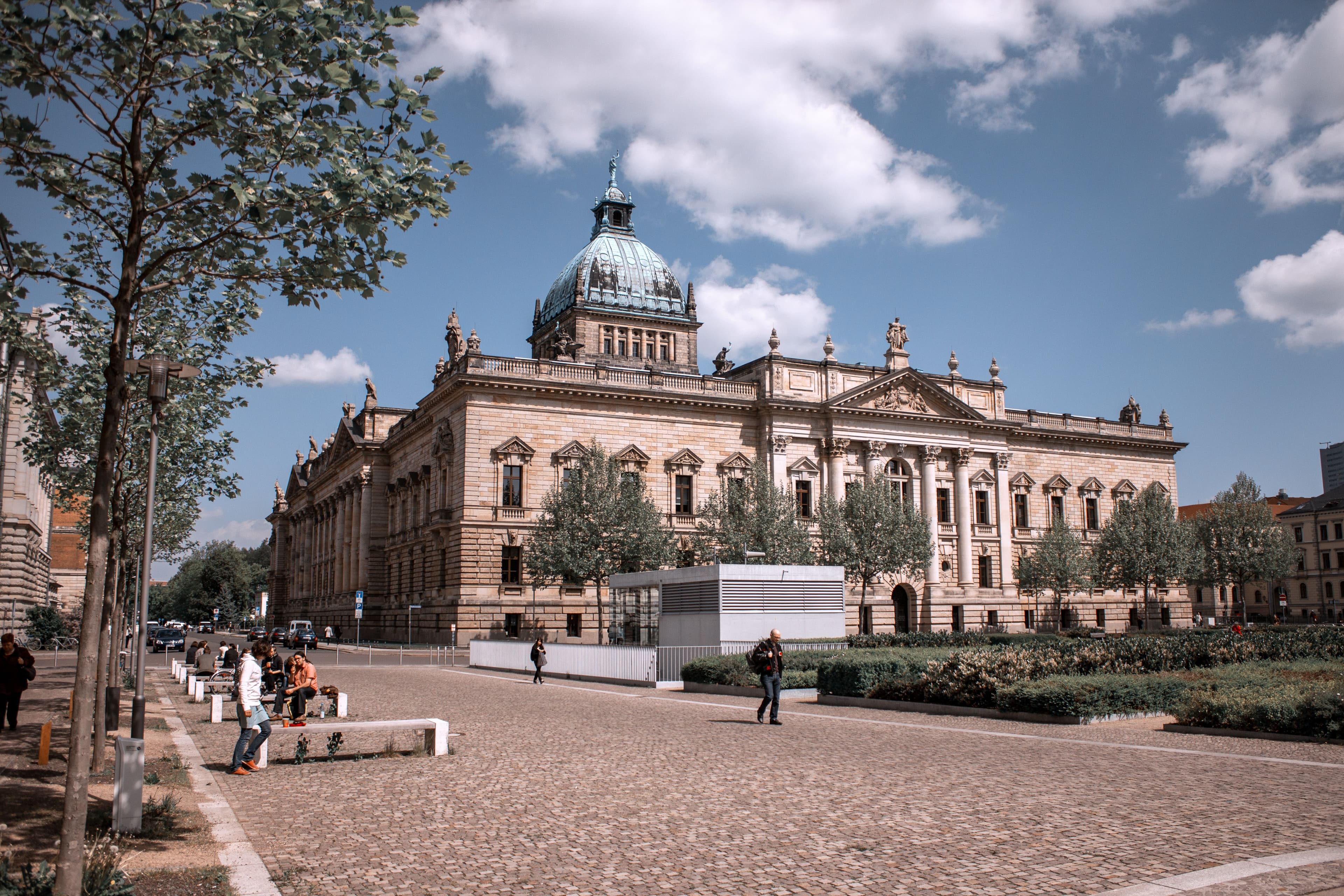
Km 0 to 2.8: Am Sportforum into the centre. The start sits in Leipzig’s main sports precinct, with the Marathon-Campus next door handling changing, showers and baggage. Friedrich-Ebert-Straße carries the field toward the New Town Hall at km 1.8, past the domed Federal Administrative Court, and on to Augustusplatz at km 2.3, with the Gewandhaus, the Opera and the university tower around it. This is the clearest set piece on the course and the easiest place to run faster than planned.
Km 2.8 to 6.2: Prager Straße to the monument. South-east past the GRASSI museum quarter, the university hospital and the former exhibition grounds. The road rises about 23 m between km 4 and 6, most of it on Prager Straße, to the Völkerschlachtdenkmal at about km 6.2, the highest point of the lap at 144 m and visible from a long way out. The surrounding old fair site is more functional than scenic, and the rise is a good reason not to push here.
Km 6.2 to 13: Deutscher Platz, and the section that doubles back. The route turns west and drops to its southernmost ground, then reaches the German National Library at about km 9.9, runs north to a turn near Bayerischer Bahnhof at km 11.7, and comes back past the library again at about km 13. Two passes of the same building inside three kilometres, plus the turnarounds, break up the rhythm, and on the second lap the turns cost more than the gently falling road gives back.
Km 13 to 18.2: west through the green city. Out through Südvorstadt toward the southern floodplain forest, past the racecourse and Clara-Zetkin-Park, crossing the Pleiße, the Elster flood channel and the Weiße Elster before reaching Plagwitz at about km 18.2. This is the quietest and greenest running of the lap, and gently downhill, losing about 15 m to Plagwitz.
Km 18.2 to 21.1: the finishing straight you do not finish on. Back north-east to the Sportforum and the Marschnerstraße straight, close to 800 m long and lined with spectators. Marathon runners run down it and keep going. The organiser enforces a first-lap cutoff of 12:40 here: a marathoner who misses it is taken out of the marathon, though they may complete the half-marathon distance without a half-marathon placing.
Km 21.1 to 42.195: the same lap, again. Everything returns in sequence 21.1 km later: the town hall at km 22.9, Augustusplatz at km 23.4, the monument at km 27.3, the library at km 31, Plagwitz at km 39.3. The second circuit repeats the same rise to the monument between km 25 and 27 and nothing more, so a runner who raced the first lap hard mostly finds the second long. The late checkpoint at Schleußiger Weg and Wundtstraße closes at 15:00, backing up the six-hour limit, and this time the 800 m straight ends at the line, with medals handed out on Am Sportforum itself.
Course Map
One 21.1 km circuit, run twice, out through the centre to the Monument to the Battle of the Nations and back through the green west. Tap a marker for details, and scrub the slider or press play to move the orange marker along the course with the elevation profile beneath it.
A 10:00 start, the New Town Hall at km 1.8 and Augustusplatz at km 2.3, then out along Prager Straße to the Völkerschlachtdenkmal at km 6.2. The most crowded running of the lap.
The National Library at km 9.9, a turn near Bayerischer Bahnhof at km 11.7, then back past the library at km 13. Turnarounds and repeated views; this is where momentum leaks.
Südvorstadt, the racecourse and Clara-Zetkin-Park, three river crossings, Plagwitz at km 18.2, then the 800 m Marschnerstraße straight, which you run down and keep going. First-lap cutoff 12:40.
Every landmark returns 21.1 km later. The same gentle rise to the monument, and nothing new. Checkpoint at Schleußiger Weg closes 15:00; the finish is open to 16:00.
Pacers
Seven pace groups, and the targets are set deliberately just under the round numbers: 2:59, 3:14, 3:29 and so on. That is a small kindness on a two-lap course, where the difference between finishing at 3:00:04 and 2:59:58 is decided by how honestly you ran the first circuit. Pacers wear conspicuous shirts and carry a balloon or beach flag showing the target, with time boards in the start area marking where each group assembles.
| Target | Approx pace |
|---|---|
| 2:59 | 4:15/km |
| 3:14 | 4:36/km |
| 3:29 | 4:57/km |
| 3:44 | 5:19/km |
| 3:59 | 5:40/km |
| 4:14 | 6:01/km |
| 4:29 | 6:23/km |
What to wear
Mid-April in Leipzig sits on the cooler, more changeable side of spring. The 1991 to 2020 normals give a daily mean around 9 to 10°C, highs in the mid-teens and lows around 4 to 5°C. The 2026 edition is the useful counter-example: heavy rain arrived shortly after the winner finished and turned the rest of the day into a wet race, which is exactly what a long-term average will not tell you.
A light waterproof or a disposable outer layer makes sense on a cold or wet forecast, and the 10:00 start means you have time to look at the actual weather before deciding. No formal throwaway-clothing collection scheme has been published, so plan for anything you discard. On the other hand, the Marathon-Campus is right beside the start with changing rooms, showers and clothing storage, so a proper warm layer to the start line and a dry change for afterwards are both easy to arrange.
Entry
Entry is open registration with no ballot. Marathon pricing rises through four bands: €70, then €80, then €90, then €99 for late entries, which is roughly £60 to £85. An optional technical event shirt costs €25. No fixed marathon quota is published, though the organiser reserves the right to limit entries or close registration early.
One thing to plan around firmly: there is no race-day entry for the marathon. On-site late registration at the Marathon-Campus exists for the half marathon, the 10 km and the 4 km, and the FAQ states explicitly that it does not extend to the marathon distance. If you want to run 42.195 km here, enter in advance.
The organiser’s own pages disagree with themselves on two dates, and neither is worth guessing at. Registration opening is given as 18 September on the FAQ and 19 September on the event page. The pre-registration price deadline is given as 28 March in one place and 29 March in the fee table and FAQ. Use the live registration portal, not either published figure, and if you are entering close to a deadline, assume the earlier of the two.
Transfers to another participant and distance changes are both permitted, with a €10 fee applying after the late-March threshold. Moving up to a longer distance means paying the difference; moving down does not produce a refund. The linked terms-and-conditions PDF was still labelled for the previous edition at the time of research and states that a non-starter, illness included, gets no refund and no voucher, so check the current version before assuming otherwise.
Fast Runner / GFA Standards
None. There is no Good for Age route and no qualifying-time entry. The relevant qualification here runs the other way: the organiser states the course meets Boston Athletic Association standards, so a time run at Leipzig can be used to enter Boston. The minimum age for the 2027 marathon is runners born in 2009 or earlier.
Race Weekend
Expo
Bib collection and the Marathonmesse both run at the Marathon-Campus, Jahnallee 59, which is the Faculty of Sport Science building at Leipzig University. Saturday runs 10:00 to 19:00. Sunday collection opens at 08:00, and here the organiser’s pages disagree again: the event page gives a 12:30 close and the FAQ gives 13:00.
For a marathon runner the conflict is academic, because collection closes at least 30 minutes before your own start and the marathon goes at 10:00. Collect on Saturday. It also puts you at the campus you will use on race morning for bag drop and showers, which is worth knowing in advance.
Bring the official registration confirmation. A family member, friend or acquaintance can collect on your behalf with that confirmation and written authorisation. There is no parking at either the Marathon-Campus or the Sportforum, and the organiser recommends public transport: trams 3, 7, 8 and 15 serve Sportforum Süd or Waldplatz, and tram 4 reaches Feuerbachstraße or Waldplatz.
Getting to the Start
The gun is at 10:00 on Am Sportforum, with changing, showers and clothing storage at the Marathon-Campus on Jahnallee 59 next door. There is no event parking at either, so public transport is the plan.
Race-day travel is free and generously scoped: the bib works as an MDV Zone 110 ticket from 05:30 to 19:30, covering the journey out and the journey back. From Leipzig Hauptbahnhof the organiser gives it as four tram stops on lines 3, 7, 8 or 15 to Sportforum Süd, with those lines also serving Waldplatz and line 4 reaching Feuerbachstraße. The one thing it does not cover is the airport, which sits outside Zone 110.
Anyone staying in Waldstraßenviertel or Zentrum-Nordwest can probably walk. Anyone staying centrally or near the Hauptbahnhof should allow considerably more than the nominal four-stop ride suggests: the risk on race morning is service alterations and crowding, not distance.
If you are using the personal-bottle service, the deadline is much earlier than the start: 08:15, at the signed information point on the Marathon-Campus. Build the morning around that, not the 10:00 gun. No compulsory clear-bag policy has been published, and the organiser’s liability for stored items is limited, so leave valuables at the hotel.
After finishing on Am Sportforum, medals are handed out at the line, post-finish food is to the right of the chute, and stored clothing is collected back at the Marathon-Campus.
Nutrition on Course
Aid is dense and, more usefully, predictable. Four main stations per lap at km 5, 10, 15 and 20, repeating at km 25, 30, 35 and 40, with water and tea throughout, fruit and cola from km 10, and porridge specifically at km 15 and km 35. Water-only points sit at the midpoints from km 2.5, and there is an extra marathon-only water point at the lap transition around km 21.5. In practice that is something on the road roughly every 2.5 km for the whole race.
Personal bottles can be placed at km 5 and 25, 10 and 30, 15 and 35, and 20 and 40, which is unusually generous for a race this size and worth more than usual on a two-lap course, since one bottle position serves you twice. They go to the signed information point on the Marathon-Campus by 08:15 on race morning. Containers must show your bib number and the station they are meant for, perishable items are not accepted, and nothing is returned afterwards.
No specific branded sports drink or gel is named in the published on-course list, so if your fuelling depends on a particular product, carry it. Finish nutrition, to the right after the chute, includes fruit, water, tea, apple spritzer, cola and alcohol-free drinks from Freiberger Brauhaus.
Spectating
A repeated 21.1 km circuit makes this one of the easier marathons to support. One good position gives two sightings without moving at all, and a supporter willing to use the trams between central points can realistically manage three or four.
Plan A: the Sportforum, all day. The finish corridor is the strongest single location on the course: the 10:00 start, the runner completing lap one at about km 21.1, and the finish, all from the same spot with no transport at all. The Marschnerstraße straight is close to 800 m long and lined with spectators, so there is room to find a place.
Plan B: start, centre, finish. Watch the start, take a tram from Sportforum Süd toward the centre, and pick the runner up at Augustusplatz, reached at about km 2.3 and again at km 23.4. Then return to the Sportforum for the lap-one passage or the finish. Check race-day diversions before relying on the standard timetable.
Plan C: the monument, twice. Go straight to the Völkerschlachtdenkmal and stay there. The course reaches it at about km 6.2 and km 27.3, so the two sightings are roughly a half-marathon of running apart, and the monument is unmistakable from a distance. Only head back for the finish if the runner’s pace and the live tracking give you a comfortable margin.
The south and west of the course, around Deutscher Platz, Clara-Zetkin-Park and Plagwitz, is quieter and reachable by tram, which suits a supporter who wants space to be useful. Confirm stops and closures against the organiser’s final transport plan once it is published; live tracking runs through the event’s own results system.
Post-Race Food
The finish supplies fruit and drinks, so there is no need to rush anywhere. The nearest option is Serve & Dine, directly on Am Sportforum, whose advantage is proximity: it saves a tired trip into the centre.
For a proper Saxon meal, Restaurant Lerchennest on Kleine Fleischergasse does regional dishes including potato soup and vegetarian options in a central position, and Das Alte Rathaus on the Markt does the heartier end, sauerbraten included, though that is a tram ride from the finish. Central Italian restaurants are the straightforward carbohydrate answer if nobody in the group wants to think about it. Sunday hours vary and April is outside the summer pattern, so check the specific venue close to the weekend, and book ahead for any group larger than two.
Where to Stay
Start and finish are the same place, Am Sportforum, so there is no trade-off to weigh: judge everything by distance to it. The complication is that the free Zone 110 travel included with the bib takes most of the cost out of staying further away, which makes the honest question whether you want to walk home after a marathon or take a tram.
Waldstraßenviertel and Zentrum-Nordwest
Waldstraßenviertel is the race-first choice: leafy, residential, quiet, and close enough that many properties are a walk from the start and the finish. The trade is fewer restaurants on the doorstep than the historic centre. If your priority is a simple race morning and a short walk back in wet kit, this is the answer.
Zentrum and the Altstadt
The centre has the widest hotel supply and the best sightseeing, putting Augustusplatz, the Markt and the Thomaskirche on your doorstep, and the marathon runs through it twice. Trams 3, 7, 8 and 15 reach the Sportforum in normal service. This is the right base for a first visit to Leipzig with a race attached.
Zentrum-West
Zentrum-West is the compromise between the two: access to Clara-Zetkin-Park and the green side of the city, while still leaving a walk or a short tram to the start. Less choice than the centre, less quiet than Waldstraßenviertel, but it splits the difference well.
Hauptbahnhof and the eastern edge of Zentrum
The station area is the practical pick for rail and airport arrivals, with the S5 and S5X reaching Leipzig/Halle Airport in around 12 to 15 minutes and the Sportforum four tram stops away. It is the lowest-risk arrival, at the cost of the longest journey back after finishing.
Südvorstadt and Plagwitz
Südvorstadt is a lively residential and restaurant district that the course itself touches, and Plagwitz is the characterful west-Leipzig option among canals and converted industrial buildings, passed late in each lap at about km 18.2. Both are better suited to runners extending the stay than to race-morning logistics; neither is close to the Sportforum.
There is no ballot and therefore no single results day that floods the hotel market. A flexible, cancellable booking once the date is fixed in your plans is the sensible approach, particularly for rooms near the Sportforum, which are the tightest supply on the whole trip.
Recommended hotels
An official race hotel partner, and it sits on a course landmark: the route reaches Augustusplatz at about km 2.3 on each lap. Not a walk-to-start option, but the tram is direct.
Another official partner, with the best sightseeing position of the three. Central weekend noise is the trade.
The closest of these to the start while still being central, which makes it the reasonable compromise. Expect event rates to rise as April approaches.
The pick for airport and rail logistics, since the S5 from Leipzig/Halle lands at the Hauptbahnhof. The cost is a longer trip back after finishing.
The third official partner and the furthest of them from the Sportforum, but well placed for the city centre and the station.
Three Motel One properties are named as official race hotel partners, but all three are central, not beside the start, so read “official partner” as a rate, not walk-to-start convenience.
Booking timeline
Book a flexible room as soon as the date is fixed in your plans, ideally in the autumn once registration opens. There is no ballot, so no single result date makes demand spike, and Leipzig’s convention and tourism capacity means the premium sits in the small area immediately around the Sportforum.
For UK and European travellers, flying direct to Leipzig/Halle is often less useful than routing via Berlin and continuing by ICE in about an hour and ten minutes. If you do fly into Leipzig, the S5 or S5X reaches the Hauptbahnhof in 12 to 15 minutes, which is one of the better airport connections on this batch of German races.
See & Do
Three of these five are on or beside the course, which makes them easier to reach than the distances suggest and gives them a different meaning once you have run past them twice. Distances are from Am Sportforum, where the race finishes.
Völkerschlachtdenkmal
The Monument to the Battle of the Nations sits about 6.5 km (4.0 miles) south-east of the finish and directly on the route, passed at km 6.2 and km 27.3. Seeing it before the race gives useful course context. Seeing it afterwards means a substantial stair climb to the viewing platform, which is a second-recovery-day job.
Bach-Museum
On the Thomaskirchhof in the centre, about 2.5 km (1.6 miles) from the finish. Indoor and level throughout, which makes it the best wet-weather and tired-legs option in the city, and Leipzig’s strongest claim on anyone’s cultural attention. Open Tuesday to Sunday and public holidays, generally 10:00 to 18:00, closed Mondays.
GRASSI museums
About 3 km (1.9 miles) from the finish, close to the centre and passed early in each lap on Prager Straße. Three museums in one complex, reachable without a cross-city journey, and a sensible pre-race stop on the Saturday.
Clara-Zetkin-Park
About 2 km (1.2 miles) from the finish, free, flat and directly beside the course on the western return. It is the obvious recovery walk: you can make it as short as the legs allow, and twenty or thirty minutes is a better use of the Sunday evening than anything more ambitious.
After the Race
Leipzig sits at a rail junction that makes the days afterwards unusually easy: Berlin, Dresden, Halle, Weimar and Dessau are all within about an hour and a half, none needing a car. Mid-April means long enough days to use but not reliable warmth, so the trips below lean on towns and museums. They are ordered roughly by how much walking they ask of legs that have just run the same lap twice.
A compact centre reachable without moving hotel, and a neat counterpoint: a separate race, the Mitteldeutscher Marathon, runs Leipzig to Halle directly.
High sightseeing density along the Elbe with no car needed. Better as a Monday-afternoon departure, and skip the tower and dome climbs on the first day.
Two compact historic centres with the Bauhaus and Weimar cultural sites between them, linked by rail without a car.
Bauhaus Dessau on one day and the Dessau-Wörlitz Garden Realm on the other. Put the garden day second: it involves considerably more walking than it looks.
An easy continuation with no flight. Start on the Tuesday, not straight after the Sunday finish, then keep to the U-Bahn and S-Bahn.
Frequently asked questions
Should I stay near the start or the finish?
They are the same place, Am Sportforum. Waldstraßenviertel and Zentrum-Nordwest wrap around it and let you walk; central Leipzig works well by tram and suits sightseeing.
How far in advance should I book a hotel?
Flexibly, in autumn once registration opens. There is no ballot to wait for. The properties closest to the Sportforum are the tightest supply on the whole trip.
Is there free transport to the start on race day?
Yes. The bib is a valid MDV Zone 110 ticket from 05:30 to 19:30 on race day. It covers city transport in both directions but not the airport, which is outside Zone 110.
What is the best area to stay?
Waldstraßenviertel or Zentrum-Nordwest for pure race convenience, Zentrum for a first visit. Südvorstadt and Plagwitz are on the course but further from the start.
When does the expo open?
Saturday 10:00 to 19:00 at the Marathon-Campus, Jahnallee 59, and Sunday from 08:00. The organiser gives the Sunday close as either 12:30 or 13:00; Saturday is the safe option.
What is the weather typically like on race day?
Cool to mild: April normals are around 9 to 10°C with mid-teens highs. The 2026 edition ran wet, so plan from the forecast.
How do I get from the airport?
The S5 or S5X reaches Leipzig Hauptbahnhof from Leipzig/Halle in 12 to 15 minutes. Flying to Berlin and taking an ICE, about 1 hr 10 min, often opens more routes.
Is there a bag drop?
Yes, at the Marathon-Campus on Jahnallee 59, alongside changing rooms and showers. Liability for stored items is limited, so leave valuables at the hotel.
Should I bring a throwaway layer?
Worth it on a cold or wet forecast, though the 10:00 start cuts the early waiting a lot. No donation scheme is published, so plan to keep it or hand it over.
How do I get back to my hotel after finishing?
Same place you started, and the bib stays valid until 19:30. Trams 3, 7, 8 and 15 serve Sportforum Süd and Waldplatz, subject to race-day alterations.