The Race
| Next Race Date | Sunday 3 October 2027 (provisional; the organiser has not yet published the 2027 date) |
|---|---|
| Course Type | Loop: two half-marathon laps, start and finish about 250 m apart on the same site |
| Registration | Open (no ballot) |
| Ballot Opens | Not applicable: open registration |
| Total Finishers | 306 (2025, marathon distance) |
| Average Race Day Temperature | 7.7°C to 16.8°C |
| Cutoff Time | 5 hours 30 minutes (7:49 per km), enforced by a closing vehicle. Finish line closes 14:40 |
| Free Race Day Transport | No included transport ticket. Free parking around Messe Magdeburg across the race weekend |
| Course Certification | Not confirmed |
The closing vehicle is the real cutoff
The 5 hour 30 minute limit is enforced by a vehicle on the course, not only by a clock at the finish. Runners slower than 7.67 km/h, which is 7:49 per km, are required to stop wherever the vehicle catches them. Anyone racing near that pace should treat the vehicle as the deadline and build a buffer early; there is no recovering time in the closing kilometres.
History
The Magdeburg Marathon began in 2004 in Saxony-Anhalt’s state capital, and a surviving report of the following year’s race describes it as the second running, which fixes the sequence from the start. The organiser, Volkslaufgemeinschaft 1991 Magdeburg e.V., built the event around a club identity it still states plainly: von Läufern, für Läufer, from runners, for runners. The race never grew into a marathon-only event. It became a weekend of distances run alongside each other, with a half marathon, a 10 km, a mini-marathon, relays over both the marathon and mini-marathon distances, walking and Nordic-walking events, and a children’s run named for the Elbe beaver. The marathon has always been the smallest field inside that programme, a point independent reviews note directly while still rating the organisation around it well.
The course has not stayed fixed. A detailed account of the 2004 race describes an opening stretch past the Domplatz and the Lukasklause, a crossing of the Elbe on what that report calls Europe’s longest trough bridge, a rise over the Weinberg, and a finish through Elbauenpark. That belongs to the first year and is not the modern route: the current course does not go near the water-crossing junction north of the city at all.
On performance, a 2009 report records Jörg Richter setting a men’s course record of 2:32:47 that year, improving his own 2007 mark by about three and a half minutes, with the women’s record then standing to Angelika Hummel at 3:03:37 from 2005. The organiser’s own Hall of Fame shows faster winning times since: Nadja Koch in 2:55:33 in 2023, Jan Stelzner in 2:28:41 in 2024. The 21st edition went to Sören Ulbrich in 2:41:08 and to Joanna Wasielak of Poland in 3:07:36 in 2025. The pandemic disrupted the race as it did most German events, and the organiser’s record shows the 17th edition, in 2021, run across two days with staggered waves before being scored as one competition.
The 2026 race is the 22nd edition, still based at Messe Magdeburg, and still positioned as an accessible autumn city marathon. The earliest 2026 fee tier was €40, and even the final standard tier sits at €60, well below the entry cost of a major-city race.
The course
Two laps, not one
The marathon is run as two identical half-marathon laps. Runners pass back through the start and finish area at halfway without a formal crossing, then repeat the same ground. That makes pacing comparison against the first half unusually direct, but it also means the field thins visibly on the second lap once the shorter distances have finished, so the second half feels different regardless of pace.
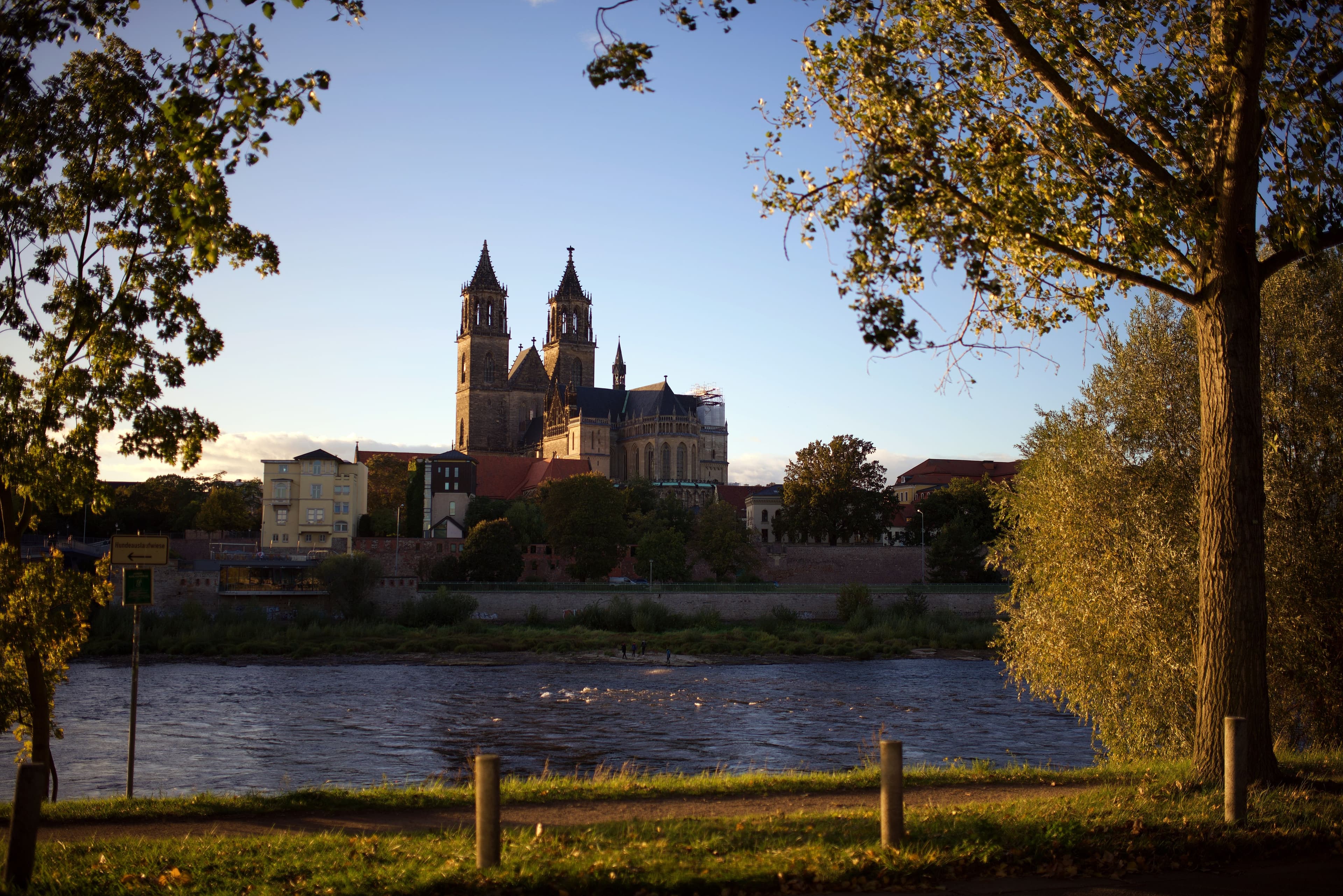
The marathon starts at 09:10 on Tessenowstraße, beside Messe Magdeburg and Elbauenpark, and finishes between Messehallen 1 and 2 on the same grounds, about 250 m from where it began. The 42.195 km distance is covered as two identical half-marathon laps. Each lap runs north from the exhibition grounds through the Herrenkrug park on the eastern bank, crosses the Elbe at about km 4.5, comes south down the western bank through the Industriehafen and Alte Neustadt to the Altstadt riverside, and passes Magdeburg Cathedral at roughly km 9. It then crosses onto the Werder, the river island, loops round it between about km 11 and 16, and returns over the Anna-Ebert-Brücke and along the Alte Elbe to the Messe. The Cathedral and the Hundertwasser-designed Grüne Zitadelle both sit within a few hundred metres of the route on the Altstadt section. The course is flat: the entire route spans roughly 11 m of elevation. No official total-ascent figure has been published, so none is given here.
Km 0 to 1: Tessenowstraße and the settle. The start sits inside the same complex as bag drop, changing rooms and the expo, so there is no long walk out to an exposed holding area beforehand. A music-led warm-up runs from 09:00. The organiser sends several distances from the same site across the morning, with the 10 km at 09:30 and the half marathon at 09:50, and disqualifies runners who start from a block intended for a different race, so marshalled block instructions are worth following exactly.
Km 1 to 7: Herrenkrug and across the Elbe. The route heads north from the exhibition grounds through the Herrenkrug park on the eastern side of the river, crosses the Elbe at about km 4.5, and comes back south along the western bank past the Industriehafen and the Sarajevo-Ufer. This is the most open running of the lap, with little building cover, so it is where a headwind costs most on a breezy October morning. The field is still dense here with the 10 km and half-marathon runners on the same road, which keeps the pace honest and makes it easy to run the first few kilometres faster than planned.
Km 7 to 12: The Altstadt and the Cathedral. Still on the western bank, the course runs along Petriförder and the Elbuferpromenade below the Altstadt and reaches Magdeburg Cathedral at about km 9, the single best-known point on the route and the one place where crowd support concentrates. The Grüne Zitadelle sits a few hundred metres off the line in the same stretch. At about km 10.5 the route crosses onto the Werder, the island in the Elbe. Because both laps come through here, this is the stretch a supporter should pick if they only want to stand in one place.
Km 12 to 21: The Werder and back to the Messe. The course loops round the Werder past the Winterhafen, crosses back to the eastern bank on the Anna-Ebert-Brücke at about km 15.5, and follows the Alte Elbe cycle path and the Herrenkrug roads north to the exhibition grounds, closing the lap at about km 21. Runners pass directly through the Messe area at halfway without a formal finish-line crossing, then go straight back out. This is where the character of the race changes: the half marathon and the shorter distances have finished, and the marathon field, the smallest of the weekend, is left on the road alone.
Km 21 to 42.195: The second lap. The second circuit is the same ground, later in the morning, with a thinner field. Independent reviews single this out, and it is a reason to think carefully about pacing here: a runner who relies on packs and crowd noise will find less of both after halfway. The closing kilometres are also where the cutoff becomes real. No blue tangent line or official split-mat list has been published for this course, so following the marked route and the marshals is more reliable than planning a racing line in advance. The finish, between Messehallen 1 and 2, sits inside the same complex as everything else, so there is no separate walk to find it.
Course Map
One lap of the two, from the Messe north through Herrenkrug, across the Elbe and south past the Cathedral, round the Werder island and back. Tap a marker for details, and scrub the slider or press play to move the orange marker along the course with the elevation profile beneath it.
Pacers
No official pace groups are confirmed for this race. Nothing on the organiser’s entry terms, FAQ or course pages mentions a Tempomacher programme. Runners who normally race behind a pace group should plan to pace themselves, and check the printed race-weekend programme on arrival in case an arrangement exists that is not published online.
What to wear
Long-run averages for 4 October put the overnight low near 7.7°C and the daytime high near 16.8°C, with October typically humid at this latitude and a noticeable breeze possible on the open river and park sections. That range supports a light long-sleeve or a throwaway layer at the 09:10 start, shed once the field is moving; this is not kit for real cold. Humidity, not heat, is the more realistic risk here: a damp, grey morning is at least as likely as a warm outlier year, so a runner planning for sun should reconsider. No organiser clothing-donation scheme has been confirmed, so a layer worth keeping should go to a friend or into bag drop. Given how exposed the northern stretch of each lap is, a light wind or waterproof layer left at bag drop is a reasonable contingency for the finish, when a runner has stopped moving and the temperature has not yet climbed.
Entry
Magdeburg Marathon uses open registration: no ballot, no lottery, and no qualifying time for standard entry. Applications are processed online with an automatic email confirmation, and the organiser keeps a running, publicly viewable participant list.
The fee rises in four tiers: €40 up to 1 March, €50 up to 30 June, €60 up to 22 September, and €65 for late entry. At an exchange rate of €1 to £0.859, those work out at roughly £34, £43, £52 and £56. Treat the sterling figures as a guide, since rates move.
Standard registration closes on 22 September. Online late entry then runs until midday on the Saturday before the race, and in-person late registration operates at Messe Magdeburg on the Saturday from 14:00 to 18:00 and the Sunday from 08:00. Marathon-specific late entry on race-day Sunday closes at 08:30, well ahead of the 09:10 gun. The Team Marathon category has no late-entry option at all.
Payment differs by where the entrant lives. Participants resident in Germany pay by direct debit, while those resident outside Germany can also pay by credit card, so an international runner does not need a German bank account to enter.
Community discussion of smaller German marathons has named Magdeburg, alongside Leipzig and Dresden, as a race where places stay available close to race day. That is forum comment, not a guarantee from the organiser, though it is consistent with the formal late-entry system. Runners who have decided to run should still enter before 22 September, both to avoid the higher fee and to make bib collection over race weekend simpler.
The organiser’s accessible terms do not set out a deferral, refund or transfer policy, so check the current participation conditions directly. No official charity-place programme or tour-operator allocation was found, and elite invitation standards, if any exist, are not published.
Fast Runner / GFA Standards
There is no Good for Age or fast-runner entry route for this race. Entry is open to everyone at the same fee tiers, and a qualifying time confers no advantage.
Race Weekend
Expo
Bib and finisher-shirt collection takes place in Messehalle 1 at Messe Magdeburg, Tessenowstraße 9, 39114 Magdeburg, open Saturday 3 October from 14:00 to 18:00 and Sunday 4 October from 08:00 to 09:00. The same hall holds the information desk, late registration, a sport and club expo, and a pasta party with a stage programme from 14:00 to 17:30 on the Saturday. Entrants who selected the pasta option at registration receive one portion free, and accompanying guests can buy a serving for a small fee.
Start documents and finisher shirts are not posted out. Collection is in person, either by the runner or by a representative carrying the confirmation email. No separate passport or medical-certificate requirement has been stated for recreational entrants, German or international.
Saturday is the sensible collection day for marathon entrants specifically, because Sunday’s on-site window closes at 09:00 and marathon late entry closes at 08:30, under 40 minutes before the gun. The Messe site offers free event parking on both collection days under the organiser’s current arrangement, which removes one of the more irritating pre-race logistics problems for anyone driving in.
Getting to the Start
Race morning is built around a single compact site. Messe Magdeburg and Elbauenpark hold the start, finish, expo, baggage, medical support and changing facilities within a short walk of each other. The marathon starts at 09:10 on Tessenowstraße after a music-led warm-up from 09:00. The 10 km starts at 09:30 and the half marathon at 09:50 from the same general area, so runners should follow marshalled block instructions; standing in a neighbouring pen is not harmless: the organiser disqualifies entrants who start from a block intended for a different distance.
The halls divide the work clearly. Messehalle 2 holds baggage drop, the emergency and medical point, post-race care and massage. Messehalle 3 holds changing rooms and showers. Messehalle 1 is the information and late-registration hub. The organiser states that parking around the exhibition grounds is free for runners and visitors across the event weekend, since it rents the spaces directly, so there is no need to plan a paid car park separately.
Public transport reaches the Messegelände/Elbauenpark stop directly, with tram lines 5 and 6 serving the area under normal service. Race-day diversions should be checked before relying on a fixed timetable, and no evidence has been found that entry includes a complimentary transport ticket. Runners staying centrally in the Altstadt or near Hauptbahnhof should treat the tram as the lower-effort option over walking or driving. A runner staying at Herrenkrug, close to the race hub in a straight line, should still confirm the walking route and any course closures.
Given the 7.7°C average overnight low on 4 October, a warm layer before the gun is sensible. No official discarded-clothing collection has been confirmed, so plan to keep or hand off a layer.
After the finish, runners move directly back into the Messe complex. Hall 2 provides refreshments, medical and post-race care, baggage collection and massage; Hall 3 provides changing rooms and showers. Every finisher receives a medal, and certificates are generated online from the results afterwards. The published 14:40 finish-line closure sits behind a stricter operational rule: the 5 hour 30 minute cutoff is enforced by a closing vehicle at 7:49 per km, so runners near that pace should not assume the course stays open until the stated closure time regardless of where they are on it.
Nutrition on Course
Aid stations are spaced roughly every 5 km. Water and other drinks are available from the first station onward, and from around km 15 the organiser adds bananas, apples and cola. This is a traditional club-marathon setup: no sports-nutrition brand, cup or bottle format, or personal-bottle-drop service has been confirmed, so a runner who depends on a specific carbohydrate gel should carry their own instead of expecting one on the course.
Because the race is two laps, the station pattern repeats, which makes it straightforward to plan the second half against what was actually available on the first. Every aid station doubles as a medical-reporting point, and the organiser describes the course as radio-connected for incident response, which matters on a course where the field thins considerably after halfway.
At the finish, inside Messehalle 2, the provision extends to alcohol-free beer, chocolate and biscuits alongside standard drinks, a broader recovery spread than the on-course stations offer and worth timing a strategy around for anyone managing a specific recovery plan.
Spectating
The two-lap design gives spectators a structural advantage over a single-loop race: one well-chosen point produces two sightings of the same runner without moving. The Altstadt section around the Cathedral, at roughly km 9 and again at roughly km 30, is the strongest single choice, because it combines the best-known landmark on the route with the part of the course where support concentrates.
The simplest plan is to watch the 09:10 start at Tessenowstraße, take tram 5 or 6 toward the city centre for a second sighting once the field has spread out, and return by tram to the Messegelände/Elbauenpark stop for the finish. A supporter who would rather not move at all can base themselves on the central Elbe section and see both laps from the same spot before taking the tram back to the Messe. Skipping the start entirely and picking a city-centre point instead works well for anyone travelling with children, since it removes the early journey out to the exhibition grounds.
Crowd density is greatest around the Messe hub and the central sections, and noticeably thinner on the second lap once the shorter-distance fields have finished. A supporter waiting at the finish should expect a long, quiet gap between the half-marathon finishers and the bulk of the marathon field. No dedicated live-tracking app has been confirmed; unofficial results can reportedly be checked by scanning a QR code displayed in the finish area.
Post-Race Food
Immediate recovery food is inside the race operation itself: drinks, alcohol-free beer, fruit, chocolate and biscuits at the finish in Messehalle 2. For a sit-down meal, Ristorante Da Nino Dolce Vita on Ernst-Lehmann-Straße sits close to the Messe and Herrenkrug side of the city and lists Sunday lunch and evening opening, which suits pizza or pasta refuelling without a long journey. Daniel’s Restaurant on Werner-Heisenberg-Straße, also near the river, lists Sunday hours to 18:00, better for an earlier meal than a restaurant that opens only in the evening. Runners heading back into the centre have L’Osteria Magdeburg on Ernst-Reuter-Allee, with large portions and Sunday opening from morning into the evening; it sits further from the Messe but works for anyone staying around Hauptbahnhof or the Altstadt. Confirm hours at all three before travelling, since they change between seasons.
Where to Stay
The finish, not the start, is the right anchor for choosing a hotel. At Magdeburg the two sit about 250 m apart on the same site, so that rule produces one decision, and the real question becomes how much city-break value a runner wants alongside race-day convenience.
Herrenkrug
Herrenkrug, on the Elbauenpark side of the city, is the race-first choice. It sits close to the Messe start and finish, cuts dependence on race-morning trams, and is where the organiser has previously promoted a runner package with the Dorint Herrenkrug Parkhotel Magdeburg; confirm whether a current version exists before booking independently. The area is quieter than the centre and offers less choice for an evening meal, which suits a runner prioritising a simple race morning over a lively weekend.
Altstadt
The Altstadt, around Breiter Weg, gives the best overall balance. Hotels here sit among the main sights, restaurants and tram connections, and while the start is not walkable, trams toward Messegelände/Elbauenpark run without much fuss under normal conditions. This is the stronger choice for a runner travelling with people who want something to do on the days either side of the race, and it has the additional advantage of sitting on the course itself, so a supporter can walk out of the hotel to watch both laps.
Hauptbahnhof
The streets around Hauptbahnhof and Otto-von-Guericke-Straße suit rail logistics best. Staying here simplifies arrival and departure with luggage, avoids a taxi from the station, and keeps central tram access to the race hub, even though it is less race-specific than Herrenkrug. For most international visitors, who will arrive via Berlin or Leipzig/Halle, this is the lowest-friction option overall.
Werder
Werder, the island in the Elbe, suits a runner who wants river access and a quieter setting, and the course loops round it between about km 11 and 16 on each lap. It sits geographically between the centre and the race area, and bridge closures on race day can affect the exact walking or tram route, so choose it for the setting, not for certainty about Sunday morning.
Alte Neustadt and Stadtfeld Ost
Alte Neustadt, north of the centre near the university, is a practical middle ground, closer to the Messe than many southern districts while still offering a reasonable choice of places to eat, though it usually means a short tram ride on race morning. Stadtfeld Ost offers the broadest hotel and apartment inventory and a residential feel, useful mainly when central or race-side rooms are priced high, at the cost of the longest race-morning journey of the areas covered here.
For a runner focused on performance, Herrenkrug is the clear pick. For a two- or three-night trip built around the city as well as the race, the Altstadt or the Hauptbahnhof area will give a better weekend. Because the race falls on German Unity weekend, with Saturday 3 October a national holiday, book earlier than the size of the marathon field alone would suggest.
Recommended hotels
The organiser has previously promoted a runner package through this hotel. Confirm whether a current-year package exists, and check the practical walking route to Tessenowstraße, before treating it as the automatic race-day base.
A quieter, river-set alternative to a central stay. Bridge or course closures on race morning can affect the walking and tram route, so check access before committing to it as the primary plan.
A central, modern base within reach of the restaurants and sights, better suited to a city weekend than a walk-to-the-start plan. Reaching the race hub depends on the tram running to normal schedule.
The strongest choice for a runner arriving and leaving by train, since it removes the awkward transfer with luggage. It sits further from the start than Herrenkrug, so build the tram journey into race morning.
The lower-cost central option here, with simpler facilities than the others. Plan the tram journey to the start in advance; it is not a short walk.
Booking timeline
There is no ballot here, and registration stays open until late September with a formal late-entry mechanism beyond that, so entry does not force an early travel decision the way a ballot race does. Accommodation is what to secure early if a particular area matters. The organiser has previously promoted a Dorint Herrenkrug Parkhotel runner package; check whether a current one exists before booking that hotel independently, since a package rate may differ from the standard one. The race sits on German Unity weekend, with the Saturday a national holiday, so Magdeburg sees leisure demand unconnected to the marathon in the same window: book race-side or central rooms earlier than the modest size of the marathon field alone would suggest. Rail travellers should compare advance Deutsche Bahn fares once that autumn’s schedules are published, and check for engineering work affecting the race weekend, since Magdeburg is better connected by rail than by air for most international visitors.
See & Do
Everything below is judged from the finish at Messe Magdeburg and the hotel areas around it. Two of the five are on the finish site itself, and the other three sit together in the Altstadt, on the far side of the river, which the course itself crosses.
Elbauenpark and the Jahrtausendturm
Immediately adjacent to the finish, well under 1 km (0.6 miles). The park surrounding the Messe grounds is open 09:00 to 18:00 through September and October, and the Jahrtausendturm, a timber viewing tower inside it, keeps the same October hours from 10:00. The paths are mostly level and well provided with benches, which makes it a realistic low-effort visit for a Monday recovery walk.
LUMAGICA at Elbauenpark
Same site as the finish, well under 1 km (0.6 miles). This illuminated light trail typically opens in early October and runs into the new year, which has meant overlapping with marathon weekend in past editions; confirm the current season’s dates before relying on it. The route covers roughly 2 km, which is a real consideration on legs that have just raced: a Sunday evening visit only makes sense if recovery is going well, and walking it the night before the race is best avoided.
Magdeburg Cathedral
Roughly 3 to 4 km (2 to 2.5 miles) from the finish, in the central Altstadt. The course passes it at about km 9 and again at about km 30, so most runners will have seen it twice at speed before visiting properly. It anchors the old town and works best combined with a short walk around the surrounding streets.
Grüne Zitadelle
Roughly 3 to 4 km (2 to 2.5 miles) from the finish, in the central Altstadt. Friedrich Hundertwasser’s last completed building is easy to see from the outside with very little walking, and it sits a few hundred metres off the race route in the same stretch as the Cathedral.
Kloster Unser Lieben Frauen
Roughly 3 to 4 km (2 to 2.5 miles) from the finish, in the central Altstadt. A former monastery now housing the city’s art museum, useful specifically because it is indoors and level throughout, which makes it the right choice on a wet or windy October day when a walk through the old town is less appealing.
After the Race
Magdeburg sits on fast rail lines to Berlin, Leipzig and the Harz, which makes the days after an early-October marathon easy to use without a long transfer. The race falls on German Unity weekend, so the Monday is a normal working day and services run as usual. Everything below is chosen to suit legs that raced on the Sunday: the two day trips are level-to-moderate, and the longer extensions put any real walking later in the stay.
The Bauhaus Building and the Masters’ Houses form a UNESCO World Heritage site reachable without a long transfer, and October’s low light suits the glass and steel lines. One day covers the core buildings without an exhausting walking tour on raced legs.
A UNESCO-listed half-timbered old town below a castle hill, with more cobbled walking than Dessau, so it suits a slightly later day once the legs have had another day. Autumn colour on the Schlossberg slopes is a real October reason to go.
A well-connected city with deep hotel and restaurant inventory and its own international airport, useful as a low-effort first stop for runners continuing their trip. The flat promenade ring around the old town suits a slow first evening.
Magdeburg’s rail position makes Berlin a practical continuation. A Monday transfer followed by a slower Tuesday of sightseeing suits recovery better than trying to see the city the day after the race.
A longer extension based in Wernigerode, using the narrow-gauge Brockenbahn to reach the Brocken summit without a demanding hike, alongside the half-timbered old town below the castle. Three to four nights works; schedule any real walking later in the stay.
Frequently asked questions
Should I stay near the start or the finish?
They are the same place: both sit at Messe Magdeburg beside Elbauenpark. Herrenkrug is the simplest race-first base for that reason. Runners wanting restaurants and sights should stay in the Altstadt or near Hauptbahnhof and take tram 5 or 6.
How far in advance should I book a hotel?
Entry stays open until 22 September with late entry beyond that, so booking is the binding constraint, not registration. The race falls on German Unity weekend, so secure a central or race-side room once travel is confirmed.
Is there free transport to the start on race day?
No included transport ticket has been confirmed. The organiser provides free parking around Messe Magdeburg for the whole weekend instead. Tram lines 5 and 6 serve Messegelände/Elbauenpark under normal service; check for race-day diversions.
What is the best area to stay?
Herrenkrug for race-day convenience, since it sits closest to the start and finish. The Altstadt gives the best balance of sights, restaurants and tram access. Hauptbahnhof works best for runners arriving and leaving by train.
When does the expo open?
Messehalle 1, Saturday 3 October from 14:00 to 18:00 and Sunday 4 October from 08:00 to 09:00. Marathon late entry on the Sunday closes at 08:30, so Saturday is the more comfortable collection window for the full distance.
What is the weather typically like on race day?
Long-run averages for 4 October give a low near 7.7°C and a high near 16.8°C. October here tends to be humid, with wind possible on the open river and park sections, so plan for cool and damp.
How do I get from the airport?
Magdeburg is better served by rail than by direct flights. Most travelling runners fly into Berlin or Leipzig/Halle and take a Deutsche Bahn connection to Magdeburg Hauptbahnhof. Check for engineering work close to the weekend.
Is there a bag drop?
Yes, in Messehalle 2, which also holds the medical point, post-race care and massage. Changing rooms and showers are in Messehalle 3. All of it sits inside the same complex as the start and finish.
Should I bring a throwaway layer?
With a 7.7°C average low and a 09:10 start, a warm layer beforehand is sensible. No organiser clothing-donation scheme has been confirmed, so plan to keep it or hand it to someone.
How do I get back to my hotel after finishing?
The finish is inside Messe Magdeburg. Herrenkrug is walkable. From the Altstadt or Hauptbahnhof, take tram 5 or 6 from Messegelände/Elbauenpark, checking for race-day diversions before planning a fixed departure.