The Race
| Next Race Date | Sunday 14 March 2027 |
|---|---|
| Course type | Loop, start and finish 330 m apart inside La Granadilla |
| Registration | Open online entry, capped at 1,000 |
| Ballot opens | No ballot |
| Start | Ciudad Deportiva Municipal La Granadilla, 09:00 |
| Finish | La Granadilla, the same sports complex |
| Total finishers | About 384 (marathon, most recent edition) |
| Avg race-day temp | 7 to 20°C (AEMET March normal: average daily minimum and maximum) |
| Cutoff time | 5 hours |
| Free race-day transport | No |
| Course certification | Spanish federation calendar and Extremadura championship; no World Athletics label |
History
A second edition of the Badajoz marathon was being promoted in the autumn of 1991, which puts the first at around 1990 and makes this one of the older municipal marathons in Spain. It belongs to the city: the Fundación Municipal de Deportes of Badajoz City Council organises it, and it has always run alongside a half marathon.
For years the marathon used repeated circuits based on the riverside Paseo Fluvial; a 2012 description records two unequal laps adding up to 42.195 km. By the 2020s the organisers had moved the start and finish to the Ciudad Deportiva Municipal La Granadilla and redrawn the race as one loop of the city, with showers, a bag store and physiotherapy on the same site. The race also carries the Extremadura marathon championship, so a regional title race runs inside the popular one.
It has had interruptions. The 2020 edition was cancelled at the start of the pandemic and there was no race in 2021; the marathon returned in 2022 as the 29th edition. In March 2024 the 31st edition was called off at short notice because the city could not supply enough police officers to close a single loop across so much of Badajoz.
It came back the following year, when Carlos Gazapo won in 2:28:04 and Mónica Gutiérrez in 2:42:53, with more than 1,500 runners across both distances. At the most recent edition Bilal Marhoun of Morocco won in 2:23:38 and María Mercedes Pila Viracocha of Ecuador won the women's race in 3:01:51, 16 seconds ahead of María Cárdenas Rodríguez. The race lists best marks of 2:20:09 and 2:47:20.
The course
The marathon starts and finishes inside the Ciudad Deportiva Municipal La Granadilla, the city sports complex in the south-west of Badajoz, with the two points about 330 m apart. It is one lap of the city, and the lap crosses the Guadiana four times. The first quarter runs south and then north up the western ring road, crosses to the north bank at about km 8, passes the IFEBA fairground at km 9.4 and comes back over the Puente Real at km 12.9. The middle of the race works both banks: the Paseo Fluvial on the south side, Puente de Palmas at km 17, the north-bank districts of San Fernando and Las Moreras, and back over the same bridge at km 24.
The old town comes late. From km 25 the course circles below the Alcazaba walls to its furthest point, San Roque, at km 28, 5.7 km from the start, then climbs into the historic centre. Three short rises follow in five kilometres: 13 m up to Plaza Alta at km 30.8, which is the high point of the day at 192 m; 15 m up again past the Cathedral at km 32.4; and 13 m more to km 34.5. Each takes about half a kilometre, and each is followed by a drop back toward Puerta de Palmas. From km 34.5 the course loses 28 m over the next 3.7 km to the river and runs home through Valdepasillas.
Everything else is flat. Before km 24 the course never strays outside a band from 161 m to 178 m, and the 28 m it gains between km 24.4 and km 30.7 comes at an average of 0.4 per cent. The surface is tarmac and city paving throughout, and the four bridges and the riverside paths are the exposed parts of the course.
Kilometre by kilometre
Km 0 to 8: south, then up the Ronda Sur. The gun goes at 09:00, ninety minutes before the half marathon, so the marathon has the roads to itself. With a field of a few hundred the start is uncrowded and the roads are wide. The first three kilometres climb 10 m along the EX-107 through Barriada de Llera, and then the course turns north up the Ronda Sur, the ring road on the city's western edge, where it is flat and open. Settle early and resist banking time in the cool.
Km 8 to 17: over the river and back. The course crosses the Guadiana at about km 8, passes IFEBA, where bibs were collected, at km 9.4, and runs east along Avenida de Elvas on the north bank. At km 12.9 it recrosses on the Puente Real into Valdepasillas and follows the Paseo Fluvial east along the south bank, reaching the lowest ground of the day, 161 m, around km 15. At km 16.5 it passes Puerta de Palmas for the first of five times, and at km 17 it crosses Puente de Palmas. Bridges are the windiest places on this course. The pacer groups, 3:00 to 4:00 at the most recent edition, are worth more here than any tangent.
Km 17 to 24: the north bank. Seven kilometres through San Fernando and Las Moreras on the north side of the river: west along the bank, a turn, and back east under the Puente de la Universidad at km 22.4. The field strings out behind the 4:00 group here and crowds are thin. March temperatures start to count from this point: a 6°C start can be a 16 to 18°C late morning on a sunny day, and the riverside has little shade. At km 24 the course crosses Puente de Palmas again, past the gate at km 24.6.
Km 24 to 30: round the walls. The route follows the ring roads below the Alcazaba and out east to San Roque, turning at km 28, the furthest point from the start. The ground rises almost without being noticed, 28 m over six kilometres, so the old town begins from slightly higher than the river.
Km 30 to 34.5: three rises through the old town. This is where Badajoz takes its toll. The course climbs 13 m to Plaza Alta and its arcaded houses below the Alcazaba at km 30.8, drops to Puerta de Palmas at km 31.7, climbs 15 m past the Cathedral at km 32.4, drops again past Puerta de Palmas and Parque de Castelar at km 33.1 to 33.4, then climbs 13 m more to km 34.5. Each rise is about half a kilometre long. The streets narrow and the turns come quickly, which breaks rhythm just as legs start to fail. Shorten your stride on the rises and do not try to hold pace up them. This is also where the local crowds are.
Km 34.5 to 42.2: down to the river and home. From the top of the third rise the course falls 28 m over 3.7 km through Santa Marina, past Puerta de Palmas one last time at km 36.6, to the Paseo Fluvial at km 38. An 11 m rise through Valdepasillas between km 38 and km 39.5 is the last climb, and the final two kilometres are flat into La Granadilla. The finish is inside the sports complex, with showers, changing rooms and a physiotherapy room a few metres from the line.
The organiser publishes no tangent line, so follow the road markings and marshals. The route was changed slightly just before race day at the most recent edition because of the weather, so use the final map in the current regulations. Bicycles, skates and other wheeled vehicles accompanying runners were banned from the course.
A 10 m rise on the EX-107, then the flat Ronda Sur, over the Guadiana at km 8 and back at km 12.9. Find a pacer group on the open roads.
Seven kilometres of north-bank riverside, back over Puente de Palmas at km 24, then round the walls to San Roque at km 28. A gentle 28 m gain from km 24.
Three rises of 13 to 15 m in five kilometres, past Plaza Alta and the Cathedral, with a drop to Puerta de Palmas between each. Accept losing seconds here.
A 28 m descent to the river by km 38, one last 11 m rise through Valdepasillas, then flat into La Granadilla.
Course Map
One loop of Badajoz from La Granadilla, crossing the Guadiana four times and circling the old town before the three rises past Plaza Alta and the Cathedral. Tap a marker for the start and finish, bib collection at IFEBA, the stations and the course landmarks, and scrub the slider or press play to move the orange marker along the course with the elevation profile beneath it.
Pacers
Pacer groups ran at 3:00, 3:15, 3:30, 3:45 and 4:00 at the most recent edition, from a single start at 09:00 with no corrals. None was advertised slower than 4:00, and the cutoff is five hours, so runners aiming for 4:30 to 5:00 run their own race after the first hour.
Dress for the finish. Badajoz in March covers a wide range: the AEMET normal for Badajoz airport gives an average daily minimum of 6.6°C and an average maximum of 20.1°C. At 09:00 the air can be close to the bottom of that range. By noon, on a clear day, a runner still on the course can be in the high teens with the sun on their back.
An old top for the wait at La Granadilla is sensible on a cold morning, and arm warmers that can be pushed down beat a long-sleeved top that will be too warm by 25 km. The bag store opened at 08:00 at the most recent edition, so a warm layer for after the finish can be left there. The bridges and the riverside are the exposed parts of the course, so a thin cap helps on a sunny day, and March sun in Extremadura is stronger than the temperature suggests. Rain is possible but not frequent: March averages about 30 mm over roughly five days. Road shoes are all that is needed; watch the old-town paving if it is wet.
Badajoz sits a few kilometres from Portugal, and the Portuguese garrison town of Elvas is a 20-minute drive away. The two countries are in different time zones: Portugal runs one hour behind Spain. Runners flying into Lisbon or staying on the Portuguese side before the race need Spanish time for a 09:00 start at La Granadilla, which is 08:00 on a Portuguese phone. The hour works in your favour afterwards: a Monday in Elvas or Évora starts an hour earlier on the local clock.
Entry
Entry is first come, first served, with no ballot, no qualifying times and a cap of 1,000 marathon runners. It is among the cheapest marathons in Europe: at the most recent edition the fee was €15 (about £13) until late February and €30 (about £26) after that, until entries closed about a week before the race. The half marathon, capped separately at 1,000, sold out. The marathon did not reach its cap, with fewer than 400 finishers.
Registration runs through the city's Fundación Municipal de Deportes and its timing partner, ChipSerena. The regulations for each edition appear in the weeks after the new year, and entry opens then. At this price the only reason to use a travel package is to have transport and a hotel arranged for you.
Two rules concern overseas runners. The regulations at earlier editions said completed registrations were non-refundable and could not be changed after the entry list was published, so check the current wording before paying. And runners chasing a place in the Extremadura championship classification must also register through the federation system; that applies to licensed Spanish athletes, not to visitors running the popular race.
There is no wave or corral system. The marathon starts as one field at 09:00 and the half marathon follows at 10:30, so the marathon start is never crowded by the shorter race. Slower runners should plan around the five-hour cutoff: 5:00 is an average of about 7:07 per kilometre including drinks, and the old-town rises after km 30 cost time. No charity-place scheme or tour-operator allocation was found.
Fast runner standards
There is no fast-runner or good-for-age entry route, and nothing to qualify for. Everyone enters the same way.
Race registration and results on ChipSerena →Race Weekend
Bib collection
Bib collection is a desk, not an expo. At the most recent edition it was on the Saturday at IFEBA, the Institución Ferial de Badajoz, from 10:00 to 14:00 and 16:00 to 19:00. IFEBA is on the western edge of the city on the north bank, about 5 km from the old town, so a taxi is the practical way there; the marathon passes it at km 9.4.
Race-morning collection was offered only to runners who do not live in Badajoz. Visitors can use it, but it adds a queue to a morning with a 09:00 start and a bag store that opens at 08:00. Collect on Saturday and keep the afternoon free. Bring photo ID and the registration confirmation, and collect in person: proxy rules were not published.
There are no stands, no shopping and no pasta party. The Saturday is better spent on a short visit to the Alcazaba or a slow walk along the river.
Getting to the start
The marathon starts at 09:00 inside the Ciudad Deportiva Municipal La Granadilla, on the western side of the complex by Avenida del Club Deportivo Badajoz. The half marathon starts at 10:30, so the marathon has the site to itself for ninety minutes.
Getting there. There is no race shuttle and no free public transport. Every central hotel is between 2.6 km and 3.1 km away, a walk of 35 to 45 minutes, so most visitors take a taxi. Leave before about 08:15: roads close before the start and buses on the course line are diverted. Parking was signposted around La Granadilla and the Estadio Nuevo Vivero at the most recent edition, but driving in on race morning is the least reliable option for a visitor.
At La Granadilla. The sports complex does most of the work. The organiser advertised a bag store (guardarropa) from 08:00, toilets and changing rooms, showers, a physiotherapy service and a stretching room. Arrive 45 to 60 minutes before the start if you are leaving a bag. There are no pens or waves; runners line up by expected pace, and the pacer signs are the reference points. On a cold morning, keep an old top on until the last few minutes and hand your good layer in at the bag store.
Timing and the finish. ChipSerena times the race, and the finish control closes five hours after the start. The finish is back inside La Granadilla, so the medal, drinks, your bag, a shower and physiotherapy are all within a short walk. Food trucks were advertised on site and the prize-giving began at 14:00. Once the roads reopen, taxis are the simplest way back to the centre.
From the airport. Badajoz Airport is about 13 km east of the old town. On weekends and public holidays the airport bus runs as an on-demand service (BusKme), so pre-book it or take a taxi.
Nutrition on course
Aid stations were placed roughly every 5 km at the most recent edition, about eight on the course. Each served water and an isotonic drink, and one handed out energy gels. The kilometre of the gel station, the brands and the cup or bottle format were not published.
Carry your own gels. With one gel point and no published brand, a runner who relies on a particular product needs two or three in a belt or pocket to cover the gaps.
Drink more than the start temperature suggests. A 09:00 start in single figures can feel like a cold-weather race, but by the time a 4:00 runner reaches the old town the air can be 10°C warmer, and the north-bank riverside from km 17 to km 24 has little shade. A few mouthfuls at every station from 10 km on beats waiting to feel thirsty. The stations between km 30 and km 34.5 fall among the rises and the turns: slow down to drink there.
There is no personal-bottle service. Check the current regulations on whether supporters may hand over bottles; unofficial bicycles and other wheeled vehicles accompanying runners were banned at the most recent edition.
Spectating
Badajoz is a good race to watch on foot, because the course keeps coming back to the same river gate. Puerta de Palmas sits beside the course at km 16.5, 24.6, 31.7, 33.1 and 36.6, and the old town between Plaza Alta and Parque de Castelar is a ten-minute walk across. A supporter who stays in the historic centre can see a runner five or six times without transport, then take a taxi to La Granadilla for the finish.
For a 4-hour runner, the first pass of Puerta de Palmas comes at about 10:35 and the second at about 11:20; Plaza Alta at km 30.8 comes at roughly 11:55 and the last pass of the gate at km 36.6 around 12:30. For a 3-hour runner, take roughly a quarter off the time elapsed since 09:00. Crowds are thin outside the old town and the finish, so supporters who want company should stay central. No live-tracking app has been published; ChipSerena's results pages have shown intermediate splits at past editions.
- Breakfast in the old town, then stand at Puerta de Palmas for km 16.5 and km 24.6
- Walk about 10 minutes up to Plaza Alta for km 30.8
- Walk back down to Puerta de Palmas or Parque de Castelar for km 33 and km 36.6
- Taxi to La Granadilla for the finish
- Start near Hotel Río on Avenida Adolfo Díaz Ambrona, 60 m from the course at km 17.9
- Stay on the north bank for the return along the river at about km 22 to 23
- Cross Puente de Palmas on foot to the old town for km 30 to 33
- Taxi to La Granadilla for the finish
- Watch the 09:00 start at La Granadilla
- Breakfast near the complex while the field is on the far side of the city
- Walk to Valdepasillas for the rise at about km 39
- Return to La Granadilla for the finish; the lowest-effort option, and it suits families
Post-race food
The first food is at La Granadilla: drinks at the finish and, at the most recent edition, food trucks inside the complex. For a proper meal, shower and go into the historic centre, where the streets between Plaza de España, Plaza Alta and San Juan hold a compact grid of bars and restaurants within a few minutes of each other.
Extremadura cooks around Iberian pork: jamón from dehesa-raised pigs, presa and secreto off the grill, and migas, fried breadcrumbs with chorizo and peppers, a heavy but effective post-race carbohydrate. Torta del Casar, the soft sheep's cheese from Cáceres province, is on most menus. Spanish Sunday lunch runs from about 14:00 to 16:00, which suits a runner finishing around noon. If your stomach is unsettled, start with soup or eggs and chips and save the jamón for the evening.
Where to Stay
Stay near the finish is the usual rule, and in Badajoz it cannot be followed. The start and the finish are the same place, the Ciudad Deportiva Municipal La Granadilla, and it sits among sports grounds in the south-west with no hotel close by: every hotel below is 2.6 km to 3.1 km away. So choose for the city and budget for two short taxi rides. The old town is the right base for most runners, because it is where the restaurants are and where the course spends kilometres 30 to 37.
Historic centre: Plaza de España, Plaza Alta and San Juan
The historic centre is where to stay for the city itself: the Cathedral, Plaza Alta, the Alcazaba and the densest cluster of bars and restaurants. The course climbs through it between km 30 and km 34.5, which suits supporters. Race morning means a taxi or a walk of about 45 minutes to La Granadilla. Saturday night can be noisy on the bar streets, so ask for an inside room. Price tier: ££ to £££.
Parque de Castelar and Puerta de Palmas
Parque de Castelar is the quieter western edge of the old town, a few minutes from the river gate. The Sercotel Gran Hotel Zurbarán faces the park, and the course passes the park at km 33.4 and the gate five times. It is walkable to restaurants and about 3.1 km from La Granadilla. Price tier: ££.
North bank: Avenida Adolfo Díaz Ambrona
The north bank looks back across the river to the old town, ten minutes on foot over Puente de Palmas. The NH Gran Hotel Casino Extremadura and Hotel Río are on this avenue, and the course runs past the Río at km 17.9 and back along the river at km 22 to 23. Rooms are larger and parking is easier. Race morning needs a taxi. Price tier: ££ to £££.
Avenida Damián Téllez Lafuente and the bus station
This modern district south of the old town holds the Hotel Badajoz Center, a few minutes from the bus station. It is quiet on a Saturday night and priced below the historic centre, and La Granadilla is about 2.9 km away, a 35-minute walk. Dinner means a short taxi or a 20-minute walk into the old town. Price tier: ££.
University side of the north bank
The AC Hotel Badajoz sits near the university campus on the north bank, 2.6 km from La Granadilla in a straight line, the closest of these, though the walk crosses the Puente Real. It is a business district with little evening life, and it suits runners arriving by car from Portugal. Price tier: ££.
Elvas, Portugal
Elvas is about 15 km away across the border, and some runners combine the two. Staying there before the race is a poor plan: Portugal is an hour behind Spain, the border adds a transfer on race morning and taxis across it cost more. Save it for the day after.
Recommended hotels
Opposite Parque de Castelar at the edge of the old town. The course passes the park at km 33.4 and Puerta de Palmas, a few hundred metres away, five times, so supporters can walk out of the door onto it. Restaurants are close. Race morning needs a taxi.
On Avenida Adolfo Díaz Ambrona, 60 m from the course at km 17.9, with the old town a walk across Puente de Palmas. A value choice for a runner with supporters who want to see the race without moving.
On the same avenue as the Río, looking back across the river to the old town. NH has offered eligible direct-booking members Sunday checkout to 15:00, subject to availability, which suits a finish around noon.
A modern hotel a few minutes from the bus station, useful for anyone arriving by coach from Seville, Madrid or Lisbon. It has a gym, and direct bookings have been offered late checkout to 15:00, subject to availability. The walk to La Granadilla is about 35 minutes.
The closest of these to La Granadilla in a straight line, across the Puente Real on the north bank near the university campus. A business-district hotel with little evening life, and the handiest of the five for runners arriving by car from Portugal.
Booking timeline
There is no ballot, so the booking window opens when the regulations and registration appear, usually in the first weeks of the new year. Enter and book a refundable hotel on the same day. Badajoz does not sell out months ahead the way major-marathon cities do, but the old-town choice is small and the same morning carries a 1,000-runner half marathon that sold out at the most recent edition.
Flights are the harder part. Badajoz Airport has a handful of domestic routes and no direct UK service, so most UK runners fly to Madrid, Seville or Lisbon and continue by train, bus or hire car. Madrid to Badajoz by train takes several hours; Lisbon is about 230 km by road. Book the onward legs early, particularly for Sunday evening and Monday morning. The race usually falls a week or two before Semana Santa, and in years when Holy Week comes early, hotel prices across Extremadura and Seville rise.
See & Do
La Granadilla has no sights of its own, so everything below is in the historic centre, 3.3 km to 4 km from the finish and within a few minutes' walk of the recommended hotels. Three of the four sit on the marathon course.
Alcazaba of Badajoz
The Moorish citadel on the hill above the Guadiana, with one of the longest wall circuits of any alcazaba in Spain and the provincial archaeological museum inside. The approach from Plaza Alta climbs, so visit on Saturday. The course runs below its walls around km 25.6.
Plaza Alta
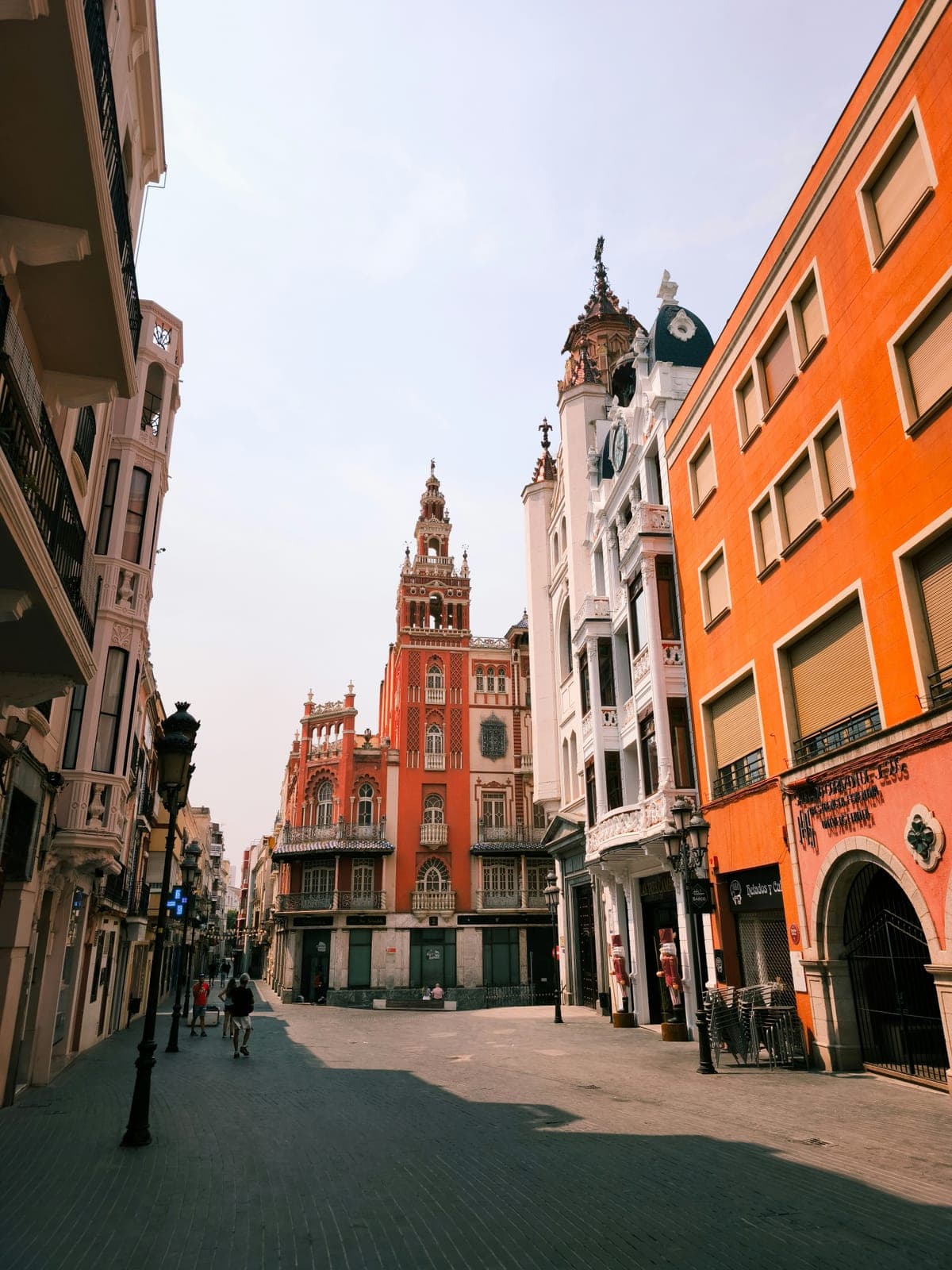
The arcaded square at the foot of the Alcazaba, with its painted facades. The marathon runs through it at km 30.8, at the top of the first old-town rise and the highest point of the course, so a Saturday visit doubles as a look at the hardest part of the race.
Puerta de Palmas and the Guadiana
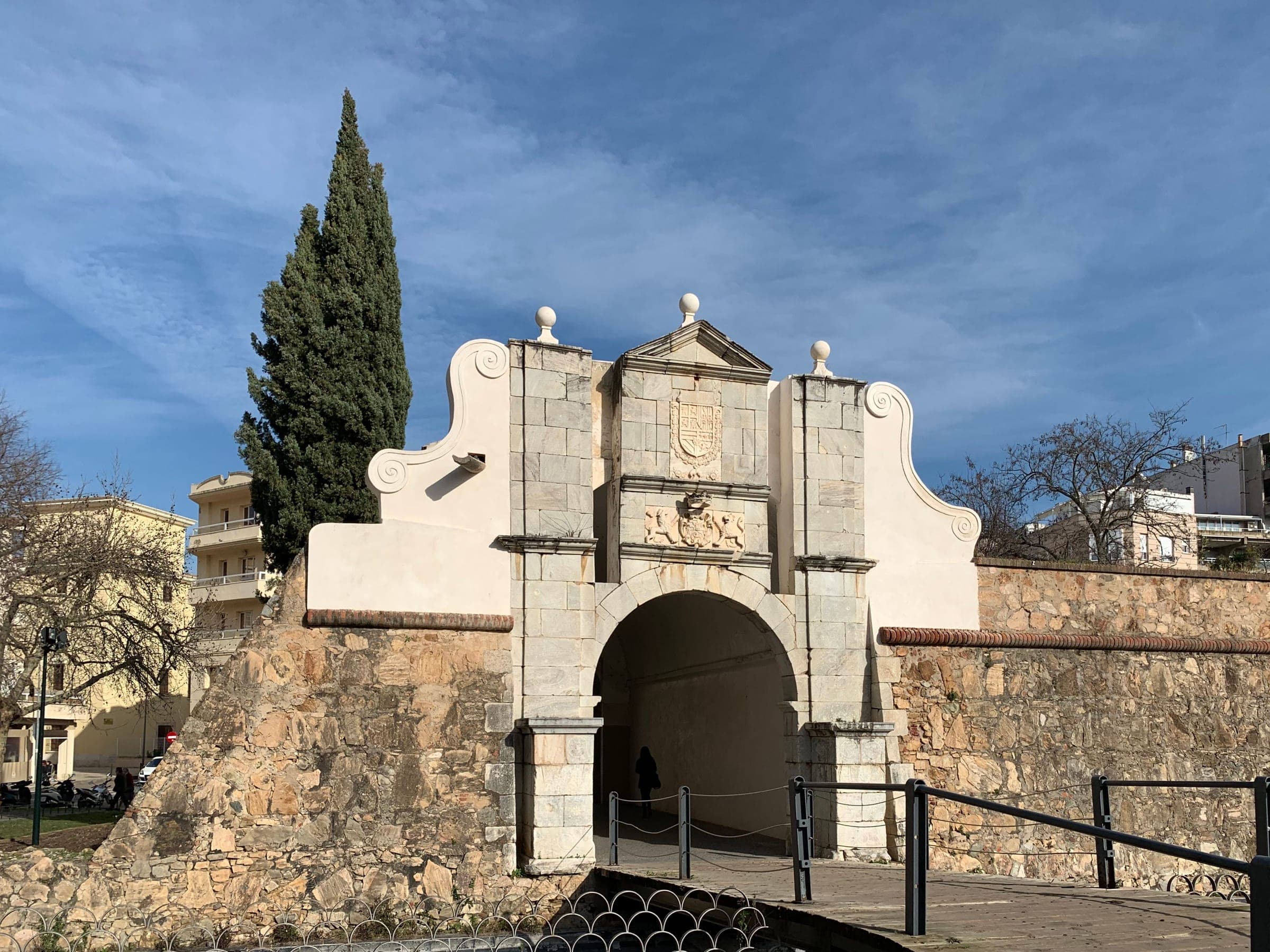
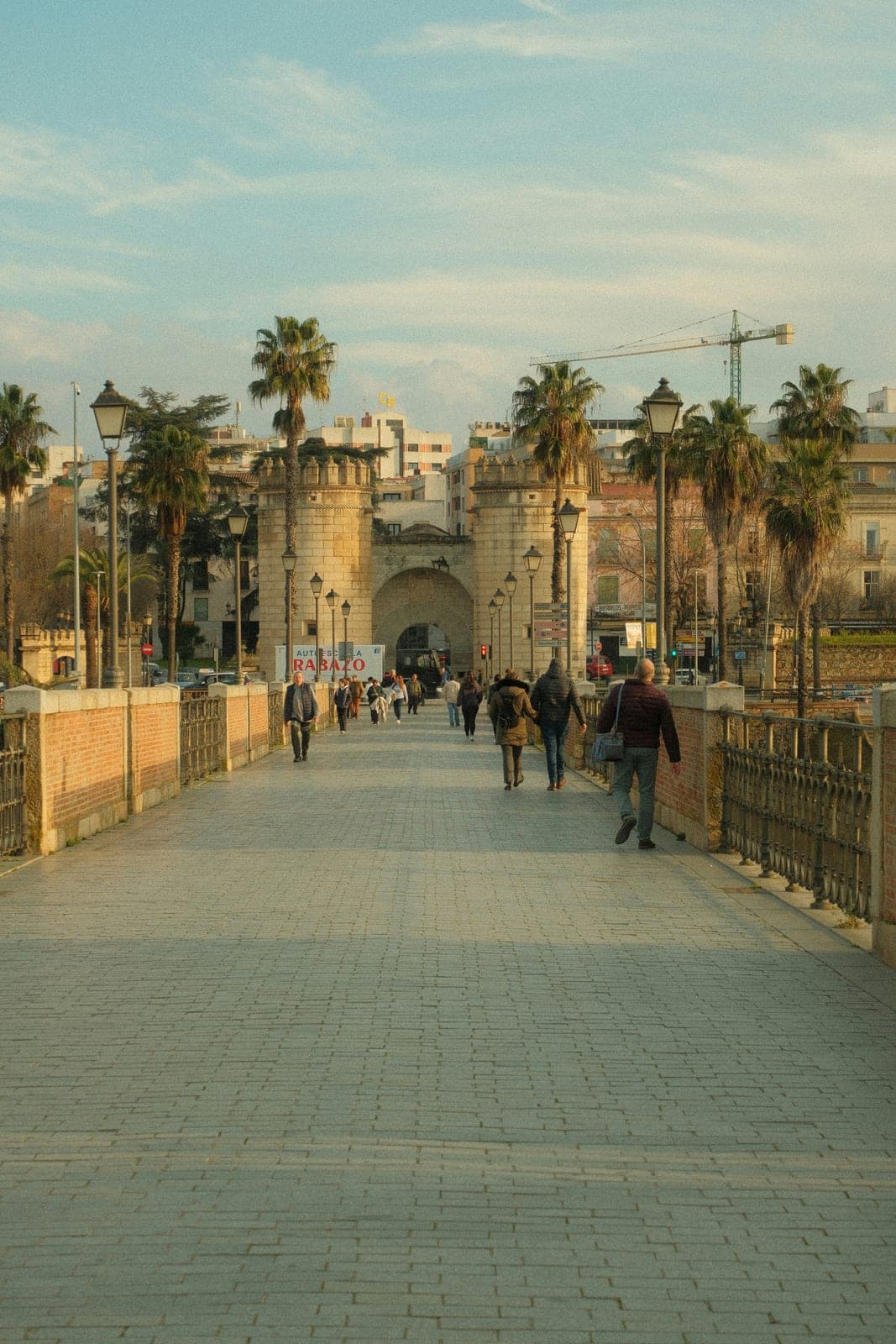
The sixteenth-century river gate with its two round towers stands at the end of Puente de Palmas, and the course passes it five times. The flat riverside paths either side make an easy recovery walk the day after the race.
Cathedral of San Juan Bautista
Badajoz Cathedral on Plaza de España has fortress-like walls built with the city’s defences in mind. It is a short, flat visit from any central hotel, and the course passes beside it at km 32.4, at the top of the second rise.
After the Race
Mid-March in Extremadura and the Alentejo is warm enough for café terraces and cool enough for walking, before Semana Santa fills the region. Badajoz sits on the Portuguese border, so the best trips cross it: Elvas is 20 minutes away and Évora a bus ride further, with Lisbon beyond for the flight home. Mérida's Roman city is 40 minutes east by train and mostly flat, which is worth a great deal the day after a marathon. The walled towns are hillier, which is why Elvas is framed around its main square and aqueduct and Évora gets a night.
A UNESCO-listed garrison town across the border, ringed by bastioned walls and two hilltop forts, with a long aqueduct. The centre is compact but hilly, so keep to the main square and the aqueduct on post-race legs. Portugal is an hour behind Spain.
The capital of Roman Lusitania, with a theatre still used for performances, an amphitheatre and a Roman bridge over the Guadiana. Most sites are flat and one combined ticket covers them. The national Roman art museum usually closes on Mondays.
A small town that was Portuguese until 1801, with Manueline churches and a keep, now inside Spain. Small and flat enough for a slow half-day.
The walled capital of the Alentejo, with a Roman temple, a Gothic cathedral and the Chapel of Bones, then a direct train to Lisbon for the flight home.