The Race
| Next Race Date | Sunday 7 February 2027 |
|---|---|
| Course type | Loop, start and finish 180 m apart |
| Registration | Open online entry; the fee rises as places sell |
| Ballot opens | No ballot |
| Start | Avenida Teniente Flomesta by the Glorieta de España, 09:00 |
| Finish | Plaza Cardenal Belluga, in front of the Cathedral |
| Total finishers | 1,222 (marathon, most recent edition) |
| Avg race-day temp | 6 to 18°C (AEMET February normal: average daily minimum and maximum) |
| Cutoff time | 6 hours, with intermediate controls from 5 km |
| Free race-day transport | No |
| Course certification | World Athletics Road Race Label; RFEA homologated |
History
The modern Maratón de Murcia dates from 2013. It began as the city's own road marathon, built around the urban centre, and its organiser, Club Murcia Challenge, still runs it with the City Council, the regional government and the regional athletics federation.
The race moved to February and grew quickly. The weekend added a half marathon and a 10K, and by the most recent edition more than 11,000 runners were taking part across the three distances. That growth forced a decision. The finish is in the square in front of Murcia Cathedral, and the organiser concluded that the historic streets around it could not safely take more runners; the event now concentrates on the marathon and half marathon.
The course is homologated by the Spanish federation and measured to World Athletics and AIMS rules, and the most recent edition was the first to carry a World Athletics road race label, putting it on the Global Calendar. At that edition Peter Kariuki Wanjiru won the men's race in 2:16:51 and Dominika Stelmach the women's in 2:36:35. The organiser's course records are faster: 2:11:51 for Abdellah Taghrafet and 2:35:04 for Sou Kambouchia. The marathon field has grown with everything else: 1,222 finishers at the most recent edition, with a median time of 3:46.
The course
The marathon and half marathon start together at 09:00 on Avenida Teniente Flomesta, the riverside avenue by the Glorieta de España and the town hall, and the two races share the road for the first 15 km. The marathon finishes 180 m from where it started, in Plaza Cardenal Belluga in front of the Cathedral. It is tarmac from start to finish and flat throughout.
The first half is a tour of the eastern and southern districts and then the north. The course runs east along the Segura to a turn on Avenida de la Azacaya at km 5.5, the furthest it gets from the start at 3.7 km, comes back through Los Dolores and the Barrio del Progreso south of the river, crosses the Puente de Hierro at km 13.2 and passes the Glorieta and Plaza de las Flores at km 13.5 to 14. It then runs north past Plaza Circular at km 15.9 to a turn on Avenida Juan Carlos I at km 18.2, and back through Plaza Circular at km 19.9.
The second half repeats much of the first. After a loop through Zarandona in the north-east at km 21 to 24, the course runs the eastern streets again, turning on Avenida de la Azacaya about 800 m short of the first turn at km 26.5, passes the Iglesia del Carmen at km 32, crosses the Puente de Hierro again at km 34.9 and goes back through the Glorieta at km 35.3. The only new ground after halfway is the north-west loop to El Puntal between km 37 and km 41, before the run back through the centre to the Cathedral.
Kilometre by kilometre
Km 0 to 5.5: east along the Segura. Marathon and half marathon leave together from four corrals assigned by predicted time, so the first kilometres are the busiest of the day. The field runs east along Ronda de Garay past the Hospital Reina Sofía bridge at km 0.6 and out through Puente Tocinos on Avenida Miguel Induráin and Avenida de la Azacaya. Do not weave. Slow runners have a hard reason to settle quickly: the first control closes at 5 km after 35 minutes.
Km 5.5 to 15: south of the river, and back through the centre. After the turn on Avenida de la Azacaya the course comes back west through Los Dolores and along the railway in the Barrio del Progreso, runs out and back on Avenida Infante Juan Manuel, then crosses the Puente de Hierro at km 13.2 into the centre. The Glorieta, the Puente Viejo and Plaza de las Flores come in quick succession between km 13.5 and km 14, the loudest stretch of the first half. The controls through 15 km need 7:00 per kilometre, because the half marathon shares the road until here.
Km 15 to 24: the north. The two races separate at 15 km, and the marathon field thins at once. It runs north past Plaza Circular at km 15.9 and along Avenida de los Pinos to a turn on Avenida Juan Carlos I at km 18.2, comes back through Plaza Circular at km 19.9, and then loops through Zarandona in the north-east before coming back down Avenida Primero de Mayo.
Km 24 to 35: the repeat. From km 24 the marathon runs the eastern and southern streets a second time: Avenida Miguel Induráin, a turn on Avenida de la Azacaya at km 26.5, Los Dolores and the Barrio del Progreso. Runners who find repetition hard should know it is coming; the upside is that every corner is familiar. With the half marathon gone there can be a few hundred metres between runners here, so run with a group if you can find one. The Iglesia del Carmen at km 32 and the Catalonia hotel on Calle Princesa at km 32.6 mark the return toward the river.
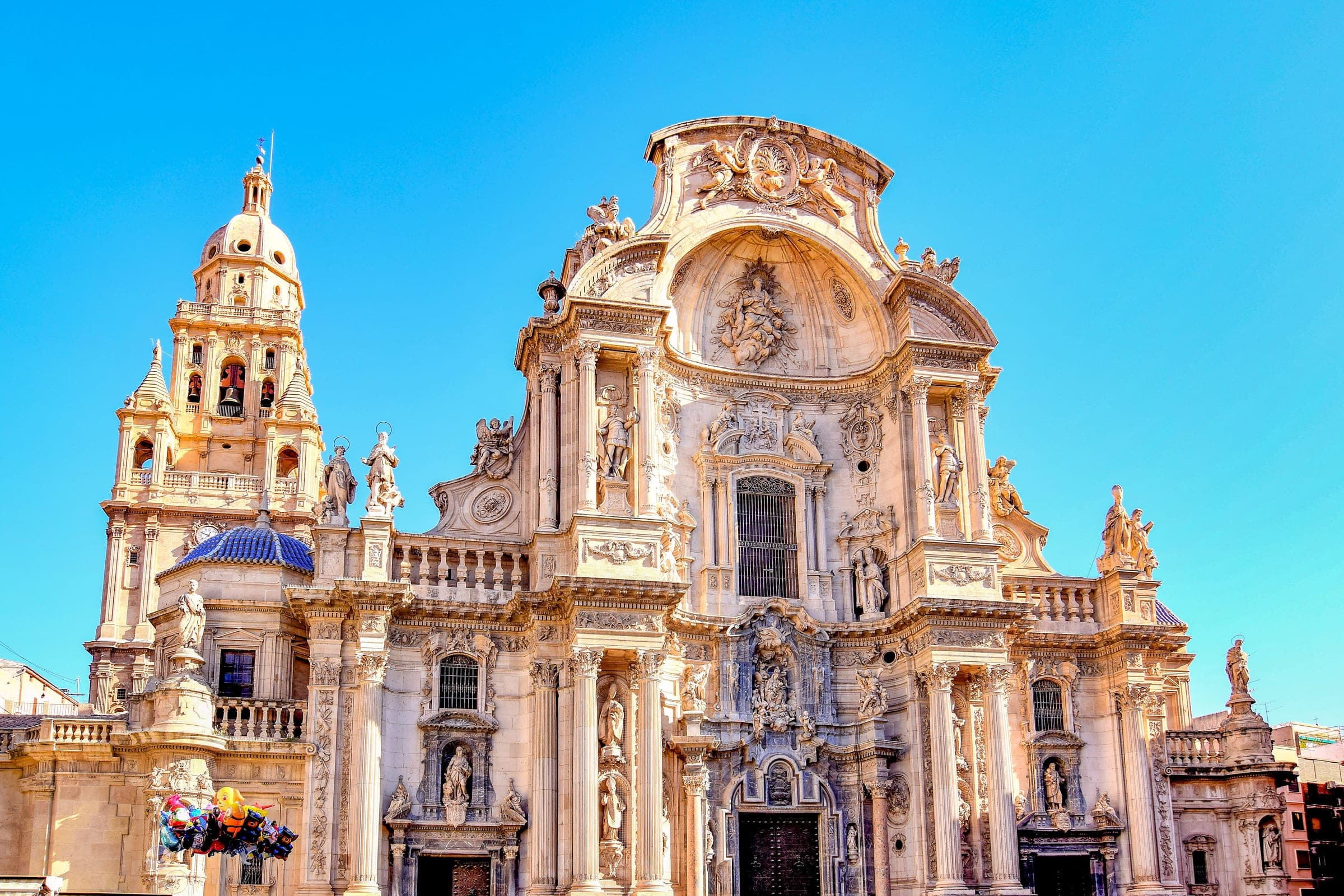
Km 35 to 42.2: the centre, the north-west and the Cathedral. The course crosses the Puente de Hierro at km 34.9 and passes the Glorieta and Plaza de las Flores again at km 35.3 to 35.7, the best-supported part of the second half. Then comes the one stretch not run before: a loop north-west past Calle Miguel de Unamuno to El Puntal and back down Avenida de los Pinos. The last kilometre comes back through the centre past Santo Domingo and Plaza de las Flores to the finish in Plaza Cardenal Belluga, between the Cathedral's Baroque front and Rafael Moneo's municipal building.
No blue line is published. Intermediate controls continue at 20, 25, 30, 35 and 40 km, and runners outside them must leave the race.
East to Avenida de la Azacaya, back south of the river and through the centre at km 13.5. The controls need 7:00 per kilometre until the races separate.
Plaza Circular twice, a turn on Avenida Juan Carlos I at km 18.2 and a loop through Zarandona. The field thins sharply.
The eastern and southern streets again, turning 800 m earlier on Avenida de la Azacaya. Find a group and use the fact that you know every corner.
The Glorieta crowds at km 35, a last new loop to El Puntal, and the finish in Plaza Cardenal Belluga.
Course Map
A city loop from the Glorieta that repeats much of its first half, with turns in the east, the north and the north-west. Tap a marker for the start, the finish, the course turns, the runner fair and the stations, and scrub the slider or press play to move the orange marker along the course with the elevation profile beneath it.
Pacers
Not confirmed. No pacer list has been published for the coming edition. The marathon and half marathon start from four corrals assigned by predicted finishing time, and the pacing plan usually appears in the runner guide shortly before race day.
The 2027 regulations allow six hours, but not at an even pace. Because the marathon shares its first 15 km with the half, the controls to that point ask for 7:00 per kilometre; after that the required average eases to 9:22. A runner aiming for five and a half hours or more should run the first 15 km at 7:00 per kilometre or better and ease off afterwards.
| Control | Closes after |
|---|---|
| 5 km | 0:35 |
| 10 km | 1:10 |
| 15 km | 1:45 |
| 20 km | 2:31 |
| Half way | 2:45 |
| 25 km | 3:33 |
| 30 km | 4:16 |
| 35 km | 4:58 |
| 40 km | 5:41 |
| Finish | 6:00 |
The race website disagrees with itself. The dated regulations give a 09:00 start and six hours; the separate course page still shows a 09:30 start, a 5:30 limit and slower early controls (36:40 at 5 km). The regulations are used here as the controlling document. Check both in race week.
February in Murcia starts cold and ends mild. The AEMET normal for the city gives an average daily minimum of 5.9°C and an average maximum of 18.4°C, with a monthly mean of 12.2°C. At a 09:00 start the temperature is usually close to the bottom of that range. A four-hour runner finishes around 13:00, when the sun can make the Cathedral square feel warm.
Wait in the corral in an old top or bin bag and race in normal marathon kit. Gloves and arm warmers are useful in the first hour and easy to stash. No clothing-donation scheme has been published, so discard layers where they will not trip anyone. Rain is uncommon, with 27 mm in an average February, and humidity is moderate, so sunglasses and a cap are more use late in the race than a rain jacket early on. The course is tarmac throughout.
Entry
Entry is open, with no ballot and no qualifying times, and the price is set by how many people have already entered. The official marathon bands are €44 (about £38) for the first 750 places, €57 (about £49) up to 2,000, €72 (about £62) up to 4,000 and €97 (about £83) after that, counting entries across both distances, with a total cap of 6,000. Entering as soon as registration opens is the single best way to save money.
Every runner needs an athletics licence. Visitors without a Spanish federation licence buy the RFEA day licence (€6) during registration. The fee covers timing, the bib, aid stations, medical cover, a commemorative shirt, the post-race recovery zone and, for marathon finishers, a finisher garment.
Refund insurance costs €12 and can only be bought with the original entry. With it, a runner can recover the full fee until late January and 70% in the last week or so. There is no race-day entry and no entry after the deadline.
Runners are placed in one of four corrals by predicted finishing time. Moving to a slower corral is allowed; moving forward needs the organiser's approval, and fast predictions (under 2:30 for men and 3:15 for women) may need proof from a marathon in the past four years. A travel portal linked to the event sells hotel-and-entry packages; direct entry plus a refundable hotel is usually more flexible. There is no charity-place scheme.
Fast runner standards
There is no good-for-age or qualifying entry. The 2:30 and 3:15 thresholds above only validate a place in the front corral.
Official Maratón de Murcia site →Race Weekend
Runner fair
The runner fair and bib collection pages for the coming edition have not yet been published. At the most recent edition the Feria del Corredor was at the FICA fair and congress area beside the Auditorio y Centro de Congresos Víctor Villegas, about 1.4 km east of the Cathedral, a walk of about 20 minutes from the centre or a short taxi ride. Treat that as a guide to the likely venue.
There is no ordinary bib collection on race morning, so arrive in Murcia by Saturday at the latest and collect during the fair. The organiser can authorise race-morning collection in exceptional cases; do not plan around it. Someone else can collect your bib with your authorisation, a copy of your ID and your registration locator. Keep the confirmation email available offline and bring photo ID.
Getting to the start
The marathon and half marathon start together at 09:00 on Avenida Teniente Flomesta, beside the Glorieta de España and the town hall. Every recommended hotel is within 1 km, and most within 500 m, so walking is the way to get there. There is no race shuttle and no free public transport for runners, and buses are diverted by the closures.
Corrals and bags. There are four corrals, assigned by predicted finishing time. Arrive about an hour before the start: the combined field is several thousand runners, the streets by the river are narrow, and finding the right corral takes time. Bags must be in the official race bag with its sticker; other bags are refused. Corral entrances and bag-drop hours come with the runner guide. On a cold morning keep an old layer on until the last minutes.
The finish. After the line in Plaza Cardenal Belluga, runners pass through a controlled recovery area with water and food, collect the medal and the marathon finisher garment, and then reclaim bags. There is no re-entry once you leave, so agree a meeting point outside it with supporters; Plaza de las Flores, 300 m away, is the obvious choice.
From the airport. Región de Murcia International Airport (RMU) is about 20 km south of the city, and Interbus links it to San Andrés bus station, 900 m from the Cathedral. Many UK runners fly to Alicante (ALC) instead; check the onward bus or train for a Saturday arrival before the fair closes.
Nutrition on course
Aid stations sit about every 5 km. All serve drinks and some add solid food. The organiser has not yet published the station list, the brands or whether drinks come in cups or bottles, so carry your own gels, enough for the whole race.
Because the second half repeats the eastern and southern streets, many station sites come round twice. Note where they are on the first pass and plan around them on the second. The cold start hides fluid loss: by the second half the temperature can be 10°C higher than at the gun, especially in the sunny squares of the centre, so take a few mouthfuls at every station after 10 km. Medical services are on the course and at the finish.
Spectating
The repeated circuit and the central finish make Murcia easy to follow on foot. Around the Glorieta and Plaza de las Flores, runners pass at the start, at km 13.5 to 14, at km 35.3 to 35.7 and in the last kilometre, all within a few minutes' walk of each other. Plaza Circular, 1 km north, gets two more passes at km 15.9 and km 19.9. No public transport is needed.
For a 4-hour runner, the first central pass comes at about 10:17, Plaza Circular at about 10:30 and 10:53, the second central pass at about 12:21 and the finish around 13:00. For a 3:15 runner, those become roughly 10:02, 10:14, 10:32, 11:43 and 12:15. The finish square is tight for space, and Plaza de las Flores and Santo Domingo, a few minutes away, are calmer. The half marathon shares the first 15 km, so the centre is crowded until about 11:00. No live-tracking details have been published for the coming edition.
- Watch the start by the Glorieta
- Coffee in Plaza de las Flores, on the course at km 14
- Stay for the second pass at km 35.7, or walk to the Glorieta for km 35.3
- Walk to Plaza Cardenal Belluga for the finish
- Watch the start, then walk 15 minutes north to Plaza Circular
- See runners at km 15.9 and again at km 19.9
- Walk back to the centre for km 35
- Finish at the Cathedral
- Skip the start
- Stand on Calle Princesa by the Iglesia del Carmen for km 32 to 32.6
- Walk five minutes over the Puente Viejo to the Glorieta for km 35.3
- Walk to the Cathedral for the finish
Post-race food
The finish is in the middle of Murcia's best eating district. Plaza de las Flores, Santa Catalina and San Pedro, all within five minutes of the Cathedral, are full of tapas bars, and Sunday lunch starts from about 13:30. The city tourism office's tapas route points to La Tapa, El Parlamento and Las Mulas, all around Plaza de las Flores. Book a table if you are in a group, because the centre fills with runners and families after the race.
The local dishes suit a tired runner. The marinera is the city's signature tapa: a ring-shaped breadstick topped with Russian salad and an anchovy. Pastel de carne, a minced-meat pie in flaky pastry, is filling and easy to eat standing up. Zarangollo, courgette scrambled with egg and onion, is light if your stomach is unsettled. Michirones, a stew of dried broad beans, is heavier and better kept for the evening.
Where to Stay
Stay close to the finish. The Maratón de Murcia ends in Plaza Cardenal Belluga in front of the Cathedral and starts 180 m away, so a hotel in the historic centre removes the pre-race transfer and the post-race walk in one decision. The centre is compact, and every hotel below is within 1 km of the line.
Cathedral quarter and the Glorieta
The Cathedral quarter is as close as it is possible to be: the finish is outside and the start round the corner. Hotel Cetina, between the Cathedral and the Real Casino, is 200 m from the line. The trade-off is Saturday-night noise on the busiest streets and higher prices on race weekend. Price tier: ££ to £££.
Plaza de las Flores and San Pedro
Plaza de las Flores is Murcia’s tapas square, 300 m west of the finish, and the course passes it three times. It suits runners travelling with supporters, who can eat well without a taxi. Ask for a quiet room: the square is lively on Saturday night. Price tier: ££.
Gran Vía and Madre de Dios
Gran Vía is the main central avenue, a few minutes north of the Cathedral. The Hesperia Murcia Centro on Calle Madre de Dios is 140 m from the line, and everything a race weekend needs is within walking distance. Price tier: ££.
Calle Princesa and Floridablanca
This district lies just south of the river, five minutes from the Cathedral over the Puente Viejo. The Catalonia Conde de Floridablanca is here, and the course passes its door at km 32.6. It is calmer than the bar streets and still an easy walk to the start. Price tier: £££.
Paseo de Garay and the river
Paseo de Garay runs along the Segura east of the old bridge. The Occidental Murcia Siete Coronas is here, 500 m from the finish, and the course passes it 400 m after the start. It is a little removed from nightlife. Price tier: £££.
Plaza Circular and Vistalegre
Plaza Circular is 1 km north of the Cathedral. Hotel El Churra is here, better value and quieter at night, and the course passes the square at km 15.9 and km 19.9. The walk back after the finish takes about 15 minutes. Price tier: ££.
There is no ballot, so book a refundable room as soon as you enter. The event has grown enough to drop its 10K for lack of space around the finish, and the hotels by the Cathedral fill before the rest of the city.
Recommended hotels
On Calle Madre de Dios, 140 m from the finish line and about 60 m from the course where it passes at km 13.8 and km 35.6. The start, the finish and the tapas bars are all a few minutes on foot. Parking is of little use on race weekend because of the closures.
Between the Cathedral and the Real Casino, so the finish is a couple of minutes away and the start is round the corner. The shortest possible walk from the line, with the noise of the Saturday-night centre to match.
Five minutes from the Cathedral over the Puente Viejo, and quieter at night than the bar streets. The course passes the door at km 32.6, which makes it a good base for supporters.
On the river east of the old bridge, a short flat walk from the start, and the course runs past it 400 m after the gun. A little away from the Saturday-night noise.
Better value north of the centre, beside Plaza Circular, which the course passes at km 15.9 and km 19.9. The walk back after the finish takes about 15 minutes.
Booking timeline
There is no ballot and no results day to wait for. The entry price rises as the field fills, so enter early and book a refundable hotel the same day. Hotels in the Cathedral quarter go first, but Murcia has plenty of rooms further out: a month before the race is late for the centre and fine for Plaza Circular or the river.
For UK runners, compare flights to Región de Murcia International Airport (RMU) and Alicante (ALC). Alicante usually has more routes; RMU has a direct Interbus link to the city. Saturday arrival is the minimum, because there is no race-morning bib collection, and Friday gives time for the fair and a quiet Saturday. The race-linked travel portal sells hotel-and-entry packages; compare it with booking directly before paying.
See & Do
The finish is in the middle of old Murcia, so four of these five are a short, flat walk from the line and the central hotels. The fifth needs a taxi.
Murcia Cathedral
The finish is in the square in front of its Baroque west front, with the bell tower rising beside it. Visit on Friday or Saturday, not after 42 km on your feet, and check February visiting and tower hours before you go.
Real Casino de Murcia
The nineteenth-century club on Calle Trapería, with an Arab-style patio and a ballroom, is open to visitors and makes a short, flat visit the day before the race. Check current hours.
Plaza de las Flores
Less a sight than the city’s tapas square, and the easiest place to eat after the race without extra walking. The course passes it at km 14, km 35.7 and in the last kilometre.
Museo Salzillo
The museum of the eighteenth-century sculptor Francisco Salzillo, whose processional figures are carried through Murcia in Holy Week. Indoor and flat, and a good Monday option.
Santuario de la Fuensanta
A hillside sanctuary south of the city looking over the huerta, Murcia’s irrigated farmland. Take a taxi; the climb is not one for post-marathon legs.
After the Race
Early February on the Costa Cálida is mild and quiet, and the flat towns of the Segura and the Vega Baja suit legs that have just run 42 km. Murcia del Carmen station sends Cercanías trains down the valley to Orihuela and Elche, and on to Alicante for the flight home. Cartagena is best reached by bus. The trips below run from the shortest to the longest, and none of them asks for a hill.
A small cathedral city on the Segura with Baroque churches, a Gothic cathedral and a flat riverside centre. The easiest half-day out of Murcia.
The Palmeral of Elche, a UNESCO-listed forest of date palms laid out in the Moorish period, walked on flat paths in the middle of town.
A port with a Roman theatre uncovered in the 1990s, a Modernista high street and a flat waterfront. The theatre museum closes on Mondays, so the day after the race suits the harbour and streets more than the museums.
The Explanada de España, a flat seafront promenade, a castle reached by lift and an airport 30 minutes away for the flight home.