The Race
| Next Race Date | To be Confirmed |
|---|---|
| Course type | Loop: an opening loop and 14 laps of about 2.96 km |
| Registration | Open online entry; race-day entry if places remain |
| Ballot opens | No ballot |
| Start | Avenida de la Música, Almagro, 09:00 |
| Finish | Avenida de la Música, the same place |
| Total finishers | About 72 (2026) |
| Avg race-day temp | 1 to 11°C (AEMET Ciudad Real January normal, 23 km away) |
| Cutoff time | 6 hours |
| Free race-day transport | No |
| Course certification | Not certified; the organiser’s measurements total about 42.26 km |
History
The Maratón de Almagro is a club race. Club Kilómetro Cero, a local running club, started it with the town council around 2018, separate from Almagro’s older half marathon. The first two editions were summer night races in June; the 2019 event raised money for the Spanish cancer association.
In January 2020 the race moved to a winter morning, and the format that defines it was set: a flat, paved circuit of about 3 km run 14 times. Around 45 runners were entered that year, and the proceeds went to AMFISA, a local association for people with physical disabilities. The race returned in January 2022, described by one runner as a “maratón artesano”, a handmade marathon, with a relay option for pairs.
It has run every January since. The eighth edition, on 25 January 2026, used an opening loop of about 816 m and 14 laps of 2,960 m, adding up to about 42.26 km by the organiser’s own measurements, a little over the marathon distance. The course has never been certified. Óscar Buján won in 2:37:04 and Macarena Porrero Fernández in 3:39:06, and the official results list 95 runners with about 72 finishers. The appeal is the scale: a marathon where the aid station, the volunteers and the spectators are passed 14 times and everyone knows the runners by the end.
The course
The race is run on a circuit on the south-west edge of Almagro. It starts and finishes on Avenida de la Música, 750 m from the Plaza Mayor, with an opening loop of about 816 m and then 14 laps of about 2.96 km, out along the CR-5123 and the roads on the edge of the town and back past the timing area and the aid station. Individual runners pass halfway after seven laps, where relay teams hand over.
The organiser describes the course as completely flat and entirely on asphalt, and the elevation data agrees: the whole circuit sits between 644 m and 647 m. The lap has several sharp turns, so 14 laps add up to dozens of corners. The course is not certified by the Spanish federation or AIMS.
Kilometre by kilometre
Km 0 to 3.8: the opening loop and the first lap. The race starts at 09:00 on Avenida de la Música. The short opening loop stretches the field before it joins the main circuit, and with under 100 runners there are no pens and no crowding after the first corner. In January it may be close to freezing at the start, so the first lap doubles as a warm-up.
Km 4 to 21.5: laps two to seven. The circuit is flat and paved all the way. Each lap passes the aid station, where runners can leave their own drinks and gels as well as using the organiser’s food and drink. This is the time to settle into a rhythm. With the field spread around a 3 km loop, faster runners lap slower ones, sometimes more than once; keep to the side on the turns. Relay runners are on the course too.
Km 21.5 to 36: laps eight to twelve. This is the part the format makes hard. There are no hills and no views to change, and the aid station comes round every 12 to 25 minutes depending on pace, which makes it tempting to stop or change a plan. Count laps, not kilometres; five left feels shorter than 20 km. The turns, repeated this many times, will be felt in the hips and calves.
Km 36 to 42.26: the last two laps. The finish comes into view every 3 km, which helps, and supporters who have stood at the aid station all morning will be there each time. The finish is back on Avenida de la Música, about 60 m beyond the marathon distance by the organiser’s measurements.
The limit is six hours. There is no blue line and no published timing points beyond the start and finish; the chip records every lap.
A short opening loop and the first lap on a cold morning. Treat it as the warm-up.
Flat, paved and repetitive. Use the aid station every lap and settle in.
The mental middle. Count laps, not kilometres.
The finish is in sight every 3 km. The course runs slightly over 42.195 km.
Course Map
One lap of about 2.96 km, run 14 times after a short opening loop, on the south-west edge of the town. Tap a marker for the start and aid station, the far corner of the lap, the showers and the Plaza Mayor, and scrub the slider or press play to move the orange marker round the laps with the elevation profile beneath it.
Pacers
No pacers have been published. There are no pens either; with under 100 runners and a relay field on the same circuit, runners line up by pace and spread out within a lap.
The course is not certified. The regulations’ reference to RFEA homologation covers the timing company, not the course. Runners who need a marathon time for a championship qualification, a good-for-age place at a major marathon or a club record should check that the receiving event will accept it; many require an RFEA, AIMS or World Athletics certified course. By the organiser’s measurements the course is about 61 m long, which errs on the right side.
January in La Mancha is cold. The nearest weather station, at Ciudad Real, averages a low of about 1°C and a high of about 11°C in January, with frost on 13 days of the month. At the 09:00 start it may be at or below freezing; by the finish it is usually cool and bright.
Dress for a cold start and a milder finish: gloves, a hat or headband and long sleeves for the first hour. Because the course comes past the same point every 3 km, layers can be handed to a supporter at the aid station or left with your own drinks. The circuit is on a plateau at about 645 m, and wind can cross the open ground around the town. Rain is not common, about 35 mm in the month. Bring warm clothes for after the race; there are showers at the Pabellón José Manuel Roldán, 300 m from the finish, but you will cool down quickly on the way.
Entry
Entry is online through the timing company DXT Chip Run, with no ballot. At the most recent edition registration opened in July and closed a week before the race. The individual marathon cost €40. A relay lets two runners share the distance, seven laps each, at €20 per person, with a maximum of 12 teams. Members of the Club 100 Maratones España get €5 off. If places remain, entries are taken on race day at €50 for the marathon and €30 per relay runner, without the guarantee of a shirt.
The marathon is open to runners aged 18 and over, with or without a federation licence. There is no good-for-age scheme, no charity entry and no tour-operator allocation. Entries are personal and not refundable, but up to about a month before the race a runner who is injured can pass the place to someone else or carry it over to the following year.
The organiser announces each edition’s date and registration separately; recent races have been in the second half of January.
Fast runner standards
There is no good-for-age or fast-runner entry route. Everyone enters the same way.
Race page on DXT Chip Run →Race Weekend
Bib collection
There is no expo. The Maratón de Almagro is a small club race, and the organiser’s material covers registration and the race itself. Bib-collection times and place were not published in the regulations for the most recent edition. Race-day entries are taken when places remain, so there is a desk at the start area on the morning, but do not assume normal bibs are handed out there. Check with the organiser or on the DXT Chip Run event page in race week, and take photo ID and your registration confirmation.
Getting to the start
The race starts at 09:00 on Avenida de la Música, on the south-west side of Almagro. The town is small: from the Plaza Mayor the start is 750 m, a walk of about 10 minutes, and from the Parador about 500 m.
Getting there. No race transport is provided and none is needed from central Almagro. Runners staying in Ciudad Real, 23 km away, need a car or taxi; early-morning public transport on a Sunday is limited.
Before the start. There is no pen system. Arrive in time to collect your number if needed and to leave personal drinks or gels at the aid station, which the rules allow. No formal bag drop is described; supporters can hold kit, or runners staying centrally can leave it at the hotel. Relay teams start with the individual runners and change over after seven laps.
The limit and the finish. The limit is six hours; the most recent results list a few runners slightly beyond it, but do not rely on leeway. Individual finishers receive a medal, the regulations promise a finisher’s garment, and there is a finish refreshment point. Showers are at the Pabellón José Manuel Roldán. Ambulance cover and accident and liability insurance are included.
Getting to Almagro. The town has a station on a regional line, but the practical route from Madrid is the high-speed train to Ciudad Real, about 50 minutes, then 23 km by bus or taxi. Madrid is about 200 km by road.
Nutrition on course
The aid station is passed on every lap, about every 3 km, 14 times in all, with drinks and solid food. Runners may also leave their own drinks and gels there and pick them up as they pass, which is rare at a marathon and one of the real advantages of the lap format. The organiser does not list brands or whether drinks come in cups or bottles.
Treat the aid station as a personal feed zone. Put out a bottle and gels in a labelled bag, decide in advance on which laps you will take them, and stick to it. Taking something every lap is too much for most runners; every second lap is closer to what they would take at a race with aid every 5 or 6 km. In the cold, runners drink less than they need, so set the plan before the start.
Spectating
This is one of the easiest marathons in Spain to watch. Runners pass the same point 14 times, every 12 to 25 minutes for runners between three and six hours, so a supporter who stands by the aid station on Avenida de la Música sees them every lap without moving. Because the aid station allows runners’ own supplies, a supporter is useful: they can hand over drinks, take discarded layers and pass on split times. Stand where you are not blocking the circuit. Results come from DXT Chip Run; live tracking is not needed when the runner comes back every lap.
- Watch the 09:00 start on Avenida de la Música
- Stay by the aid station and timing area for every lap
- Watch the finish in the same place
- See the start, then walk 10 minutes into the centre for breakfast in the Plaza Mayor
- Walk back to the circuit for the final hour and the finish
Post-race food
Almagro’s food is La Mancha’s: migas, fried breadcrumbs with pork and garlic; pisto manchego, a slow-cooked stew of peppers, tomatoes and courgette; gachas, a thick savoury porridge; and Manchego cheese. The town’s own product is the berenjena de Almagro, a small aubergine pickled with vinegar, oil, cumin, garlic, paprika and fennel and sold in jars in every shop. After a cold-morning marathon, a hot plate of migas or pisto is the right lunch.
The municipal tourism office lists La Parrilla de San Agustín in the historic centre, Restaurante La Muralla near the Parador, and the Parador’s own restaurant, Marmitia, all a short walk from the circuit and the Plaza Mayor. Take home a jar of berenjenas.
Where to Stay
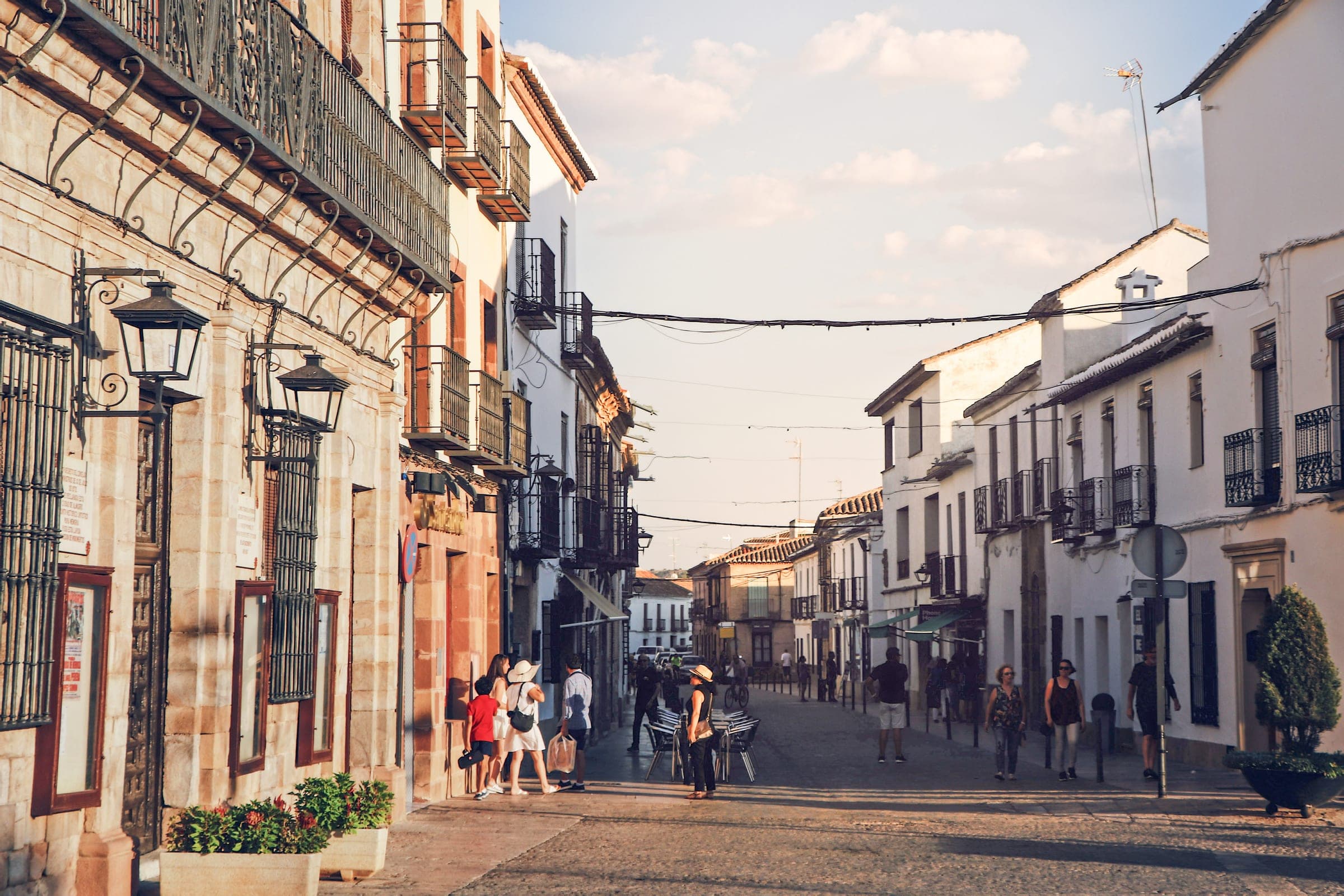
The start and finish are the same place, on the south-west edge of town, and Almagro is small enough that anywhere in the centre is within a 10-minute walk. Stay near the finish, which here means staying in Almagro, not Ciudad Real.
Historic centre and Plaza Mayor
The historic centre around the Plaza Mayor is the best base, and for most visitors the reason to come. The square, lined with two long galleries of green-framed windows, holds the Corral de Comedias, with restaurants and cafés around it. The start is 750 m away. Rooms on the square can be noisy on a Saturday night; choose a side street if sleep matters. Price tier: ££.
Ronda de San Francisco and the Parador
Just south of the centre, the Parador occupies a former Franciscan convent and the Hotel Boutique Arte y Descanso is nearby. It is quieter than the square, about five minutes from it, and the closest hotel district to the start, 500 to 600 m away. Price tier: ££ to £££.
Ciudad Real
Ciudad Real, the provincial capital, 23 km away, has far more hotels and the high-speed station, but it means a race-morning drive with no public transport at that hour. It suits runners arriving late on Saturday by train with a hire car. Price tier: ££.
The race is tiny and entry is not the constraint, but Almagro’s historic hotels are small and January weekends can still fill. Book refundable once the date is announced.
Recommended hotels
A former Franciscan convent five minutes’ walk from the Plaza Mayor, quiet at night and the closest of these to the start. Check that breakfast is served early enough for a 09:00 start.
Close to the Parador and the historic centre. Small, so book early.
A historic house east of the Plaza Mayor, a short walk from the square and about 12 minutes from the circuit.
Booking timeline
Wait for the date. The organiser has run the race in the second half of January every year since 2022, but announces each edition separately; registration for the most recent race opened in July. Once it is announced, book a refundable room in Almagro, then enter: the field is small and places are not the constraint, but there are few hotels in the historic centre.
For travel, fly to Madrid (MAD) and take the high-speed train from Madrid Puerta de Atocha to Ciudad Real, about 50 minutes, then a bus or taxi for the last 23 km. A hire car from Madrid, about two hours by road, is the simplest option and makes the day trips to Las Tablas de Daimiel and Calatrava la Nueva possible. Arrive by Saturday, and check bib-collection arrangements in race week.
See & Do
The start is 750 m from the Plaza Mayor, and everything below is within a flat walk of the finish.
Corral de Comedias
A courtyard theatre on the Plaza Mayor dating from 1628, described by the town as the only early-seventeenth-century comedy theatre preserved intact and still in use. Guided visits run most days; check times.
Plaza Mayor
The long arcaded square at the centre of town, lined with green-framed glazed galleries. Flat, free and the obvious place for a post-race coffee.
Museo Nacional del Teatro
Spain’s national theatre museum, in the historic centre, a natural follow-on from the Corral de Comedias. Indoors, useful on a cold January afternoon. Check opening days.
Convento de la Asunción de Calatrava
A Renaissance convent with a two-storey cloister, one of the finest buildings in town. Check visiting arrangements.
After the Race
January on the plateau is cold and bright, and the country around Almagro is quiet. Two day trips need a car: the wetland boardwalks of Las Tablas de Daimiel, best for wintering birds when water levels allow, and the hilltop castle-convent of Calatrava la Nueva. From Ciudad Real the high-speed line runs south to Córdoba in under an hour and north to Madrid in about 50 minutes, and both earn two nights.
A wetland national park crossed on level wooden boardwalks, at its best for wintering birds in January, when water levels allow.
The hilltop castle-convent of the military order that ruled Almagro, above the plain of the Campo de Calatrava. A drive almost to the gate, then uneven ground inside. Closed on Mondays in winter.
The Mezquita, the Roman bridge and the flat lanes of the Judería, with orange trees in fruit in January.
The Prado, the Retiro and a winter city at its clearest, on the way to the airport.