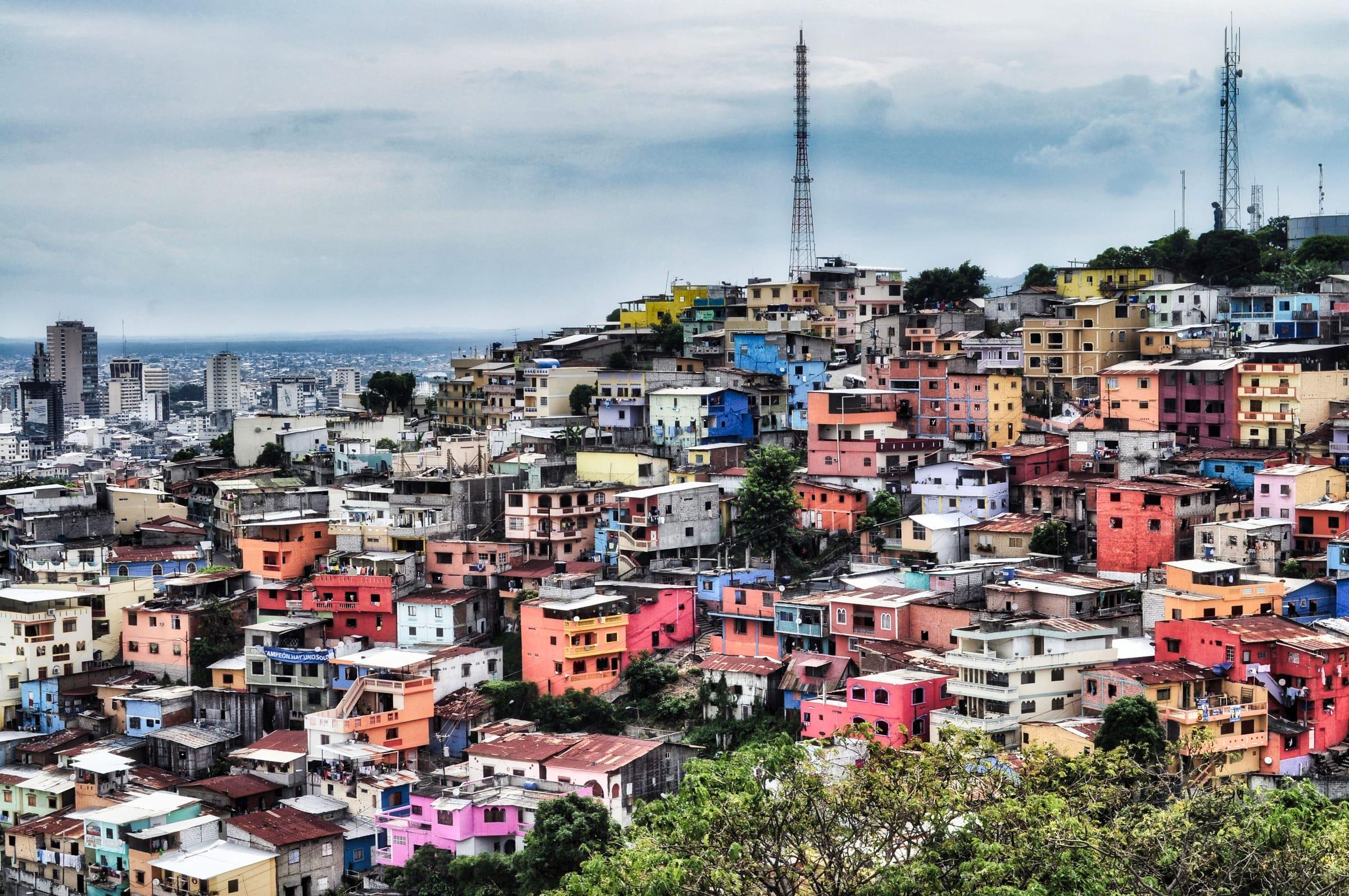
The marathon starts at 04:00, earlier than almost any other race on the site. Alarms go off around 02:30, ordinary hotel breakfast hours do not help and there is no public transport. Sleep in the old centre if you can, ask for a breakfast box on Saturday and lay your kit out the night before. The sun comes up close to 06:00, so the first two hours are run in the dark and the last in full daylight.
| Next Race Date | To be Confirmed |
|---|---|
| Course type | City loop from the Malecón in the old centre, west through Urdesa and Los Ceibos and back through the Cerro Santa Ana tunnel |
| Registration | Open online entry through the organiser, DM3; no ballot |
| Ballot opens | Not applicable |
| Start | Old centre, near the Palacio Municipal; 04:00 at the last edition |
| Finish | Old centre, near the Palacio Municipal |
| Total finishers | Not published (about 1,500 athletes across all distances at the latest edition) |
| Average race day temperature | About 22 to 31°C (October daily low and high; the 04:00 start sits at the low end) |
| Cutoff time | Not published |
| Free race-day transport | None announced |
| Course certification | On the World Athletics certified-course list to 2027; no label |
Before you go
Entry, accommodation and travel: what to sort out before you book.
Entry
Entry is open and handled online through the organiser, DM3. There is no ballot, no guaranteed-entry scheme and no qualifying time. At the latest edition the marathon cost USD 75 including VAT, about £56 at a mid-October exchange rate. The 5K, 12K and half marathon cost USD 45, and the listing states half price for athletes with disabilities and for older athletes.
Registration had closed by the time the race was reported, and DM3 had not announced the next full-marathon date. The only 2027 event DM3 listed was a separate half marathon in July, which is a different race and does not enter you in the October marathon.
The marathon lists general men and women, handcycle, Olympic-style wheelchair and athletes with disabilities without mechanical aids, each for men and women. Prizes are also awarded in seven age groups from under 20 to 70 and over. These are prize categories, not qualifying standards.
No refund, transfer or deferral policy, charity or tour allocation, elite standard or minimum age has been published. Wait for the announcement before buying non-refundable flights. When registration opens, confirm the page names the full marathon, check how a foreign passport is entered and read the collection requirements.
Fast runner standards
No guaranteed-entry or fast-runner standards table has been published.
See the organiser's DM3 site →Where to Stay
Stay near the finish. In Guayaquil the start and finish are in the same place in the old centre, so the answer is the same for both, and the 04:00 start strengthens it: a hotel within walking distance removes a taxi in the dark. Distances below are straight-line from the start line, not walking routes.
Old centre, around Parque Seminario and the cathedral
Hotel Palace (0.3 km), Unipark (0.3 km) and the Grand Hotel Guayaquil (0.5 km) are all in this part of the city, the strongest area for a pre-dawn walk to the start. Check the hotel's street, whether a runner can leave on foot at 03:30 and which side of the closures it falls on.
Malecón and Las Peñas edge
The Hotel Ramada is here. The riverfront is close to the start, but its ordinary breakfast hours of 07:00 to 10:30 fall after the start, so an early breakfast box has to be agreed in writing.
Puerto Santa Ana
The Wyndham (1.9 km) sits in a waterfront development a longer way from the start. It suits a leisure stay but turns race morning into a driven journey, and no shuttle has been announced.
Airport and convention-centre area
This area suits a short stopover or a late arrival, and it holds the previous edition's kit collection at the Centro de Convenciones, 4.1 km from the start. It adds a long early journey on race morning and is not recommended as the base for race night.
Noise, safety and price levels by district are not verified. Book a room with free cancellation and ask each hotel in writing about early breakfast, a luggage hold and late checkout.
Recommended hotels
A central hotel at Chile 214 y Luque. Ask whether the street is open to pedestrians at 03:30 and whether breakfast can be moved forward.
A higher-end hotel beside the cathedral square. Request a race breakfast and late checkout in writing.
A central hotel with a restaurant, La Pepa de Oro. Confirm opening and terms with the hotel.
A working hotel on the riverfront side. Ordinary breakfast runs 07:00 to 10:30, after the start, so ask for a breakfast box on the Saturday night.
A waterfront hotel suited to a leisure stay. It is a longer early-morning journey to the start, and no race shuttle has been confirmed.
Booking timeline
Hold off on non-refundable bookings until the organiser announces the date for the full marathon. The first Sunday of October is the pattern, but the only event DM3 had listed for the following year was a July half marathon.
Once the date is public, reserve a refundable room in the old centre first, then check that the registration page names the marathon and the right year.
A 04:00 start makes breakfast an item to arrange before arrival, so ask each hotel for a breakfast box or an early opening in writing. October is the drier part of the year, but humidity stays high all month. The October holiday weekend may affect prices and availability.
Race weekend
The expo, number collection and the days either side of the start.
Race Weekend
Kit collection
At the latest edition, kit collection took place at the Centro de Convenciones Simón Bolívar, 4.1 km from the start line in a straight line. Runners received a shirt, race number and electronic timing chip there. It is a different place from the start, so a runner cannot collect a bib on the way to the line.
Opening days and hours for the next edition, the documents required, whether a friend can collect for a runner and whether race-morning collection exists have not been published. Keep your passport and registration confirmation on a phone and in print, and plan to arrive at least one clear day before the race so a late flight does not leave you without a number.
Getting to the start
The marathon starts at 04:00 on the first Sunday of October, so the usual advice about breakfast and public transport does not apply. One central hotel opens its breakfast room at 07:00 and closes it at 10:30, when most runners are already on the course. Ask for an early breakfast box in writing, or bring food that needs no kitchen.
Start and finish are in the old centre near the Palacio Municipal. A hotel in the centre removes the need for any race-morning transport, provided the street in front of it stays open to pedestrians, so check that with the hotel before booking. A hotel elsewhere needs a pre-arranged taxi or driver and a drop-off outside the road closures, followed by a short walk. Authorised taxis operate at the airport around the clock, but that says nothing about road access on race morning.
The start-gate address, toilet provision, bag drop, corrals, headphone rule and post-finish layout have not been published, and no free public transport has been announced. Plan to meet a supporter outside the controlled area after the finish and carry a card with the hotel address in Spanish. The municipality put 110 traffic agents and 96 vehicles on course support at the latest edition.
Wear the lightest kit you own. October in Guayaquil averages an overnight low of about 22°C and a daytime high of about 31°C, with humidity near 70%. The 04:00 start means the first stretch is dark and already warm, so no warm-up layer is needed. A throwaway layer helps only if rain or wind is forecast.
Sunrise is close to 06:00 all year at this latitude. A runner finishing in four hours spends about two hours in daylight, and the sun is climbing by the final 10 km. A cap or visor and sunglasses should be on the head or in a pocket from the start. Sunscreen on the neck, shoulders and the back of the legs matters for anyone finishing after about 07:30.
Choose shoes you have worn in humid conditions, since wet feet blister more easily, and a light-coloured top for the dark first hour. No secure storage has been confirmed, so carry cash or a card only if you can run with it.
Race day
The course, the clock, getting to the start and what to carry.
The Race
The course
The marathon starts on the Malecón Simón Bolívar in the old centre of Guayaquil and finishes about 170 m from the start line, on Pichincha. The course is almost all flat and runs west and back, with one late hill.
The first kilometres run north along the river on the Malecón, past the gardens at km 1, then turn inland onto Avenida Pedro Menéndez Gilbert at km 2 and Avenida Carlos Luis Plaza Dañín at km 3 to 5. From km 6 the course loops through the avenues of Urdesa and Kennedy, on Avenida Rodrigo Chávez González and José Castillo, and covers that area several times up to km 16. It reaches Miraflores at km 17, Avenida del Bombero at km 18 and the Los Ceibos district at km 19 to 25, where the Hospital General IESS sits.
The far point is at km 20.7, 7.8 km from the start in a straight line. The return runs back through Miraflores and Urdesa at km 26 to 36, along Avenida Kennedy at km 31, and rejoins Plaza Dañín and Menéndez Gilbert at km 37 to 39.
The chart spans 6 to 33 m and the course has no hill. The road is at about 10 m on the Malecón and stays between 9 and 14 m through Urdesa and Kennedy to km 18. It then climbs about 23 m to the high point of 33 m in Los Ceibos at km 20.9, falls back to about 7 m by km 26 and stays within 7 to 14 m to the finish. The course runs through the Cerro Santa Ana tunnel at about km 40, so the last kilometres are level.
The route on this page is the last known course. The 2027 map has not been published, so treat every street and kilometre as the last known route.
Kilometre by kilometre
Km 0 to 6: the Malecón and Plaza Dañín. The start is at 04:00 on the Malecón Simón Bolívar, in the dark. The course runs north along the riverfront gardens at km 1, then inland on Avenida Pedro Menéndez Gilbert at km 2 and Avenida Carlos Luis Plaza Dañín at km 3 to 5, where the road is level at 6 to 8 m.
Km 6 to 17: the Urdesa and Kennedy loops. From km 6 the course winds through Urdesa and Kennedy on Avenida Rodrigo Chávez González, José Castillo and the side avenues, crossing the same district repeatedly up to km 16. It is the longest flat section, at 9 to 14 m, and run entirely in darkness by the main field. Miraflores follows at km 17.
Km 17 to 26: Los Ceibos. Avenida del Bombero at km 18 leads into Los Ceibos, where the road climbs about 23 m to the far point at km 20.7 and the 33 m high point of the course at km 20.9. The halfway mark is near the Hospital General IESS. The descent starts at km 22 and takes the course back to about 7 m by km 26.
Km 26 to 38: back through Urdesa. Víctor Emilio Estrada and the Urdesa avenues carry the field east again at km 26 to 36, with Avenida Kennedy at km 31. Dawn arrives at about 06:00, and these kilometres are run in rising heat. Plaza Dañín at km 37 and 38 is flat.
Km 38 to 42.2: the Santa Ana tunnel and the finish. Pedro Menéndez Gilbert at km 39 leads to the Cerro Santa Ana tunnel at about km 40, and the road stays level at 8 to 14 m. Juan Montalvo at km 41 and Pichincha at km 42 lead to the finish near the start.
A 04:00 start on the Malecón in air close to the overnight low of about 22°C and high humidity. Run the first kilometres by feel.
A long flat run through repeated avenues, then a 23 m climb to the far point at km 20.7. Drink at every station, because sweat rates are high long before the sun is up.
Dawn at about 06:00 and rising heat on the return. Slow down early by a few seconds per kilometre.
The course runs through the Cerro Santa Ana tunnel at about km 40 and finishes on level ground, in full daylight.
Course Map
The last known route from the Malecón: north along the river, a long loop through Urdesa and Kennedy, a western leg to Los Ceibos, and the return through the Cerro Santa Ana tunnel. Tap a marker for details, and scrub the slider or press play to move the orange marker along the course with the elevation profile beneath it.
Pacers
The organiser has not published a pacer programme.
The marathon has separate handcycle, Olympic-style wheelchair and non-mechanical disability categories for men and women, and the organiser offers half-price entry for athletes with disabilities. Equipment rules, start order and course-access details have not been published, so contact the organiser before travelling.
The route used for this page is from an earlier edition and the next course has not been confirmed. Treat landmarks and distances as the last known route, and check the dated map before planning a sighting.
Nutrition on course
The organiser's route map marks service points, but a station-by-station list of water, sports drink and gels has not been published. Positions, cup format, sports drink brand and whether personal bottles are accepted are unknown.
In warm, humid conditions every station counts. Carry the gels you have trained with, because none is confirmed on course, and start drinking early, since the 04:00 start hides how much sweat is lost in the first hour. The course covers the Urdesa and Kennedy avenues several times, so note each station against the kilometre markers on the first pass.
Spectating
The most reliable plan is to stay in the old centre and meet the runner after the controlled exit. The course is a city circuit, and reaching a second point by public transport has not been tested or published.
A four-hour runner averages about 5:41 per km, so a 10 km gap between two points is about 57 minutes of running, from which a supporter must subtract the walk to the road, any legal crossing and the time to leave the first spot. The Urdesa and Kennedy avenues are run several times between km 6 and km 16 and again between km 26 and 36, so one position there could give several sightings, but that needs confirming against the official map.
- Wait in the old centre for the start and the finish.
- No second sighting is promised.
- Pick one point in the Urdesa and Kennedy avenues only after the official map confirms it is open to pedestrians.
- No transit line, stop or kilometre pairing has been verified.
- Choose one point after km 37 and walk back to the finish area.
- No station or bus line has been confirmed.
After the race
Where to eat, what to see and how to spend the days after the finish.
See & Do
Distances are from the start and finish line, in a straight line, kilometres first.
Parque Seminario
A small park in front of the cathedral, laid out in 1693 as the colonial main square and known for its iguanas, of which the city counted about 350. It is flat, shaded and beside several of the old-centre hotels.
Malecón 2000
A riverside promenade of about 2.5 km on the west bank of the Guayas, with gardens, a planetarium and several museums. The path is flat and paved, so it is the easiest walk in the city on tired legs. Go in the evening, after the heat.
Las Peñas and Cerro Santa Ana
The hill quarter of Las Peñas rises to a lighthouse, a chapel and a naval museum at the top of 444 steps, with views over the city and river. Climbing 444 steps the day after a marathon is hard, so go on the second day or take the lower streets only.
Post-race food
Lo Nuestro serves Ecuadorian coastal and seafood cooking and lists daily opening from 12:00 to 22:00 on its own website. It suits a late lunch once you have showered and changed.
La Pepa de Oro, the restaurant at the Grand Hotel Guayaquil, serves Ecuadorian and international food and suits anyone staying in the centre who does not want to cross the city after a marathon.
Finish-area food has not been published. Plan to eat at the hotel or in the centre after leaving the controlled exit, and book a flexible time: a 04:00 start leaves the whole afternoon free.
After the Race
The race is on a Sunday in early October, and Monday is the first free day. Playas is a beach town about 96 km west, and Salinas is the westernmost city on the mainland. Cuenca is a highland city at about 2,540 m. A four-night stay in the Galápagos starts with a flight from Guayaquil. Fares and timetables are indicative, so confirm them when you book.
The nearest beach town to Guayaquil, about 96 km west, with a long beach, a water promenade and a fishing community known for seafood. October is dry on this coast, but mornings are cool and often overcast.
The westernmost city on mainland Ecuador, with a seafront promenade, Playa Chipipe and the cliffs at La Chocolatera. The tail of the whale season falls around the race weekend, so sightings are not guaranteed.
A highland city at about 2,540 m with a UNESCO-listed historic centre, the blue-domed New Cathedral and Panama hat workshops. Allow a day for the altitude before any hill walking.
Four nights based in Puerto Baquerizo Moreno, where sea lions lie on benches and the beaches are a short walk from town. October is the cool garúa season, with mild temperatures and overcast skies.
Background
History
Guayaquil's marathon began in 2005. DM3, a local sports-marketing company, has organised it from the start with the city council behind it, and it falls on the first Sunday of October during the city's independence celebrations.
The early winners were Ecuadorian and Colombian. Juan Carlos Cardona of Colombia won the first two men's titles, in 2:20:05 and 2:23:18, and Sandra Ruales won the first women's race in 2:41:40 and four of the first five. Reuben Ondari of Kenya ran 2:19:27 in 2009, the fastest men's time in the published results to 2018. Ecuadorians took most titles after that, among them Dimas Quingaluisa, who won four in a row from 2012.
The start line has moved. The early course started and finished at the 5 de Junio bridge on the Malecón del Salado, passing Parque Centenario, Malecón 2000 and the Barcelona Sporting Club stadium. A later edition used the Policentro car park. The two most recent editions started and finished in the old centre.
Geoffrey Kiptoo of Kenya won in 2017 and again at the latest edition, with Jennifer Campoverde of Cuenca winning the women's race. The year before, Demetrio Olmedo and Ángela Brito won. The city counted 2,341 athletes across the 5K, 12K, half marathon and marathon in 2025, and about 1,500 at the latest. The race poster calls the latest running the 23rd edition.