The Race
| Next Race Date | Sunday 15 November 2026 |
|---|---|
| Course type | Point-to-point, Mirador del Valle to the Parque de la Vega |
| Registration | Open online entry, no ballot |
| Ballot opens | No ballot |
| Start | Mirador del Valle, 09:00 (relays 09:30) |
| Finish | Parque de la Vega |
| Total finishers | First edition, 15 November 2026 |
| Avg race-day temp | About 5 to 15°C (AEMET Toledo November normal) |
| Cutoff time | 5 hours 30 minutes; 25 km by 13:35 |
| Free race-day transport | Relay runners only; nothing confirmed for solo runners |
| Course certification | Homologated by the Castilla-La Mancha athletics federation |
History
Toledo’s first marathon runs on 15 November 2026. Mayor Carlos Velázquez announced it during the city’s State of the City debate in 2025, when Toledo was European City of Sport, and it is closely associated with the sports councillor Rubén Lozano, a runner who had organised the city’s night race and half marathon.
Toledo already had running events: the Carrera Nocturna reached its eighteenth edition and about 5,500 entrants in 2025, and the half marathon was approaching its sixth. A full marathon was harder. The old city is compact, steep and difficult to close to traffic, and most of Toledo’s people live in districts outside the walls. The route sets out to link them.
It was presented on 5 December 2025 at the university’s Fábrica de Armas campus, with the Spanish marathon runners Julio Rey, Abel Antón, Martín Fiz and Alberto Juzdado. The first edition has room for 5,000 people: 1,700 solo runners, 850 two-person relay teams and 400 four-person teams. The course is homologated by the regional athletics federation. There are no past winners, records or results yet.
The course
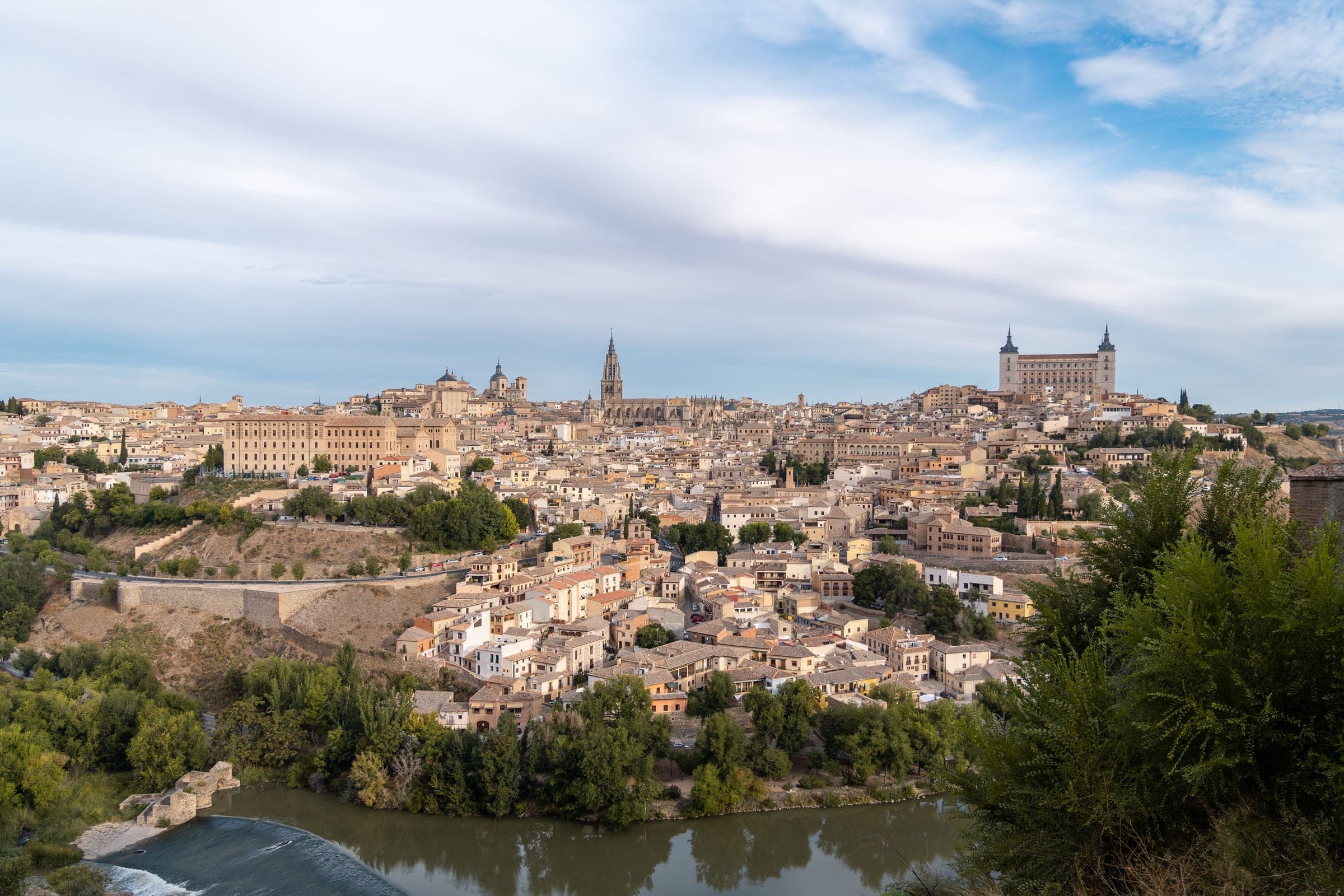
The course runs point to point from the Mirador del Valle, on the hill south of the Tagus opposite the old city, to the Parque de la Vega below the northern walls. Start and finish are 1.5 km apart in a straight line; the route between them makes a long tour of Toledo’s districts. The surface is asphalt with some unpaved sections.
It opens with a drop of 49 m in 2 km, about 2.5 per cent, from the Mirador to the river, then a short 18 m rise into Santa Bárbara past the railway station at km 2.9. From the Santa Bárbara roundabout at 5 km it heads east through the Polígono of Santa María de Benquerencia, rising 27 m over 5 km, very gently, to the furthest point at km 13.2, and falls back 31 m to Santa Bárbara at 20 km. Halfway is on Paseo de la Rosa by the station.
The second half is harder. The route crosses the Tagus and climbs 40 m in 2.2 km, about 1.8 per cent, past the bus station to the bullring at km 24, reaches Duque de Lerma at 25 km, and rolls through the northern and western districts: down 38 m to Avenida de Barber, up 22 m on Avenida Adolfo Suárez at 30 km, and down again to La Peraleda, the low point at 441 m around km 35. From there it climbs 92 m in 6 km to the top of the old town, 537 m at km 41.2, the steepest part at 2.5 to 2.8 per cent between km 38 and km 41 along the western walls and through the Jewish quarter past the Synagogue of El Tránsito and the cathedral. The last kilometre drops 43 m through the Puerta del Sol to the Vega.
Kilometre by kilometre
Km 0 to 3: down from the Mirador. The start at 09:00 has the view of the Alcázar and the cathedral across the Tagus gorge. The first two kilometres drop 49 m to the river: free speed that costs quadriceps, with a 92 m climb waiting at the end. Let the hill carry you and do not push. Wheelchairs start at 09:20 and relays at 09:30, so faster relay runners come through from behind all morning.
Km 3 to 20: Santa Bárbara and the Polígono. Past the station the route runs east on broad roads into Santa María de Benquerencia, the modern eastern district: wide avenues, industrial and residential blocks, and room to find a rhythm. It rises 27 m to the far end at km 13 and falls back. Wind is the main hazard on these open roads. The first four-person relay exchange is by the IES Juanelo Turriano at about 10 km.
Km 20 to 25: halfway and over the river. Halfway is on Paseo de la Rosa by the station, where the two-person relays change. The route crosses the Tagus and climbs 40 m past the bus station to the bullring, the first real climb since the start. The only intermediate cutoff is at 25 km, Duque de Lerma: 13:35.
Km 25 to 35: north and west. Avenida de Europa, Avenida Adolfo Suárez, where the third relay exchange sits, and La Peraleda. The kilometres roll, down 38 m, up 22 m and down again, and this is where the solo marathon becomes lonely: relay runners are fresh and the crowd is thin. Take the aid at 35 km whether or not you feel like it.
Km 35 to 41.2: the climb into the old town. The hardest section of the race: 92 m in 6 km, steepest between km 38 and km 41 as the route climbs along the western walls and through the Jewish quarter, past the Synagogue of El Tránsito at km 40 and the cathedral, on narrow streets with stone paving in places and sharp corners. Shorten the stride and forget pace; on wet stone keep off painted markings. The last aid station, with salts, is on Paseo de Recaredo at 40 km.
Km 41.2 to 42.2: down to the Vega. Past the top near Plaza de Zocodover the route drops 43 m through the Puerta del Sol, where relay teams can join their last runner, to the finish in the Parque de la Vega. Watch for groups merging onto the course.
The course is marked every kilometre and carries a painted line. Timing is by chip on the back of the bib.
49 m down from the Mirador to the river, then flat roads east. Let the hill do the work.
Broad, open avenues, relay exchanges and a 40 m climb over the river after halfway.
Rolling, quieter kilometres out to La Peraleda. Save something.
92 m up through the Jewish quarter to 537 m, then 43 m down to the Vega.
Course Map
Down from the Mirador del Valle, east to the Polígono and back, across the river and round the northern districts, then up through the old town and down to the Vega. Tap a marker for the start, the finish, bib collection, the landmarks and the stations, and scrub the slider or press play to move the orange marker along the course with the elevation profile beneath it.
Pacers
Pacers run at 2:45, 3:00, 3:15, 3:30, 3:45 and 4:00, all in the 09:00 solo start. There are no groups slower than 4:00, although the limit is 5:30. Start boxes are set from a recent result supplied at entry.
The Maratón de Toledo is three races on one course. Solo runners start at 09:00, relay teams at 09:30, and fresh relay runners take over at about 10 km, halfway and 30 km. From the first exchange, expect to be overtaken by runners on fresh legs, and hold a steady line through the exchange zones. At the Puerta del Sol near the end, relay teams may join their final runner and finish together through a separate arch.
The Mirador del Valle is on the Carretera de Circunvalación, across the gorge from the old town, 1.5 km from the finish in a straight line and a 35 to 50 minute walk from Plaza de Zocodover with a climb. The organiser has confirmed free public transport and a cloakroom for relay runners with their bib, but had published nothing for solo marathon runners by late September. Settle it before race week, and do not book an ordinary taxi without checking how close vehicles can get once roads close.
Mid-November in Toledo is usually cool and dry, but not reliably so. AEMET’s November normals for the city are about 5°C at night and 15°C by day, so the 09:00 start is often in single figures. A cold, wet or windy morning is possible, and the Mirador del Valle start is an exposed hilltop.
A vest or T-shirt with arm warmers suits most runners. Take a warm layer for the wait at the Mirador and plan to discard it; no clothing-donation scheme has been published. Gloves and a hat can go in a pocket after the opening descent. The Polígono is open to the wind, and the climb through the old town is on stone in places: in rain, grip matters more than usual.
Entry
Entry is open online, with no ballot. The first edition caps the solo marathon at 1,700, with 850 two-person relay teams and 400 four-person teams, 5,000 people in all. Registration closes on 10 November unless places run out first.
The solo marathon costs €40 for December entries, €50 from January to August and €60 from September to 10 November. A two-person team pays the same as one solo runner; a four-person team pays €60, rising to €80 in the final period. Runners with a recognised disability of at least 33% receive 50% off. To be placed ahead of the general field, supply a public results link from a homologated 10 km, 15 km, half marathon or marathon run in 2023 to 2025, by 19 October.
Transfers go through your personal area on the registration platform; lending a bib is not allowed. Injury cancellation needs a medical certificate and is refunded at 75% until 1 September and 50% until 1 November, less a €5 fee. The entry includes timing, aid stations, a medal and finish refreshments. Wheelchair athletes start at 09:20; contact the organiser for guide-runner arrangements.
Fast runner standards
There is no good-for-age, charity, elite or tour-operator route. A recent homologated result moves you forward in the start boxes.
Official Maratón de Toledo site →Race Weekend
Bib collection
Bibs are collected at the Colegio San Patricio, Calle Juan de Vergara 1, on Thursday 12 November and Friday 13 November from 17:00 to 21:00 and Saturday 14 November from 11:00 to 19:00. There is no race-day collection.
Bring your registration confirmation and official photo ID. Someone else can collect for you with a signed authorisation, the registration details and a copy of your ID. The chip is fixed to the back of the bib: test it at collection and do not fold or pierce that part.
The school is in the north-west of the city, about 4 km from the Vega finish and not near the railway station; take an urban bus or a taxi. Saturday collection closes at 19:00, so anyone travelling from Madrid on Saturday should aim for the morning.
Getting to the start
The solo marathon starts at 09:00 at the Mirador del Valle. Wheelchair athletes start at 09:20 and the relays at 09:30.
Getting there. See Getting to the start above: nothing had been published for solo runners by late September. Check the organiser’s final instructions for a shuttle.
Bags. A cloakroom for solo runners, and whether a bag left at the Mirador is carried to the Vega, had not been confirmed. Keep valuables at the hotel until it is.
Rules. The bib goes on the chest, with the chip behind it, unfolded. No dogs, pushchairs or wheeled devices other than authorised racing wheelchairs. The rules do not ban headphones.
Cutoffs. Five hours 30 minutes in total. The one intermediate cutoff is at 25 km, by 13:35, and the finish closes at 14:30.
The finish. The Parque de la Vega, below the northern walls near the Puerta de Bisagra, with water, isotonic drink, bars, fruit, sweets and a medal. Showers and massage have not been mentioned. Hotels around the Puerta de Bisagra are a few minutes’ walk; the old town is uphill.
Nutrition on course
The organiser lists nine aid points, one every 5 km from 5 to 40 km plus the finish, with products building through the race. There is only one gel point, at 30 km, with no brand named, so carry your own gels. The first 15 km offer water only.
The regulations also mention liquid points at 32 km and 37.5 km that do not appear on the website’s table; treat them as possible, not certain. The last full station before the old-town climb is at 35 km.
| Km | Location | Water | Sports drink | Other |
|---|---|---|---|---|
| 5 | Rotonda de Santa Bárbara | Yes | ||
| 10 | IES Juanelo Turriano | Yes | ||
| 15 | Indoor pool, Santa María de Benquerencia | Yes | ||
| 20 | Rotonda de Santa Bárbara | Yes | Yes | |
| 25 | Duque de Lerma | Yes | Yes | Fruit; cutoff 13:35 |
| 30 | Avenida Adolfo Suárez | Yes | Yes | Gel |
| 35 | La Peraleda | Yes | Yes | Fruit |
| 40 | Paseo de Recaredo | Yes | Yes | Salts |
| Finish | Parque de la Vega | Yes | Yes | Bars, fruit, sweets |
Spectating
The course spreads across the city, so choose one area and stay close to it. The start has the best photograph, but once roads close it can leave spectators on the wrong side of the river. Santa Bárbara, which the course passes at 5 and 20 km, and the finish are safer bets. The old town’s climb, at km 39 to 41, is the most dramatic place to watch and a short walk from the finish.
The organiser’s app gives positions every 5 km, with a warning that times can be wrong. Spectators pay ordinary bus fares; free transport is for relay runners only.
- Watch at the Rotonda de Santa Bárbara, km 5
- Stay in the district for halfway on Paseo de la Rosa, km 20.8
- Walk to the old town for the climb, then down to the Vega, allowing 40 minutes
- Stand by the Synagogue of El Tránsito, km 40
- Walk 10 minutes to Zocodover for the top of the climb, km 41.2
- Walk down through the Puerta del Sol to the Vega for the finish
- Wait at La Peraleda around km 35
- Walk to Paseo de Recaredo for the 40 km station
- Continue to the Parque de la Vega for the finish
Post-race food
The finish is in the Vega, and most of Toledo’s restaurants are up in the old town, a short but uphill walk. Collect your things, get warm, then climb once, to one place.
Cervecería El Trébol, on Calle Santa Fe near Plaza de Zocodover, is known for its pulgas, small filled rolls, and the bomba, a stuffed potato ball. La Abadía, on Plaza de San Nicolás, serves Castilian dishes in a vaulted cellar for a long sit-down lunch. Toledo’s own dishes are carcamusas, a pork and tomato stew, partridge and game, with marzipan afterwards. Menus lean on meat. Reserve for 15:00 or later.
Where to Stay
Stay near the finish in the Vega. No area of Toledo is close to both the Mirador del Valle start and the finish, and the finish matters more: race-morning transport can be arranged in advance, but everyone has to get home from the Vega on tired legs.
Puerta de Bisagra and the Vega
The streets around the Puerta de Bisagra and Real del Arrabal are 3 to 10 minutes from the finish, below the steepest climbs, and the course runs down Real del Arrabal in the last kilometre. Choose this area for the shortest walk after the race.
Zocodover and the Casco Histórico
The old town is the reason to come to Toledo: the cathedral, the Alcázar, the restaurants and the museums. The Vega is 10 to 15 minutes away, downhill before the race and uphill after it, and the course crosses it at km 40 to 42. Cars cannot reach many doors.
Jewish Quarter
The Jewish quarter, in the west of the old town, is quieter, close to the El Greco Museum and the synagogues, and on the course’s climb. The Vega is 15 to 20 minutes away.
Santa Bárbara and the railway station
Santa Bárbara suits arrivals by Avant train and is on the course twice. The finish is 1.1 km away in a straight line but 25 to 35 minutes on foot with hills.
The Cigarrales, south of the Tagus
Hillside hotels among the Cigarrales country houses are nearest the Mirador and have the famous view, but steep roads make a car-free weekend hard. Only with confirmed transport.
Toledo’s easy-access central rooms are limited and autumn weekends are busy with visitors from Madrid. Book a cancellable room near the Vega when you enter.
Recommended hotels
Almost beside the finish, inside the walls by the Puerta de Bisagra. A historic building, so expect steps.
On the street the course runs down in its last kilometre, a few minutes from the finish. Check breakfast time.
Central, near the top of the course’s climb, with a roof terrace. Vehicle access is restricted and the walk back is uphill.
Booking timeline
There is no ballot. Enter early, when prices are lowest, and book a cancellable room near the Vega or the Puerta de Bisagra at the same time. A first edition has no sell-out pattern, but Toledo’s convenient hotels are few and the city is busy at weekends all autumn.
Fly to Madrid (MAD). Cercanías trains or the airport express bus reach Atocha, and Avant trains run to Toledo in about 33 minutes, roughly hourly; direct buses from Plaza Elíptica take about an hour. Arrive by Friday or Saturday morning: bib collection closes at 19:00 on Saturday. Two to four weeks before the race, confirm how solo runners reach the Mirador and whether there is a cloakroom.
See & Do
The finish is in the Vega below the northern walls, and the old town’s sights are uphill from it, most of them on the course’s last climb.
Alcázar and Army Museum
The fortress at the top of the city and a large military museum. Tiring after a marathon; better on Saturday.
Toledo Cathedral
The Gothic cathedral in the heart of the old town, passed at km 40.8, with paintings by El Greco in the sacristy. Allow 60 to 90 minutes.
El Greco Museum
A compact museum on the painter’s life in Toledo, in the Jewish quarter. Mostly level inside.
Synagogue of El Tránsito and the Sephardic Museum
A fourteenth-century synagogue with Mudéjar plasterwork, now the museum of Spanish Jewish history, beside the course at km 40.
Mirador del Valle
Go back to the start line in daylight after the race, by taxi or the tourist bus, to see the view without the pre-race nerves.
After the Race
Mid-November on the plain around Toledo is cool and clear, good walking weather for tired legs. Consuegra’s windmills and the gardens of Aranjuez are easy day trips, Madrid is half an hour by train, and Cuenca’s hanging houses earn two nights.
A ridge of white windmills and a castle above the plain of La Mancha, reachable by car to the top.
A royal palace and flat riverside gardens along the Tagus, the gentlest walking within reach of Toledo. The palace closes on Monday.
The Prado, the flat paths of the Retiro and the old centre, with the airport a short train ride away.
Houses hanging over a gorge, a museum of abstract art inside them and a Parador in a convent opposite. Steep, so take the bus up.