The Race
Inside FC Metz’s stadium, 3 km from the end
At km 39.1 the course runs through Stade Saint-Symphorien, home of FC Metz, on the west bank of the Moselle in Longeville-lès-Metz. The stadium passage was added when the race was relaunched in 2025. It comes straight after five flat kilometres on the river path, and straight before the last climb of the day, 11 m up to Avenue Kennedy, with three kilometres left to the finish at Centre Pompidou-Metz.
| Next Race Date | 11 October 2026 |
|---|---|
| Course Type | Loop: one lap, starting on Rue aux Arènes and finishing beside Centre Pompidou-Metz, about 350 m apart |
| Registration | Open entry through Finishers, price rising in four phases; phase 4 is 79 euros (74 euros with an FFA licence) |
| Ballot Opens | No ballot. Places are limited and sold first come, first served |
| Total Finishers | Not confirmed. Nearly 9,000 took part across all 2025 races |
| Average Race Day Temperature | October at Metz-Frescaty: 15.4°C average high, 7.2°C average low (Météo-France, 1991 to 2020) |
| Cutoff Time | 6 hours |
| Free Race Day Transport | None announced; the start is a short walk from Metz-Ville station |
| Course Certification | Not confirmed. No FFA label for 2026; the Eurométropole’s contract asks the organiser to seek one from 2027 |
History
On 17 October 2010, 1,688 runners started the first Marathon Metz Mirabelle, named after the small golden plum Lorraine is known for, among 2,371 participants across the day. The race became a fixture on the second Sunday of October. By 2017 the city magazine counted 6,657 runners across the weekend’s events, from 64 French departments and 36 countries, and around 800 volunteers and a hundred musicians lined the course for one edition.
The pandemic interrupted it, and after editions in 2019, 2021 and 2022 the Mirabelle marathon paused. In 2025 the French athletics federation’s calendar listed the Mirabelle race as cancelled. That same October, the Eurométropole de Metz staged a new event in its place: the Euro Marathon Metz, which it called the marathon’s “grand retour”. It is a separate event with a new organiser and a new course. The 2025 edition ran through Stade Saint-Symphorien for the first time, and nearly 9,000 people took part across all its races. Florent Pierrat won the marathon in 2:29:26.
The Eurométropole has since awarded a concession covering the 2026, 2027 and 2028 editions, on a regular second-weekend-of-October date, and the contract asks the organiser to pursue a French athletics federation label from 2027. The 2026 weekend adds a half marathon for the first time, alongside the marathon, two- and four-person marathon relays, a 10 km and children’s races on the Saturday. Results from the Mirabelle years belong to a different course, so the new race has no course record beyond the 2025 winning time.
The course
The marathon starts at 08:30 on Rue aux Arènes, beside the Centre des Congrès in Metz’s station district, and finishes on the parvis beside Centre Pompidou-Metz, about 350 m away. In between it runs one loop. The first ten kilometres circle the city centre past Place Saint-Louis, the Porte des Allemands, the cathedral and the Temple Neuf. The course then heads south along the Seille through Magny and Marly to Augny, 6.7 km from the start at its furthest, and swings back north through Montigny-lès-Metz and Moulins-lès-Metz. From km 33 it follows the Moselle to Longeville-lès-Metz, runs through Stade Saint-Symphorien at km 39.1 and climbs back to the finish.
It is a flat course. The organiser publishes no climbing total, but the whole route sits between 161 m and 197 m, and no sustained climb is steeper than 1.7%. The longest rise is 29 m spread over 3.4 km to the high point in Augny at km 20; the longest descent is the 13 km that follow it, down to the Moselle. The final 6 km gain 20 m, most of it in one kilometre after the stadium.
Km 0 to 10: the city centre. The field leaves Rue aux Arènes, passes Metz-Ville station at km 0.9 and heads into the old town, through Place Saint-Louis at km 2.2 and the Porte des Allemands, the fortified gate over the Seille, at km 2.8. It reaches the cathedral on Place d’Armes at km 4.2, drops to the Moselle, and passes the Temple Neuf on its island at km 5.7. The only real pull of the first half follows: 15 m in under a kilometre back up into the centre, at about 1.7%. The course then runs south past the station a second time at km 7.8 on Rue Lafayette. Expect plenty of turns and the biggest crowds of the day.
Km 10 to 17: south along the Seille. After the Pont Lothaire at km 10 the course heads south through Sablon and Magny, along the Seille, and into Marly. The ground is almost level, between 167 and 177 m, with a single short rise of 10 m around km 14 to 15.
Km 17 to 20: the climb to Augny. This is the longest climb of the race: 29 m spread over 3.4 km, about 0.9%, with the steepest kilometre, km 18 to 19, at 1.2%. It tops out at 197 m, the high point of the course, just before km 20 in Augny. Halfway comes soon after.
Km 20 to 33: the long way down. From Augny the course loses 34 m over 13 km, at about 0.3%. It runs north on the M5b and Rue de Frescaty to Montigny-lès-Metz, with the steepest drop of the race between km 28 and 29 (13 m), then turns west through Moulins-lès-Metz. This is the quietest part of the race and the place to settle into a rhythm.
Km 33 to 39: the Moselle and the stadium. At km 33 the course reaches the Moselle at its lowest point, 161 m, and follows the Chemin de la Moselle through Scy-Chazelles to Longeville-lès-Metz, crossing the Pont de Verdun around km 36 and continuing along the riverside promenade. Five kilometres of flat, open river path end at Stade Saint-Symphorien, which the field runs through at km 39.1.
Km 39 to 42.2: the last climb. Out of the stadium the course climbs 11 m in a kilometre, the second-steepest stretch of the day, to Avenue Kennedy at km 40, then drops 8 m through Sablon to the finish beside Centre Pompidou-Metz. Save something for km 39 to 40.
The timing chip is stuck to the back of the bib. It is read at the start and checked at halfway, and runners who leave the roadway are not ranked.
Course Map
One loop from the station district: the old town first, then south to Augny, back along the Moselle and through the stadium to the finish beside Centre Pompidou-Metz. Tap a marker for details, and scrub the slider or press play to move the orange marker along the course with the elevation profile beneath it.
Pacers
Yes. The organiser says each start corral will have pace leaders carrying flags in that corral’s colour. The target times and corral details had not been published by mid-September; check the organiser’s race-week email. Runners who meet the elite standard (3:00 for men, 3:30 for women, or equivalents over shorter distances) could apply for the elite corral until 30 June.
What to wear
Dress for a cool morning. Météo-France’s Metz-Frescaty station, a few kilometres from the high point of the course, records an October average low of 7.2°C and high of 15.4°C, so the 08:30 start is usually in single figures and most runners finish before the day peaks. October brings 64.8 mm of rain on average, so check the forecast in race week and pack for wet conditions as well as dry. Short sleeves or a light long-sleeve top suit most people once moving.
There are no changing rooms and no toilets along the corrals, so arrive dressed to run and bring an old top to wear while you wait, then drop it before the gun. Gloves are worth having on a cold morning. The Moselle path from km 33 to km 38 is open ground by the water, where wind is more noticeable than in the streets. Headphones are tolerated at the runner’s own risk.
Entry
Entry is open, with no ballot, through the Finishers platform linked from the organiser’s website. Places are limited and the price rises in four phases. In mid-September 2026 sales were in phase 4, at 79 euros, or 74 euros with an FFA licence. The earlier phases cost 55, 65 and 75 euros (50, 60 and 70 with a licence), so enter early in future years. The event T-shirt is an optional extra.
You must be 18 on race day, which for 2026 means born on or before 11 October 2008. To complete your entry, upload either a French athletics federation (FFA) licence or a Parcours Prévention Santé (PPS) certificate to your Finishers account. The PPS is an online health-awareness module from the FFA, valid for one year, and the route for anyone without a French licence. Complete it well before race week: the organiser validates it online, and if it is not validated a week before the race you must bring it to bib collection.
Entries are final. There are no refunds, even for medical reasons, no transfers and no official resale platform. Non-licensed runners are responsible for their own insurance. Companies can enter teams through the Challenge and Premium packages.
The same weekend offers a half marathon (3-hour limit, open to adults, 47 euros in phase 4, or 44 with a licence), a two-person marathon relay also open to adults, a four-person relay and a 10 km (1 h 45 min limit) open from age 16, and free children’s races on the Saturday.
Fast Runner / GFA Standards
There is no guaranteed-entry route. The elite corral was open to runners with a qualifying performance, requested by 30 June 2026:
| Performance over | Men | Women |
|---|---|---|
| 10 km | 39:07 | 45:39 |
| 15 km | 1:00:08 | 1:10:09 |
| Half marathon | 1:26:19 | 1:40:43 |
| Marathon | 3:00:00 | 3:30:00 |
To request it, enter corral 1 and email proof of the performance to the organiser. Relay teams cannot use the elite corral.
Race Weekend
Expo
Bib collection is at the Centre des Congrès Robert Schuman, on the parvis between Metz-Ville station and Centre Pompidou-Metz, on Friday 9 October from 12:00 to 20:00 and Saturday 10 October from 10:00 to 20:00. There is no collection or registration on race day. Bring the QR code from your registration (also sent in the race-week email and available in your Finishers account), photo ID, and a copy of your PPS certificate or FFA licence if it has not already been validated on Finishers.
Someone else can collect your bib if they bring the QR code and a copy of your ID, plus your PPS if it was not validated in advance. The timing chip comes already stuck to the back of the bib. The congress centre is 200 m from the start line and the finish, so it is worth walking the start area on the same trip. The children’s races are on the Saturday afternoon, from 16:00 in the Parc de la Seille, and were already full in September.
Getting to the Start
The marathon starts at 08:30 on Sunday 11 October. One runner who came in 2025 believed the start was at 09:00, arrived at 08:43 and found the race gone, so set the alarm by the organiser’s time. The course starts on Rue aux Arènes beside the Centre des Congrès, in the Amphithéâtre district. The organiser had not yet published the corral layout or start-area timetable by mid-September; it sends these by email before race day.
On foot. From hotels around Metz-Ville station the start is a few minutes’ walk; from the cathedral quarter, allow about 20 minutes. There is nothing more to plan than that.
By train. Metz-Ville station is about 300 m from the start line, served by TGV from Paris Gare de l’Est and by regional trains from Luxembourg, Nancy and Strasbourg. Check whether an early Sunday arrival works before relying on it.
Before the gun. Bag drop is free, with a size limit of 45 cm high, 36 cm wide and 20 cm deep; the organiser can refuse larger bags, and you collect yours after the race with your bib. There are no changing rooms. Toilets are at the start, but there are none along the corrals and urinating there is banned, so go before you enter yours. Relay runners are taken to their changeover points by bus, with times and pickup places sent by email.
Nutrition on Course
Refreshment stations with food and drink are set every 5 km, with another after the finish line. The organiser’s nutrition partner, TA Energy, hands a raspberry gel to every marathon runner and provides lemon electrolyte drink on the course. If you have not tried those products, carry your own; the brand’s gels are sold through Nutri-bay, and the organiser’s site lists a discount code for testing them in training.
Stations every 5 km means gaps of 5 km between drinks, longer than at some city marathons, so runners who drink often should carry a small bottle. The organiser has not published the exact kilometres or the food offered. The long gradual descent from km 20 to km 33 is the easiest place to take a gel without losing rhythm, and the last station before the Moselle stretch and the climb after the stadium matters most. Alcohol is banned on the course. To drop out, go to a refreshment station or first-aid post and hand in your bib and chip.
Spectating
The start, the finish and the first ten kilometres are all in central Metz, so supporters can see a runner several times without transport. Bicycles and wheeled devices are banned from the course. Results go up on the organiser’s site and Finishers on the afternoon of the race.
Plan A: the old town. Watch the start on Rue aux Arènes at 08:30, then walk north to Place Saint-Louis (km 2.2) or the cathedral (km 4.2), about 15 minutes away. Head back towards the station for km 7.8 on Rue Lafayette. A runner on 4-hour pace reaches the cathedral around 08:55 and the station a second time around 09:15.
Plan B: the stadium and the finish. Stade Saint-Symphorien, where the course passes at km 39.1, is about 1.5 km on foot west of the station, across the Moselle. A 4-hour runner reaches it around 12:15, then needs about 20 minutes to finish, enough time to walk back to Centre Pompidou-Metz for the finish. The organiser had not said by mid-September whether spectators can enter the stadium, so plan to watch on the approach outside it.
Plan C: the Moselle path. The riverside between Longeville-lès-Metz and the Pont de Verdun (km 35 to 38) is open, flat and quiet, a good spot to shout a runner through the stage where the race starts to hurt. It is a 30 to 40-minute walk from the station.
Post-Race Food
The finish area has its own refreshment station. For a proper meal, the station district around the finish is quiet on a Sunday, and the restaurants are mostly in the old town, a 15 to 20-minute walk north around Place Saint-Jacques, Place Saint-Louis and the cathedral. Lorraine cooking suits a recovery lunch: quiche lorraine, pâté lorrain in pastry, and anything made with mirabelle plums, including the plum brandy.
Book ahead for Saturday dinner and for Sunday if you are eating as a group. La Réserve, the restaurant at La Citadelle Metz, is listed in the Michelin Guide and sits between the finish and the old town.
Where to Stay
The standing rule is to stay near the finish, and in Metz that also puts you near the start, bib collection and the railway station. All four are within about 500 m of each other in the Amphithéâtre and station district.
Amphithéâtre and the station
The Amphithéâtre district, built around Centre Pompidou-Metz and the congress centre, is the best base for this race. The finish is at your door, the start is on Rue aux Arènes, and Metz-Ville station is a few minutes away for arrival and departure. The station district on its north side, part of the German-era Imperial Quarter, is on the course at km 0.9 and km 7.8. It is less lively in the evening than the old town.
Historic centre and cathedral
The historic centre, around the cathedral and Place Saint-Louis, is about 1.5 km north of the finish, a 20-minute walk. It has most of the restaurants and the city’s sights, and the race passes through it in the first ten kilometres. Stay here if you want evenings in the old town and do not mind a longer walk on race morning.
République and the Citadelle
République, around Place de la République and the Esplanade, sits between the two, about 1 km from the finish. It is close to the Moselle and the parks, and it makes a quieter base with the old town and the station both within a short walk.
Recommended hotels
A 101-room hotel on the same street as the start, 260 m from the station and 500 m from Centre Pompidou-Metz. The most convenient place to sleep for this race, with bib collection and the finish both a few minutes away.
A three-star renovated in 2023, about 100 m from the station. Rue Lafayette is on the course at km 8, so you can watch the field pass from the door once your own race is done, or have a supporter do it.
Seventy-eight rooms inside a military building from 1559, facing Square Giraud between the station and the old town. Its restaurant, La Réserve, is listed in the Michelin Guide, which makes it a good choice for Saturday dinner too.
Seventeen individually furnished rooms opposite the cathedral, with a terrace bar. The course passes the cathedral at km 4.2. There is no lift, which matters on Sunday evening.
Booking timeline
For 2026, book a room now and enter while places remain; sales are in their last price phase. Complete your PPS and upload it to Finishers at least a week before the race so it is validated before bib collection. In race week, read the organiser’s email for your corral, pacer targets and start-area details, and book Saturday dinner. For 2027, the Eurométropole’s contract points to the second weekend of October again: book a refundable room in the station district as soon as the date is confirmed, and enter in phase 1, when the marathon costs 24 euros less than in phase 4.
See & Do
All of these are within a flat walk of the finish and the station-district hotels. Distances are from the finish beside Centre Pompidou-Metz.
Centre Pompidou-Metz
At the finish, 0.1 km (0.1 miles). The regional branch of the Paris museum, under a woven timber roof, shows modern and contemporary art on three long galleries stacked at angles. It is indoors, step-free and the obvious Sunday afternoon or Monday visit. Check opening days and exhibitions at centrepompidou-metz.fr before planning around it.
Cathédrale Saint-Étienne
About 1.5 km (0.9 miles) north. One of the tallest Gothic naves in France, lit by around 6,500 square metres of stained glass, including windows by Marc Chagall. The course passes it at km 4.2. Entry to the nave is free.
Place Saint-Louis and the old town
About 1 km (0.6 miles) north. A long medieval square with arcades along one side, built by the city’s merchants, and the start of the pedestrian streets that lead to the cathedral. The course crosses it at km 2.2.
Porte des Allemands
About 1.2 km (0.75 miles) north-east. A fortified gate and bridge across the Seille, with round towers, and one of the landmarks the Eurométropole used to promote the 2025 race. The course passes at km 2.8. A good short walk from the old town.
The Temple Neuf and the Moselle islands
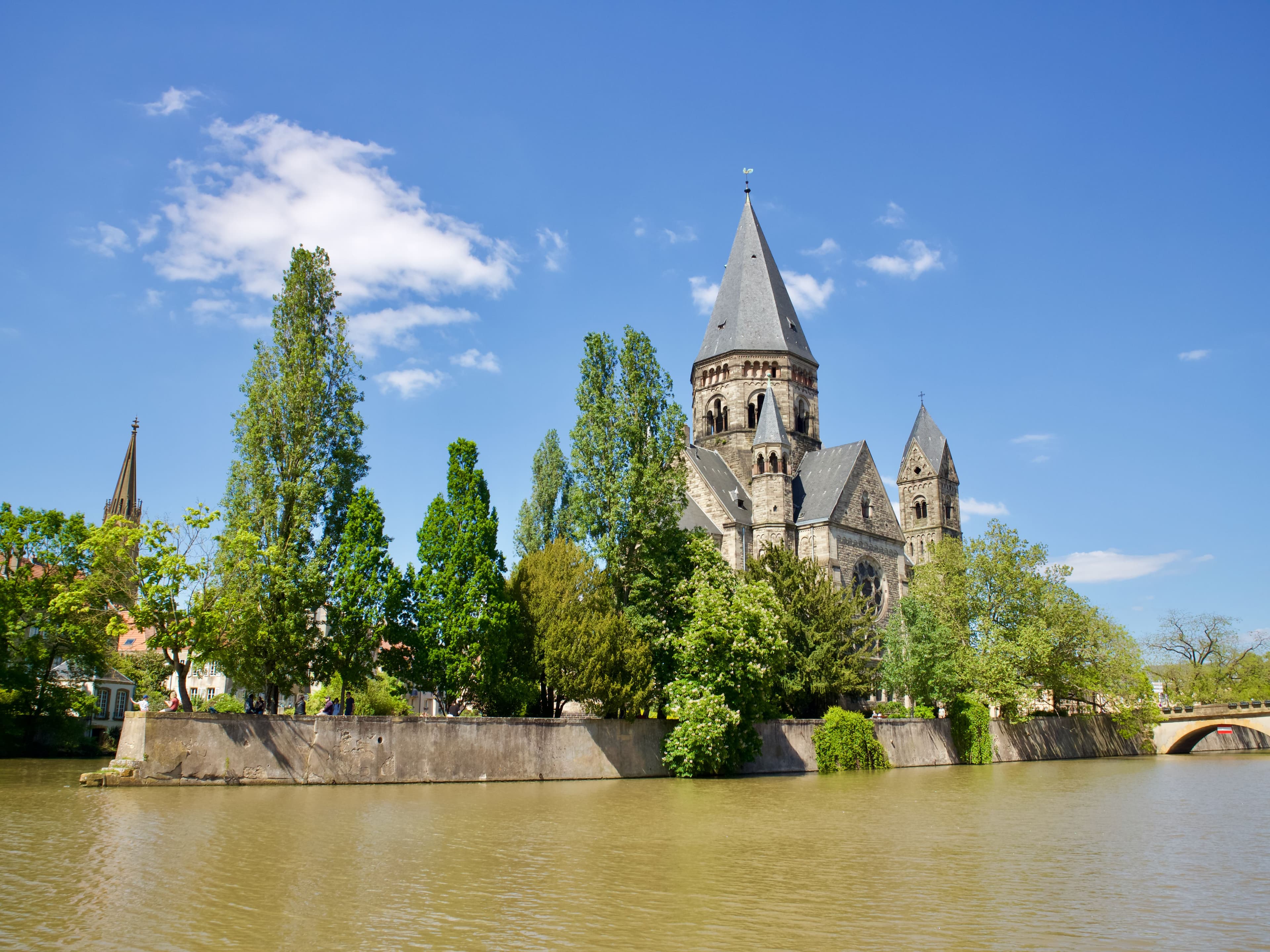
About 1.7 km (1.1 miles) north-west. The Temple Neuf, a Protestant church built in the early 20th century, stands on a small island in the Moselle beside the Place de la Comédie and the Opéra-Théâtre. The riverside paths and the Plan d’Eau lake nearby make a flat recovery walk. The course passes the church at km 5.7.
After the Race
Metz-Ville station is a few minutes from the finish, and in mid-October the three cities below are all within two hours by train, cool enough for walking and past the summer crowds. On Monday, choose flat old towns and short distances: Luxembourg for a day, Nancy for a night, or Strasbourg for two.
Old town fortifications above two river valleys, and public transport that is free inside Luxembourg once you arrive. Close enough to go and come back on Monday without a hotel change.
Place Stanislas and its gilded gates, the Pépinière park next door and a compact old town. Flat, short walks and a good last night before heading home via Paris.
The canals of Petite France, the cathedral and a tram that saves the legs. Enough for two slow days in Alsace.
Frequently asked questions
Should I stay near the start or the finish?
Both are in the station district, about 350 m apart, with bib collection between them. A hotel around Metz-Ville station covers the whole weekend on foot.
How far in advance should I book a hotel?
Straight away for 2026. The weekend drew nearly 9,000 participants in 2025, before a half marathon was added, and station-district hotels fill first.
Is there free transport to the start on race day?
None has been announced, and most runners will not need it: the start is a short walk from Metz-Ville station and the central hotels.
What is the best area to stay?
The Amphithéâtre and station district. The start, finish, bib collection and trains are all within about 500 m.
When does the expo open?
Friday 9 October, 12:00 to 20:00, and Saturday 10 October, 10:00 to 20:00, at the Centre des Congrès Robert Schuman. No race-day collection.
What is the weather typically like on race day?
Cool. Metz averages 15.4°C high and 7.2°C low in October, and the 08:30 start means most of the race is run below the day’s peak.
How do I get from the airport?
Luxembourg Airport, then bus and train to Metz-Ville, around 50 minutes by rail; or a direct TGV from Paris Gare de l’Est.
Is there a bag drop?
Yes, free, with a 45 × 36 × 20 cm size limit. There are no changing rooms, so arrive ready to run.
Should I bring a throwaway layer?
Yes. Mornings average around 7°C and there is nowhere indoors to wait. Drop it before the gun at 08:30.
How do I get back to my hotel after finishing?
Walk. The finish beside Centre Pompidou-Metz is a few hundred metres from the station and its hotels.