The Race
The two cutoffs
The finish at Parc de la Victoire stays open until 16:00, eight hours after the start. There is one earlier check. At km 10.4, opposite the La Cresse bridge, the 23 km runners leave the shared course. Marathon runners who reach that turn-off after 10:00 are sent down the 23 km route with them. Two hours for 10.4 km works out at about 11 min 30 s per km, so it only affects walkers and very slow starters. Anyone planning on more than seven hours should still start near the front of their group.
| Next Race Date | Saturday 25 September 2027 (provisional; the organiser has not yet published the 2027 date) |
|---|---|
| Course Type | Loop: one lap from avenue Jean-Jaurès up the Tarn valley to Peyreleau and back to Parc de la Victoire, about 700 m from the start |
| Registration | Open entry, 75 euros from 1 September; closes 20 September 2026 at midnight. No race-day entry |
| Ballot Opens | No ballot |
| Total Finishers | 303 (2025) |
| Average Race Day Temperature | September at Millau station (712 m): 20.9°C average high, 11.2°C average low (Météo-France, 1991 to 2020); the course runs about 300 m lower |
| Cutoff Time | Finish closes at 16:00 (8 hours). Runners passing the 23 km turn-off at km 10.4 after 10:00 are redirected |
| Free Race Day Transport | None needed from central Millau; runners walk in procession to the start |
| Course Certification | Not confirmed for the marathon. The 100 km course, which shares these roads, holds an FFA measurement certificate valid to 2029 |
History
At 5 a.m. on 17 September 1972, Bernard Vidal started 68 runners on the first 100 km de Millau, a race he had devised with Serge Cottereau at a time when French road running barely went beyond the marathon. Thirty-eight finished. Cottereau won in 7 h 50 min and went on to win it four times. Within two years the race had moved to the course it still uses, with the first loop running up the Tarn valley from Millau, and by 1977 more than 1,000 runners were starting every year. The 20th edition drew 3,875 entrants, a record that still stands.
The marathon is that first loop, entered and ranked as a separate race. The organiser, the volunteer-run S.O. Millau Athlétisme, is frank about its purpose. It is not trying to compete with Paris or the Médoc, and the profile is not one for a fast time. It is a way to try the 100 km’s first loop before attempting the full distance the following year. Every finisher gets the same reward and there is no prize money. Bibs are different colours for each race, and the choice is fixed: a 100 km runner who stops in Millau is a 100 km non-finisher, and a marathon runner who feels good at the finish cannot carry on.
The organiser’s results list the marathon back to at least 2013, when Jérôme Chiotti won in 2:46:42 and Simon Dubocage was third in 3:05:07. Twelve years later Dubocage won the 2025 race in 2:34:39. Coralie Blanchard was the first woman, ninth overall in 2:58:40, and 303 runners finished, the last in just over eight hours. The 2025 edition also moved the start to 08:00 and added a 23 km race. The 2026 event is the 54th 100 km de Millau, with around 1,600 runners across the three races and 800 volunteers.
The course
The marathon starts at 08:00 on avenue Jean-Jaurès, at the north end of Millau, and heads north-east up the Tarn. The outward leg follows the north bank through Aguessac, Compeyre and Rivière-sur-Tarn to Boyne and Le Rozier, where the Jonte gorge joins the Tarn at the mouth of the Gorges du Tarn. At about km 21 the course crosses into Peyreleau and turns for home along the south bank, through Les Prades, La Cresse and Paulhe, and back into Millau to finish at Parc de la Victoire. It is on paved roads throughout, with kilometre markers at least every 5 km and yellow arrows painted on the right-hand side.
The organiser gives 220 m of climbing. Its profile shows the course between about 360 m and 420 m: a gentle rise over the first 20 km, a run of short, sharp bumps between Peyreleau and La Cresse, then a long drop from about km 31 to km 40 before a short rise into the finish. Roads are only partly closed. Service vehicles use the course, runners keep to the right unless told otherwise, and inside Millau traffic is not restricted at all.
Before the start. Runners gather at the back of Parc de la Victoire until 07:30, then walk together in a compulsory procession to avenue Jean-Jaurès, about 700 m away. The 100 km, the marathon and the 23 km all start together at 08:00, so the first kilometres are shared with runners pacing for a much longer day.
Km 0 to 10: north along the Tarn. The course leaves Millau on avenue Édouard-Alfred Martel and the D809, the road between Millau and Aguessac that the race has used since 1974. It climbs gently for the first 5 km, then drops into Aguessac, where the first aid station is at about km 6.5. From there the route follows the valley road through Compeyre and the hamlet of Pailhas.
Km 10.4: the 23 km turn-off. Opposite the metal bridge to La Cresse, near the Quézaguet farm, the 23 km runners cross the river and head for home. Marathon runners carry straight on, unless they reach this point after 10:00, in which case they are sent with the 23 km runners.
Km 10 to 21: Rivière-sur-Tarn to Le Rozier. The second aid station is at Rivière-sur-Tarn, around km 12. The road then climbs about 25 m on the D907 beyond the village and runs on through Boyne (aid at km 15.6) and Mostuéjouls, with the cliffs of the causses closing in. At km 20.8 the course reaches Le Rozier, crosses into Peyreleau and passes the fourth aid station. The short climb into Peyreleau takes the course to its highest point on the organiser’s profile, just after halfway.
Km 21 to 31: the bumpy return. The return along the south bank is the hilliest stretch, a series of short rises and falls on the D187 through Les Prades (aid at km 24.8) to La Cresse, where the sixth aid station is at km 30.2. None of the climbs is long, but they come one after another and break the rhythm.
Km 31 to 42.2: down to Millau. After La Cresse the road runs down through Paulhe, the last listed aid station at km 34, past Millau-Plage around km 35 and on to the lowest ground of the race near km 40. The final kilometre and a half climbs gently through town, past Place du Mandarous at km 41, to the finish at Parc de la Victoire. The first runners arrive from about 10:45.
Wear the bib on the front with four pins and do not fold it: the timing chip is on its back, and a bib that cannot be read at the checks on the course or in the last 50 m means disqualification.
Course Map
One loop up the Tarn valley and back: out on the north bank to Le Rozier, back on the south bank through La Cresse. The red pin marks the 10:00 turn-off. Tap a marker for details, and scrub the slider or press play to move the orange marker along the course with the elevation profile beneath it.
Pacers
None published for the marathon. The organiser has listed volunteer pace leaders for the 100 km in past years, and those runners share the first loop, but their targets are set for 100 km, not 42. Plan to run your own race.
What to wear
Late September in Millau is mild but unpredictable. Météo-France’s Millau station, on the plateau at 712 m, averages 20.9°C at its warmest and 11.2°C at its coolest in September; the course is about 300 m lower in the valley and usually a little warmer. Many runners finish around midday, so short sleeves suit the race itself, but check the forecast: the organiser warns that the weather can force changes, and the season can bring rain as easily as sun.
Bring a layer for the wait. Runners assemble in Parc de la Victoire before the 07:30 procession and start at 08:00, so there is half an hour outdoors in the cool of the morning. Carry anything you need, since personal supplies are allowed and are your own responsibility, and wear sun protection for the open valley road on the return leg. The bib goes on the front, flat, with four pins.
Entry
Entry is open, with no ballot, and for 2026 it closes on 20 September at midnight. There is no race-day entry. The fee rises through the year: 65 euros until 30 June, 70 euros in July and August, and 75 euros from 1 September. It includes the on-course refreshments, a technical T-shirt (collected with a ticket from your bib pack), the runners’ buffet after the race on showing your bib, and a finisher’s diploma to print from the website plus a surprise gift.
Choose the distance carefully. The 100 km, the marathon and the 23 km are separate entries with separate results, and you cannot change race on the day. The marathon is open to adults in the French athletics federation’s Espoirs category and older. Entrants need either a 2026/2027 FFA licence (Athlé Compétition, Athlé Entreprise or Athlé Running) or a Parcours Prévention Santé (PPS), the federation’s online health module, and foreign runners need the PPS too. No entry is accepted without one.
Bibs are personal: a runner who passes one on is responsible for any accident the other person has or causes. There are no refunds or deferrals for non-participation, and none if the race is cancelled for safety or weather. The organiser publishes the list of entrants on its website.
Fast Runner / GFA Standards
There is no guaranteed-entry route or qualifying time. Every runner enters the same way.
Race Weekend
Expo
There is no expo. Bibs are collected at the Salle des Fêtes in Parc de la Victoire, avenue Charles-de-Gaulle, on Friday 25 September from 16:00 to 22:00, or on race morning from 06:00 to 07:30. Bring the collection coupon the organiser emails you; without it you will be asked for photo ID. The detailed event programme is handed out at the same time, along with the ticket for your T-shirt.
Collect on Friday if you can. The Saturday window closes as the procession assembles, and the same hall is busy with 100 km runners. Vehicles cannot park inside Parc de la Victoire.
Getting to the Start
Race morning starts at Parc de la Victoire, not at the start line. Runners gather at the back of the park until 07:30, then walk together in a compulsory procession to avenue Jean-Jaurès, about 700 m away, where the start is given at 08:00 sharp. From a hotel in central Millau, walk to the park; allow for the Saturday bib queue if you have not collected yours.
By car. Most visitors reach Millau by car, on the A75 from Montpellier or Clermont-Ferrand. Parking is not allowed inside Parc de la Victoire, and traffic inside Millau is not restricted during the race, so park early in the town and walk.
By train. Millau station is about 400 m from the start, but services are limited, so arriving on race morning by rail is not practical. Travel the day before.
The organiser’s rules do not describe a bag drop or showers for the marathon, so leave your things at your hotel. The first 10 km are the easiest part of the course; with the 10:00 turn-off at km 10.4, use them to settle in.
Nutrition on Course
Seven aid stations, shared with the 100 km runners, serve the marathon: Aguessac (about km 6.5), Rivière-sur-Tarn (km 12), Boyne (km 15.6), Peyreleau (km 21), Camping Les Prades (km 24.8), La Cresse (km 30.2) and Paulhe (km 34). The organiser’s kilometres are rounded (7, 12, 17, 21, 25, 31 and 34); these figures come from the course line. The rules say only that the supplies suit this kind of race, without listing them, so bring your own gels.
Personal supplies are allowed, provided you manage them yourself; companions on foot or bike are not permitted on the marathon, so nobody can hand you a bottle between stations. The gap from Paulhe to the finish is the longest, about 8 km, mostly downhill, so drink well at km 34. Bins are set out at every aid station, and dropping litter anywhere else is not tolerated: the course runs through protected countryside.
Spectating
Central Millau is the easy place to watch. Supporters can see the procession leave Parc de la Victoire at 07:30, the start on avenue Jean-Jaurès at 08:00 and, a few hours later, the finish back at the park. The first marathon runners arrive from about 10:45. A runner on 4 h 30 min pace passes the 23 km turn-off around 09:05, reaches halfway around 10:15, passes La Cresse around 11:15 and finishes around 12:30.
Paulhe or Millau-Plage. The return leg between km 34 and km 39 is close to town on the south bank. Roads are only partly closed and the 100 km runners are on them for much of the day, so check the route in the programme and drive or cycle out early, before your runner is due.
Le Rozier and Peyreleau. The halfway turn, where the Jonte gorge meets the Tarn, is the most striking place on the course, about 20 km from Millau. Choose it as your one remote viewing point, arrive well before 10:00, and expect to stay until the course clears, since the valley road is the course.
Do not try to drive alongside the race. Accompanying runners on foot or by bike is not allowed on the marathon.
Post-Race Food
Your entry includes the runners’ buffet at the finish, served on showing your bib. After that, central Millau’s restaurants are a few minutes’ walk away around Place du Mandarous, Place de la Capelle and the old streets near the belfry. Aveyron food is heavy and good: aligot, the cheese-and-potato purée; farçous, herb and chard fritters; local charcuterie; Roquefort from 25 km away; and gâteau à la broche, a spit-baked cake. Save the aligot for the evening.
The Cévenol Hôtel’s restaurant, Le Pot d’Étain, serves regional dishes. Book ahead for Saturday dinner: with around 1,600 runners in town, tables fill.
Where to Stay
The usual rule is to stay close to the finish, and in Millau the finish, Parc de la Victoire, is also where bibs are collected and where the race assembles before the start. So the aim is a room within walking distance of the park. The organiser refers accommodation questions to the Millau tourist office.
Central Millau
Central Millau, between Place de la Capelle, Place du Mandarous and Parc de la Victoire, is the best base. The start is on avenue Jean-Jaurès at the north end of the centre, the park is a few minutes away, and the restaurants are all here. No car is needed from Friday evening to Sunday.
Creissels
Creissels is a village 2 km south-west of Millau across the Tarn, below the viaduct. It suits a longer holiday around the race, but on race morning you will need to drive into Millau and park outside Parc de la Victoire.
Outer Millau
The hotels on the edges of Millau, towards the A75 junctions, are often cheaper and have parking. They put you a drive away from the 07:30 assembly, so leave early.
The Tarn valley
The villages up the valley, from Aguessac to Le Rozier, make lovely bases for the days after the race. For race morning they are a poor choice, because the course uses their roads.
Recommended hotels
Forty rooms, renovated in 2019 and 2021, set back from the road on a square in the town centre, with a terrace looking out over the causses. The start on avenue Jean-Jaurès is about 300 m away and the station a ten-minute walk.
A 42-room three-star with a seasonal outdoor pool, free private parking and its own restaurant, Le Pot d’Étain. Some superior rooms look towards the viaduct. A good choice for runners arriving by car.
A four-star hotel in a 12th-century castle and a modern wing, with 22 rooms, 4 suites, a pool and a restaurant. Better for a longer stay around the race than for race morning, when you will need to drive and park outside Parc de la Victoire.
Booking timeline
For 2026: entries close on 20 September at midnight, so enter now if you have not, and book a room in central Millau straight away. For future years, the race is on the last Saturday of September. Book a refundable central room early in the year, and enter before 30 June to pay 65 euros, 10 less than in September. Complete your PPS in the summer, since no entry is accepted without it. In race week, check the forecast, plan to collect your bib on the Friday evening, and book a table for Saturday dinner.
See & Do
The first two are a short walk from the finish and the central hotels; the rest need a car. Distances are from the finish at Parc de la Victoire.
Central Millau and the belfry
About 1 km (0.6 miles). The old town around Place du Mandarous and Place Foch, with its arcades and belfry, is flat and compact. Millau made its name as a glove-making town, and its leather trade is still part of the centre. An easy walk on the Sunday.
The Tarn riverside
About 1.5 km (0.9 miles). The Tarn runs along the south side of town, with riverside paths and the old bridge. It is the gentlest walk in Millau.
The Millau Viaduct
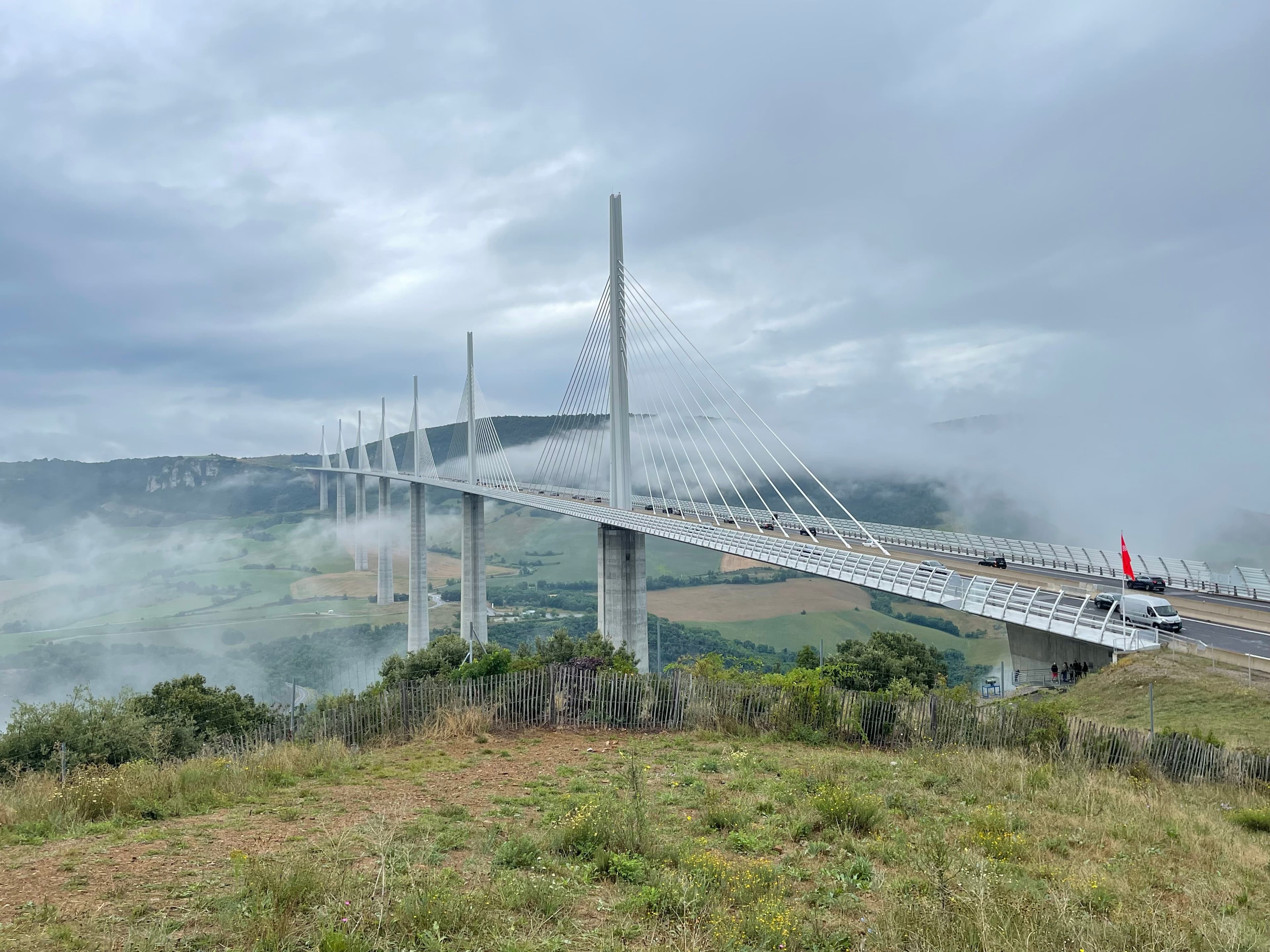
About 5 km (3 miles) south-west as the crow flies. The bridge, opened in December 2004, is 2,460 m long, and its highest pylon stands 343 m above the ground. The marathon does not go near it. Its visitor area, reached from the A75 and from Millau, has viewpoints and a free exhibition in an old causse farmhouse.
The Gorges du Tarn
About 20 km (12 miles) by road to Le Rozier. The marathon turns at the mouth of the gorge; drive on from Le Rozier to see the gorge itself, with its cliffs, villages and viewpoints.
Roquefort-sur-Soulzon
About 25 km (16 miles) by road. The cheese village built against the Combalou cliff, where every Roquefort is aged in the caves. Visits need booking and involve some stairs.
After the Race
Late September is a good time in the Grands Causses: the summer crowds have gone, and the days are usually warm enough for a slow day outdoors. All three trips below need a car and involve little walking, which suits Sunday legs after 42 km.
The bridge the marathon never goes near: a free visitor area with exhibitions and viewpoints, and the cliff village of Peyre below it. Short walks only.
Drive on from where the marathon turned at Le Rozier, into the gorge proper: Sainte-Enimie, the Point Sublime viewpoint and boat trips below the cliffs.
The village under the Combalou where every Roquefort cheese is aged, with cave tours and tastings. Indoors, cool, and a good use of a post-race Sunday.
Frequently asked questions
Should I stay near the start or the finish?
Near Parc de la Victoire: it is the bib collection point, the pre-race assembly point and the finish. The start is a 700 m procession away.
How far in advance should I book a hotel?
Now for 2026. Around 1,600 runners across three races come to a small town, and central rooms are limited.
Is there free transport to the start on race day?
None is needed if you stay in Millau: runners walk together from Parc de la Victoire to the start at 07:30.
What is the best area to stay?
Central Millau, between Place de la Capelle and Parc de la Victoire. Avoid valley villages, which are on the course.
When does the expo open?
Bib collection is at the Salle des Fêtes, Parc de la Victoire: Friday 25 September 16:00 to 22:00, and race morning 06:00 to 07:30.
What is the weather typically like on race day?
Mild but changeable. The Millau plateau station averages 20.9°C high and 11.2°C low in September; the valley course is a little warmer.
How do I get from the airport?
Millau has no airport. Fly to Montpellier (about 1 hour 10 minutes by car) or Rodez (about 1 hour) and drive.
Is there a bag drop?
The rules do not mention one. Leave your things at your hotel; the finish is back in central Millau.
Should I bring a throwaway layer?
Yes, for the half-hour assembly and procession before the 08:00 start on a cool valley morning.
How do I get back to my hotel after finishing?
Walk. The finish is at Parc de la Victoire, a few minutes from the town centre.