The Race
The last 3.4 km climb 46 m
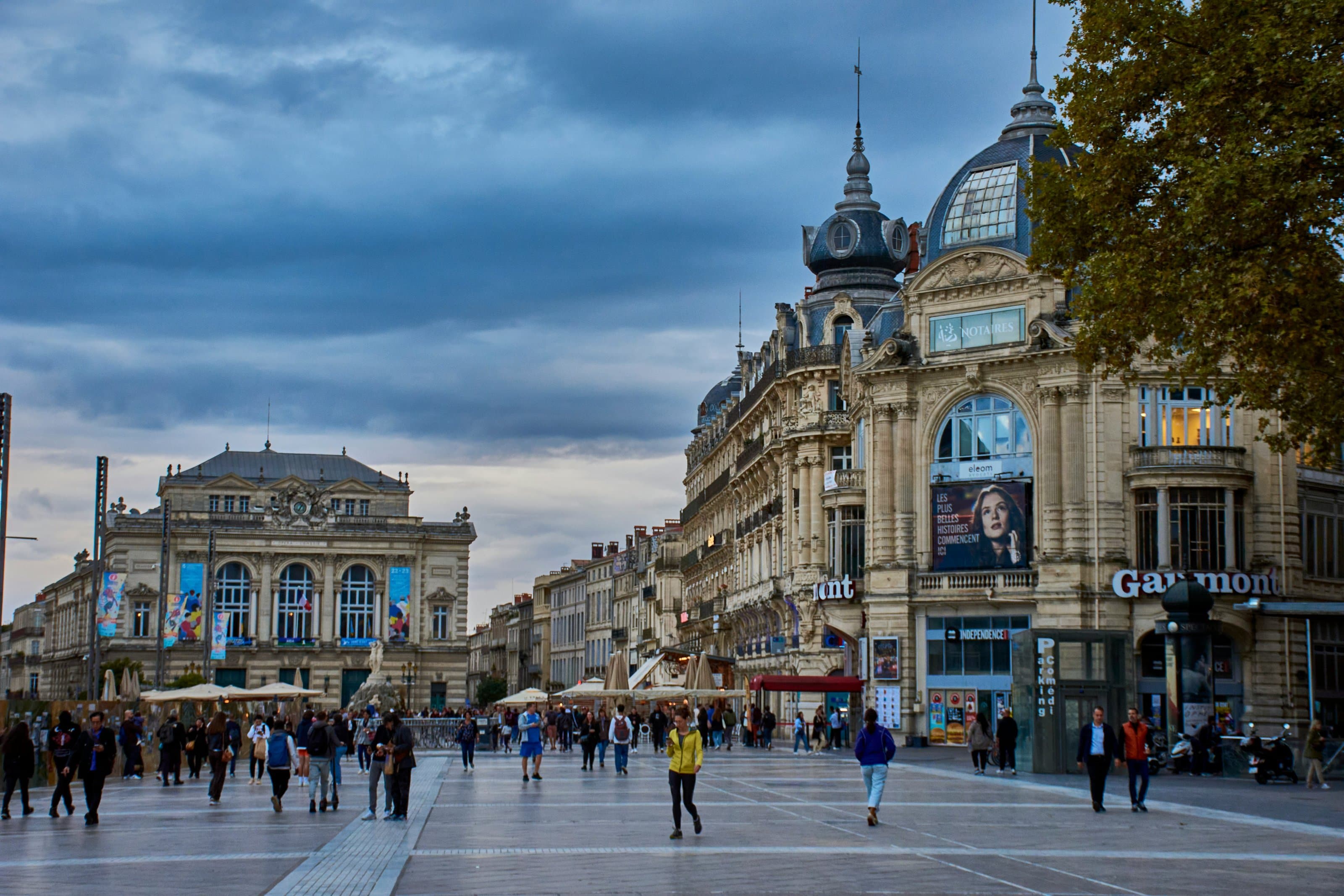
The course reaches its lowest ground by the Hôtel de Ville in Port Marianne, about 13 m above sea level, at km 39. From there it climbs back up to the old town: 46 m over the last 3.4 km, with 22 m in the final kilometre up past the Comédie to Rue Foch. The finish line under the Arc de Triomphe is the highest point of the race. Runners met the same climb at the end of the first lap, around km 19 and 20, so it will not be a surprise, but it arrives when the legs are emptiest. Keep something back for it.
| Next Race Date | To be Confirmed: April 2027. The 2026 race ran on Sunday 19 April |
|---|---|
| Course Type | Loop: two laps east of the centre, the second extended through Saint-Aunès; start on Boulevard des Arceaux, finish on Rue Foch about 740 m away |
| Registration | Open entry, capped at 1,500. In 2026 the price rose from 63 to 73 euros as places sold; 2027 prices not yet published |
| Ballot Opens | No ballot. The organiser announces 2027 registration by newsletter |
| Total Finishers | Not confirmed. 1,250 started in 2025 |
| Average Race Day Temperature | April at Montpellier airport: 18.7°C average high, 9.2°C average low (Météo-France, 1991 to 2020) |
| Cutoff Time | 6 hours |
| Free Race Day Transport | No. Trams and buses are free only for Métropole residents |
| Course Certification | FFA Bronze road-race label |
History
The first Marathon de Montpellier started and finished on the Place de la Comédie on 17 October 2010, with entertainment around the city and pace leaders for runners chasing target times. It came back in 2011 and 2012, and the 2012 runners noticed that a hard late climb from the first edition had been softened. Editions followed through the 2010s until the pandemic, and the marathon returned in 2022.
In 2024 the club Montpellier Athletic Méditerranée Métropole, with the events company Playground, folded the marathon into a new weekend, the Montpellier Run Festival, with a half marathon, 10 km, 5 km, an Ekiden relay and children’s races around a village on the Promenade du Peyrou. The festival has grown fast: around 9,200 runners in 2024, nearly 14,000 in 2025 and around 15,000 in 2026. The marathon has grown with it, from about 1,000 starters in 2024 to 1,250 in 2025, and the field is now capped at 1,500. It holds the French athletics federation’s Bronze road-race label.
The race now runs in April as part of the festival, on a two-lap course. Cédric Lefèvre won in 2025 in 2:28:07, with Jade Richer the first woman in 3:03:48. In 2026 Redouane Aouarouar won in 2:30:51 and Sonia Larralde in 3:15:15. The organiser has confirmed a 2027 edition but not yet its date.
The course
The marathon starts at 08:00 on Boulevard des Arceaux, below the Promenade du Peyrou, and finishes on Rue Foch beneath the Arc de Triomphe, about 740 m away. The organiser describes two 21.1 km loops, and in practice the laps differ. The first crosses the old town to the Comédie, heads north-east through Castelnau-le-Lez to Le Crès, and returns past Grammont and the Hôtel de Ville in Port Marianne to the Comédie at halfway. The second skips the opening leg and repeats the eastern loop with an extension through Saint-Aunès, where the course is furthest from the start, 7.8 km away at km 30.6, before the same return past Grammont and the Hôtel de Ville.
The organiser gives 225 m of climbing. The whole course sits between about 12 m and 59 m, with no long hill, but it rises and falls all the way round. The notable climbs are the two returns from the Lez valley at Port Marianne up to the centre: 23 m between km 18 and km 20, and 46 m over the last 3.4 km, with the steepest kilometre, 22 m, at the very end.
Km 0 to 4: through the old town. From Boulevard des Arceaux the field drops 14 m in the second kilometre, rises to the Comédie at km 3.5 and crosses the Esplanade to the Corum at km 4. The start is the busiest part of the day, shared with the half marathon.
Km 4 to 13: north-east to Le Crès. The course drops over the Viaduc Alphonse Loubat to the Boulevard des Sports, the Lez valley, then climbs gradually, 28 m over 7.5 km, along the Avenue de la Pompignane into Castelnau-le-Lez and out to Le Crès at km 10. It comes back past Château de Verchant at km 11.7 and Grammont at km 13.
Km 13 to 21: Port Marianne and the first climb. From Grammont the road descends through Port Marianne to the lowest ground of the race, around 12 m by the Lez and the new Hôtel de Ville at km 18. It then climbs 23 m in two kilometres on Boulevard de Strasbourg and Rue d’Alger, back to the Comédie at km 20.4, where the half marathon runners turn off for the finish, and on to the Corum at km 21.
Km 21 to 34: the second lap and Saint-Aunès. The second lap drops over the Viaduc Loubat again and repeats the gradual climb through Castelnau-le-Lez. This time it carries on east through Saint-Aunès, down to 23 m at km 30, the furthest point of the course at km 30.6, then up 18 m along the Chemin de Calage to Grammont at km 34.
Km 34 to 42.2: down to the Lez and up to the Arc. From Grammont the course falls 36 m over 4.4 km to the Hôtel de Ville at km 39, then climbs 46 m over the last 3.4 km, past the Comédie at km 41.5 and up Rue Foch to the finish line beneath the Arc de Triomphe, the highest point of the race.
Musicians and entertainment are spread along the course, and the organiser says the route can change depending on permits, weather and conditions on the day.
Course Map
Two laps east of the old town, both passing the Comédie, Grammont and the Hôtel de Ville; the second runs out to Saint-Aunès. Tap a marker for details, and scrub the slider or press play to move the orange marker along the course with the elevation profile beneath it.
Pacers
Yes. In 2026 pace leaders ran at 3:00, 3:15, 3:30, 3:45, 4:00, 4:15 and 4:30 and over. The start corrals in 2025 were Handisport, Elite, under 3:00, under 3:30, under 4:00, under 4:30 and over 4:30. The 2027 pacers are not yet announced.
What to wear
April in Montpellier is mild. Météo-France records an average high of 18.7°C and low of 9.2°C for the month at the airport, so the 08:00 start is usually cool and most runners finish in the mid to high teens. The weather is changeable: the Mediterranean wind can pick up, showers come through, and a clear sky can make the finish climb feel warm. Short sleeves or a vest suit most people, with a light throwaway top for the wait.
Plan for the wait. The organiser asks runners to reach the start 15 to 30 minutes early for a security check, and bags go to the Peyrou bag drop 45 minutes before the gun. Wear the bib on the front where it can be seen. Backpacks over 20 litres, Nordic walking poles and worn-out shoes are banned, and there is no plastic bottle on the course, so a soft flask you can refill at aid stations is worth carrying.
Entry
Entry is open, with no ballot, and capped at 1,500 marathon runners. The organiser has not yet opened 2027 registration or published prices; sign up to its newsletter to hear when it does. In 2026 the price rose as places sold: 63 euros for the first 500 entrants, 67 euros for the next 350 and 73 euros after that, plus a platform fee. Entering early saves money, and the field has grown every year.
You must be 20 by 31 August of the current athletics season. Every entrant needs a French athletics federation (FFA) licence or a PPS, the federation’s online health module; medical certificates were not accepted in 2026. The race T-shirt is included unless you opt out, and race socks cost 13 euros. In past years the organiser has offered to post bibs in advance, with an early deadline, and closed entries on the Saturday before the race.
The same weekend includes a half marathon, a 10 km, two 5 km races, an Ekiden marathon relay for teams and children’s races, so the rest of your group can run too.
Fast Runner / GFA Standards
There is no guaranteed-entry route. An Elite corral exists at the start; contact the organiser for its criteria.
Race Weekend
Expo
The race village fills the Promenade du Peyrou for the whole weekend. In 2026 it was open on Friday from 12:00 to 19:00, Saturday from 09:00 to 22:00 and race day from 06:30 to 16:00. Bibs were handed out on the Friday from 12:00 to 19:00 and the Saturday from 09:00 to 18:00 only, with none on race morning. The 2027 times will follow the date announcement.
Bring the collection card emailed in race week (it is also in your runner account), photo ID and your PPS number if you have not uploaded it. Someone else can collect for you with your card and a copy of your ID. The organiser publishes a chart of busy times and advises coming early in the day. Your T-shirt and any socks are collected at the village too, as are the Nutripure energy bars or gels given with each bib. In 2026 runners could also personalise their bib with a name at the supporters’ stand. The village has music on the Saturday evening.
Getting to the Start
In 2026 the marathon and half marathon started together at 08:00 on Boulevard des Arceaux, beside the Peyrou. Arrive 15 to 30 minutes early for the security check at the entrance. A warm-up starts at 07:30.
Bag drop. The free bag drop is on the Promenade du Peyrou, open from 07:00 to 15:00. Bags must be 20 litres or smaller. Stick the counterfoil on the back of your bib; your bag number is not your bib number. Drop your bag 45 minutes before the start.
By tram or bus. Tram line 4 stops at Peyrou Arc de Triomphe and line 3 at Plan Cabanes; buses 6 (Paladilhe) and 7 (Hôtel du Département) also serve the area. Public transport is free for Métropole residents only, so visitors need a ticket.
By car. The Indigo Peyrou Pitot and EFFIA Arc de Triomphe car parks are next to the village. Roads around Foch and the Peyrou are closed during the races, and the organiser advises supporters to check traffic before driving.
On foot. From the Comédie or Saint-Roch station, the start is about a 15-minute walk.
Nutrition on Course
The organiser lists food and drink at km 5, 10, 15, 20, 22, 26, 31, 36 and 41, and at the finish. There are no plastic bottles: water comes from the city’s drinking-water network in pre-filled reusable cups, and you can refill your own flask or hydration vest at every station. In 2026 the stations served organic, locally sourced food chosen with a dietitian, including fresh and dried fruit, almond paste, pretzels and crackers. Nutripure bars or gels come with your bib, so carry them from the start.
The spacing is tighter late in the race, with stations every 4 to 5 km from km 22. The station at km 36 comes just before the long descent to the Hôtel de Ville and the climb to the finish, so it is the one to use well. At the finish in 2026 there was bread, water, juice, grenadine, shortbread, cheese, fresh fruit and nuts. Taking food from anyone outside the official stations can lead to disqualification.
Spectating
The two-lap course makes Montpellier easy to watch. Place de la Comédie is on the course at km 3.5, km 20.4 and km 41.5, a few minutes’ walk from both the start and the finish, so a supporter can stand in one square and see a runner three times. The organiser also offers live tracking on race day.
Plan A: the Comédie and the finish. Watch the start on Boulevard des Arceaux at 08:00, walk to the Comédie for km 3.5 about 20 minutes later, and stay for halfway. A 4-hour runner passes at about 08:20, 09:55 and 11:55, then finishes on Rue Foch about 5 minutes after the last pass.
Plan B: Port Marianne. The Hôtel de Ville at Port Marianne is on the course at km 18 and km 39, and on the tram network. It is where runners start the climb back to the centre, a good place for encouragement. A 4-hour runner passes at about 09:40 and 11:40; take the tram back towards the centre straight after to catch the finish.
Plan C: the village. Stay on the Promenade du Peyrou, where the village has entertainment through the morning, and walk to Rue Foch for the finish. Streets around Foch and the Peyrou are closed during the races, so leave the car behind.
Post-Race Food
The finish on Rue Foch is at the edge of the Écusson, and the restaurants around Place de la Canourgue, the Comédie and the old town lanes are a few minutes’ walk away. Montpellier eats from the sea and the market: shellfish and fish from the lagoons and the coast, brandade, and Languedoc wines. For a proper lunch after the race, book, because the festival fills the centre.
The Grand Hôtel du Midi’s café, Les Loges, faces the opera house on the Comédie and serves breakfast until 11:00 for anyone who wants a slow start the next day.
Where to Stay
The usual rule is to stay close to the finish. In Montpellier the finish on Rue Foch, the start on Boulevard des Arceaux and the race village on the Peyrou are all within about 750 m, on the western side of the old town, so anywhere between the Arceaux and the Comédie works.
Arceaux and the Peyrou
The Arceaux district, named after the arches of the old aqueduct, sits right beside the start and the village. It is mainly residential, with fewer hotels, but it gives the shortest walk on race morning and back after the finish.
The Écusson and the Comédie
The Écusson, the old town, runs from the Peyrou to Place de la Comédie. It has the restaurants, the shops and the sights, and the course passes the Comédie three times. The finish is a 10-minute walk from the square, and the tram stops at the Comédie.
Saint-Roch station
The station district, just south of the Comédie, is the practical base for anyone arriving by TGV. The start is about 1.2 km away, and the trams run from the station.
Antigone and Port Marianne
Antigone, the 1980s neoclassical district east of the Comédie, and Port Marianne further along the Lez are modern and on the tram. Port Marianne is on the course at km 18 and km 39. Both are a longer trip to the 08:00 start.
Recommended hotels
Two 19th-century townhouses joined into one hotel, with a terrace and garden, on the same boulevard as the start. The Peyrou bag drop is a few minutes’ walk. The quietest way to do race morning.
A 44-room hotel in a 19th-century building facing the opera house, 50 m from the Comédie tram stop. The course passes the square at km 3.5, 20.4 and 41.5, so supporters can watch from the door.
A 119-room four-star renovated in 2024, a two-minute walk from Place de la Comédie and beside the Antigone tram stop, with its own car park. Good for groups and anyone arriving by car.
Booking timeline
Sign up to the organiser’s newsletter now. When the 2027 date is announced, book a refundable central hotel straight away and enter as soon as registration opens, to get the lowest price tier before the first 500 places go. Complete your PPS in the weeks before the race. Two months out, check the published course and pacers, and book a table for the Saturday evening. In race week, plan to collect your bib on the Friday or Saturday, since there is none on race morning, and check the forecast for wind.
See & Do
All five are a short, mostly flat walk from the finish on Rue Foch and the central hotels. Distances are from the finish.
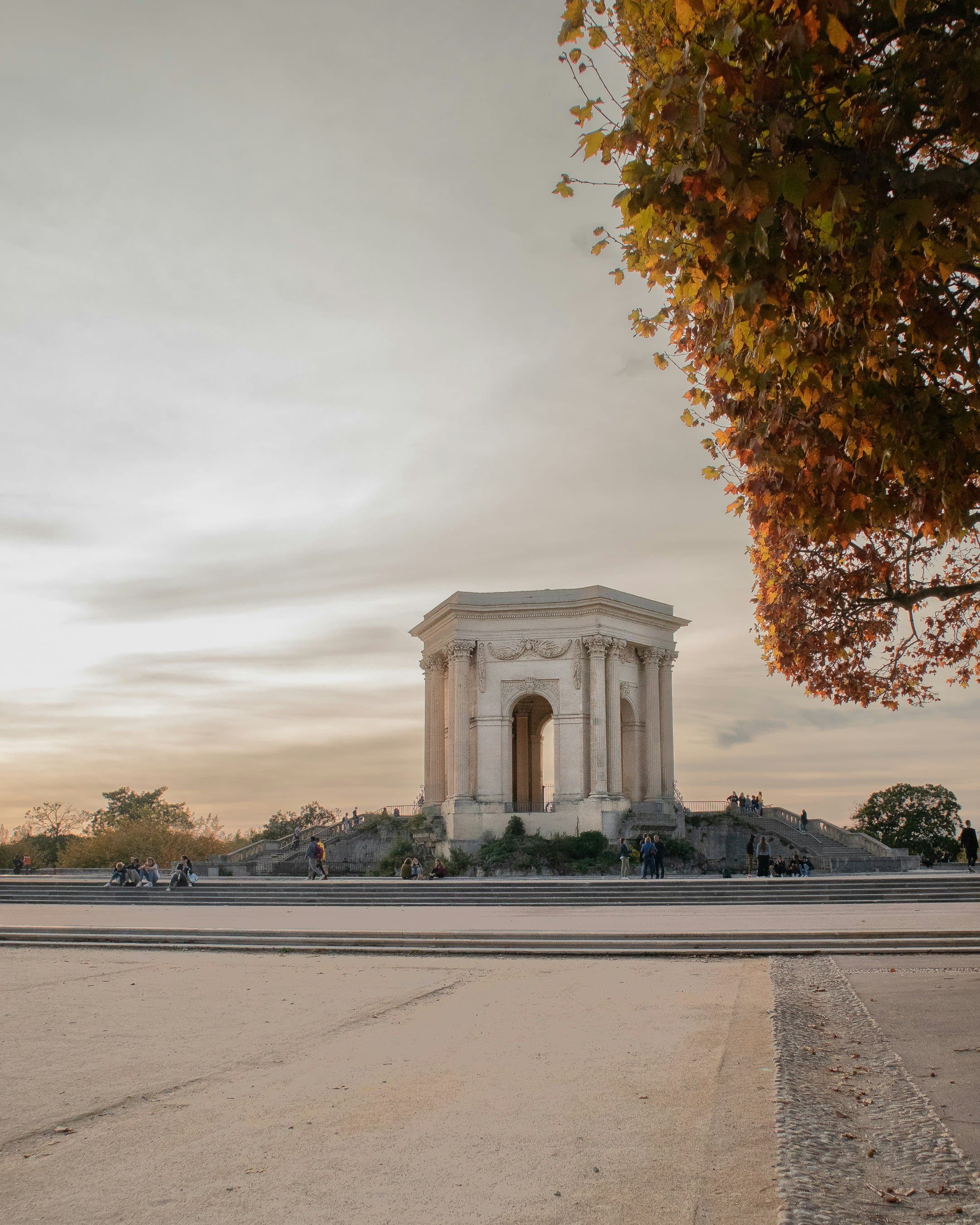
Promenade du Peyrou and the Château d’Eau
About 0.2 km (0.1 miles). The 18th-century promenade that hosts the race village ends at the Château d’Eau, a columned water tower fed by the Saint-Clément aqueduct, whose arches run away across the Arceaux district. The terrace looks out over the west of the city.
Jardin des Plantes
About 0.4 km (0.25 miles). France’s oldest botanical garden, founded in 1593, is just north of the Peyrou and free to enter. A quiet, shady walk for the day after. Check opening days before you go.
Place de la Comédie
About 0.7 km (0.4 miles). The city’s main square, with the Opéra Comédie, the Three Graces fountain and café terraces, and the tram running through. The course crosses it three times.
Musée Fabre
About 0.8 km (0.5 miles). The city’s fine-art museum, beside the Esplanade Charles de Gaulle, with European painting from the Renaissance onwards and a large room of Pierre Soulages’s black canvases. Indoors and level; check opening hours for the race weekend.
Antigone
About 1.5 km (0.9 miles). Ricardo Bofill’s 1980s district of monumental neoclassical housing, laid out along a straight axis from the Polygone to the Lez. Flat, open and unlike anything else in the city.
After the Race
Mid-April on the Languedoc coast is mild but early in the season, better for walking than swimming. All three trips below leave from central Montpellier by tram or train, take under an hour, and ask little of legs that ran 42 km the day before.
The nearest seaside town, with a canal, a harbour and a long beach for a flat walk. April is early in the season: come for the sea air and a fish lunch.
A Roman amphitheatre still in use, the Maison Carrée temple and the Jardins de la Fontaine. Mostly flat, and all within a short walk of the station.
A fishing port built on canals below Mont Saint-Clair, with the cemetery where Paul Valéry lies, a Georges Brassens museum and the local tielle pie.
Frequently asked questions
Should I stay near the start or the finish?
Both are within about 750 m of each other on the western edge of the old town, with the race village between them. Stay between the Arceaux and the Comédie.
How far in advance should I book a hotel?
As soon as the 2027 date is published. Around 15,000 runners came for the 2026 festival, and central rooms go first.
Is there free transport to the start on race day?
Not for visitors; trams are free only for Métropole residents. Tram 4 stops at Peyrou Arc de Triomphe, beside the start area.
What is the best area to stay?
Arceaux and the Peyrou for race morning, or the Écusson and Comédie for everything else. The course passes the Comédie three times.
When does the expo open?
In 2026, bibs were handed out on the Peyrou on Friday 12:00 to 19:00 and Saturday 09:00 to 18:00. None on race day. 2027 hours are not yet out.
What is the weather typically like on race day?
Mild: April averages 18.7°C high and 9.2°C low at Montpellier airport. Wind and showers are possible.
How do I get from the airport?
The airport is about 8 km from the centre, linked by shuttle bus to the tram. Many visitors come by TGV to Saint-Roch instead.
Is there a bag drop?
Yes, free, on the Promenade du Peyrou from 07:00 to 15:00 in 2026, for bags of 20 litres or less.
Should I bring a throwaway layer?
Yes. April mornings average about 9°C, and there is a security check and a corral wait before the 08:00 start.
How do I get back to my hotel after finishing?
Walk, or take tram 4 from Peyrou Arc de Triomphe beside the finish. Roads around the finish are closed.