The Race
| Next Race Date | 12 September 2027 |
|---|---|
| Course Type | Loop: start on Schlossplatz, finish on the Prinzipalmarkt, 707 m apart |
| Registration | Open entry, no ballot. Entries open 2 November 2026 |
| Ballot Opens | Not applicable. Places are first come, against a capped field |
| Total Finishers | Not published. More than 4,500 entered the marathon in 2026 |
| Average Race Day Temperature | 11 to 19°C, the September low and high from climate normals |
| Cutoff Time | 6 hours, finish closing about 15:00 |
| Free Race Day Transport | Not confirmed. No entitlement bundled with entry has been published |
| Course Certification | Internationally measured, certificate GER-2023-0093, valid through 2027. AIMS full member |
History
Münster’s marathon started in 2002 and drew more than four thousand finishers in its first year, an unusually large opening field for a new city race. It was put on by Münster-Marathon e.V., a local association formed for the purpose, and it still is. Janusz Sarnicki of Poland won that first men’s race in 2:25:08 and Janina Malska took the women’s title in 2:50:54.
Times have come down a long way since. Charles Yosei Muneria of Kenya holds the men’s course record from 2023, reported as 2:09:07 by some outlets and 2:09:06 by others; the two differ by a second and neither has been checked against an organiser record list. Lilian Jelagat of Kenya set the women’s record of 2:27:39 in 2022. In 2025 Samuel Kiplimo Naibei won in 2:09:20 with three men under 2:10, and Aberash Fayesa Robi took the women’s race in 2:29:21.
The 24th edition, on 13 September 2026, ran through continuous rain and still set a participation record: more than 13,000 entries across the weekend’s distances, of which over 4,500 were for the marathon itself. Dickson Kiptoo of Kenya won in 2:10:03, about a minute outside the course record, from his compatriot Dickson Kiprop in 2:10:46 and Emanuel Giniki Gisamoda of Tanzania in 2:12:37. Agrie Belachew Wole of Ethiopia won the women’s race in 2:28:43, ahead of Cecilia Wayua Michael in 2:30:21 and Azalech Masresha Woldeselasse in 2:31:09. Lisa Huwatscheck was fourth in 2:34:31, the fastest time a German woman has run at this race.
The course is measured under international certificate GER-2023-0093, valid through 2027, and the race is an AIMS full member and a World Rankings Competition registered with the regional federation FLVW. It holds no World Athletics label. September 2027 brings the 25th edition.
The course
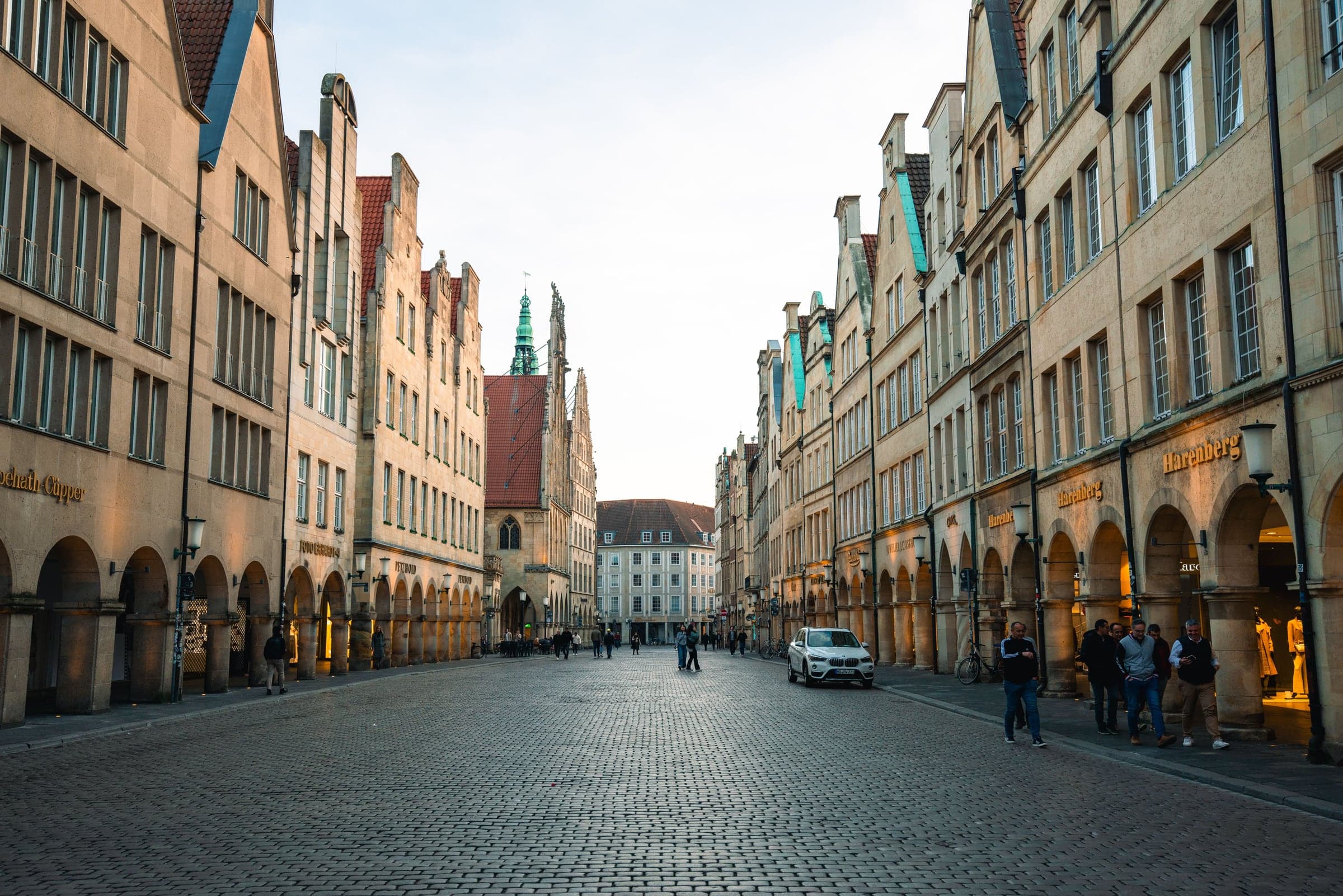
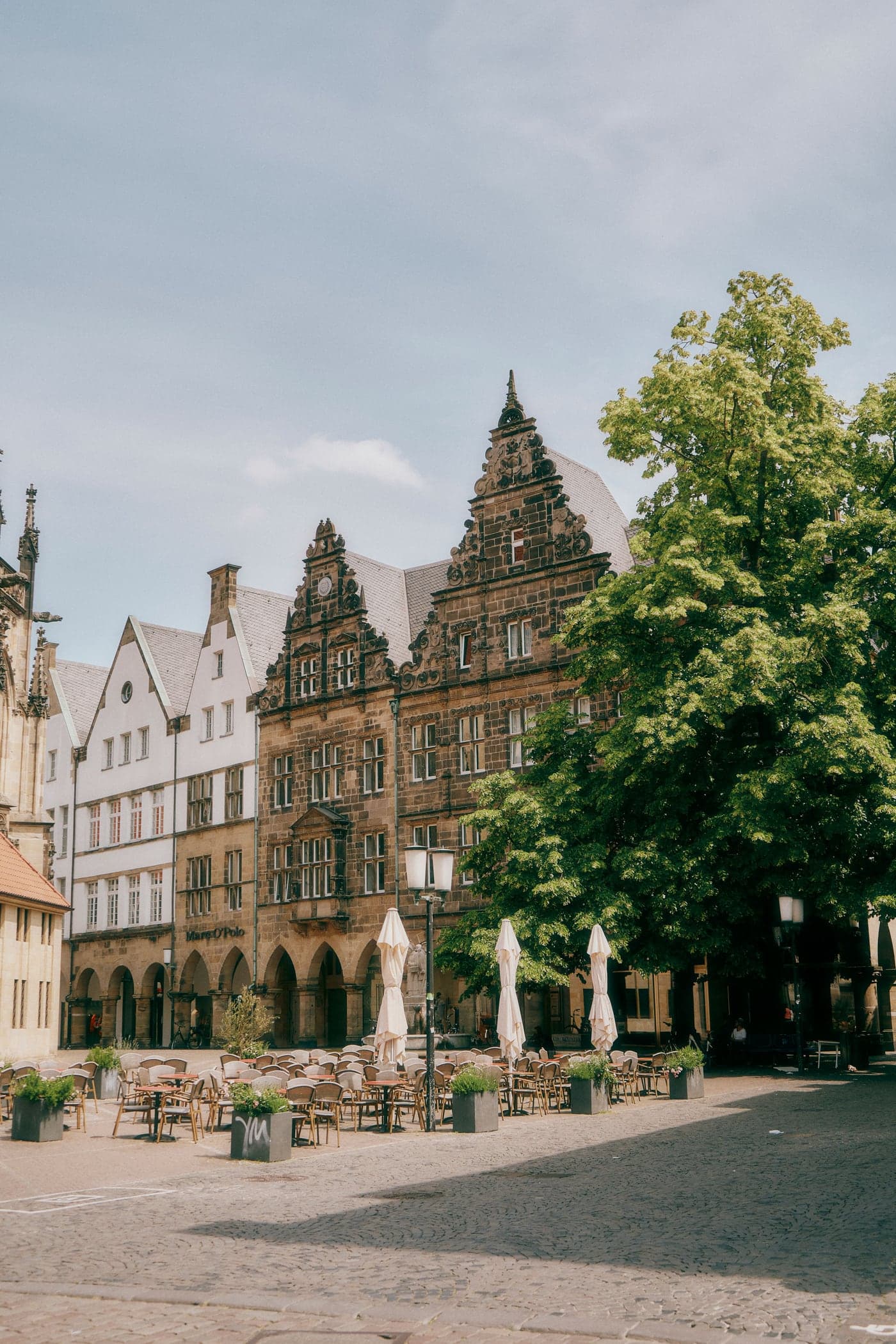
One lap, and a flat one. The race starts on Schlossplatz beside the former prince-bishop’s palace and finishes 707 m away on the Prinzipalmarkt, the arcaded street of gabled merchant houses at the centre of the old city. Between those two points it covers 42.195 km in a single loop that spends its first quarter inside the city walls and its middle half in the western districts.
The SRTM profile below runs between 57 m and 84 m, a band of 26 m across the whole marathon. The high ground is at km 21.3 out at Kinderhaus and the low point is at km 6.4 in the old city, so the shape of the day is a long gradual drift upward to halfway and an equally gradual return. No kilometre on the course averages steeper than 1 per cent in either direction. A third-party route guide puts total climb at about 130 m; the organiser publishes no figure and this page does not treat that estimate as confirmed.
What decides times here is wind. From roughly km 21 to km 32 the course crosses open farmland around Nienberge and Roxel with nothing between the field and the weather, and local race reports name wind, never gradient, as the reason fast days turn ordinary.
Km 0 to 10: inside the walls. The gun goes at 09:00 on Schlossplatz. The opening ten kilometres work through the Altstadt, out along the Promenade, the tree-lined ring on the line of the demolished ramparts, and north into the Kreuzviertel around km 4 to 6, which is where the course touches its low point of 57 m. It comes back down Salzstraße at about km 10, passing the foot of the Prinzipalmarkt, so most runners see the finish street once before they earn it. The relay starts at 09:15 and the 28 km race at 10:10, so this stretch belongs to the marathon field alone.
Km 10 to 16: the Aasee and out. The route leaves the centre on Bismarckallee and rounds the Aasee on Kardinal-von-Galen-Ring, reaching the lake’s southern basin at about km 12, then climbs back north past Annette-Allee and Robert-Koch-Straße into Sentruper Höhe. Nothing here is steep: the ground rises 6 m between km 11 and km 15. This is the last dense crowd support until the closing kilometres, and it is the natural place to settle on target pace.
Km 16 to 21: the long lift to Gievenbeck. Corrensstraße and Gievenbecker Weg take the course into Gievenbeck, and from km 16 to the high point at km 21.3 the profile gains about 19 m. Spread over five kilometres that is 0.4 per cent, a gradient you feel as effort rather than see as a hill, with the single steepest kilometre from km 19 to km 20 at 1 per cent. Buildings thin out, crowds thin with them, and by Kinderhaus at km 21 the course is on the city’s northern edge at its highest ground of the day, about 84 m.
Km 21 to 32: Nienberge, Roxel and the wind. From the high point the course loses 22 m over the next five kilometres through Nienberge, reaching the furthest point from the start at km 25, six kilometres out. Then it gives half of that back, climbing 15 m between km 26 and km 29 into Roxel, and drops 10 m again in the single kilometre after km 31. These are the most exposed eleven kilometres of the day, on farm roads and village streets with intermittent support. If a headwind is up, run this section on effort and let the split go.
Km 32 to 40: back through Gievenbeck. The course re-enters Gievenbeck from the west and spends five kilometres there, on Dieckmannstraße, Borkenfeld, Mergelberg and Rüschhausweg, passing Haus Rüschhaus at km 35.9 for the second time, having run by it at km 17.6 on the way out. The ground is mildly undulating and nothing exceeds 0.3 per cent. Suburb continues to about km 39 through Sentruper Höhe: the city proper returns later than most race descriptions suggest.
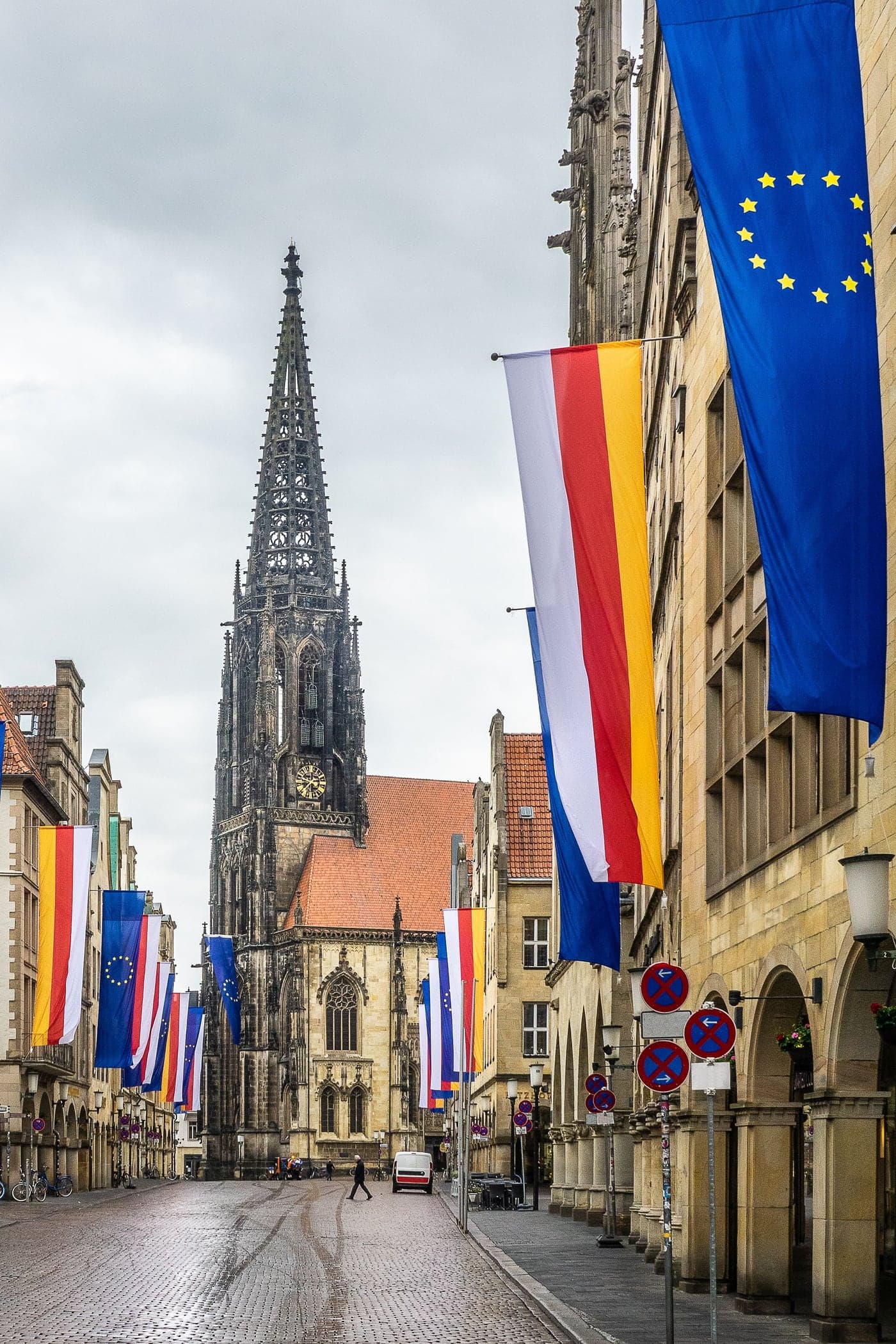
Km 40 to 42.195: the Prinzipalmarkt. Pottkamp and Himmelreichallee bring the course past the top of the Aasee at about km 41 and into the old city for the last kilometre and a half. That is where the noise is: 2026 drew more than 100,000 spectators and around 300 bands and performers along the route, with a red carpet laid down the finish street. The Prinzipalmarkt runs straight and long, so the arch is in view well before it arrives, which makes the last few hundred metres feel further than they measure.
No painted tangent line has been confirmed on this course, so run the turns yourself instead of trusting the road surface to show the shortest route.
Course Map
The map carries the route line, the start and finish, the four landmark districts and the bib collection venue. Tap a marker for details, and scrub the slider or press play to move the orange marker along the course with the elevation profile beneath it.
Pacers
The race runs official pace groups. A detailed guide to the 2026 edition listed nine targets: 3:00, 3:15, 3:30, 3:45, 4:00, 4:15, 4:30, 5:00 and 5:30. One other summary describes coverage more loosely as spanning 3:00 to 6:00, and neither list is confirmed for 2027. There are no published wave times or corral letters: the marathon goes off as a single mass start at 09:00 with seeding inside the start area.
What to wear
September mornings in Münster vary widely. Climate normals give a monthly average near 14.5°C, typical highs around 19°C and lows around 11°C, and recent editions have delivered both humid warmth and the steady rain that fell through 2026. Check the forecast rather than the average.
Schlossplatz is a wide open square with nothing to stand behind, so the twenty minutes before a 09:00 start can feel considerably colder than the day’s high suggests. A cheap disposable top is worth having even when the afternoon is forecast to warm up. No organiser clothing-donation scheme has been confirmed for 2027, so plan on keeping or disposing of whatever comes off rather than assuming it will be collected for charity.
A light shell is worth carrying for the western kilometres, where there is no shelter from either wind or rain. Anyone finishing into a warm late morning should treat sunscreen as necessary: the run-in through the old city has very little shade.
Entry
Entry is open registration with no ballot and no lottery. The organiser opens 2027 entries on 2 November 2026, and places go first come against a capped field. That makes this one of the more straightforward major German marathons to get into, provided you do not leave it until the summer.
The most recently published marathon pricing was €75 to €95 depending on registration phase, with a student discount reported by secondary listings. Pricing for 2027 has not been published, and German marathons routinely raise the entry fee in steps as registration numbers pass thresholds, so the cheapest tier is the one that disappears first.
There is no Good For Age route, no guaranteed-qualification standard, and no separate charity-place allocation for the marathon distance, though a standalone 10 km charity run exists alongside it. No public list of official international tour operators has been found, and no elite qualifying standard has been published.
Seeding is handled by start blocks inside a single mass start, and older guidance describes proof-of-time evidence being asked for at registration, though the exact 2027 procedure is not published. Transfer, deferral, cancellation and insurance terms could not be verified from a current organiser document; check them before paying if any of those matter to your plans.
Demand is rising. The 2026 edition set a participation record of more than 13,000 across all distances, over 4,500 of them in the marathon, and reporting at the time described local accommodation filling well ahead of race weekend. Enter when entries open and book a cancellable room at the same time.
Fast Runner / GFA Standards
There is no qualifying route for this race. Every place is sold on the open registration, and a fast recent time buys a better start block, nothing more.
Race Weekend
Expo
Bib collection has been at the Gymnasium Paulinum, Am Stadtgraben 30, in recent editions, on a pattern of roughly Friday 14:00 to 19:00, Saturday 10:00 to 19:00 and Sunday 07:00 to 08:30. Both the venue and those hours need confirming for 2027.
The Paulinum sits 474 m from the start on Schlossplatz and 732 m from the finish, which removes the usual expo problem: no dedicated trip, no shuttle, no separate part of the city. Anyone staying centrally passes it anyway. Recent event guidance also uses the Paulinum area for changing and baggage before the race.
Exact 2027 collection requirements have not been published, including whether photo identification, a registration QR code or written authorisation for proxy collection are needed, and whether international runners need anything additional. Bring the confirmation email and a passport or identity card as a working default.
Race-morning collection between 07:00 and 08:30 is possible but tight against a 09:00 start in a field of this size. Saturday afternoon is the busiest window; Friday afternoon is the quietest if your travel allows it.
Getting to the Start
Walk. That is the whole plan for most visiting runners, and it is the single biggest practical advantage this race has. Schlossplatz is 1.5 km from Münster Hauptbahnhof, about twenty minutes on foot through the centre, and considerably less from an Altstadt hotel. The finish on the Prinzipalmarkt is 707 m from the start and 800 m from the station.
Recent race guidance has named Neutor/Schlossplatz Nord and Münzstraße as useful bus stops near the start. Treat them as a fallback: race-morning closures cut across routes through the centre, and a bus that has to cross the course is a bus that may not arrive. The closures themselves are extensive, so anyone driving in on Sunday morning should expect to park outside the ring and walk in.
The gun is at 09:00 for the marathon. The four-person relay follows at 09:15 and the 28 km Wecker-28 at 10:10, which means the marathon start area clears before the other fields build up, but also that relay runners on fresh legs will come through the marathon field from about the second kilometre onward.
Changing and baggage facilities have been provided near the start and around the Paulinum in recent years. The 2027 opening time, permitted bag type and any security check have not been published. Because the start and finish are seven hundred metres apart, there is no bag transfer across the city to plan for and no risk of a bag ending up at the wrong end of the course.
Toilet provision has historically included facilities at Schlossplatz and the Paulinum. Queue length on the morning itself is the usual gamble, and a field that has grown past 4,500 in the marathon alone argues for arriving earlier than feels necessary.
After the finish you are already in the middle of the Altstadt. The station is a ten-minute walk, Schlossplatz is walkable in the other direction, and there is no shuttle to queue for. Recent finisher provision has included a medal, recovery food and alcohol-free beer; the 2027 contents and any shower facilities are not published.
Nutrition on Course
A detailed guide to the 2026 edition counted 17 aid stations across the marathon, carrying water, an isotonic drink, cola later in the race, bananas and other fruit, and sweets. Event material separately mentions electrolyte drink and alcohol-free beer at the finish.
Seventeen stations over 42.195 km works out at something between two and two and a half kilometres apart, though no kilometre-by-kilometre table has been published for 2027 and the spacing is unlikely to be even. Treat that figure as a planning average, not a schedule.
The exception worth preparing for is the western section. Between km 21 and km 32, out through Nienberge and Roxel, the same spacing costs more effort if there is a headwind, and it is the part of the course where a missed station is hardest to recover from. Carrying a single gel and a small flask through that stretch is reasonable insurance even on a course this well supplied.
The brands, the cup type and whether cups or pouches are used have not been published. Personal-bottle support has been available in past editions, but the 2027 procedure and submission deadline are not confirmed, so do not build a race plan around bottles until the participant guide says so.
Spectating
Accept the shape of this course and spectating becomes easy. The first ten kilometres and the last two are in the old city; everything from km 10 to km 40 is out west and harder to reach. The 2026 race drew more than 100,000 spectators along the route with around 300 bands and performers, and the density of both follows the same pattern.
The strongest single position is the Prinzipalmarkt itself, which combines the loudest crowd on the course with arcades to shelter under when the weather turns. It requires no transport decision at all if the same spectator watched the start on Schlossplatz, seven hundred metres away.
Itinerary A: the old city, on foot
Watch the start on Schlossplatz at 09:00, walk five minutes east into the Altstadt for a second sighting on the Promenade or Salzstraße between km 7 and km 10, then take a long coffee and be on the Prinzipalmarkt for the finish. Three sightings, no transport, and the whole morning inside a square kilometre.
Itinerary B: the Aasee addition
The same start, then a fifteen-minute walk south-west to the Aasee for the km 11 to km 13 passage along Bismarckallee and Kardinal-von-Galen-Ring, then back into the centre for the finish. This adds a genuinely different setting to the day and still needs nothing but legs.
Itinerary C: west to Gievenbeck or Roxel
The outer districts can be reached by bus toward Gievenbeck or Nienberge, or by regional train to Roxel, and the course is out there for three hours. The risk is the return: race-day diversions and a closed course between you and the Prinzipalmarkt can leave you missing the finish. Attempt it only with live tracking and the final 2027 timetable, and set a hard departure time before you go.
The race has promoted live runner tracking in recent years; the 2027 app or platform has not been confirmed.
Post-Race Food
Finishing on the Prinzipalmarkt puts you in the middle of the city’s restaurants instead of a field on the outskirts, which is worth more than it sounds at half past one on a Sunday.
The Ratskeller, in the cellar of the historic Rathaus on the Prinzipalmarkt, serves traditional German food in large portions and opens on Sundays, and it is a hundred metres from the line. Kleiner Kiepenkerl and Großer Kiepenkerl, a short walk away on Spiekerhof, do hearty Westphalian cooking and also trade on Sundays.
For something lighter and more clearly carbohydrate-shaped than a Westphalian plate, the pasta places on Salzstraße inside the pedestrian area are the better call. Check Sunday hours close to race weekend: Münster’s shops close on Sundays even where its restaurants stay open, and kitchen times shift with the season.
The rest of the weekend
The marathon is one event among several. A four-person relay splits the same 42.195 km course, with handovers reported around the Aasee, Nienberge and Roxeler Straße in past editions. A 28 km race called the Wecker-28, a 10 km charity run, a 6.5 km health run and a children’s race fill out the weekend, which is how combined entries passed 13,000 in 2026.
For a marathon runner the practical effects are the relay traffic coming through from the second kilometre and a finish area shared with several thousand people who have run a good deal less far. For a travelling companion, it means an event to enter instead of a morning spent waiting on a kerb.
Where to Stay
This site normally tells runners to book for the finish, because a finish-side hotel saves the walk that hurts most. In Münster that advice collapses into nothing useful: the Prinzipalmarkt and Schlossplatz are 707 m apart, the bib collection sits between them, and the railway station is 800 m from the finish. Everything inside the Promenade ring works for both ends of race day, so choose on price, noise and what you want to do on the days either side.
Altstadt and Prinzipalmarkt
The Altstadt is the most convenient and the most expensive, running from the finish line out to about a kilometre in any direction. It is also the loudest: the restaurant and bar streets around Spiekerhof and Kuhviertel are directly on top of it, and a Saturday night room facing the street will hear them. Pick a courtyard room, or pick somewhere else, if you sleep badly the night before a race.
Aegidii
Aegidii, immediately south-west of the Prinzipalmarkt, is the compromise most runners should take first. It sits roughly halfway between start and finish, about 500 m from one and 600 m from the other, with the Aasee a ten-minute walk away and the busiest bar streets a block further north. Prices are a step below the Prinzipalmarkt frontage and the walk is no worse.
Kreuzviertel
Kreuzviertel, north of the Promenade, is residential, full of cafés, and the quietest of the central options on a Saturday night. The course runs through it between km 4 and km 6, which gives anyone staying there a sighting without leaving the doorstep. Walking to Schlossplatz takes ten to fifteen minutes. Accommodation here is thinner than in the Altstadt and skews toward small properties, so it sells out early.
Bahnhofsviertel
The station district suits anyone arriving late on Saturday or leaving on Sunday evening. The finish is 800 m away and Schlossplatz about 1.4 km, and the area holds most of the city’s larger chain hotels, which is where the rooms are when the Altstadt has sold out. It is functional and the character changes block by block, so read the map before booking on price alone.
Schlossplatz and the university
The area around the palace and the university buildings is green, quiet and closest to the start, with the Botanischer Garten behind the Schloss and the Aasee to the south. Its drawback is stock: this is a district of institutions, so there are few hotels, and the ones that exist fill on any weekend with a large event.
Hafen and Kreativkai
The old harbour south-east of the station has become the city’s evening district, with restaurants and bars along the quay. It suits companions who want a night out more than it suits the runner: it is about 1.5 km from the finish, the walk back after the race is unremarkable, and noise is the point of the area.
Staying well outside the centre to save money makes little sense in a city this compact. Availability is the real constraint, and 2026’s record field made that visible: the booking window matters considerably more than the neighbourhood.
Recommended hotels
The closest of these to the finish line and the largest, at 138 rooms, which is the practical argument for it on a weekend when small central properties sell out. Expect race-weekend pricing well above the normal rate.
Aegidiistraße puts you almost exactly between the two ends of race day: 0.5 km to the finish, 0.6 km to the start. Quieter at night than the bar streets a block north.
On Herwarthstraße behind the station, which makes it the sensible choice if you are travelling by rail and leaving on Sunday evening. The walk to Schlossplatz on race morning is about 1.3 km.
The cheapest central bed on this list, next door to the Novotel and the same walk from the finish. Rooms are small and functional, and the station is two minutes away.
Booking timeline
The 2027 date is already fixed at 12 September and entries open on 2 November 2026, so there is no ballot result to wait for and no reason to hold off on a room. Book a cancellable central hotel as soon as you decide to run, then enter when registration opens, then buy rail tickets once the timetable is loaded.
That order matters more than usual here. The 2026 edition set a participation record above 13,000 entries and contemporary reporting described hotels filling ahead of race weekend; the best-value central rooms go first. German intercity rail fares also rise as the cheap quota sells, so a Sparpreis booked early is worth real money.
For UK travellers the usual routing is a flight to Düsseldorf and a train on to Münster, taking about ninety minutes to two hours. Münster Osnabrück Airport works where the flight schedule allows. No official 2027 race hotel block has been published.
See & Do
Everything below is within a kilometre and a half of the finish and of the hotels above, which in a city this size means everything below is walkable on Sunday afternoon legs.
Prinzipalmarkt and the historic Rathaus
0 km (0 miles) from finish. The finish street is also the city’s principal sight: a rebuilt row of arcaded gabled houses with the Rathaus at its centre, where part of the Peace of Westphalia was negotiated in 1648. The Friedenssaal inside is open to visitors. Shops close on Sundays, which makes the architecture easier to look at.
St-Paulus-Dom and the Domplatz
0.3 km (0.2 miles) from finish. The cathedral is a few hundred metres west of the Prinzipalmarkt, with an astronomical clock from the 1540s inside that still draws a small crowd at noon. Check service times before planning a visit around worship.
LWL-Museum für Kunst und Kultur
0.4 km (0.25 miles) from finish. On the Domplatz, and the strongest indoor option for a wet Saturday before the race. Münster’s museums generally close on Mondays, so anyone staying through to Monday should use it on the day before instead.
The Aasee
1.5 km (1 mile) from finish. The lake the course rounds at km 12, about fifteen minutes’ walk from the Prinzipalmarkt. A short section of the flat lakeside path is a sensible recovery walk on Monday morning; the full circuit is more than sore legs want.
Botanischer Garten
1.2 km (0.75 miles) from finish. Behind the Schloss, near the start, free and open year round. It solves the Monday problem created by the museum closures and asks almost nothing of the legs.
Reading
Peter H. Wilson’s The Thirty Years War: Europe’s Tragedy is the book for this particular finish line. The settlement signed in Münster and Osnabrück in 1648 ended that war, and Wilson explains why two Westphalian towns ended up hosting it. Worth having read before walking into the Friedenssaal a hundred metres from where you stopped your watch.
After the Race
Mid-September is a good time to still be in north-west Germany: warm enough for outdoor tables, past the summer crowds, and everything still open. Münster also sits on fast rail lines in three directions, so the day after a marathon can involve a train and very little walking. These five itineraries are built around that, from a same-day trip to Osnabrück to four nights working south through the Ruhr to Cologne.
The other half of the Peace of Westphalia, negotiated simultaneously in both cities in 1648. Direct trains, a compact old town, and enough for a Monday without a hotel change.
Industrial heritage on a scale nothing in Münsterland matches, plus German football culture at close range. One night is enough to see a colliery and a stadium.
Two nights spreads the cathedral, the Rhine promenade and the old town across separate days, which is the right pace for legs three days past a marathon.
A Ruhr industrial stop followed by two nights in Cologne, all by rail. Trims to three nights by cutting the Ruhr stage to a single overnight.
Flat castle-route country immediately outside the city, for anyone who would rather not board another train. Gentle cycling once the legs come back, and no obligation to do any.
Frequently asked questions
Should I stay near the start or the finish?
Barely a choice here. Schlossplatz and the Prinzipalmarkt are 707 m apart with the bib collection between them, so an Altstadt or Aegidii hotel serves both ends of race day on foot.
How far in advance should I book a hotel?
Early. The 2026 race drew a record 13,000 entries across its distances and central hotels filled ahead of the weekend. The 2027 date is fixed and entries open 2 November 2026, so book a cancellable room first.
Is there free transport to the start on race day?
No entitlement bundled with entry has been published. Most visiting runners can walk: the start is 1.5 km from the Hauptbahnhof, and race-morning closures cut across bus routes through the centre anyway.
What is the best area to stay?
Altstadt or Aegidii for the shortest walks, Kreuzviertel for a quieter Saturday night, the Bahnhofsviertel for an early train home. All four are inside a kilometre of the finish.
When does the expo open?
Recent years have used the Gymnasium Paulinum on Am Stadtgraben, Friday afternoon through Sunday morning, five minutes on foot from the start. Bring your confirmation and photo identification; 2027 hours are not published yet.
What is the weather typically like on race day?
September in Münster averages about 14.5°C, with highs near 19°C and lows near 11°C, and rain is common: the 2026 race ran in a downpour. Wind on the open western farmland matters more than temperature.
How do I get from the airport?
Münster Osnabrück Airport has a scheduled bus to the Hauptbahnhof where the timetable fits. Flying to Düsseldorf and taking the train is often simpler from the UK, at ninety minutes to two hours.
Is there a bag drop?
Recent editions have run changing and baggage facilities at the start and around the Paulinum. With 707 m between start and finish there is no cross-city bag transfer to plan around. Confirm 2027 details in the participant guide.
Should I bring a throwaway layer?
Usually worth it. Schlossplatz is an open square with no shelter before a 09:00 start. No organiser donation scheme has been confirmed, so plan to keep or dispose of whatever you take off.
How do I get back to my hotel after finishing?
On foot. The Prinzipalmarkt finish is in the middle of the Altstadt, 800 m from the Hauptbahnhof, with no shuttle to queue for and no transport decision to make afterwards.