The Race
| Next Race Date | 11 October 2026 |
|---|---|
| Course Type | Loop: single lap, start and finish about 700 m apart inside Olympiapark |
| Registration | Open, no ballot. Online until 27 September 2026, subject to remaining quota |
| Ballot Opens | Not applicable: open registration |
| Total Finishers | Not published. 6,500 marathon entrants in 2025 |
| Average Race Day Temperature | 5°C to 14°C, monthly mean near 10°C |
| Cutoff Time | 6 hours 20 minutes, finish closing 15:20 from a 09:00 start. Intermediate passage times are also enforced |
| Free Race Day Transport | No included MVV ticket. Budget for a fare or day pass |
| Course Certification | Measured to DLV and World Athletics specifications, record and ranking eligible. AIMS full member. No current World Athletics Label |
New course since 2025: what changed
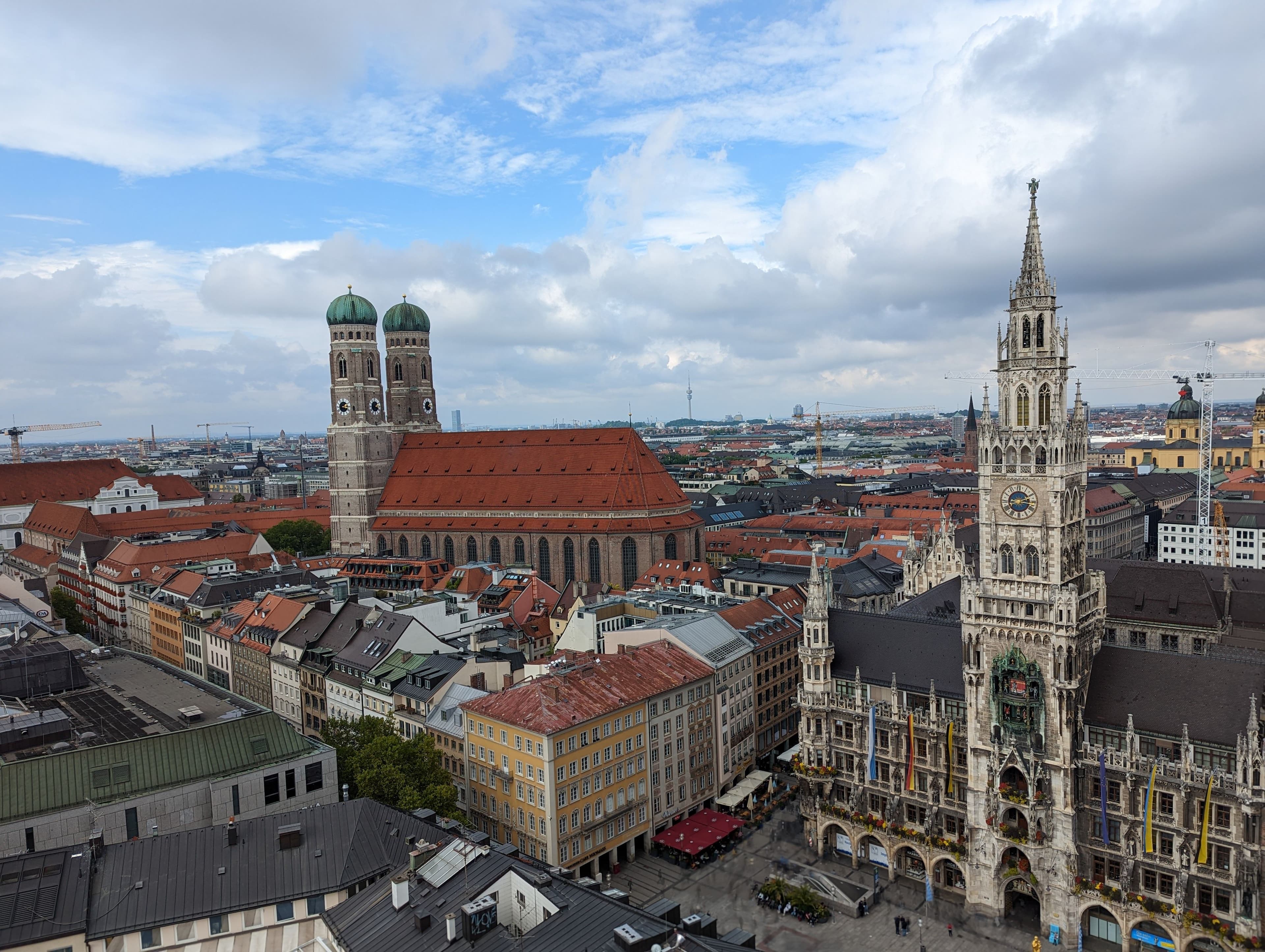
Anyone who ran or followed Munich’s marathon before 2025 should not expect the old race. The event changed operator after 2024, when Laufstatt Event gGmbH won the City of Munich’s tender for 2025 and 2026, a decision the Bavarian Administrative Court confirmed in July 2025 after a challenge from the previous organiser. The course changed with it: a multi-lap route finishing inside the Olympiastadion became a single lap through central Munich by way of Sendlinger Tor and the Werksviertel district, finishing at Willi-Daume-Platz beside the Olympiasee while the stadium is renovated. Course records and the World Athletics Label from the pre-2025 race belong to that earlier course and organisation, not to the event as it runs today.
History
Munich’s city marathon began on 8 May 1983, when FVS e.V., under Hans-Werner Lachner and Ali Schneider, organised the first Olympia City Marathon. A City of Munich historical publication puts the field at 2,013 runners. Sweden’s Kjell-Erik Ståhl won in 2:12:33, and Christa Vahlensieck won the women’s race in 2:33:45. The choice of city was deliberate. Eleven years earlier Frank Shorter had won Olympic marathon gold by entering the Olympiastadion alone, and the new race staked a direct claim to that 1972 inheritance.
The event was relaunched in 2000 as the Medienmarathon, based at the Zenith site, before returning to the München-Marathon name in 2006, the year it also hosted the German Marathon Championships. A 2007 course redesign made Olympiapark the permanent base, sending runners out through the city and back for a stadium finish that defined the race’s image for close to two decades. Under its later operator, Munich Marathon GmbH, the event traded as the GENERALI MÜNCHEN MARATHON and grew into a large multi-distance weekend. It returned to international elite competition in 2022, when Kenya’s Philimon Kipchumba ran 2:07:28 and Agnes Keino 2:23:26, both well inside the previous course records. That 2022 race held a World Athletics Elite Label, a status belonging to the GENERALI-era course and organiser, not the event as it exists today.
The City of Munich put the right to organise the marathon out to tender for 2025 and 2026. Laufstatt Event gGmbH won that process in February 2025, the former organiser contested the decision, and the Bavarian Administrative Court confirmed the award in July 2025. The new organiser redesigned the course at the same time, replacing the old route with a single lap through central Munich and moving the finish out of the Olympiastadion, closed for renovation, to Willi-Daume-Platz beside the Olympiasee. The 2025 relaunch drew a record 28,500 entrants across the full weekend, including 6,500 in the marathon itself, with roughly 150,000 spectators reported. Gabriel Lautenschlager and Nina Voelckel won the first race on the new course, in 2:18:30 and 2:31:34 by the World Athletics results; the organiser’s own press release differs by one to two seconds on both, and both figures are given here.
The 2026 edition keeps the same single-lap structure from the same Olympiapark base, and adds the Bavarian Marathon and Masters Marathon Championships to the day.
The course
MARATHON MÜNCHEN by Brooks starts at Spiridon-Louis-Ring in Olympiapark and finishes at Willi-Daume-Platz beside the Olympiasee, about 700 m away inside the same complex. It is a certified 42.195 km single-lap road course, run on roads, not trail or park surface, introduced in 2025 to replace the previous multi-lap route.
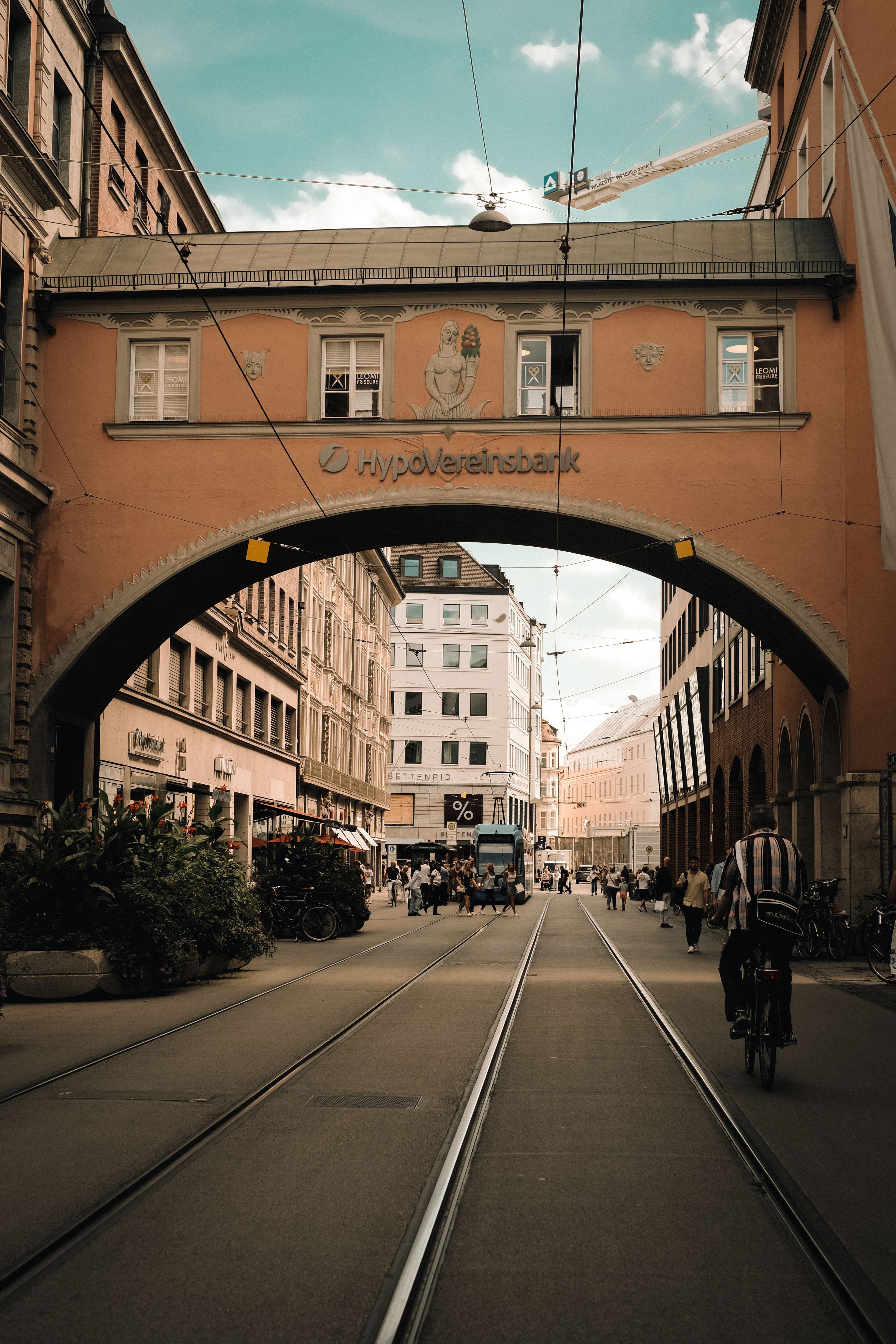
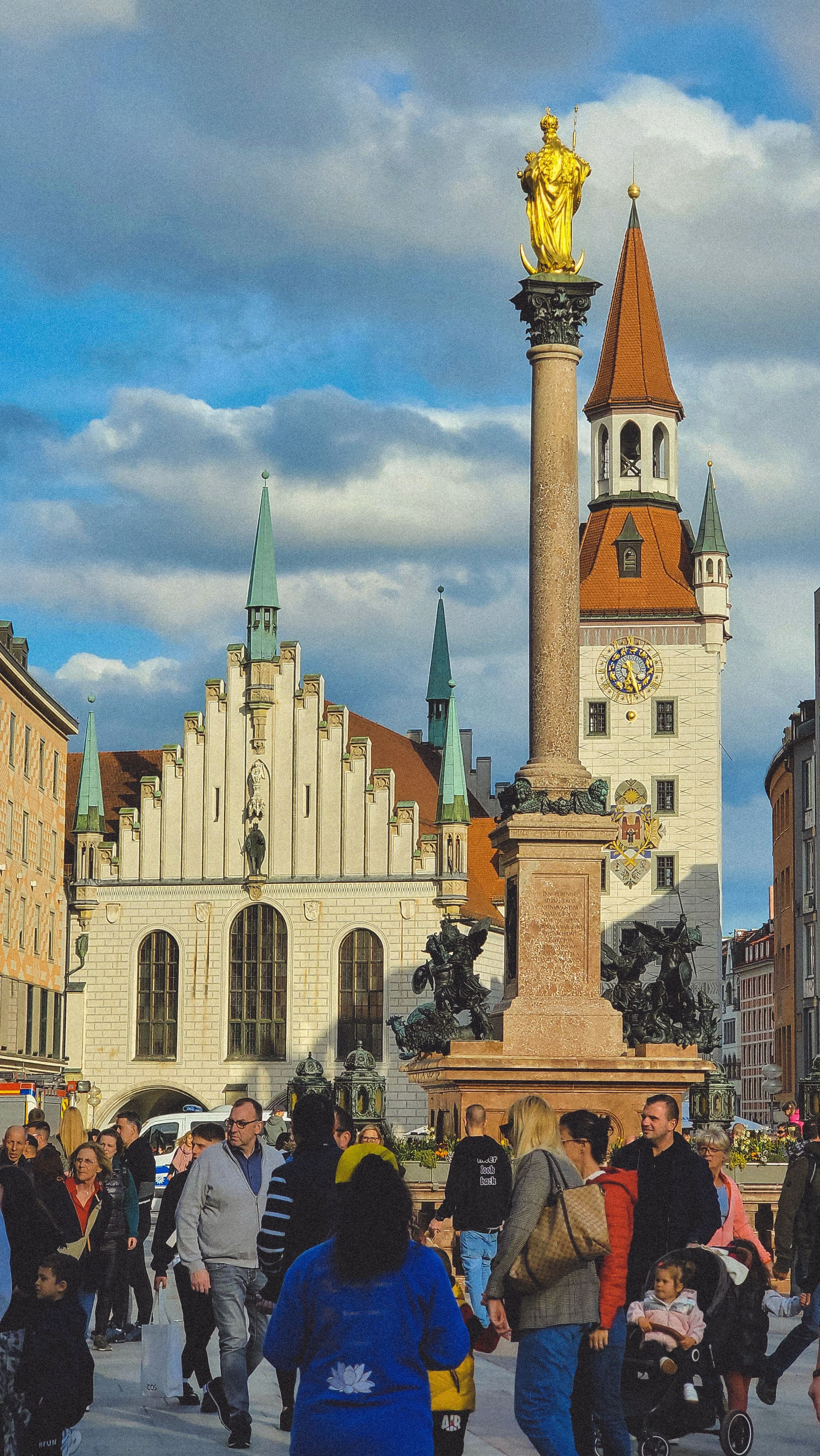
From Olympiapark the route runs south-east by way of Elisabethstraße to the Leopoldstraße university corridor, past the Siegestor, then into the old town around Sendlinger Tor, Rindermarkt, Dienerstraße, Marienplatz and Odeonsplatz. It turns north-east through the Englischer Garten before a long arc through Bogenhausen and the eastern city, using Tivolistraße, Montgelasstraße, Oberföhringer Straße, Cosimastraße and Weltenburger Straße, to the Werksviertel district around Ampfingstraße. It then crosses the Isar on Ludwigsbrücke, passes Isartor, and returns through the city centre and the Siegestor to Olympiapark by way of Franz-Joseph-Straße.
One feature of that shape is worth planning around: the route threads the central squares more than once. The field passes the Siegestor three separate times, and Odeonsplatz and Marienplatz three times each, in the early kilometres and again on the way home. For a supporter, that turns one well-chosen spot near Ludwigstraße into several sightings without moving.
The organiser describes the course as fast and flat, and no official kilometre-by-kilometre elevation table has been published. The finish no longer runs inside the Olympiastadion, so runners working from older race reports should expect the line to sit outside the stadium, beside the Olympic lake instead.
Km 0 to 10: Olympiapark and the university axis. The field starts on Spiridon-Louis-Ring with the Olympic venues around it. Roads are broad, the crowd is fresh, and the temptation to run too hard is real: this is the fastest-feeling section of the whole course and not the place to bank time. The route leaves the park by Elisabethstraße onto Leopoldstraße, running the wide university axis past the Siegestor, the day’s first real landmark. October mornings here can sit close to freezing at the 09:00 start, so expect a field still shedding throwaway layers through this stretch.
Km 10 to 13: Sendlinger Tor and the old town. The course turns into the historic centre, using Sendlinger Tor, Rindermarkt and Dienerstraße before running past Marienplatz and Odeonsplatz. This is the densest spectator section of the route and the trickiest to run cleanly: street widths and directions change repeatedly, and runners drifting toward the barriers for the noise lose metres they will not get back over the closing kilometres. The relay’s first exchange point falls at km 10, which adds crowd noise here without adding marathon distance.
Km 13 to 21: the Englischer Garten. The route turns north-east into the Englischer Garten by way of Martiusstraße and Tivolistraße. Support thins noticeably against the old-town section just run, and the shift from packed streets to open parkland can feel like a drop in energy. This is also the lowest ground on the course, 499 m on the Isar floodplain around km 16, before a rise of about 10 m in a kilometre out of the park toward Bogenhausen near km 21, and in wet or windy weather it is where the cold becomes most noticeable, with less cover than the built-up sections either side.
Km 21 to 32: Bogenhausen to Werksviertel. A long run through Bogenhausen and the eastern city follows, on Montgelasstraße, Oberföhringer Straße, Cosimastraße and Weltenburger Straße, before Truderinger, Neumarkter and Ampfingstraße bring the field into Werksviertel. This is the least scenic stretch and it arrives exactly when fatigue starts to bite. The organiser has built cheering points and live entertainment through the district for that reason, and the four-person relay exchange also lands here. It is also the high ground of the course, a gentle 20 m climb over 8 km to the high point of 538 m around km 33, which makes the closing kilometres a net descent.
Km 32 to 42.195: back across the Isar to the finish. The route crosses the Isar on Ludwigsbrücke and passes Isartor, a clear psychological turn: from here the direction of travel is unmistakably back toward Olympiapark. The road drops about 20 m in the two kilometres down Rosenheimer Straße to the river, the steepest ground on the course at about 1%. It runs back through the city centre and past the Siegestor a final time before Franz-Joseph-Straße carries the field home. Because the finish sits at Willi-Daume-Platz, outside the Olympiastadion, there is no stadium lap: the closing kilometres stay on open roads to the line.
Follow the blue line painted on the road throughout. It marks the shortest legal route and the measured 42.195 km, and drifting off it across a course this varied in street width adds real distance over the full route. No note about a timing mat sitting away from the visible finish was found in the material reviewed, so treat the Willi-Daume-Platz line as both the visual and the timing finish unless the current runner’s guide says otherwise.
Course Map
The single lap from Olympiapark through the old town and the Englischer Garten, out to Werksviertel and back across the Isar. Tap a marker for details, and scrub the slider or press play to move the orange marker along the course with the elevation profile beneath it.
Bavarian Marathon and Masters Championships
The 2026 marathon also serves as the Bavarian Marathon Championships and the Bavarian Masters Marathon Championships. That affects the elite field and the composition of the front of the start line, but it changes nothing about entry, course or timing for everyone else. The exact championship qualifying criteria and medal categories have not been published beyond the marathon distance itself hosting the title.
Pacers
Munich fields official pacers at fifteen-minute increments from 3:00 to 5:00, each carrying a Suunto flag showing the target finish time. The structure differs from most large races: there is no lettered corral or small number of broad waves. Start blocks are assigned individually from the target time each runner declares at registration, and the bib itself shows that runner’s personal start time and block. Pacers sit inside the block matching their own target.
The mapping between individual start blocks and each pace group is not published, so a runner intending to race behind a specific group should find them in the start area on the morning.
What to wear
October race mornings in Munich typically sit in the 5°C to 7°C range at the 09:00 start, warming toward a daytime high near 14°C by afternoon. The monthly mean is close to 10°C, and rain is common enough to plan for. A throwaway layer is the sensible default for the corral: the organiser collects clothing left behind in the start area and passes it to a charitable organisation, so an old top or a bin bag costs nothing beyond its purchase price. Wind exposure along the broad Leopoldstraße and through the Englischer Garten can make the effective temperature colder than the forecast suggests, particularly in the early kilometres before the body has warmed up. Because the field starts relatively late in the morning for October, sunscreen matters less than on a summer race, though a clear day can still catch pale skin over four hours or more outdoors. Treat cool and dry as the hopeful case, and pack for the possibility of cold rain over the full distance.
Entry
MARATHON MÜNCHEN by Brooks runs open registration with no ballot. Entry is sold directly through the organiser’s platform on a tiered dynamic pricing structure. An independent 2026 listing reported the marathon ladder running from €115 to €145, and by early 2026 media coverage indicated the marathon had already reached its top €145 tier after the relevant participant threshold was crossed. At the September 2026 exchange rate, €115 converts to roughly £99 and €145 to roughly £125. Check both the euro price and the conversion before treating either as a live purchase price.
Registration opened on 13 November 2025 and stays open online until 27 September 2026, subject to remaining quota. The half marathon and 10 km distances had already sold out by the time this page’s research was compiled, so a runner should not assume the marathon itself stays open right up to that nominal deadline.
There is no Good for Age or fast-runner guaranteed-entry route for this race. Elite entry does exist, with published standards of sub-2:20:00 for men and sub-2:35:00 for women. Applications go to the organiser’s elite address with a sporting CV, target time, home address and, where available, a World Athletics profile link. The 2026 application deadline is 10 September 2026 and places are limited. The organiser also runs an official tour-operator programme offering secured entries alongside travel and hotel packages; take the current list of participating operators from the organiser’s live page, since it changes between editions.
Laufstatt Event gGmbH is a non-profit organiser and partners with Special Olympics Bavaria among other projects, but no London-style charity-bond entry route into the marathon was identified. Charity involvement here supports the organiser’s own causes and is not a separate way in.
Runners who need to change plans can transfer a place through the official Manage Registration system until 27 September for a €20 fee. The original entry fee is not refunded, and any payment between the original and replacement runner is a private arrangement between them. Distance changes work similarly: upgrading to a longer distance costs the price difference plus €15, downgrading gives no refund and still costs €15, and both are subject to the same 27 September deadline and remaining availability. Ordinary cancellation with a refund is not offered, so a runner who cannot start should use the transfer process.
Fast Runner / GFA Standards
Not applicable. No public Good for Age or fast-runner guaranteed-entry route exists for this race. Entry is open registration for every standard below the elite thresholds above.
Race Weekend
Expo
The expo runs at Olympiahalle in Olympiapark, with race materials specifying the east entrance for runner access. Bib collection opens Friday 9 October from 14:00 to 18:00, continues Saturday 10 October from 10:00 to 18:00, and has a short emergency-only window on Sunday 11 October from 07:00 to 08:00 for runners who cannot collect beforehand. Saturday is the busier of the two main days by a wide margin, so collecting on the Friday afternoon, where travel plans allow, avoids the weekend queue entirely. Collection in person requires valid photo ID and proof of participation, and a proxy can collect on a runner’s behalf with written authorisation and their own ID. There is no postal delivery of race bibs.
The marathon field receives what the organiser calls the 2026 Signature Runner’s Bag, holding the personalised bib with its integrated timing transponder, four safety pins, the printed Runner’s Guide, a bag-number sticker for the bag-drop system, and any pre-ordered vouchers and partner extras. The wider Runners Festival occupies Olympiahalle and the adjoining Hans-Jochen-Vogel-Platz across the whole weekend. The official Pasta Party runs on the Saturday from 13:00 to 18:00 behind Biergarten Coubertin, with pre-booked portions at €8.50 rising to €11.50 for anyone buying on site, while stock lasts.
Getting to the Start
The marathon starts at 09:00 on Spiridon-Louis-Ring in Olympiapark. The organiser’s recommended route from central Munich is U3 or U8 to Olympiazentrum, a direct single-line journey from most central stops. Road closures on the day can affect surface trams and buses even where the U-Bahn keeps running, so check the MVV app for service notices. From Munich Airport, the S1 or S8 line reaches the city in around 40 minutes to Hauptbahnhof, with onward travel by U-Bahn toward Olympiazentrum. No free MVV ticket bundled with race entry has been identified, so budget for the appropriate fare or a day pass.
Start blocks are assigned from the target time submitted at registration, and the bib displays each runner’s personal start time and block. Only bib holders can enter the corresponding start area. Bag drop uses the same Runner’s Bag issued at the expo: label it with the bag-number sticker and deposit it in the correctly numbered group at the designated Olympiahalle and Olympiapark drop point. Anyone needing to store more than fits in that bag can use the separate special-luggage facility for €10. Changing rooms are available inside Olympiahalle before the start.
Clothing left behind in the start area is collected for charitable donation, which makes an old top or a bin bag a sensible throwaway layer. The organiser also promoted an extended after-run service through the Olympic swimming facility for 2026, including showers, recovery space and professional massage; exact access terms and any fee have not been confirmed, so check the current runner’s guide before counting on it.
At the finish, Willi-Daume-Platz sits beside the Olympiasee. Runners receive their medal and pass into a one-time refreshment area stocked with water, energy bars, fruit, cake, pretzel sticks and alcohol-free beer. Once a runner leaves that area re-entry is not permitted, so it is worth taking what is needed before moving on. Medal engraving is available on the roof of the Kleine Olympiahalle for €15 when pre-ordered.
Nutrition on Course
The course carries thirteen aid points, alternating water-only stops with fuller supply stations. Water stops fall at roughly km 6, 8.5, 16, 23.5, 28.5 and 35. Supply stations, carrying electrolyte drink, bars and bananas alongside water, fall at km 10.5, 13, 20, 26.5, 31.5, 37 and 39. Gels are available from km 26.5 onward rather than from the start.
Water is supplied by Stadtwerke München, the electrolyte drink is a brand named Nurish on the organiser’s own course page, and solid fuel is Dextro sport and energy bars with Dextro gels from km 26.5. Runners can submit personal bottles in advance, and these are placed on a separate table at the start of each supply station. Personal bottles can be handed in on Saturday 10 October and again on race morning until 07:30 at the organiser’s information point.
The official pages show a minor inconsistency between the water-station placements listed as 16 and 16.5, and as 23.5 and 24, in different renderings. Treat the final printed 2026 runner’s guide and course map as definitive for exact positioning. Mobile toilets are positioned at the start and finish and at every water and supply station, and the Olympiahalle toilets are also available before the start for anyone who prefers a fixed facility.
Spectating
Munich’s single-lap course rewards spectators who plan around the U-Bahn and S-Bahn. A realistic maximum for a companion using public transport well is three sightings across the day. The single best option for anyone who would rather not travel at all is Olympiapark itself: it covers the start, gives access to the Runners Festival while the runner is out on the course, and puts a spectator back in position for the finish without a single train journey.
For a supporter willing to move, the strongest plan is to watch the start in Olympiapark, take U3 from Olympiazentrum toward the centre and get off around Universität or Odeonsplatz for the Siegestor and the central section, then walk or ride a short distance to Marienplatz for a second sighting timed against the runner’s expected pace, before returning on U3 to Olympiazentrum in good time for the finish. The central squares are the place to do this: the course passes the Siegestor, Odeonsplatz and Marienplatz three times each, so a single position near Ludwigstraße can produce several sightings on its own.
Two alternatives work well. From the old town, the S-Bahn or U5 toward Ostbahnhof reaches the Werksviertel and Ampfingstraße area in about ten minutes on foot from the station, where the organiser concentrates cheering points and the four-person relay exchange. Or take U3 or U6 to Universität for the Englischer Garten crossing, then return quickly by U3 to take up a finish position around Willi-Daume-Platz. Live tracking runs through the official race system and app; take the current spectator-app link from the runner’s guide.
Post-Race Food
The official finish provision of water, bars, fruit, cake, pretzel sticks and alcohol-free beer covers the first hour reasonably well, but three sit-down options are worth planning for beyond that. Olympia Parkcafe, on Spiridon-Louis-Ring itself, is the closest to the finish and currently lists Sunday opening, which matters most if walking any further is uncomfortable. Hofbräu am Oberwiesenfeld, on Hildeboldstraße, is a short taxi or transit ride from the park, opens Sunday from late morning, and serves the kind of hearty Bavarian food that suits a large, filling meal. In the centre, Wildmosers Restaurant-Café am Marienplatz lists Sunday opening too, though it needs a U-Bahn trip after finishing. Restaurant 181 in the Olympic Tower, once a well-known finish-day choice, is marked temporarily closed in current business listings and is left out here for that reason.
Where to Stay
The usual rule is to pick a hotel by its distance to the finish. Here that distinction almost disappears, since both sit inside the same Olympiapark complex about 700 m apart. What actually varies between the neighbourhoods below is the balance between race-morning convenience and having a city weekend worth staying for.
Olympiapark and Milbertshofen
Olympiapark and Milbertshofen give the shortest possible route to the start line, a walk or one short transit hop for most hotels in the area. The area is quieter than the centre and lighter on tourist restaurants, which suits a runner treating the weekend as a performance trip.
Schwabing
Schwabing and the area around Münchner Freiheit offer the strongest middle ground: U3 runs directly to Olympiazentrum, and the neighbourhood has enough restaurants and cafés to make Friday and Saturday feel like more than a wait in a hotel room. Saturday nights get loud around Münchner Freiheit itself, so a room a street or two off the main strip is worth the small extra walk.
Maxvorstadt
Maxvorstadt and the streets around the Universität are central and culturally dense, sit directly on the U3 line, and give easier sightseeing than an Olympiapark base while keeping race morning to a simple ride. This is a reasonable default for a first-time visitor who wants both convenience and a proper look at the city, and it sits on the course as well.
Altstadt
The Altstadt around Marienplatz is the strongest choice for sightseeing and the weakest on price. A direct U3 journey from Marienplatz to Olympiazentrum makes race morning easy, but weekend hotel rates run high and some of the pedestrian streets carry noise into the evening. It has one clear advantage for anyone travelling with a supporter: the course comes through these streets three times.
Hauptbahnhof and Bogenhausen
Hauptbahnhof and Ludwigsvorstadt suit anyone prioritising airport and rail transfers, with a wide spread of hotel choice and Olympiapark reachable by U-Bahn with one change or a short combined journey; the immediate station area is functional. Bogenhausen and Arabellapark matter mainly because the organiser’s two official partner hotels sit there. Both are comfortable and quiet, but neither is the shortest route to the start, so allow extra time for the U-Bahn connection on race morning.
Oktoberfest ends before marathon weekend in 2026, so this is not a Wiesn-adjacent booking rush. Munich stays a high-demand city year-round regardless, and central rooms are still worth securing early.
Recommended hotels
Official race partner hotel, with a published 2026 runner rate of €155 single and €185 double including breakfast, roughly £133 and £159. Breakfast opens from 06:00 on race morning and the hotel runs a Saturday marathon menu, both aimed at runners.
The second official partner hotel, at €120 single and €145 double including breakfast, again served from 06:00 on race day. It shares the Westin’s Bogenhausen trade-off: comfortable and quiet, but reached by U-Bahn.
The third official partner hotel, at €190 single or double including breakfast. Well placed for the station and the city centre generally, though it is not within walking distance of the Olympiapark start.
Not an official partner property, but its position near Olympiapark makes it a practical independent option for runners prioritising a short race-morning journey. Confirm the current weekend rate and the exact walking route before booking on proximity alone.
The most race-morning-convenient of the independent choices by location. Expect an event-weekend price premium given how close it sits to the start, and confirm availability early.
Partner runner rates are limited by availability, and should be confirmed directly with the hotel at the time of booking.
Booking timeline
There is no ballot for this race, so the usual pressure of waiting on a results date does not apply. The real timing risk is hotel price and race quota; there is no entry lottery. Registration opened in November 2025, and by the time this page’s research was compiled the half marathon and 10 km had both sold out while the marathon remained open, which is a fair warning against assuming every distance stays bookable up to the nominal late-September deadline. The organiser’s official partner-hotel runner rates were announced in July, well ahead of the race, so comparing those immediately after entering is more useful than waiting until autumn. Flights between the UK and Munich run frequently, but a same-day Sunday-evening return after finishing leaves little buffer if the race, transport or a delayed flight runs long; a Monday departure is the more comfortable option. Munich Airport sits around 40 minutes from Hauptbahnhof by S1 or S8, with onward travel to most hotel areas by U-Bahn.
See & Do
Everything below is judged from the finish in Olympiapark and the hotel areas around it. Two sit on the race site itself, and the rest are reachable on the U-Bahn lines a runner will already be using. Race weekend falls after Oktoberfest has ended, so this is not a Wiesn trip.
Olympiapark and BMW Welt
The race base doubles as one of Munich’s main visitor areas. BMW Welt sits directly opposite the park, close enough to combine with bib collection without a long extra walk, while the adjoining BMW Museum involves more standing and suits Saturday better than the day after finishing, when legs are stiffest.
Marienplatz and the Altstadt
Marienplatz is both a course landmark and the centre of the old town’s sightseeing. Visit on the Friday or Saturday; on Sunday, road closures for the race turn the same streets into a navigation exercise. Anyone already staying centrally needs no extra travel at all.
Englischer Garten
The marathon route runs through and along the park, and a gentle post-race visit works well for recovery, provided the plan is a short walk, not a full circuit of one of Europe’s largest urban parks the day after 42.195 km.
Deutsches Museum
A strong option if the weather turns, sitting on an island in the Isar close to where the course crosses at Ludwigsbrücke. The museum is large enough that covering it in one visit is unrealistic on tired legs, so picking two or three galleries in advance works better than an open-ended wander.
Nymphenburg Palace
A worthwhile Monday extension away from the race streets. The grounds involve significant walking if covered on foot, so arrive by tram or taxi and keep the visit focused.
Reading
The Games: A Global History of the Olympics by David Goldblatt. The connection to this race is direct: the marathon starts and finishes inside Munich’s 1972 Olympic complex, a setting whose sporting and political history is inseparable from the ground a runner crosses on race day.
After the Race
Munich is one of the best-placed marathon cities in Europe for continuing a trip by rail. Salzburg, the Alps and Nuremberg all sit within about 90 minutes of the Hauptbahnhof, and none of the options below needs a hire car. Mid-October is shoulder season in the mountains, when some summer boat and cable-car timetables reduce or stop, so check current schedules before building a day around a single attraction. Everything here assumes legs that raced on the Sunday: the walking-heavy options come later in each stay.
A historically essential half-day, not a leisure outing, reached entirely by public transport. It asks for emotional as well as physical energy the day after a marathon, so keep the rest of that day light.
The simplest international extension from Munich, with a compact old town that suits a single night if walking stays modest. October keeps the baroque centre and the Salzach river walks comfortable without summer crowding.
Alpine access without a hire car, built around cable cars and valley sightseeing, since mid-October mountain weather turns quickly and is not the moment for an ambitious summit on recovering legs.
A city-history extension built around the old town and its medieval and wartime layers. The centre is walkable but cobbled throughout, so plan on trams and taxis if calves are still sore.
A rail-based loop toward Neuschwanstein and Hohenschwangau, with a shorter stay at Tegernsee. October is not a guaranteed run of alpine sunshine: rain, cold and early snow higher up are all realistic, so plan around valley and lakeside options.
A slower international loop through Salzburg, the Salzkammergut lakes and Innsbruck, run entirely by rail and easily trimmed to three nights. Some summer boat and cable-car timetables reduce for the season, so check current schedules first.
Frequently asked questions
Should I stay near the start or the finish?
Both are in the same place. The race starts and finishes inside Olympiapark, so a hotel near Olympiazentrum gives the shortest race-morning journey either way. Schwabing or Maxvorstadt gives a better city weekend on a direct U3 ride.
How far in advance should I book a hotel?
Several months. Munich runs at high demand even outside Oktoberfest, and the 2025 relaunch drew 28,500 entrants across the weekend. Partner-hotel runner rates were published in July, so compare them as soon as you enter.
Is there free transport to the start on race day?
No free MVV entitlement has been confirmed with race entry. Budget for the appropriate fare or a day pass, and take U3 or U8 to Olympiazentrum, which is the organiser’s own recommended route to the start.
What is the best neighbourhood to stay in?
Schwabing balances a lively base against a direct U3 ride to Olympiapark. Choose Olympiapark or Milbertshofen instead if minimising race-morning travel matters more to you than having the city on your doorstep.
When does the expo open?
Olympiahalle, Friday 9 October 14:00 to 18:00 and Saturday 10 October 10:00 to 18:00, with a Sunday emergency-only window 07:00 to 08:00. Bring photo ID and proof of participation. There is no postal delivery of bibs.
What is the weather typically like on race day?
Cool and changeable. Expect a high near 14°C and an early low of 5 to 7°C, with rain a real possibility. At the 09:00 start it feels colder than the daily high suggests, so carry a throwaway layer to the corral.
How do I get from Munich Airport?
The S1 and S8 lines run into the city, around 40 minutes to Hauptbahnhof and roughly every 10 minutes for much of the day. Continue by U-Bahn to your hotel, or toward Olympiazentrum on race morning.
Is there a bag drop?
Yes, using the Runner’s Bag issued at the expo. Label it with the bag-number sticker and leave it in the correct numbered group at the Olympiapark drop point. Larger items go into a separate facility for €10.
Should I bring a throwaway layer?
Yes. The organiser collects clothing left in the start area and donates it to a charitable organisation, so an old top costs nothing beyond its purchase price. The corral is the coldest part of the day for most runners.
How do I get back to my hotel after finishing?
Walk to Olympiazentrum and take U3 or U8. Looking for a taxi at the finish is usually slower than the train, since closures and crowds persist into the afternoon. Note the finish refreshment area cannot be re-entered once left.