The Race
Over the Erdre on a pontoon, 800 m from the end
Since 2025 the last kilometre has crossed the Erdre on La Traversante, a 324 m floating pontoon laid across the river for race weekend only. Runners reach it at about km 41.4 beside the Centre Nautique Nantais, cross the water, and finish a few hundred metres later at the Parc des Expositions de La Beaujoire. Only runners with a bib can step on it during the race. Expect it to feel narrower than the road, and to move a little underfoot.
| Next Race Date | 25 April 2027 |
|---|---|
| Course Type | Point-to-point: Machines de l’Île to the Parc des Expositions de La Beaujoire, 6.6 km apart |
| Registration | Open entry in four price tiers from 61 euros, capped at 7,000. Public sale opens 22 September 2026 at 12:00 |
| Ballot Opens | No ballot. Priority windows for 2026 volunteers and Loire-Atlantique FFA club members open first |
| Total Finishers | Not confirmed. All 7,000 bibs sold for 2026 |
| Average Race Day Temperature | April at Nantes-Bouguenais: 16.2°C average high, 6.6°C average low (Météo-France, 1991 to 2020) |
| Cutoff Time | 5 hours 45 minutes, with checks at 5, 10, 15, 21.1 and 30 km |
| Free Race Day Transport | Yes: the Naolib network is free for everyone at weekends (not the airport shuttle), though many lines are cut on race morning |
| Course Certification | FFA Label Argent (Silver), measured by FFA officials; French Championships qualifier; AbbottWMM age-group ranking race |
History
The Marathon de Nantes began in 1981, created by the athletics section of Nantes Étudiants Club, with 104 runners. For years it was a road race of the outskirts, heading east along the Loire towards Mauves-sur-Loire. Pascal Fétizon ran 2:15:44 there in 2000, and Felix Kirui won in 2:16:06 in 2017.
In 2016, with the backing of Nantes Métropole, the organisers moved the race into the city. The course became a tour of Nantes: the Machines de l’Île, the central squares, the parks, the château and the Erdre. The weekend grew around it, with a half marathon, the 10 km Foulées de l’Éléphant on Saturday night and a four-person company relay over the marathon course. In 2025 the organisers added La Traversante, a 324 m floating pontoon across the Erdre, near the finish.
Today the race is run by the club Courir à Nantes and OC Sport, with Abalone as title sponsor. It holds the French athletics federation’s Silver label and qualifies runners for the French Championships. The 2026 marathon sold all 7,000 bibs, about 1,500 more than in 2025, in a weekend of around 23,000 runners and 1,500 volunteers. Hamza Sahli won in 2:15:19, which the organiser lists as the men’s record, and Amélie Sinquin won the women’s race in 2:52:33. The women’s record is Fatiha Asmid’s 2:32:49 from 2022. The 45th edition is on Sunday 25 April 2027.
The course
The marathon starts at 09:15 beneath the Nefs des Machines de l’Île and finishes 6.6 km away at the Parc des Expositions de La Beaujoire. The first 12 km stay by the Loire, around the Île de Nantes and across to Saint-Sébastien. The course then runs a loop west through the Parc de Procé and back through the Places Graslin and Royale, a loop east past the Jardin des Plantes, the cathedral and the château, and the western loop a second time. From km 36 it heads north up the Erdre past the university to the Jonelière, crosses the river on La Traversante and finishes at La Beaujoire.
The organiser gives 235 m of climbing. The course sits between the river and about 37 m, and the climbing comes mainly in two repeats: each western loop rises 25 m over about 2.3 km from the Procé area to Boulevard Guist’hau, the high point, then drops about 28 m back to the Erdre. The first 12 km and the eastern quays are almost flat.
Km 0 to 12: the Loire. From the Machines de l’Île the field heads west to the tip of the island at the Quai des Antilles, turns back along the Quai Président Wilson and crosses the island to Boulevard Victor Hugo. Around km 5.5 it crosses the south arm of the Loire to Saint-Sébastien, loops back onto the island and returns to the north bank over the bridges by Malakoff, the Pont Éric Tabarly and the Pont de Tbilissi, between km 10 and 12. It is flat, between 3 and 13 m, and open to any wind off the river.
Km 12 to 20: the first western loop. Along the Quai André Morice and up through the Canclaux district, the road climbs 16 m to km 14.7, passes the Parc de Procé at km 15.4, then climbs another 25 m over 2.3 km through Dervallières and Rue George Sand to the high point, 37 m on Boulevard Guist’hau, near km 18. It drops through Place Graslin at km 18.5 and Place Royale at km 18.8, and down to the Erdre at the Île de Versailles by km 20.
Km 20 to 28: the eastern loop. Halfway comes in the Saint-Donatien district. The course passes the Jardin des Plantes and the station at km 23.5 to 24, the cathedral at km 24.8 and the Château des ducs de Bretagne at km 25, then drops 20 m to the Loire quays by km 28.
Km 28 to 36: the western loop again. The course repeats the climb: Quai de la Fosse, Place Canclaux at km 30, Procé at km 31.2, then 25 m up to Boulevard Guist’hau at km 34, followed by the steepest kilometre of the race, down 20 m past Graslin and Royale to the Erdre. Knowing the climb from the first lap helps; it is hardest now.
Km 36 to 42.2: up the Erdre to La Beaujoire. From the Île de Versailles the course follows the Erdre north on Boulevard Van Iseghem and along the university campus, rising about 10 m by km 39, then drops to the river at the Jonelière. At km 41.4, beside the Centre Nautique Nantais, runners step onto La Traversante and cross the Erdre, then finish at the Parc des Expositions de La Beaujoire.
Timing mats read the half, km 30 and the finish. A sweep bicycle marks the back of the race, and runners behind it are outside the race’s safety cover.
Course Map
Point to point from the Machines de l’Île: the Loire first, two western loops either side of an eastern one, then north up the Erdre to the pontoon and La Beaujoire. Tap a marker for details, and scrub the slider or press play to move the orange marker along the course with the elevation profile beneath it.
Pacers
Recent editions have had pace groups, including a 3-hour group, but the organiser has not published the 2027 pacer times. Check the runner guide in the weeks before the race.
What to wear
Late April in Nantes is spring on the Atlantic side of France. Météo-France records an April average high of 16.2°C and low of 6.6°C at Nantes-Bouguenais, with rain on about one day in three and a few strong-wind days each month. The 09:15 start usually means the race is run in the low to mid teens. Warm days happen, though: the station has recorded 28.3°C in late April, and the organiser can set up misting points in the heat.
Short sleeves suit most runners, with an old top for the wait at the start, which sits on the open riverside of the Île de Nantes. Bring a light rain layer if showers are forecast. The first 12 km along the Loire are the most exposed to wind. Keep your bib fully visible, and do not cut or fold it.
Entry
Public entry for the 2027 marathon opens on Tuesday 22 September 2026 at 12:00. Volunteers from 2026 had a priority window from 14 to 20 September, and Loire-Atlantique FFA club members from noon on 21 September. The race is capped at 7,000 and sold out for 2026, so enter early. Classic bibs cost 61 euros for the first 500, 71 euros for the next 1,000, 81 euros for the next 1,500 and 91 euros for the rest, plus service fees, with 5 euros off every tier for FFA licence holders.
A Premium bib costs 179 euros and adds a private area after the finish with catering, massage and a view towards La Traversante, with an option for a companion. You must be born in 2007 or earlier. Every entrant needs an FFA licence or a PPS, the federation’s online health module; since January 2026 it costs 5 euros and lasts a year, although parts of the race rules still describe the older three-month version.
If you cannot run, the organiser has its own system: transfer your bib to another runner, or give it back to the official waiting list, until Thursday 22 April 2027, for a 6 euro admin fee plus service fees. Do not sell or swap bibs any other way. Cancellation cover is offered at entry.
Fast Runner / GFA Standards
There is no guaranteed-entry route. Runners aged 40 and over can use the race for points in the AbbottWMM age-group world ranking; age is taken on 1 May of the race year.
Race Weekend
Expo
The organiser has not yet published the 2027 venue or hours for bib collection. Its volunteer schedule shows collection running on Friday 23 April from the afternoon and throughout Saturday 24 April, and the rules are clear that no bibs are handed out on Sunday. Plan to arrive in Nantes by Saturday.
Bring photo ID and the collection card or QR code the organiser emails shortly before the race. Saturday is busy, with the 10 km Foulées de l’Éléphant that evening, so collect early in the day if you can.
Getting to the Start
The start is at 09:15 beneath the Nefs des Machines de l’Île, on the western half of the Île de Nantes. The finish is 6.6 km away at La Beaujoire, so plan three things before race morning: how you reach the start, where your bag goes, and how you get back from the finish.
On foot. From Graslin or Commerce, the start is about 15 minutes’ walk across the Loire; from the station, about 30. Walking is the safest option, because the race cuts public transport.
By tram or bus. Naolib is free for everyone at weekends. In 2026, though, lines were cut from 07:45 on race morning: tram line 1 between Gare Maritime and Duchesse Anne until 13:30, line 2 between Bourgeonnière and Pont Rousseau until 15:00, line 3 between Wattignies and Pirmil until 10:30, line 4 between Foch Cathédrale and Duchesse Anne until 13:30, and line 5 not at all until 10:30. Expect a similar plan in 2027 and check it in race week.
By car or train. The organiser recommends park-and-ride and public transport; roads across the city are closed from 07:00 to 15:00, reopening from 09:30. In 2026 the Pays de la Loire region offered 5 euro TER tickets to and from Nantes for race weekend.
A bag service runs through race day. The 2027 hand-in and collection arrangements will be in the runner guide; read them carefully, since start and finish are far apart.
Nutrition on Course
Aid stations are about every 5 km and at the finish. They serve water in cups that are recycled after the event, a glucose drink, dried and fresh fruit and sugar. The rules follow the FFA ban on outside assistance, so supporters cannot hand you bottles or gels, and personal feeding outside the stations is not allowed. Carry your own gels if you use them.
The two western loops are where fuelling matters most: take on water before the climbs near km 16 and km 32. On a hot day the organiser can add misting points. Drop litter only at the stations. If you pull out, tell a medical or aid post; a shuttle takes runners who stop to the finish.
Spectating
Because the course loops back on itself, a supporter in the centre can see a runner several times without transport. Around 15 entertainment points line the course. Stay on the pavements, keep off the race lane and do not run alongside anyone.
Plan A: Graslin and Royale. Place Graslin is on the course at km 18.5 and km 34.3, with Place Royale a few hundred metres on. A 4-hour runner passes at about 11:00 and 12:30. In between, walk 15 minutes to the château or the cathedral for km 25, at about 11:35.
Plan B: the Erdre. The Île de Versailles, a small garden island on the Erdre, is on the course at km 20.2 and km 35.9, about 11:10 and 12:40 for a 4-hour runner. From there the course heads north along the river towards the finish.
Plan C: the finish. Go straight to La Beaujoire, by tram line 1 if it is running, and watch runners come off the pontoon. A 4-hour runner finishes at about 13:15. This is the easiest plan for families.
Post-Race Food
The finish has its own refreshment station, but La Beaujoire has little else, so most runners eat back in town. The tram brings you to Bouffay, Graslin and Feydeau, where the restaurants are. Nantes food leans on the Loire and the Atlantic: fish with beurre blanc, galettes and crêpes, oysters, Muscadet from the vineyards south of the city, gâteau nantais, and the LU biscuits first made here.
Book for Sunday lunch or an early dinner: tens of thousands of runners and supporters are in town.
Where to Stay
The usual rule is to stay near the finish. Nantes is an exception: the race is point to point, and the finish at La Beaujoire is an exhibition park 6.6 km from the start, with few hotels and little to do. Most runners are better off in central Nantes, which the course passes through twice, and where the tram runs to La Beaujoire.
Graslin, Commerce and the château
Central Nantes, between Place Graslin, the Commerce tram hub and the Château des ducs de Bretagne, is the best base. The course passes Graslin at km 18.5 and 34.3 and the château at km 25, the start is about 15 minutes’ walk across the Loire, and the restaurants of Bouffay and Feydeau are all here.
Île de Nantes
The Île de Nantes, the former shipyard island, is home to the Machines de l’Île and the start. Staying here makes race morning a short walk, with no reliance on trams. The finish is on the far side of the city.
The station and the Jardin des Plantes
The station district suits anyone arriving by TGV. The course passes the station and the Jardin des Plantes at km 23.5 to 24, and the château is a short walk away. The start is about 30 minutes’ walk.
La Beaujoire
La Beaujoire, in the north-east of the city, puts you beside the finish, with hotels that have parking. The start is on the other side of Nantes on a morning when the trams are cut, so allow plenty of time.
Recommended hotels
A four-star in an 18th-century townhouse just off Place Graslin, beside the Passage Pommeraye. The course passes Graslin at km 18.5 and km 34.3, and the start is about 15 minutes’ walk across the Loire. No parking.
A design hotel a few minutes from the château, which the course passes at km 25, and a 10-minute walk from the station. Well placed for tram line 1 to La Beaujoire after the race.
The finish-side choice, with free parking and a fitness room, served by tram line 1. The start is on the other side of the city, so allow plenty of time on race morning, when trams are cut.
Booking timeline
Enter on 22 September 2026 at noon, when public sales open, for the cheapest tier, and book a refundable central hotel the same week. Over the autumn, watch for the 2027 course map and check whether the 235 m climbing figure changes. In the new year, complete your PPS under the one-year system and book your train, checking whether the region repeats its 5 euro TER offer. In March and April, read the runner guide for bib collection, pacers and the bag service. In race week, download the Naolib disruption map and work out your route to the start and back from La Beaujoire.
See & Do
These are in central Nantes, near the recommended hotels. Distances are from Place Graslin.
Les Machines de l’Île
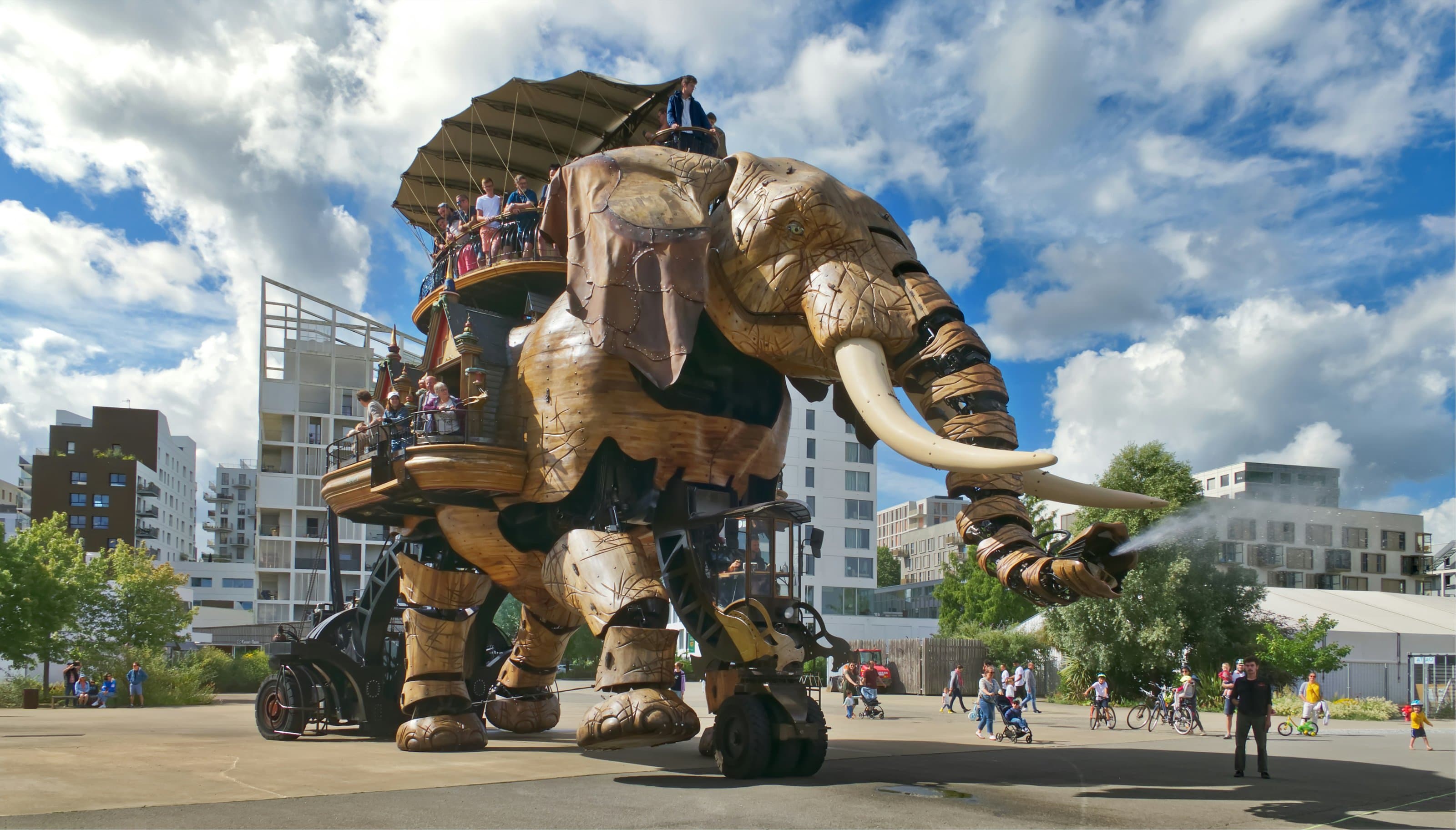
About 1 km (0.6 miles), across the Loire. Mechanical creatures inspired by Jules Verne and Leonardo da Vinci, built in the old shipyard halls where the race starts: the Grand Éléphant, which walks with passengers on its back, the Galerie des Machines and the Carrousel des Mondes Marins. Visit on Friday to keep Saturday for rest; check opening times for April.
Château des ducs de Bretagne
About 1 km (0.6 miles). The castle of the Dukes of Brittany, with walkable ramparts and the city history museum inside. The museum usually opens 10:00 to 18:00 outside summer and closes on Mondays, so do not save it for the day after the race.
Passage Pommeraye
Next to Place Graslin. A 19th-century shopping arcade on three levels with carved staircases and galleries, indoors and good in the rain.
Jardin des Plantes
About 1.7 km (1 mile). The city’s botanical garden beside the station, with greenhouses and quirky art installations. The course passes it at km 24. Flat and restful.
Île de Versailles
About 1.3 km (0.8 miles). A small island on the Erdre laid out as a Japanese garden, and the start of the riverside path. The course passes it twice.
Further reading
Around the World in Eighty Days by Jules Verne, who was born in Nantes in 1828. The Machines de l’Île take their inspiration from his books.
After the Race
Late April in and around Nantes is green and mild, too cool for the beach but good for a gentle day out. The first option stays in the city; the other two are short train rides. All three keep the walking light for legs that ran 42 km the day before.
The Grand Éléphant, the château and the Passage Pommeraye, then a river shuttle to the old fishing village of Trentemoult. All close together and flat.
A ruined castle above the Sèvre and a town rebuilt in Italian style, in the middle of the Muscadet vineyards. Small, quiet and easy on tired legs.
The Atlantic port at the mouth of the Loire, with a wartime submarine base you can walk across and views over the shipyards.
Frequently asked questions
Should I stay near the start or the finish?
Neither end is ideal: it is point to point, and the finish is an exhibition park. Stay in central Nantes, which the course passes twice.
How far in advance should I book a hotel?
When you enter. All 7,000 places sold for 2026; public entry for 2027 opens on 22 September 2026 at noon.
Is there free transport to the start on race day?
Naolib trams and buses are free for everyone at weekends, but many lines are cut on race morning. Walk to the start if you can.
What is the best area to stay?
Central Nantes around Graslin and the château. The Île de Nantes is closest to the start.
When does the expo open?
Not yet published for 2027. Expect Friday afternoon and Saturday; there is no collection on race day.
What is the weather typically like on race day?
Cool to mild: April averages 16.2°C high and 6.6°C low, with rain about one day in three.
How do I get from the airport?
The airport shuttle runs to the centre; it is the one Naolib service that is not free at weekends. Many visitors come by TGV.
Is there a bag drop?
Yes, but the 2027 hand-in and collection points are not yet published. Start and finish are 6.6 km apart, so read the race-week guide.
Should I bring a throwaway layer?
Yes. Mornings average about 7°C and the start is on the open riverside.
How do I get back to my hotel after finishing?
Tram line 1 from La Beaujoire, free at weekends. Check the race-day cuts in the city centre first.