The Race
Check the organiser’s site for the current course map. Every course-shape, landmark and elevation detail below is drawn from the 2025 route, the most recent available, and should be re-checked against oslomaraton.no once the 2026 map is released.
| Next Race Date | Saturday 18 September 2027 |
|---|---|
| Course Type | Loop, starts and finishes at Radhusplassen; marathon runners complete the half marathon's own loop twice (2025 course) |
| Registration | Open via Onreg; marathon, half marathon and Oslotrippelen distances are sold out, with a waitlist and resale marketplace |
| Ballot Opens | Not applicable, open entry |
| Total Finishers | Around 4,180 for the September 2025 edition |
| Average Race Day Temperature | Not confirmed |
| Cutoff Time | 6 hours from the 09:00 start; runners must also pass halfway within 3 hours |
| Free Race Day Transport | Not confirmed; the organiser recommends Oslo's existing public transport, Nationaltheatret the nearest stop |
| Course Certification | Part of the Abbott World Marathon Majors Wanda Age Group ranking system. AIMS certification not confirmed |
A nationally televised race, and a route to the Abbott Age Group World Championship
The DNB Oslo Marathon is broadcast live nationally on NRK, Norway’s public broadcaster, on race day itself, a level of domestic television coverage most races on this site do not carry. The race is also part of the Abbott World Marathon Majors Wanda Age Group world ranking system: age-group runners meeting the automatic qualifying standard for their category, or otherwise placing well within it, can receive an invitation to the annual AbbottWMM Wanda Age Group World Championship. This is a distinct status from full Abbott Six Star Major membership, which Oslo does not hold.
History
The DNB Oslo Marathon is Norway’s capital-city marathon, run as a multi-distance festival alongside a half marathon, a 10 km race branded “10 for Grete,” a 10 km wheelchair-racing event, and a children’s event, all starting and finishing at Radhusplassen, Oslo’s City Hall Square. The event has carried different title sponsor names over recent years, including BMW, and the organiser’s own site currently brands the 2026 edition as the DNB Oslo Maraton.
The marathon, half marathon and the Oslotrippelen (a same-day triple of marathon, half marathon and 10 km) all sold out for the 2026 edition, with a waitlist and a resale marketplace open to returning entries, a strong indicator of the race’s local popularity even without full Abbott Major status.
The course
The DNB Oslo Marathon starts and finishes at Radhusplassen, Oslo’s City Hall Square. On the 2025 course, marathon runners complete the half marathon’s own loop course twice: the same start-area landmarks, aid stations and spectator points repeat at the marathon’s halfway mark. The organiser’s 2025 course data puts the half marathon loop at around 175 height-metres of gain per circuit, around 350m for the marathon. Some race listings describe the course as flat with only around 80m of total gain; the organiser’s figure is the one used here, and the elevation chart shows why “flat” is wrong: each loop has two real climbs.
Each loop runs west from City Hall, climbs through Frogner past Frognerparken and its Vigeland sculpture park, drops to the Oslofjord shoreline at Sjølyst and follows the waterfront back past Aker Brygge, then climbs again through Kvadraturen and up to Bislett before descending to Radhusplassen.
Km 0-5: Out of Radhusplassen and up through Frogner. The marathon starts at 09:00 from Radhusplassen, directly in front of Oslo City Hall, with the field organised into three waves five minutes apart by estimated finish time. The route runs west along Drammensveien and then climbs about 48m over 4km up Halvdan Svartes gate and Kirkeveien to the high point of the loop, about 60m, near Frognerparken at 5km.
Km 5-13: Frognerparken and the Oslofjord waterfront. The course passes Frognerparken, home to the Vigeland sculpture park, then descends about 59m over 6km through Skøyen to the shoreline at Sjølyst, the lowest point of the course at close to sea level around 10km. The flat waterfront path back east past Filipstad and Aker Brygge is one of the course’s more scenic stretches.
Km 13-21.1: Kvadraturen, Bislett and the first lap. The second climb of the loop starts behind City Hall: about 43m over 4km through Kvadraturen and up Kristian Augusts gate to Bislett around 17km, followed by a 36m descent back to Radhusplassen, where the first of two identical loops ends at the half marathon distance.
Km 21.1-42.195: The second loop. Marathon runners repeat the same loop a second time, with the Frogner climb between 22 and 26km and the Bislett climb between 35 and 38km; half marathon finishers, who started earlier the same day, are not on course at the same time, so this repeat pass is a solitary experience. The course closes with the descent from Bislett and a return to Radhusplassen, finishing directly in front of the same City Hall building the race started beside.
Because the two loops are identical, every hill met on the first lap comes round again on the second, and the Bislett climb arrives for the second time after 34km. Pace the first lap with that in mind.
Course Map
The map shows the 2025 course: two loops from Radhusplassen up through Frogner past Frognerparken, down to the Oslofjord waterfront, and up to Bislett before returning to City Hall. Tap a marker for details, and scrub the slider or press play to move the orange marker along the course with the elevation profile beneath it.
West from Radhusplassen, a 48 m climb through Frogner past the Vigeland sculpture park, then down to the Oslofjord shoreline, the field still tightly packed.
Along the waterfront past Aker Brygge, then a 43 m climb to Bislett before closing the first loop at the half marathon distance, a useful marker for pacing the second half.
The Frogner climb and the drop to the fjord repeat, without the half marathon field, which started separately earlier in the day.
The waterfront, then the second Bislett climb after 34km, and the descent to the same City Hall square the race started beside.
Pacers
| Wave | Start time | Pacers available |
|---|---|---|
| Pulje 1 | 09:00 (target finish under 3 hr 45 min) | 3:00, 3:15, 3:30, 3:45 |
| Pulje 2 | 09:05 (target finish under 4 hr 15 min) | 4:00, 4:15 |
| Pulje 3 | 09:10 (target finish over 4 hr 15 min) | 4:30, 4:45, 5:00, 5:30 |
Wave placement is based on the estimated finish time entered at registration, and runners are not permitted to start in a wave other than the one assigned. Pacers are marked with a pace flag on their back.
What to wear
Mid-September in Oslo generally runs mild by early autumn standards, but conditions can vary meaningfully year to year, and the course’s waterfront sections carry real wind exposure along the Oslofjord shoreline. A throwaway layer for the pre-09:00 start-line wait is a sensible general call regardless of the exact conditions on a given year.
Entry
Entry is direct online registration through the organiser’s Onreg platform, with no ballot. For 2026 the marathon, half marathon and Oslotrippelen (a same-day triple of marathon, half marathon and 10 km) sold out, with a waitlist for new entries and a resale marketplace, open until 1 September, for existing entrants unable to attend. 2026 pricing: 10 for Grete (10 km) at 790 NOK, half marathon at 990 NOK, marathon at 1,200 NOK, and the Oslotrippelen at 2,500 NOK, plus a one-time 40 NOK administration fee and a 50 NOK athletics licence fee unless the runner already holds an annual licence. Students receive a 15% discount on request.
Runners wishing to change distance must contact the organiser directly and pay any price difference for an upgrade; downgrades are possible only if the new, shorter distance is not itself sold out. Purchase of a start place is binding and non-refundable under Norwegian consumer purchase law, though a cancellation insurance product (MySafety) can be added at the time of registration, not afterward, covering illness or other unforeseen circumstances.
Elite entry standards
There is no Boston- or London-style Good For Age route, but the race does operate a separate elite-entry pathway with its own qualifying standards for 2026: marathon under 2:29:59 (men) or 2:59:59 (women); half marathon under 1:09:59 (men) or 1:19:59 (women); 10 for Grete under 30:59 (men) or 35:59 (women). Elite entrants receive access to a dedicated tent at Radhusplassen for baggage on race day. All entrants, elite or otherwise, must follow World Athletics’ competition shoe rules, and podium finishers or record-setters may be asked to submit their shoes for inspection.
Race Weekend
Expo
The Expo is a free-entry tent at the start and finish area on Radhusplassen, open Thursday 10 September 09:00-20:00, Friday 11 September 09:00-20:00, and Saturday 12 September (race day) 07:00-18:00. The organiser explicitly recommends collecting a bib on the Thursday or Friday to avoid the longer queues typical of Saturday collection.
To collect a bib, a runner needs their start card, sent by email and SMS in the week before the event, and valid photo identification; a runner may also collect on behalf of someone else if they carry that person’s start card and a copy of their ID. Runners who ordered the event T-shirt collect it at the same time as their bib and baggage bag.
Race Morning
The organiser recommends arriving via public transport rather than by car; the nearest stop is Nationaltheatret, served by bus, tram and the T-bane metro, with Oslo Sentralstasjon (the main railway station) also within easy walking distance. The marathon starts at 09:00 in three waves five minutes apart, assigned by the estimated finish time entered at registration.
Baggage storage is in the City Hall’s own courtyard at Fridtjof Nansens plass, directly beside the start, open 07:00-18:30 on race day. Only the official baggage bag distributed at bib collection can be deposited; personal bags, suitcases or similar items are not accepted, and runners are advised to use Oslo Sentralstasjon’s own left-luggage facilities for anything larger. Toilets are concentrated on Otto Sverdrups gate near the start pens, with over 100 cubicles there specifically to reduce pre-race queuing, plus a smaller bank of eight toilets at Radhusplassen immediately after the finish, and three at every aid station on the course itself.
No headphones of any kind are permitted on the course, a rule introduced at the request of the local police for safety reasons, and strollers and pets are also prohibited. The race is livestreamed nationally on NRK, and a dedicated event app allows spectators to track individual runners live on the course.
Nutrition on Course
Aid stations are positioned roughly every 5 km, serving Maxim sports drink and water at every station; marathon aid stations, and some half marathon stations, additionally serve bananas and cola. Runners are not permitted to hand out or receive personal energy gels from supporters along the course, though carrying and consuming a runner’s own gels is allowed; personal drinks can only be handed off at the official aid stations themselves, and only by a support-crew member standing at that specific station. After the finish, every runner receives a bottle of water and further refreshments in the finish chute.
Spectating
Because the marathon runs the half marathon’s own loop twice, a spectator positioned anywhere on the shared section of the course sees the marathon field pass at least twice, a genuine two-for-one advantage over a single-pass point-to-point route. A dedicated event app allows spectators to track individual runners live on the course by name or bib number, and the race is broadcast live nationally on NRK on race day. Prize ceremonies for the top three men and women in every distance take place on a stage in the middle of Radhusplassen.
Post-Race Food
Every finisher receives water and further refreshments in the finish chute itself, included in the entry fee. Radhusplassen sits between Aker Brygge’s waterfront restaurant strip and the Nationaltheatret area, two of central Oslo’s denser dining concentrations, but this page will not name a specific venue without a direct source.
Where to Stay
Because the course starts and finishes at the same point, Radhusplassen, a hotel anywhere within easy walking distance of City Hall serves both ends of the race equally well.
Around Radhusplassen and Nationaltheatret
The most practical base, and the organiser’s own recommended access point via public transport: this puts a runner within walking distance of the start-finish, the Expo tent, and the Aker Brygge waterfront. Hotel stock here is dense and includes the race’s own official partner hotel.
Aker Brygge
Immediately adjacent to Radhusplassen along the waterfront, trading a slightly longer walk to the exact start line for direct access to the harbourside restaurant strip.
Karl Johans gate and central Oslo
A short walk from Radhusplassen through the city’s main pedestrian shopping street, with a wider spread of hotel price points than the immediate square-front cluster.
Grunerlokka and the wider city
A characterful district a longer walk or short tram ride from Radhusplassen, better suited to a visitor prioritising a quieter, more residential base over minimising race-morning walking distance.
Recommended hotels
The race's own official partner "Runners Hotel," promoted directly on oslomaraton.no with a dedicated booking link, the most directly race-endorsed option here.
A historic grand hotel a few hundred metres from the organiser's own recommended transport hub, with a pool, a useful post-marathon amenity.
A large international-chain property with a pool, within easy walking distance of both Radhusplassen and the Nationaltheatret transport hub.
A well-reviewed budget-oriented option in the same central cluster as the more expensive hotels above, a practical choice for a runner prioritising value over amenities.
A boutique property in the same central corridor, a smaller-scale alternative to the larger international chains listed above.
Booking timeline
Entry is open registration with no ballot results date, though the marathon, half marathon and Oslotrippelen distances are already sold out for 2026, so a runner relying on the waitlist or resale marketplace should not assume a late, leisurely hotel-booking timeline. Oslo carries strong general city-break demand through September regardless of the marathon, so early booking is a reasonable general recommendation independent of race-specific pressure.
See & Do
These sit at or close to the finish, or directly on the 2025 course’s own route.
Aker Brygge and the Oslofjord Waterfront
Directly adjacent to Radhusplassen (finish). A redeveloped former shipyard turned waterfront dining and shopping district, flat and easy walking directly beside the finish line, and part of the marathon course itself on the 2025 route.
Vigeland Sculpture Park, Frognerparken
A tram ride or a longer walk from the city centre. Norway’s largest sculpture park by a single artist, Gustav Vigeland, holding over 200 bronze, granite and wrought-iron works across Frognerparken, and a landmark the marathon course itself passes on its 2025 route.
Oslo Opera House
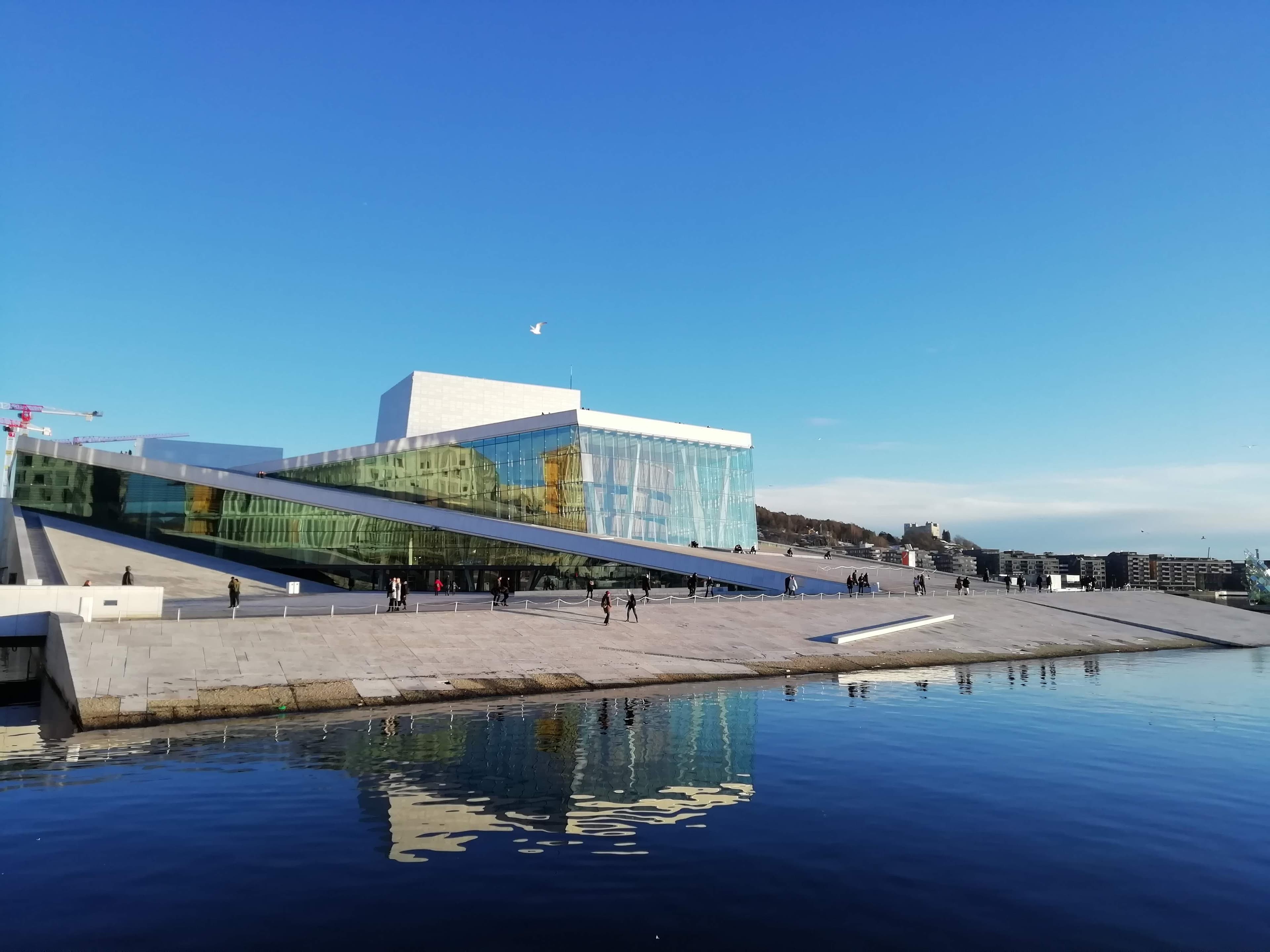
Within walking distance of the harbourfront. A striking marble-and-glass building on Oslo’s harbourfront, with a public roof that can be walked for a harbour view without needing a ticket to a performance.
Munch Museum
Near the harbourfront. A dedicated museum for Edvard Munch’s work, including versions of “The Scream,” housed in a distinctive leaning tower building.
Bygdoy Museums
Reached by ferry or bus from the city centre. A peninsula holding several of Oslo’s best-known museums together, including the Viking Ship Museum and the Fram Museum, a manageable half-day option.
Reading recommendation
Kristin Lavransdatter by Sigrid Undset. Undset’s medieval Norwegian trilogy, awarded the Nobel Prize in Literature in 1928, set in 14th-century Norway rather than Oslo specifically, but a genuine, well-documented cornerstone of Norwegian literature for a visitor wanting a substantial book connected to the country the race takes place in.
After the Race
Oslo Marathon runs in September. These itineraries stay within the Oslofjord, or extend further into Norway.
A cluster of small, largely car-free islands in the Oslofjord itself, including Hovedoya with its ruined 12th-century monastery, reachable on the same ticket used for the city's buses and trams.
A small wooden-house fjord town with Norway's own year-round Christmas House and the offshore Oscarsborg Fortress, best known for sinking the German cruiser Blucher in 1940.
Northern Europe's best-preserved fortified old town, Gamlebyen, its star-shaped ramparts and moat still intact, reached across the Glomma river by a free local ferry.
Norway's second city, reached by a train journey that crosses the Hardangervidda plateau before descending to a coastal city built around a UNESCO-listed wharf.
Frequently asked questions
Should I stay near the start or the finish?
No distinction to make: the course starts and finishes at the same point, Radhusplassen, so any hotel within walking distance of City Hall serves both equally.
How far in advance should I book a hotel?
As early as possible. The marathon, half marathon and Oslotrippelen distances are already sold out for 2026, and Oslo carries strong September city-break demand regardless.
Is there free transport to the start?
No dedicated free race-day transport confirmed; the organiser recommends Oslo's existing public transport, with Nationaltheatret the nearest stop.
What is the best area to stay?
Around Radhusplassen or the Nationaltheatret transport corridor. The race's own official partner hotel, Comfort Hotel Borsparken, sits in this same area.
When does the expo open?
The Expo tent at Radhusplassen runs Thursday and Friday, both 09:00-20:00, and race day 07:00-18:00. The organiser recommends Thursday or Friday collection.
What is the weather typically like?
Not confirmed for a specific range. Mid-September in Oslo generally runs mild. Check a live climatology source closer to race day.
How do I get from the airport?
The Flytoget airport express train runs from the airport to central Oslo; check current times and fares before travelling.
Is there a bag drop?
Yes, in City Hall's own courtyard at Fridtjof Nansens plass, beside the start, 07:00-18:30. Only the official baggage bag can be used.
Should I bring a throwaway layer?
Sensible for the pre-09:00 start-line wait. Note headphones of any kind are not permitted on course, a police-mandated safety rule.
How do I get back to my hotel after finishing?
If staying near Radhusplassen or Nationaltheatret, on foot; the course finishes exactly where it started.