The Race
| Next Race Date | Sunday 18 October 2026 |
|---|---|
| Course type | Loop: two laps from the cathedral seafront |
| Registration | Open online entry, no ballot; sold out for 2026 |
| Ballot opens | No ballot |
| Start | Seafront opposite the cathedral, 08:05 (10 km at 08:00) |
| Finish | Seafront beside Parc de la Mar |
| Total finishers | Not confirmed |
| Avg race-day temp | 15 to 24°C (AEMET Palma October normal) |
| Cutoff time | 6 hours; 32 km by 12:45 |
| Free race-day transport | No |
| Course certification | RFEA certified; AIMS calendar |
History
The Palma Marathon was first run in 2004, built as an autumn race for visitors: October on Mallorca is past the summer heat but warm enough for a beach, and the flights from northern Europe are still running. Kumulus Active World organises it with the city’s municipal sports institute, and the name has followed its sponsors, Zafiro for a spell and TUI from the mid-2020s.
The early courses kept mostly to the broad Paseo Marítimo. Later versions pulled the route into the old town, so runners now pass the cathedral and squeeze through the medieval streets around Plaça Major and Plaça Cort. The present marathon is two laps of the half-marathon circuit, with extra legs on the second lap to make up the distance. The course records date from 2022: Aziz Boutoil of Morocco ran 2:27:14 and Julia Davis of Great Britain 2:42:52.
The field is one of the most international in Spain. In 2025 about 9,000 runners from 76 countries took part across the marathon, half and 10 km, 39% of them German and 21% British, and every bib had gone two months before race day. Germans won both marathons: Thomas Kühlmann in 2:31:48 and Rebecca Robisch in 2:46:21. For 2026 the combined cap rose to 9,500, and that sold out too. The race holds RFEA certification and sits on the AIMS calendar, with no World Athletics label and no elite field; its draw is the setting and the six-hour limit.
The course
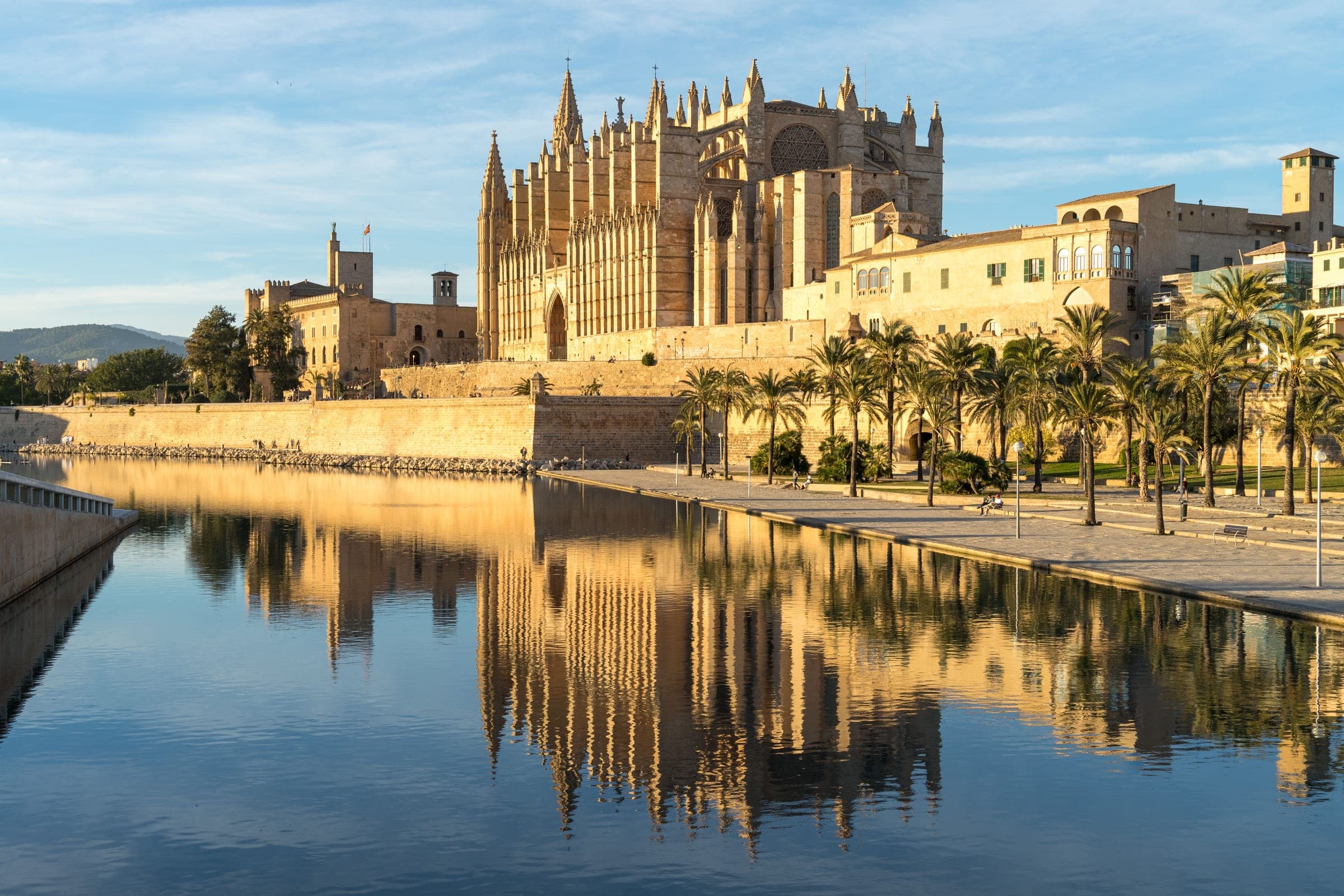
The marathon starts at 08:05 on the seafront road opposite Palma Cathedral and finishes in the same race area beside Parc de la Mar. It is two laps of the half-marathon circuit, with extra legs on the second lap.
Each lap heads west along the Paseo Marítimo to a turn near Club de Mar at km 3.1, returns through the commercial port and runs east past the cathedral to Portixol and El Molinar at km 9 to 10. The seafront is at sea level. From the coast the route climbs about 20 m over the next few kilometres, up Avenida Gabriel Alomar into the old town, and winds through the medieval squares: Plaça Cort, Plaça Major at km 15.9, Sant Miquel and out to Passeig Mallorca at km 18, the top of the lap at about 30 m. It then drops 21 m over 4 km down Passeig Mallorca, Jaume III and the Born to the seafront at halfway, where the half-marathon runners peel off.
The second lap runs further west, to the Estació Marítima, turning at km 24.4, and adds an extra turn in El Molinar at km 31, the furthest point from the start at 2.6 km. The climb back into the old town is sharper this time, 17 m in a kilometre at about 1.7 per cent from km 32.7, then another 20 m to the high point, 34 m at km 37.6, before 22 m of descent over the last 4.6 km to the finish.
Kilometre by kilometre
Km 0 to 4: seafront and the Club de Mar turn. The 10 km leaves five minutes earlier, and the marathon and half go together at 08:05, so the first kilometres are dense. The road west along the Paseo Marítimo is wide and flat, with the marinas on the left and Bellver’s wooded hill above the hotels on the right. A 180-degree turn near Club de Mar comes at km 3.1. Settle here; the first aid station is at 4 km.
Km 4 to 11: port, Portixol and Molinar. The route runs back east through a gate in the commercial port, a quiet working stretch, then past the cathedral to Portixol and El Molinar, the old fishing districts, at km 9 to 10. Several turns here, and the sea breeze can swing from behind to head-on within minutes.
Km 11 to 21: the old town. The climb up Avenida Gabriel Alomar to Porta des Camp is gentle but it is the first gradient after 11 flat kilometres. Inside the walls the course twists through Sant Francesc, Plaça Santa Eulàlia and Plaça Cort to Plaça Major at km 15.9, with corners every couple of hundred metres and the thickest crowds. Tangents matter; so does not braking hard on every bend. Station 5 at 16 km holds the personal-needs bottles. The lap drops 21 m down Passeig Mallorca and the Born to the seafront.
Km 21 to 32: the split and the second lap out. At the seafront the half-marathon runners turn for the finish and the marathon goes round again: the hardest moment of the day for many, as most of the field stops. The second lap runs further west to the Estació Marítima, turning at km 24.4, with gels at 25 km, then east again to El Molinar and an extra turn at km 31. The time control at Cuesta del Gas, km 32, closes at 12:45. Late-morning sun lands full on this stretch in a warm year.
Km 32 to 42.2: old town and home. The climb back into the old town is sharper second time round, 17 m in a kilometre from km 32.7, and the corners come again on tired legs, to the high point of the course, 34 m, at km 37.6. The crowds are still in the squares and on the Born. The last aid is at 41 km, and the last 4.6 km fall gently to the cathedral and the finish.
No painted line is advertised, so follow the arrows and marshals at each split. Timing uses a disposable chip on the bib; every control mat must be crossed. The finish closes at 14:15.
Flat, wide and shared with the half. Run the port and Molinar by effort; the wind changes direction with the route.
A gentle climb to Porta des Camp, then corner after corner through Palma’s medieval squares.
The half finishes, the marathon goes round again. Gels at 25 km and the Cuesta del Gas control by 12:45.
A sharper climb into the old town, the high point at km 37.6, then down to the cathedral.
Course Map
Two laps from below the cathedral: west to Club de Mar, east to Portixol, up through the old town and down to the seafront, with longer legs on the second lap. Tap a marker for the start and finish, the landmarks and the transport hub, and scrub the slider or press play to move the orange marker along the course with the elevation profile beneath it.
Pacers
Marathon pacers run at 3:30, 3:45 and 4:00, with half-marathon pacers at 1:30, 1:45 and 2:00, in the single 08:05 start. There is no marathon group slower than 4:00, so runners aiming at five hours or the six-hour limit need their own split plan.
At the seafront below the cathedral the half-marathon field turns for the finish and the marathon goes round again. Most of the runners on the road stop here. The second lap is quieter, adds two extra legs, and passes the km 32 time control at Cuesta del Gas, which closes at 12:45. Follow the marathon arrows at every split and plan the second half as a separate race.
Heat and humidity are the main risk in Palma, not cold. AEMET’s October normals are about 15°C at night and 24°C by day, and at 08:05 the seafront can already feel close and damp. A runner on 4 hours 30 minutes is still out on the second lap at half past twelve, often in full sun on the Paseo Marítimo and in Molinar.
Race in the lightest kit you have tested in warm weather, with a cap, sunglasses and sunscreen even if the morning starts grey. A throwaway layer is rarely needed. Autumn storms do happen on Mallorca in October: if heavy rain is forecast, a bin bag for the wait and shoes with grip for painted crossings and old-town paving are worth more than warm clothing. There are no showers at the finish, so leave a dry top and a towel in the wardrobe bag.
Entry
Entry is first come, first served, and it sells out: the 2025 field was full two months before race day, and the 9,500 places for 2026 across the marathon, half and 10 km had gone by mid-September. Registration opens on the official site, usually soon after the previous edition. Marathon runners must be 18 on race day.
The entry includes a one-day Spanish athletics licence with accident insurance and the disposable chip. Marathon entrants receive an official shirt, and the Saturday pasta party is included. A full refund of the race fee is available until 30 June and 50% until 31 August; until 30 September a place can be deferred once to the following year. A bib cannot be sold, transferred or put in another name. Distance changes at the expo cost €20 in cash.
Runners with a documented disability receive 50% off, and the guide of a blind or visually impaired athlete enters free after contacting the organiser. Wheelchair athletes should get written confirmation before entering: the general rules ban wheeled devices while the category list includes a wheelchair class.
Fast runner standards
There is no good-for-age, charity or tour-operator route. Enter as soon as registration opens.
Official Palma de Mallorca Marathon site →Race Weekend
Expo
Bib collection is at the race village and expo beside Parc de la Mar, below the cathedral and next to the start and finish. It is open on Friday and Saturday from 11:00 to 19:00. The expo reopens on race morning from 09:00 to 14:00, but numbers cannot be collected on Sunday, so anyone arriving late on Saturday evening misses the race.
Bring the registration confirmation and official photo ID. The rules say numbers can only be picked up by the participant, so plan to collect in person. Marathon runners collect their shirt at a separate tent. The pasta party runs on Saturday from 12:00 to 14:00. From Plaça d’Espanya, where the airport bus stops, the race village is 1.4 km, about 20 minutes on foot.
Getting to the start
The 10 km starts at 08:00 and the marathon and half at 08:05, on the seafront road opposite the cathedral.
Getting there. Walk. From the old town, La Llonja, Calatrava or the eastern end of Santa Catalina it is 5 to 25 minutes. The metro and island railway end at Plaça d’Espanya, about 20 minutes away, and city buses are diverted. Hotels on the western Paseo Marítimo can be cut off by the closed seafront road; plan a walking route that does not rely on crossing the course.
Bag drop. The wardrobe opens at 06:00 and only accepts the official bag handed out at collection; staff may look inside. It stays open until 14:30. Leave valuables at the hotel. Aim to be at the race area by 07:00.
Rules. No headphone rule appears in the regulations, but littering, missing a timing control and using another runner’s bib all lead to disqualification. No bicycles may accompany runners.
The finish. Medal, water and recovery food, and a free massage service with limited capacity. There are no showers or changing rooms; most runners walk back to their hotels to wash. The marathon awards are at 12:15 and the event closes at 14:15.
Nutrition on course
Eleven aid points serve the marathon, six on the first lap and five on the second. Station 5, at 16 km, is a personal-needs table: hand in labelled bottles or gels through the wardrobe process and staff set them out by bib number. It is the only point for personal supplies, and runners pass it once.
Gels are promised only at 25 and 33.3 km, with no brand named, so carry your own from the start. In a warm year the gap between 16 and 20 km, all in the old town, can feel long.
| Station | Km | What is there |
|---|---|---|
| 1 | 4 (after the Club de Mar turn) | Water, isotonic drink, sponges |
| 2 | 8.5 (Portixol) | Water, isotonic drink, fruit |
| 3 | 12.3 | Water, isotonic drink, fruit |
| 4 | 13.8 (Sant Francesc) | Water |
| 5 | 16 (Sant Miquel) | Water, isotonic drink, personal needs |
| 6 | 20 | Water, isotonic drink, fruit |
| 7 | 25 | As first lap, plus gels |
| 8 | 30.5 | As first lap |
| 9 | 33.3 | As first lap, plus gels |
| 10 | 37 | As first lap |
| 11 | 41 | As first lap |
Spectating
The two-lap course lets a spectator on foot see a runner four or five times without transport. The best single place is the seafront between Plaça de la Reina and the cathedral: runners pass near halfway and again in the last kilometre, and the finish is a few steps away. The old town has the most noise, with crowds in Plaça Cort, Plaça Major and along the Born on both laps.
The main hazard is getting stuck on the wrong side of a barrier: the seafront road is closed all morning, so pick crossing points in advance.
- Watch the 08:05 start opposite the cathedral
- Stay below the cathedral for halfway
- Stay for the last kilometre and the finish
- After the start, walk up to Plaça Major for km 15.9
- Stay in the old town for the second pass at km 37.3
- Walk 10 minutes down to the finish
- Walk east along the seafront before the roads close to Portixol, km 9 to 10
- Stay for the second pass, km 30 to 32; the promenade has cafés
- Walk back along the seafront path, 35 to 45 minutes, to the finish
Post-race food
The finish is a short walk from the old town, and Palma’s recovery food is carbohydrate and salt: pa amb oli (bread rubbed with tomato and oil, topped with ham or cheese), tumbet, croquettes and grilled fish.
Can Joan de s’Aigo on Carrer de Can Sanç has served hot chocolate, ice cream and ensaïmadas since the eighteenth century. Bar España on Carrer de Can Escursac, near Plaça Major, has a long counter of pintxos. Celler Sa Premsa, near Plaça d’Espanya, is a large traditional cellar restaurant with Mallorcan dishes and room for a group. With 9,500 entrants and their companions leaving the same area, book Sunday lunch for 14:00 or later.
Where to Stay
Start and finish are in the same place, on the seafront below the cathedral, so stay close to it. With no showers at the finish, a short walk back to the hotel matters more than usual.
Old town and Calatrava
The old town and the Calatrava quarter around the Arab Baths are 5 to 15 minutes on foot from the start and finish. The streets are narrow and mostly pedestrian, so taxis cannot reach every door. Calatrava is quiet on Saturday night; Plaça Major is busier.
La Llonja and El Born
La Llonja and El Born, west of the cathedral, are 10 to 20 minutes from the race area and on the course. This is the centre of Palma’s restaurants and bars; ask for an interior room.
Santa Catalina
Santa Catalina, the former fishermen’s district west of the centre, is 20 to 35 minutes on foot from the start, with a covered market, dozens of restaurants and cheaper hotels. The seafront road here is on the course, so check the walk to the start does not rely on crossing it.
Plaça d’Espanya
The streets around Plaça d’Espanya are 20 to 30 minutes from the start. The airport bus, the island railway, the Sóller train and the island buses all leave from here, which suits day trips after the race.
Portixol and the western Paseo Marítimo
Portixol and El Molinar are on the course at km 9 and km 30, quieter, with a flat promenade and fish restaurants. The larger hotels on the western Paseo Marítimo are 30 to 50 minutes’ walk from the start and on the closed seafront road; only choose one with a mapped walking route.
With the field sold out months ahead and most runners travelling from abroad, central rooms go early. Book a refundable room as soon as entry is confirmed.
Recommended hotels
A larger hotel on the western edge of the old town with a rooftop pool, 90 m from the course at km 18 and km 39. Lively area on Saturday night.
A modern hotel on Palma’s main shopping avenue, 100 m from the course. Ask for a room away from the street.
A small hotel in the quiet lanes near the Basilica of Sant Francesc, 75 m from the course at km 14. Few rooms.
An upscale hotel on the edge of the old town above Parc de la Mar, 10 minutes’ walk from the start.
A converted seventeenth-century seminary with a restaurant and spa, 80 m from the course at km 16 and km 37.6.
Booking timeline
There is no ballot to wait for: entry is immediate, and the race sells out. Enter as soon as registration opens and reserve a refundable old-town or central room the same day. Match its cancellation date to the race’s refund rules: 100% until 30 June, 50% until 31 August, and one deferral until 30 September.
Almost the whole field flies in, and the third weekend of October falls near the end of the summer schedules on some routes, so book flights several months ahead. Palma Airport (PMI) is about 8 km east of the centre; the EMT A1 bus runs to Plaça d’Espanya roughly every 15 minutes, and a taxi takes 15 to 20 minutes. Arrive by Friday so bib collection is not squeezed into Saturday evening.
See & Do
The finish is directly below the cathedral, and the old town’s sights are a short, flat walk from it.
Palau de l’Almudaina
The royal palace next to the cathedral, begun as a Moorish fortress and still used for official events. Check for closures on state occasions.
La Seu, Palma Cathedral
The Gothic cathedral directly above the start and finish, with a canopy over the altar by Antoni Gaudí. Visit on Friday or Monday and book a timed ticket.
Banys Àrabs and the Calatrava lanes
The eleventh-century Arab Baths in a small garden in the Calatrava quarter, reached through flat lanes behind the cathedral.
Es Baluard
Modern and contemporary art inside a Renaissance bastion on the old city wall, with a terrace over the harbour. Mostly flat and indoors.
Castell de Bellver
A round fourteenth-century castle on the wooded hill above the western seafront. The walk up is steep; take a taxi up and walk down.
After the Race
October keeps Mallorca warm enough for the coast and cool enough for the mountain villages, and most of the island is reachable from Plaça d’Espanya by train or bus. The day after, the Tramuntana villages and the old wooden train to Sóller ask little of the legs.
The Carthusian monastery where Chopin and George Sand spent a winter, in a mountain village of stone lanes.
An hour-long guided walk through limestone caves ending in a short concert on an underground lake.
The wooden electric train through the mountains, then the tram to a flat, curving bay.
A walled medieval town beside a Roman city, a short walk from a long flat beach. The sea is still warm enough for a swim in October.