The Race
| Next Race Date | 2 May 2027 |
|---|---|
| Course Type | Loop: start on Kruppstraße, finish inside the schauinsland-reisen-Arena, both within Sportpark Duisburg |
| Registration | Open, online, no ballot. Five price bands rising as the race approaches |
| Ballot Opens | Not applicable: open registration |
| Total Finishers | 1,144 (2026, marathon distance) |
| Average Race Day Temperature | 8°C to 17°C, early May |
| Cutoff Time | 5 hours 30 minutes |
| Free Race Day Transport | Yes. Free travel across the VRR network on race day using the start number as a ticket, plus a shuttle between course points and the finish |
| Course Certification | National (DLV) measured road course. No current World Athletics or AIMS label confirmed |
The finish is on the pitch
Runners enter the schauinsland-reisen-Arena, home of MSV Duisburg, and finish on the stadium floor in front of the grandstands. It became the race’s defining feature early in its history and is the detail returning participants mention first. If a supporter has to choose one place to be, this is it: the stadium entrance beats any additional course sighting.
History
The Rhein-Ruhr-Marathon traces back to 19 September 1981, when Duisburg’s then mayor Josef Krings sent 485 runners onto the city’s streets. Only 385 finished, a completion rate that says something about how unfamiliar marathon running still was in West Germany at the start of the 1980s. Manfred Brucks of GW Wesel-Fürlen won the first men’s race in 2:26:36, and Mary Anne Christey-Meyer won the women’s race in 2:53:50.
The race grew steadily through the 1980s and 1990s, drawing more than 140,000 starters across its first 40 editions and producing its fastest times in 1989, when Tibor Baier of Hungary ran 2:14:33 and Irina Bogachova of the Soviet Union ran 2:35:09. Both still stand as the course benchmarks, though those figures come from a secondary source, not the organiser’s own records page, and are worth treating as indicative. Unlike Germany’s international-facing majors, Duisburg’s race stayed closely tied to local club organisation, a character still visible in its long-standing slogan, von Läufern, für Läufer, from runners, for runners.
The stadium finish became the defining feature early on and has stayed. Over the decades the event expanded into a full weekend sports festival, with a half marathon, an inline skating marathon, handbike racing, relay teams and school events running alongside, though none of that changes the marathon’s own 08:30 start or its 42.195 km route.
The mid-2020s brought a sharp rise in participation. The 2026 edition, the 43rd, recorded 9,341 registered participants across the weekend, up from 8,969 the year before, and more than 1,000 names filled the 2027 marathon register within four days of its late-August 2026 opening. The organiser has set a public target of exceeding 10,000 participants across all disciplines in 2027. Worth keeping those weekend-wide numbers separate from the marathon itself, which had 1,144 finishers in 2026: this is a big festival wrapped around a mid-sized marathon.
The course
The marathon starts at 08:30 on Kruppstraße beside Sportpark Duisburg and finishes inside the adjoining schauinsland-reisen-Arena, the two ends about 200 m apart within the same sports complex. From the start the route runs through Neudorf into the city centre and reaches the Innenhafen, Duisburg’s redeveloped Inner Harbour, at about km 4. It then works north across the Ruhr through Kaßlerfeld and Meiderich, and back west to Ruhrort at about km 17, crosses the Rhine on the Friedrich-Ebert-Brücke, spends roughly eight kilometres on the left bank, and recrosses to return through Duisburg’s southern districts before entering the stadium.
The organiser markets the course as flat and fast, and the elevation chart below supports that: the whole route sits inside a band of about 21 m. There is no climb to plan around. The course’s character comes instead from its two bridges, its exposed riverside stretches, and the shift between busy central sections and quieter residential and industrial districts.
Km 0 to 5: Sportpark and Neudorf. The race leaves Sportpark Duisburg at 08:30 and runs through Neudorf into the city centre on wide urban roads. This opening stretch is fast, so hold back. The first aid station does not appear until shortly after km 5, which is a deliberate gap: there is no reason to overdrink at the start.
Km 5 to 18: the harbour and the run north. The route reaches the Innenhafen, where converted warehouses and waterside architecture give the first real visual change from the opening city streets, and the first aid station sits here. From the harbour the course works north through Kaßlerfeld along the Ruhrdeich and into Meiderich, touching its northernmost point at about km 13 before turning west toward Ruhrort, Duisburg’s historic port quarter, at about km 18.
Km 18 to 26: across the Rhine and back. The course crosses the Rhine on the Friedrich-Ebert-Brücke just after km 18 and spends roughly eight kilometres on the left bank, moving south through Homberg, Essenberg and Rheinhausen, before recrossing on the Brücke der Solidarität. Bridge crossings on an otherwise sheltered course are the most wind-exposed sections of the day, and both of them fall in this stretch. Crowd density varies noticeably here: the organiser positions samba bands at set points specifically to fill the quieter gaps, with 18 planned for the current edition.
Km 26 to 36: the long southern leg. Back on the right bank, the course turns south for its longest continuous stretch, reaching the southernmost point of the route at about km 36. The route runs through Hochfeld, Wanheimerort, Buchholz and Großenbaum, and the flat profile does not forgive an overambitious first half, and local runner accounts from recent editions describe exactly that pattern: a sub-four-hour pace collapsing into cramp on Kalkweg in the final third.
Km 36 to 42.195: back to Sportpark and the stadium. The closing kilometres run back north toward Sportpark. The course’s defining moment comes at the very end, entering the arena and finishing on the pitch in front of the grandstands. Repeat participants consistently rate it the strongest single feature of the race, and it is worth holding something back to enjoy it.
Following the racing line through the corners makes a measurable difference over the full distance. No published blue tangent line was found for the current course. Timing uses a disposable transponder integrated into the start number, so there is no chip-return queue at the finish, and exact intermediate mat positions should be taken from the final starter map.
Course Map
North through the Innenhafen and the port districts, twice across the Rhine, then a long southern leg back to the stadium. Tap a marker for details, and scrub the slider or press play to move the orange marker along the course with the elevation profile beneath it.
Pacers
The marathon uses a single 08:30 start with no seeded waves or corral letters, so pacers are found in the start area. The published targets run from 3:00 to 4:30 in fifteen-minute steps.
That list is the most recent one the organiser published. A third-party course page for the coming edition references pacing groups extending to 5:30, which would be considerably wider, but it is not confirmed against the organiser’s own pages. Anyone intending to run behind a group slower than 4:30 should check the current pacer list before relying on one being there.
What to wear
Early May in Duisburg is typically cool at the 08:30 start, with overnight lows around 8°C rising to daytime highs near 17 to 18°C by early afternoon. That gap matters more here than the average alone suggests: a layer that feels necessary on the start line in Sportpark Duisburg will likely be unwelcome by the second half of the race. Rain and wind are realistic possibilities this early in the season, while genuine heat is uncommon but not impossible.
A cheap throwaway layer for the start makes sense given the temperature swing, and the compact Sportpark setup means less time standing exposed outdoors than at races with a longer walk or transfer to the start. Runners in the later stages of the field should still plan for sun exposure once the morning cloud burns off, particularly on the exposed bridge sections. Given the course’s flat reputation and the organiser’s own framing of it as a PB opportunity, dress for racing conditions, not for comfort at 08:00 in the start pen.
Entry
Entry is open, online and unballoted: there is no lottery and no qualifying standard to meet. Fees rise in five bands as the event approaches, with an early-bird rate available to 31 August, then further rises at 31 December, 15 March, 22 April and finally a race-day rate. The 2027 portal opened in late August 2026 and took more than 1,000 entries within its first four days, which is evidence that the early-bird window is worth acting on quickly.
Group discounts are published for larger parties: 10% from 10 participants, 15% from 50 and 20% from 100. There is no fast-runner or Good for Age pathway, since entry is already open to anyone, and no published charity guaranteed-entry programme. A tour-operator allocation was not found, and elite-athlete entry terms are not publicly specified.
The marathon starts as a single wave at 08:30, with no published corral or start-block system. Transfer, refund and deferral terms should be taken from the live registration terms at the time of booking, since these are exactly the conditions that change between editions.
Fast Runner / GFA Standards
Not applicable. The Rhein-Ruhr-Marathon has no qualifying-standard entry pathway, and entry is open to all runners regardless of predicted finish time.
Race Weekend
Expo
The Marathonmesse runs across two venues on two days. On the Saturday it occupies the business area of the schauinsland-reisen-Arena itself, Margaretenstraße 5 to 7, from 10:00 to 19:00; on the Sunday it moves to Marathon Plaza on Bertaallee, running 09:00 to 16:00. Start-number collection follows the same pattern, at the arena on the Saturday and again from 06:00 on race morning for anyone arriving later.
There is no postal dispatch of start numbers. Entrants receive an email confirmation on registration and a further participant email shortly before the event containing the number itself, which is used to collect the bag and bib in person. Because the venue is a single compact complex shared with the start and finish, there is comparatively little logistical reason to favour Saturday collection over Sunday morning, though arriving on the Saturday avoids any race-morning queue and leaves Sunday free for the earlier warm-up the compact start location makes realistic.
The Saturday programme also includes a breakfast run at 11:00 and a pasta party from 15:00 to 19:00.
Getting to the Start
Race morning here is unusually compact by marathon standards. Start, finish, expo, changing rooms and showers all sit within or immediately beside Sportpark Duisburg, so there is no long cross-city transfer to plan around and no reason to arrive hours early simply to be safe. The marathon starts at 08:30 as a single field.
The organiser encourages public transport over driving, and the start number itself functions as a travel ticket on race day: current marketing describes free arrival and departure across the whole VRR network, a change from the narrower single-fare-zone wording used in earlier editions. Confirm the exact zone and time wording in the final starter information before treating it as settled. A complimentary shuttle bus also runs between course and relay exchange points and the finish area, roughly 09:00 to 12:50.
Changing rooms are allocated by starter group, and additional toilets are positioned both in the start area and along Kruppstraße itself. Shower facilities at the complex are a specific strength repeat participants mention. Given early May’s typical 8°C start-line temperature, a throwaway layer is sensible, though the short, sheltered start setup means runners can reasonably stay in warmer clothing later into the morning than at a race with a longer outdoor wait.
After finishing, runners remain inside the same complex for the full range of post-race services: medal, finisher shirt, results, live tracking, personal finish video, medal engraving, recovery swimming, massage, childcare and a finish beer, before showering, changing and either walking to nearby accommodation or using the same free VRR entitlement to travel onward.
Nutrition on Course
The organiser promises 18 aid stations across the marathon course, an unusually high density for a race of this size. Stations provide water, an isotonic sports drink and bananas. The first comes shortly after km 5 in the Innenhafen, a deliberate gap that gives the field time to settle before the first drink, so there is little reason to carry extra fluid from the start. A full kilometre-by-kilometre station list has not been published, so plan on the density, not the exact positions.
The most useful feature for travelling runners is the personal nutrition service: bottles or gels can be handed in, clearly labelled, by 19:00 on the Saturday before the race, for placement at a specific aid station of the runner’s choosing. Glass containers are prohibited. That is unusual for a non-elite field, and worth planning around if you rely on a specific brand or concentration of sports drink.
Spectating
Duisburg suits spectators better than its size might suggest, because the route repeatedly crosses public transport corridors, and the organiser publishes a spectator guide with course closures and expected passage times ahead of each edition. The free shuttle bus connecting the arena to course and relay exchange points makes it realistic to see a runner at more than one place without a car.
The single best sighting is the finish. Watching a runner enter the schauinsland-reisen-Arena and finish on the stadium floor is by a wide margin the event’s strongest spectator moment, and it is worth prioritising over an additional course sighting if a choice has to be made.
The most reliable combination is to watch the 08:30 start at Sportpark, take public transport to the Innenhafen for the early-race passage around km 4 to 8, then return to the arena in good time for the finish. A city-centre point followed by a move toward Ruhrort also works, though construction around the Karl-Lehr-Brücke affected that stretch in 2026 and the final routing should be checked against the spectator guide first. For anyone who can only manage two stops, a single late-course point near a rapid transit stop followed by the stadium is the safer plan. Live tracking through the official app fills the gaps.
Post-Race Food
The finish package covers the immediate need, including the organiser’s advertised fresh König Pilsener alongside the usual recovery food. For a proper meal afterward, Mezzomar on Bertaallee sits directly by Sportpark and is the easiest walk on tired legs, though its proximity to the finish means it fills quickly once the field arrives. L’Osteria Duisburg, on Schifferstraße in the Innenhafen, is a better option for anyone staying centrally, with the same large-format pizza and pasta. Köpi Wirtshaus Duisburg, on Am Innenhafen, serves German pub food in the Inner Harbour setting for runners who want something less Italian. Confirm all three are currently trading before relying on them.
Where to Stay
The neighbourhood question resolves more simply here than at most races: the start and finish sit in the same complex, so staying near Sportpark Duisburg means staying near both.
Sportpark and Wedau
Sportpark and the surrounding Wedau district offer walking distance to number collection, the start and the finish, which makes it the natural choice for a nervous first-time marathoner or anyone who wants no morning transport logistics at all. Dining choice here is limited compared with the city centre, and that is the trade-off for the convenience. Room count is small relative to demand, so book early if this is the priority.
Hauptbahnhof and the city centre
Duisburg Hauptbahnhof and the city centre suit rail arrivals and offer a wider spread of food than Sportpark, with trams and buses reaching the race complex quickly on the day, at no cost given the free VRR entitlement. This is the better base for anyone combining the race with visits to other Ruhr cities, since it sits directly on the regional rail network those trips use.
Dellviertel and Neudorf
Dellviertel, just south of the centre, has a set of independent restaurants and a calmer feel than the Hauptbahnhof area while keeping reasonable access to the station, which makes it a workable compromise for runners who want some neighbourhood character without sacrificing convenience. Neudorf, a residential district close to the university and the sports side of the city, is a quieter option that adds little to the race-morning journey and has the incidental advantage of sitting on the opening kilometres of the course.
The Innenhafen
The Innenhafen suits an extended weekend. Its waterfront restaurants and the Museum Küppersmühle make it a pleasant base, and the marathon route passes through early in the race, though race morning still requires transport out to Sportpark.
Düsseldorf works only as a fallback. Rail connections into Duisburg are excellent, but staying in Duisburg itself is materially simpler for an 08:30 start, and there is no strong reason to choose Düsseldorf over central Duisburg unless Sportpark and city-centre options are fully booked.
Recommended hotels
The closest possible accommodation to the race complex, walking distance to the start line and the stadium finish alike. It is a hostel format with high demand on race weekend, so book it at the same time as entering.
The closest conventional hotel to the race complex for anyone who wants a private room. Room count is limited, so it books out early.
A comfortable option in a calmer district than the Hauptbahnhof area, with a tram, bus or short taxi ride needed to reach Sportpark on race morning.
The easiest option for rail and airport connections, directly useful for anyone flying via Düsseldorf, though not within walking distance of the start for most runners.
A lower-cost central base with the same public-transport requirement on race morning as the other city-centre options. The free VRR entitlement makes that journey cost nothing on the day.
Booking timeline
The 2027 registration portal opened in late August 2026 and took more than 1,000 entries within its first four days, a clear signal that this race is growing faster than its accommodation supply may be used to. The early-bird entry fee expired at the end of August 2026, with the next price rise at the end of December. For a runner travelling from the UK, the practical move is to book a cancellable Duisburg hotel at the same time as entering. Sportpark rooms are limited and worth securing first if that location matters; city-centre supply is broader and can reasonably wait. Düsseldorf and Essen both provide fallback capacity within a short train ride, but add race-morning travel that a Duisburg base avoids. Because Düsseldorf Airport sits on the same rail network as Duisburg Hauptbahnhof, flight booking can be left later than for a more isolated destination race; the hotel is the piece worth securing well before winter.
See & Do
Everything below is judged from the finish at Sportpark and the hotel areas that serve it. Two of the five sit on or beside the course itself, and Duisburg is compact enough that the rest are a short tram or train ride away.
Landschaftspark Duisburg-Nord
A decommissioned ironworks turned public park, and the best single argument for Duisburg as a destination in its own right. Blast furnaces are open to climb, the old gasometer holds a diving pool, and the whole site is lit at night. Level walking across a large area suits recovering legs, provided the furnace climb is treated as optional.
Innenhafen
The marathon route passes through the Inner Harbour at about km 4, which makes it easy to revisit properly afterwards. Converted warehouses, waterside restaurants and a short flat promenade make it the most comfortable post-race wander in the city.
Tiger & Turtle, Magic Mountain
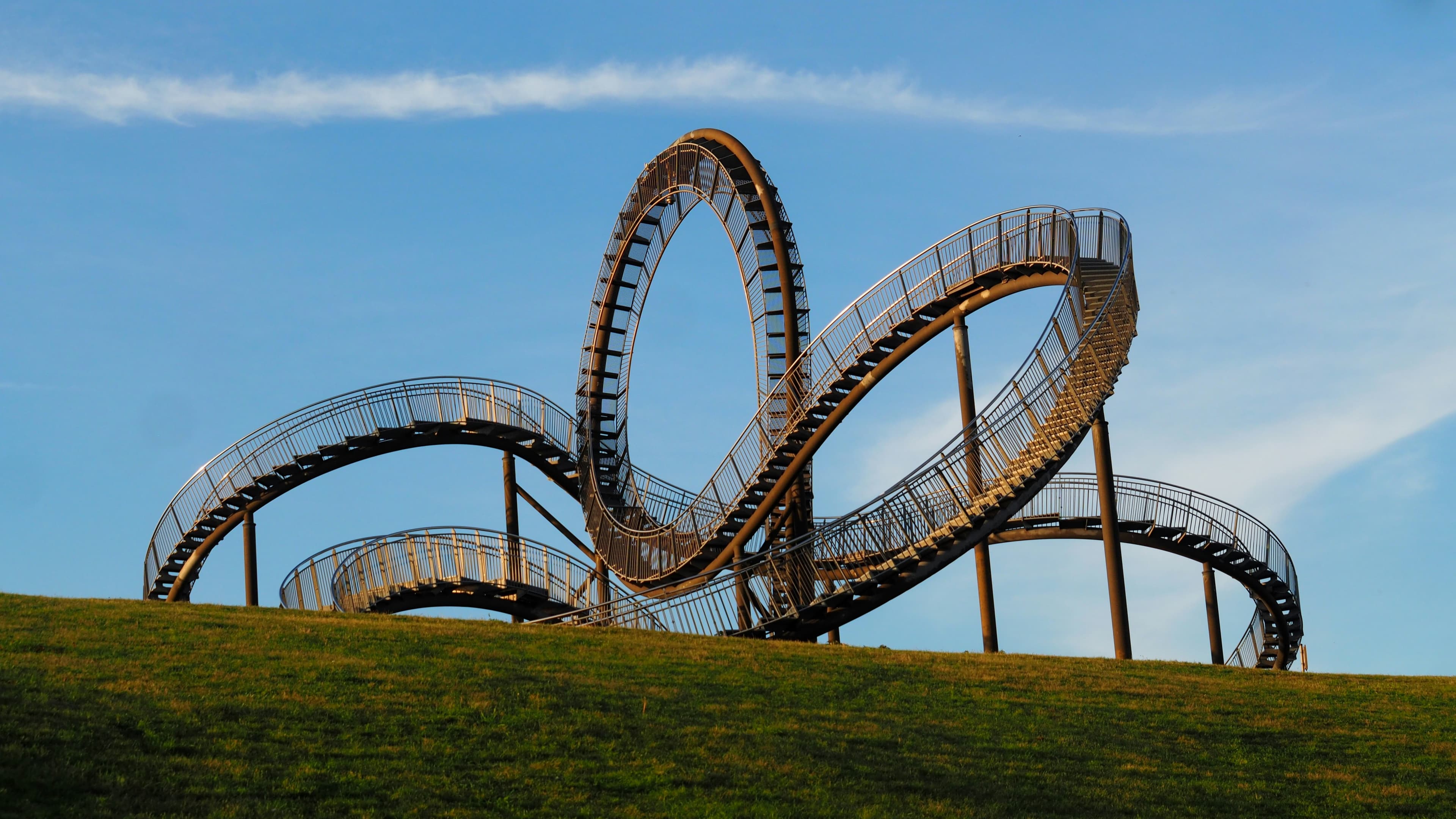
About 1.3 km off the course at roughly km 32, on a former slag heap in the south of the city. A walkable steel sculpture in the shape of a rollercoaster, free to visit and open at all hours. The loop itself cannot be walked, and the approach involves a climb, so it suits the day before the race or a recovered Monday.
Museum Küppersmühle
A former grain mill in the Innenhafen holding a major collection of post-war German art. Indoor, level and close to the waterfront restaurants, which makes it the right choice on a wet May afternoon or a day when walking is unappealing.
Duisburg harbour cruise
Departing from the Innenhafen area, a boat tour of what is the largest inland port in Europe. It requires no walking at all, which is its main recommendation the day after a marathon, and it explains the industrial landscape the course spends much of its middle third running through.
After the Race
Duisburg’s own appeal is modest, but its position is excellent. It sits on the Rhine-Ruhr rail corridor with Düsseldorf 15 minutes away, Cologne under an hour, and the Dutch border reachable without changing to a plane. That makes the days after this race unusually easy to use, and none of the options below needs a car. Early May suits all of them, and the first day after a flat, fast marathon is better spent on a train than on a hill.
Close enough for an easy afternoon, with the Altstadt, the Rhine promenade and the MedienHafen all walkable from one another. The easiest possible recovery day from Duisburg.
The Zollverein coal mine complex is the Ruhr’s definitive industrial monument and a UNESCO site, reached by regional train plus tram. Level walking across a large site suits legs that raced the day before.
The cathedral, the Roman museums and a compact old town, all within walking distance of the station. Two nights gives one gentle day and one fuller one without needing to plan around opening hours.
A cross-border extension into the Netherlands without a flight or a car. Utrecht’s canal-level wharves are the draw, and both cities are flat enough to walk comfortably on recovering legs.
Düsseldorf, Cologne and Bonn strung together on the rail network, no car required. Extends to four nights easily, and works as well in reverse if flights dictate the direction.
Frequently asked questions
Should I stay near the start or the finish?
They are the same place: the start is on Kruppstraße and the finish is inside the stadium in the same complex, about 200 m apart. Sportpark and Wedau put both within walking distance, at the cost of thin dining choice.
How far in advance should I book a hotel?
Book a cancellable room when you enter. The 2027 portal took over 1,000 marathon entries in four days, and Sportpark’s room count is small. Central Duisburg has broader inventory and can wait longer.
Is there free transport to the start on race day?
Yes. The start number works as a travel ticket across the VRR network, and a free shuttle runs between course points and the finish roughly 09:00 to 12:50. Confirm the exact zone wording in the starter pack.
What is the best area to stay?
Sportpark and Wedau for pure convenience. Hauptbahnhof and the city centre for rail access and places to eat. Dellviertel is the calmer compromise; the Innenhafen suits a longer weekend.
When does the expo open?
Saturday at the arena 10:00 to 19:00, Sunday at Marathon Plaza 09:00 to 16:00, with race-morning collection from 06:00. Numbers are not posted out; you collect in person using your participant email.
What is the weather typically like on race day?
Cool at the 08:30 start, around 8°C, rising toward 17 to 18°C by early afternoon. That swing matters more than the average. Rain and wind are realistic this early in May; real heat is uncommon.
How do I get to Duisburg?
Düsseldorf Airport is on the same rail network as Duisburg Hauptbahnhof, so flights can be booked later than for an isolated race. Duisburg sits on the main Rhine-Ruhr corridor for arrivals by train.
Is there a bag drop?
Yes. Start, finish, expo, changing rooms and showers all sit within or beside Sportpark Duisburg, so there is no cross-city transfer. Changing rooms are allocated by starter group.
Should I bring a throwaway layer?
Yes, given an 8°C start and a 17°C afternoon. The compact start means less time standing outdoors than at most races, so you can stay in warmer kit later into the morning here.
How do I get back to my hotel after finishing?
Sportpark is walkable. Otherwise the same free VRR entitlement that got you there covers the journey home on race day. Stay for the showers, engraving and finish beer first.