The Race
| Next Race Date | 14 March 2027 |
|---|---|
| Course type | Central Loop, urban road marathon |
| Certification | FIDAL Gold Label · World Athletics-recognised |
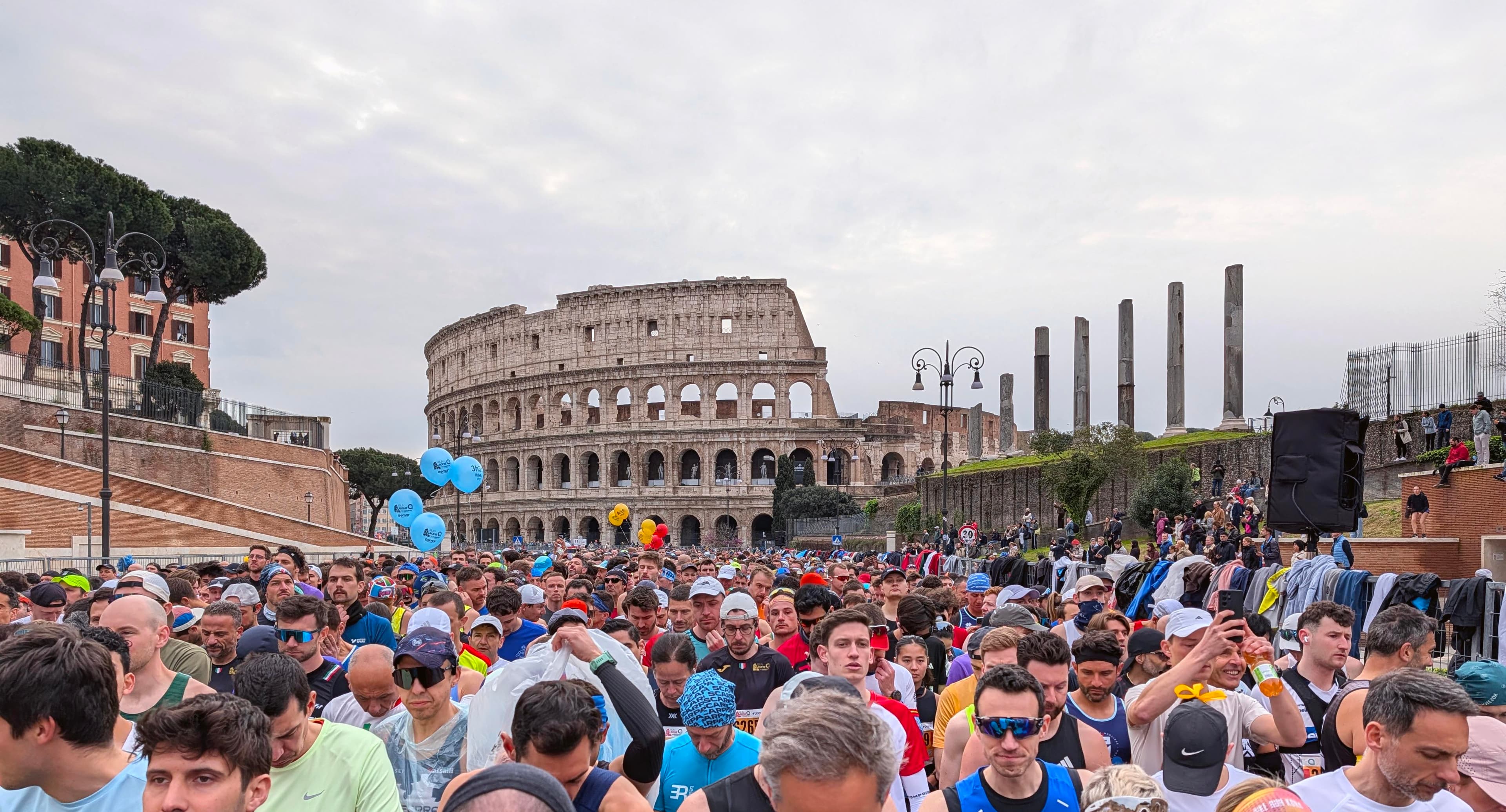
| Start | Via dei Fori Imperiali, beside the Colosseum |
| Finish | Circus Maximus (Circo Massimo) |
| Total finishers | ~30,000 |
| Avg race-day temp | 7–8°C at 9am, rising to 18–19°C by early afternoon (March) |
| Cutoff time | 6 hours 30 minutes |
| Free race-day transport | Not confirmed for general entrants; transport to finish provided for withdrawn athletes |
| Course certification | FIDAL / World Athletics framework |
| Sleeper train | Not accessible by direct overnight rail service relevant to this route |
History
Rome's marathon identity splits into two stories. There is the deep one, reaching back to Dorando Pietri and early twentieth-century distance running in the city, and there is the one a runner booking a flight is actually entering: the modern mass-participation event, which found its current, reliable annual form in the mid-1990s. Before that, Rome's relationship with the marathon distance was intermittent rather than institutional.
What makes Run Rome The Marathon unusual among city marathons is that the route was never built around the occasional landmark. It was built around all of them. The Colosseum, the Forum, Piazza Venezia, Castel Sant'Angelo, St Peter's, Piazza del Popolo, the Spanish Steps, Piazza Navona and the Circus Maximus are not detours from the race. They are the race. Few marathons can claim that their start line sits directly above buried imperial forums, or that their finish occupies an arena built for chariot racing two thousand years earlier.
The course carries one more piece of mythology: the 1960 Rome Olympic marathon, run at night and won barefoot by Abebe Bikila, finished under the Arch of Constantine, a short distance from where this race now starts. The modern event does not retrace that course, but it inherits its emotional register, ancient stone underfoot, floodlit ruins, the sense that the marathon distance belongs here in a way it does not in most cities.
The men's course record stands at 2:06:24, set by Asbel Rutto of Kenya in 2024. The women's record, 2:22:44, was set by Pascaline Kibiwot of Kenya in 2026. These are genuinely fast times for a course with bridges, underpasses and late cobblestones. Elite athletes absorb Rome's surface changes and narrow turns far more easily than the mid-pack. This is a serious race that happens to run through one of the most layered cities on earth, not a sightseeing jog with a finishing time attached.
The course
Run Rome The Marathon is a central loop course, starting on Via dei Fori Imperiali beside the Colosseum and finishing 42.195 km later inside the Circus Maximus, less than two kilometres from where it began. The route runs south past the Bocca della Verità before tracking the Tiber through Testaccio and Ostiense, the most straightforward kilometres on the course for finding rhythm. From around km 11 it turns toward the Vatican, with St Peter's Basilica visible down the axis of Via della Conciliazione and Castel Sant'Angelo rising beside the river near km 14. Between km 16 and 30 the route runs through Prati and the Foro Italico, functional rather than picturesque, where pacing discipline matters more than sightseeing. The final 7 km return through the historic centre: Piazza del Popolo at km 37, the Spanish Steps shortly after, Via del Corso, Piazza Navona around km 40, and Piazza Venezia at km 41, before the closing stretch into the Circus Maximus. The organiser does not publish an official elevation figure; the course is better described as low-lying and rolling, with bridges and underpasses, than flat or hilly.
Kilometre by kilometre
Km 0 to 3: The Colosseum start. Few marathons place their opening minutes anywhere near as theatrical as this. The start sits on Via dei Fori Imperiali, beside the Colosseum and above the buried imperial forums, and the wave starts run from 8:10am for the fastest corral through to around 9:00am for the slowest. The area uses stone, ancient street geometry and controlled pens, so movement into the start is slow rather than instant. Runners should plan to use the on-site toilets well before their wave is called: the corrals are entered from the back rather than from the side, which means a late arrival cannot simply slot into a forward position. A runner who reaches their corral late will spend the first kilometre or two further back than planned, with a knock-on effect of weaving and lane-changing around them as other late arrivals try to work forward. The fix is patience rather than aggression: settle into the field and make up the ground gradually rather than fighting through the crowd in the first kilometre.
Km 3 to 10: Riverside rhythm. The route heads south along Via Marmorata, Via Cristoforo Colombo and the Tiber embankment roads through Testaccio and Ostiense. This is the most open and runnable section of the course, and the place to settle pace properly after the congested start. Refreshment points appear at km 5.3 and 9.9, with sponge stations at 7.4 and 10.1. Conditions can feel cool here even when the afternoon will warm significantly, so taking fluid early is sensible rather than optional.
Km 11 to 15: The Vatican and Castel Sant'Angelo. This is one of the genuine highlights of the course. The route follows Lungotevere and Via della Conciliazione, with St Peter's Basilica visible down the avenue and Castel Sant'Angelo rising beside the river near km 14. The crowd noise here, combined with the Colosseum start, gives Rome a claim to crowd energy that holds its own against several of the Majors. The half-marathon point comes slightly later, after a loop north through Prati.
Km 16 to 30: Prati and the Foro Italico. The course moves through the Prati district and around the Olympic Stadium area on Lungotevere roads, the least visually dramatic section of the race. It is not unpleasant, but it is functional marathon terrain rather than postcard Rome, and this is where pacing discipline earns its keep. The route is not mountainous, but bridges, underpasses and camber add small, repeated costs rather than one dramatic climb.
Km 30 to 37: Building toward the centre. The route threads back along the river before turning into the approach to the historic centre, past Piazza Augusto Imperatore and onto Via del Corso. Fatigue typically arrives here regardless of surface, and the crowd noise begins to build as the route nears the most recognisable part of the city.
Km 37 to 42.195: The historic centre and the finish. From Piazza del Popolo at km 37, through the Spanish Steps area, Via del Corso, Piazza Navona around km 40 and Piazza Venezia at km 41, this final stretch runs through narrow streets lined with sampietrini, Rome's small basalt cobblestones. They are noticeable underfoot but manageable: a finisher in 2026 reported running the section comfortably in carbon-plated racing shoes, with the road camber and occasional drain cover requiring more attention than the cobbles themselves. The streets narrow here and the crowd thickens, so overtaking becomes harder than earlier in the race. The course closes past Teatro di Marcello and the Bocca della Verità into the Circus Maximus, a wide, open arena that gives the final few hundred metres room to breathe after the tightest part of the route.
A final practical note: follow the blue tangent line where marked, the difference over 42.195 km is real even on a course this compact. Timing mats sit at 5, 10, 15, the half marathon, 25, 30, 35 and 40 km, with the finish line and timing mat both at the Circus Maximus.
Theatre at the start, rhythm by km 5. Arrive early and use the toilets before your wave is called; corrals fill from the back, and a late arrival means working forward through traffic.
St Peter's and Castel Sant'Angelo make this the visual high point before halfway. The crowd energy here rivals the Majors. Settle in and enjoy it; the next stretch is quieter.
The least dramatic section of the course. Functional roads, bridges and underpasses rather than landmarks. This is where pacing discipline, not scenery, decides the back half of the race.
Piazza del Popolo, the Spanish Steps, Via del Corso and Piazza Navona, with sampietrini cobblestones underfoot. The Circus Maximus finish opens up wide after the tightest streets.
Pacers
Wave starts in 2026 ran from 8:10am through to 9:00am, with official pacers in each corral identified by balloons showing target finish time. Arriving at your corral well before wave time is necessary to locate and stay with a pacer group, since corrals fill from the back.
| Wave | Start time | Corral | Pacers available |
|---|---|---|---|
| 1st wave | 8:10am | A (Orange) | 2:50, 2:55, 3:00, 3:05, 3:10, 3:15, 3:20, 3:25, 3:30, 3:35, 3:40, 3:45 |
| 2nd wave | 8:20am | B (Green) | 3:05, 3:10, 3:15, 3:20, 3:25, 3:30, 3:35, 3:40, 3:45, 3:50, 3:55, 4:00 |
| 3rd wave | 8:30am | C (Blue) | 3:30, 3:35, 3:40, 3:45, 3:50, 3:55, 4:00, 4:05, 4:10, 4:15 |
| 4th wave | 8:45am | D (White) | 3:50 through 5:40 in 5–10 min increments |
| 5th wave | 9:00am | E (Red) | 4:30 through 6:30; run/walk and Fitwalking pacers also start here |
March race mornings in Rome typically start at 7–8°C and warm to 18–19°C by early afternoon, falling back to 13–14°C by late afternoon. That is a wide swing for a single race, particularly for runners in the later, slower-starting waves who will spend longer in the warmer part of the day. A throwaway layer for the start is worth bringing: mornings can be damp as well as cool, and the wait between bag drop (7:30am deadline in 2026) and a 9:00am wave start is long enough to get cold standing around. Do not assume a thermal blanket will be provided at the start; in 2026 these were reserved for runners who needed medical attention.
For the course itself, the closing 5 km through the historic centre includes sampietrini, the small basalt cobblestones common across central Rome. They are manageable rather than treacherous; runners have completed this stretch comfortably even in carbon-plated racing shoes, but a stable, well-tested shoe with predictable ground contact is a safer choice than an untested maximal trainer. The road camber and occasional drain cover in this section deserve more attention than the cobbles themselves. Sunscreen is worth packing for later waves finishing into the warmer part of the day.
Simon, who runs MarathonPassport, completed the 2026 edition as part of a long weekend in Rome and found it a comfortable race to run. A queue for the toilets meant he reached his first-wave corral later than planned. Because the corrals are entered from the back rather than the side, this left him further from the pacers he had wanted to run with, and the first one to two kilometres involved weaving past other similarly delayed runners trying to work forward through the field. His approach was to relax and make up the ground gradually rather than fight through traffic early on, a strategy that worked well over the rest of the race.
The start, beside the Colosseum, stood up against several of the World Marathon Majors he has run, and set the tone for the rest of the course. The middle section through Prati was, in his view, the least interesting part of the route, but the final 10 km back through the historic centre more than made up for it. The cobblestones in that closing stretch were not a problem, even running in carbon-plated racing shoes; the road camber and the occasional drain cover required more attention than the stone itself.
He stayed at Jo&Joe Roma, a budget hostel-style hotel within easy walking distance of the start, and would choose the same area again. The hotel laid on a simple early breakfast specifically for marathon runners on race morning. The day after the race, a Forum and Colosseum visit made for a manageable, low-impact way to see Rome's most famous sites on tired legs.
Course and logistics map
Elevation derived from GPS trace · The organiser does not publish an official elevation total
Entry
There is no ballot for Run Rome The Marathon. Entry is first-come, online, through ENDU, with the organiser reserving the right to close registration once capacity is reached. A waiting list operated in 2026 for runners who registered after the cap was hit: a place on the waiting list does not guarantee entry, and a confirmed place must be paid within 24 hours if one becomes available.
For the 2027 race, dated 14 March 2027, standard marathon entry was priced at €109 plus service fees until 31 July 2026, with several upgraded packages available: a combined Rome plus Verona Run Marathon entry at €149, a marathon-plus-Saturday-5K option at €119, a Gold VIP Packet at €369, and a Premium Platinum VIP Pack at €499 until 17 February 2027. Check all prices against the live registration page, as these are time-limited early-entry rates.
Italian participation rules are more involved than at most international marathons. Competitive entry may require FIDAL club membership, a foreign athletics federation affiliation, a Runcard or Runcard-EPS, and a medical certificate valid for competitive athletics, depending on the runner's residence and affiliation. Foreign citizens living abroad who are not members of a FIDAL or World Athletics-affiliated club can instead register as non-competitive runners by accepting a disclaimer. Under that route, a runner receives an official time but is not placed in the general ranking and is not eligible for prizes. For most international recreational entrants, this is the simpler path and avoids the Italian medical-certificate requirement, though it is worth understanding the trade-off before registering.
Wave placement is determined by declared marathon personal best from the previous four years, or an official half-marathon time if no recent marathon PB exists. The 2026 wave bands were: Top/Orange 2:00:01–2:50:00, A/Orange 2:50:01–3:25:00, B/Green 3:25:01–3:45:00, C/Blue 3:45:01–4:05:00, D/White 4:05:01–5:05:00, E/Red 5:05:01 onward.
Deferral and transfer terms are date-sensitive and not generous. The 2026 entry fee was non-refundable, but a transfer to the following year's race was possible by 31 December for €30, and a transfer to another runner cost €30 plus service fees by the same deadline. Refunds outside the waiting-list mechanism were not generally available.
A PB note worth stating plainly: Rome rewards a well-prepared runner, but it is not a purpose-built fast course. The historic-centre cobbles, narrow late-race streets, bridges and underpasses make it a poorer choice for a clean personal best than Valencia, Seville or Frankfurt. Runners targeting a specific time should choose Rome for the experience and treat a fast result as a bonus rather than the goal.
Official Rome Marathon entry page →Race Weekend
Expo
The Expo Village and bib collection are both held at the Circus Maximus, the same site as the finish. In 2026, opening hours were Thursday 09:00–20:00, Friday 09:00–20:00 and Saturday 09:00–18:00; expect a similar Thursday-to-Saturday pattern for 2027, with exact dates and hours to be confirmed once the 2027 runner guide is published.
The most direct route to the Expo is Metro B from Termini, alighting at Circo Massimo, two stops away. Saturday midday and afternoon were the busiest periods in 2026, so collecting on Thursday or Friday avoids the worst of the queues; a Saturday-morning visit is the next best option for runners who cannot arrive earlier in the week.
Collection requires a valid identity document and a confirmation letter or email, the latter shown on a phone or tablet rather than printed. Proxy collection is possible for runners unable to attend in person, provided the proxy brings their own ID, the registered runner's confirmation documents, and a signed authorisation form. No bibs are issued on race morning, so collection at the Expo is not optional.
The entry fee covers the race number, civil liability insurance, technical and medical assistance on course, a race pack including sponsor products and the official technical jersey, refreshments and sponging on course, an official programme, timing service, a finisher medal, personal clothes deposit at the start, and transport to the finish for any athlete who withdraws during the race. Exact 2027 pack contents should be confirmed once published.
Race morning
Race morning is built around three points: the start on Via dei Fori Imperiali, the bag-drop trucks on Viale delle Terme di Caracalla and Via Valle delle Camene, and the finish at the Circus Maximus, all within easy walking distance of each other. The 2026 guide recommended Metro B to Circo Massimo specifically, noting that the Colosseo metro stop would be closed on race morning. Rome's metro service starts at 5:30am.
Marathon runners are required to enter the pre-start area from Piazza di Porta Capena, via San Gregorio, between 6:00am and 7:30am at the latest. Wave starts in 2026 ran from 8:00am (wheelchairs and pushers) through 8:10am for the fastest wave, 8:20am, 8:30am, 8:45am and 9:00am for the slowest, with relay teams starting at 9:15am.
The start corrals are entered from the back rather than from the side. A runner who arrives at their corral close to the wave-start time will find themselves further back in the pen than their declared pace would suggest, with no way to move laterally into a better position. This matters most for runners aiming to run alongside a specific pacer. If you queue for the on-site toilets later than planned, the simplest response once in the corral is to settle into the pace you are running rather than fighting through traffic early, and make up ground gradually once the field opens out.
Bag drop closes at 7:30am and is strict: only the official backpack issued at race-pack collection is accepted, no personal bags, pouches or sacks. The deposit card goes in the transparent panel of the bag. Chemical toilets are located near the bag-drop vehicles and inside the start grids themselves, though queues can build; use them well before your wave is called.
After the finish at the Circus Maximus, runners collect their medal and pass through a finish area with water, mineral salts and solid food, a coeliac-friendly refreshment point, medical services, free massage, medal engraving for runners who purchased it in advance, and thermal blankets for anyone who needs one. Bag collection returns to the same Viale delle Terme di Caracalla vehicles used for drop-off that morning, and the family reunion area sits around Via dei Cerchi.
Aid stations
| Km | Type |
|---|---|
| 5.3 | Water |
| 7.4 | Sponge |
| 9.9 | Water |
| 10.1 | Sponge |
| 13.9 | Sponge |
| 15.0 | Water + mineral salts + solid food (from ~km 15.5) |
| 16.4 | Water + mineral salts |
| 16.5 | Sponge |
| 17.45 | Water + mineral salts |
| 17.9 | Water + mineral salts |
| 19.4 | Sponge |
| 20.3 | Water + mineral salts |
| 22.4 | Water + mineral salts |
| 23.9 | Sponge |
| 25.0 | Water + mineral salts |
| 29.9 | Sponge |
| 30.0 | Water + mineral salts |
| 31.6 | Water + mineral salts |
| 33.6 / 34.0 | Sponge |
| 33.8 | Water + mineral salts |
| 35.5 | Water + mineral salts |
| 36.4 | Sponge |
| 38.6 | Water + mineral salts |
| 38.7 | Sponge |
| 39.6 | Water + mineral salts |
| 39.8 | Sponge |
| 40.25 | Water + mineral salts |
| Finish | Water · mineral salts · solid food |
No personal bottle service or gel provision was confirmed in official materials accessed; carry your own race nutrition. Exact solid food items at full stations were not specified in official text; runner reports mention oranges, bananas and sponges but this is not confirmed. A 2026 finisher described the density of water stations as higher than most other marathons he has run. Each runner receives a personal sponge at race-pack collection for use at the sponge basins on course.
Spectating
A spectator who plans their route can realistically see a runner three to four times across the marathon without taking risks: near the start at Fori Imperiali or Piazza Venezia, around the Vatican side near Castel Sant'Angelo around km 14–15, in the historic centre near Piazza del Popolo or the Spanish Steps around km 37–38, and at the finish in the Circus Maximus. The official Acea Run Rome The Marathon app provides live tracking and runner statistics.
- Start at Colosseo (on foot, before the metro closure) for km 0–1
- Walk or take Metro B to Circo Massimo, then transfer toward Lepanto / Ottaviano via Metro A for km 14–15 (Vatican side, Castel Sant'Angelo)
- Return via Metro A/B interchange to Circo Massimo for the finish
- Start at Piazza Venezia (on foot) for km 1–2
- Take Metro B from Piramide or Circo Massimo toward Flaminio for km 37 (Piazza del Popolo)
- Walk approximately 15 minutes to the Spanish Steps area for km 38
- Skip early viewing and head directly to Circo Massimo for the finish, using Metro B
- Arrive at least 90 minutes before the spectator's runner is expected; finish-area crowds build steadily through the morning
- Family reunion area: Via dei Cerchi, near the Circus Maximus
Agree a meeting point well away from the immediate finish chute before race morning. Barrier access at the Vatican side can make crossing the road difficult; agree a side in advance rather than improvising.
Where to Stay
The start and finish sit close enough together, Via dei Fori Imperiali and the Circus Maximus are under two kilometres apart, that the usual start-versus-finish accommodation decision barely applies in Rome. The real choice is between staying inside the race-logistics footprint or staying further out for sightseeing convenience and accepting a longer race-morning journey.
Celio, Colosseum and Aventino
Celio, Colosseum and Aventino sit closest to both ends of the course. From here, most runners can walk to the Piazza di Porta Capena entry point, the bag-drop trucks and the post-race area without touching public transport at all. The streets directly facing the Colosseum carry constant tourist footfall; a block or two back into Aventino, particularly on the hill's quieter side, the noise drops considerably. March remains shoulder season, so the marathon-weekend price increase is rarely as sharp as it would be around Easter. Choose this area if a calm, walkable race morning matters more than where you eat dinner. Price tier: £££.
Termini, Esquilino and Monti
Termini, Esquilino and Monti form the practical-value choice. Termini connects directly to the airport rail line and to Metro A and B, including the two-stop Metro B run to Circo Massimo for both the Expo and the start area. Monti is the more characterful half of this zone, closer to the Colosseum and with a stronger restaurant scene; Esquilino tends to be cheaper and more functional. This is the natural choice for anyone arriving by train or flying into Fiumicino and taking the Leonardo Express. Price tier: ££–£££.
Prati and the Vatican side
Prati and the Vatican side are calmer and residential, with good Metro A access from Ottaviano or Lepanto, and it sits directly on the marathon route itself. Runners staying here need to plan a cross-city journey to reach Piazza di Porta Capena before road closures take effect, but it suits travellers bringing family who want quieter evenings and wider streets away from the Colosseum crowds. Price tier: £££.
Campo de'Fiori, the Pantheon and Piazza Navona
Campo de'Fiori, the Pantheon and Piazza Navona sit close to the final kilometres of the course, around km 39 to 41, which makes them appealing for spectators but less ideal for the runner sleeping there the night before. The streets are cobbled throughout, nightlife noise runs late, and race-morning movement is awkward once closures are active. This area suits a short city-break trip where the marathon is one part of a bigger Rome weekend, rather than a first-time marathoner prioritising sleep. Price tier: £££–££££.
Trastevere
Trastevere is the liveliest and most food-focused option, south-west of the historic centre. It works well for companions and for post-race meals, but Saturday night noise is a genuine risk on several streets, and the cobbles are constant. Getting to the start from here is less straightforward than from a Metro B-connected neighbourhood. Choose Trastevere for the food and nightlife; avoid it if a quiet pre-race night matters more. Price tier: ££–£££.
Testaccio and Ostiense
Testaccio and Ostiense are easy to overlook but genuinely useful. They sit close to part of the route, connect via Metro B at Piramide or Ostiense, and offer better value and a more local feel than the historic centre, while remaining a reasonable distance from the Circus Maximus and Caracalla finish area. Suits repeat visitors to Rome who do not need to be steps from the Trevi Fountain. Price tier: ££.
Hotels
Listed by an official tour operator for 2027 race packages, within roughly a mile of both start and finish. A reliable choice for runners prioritising Termini's airport and train links over a shorter walk to the start.
Listed by an official tour operator for 2027. Sits near Termini and the Colosseum side of the city, giving solid race logistics without placing runners directly in the busiest start-area streets.
On quiet streets close to the Colosseum, an easy walk to both start and finish while avoiding the busiest Termini-area crowds.
A budget hostel-style stay used by a runner in the 2026 edition, who found it an easy walk to the start and was provided a simple early breakfast specifically for marathon runners on race morning. A good option for cost-conscious entrants who still want to walk to the start.
When to book
There is no ballot result to wait for. Registration for Run Rome The Marathon is first-come, online, which means hotel booking pressure builds from the moment registration opens rather than spiking after a single results date. Rooms within walking distance of the start and finish, Celio, Aventino, Monti and Termini in particular, are the first to disappear, since the start-finish footprint is compact and the pool of genuinely convenient hotels is correspondingly small. Six to nine months ahead is a sensible target for the best combination of location and rate.
March is shoulder season in Rome generally, with lower prices than the Easter and late-spring peak, but marathon weekend still commands a premium over a quiet March weekend, concentrated specifically around the Colosseum and Circus Maximus area rather than across the whole city.
See & Do
Colosseum, Roman Forum and Palatine Hill
The start line runs directly past this site, so runners experience it twice: once at 8am with race nerves, once again at leisure once the legs have recovered. Book through the official ticketing channel in advance; standard tickets sell out, and third-party resellers charge more for the same access. The day after the race, a focused visit rather than an ambitious circuit suits tired legs better.
Circus Maximus and the Baths of Caracalla
The finish line sits inside the ancient chariot-racing arena, and bag drop is a short walk away on Viale delle Terme di Caracalla. The Baths require a separate ticket but are more spacious and less crowded than the Vatican Museums, a gentler option for the day after the race when large queues and crowded galleries are best avoided.
St Peter's Basilica and the Vatican Museums
The race itself passes within view of St Peter's via Via della Conciliazione. The basilica is free to enter but security queues run long; the Vatican Museums require advance booking through the official site (tickets.museivaticani.va). Allow a half-day rather than a quick stop.
Piazza Navona, the Pantheon and Largo di Torre Argentina
A good, gentle walk the day after the race, retracing the final kilometres of the course at a sightseeing pace rather than a race pace. The streets are cobbled throughout, worth noting for anyone with sore calves. The Pantheon is free to enter with advance booking; Largo di Torre Argentina is Rome's best cat sanctuary and the site of Julius Caesar's assassination.
Aventine Hill and the Orange Garden
Quiet and close to the Circus Maximus, with views across the city. Worth saving for after the race rather than before; the climb is short but not something to do on race morning. The Knights of Malta keyhole at the Piazza dei Cavalieri di Malta gives a framed view of St Peter's dome at the end of a perfectly aligned cypress avenue.
Post-race food
The Celio, Aventino and Testaccio neighbourhoods close to the Circus Maximus finish offer a reasonable range of brasserie-style trattorias for the immediate post-race hour. Testaccio in particular has a strong neighbourhood food tradition built around offal, cured meats and slow-cooked dishes rather than tourist menus, and is within walking distance of the finish area once legs have had time to settle. For a more substantial evening meal, the restaurants of the Trastevere neighbourhood across the Tiber, roughly 20 minutes on foot from the Circus Maximus, offer a wider range.
Read Before you Run
SPQR: A History of Ancient Rome
Mary Beard
The clearest modern introduction to the Roman Republic and Empire available, useful context for anyone starting their race beside the Forum and the Colosseum without quite knowing what they are looking at. A useful read before a race that begins in the most archaeologically dense kilometre on the course.
Rome: A History in Seven Sackings
Matthew Kneale
A narrative, place-based history that explains why Rome feels layered rather than frozen in a single era, useful preparation for a route that moves from ancient ruins to papal Rome to modern boulevards within a single morning.
After the Race
March is a good month to travel from Rome. The Easter peak has not yet arrived, the high-speed rail network from Roma Termini fans out rapidly north and south, and the weather across Tuscany and Umbria is in spring rather than summer mode. The Frecciarossa reaches Florence in 90 minutes and Naples in just over an hour. Regional trains from Termini reach Orvieto in little more than an hour. For runners who have seen enough of Rome in four days, these connections make a post-race extension straightforward rather than ambitious.
Rome's ancient port city is flat, open and easy to explore at a slow pace, the better choice for tired legs than the more strenuous Tivoli, which involves gradients and garden walking at Villa d'Este and Hadrian's Villa.
A hilltop Umbrian town with a striped Gothic cathedral, ancient tufa caves and slow food, reached by a funicular from the station so the climb is out of the equation for sore legs.
Naples is intense and brilliant; Pompeii is comparatively flat and absorbing, while the smaller, more compact Herculaneum suits tired legs better. The strongest post-race combination of history and food on this list.
A cultural decompression after Rome's intensity. A Tuscany circuit is gentler on recovering legs than Cinque Terre's steep coastal paths; if Cinque Terre is the goal, allow at least two clear days after the marathon before attempting it.