The Race
| Next Race Date | 31 July 2027, starting 18:00 |
|---|---|
| Course Type | Loop: start and finish both at the Haedgehalbinsel, Rostocker Stadthafen |
| Registration | Open, no ballot. Five price bands from €50 to €77, plus a €3 timing fee unless you own a registered chip |
| Ballot Opens | Not applicable: open registration |
| Total Finishers | 509 (2026, marathon distance) |
| Average Race Day Temperature | Low 20s°C at the 18:00 start, cooling into the mid-teens overnight |
| Cutoff Time | 5 hours 30 minutes, a 23:30 finish closure. An intermediate control at km 21.1 must be cleared by 20:40 |
| Free Race Day Transport | No. The ferry shuttle is for half-marathon starters only |
| Course Certification | Run under DLV rules. No World Athletics Label, and construction-driven route changes can remove an edition’s best-list eligibility |
This race runs at night, and that changes the kit list
The marathon starts at 18:00 in full daylight and finishes in darkness for almost everyone. The closing kilometres include roughly a kilometre of unlit field path through open meadowland, marked only by illuminated route markers every 50 to 100 metres, with no street lighting, and the organiser’s own briefing has recommended a head or chest lamp for anyone likely to finish slower than 3:30. Treat that as standard kit for this race. The other consequence is temperature: a warm start in the low 20s becomes a mid-teens finish, which changes the short-sleeve decision compared with a daytime marathon.
History
The Rostocker Marathon Nacht began in 2003, and the organiser’s own numbering places the 2027 edition as the 25th, an unbroken chronology aside from a gap in 2008, when no conventional edition took place, and 2020, when the pandemic replaced the road event.
The race’s identity became bound to a single piece of infrastructure. The Warnowtunnel is a tolled road tunnel beneath the Warnow that normally carries motor traffic and that pedestrians cannot use at all; the marathon is granted temporary access to it as part of its closed course. The tunnel introduces the only significant elevation change on an otherwise flat route, a descent followed by an ascent, and the marathon takes it twice: out to the west bank at about km 22 and back at about km 27.5.
The start and finish have moved over the marathon’s life. Older descriptions place both at Neuer Markt, in the historic centre. The event now starts and finishes at the Haedgehalbinsel in the Stadthafen, giving the race a direct waterfront setting and simplifying its relationship with the harbourside route it runs. The half marathon, by contrast, keeps a point-to-point format, starting from the east side of the tunnel and reaching its runners there by ferry shuttle; marathon runners pass the same location at roughly halfway, on foot, and the half then follows the marathon’s route through the tunnel, round the west-bank loop and back.
Route changes driven by construction and public-space restrictions have recurred in recent editions, and the organiser is explicit that these can cost an edition its best-list eligibility even when the race itself runs as planned. Participation has grown steadily without reaching mass-marathon scale: the organiser reported 3,032 pre-registrations and 2,303 finishers across all four distances in 2026, with the half marathon selling out. The marathon distance itself accounted for 509 of those finishers. In 2025 Nico Markgraf won the men’s marathon in 2:28:55 on his marathon debut, and Philine Lichtenberg won the women’s race in 3:04:47; in 2026 Maciek Miereczko won in 2:39:25 and Sarah Hacke in 3:20:28. Those are edition-winning times, not confirmed all-time course records, since no official record table has been located.
The course
The marathon starts at 18:00 on the Haedgehalbinsel, in Rostock’s Stadthafen, and returns to the same point by the 23:30 finish closure. The opening 9 km run out and back twice along the Stadthafen quays toward Altkarlshof, passing the start area again at about km 6. The course then crosses the Warnow on the Dierkower Damm at about km 10 and runs north along the east bank through Gehlsdorf and Krummendorf to the Warnowtunnel. It goes through the tunnel at about km 22, loops through Schmarl and IGA Park on the west bank, comes back through the tunnel at about km 27.5, and retraces the east bank south to recross on the Dierkower Damm at about km 37 and finish at the harbour.
The route is predominantly paved and closed to motor traffic during the race, though some sections share public foot and cycle paths, and every kilometre is signposted. The course carries no meaningful elevation beyond the tunnel’s descent and ascent, taken twice. The precise street-by-street alignment should be taken from the organiser’s final course map once published, since construction has forced late changes in recent editions, including in 2026.
Km 0 to 10: the Stadthafen, twice. The race starts on the Haedgehalbinsel at 18:00, still in full daylight on a late-July evening. The opening kilometres run east along the Stadthafen quays on Kempowski-Ufer, past the Speicherstadt’s historic warehouses and a preserved harbour crane, to a turn near Altkarlshof, back past the start area at about km 6, and out along the same road again. At about km 10 the course crosses the Warnow on the Dierkower Damm toward Gehlsdorf on the far bank. Supporters at the start see the field twice in the first hour.
Km 10 to 21: the long Warnow run to the tunnel. Gehlsdorf has a quieter, more rural character than the Stadthafen side of the river, and support thins out compared with the harbour. The route settles into a long riverside stretch north along the east bank through Gehlsdorf and Krummendorf, with the tunnel as the fixed destination of this section. Treat this as the pacing part of the race: flat, exposed to any evening sun still on the water, and the last stretch before the course’s one real physical variation.
Km 21 to 28: the Warnowtunnel, twice, and IGA Park. The tunnel is the race’s defining feature: a descent followed by an ascent through an enclosed, privately operated road tunnel, first at about km 22 and again on the way back at about km 27.5. The change in air and acoustics after more than an hour beside open water is abrupt. The km 21.1 control here must be cleared by 20:40, which works out to roughly 7:35 per kilometre, slightly tighter than simply halving the overall 5:30 cutoff. Anyone close to the limit should treat it as the harder of the two deadlines. Between the two passages the course runs a loop on the west bank through Schmarl, IGA Park and the edge of Groß Klein, the least urban stretch of the route.
Km 28 to 37: back down the east bank. Back through the tunnel, the route passes the Krummendorf side of the Überseehafen, where illuminated cargo cranes become a fixed point on the skyline as the light fades, then retraces the east bank south through Gehlsdorf on the same roads it ran out on. Support is sparser here than on the harbourside opening; the repeated ground is a function of the limited space between the Warnow, a motorway and the port facilities. Runners who prefer settling into a rhythm without constant crowd noise tend to find this the more comfortable half; those who rely on spectator energy should expect long quiet stretches.
Km 37 to 42.195: into the dark and back to the harbour. By this point most finishers are running in full darkness, and this is where the unlit meadowland path falls. The course recrosses the Warnow on the Dierkower Damm at about km 37 to 38 and runs back past Altkarlshof along the Stadthafen quays, and the city’s lights become progressively more visible as the harbour approaches. The finish on the Haedgehalbinsel stays open until 23:30.
No blue tangent line has been documented for this course, so do not assume one is painted; following the shortest legal line through each turn is still worth a measurable difference over the full distance. Timing uses a transponder built into the bib, and no complete list of timing mats beyond the start, the km 21.1 control and the finish has been published.
Course Map
The loop from the Stadthafen out along the Warnow, through the tunnel at halfway, and back past the port to the harbour finish. Tap a marker for details.
Why there is no elevation profile here
Every other race page on this site carries an elevation chart. This one does not, for a specific reason: the course’s one real gradient runs through a tunnel beneath a river, taken twice, and the satellite terrain data those charts are built from describes the ground above a tunnel, not the tunnel itself. A profile would show a rise at exactly the two points where runners descend. The same dataset also returned no coverage across roughly a sixth of this course, over the harbour and river sections, including impossible below-sea-level readings. Rather than publish a chart that is wrong in its single most important place, there is none. The organiser publishes no gain figure either.
Pacers
The marathon runs as a single 18:00 start with no published corral system, which is consistent with a field of around 500 finishers. Pacers cover six targets, and they carry beach flags marked with the target time, so look for the flags in the start area, not a numbered pen.
That line-up is confirmed for the most recent edition, not the coming one, so reconfirm before relying on a specific group. Note there is nothing between 4:30 and 5:00, and nothing beyond 5:00 at all, which matters given the 5:30 cutoff: anyone targeting the back of the field is pacing themselves.
What to wear
The defining decision here is timing. An 18:00 start in late July typically still sits in the low 20s°C, but runners finishing after roughly 21:00 move through dusk into full darkness, with temperatures dropping into the mid-teens by the later stages. Lightweight, breathable kit suited to a warm evening start matters more than a throwaway layer, which is unlikely to be needed. A cap and sun protection are worth carrying for the still-bright opening kilometres, since the sun is well above the horizon at the gun.
A head or chest lamp belongs on the list for anyone likely to finish slower than 3:30, given the unlit meadowland section in the closing kilometres. A lightweight rain layer is sensible given the possibility of a Baltic shower, but heavy insulation is not warranted for a race that starts in summer daylight. Slower finishers should budget for the drop between a warm start and a cool, dark finish, which changes the calculation on short sleeves versus a light long-sleeve top compared with a typical daytime marathon.
Entry
Entry is open registration: there is no ballot and no club membership requirement. The organiser sends an automatic confirmation to the email address used at registration and does not process entries by phone or email.
The marathon fee rises through five price bands as the race approaches, from €50 for the earliest entries to €77 in the final week, roughly £43 to £66 at recent exchange rates. Treat the sterling figures as a guide, since rates move. A €3 timing fee applies unless the runner already owns a registered timing chip, which can also be bought during registration. Online late registration, with cash payment on site, is possible from the week before the race until 30 minutes before the relevant start, subject to capacity.
There is no fast-runner or Good for Age entry route, and no official charity-entry or international tour-operator allocation has been identified: those are genuine absences rather than gaps. Non-starters have no entitlement to a refund, and the bib is not transferable between runners. A group invoicing arrangement is available for clubs and companies on request.
The half marathon has a published cap of 1,350 entrants and has sold out in recent years. No marathon-specific cap has been published, and there is no evidence the marathon itself has sold out in past editions. Even so, entering and booking early is sensible, because the Hanse Sail festival the following week tightens the city’s accommodation supply well before race weekend.
Fast Runner / GFA Standards
Not applicable. This race has no published fast-runner or Good for Age entry pathway, and entry is open to all runners at the same price bands.
Race Weekend
Expo
There is no large conventional trade expo. Start-number collection takes place at the event centre on the Haedgehalbinsel across two sessions, the Friday evening before the race and the Saturday afternoon of race day itself. Collection requires a valid photo ID and the confirmation email containing the runner’s start number. Proxy collection on behalf of another runner has been permitted in recent editions with a copy of that runner’s photo ID, a signed authorisation, and the email or start number.
Preordered race shirts are collected only on event weekend and are not posted in advance. The Haedgehalbinsel sits close to central Rostock: trams 1, 4, 5 or 6 to Kröpeliner Tor followed by roughly an eight-minute walk has been the organiser’s standing recommendation across recent editions. There is no dedicated bag storage during collection separate from the race-day bag drop.
Getting to the Start
This is an evening marathon, so the practical planning window is the whole of race day. A runner staying centrally can eat the main pre-race meal several hours ahead, keep the day deliberately quiet, and reach the start with a short walk or a brief tram journey. That is a genuine advantage of the format, and worth using rather than filling the day with sightseeing.
The organiser’s standing travel advice is trams 1, 4, 5 or 6 to Kröpeliner Tor, then about eight minutes on foot. Driving is less attractive: in recent published guidance the Stadthafen’s own car park was unavailable because of Hanse Sail build-up work in the days before the festival, leaving Am Strande, An der Fischerbastion and the Tiefgarage City underground garage as the alternatives. Because the marathon starts and finishes at the same point, there is no point-to-point baggage problem: a bag labelled with the detachable tag from the bib waits at the same site the runner returns to.
There is a single start for the full marathon field and no identified corral system. The event site has changing facilities, toilets and limited showers, plus the bag store. The bib carries an integrated transponder, so nothing needs returning after the race, and it must remain visible on the front throughout.
The km 21.1 cutoff at the Warnow crossing, 20:40 and 2 hours 40 minutes after the start, is an operational deadline, and it is tighter than simply halving the full allowance. No official sweep vehicle following the field has been documented, and the organiser has stated that a runner abandoning the course away from the harbour may need to arrange their own return. That is worth planning for on a course that crosses a tunnel not normally open to pedestrians. At the finish, all official finishers receive a medal, with water, other drinks, fruit and Rostocker beer listed as finish provisions, and recent editions have offered a free post-race massage. Showers on site are limited, so a hotel within a short walk is genuinely useful for anyone finishing between 21:00 and 23:30.
Nutrition on Course
The organiser gives a station frequency, not a full kilometre-by-kilometre list: water stations begin around km 5 and repeat roughly every 5 km, and from around km 7.5 fuller feed stations begin, also roughly every 5 km, adding a sports drink and fruit alongside the water. Mobile toilets are placed at these service points. No personal-bottle service and no branded energy gel have been identified as part of the official on-course offering, so treat gels as self-supplied.
For comparison only, the altered 2026 route used a denser set of 14 marathon service points. That sequence belonged to a course altered for construction and should not be read as the plan for the coming edition, but it is useful evidence that the organiser densifies aid provision when the route requires it. Given the evening start and a likely warm opening, a sensible strategy leans on the frequent water stations from km 5.
Spectating
Rostock’s course repeats a lot of its ground, which helps: the field passes the Stadthafen start area at about km 6, and runs the east bank through Gehlsdorf twice, northbound between about km 12 and 18 and southbound between about km 31 and 37. Plan two or three sightings along those repeated sections. Two things rule themselves out immediately: the ferry shuttle is restricted to bibbed half-marathon participants, and the Warnowtunnel is not usable as a spectator shortcut to the west-bank loop, because pedestrians and cyclists cannot walk through it outside the closed race arrangement.
The single highest-value spot without transport risk is the Haedgehalbinsel itself, which covers the 18:00 start, the finish and the event-site activity in between without needing to move at all. Given how little spectator-specific transport information is published for this course, and how late the finish falls, that is the plan worth defaulting to. A more active spectator should treat the harbour start and harbour finish as the two fixed points and take any additional sighting on the Gehlsdorf riverside, which the field passes twice, confirming against the final route map first. Live results are published online as timing data becomes available, though no dedicated tracking app has been identified.
Post-Race Food
The finish provides drinks, fruit and Rostocker beer, but most marathon finishers arrive between 21:00 and 23:30, when many kitchens in the city are already closing. Deciding on a late-service option before race day is the safer approach, and that is more true here than at almost any other race on this site.
A harbourside restaurant ship in the Stadthafen area has been recommended for late Saturday service and easy reach from the finish, and a central Italian option near Am Strande has historically kept Saturday service to around 22:00, which suits a mid-pack finish better than a late one. A further waterfront restaurant with a fish-focused menu has also been noted for late Saturday hours. Treat all three as starting points to confirm, particularly given the hospitality pressure the Hanse Sail creates the following week. For a finish expected after 22:00, the more reliable plan is to eat the finish food immediately and have a hotel bar or a confirmed late kitchen arranged in advance.
Where to Stay
Because the marathon starts and finishes at the same point, the usual advice to stay near the finish collapses into a single answer: stay as close to the Haedgehalbinsel and the Stadthafen as reasonably possible. Proximity counts for more here than at a morning race, because the return journey happens somewhere between 21:00 and 23:30, in darkness, on tired legs, and with only limited showers on site.
Stadthafen and Haedgehalbinsel
The Stadthafen is the tightest choice for pure race logistics. A hotel around Am Strande or Warnowufer puts a runner within a short walk of both the start and the finish, removing any need for transport after a late-night race. The area is lively on summer weekends, and particularly so as the Hanse Sail approaches, so waterfront rooms can carry both noise and a price premium.
Altstadt and Neuer Markt
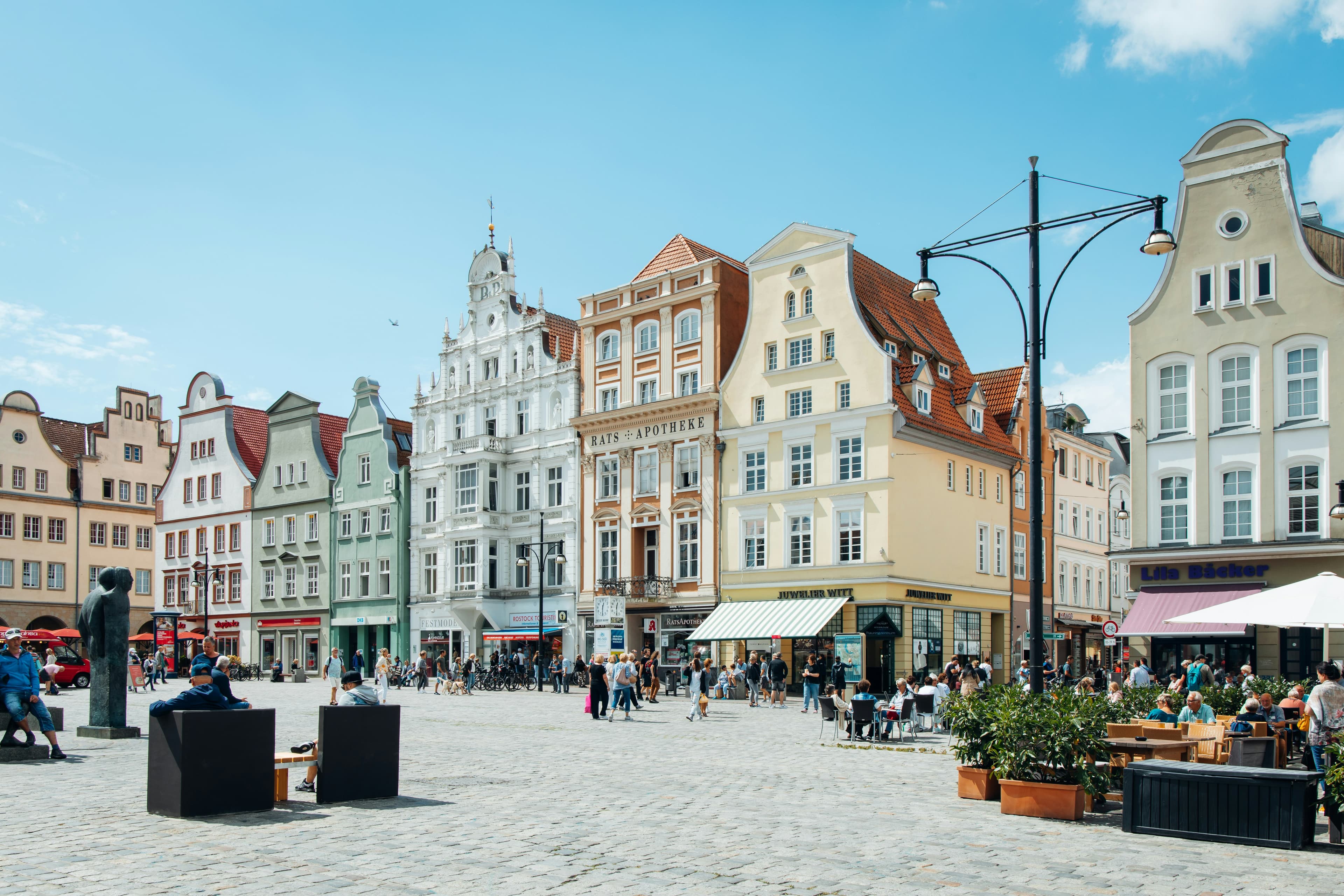
The old centre sits close enough to the harbour that walking to the race site is realistic for most runners, while offering considerably more restaurants, tram connections and general old-town character than the harbour itself. This is the strongest all-round choice for a first visit, trading a slightly longer post-race walk for a livelier base. It also happens to be where the marathon started and finished in its earlier years.
Kröpeliner-Tor-Vorstadt
West of the centre, KTV has a younger, livelier character with bars, restaurants and good tram access, plus a wider range of apartment-style and mid-range accommodation than the old town. A quiet side street is worth choosing here specifically: this is not the district for a runner sensitive to Saturday-night noise, either before a 18:00 start or after a midnight return.
Steintor, Gehlsdorf and Warnemünde
The Steintor and Hauptbahnhof corridor suits rail travellers and is practical, not picturesque, with trams reaching both Kröpeliner Tor and the Stadthafen, at the cost of a longer post-finish journey. Gehlsdorf, across the Warnow, is quieter and more residential with river views, but it is a poorer choice on race night specifically, since river crossings and evening transport matter more once road closures are in effect. Warnemünde is excellent for turning the trip into a Baltic-coast break and poor for race-night simplicity: daytime S-Bahn links are easy, but the return after a marathon finishing as late as 23:00 is considerably less so.
Book well ahead regardless of district. The organiser explicitly warns that the Hanse Sail festival begins the week after the marathon and draws large numbers of visitors to the city, tightening availability and pushing up prices in the run-up.
Recommended areas
The tightest choice for pure race logistics. A room around Am Strande or Warnowufer removes any need for transport after a late-night finish. The area is lively on summer weekends and particularly so as the Hanse Sail approaches, so waterfront rooms can carry both noise and a price premium.
The strongest all-round choice for a first visit. Close enough that walking to the race site is realistic, with considerably more restaurants, tram connections and old-town character than the harbour itself. Saturday-night street activity is noticeable but manageable.
West of the centre, with a younger character, good tram access and a wider range of apartment-style and mid-range rooms. Choose a quiet side street deliberately: this is not the district for a runner sensitive to Saturday-night noise before or after the race.
Practical, not picturesque, and the right choice for rail travellers. Trams reach both Kröpeliner Tor and the Stadthafen straightforwardly, at the cost of a longer post-finish journey and less harbourside character.
Excellent for turning the trip into a Baltic-coast break, poor for race-night simplicity. Daytime S-Bahn links are easy, but returning after a marathon finishing as late as 23:00 is considerably less so. Only worth it if the beach stay is a genuine priority, and only with the late timetable confirmed.
These are districts, not specific properties. This guide does not name individual Rostock hotels: on a race night where the walk home matters, a wrong name would be worse than none.
Booking timeline
Registration for the coming edition opened well ahead of race day, with the cheapest marathon price band closing almost a year out. Hotel booking deserves more urgency than entering the race itself: the organiser is explicit that the Hanse Sail Rostock, beginning the week immediately after the marathon, draws thousands of visitors and tightens the city’s accommodation supply in the run-up to race weekend. Book a cancellable room in the Stadthafen or Altstadt as soon as travel dates are fixed, and leave the entry until the fee band you want is about to close if budget matters more than certainty.
See & Do
Everything below is judged from the finish at the Stadthafen and the districts around it. The evening start has an incidental benefit worth using: race day itself is free until late afternoon, so the sightseeing can happen before the marathon.
Neuer Markt and the Altstadt
Roughly 1.5 km (0.9 miles) from the finish. Rostock’s central square, ringed by gabled Hanseatic merchant houses and the brick Rathaus, and the historic start and finish of this marathon before it moved to the harbour. Flat, compact and easy to combine with a coffee on the morning of an evening race.
St. Marien Kirche
About 1.5 km (0.9 miles) from the finish, in the old town. A large brick-Gothic church holding an astronomical clock that has been running since the fifteenth century. Indoor, level and undemanding, which makes it a reasonable stop on stiff legs the day after.
Warnemünde beach and lighthouse
About 20 minutes by S-Bahn from the centre. A broad Baltic sand beach, a working fishing harbour and a lighthouse, all flat and all reachable without planning. The obvious recovery morning, and considerably more appealing the day after the race than the night of it.
IGA Park
On the far bank of the Warnow, and directly on the marathon route at around km 22. A green riverside corridor that most runners will pass in fading light without seeing much of it. Worth returning to properly on a recovery walk, when the park and the river views are actually visible.
Reading
Tadellöser & Wolff by Walter Kempowski. Kempowski was born in Rostock, and this autobiographical novel is rooted in a Rostock family living through the Second World War. It gives a runner a real literary connection to the city.
After the Race
A Saturday-night finish leaves the whole of Sunday free, which suits this coast well. Warnemünde is twenty minutes away, Stralsund and Rügen under an hour, and Hamburg around two hours by direct train for anyone flying home from a larger airport. One practical note: the Hanse Sail begins in Rostock the week after the marathon, so staying on in the city itself gets harder and more expensive.
Rostock’s own Baltic resort, with a broad sand beach, a lighthouse and a working fishing harbour. Flat, close and reachable without planning, which makes it the obvious recovery day.
A lake-ringed residence city built around one of Germany’s more theatrical palaces, on its own island. Compact enough to see properly in a day and a half without much walking.
A UNESCO-listed Hanseatic old town, then onward to Germany’s largest island for the chalk cliffs. Two nights covers both without rushing the second day.
The obvious onward connection for anyone flying home from a bigger airport, and a city that repays two nights on its own terms. Flat, walkable, and full of places to sit down.
A longer coastal extension based around Binz, pairing the Rügen chalk cliffs and beech forest with the island’s resort architecture. Keeps the walking optional and the scenery constant.
Frequently asked questions
Should I stay near the start or the finish?
They are the same place, the Haedgehalbinsel. Stay as close to the harbour as you reasonably can: the finish falls between roughly 21:00 and 23:30 in darkness, and showers on site are limited.
How far in advance should I book a hotel?
Well ahead, and sooner than you enter. The Hanse Sail festival starts the week after the marathon and tightens the city’s accommodation in the run-up. The hotel is the binding constraint, not the entry.
Is there free transport to the start on race day?
No. The ferry shuttle is for half-marathon starters only, not marathon runners or spectators. Take trams 1, 4, 5 or 6 to Kröpeliner Tor, then walk about eight minutes.
What is the best area to stay?
Stadthafen for logistics, Altstadt for the best all-round base, KTV for value and a livelier evening. Warnemünde only if a beach stay matters more than an easy journey after a 23:00 finish.
When does the expo open?
There is no trade expo. Number collection runs at the Haedgehalbinsel event centre on the Friday evening and the Saturday afternoon. Bring photo ID and the confirmation email carrying your start number.
What is the weather typically like on race day?
Low 20s°C in daylight at the 18:00 start, dropping into the mid-teens as runners move through dusk into darkness. The swing matters more than the average for anyone finishing after 21:00.
How do I get to Rostock?
Direct regional and InterCity rail, with Hamburg about two hours away. In the city, trams 1, 4, 5 or 6 to Kröpeliner Tor. Driving is awkward: Hanse Sail build-up has closed the Stadthafen car park in recent years.
Is there a bag drop?
Yes, and the loop format keeps it simple: your bag waits at the same site you return to. Changing facilities and toilets are on site, showers are limited, which is an argument for a hotel within walking distance.
Should I bring a head torch?
If you might finish slower than 3:30, yes. The organiser has recommended one for that group: the closing kilometres include about a kilometre of unlit field path marked only by route lights every 50 to 100 metres.
How do I get back to my hotel after finishing?
On foot from the Stadthafen. Otherwise trams from Kröpeliner Tor, though a finish near the 23:30 closure means checking the late timetable first. Confirm the late S-Bahn if you are staying in Warnemünde.