The Race
| Next Race Date | 21 February 2027 |
|---|---|
| Course type | Single-city road loop |
| Certification | World Athletics Elite Label · AIMS-integrated · run under RFEA rules |
| Start | Avenida de María Luisa |
| Finish | Paseo de las Delicias, Glorieta de Buenos Aires |
| Total finishers | Approx. 17,000 to 20,000 (capacity raised to 20,000 for 2027) |
| Avg race-day temp | 7 to 18°C (February); typically 7 to 10°C at the 08:30 start |
| Cutoff time | 6 hours from gun; course closes 15:00 |
| Free race-day transport | Yes in 2026: free TUSSAM buses for bib holders and volunteers, 06:00 to 18:00 |
| Course certification | World Athletics and AIMS certified, RFEA road-race rules |
| Sleeper train | Not accessible from the UK for this race |
History
By 2027, the Zurich Maratón de Sevilla reaches its forty-second edition, run by the Instituto Municipal de Deportes del Ayuntamiento de Sevilla with Sport Life Ibérica. Four decades of incremental refinement separate the current race from its early years, and the result is a course built almost entirely around speed: sea level, minimal direction changes, and a February date that lands well before Andalusia's heat arrives.
The city's deeper marathon pedigree predates the mass-participation race. Seville hosted the 1999 World Championships marathon, won by Spain's Abel Antón, a result still referenced in race-week expo programming and one of the reasons organisers can claim genuine athletics heritage rather than simply borrowing the city's tourist appeal.
The elite times have climbed steeply in recent years. Ethiopia's Deresa Geleta set the current course record of 2:03:27 in 2024. In 2026, Tola Shura Kitata and Abderehman Asrar Hiyrden both ran 2:03:59. The women's record stands at 2:18:52, set by Alemu Megertu in 2022. In 2025, World Athletics reported Ethiopian debuts from Selemon Barega (2:05:15) and Anchinalu Dessie (2:22:17), describing conditions as ideal for fast racing.
Demand has grown faster than the course has changed. The 2026 field carried around 17,000 runners. For 2027, organisers raised capacity to 20,000 and introduced a phased loyalty registration system; the race sold out within weeks. That shift, from a regional fixture to a race that now sells out months ahead, marks Seville's move from hidden gem to a recognised fixture on Europe's winter marathon calendar, sitting alongside Valencia as one of the continent's two reliable December to February options for a genuine fast time.
The 2026 edition also separated the start and finish for the first time, moving the start to Avenida de María Luisa specifically to remove the last metres of positive elevation from the old shared start/finish layout. That change, retained for 2027, is the most recent structural alteration to a course otherwise defined by stability rather than reinvention.
The course
The 2027 course starts on Avenida de María Luisa, close to Parque de María Luisa, and finishes 42.195 km later on Paseo de las Delicias at Glorieta de Buenos Aires, a few hundred metres from the start but not on the same road. The route runs north through Avenida del Cid and Menéndez Pelayo before crossing the Guadalquivir at Puente de San Telmo into the Los Remedios and Triana-adjacent streets. A second river crossing at Puente de la Barqueta returns the field to the eastern half of the city, through wide roads around Nervión and Cruz del Campo, before the route turns back west through Avenida de la Palmera towards Plaza de España and Parque de María Luisa.
The closing kilometres run through the old centre: Alameda de Hércules, Campana, Tetuán, Plaza Nueva, Avenida de la Constitución, Puerta de Jerez and San Fernando, passing close to the Cathedral and La Giralda, before the final return through Avenida del Cid to Paseo de las Delicias. Organisers describe the course as flat, at sea level and wind-protected. GPS data confirms a course of minimal elevation change; no official kilometre-by-kilometre elevation table has been published, so no specific total appears on this page.
Kilometre by kilometre
Km 0 to 8: The release. Avenida de María Luisa gives a 20,000-runner field room to breathe that most European city starts cannot manage. There is no funnel, no early pinch point, just broad parkside road and a wave system that lets sub-2:45 runners clear the line at 08:30 without immediately colliding with the 3:45 wave four minutes later. The early kilometres run flat and straight through Avenida del Cid and Menéndez Pelayo. This is the part of the course that lies to you. Seven or eight kilometres in, on a cool, dry February morning, the pace will feel free. It is not. Lock onto the target split and ignore the urge to bank time.
Km 8 to 18: The river settles in. The first crossing of the Guadalquivir, at Puente de San Telmo, takes the race into Los Remedios and the streets bordering Triana. The roads here are wide rather than intimate: República Argentina, Santa Fé, Ronda de Triana. This is working marathon road, not postcard Seville, and that is the point. It is where a flat, sea-level, wind-protected course should be run on autopilot: low shoulders, even breathing, no surges past slower groups simply because the road allows it.
Km 18 to 28: The long, unglamorous middle. The route crosses back over the river at Puente de la Barqueta and runs east through Nervión-adjacent roads: Luis Montoto, Avenida de Andalucía, Cruz del Campo. None of this is why a runner chose Seville. It is, however, exactly why a runner finishes Seville close to their target time. There is no terrain to manage and no view demanding attention, so the only job left is pacing discipline. Runners who went out 10 to 15 seconds per kilometre quick in the cool early morning usually start paying for it somewhere in this stretch, even if the legs do not say so yet.
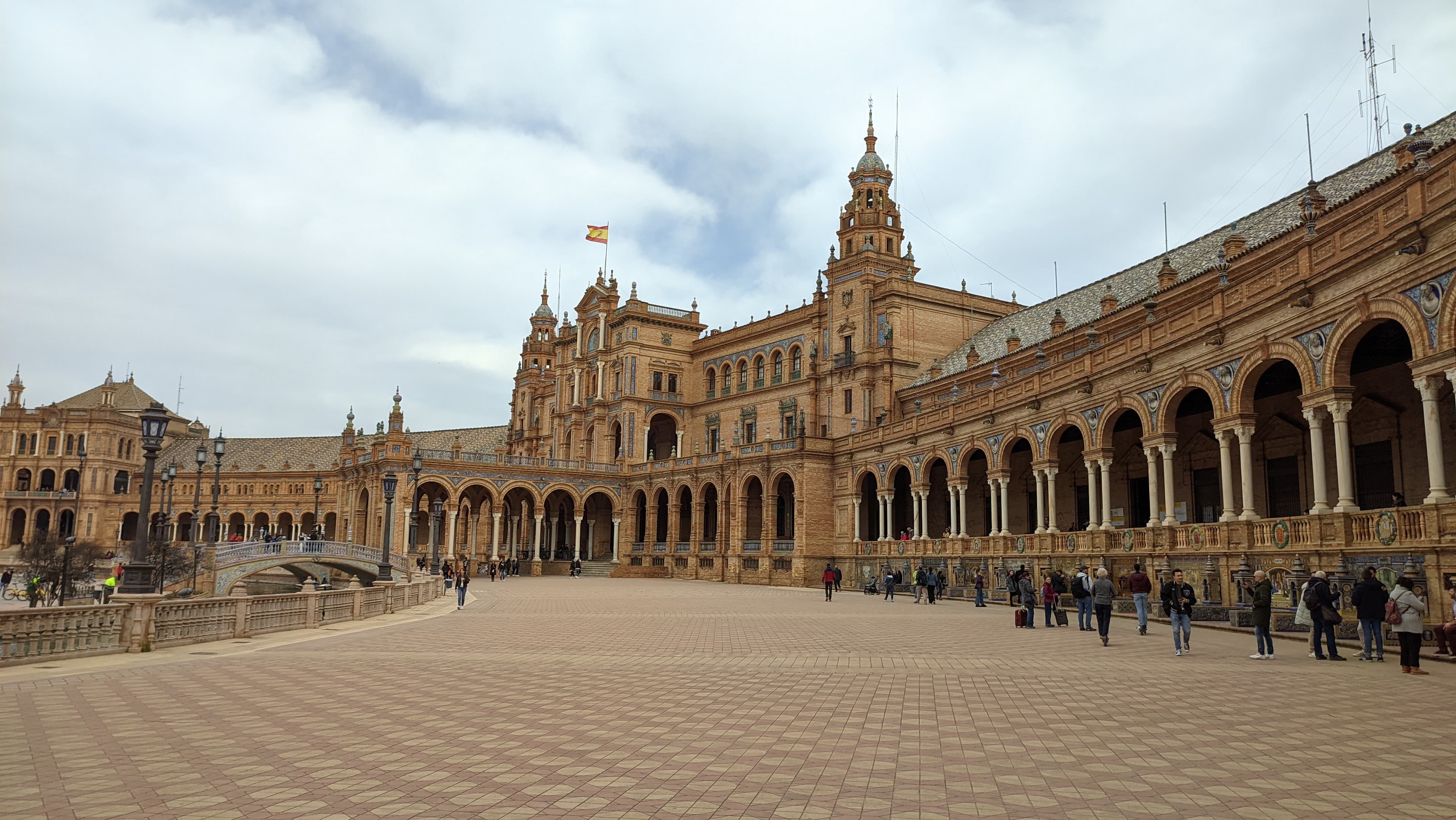
Km 28 to 35: Plaza de España. The route turns back west through Avenida de la Palmera towards Parque de María Luisa, and the city reasserts itself. Plaza de España arrives around the 35 km mark, and runners consistently describe it as the high point of the race: the tiled bridges, the semicircular colonnade, a real crowd by this point in the course. Treat it as fuel, not a finish line. There is still a 7 km old town to get through.
Km 35 to the finish: The old centre, and the arches that are not the finish. Alameda de Hércules, Campana, Tetuán and Plaza Nueva carry the route into the historic centre, past the Cathedral and La Giralda on Avenida de la Constitución. Watch road surfaces and tram lines through this section: the city centre carries active tram tracks, and a tired stride catching a rail is a real risk in the closing kilometres. The course then loops back through Puerta de Jerez and San Fernando towards Avenida de María Luisa for the run-in.
In the final 500 metres of the course, runners pass a sequence of inflatable arches, each branded for a different race sponsor. None of them is the finish line. By this point a GPS watch will commonly already read past 42.2 km, and runners arriving on tired legs have mistaken an arch for the end of the race. The actual finish line, with the timing mat, sits further on at Paseo de las Delicias, Glorieta de Buenos Aires. Whatever the watch says, the instruction is simple: keep going until the real line.
A final note that applies to the whole course: the blue tangent line marks the shortest legal route between turns, and following it through the back half, when crowds and barriers crowd the road, is worth a genuine 50 to 100 metres over 42.195 km. The timing mat sits at the formal finish on Paseo de las Delicias, not at any of the arches encountered beforehand.
A wide, parkside start with no early bottleneck. The pace will feel easy. It is a trap: hold the target split.
Wide roads around Los Remedios and Triana's edge. Flat, sea-level, wind-protected running with nothing to manage but discipline.
Functional roads east of the centre. No views, no terrain, just pacing. This is where early overcooking gets expensive.
The city's monuments return for the final third, with strong crowd noise at Plaza de España. In the closing 500 m, sponsor arches appear before the real finish line: keep going.
Pacers
Official pacers ran in all waves in 2026, identified by balloons showing target finish time. Corral times were set using a homologated race result from the previous two years; no changes were permitted at the expo in 2026, so declared times should be finalised before the January deadline.
| Wave | Start time | Corrals | Pacers available |
|---|---|---|---|
| Wave 1 | 08:30 | Sub-2:45 | 2:45 |
| Wave 2 | 08:34 | 2:45:00 to 3:14:59 | 3:00, 3:15 |
| Wave 3 | 08:40 | 3:15:00 to 3:29:59 | 3:15, 3:30 |
| Wave 4 | 08:47 | 3:30:00 to 3:44:59 | 3:30, 3:45 |
| Wave 5 | 08:52 | 3:45:00 and over | 3:45, 4:00, 4:30, 5:00 |
Wheelchair athletes start at 08:29, ahead of Wave 1.
AEMET's February averages for Seville Airport put the monthly mean at 12.5°C, with an average high of 18.1°C and a low of 7.0°C. For an 08:30 start, the practical range at the gun is closer to 7 to 10°C, rising through the morning as the sun gets up. One finisher who ran in bright, sunny but not uncomfortably hot conditions wore a vest and singlet from the start and needed no disposable layer at all, a useful data point against the more cautious advice to bring a throwaway top.
A cheap, disposable layer for the wait in the start pens is still sensible insurance, since waves run from 08:30 to 08:52 and standing in February shade is colder than racing through February sun. Sunscreen is worth applying before the start for runners in the later waves, since clear February skies in Andalusia are stronger than northern European runners typically expect.
Course and logistics map
Entry
Seville now runs a phased loyalty registration system rather than a single open sale. For the 2027 race, anyone registered for 2026 received a four-day priority window regardless of whether they actually started or finished that year's race, provided they had not cancelled under the race's refund guarantee. Runners on the 2026 waiting list who missed a place were given the next priority window. Only after both groups had registered did any remaining bibs open to the general public, and once the 20,000-bib cap was reached, a waiting list opened for places released through cancellation insurance.
Registration for 2027 opened on Thursday 9 April 2026 and was due to run until Monday 15 February 2027, or until bibs sold out, whichever came first. In practice, the race sold out on 24 April 2026, within weeks of opening, so late general entry should not be assumed for future editions.
The general non-resident entry fee for 2027 was €82.10 including management fees. Runners who entered via the post-sellout waiting list paid €97.10. A further €5 RFEA day licence applied unless the runner already held a national federation licence or a Carnet del Corredor Plus. Reduced pricing exists for residents registered in Seville province but is not relevant to most international entrants.
Italian-style competitive versus non-competitive distinction does not apply here; international recreational runners enter the same race and ranking as club runners, provided the entry conditions (homologated result, correct wave seeding) are met. No GFA or fast-runner guaranteed-entry standards table was found in accessible 2027 material.
A PB note: Seville is one of the most consistently cited fast-course options in Europe, and the times bear this out. The combination of sea-level air, flat roads, February temperatures and a deep elite field all contribute to conditions that favour fast times for recreational runners as well. Choose Seville specifically if a personal best is the goal rather than a destination experience, while acknowledging that Valencia offers a similar profile in December and has a higher elite standard as a direct comparator.
Official Seville Marathon entry page →Race Weekend
Expo
Bib collection for 2027 runs at FIBES (Palacio de Congresos y Exposiciones de Sevilla) on Friday 19 and Saturday 20 February, 10:00 to 20:00. No race-day bib collection is offered, so this is a fixed commitment within the travel itinerary. FIBES sits outside the immediate old-town core, so runners should build in transport time rather than assuming a walk from a central hotel.
Runners need their registration receipt or a digital copy, plus photo ID or passport. Proxy collection was permitted in 2026 with written authorisation and a copy of the runner's ID, though this should be reconfirmed for 2027. One finisher who collected a bib at the 2026 expo described it as well organised with no meaningful queues, a useful counterpoint to the more cautious tone of some destination-marathon expos elsewhere in Europe.
Race morning
The start and finish in Seville sit close together, which simplifies race morning considerably compared with point-to-point marathons. The 2027 race starts at 08:30 on Avenida de María Luisa, with wheelchair athletes away at 08:29. Five waves followed in 2026, departing at four to seven-minute intervals from 08:30 to 08:52.
Public transport on race morning runs through TUSSAM buses, Metro Line 1 and Cercanías. Useful bus routes serving the start/finish area include C1, C2, 1, 3, 5, 6 and 34, with stops at Prado de San Sebastián, Virgen de Luján and Paseo de las Delicias. Metro Line 1 stops at Puerta de Jerez, Prado de San Sebastián and San Bernardo all sit within walking range. In 2026, TUSSAM buses were free for runners showing a bib between 06:00 and 18:00.
For runners staying centrally, walking is often simpler than public transport on race morning itself. One finisher stayed in an Airbnb near the Plaza de Toros, roughly a five-minute jog from the start, and described the whole morning as straightforward with no transport planning required. That is broadly representative of any hotel in El Arenal or the Santa Cruz edge.
Bag drop is included with the race bib. In 2026 the cloakroom sat on Avenida Santiago Montoto in the Port of Seville area near the Aquarium, open 06:45 to 15:30. Only the official race bag should be used, and valuables should stay with a non-running companion rather than in the cloakroom.
Portable toilets are positioned at the start, finish and roughly every 5 km along the course (5, 10, 15, half marathon, 25, 30, 35 and 40 km in 2026), alongside medical points at the same intervals. After finishing, runners exit through the Paseo de las Delicias finish zone, where barriers and one-way crowd flow make casual meet-ups difficult. Agree a fixed meeting point at least 10 to 15 minutes' walk from the finish funnel before the race starts.
Aid stations
Water and isotonic drink (Aquarius in 2026) are available from 5 km, repeating roughly every 2.5 km: 5, 7.5, 10, 12.5, 15, 17.5, 20, 22.5, 25, 27.5, 30, 32.5, 35, 37.5 and 40 km. Solid nutrition (226ERS gels, energy gummies and fruit in 2026) starts from around 20 km, with heavier solid-food stations clustered at 25, 30, 35 and 40 km. Sponges are provided at two points in the second half (around 22.5 and 32.5 km in 2026). Powerade was the finish-line sports drink in 2026. No personal bottle service for mass-field runners was confirmed; carry your own race nutrition.
Spectating
Seville rewards spectators who plan around the old centre rather than chasing the full loop. Because the course returns repeatedly towards the historic core, a supporter on foot can realistically see a runner two to four times without crossing the city by taxi. The single best viewing point is the Cathedral and La Giralda sector on Avenida de la Constitución, late in the race: arrive early and pick one side of the street deliberately rather than improvising. Plaza de España, reached by the field around 35 km, is the other standout option.
- Start near Avenida de María Luisa for 08:30 gun and early kilometres.
- Walk to Paseo de Cristóbal Colón or Torre del Oro for an early river sighting around km 10 to 15.
- Reposition on foot to Avenida de la Constitución for the Cathedral sector in the closing kilometres.
- Take Metro Line 1 to Puerta de Jerez for a mid-morning sighting near the late-course route.
- Walk to Plaza Nueva or Tetuán for the old-town stretch.
- Finish at Paseo de las Delicias for the line, allowing 20 to 30 minutes to clear barriers and crowds.
- Stay central around Plaza Nueva or Campana for a single, low-effort viewing point in the historic centre.
- The course returns past this area more than once in the final third, allowing multiple sightings from one position.
- Family reunion: agree a point 10 to 15 minutes' walk from the Paseo de las Delicias finish before the race.
Triana, across the river, suits supporters who prefer a more local feel over postcard Seville, though the 2027 route crosses at Puente de San Telmo first and Puente de la Barqueta later, not at the Puente de Triana itself, so spectating plans should follow the confirmed crossings rather than assume the named bridge is on course.
Post-race food
Bar Postiguillo on Calle Dos de Mayo 2 in El Arenal, opposite the Reales Atarazanas and close to the Cathedral, is a strong post-race option: traditional Andalusian cooking, a wide tapas menu, and a setting, an 18th-century former fish market with Roman columns still visible in the walls, that makes sitting down for an hour feel like part of the trip rather than a recovery chore. The rabo de toro (oxtail stew) and croquetas de jamón are the standout orders, and the kitchen runs long hours (typically midday until midnight).
El Arenal generally is a sound post-race base for food: close to both the late-course Cathedral sector and the finish on Paseo de las Delicias. Runners who finish craving something simpler will find bakeries and cafés around Plaza Nueva and Avenida de la Constitución for an immediate post-finish snack before a proper meal later in the day.
Where to Stay
The single most useful fact about staying in Seville for the marathon is that, because the start and finish sit close together on Avenida de María Luisa and Paseo de las Delicias, almost any central neighbourhood works logistically. The real choice is between character, noise and walking distance after the race, not between convenient and inconvenient.
El Arenal
El Arenal sits between the Cathedral and the river, close to Torre del Oro and the bullring, probably the best single compromise for marathon weekend: central, scenic, and usually within 10 to 20 minutes' walk of the finish. One finisher's Airbnb near the Plaza de Toros, a five-minute jog from the start, sits squarely in this area and worked without any race-morning transport planning at all. Price tier: ££–£££.
Santa Cruz
Santa Cruz is the old Jewish quarter beside the Cathedral and Alcázar: narrow lanes, genuine history, 15 to 25 minutes' walk to the start and finish. It is also tight and can be loud on Saturday night. Runners sensitive to noise, or travelling with luggage through narrow lanes, may find it more charming to visit than to sleep in. Price tier: £££–££££.
Prado / San Bernardo
Prado and San Bernardo sit immediately south of the old centre, offering easy access to the finish zone and Parque de María Luisa. Quieter than Santa Cruz on a Saturday night, and home to several official package hotels. Metro Line 1 at Prado de San Sebastián or San Bernardo provides transport links. Price tier: ££–£££.
Centro (Plaza Nueva)
Centro sits around the main shopping streets and Plaza Nueva, easy access to restaurants and the late-course city-centre section. A similar Saturday-night noise profile to Santa Cruz; a quiet or rear-facing room is worth requesting specifically. Price tier: £££.
Nervión
Nervión is modern and east of the centre, trading historic charm for practicality: larger hotels, generally quieter rooms, and reasonable Metro or walking access to the start. Suits runners prioritising sleep and a straightforward room over a historic setting, and several of the official package hotels sit in this district. Price tier: ££–£££.
Triana
Triana sits across the Guadalquivir, with the strongest neighbourhood identity of any option: ceramics workshops, flamenco associations, a genuinely local feel. It runs 20 to 35 minutes' walk to the finish depending on the exact street, and streets near Calle Betis and the river can be lively late into Saturday night. Price tier: ££–£££.
Alameda de Hércules / La Macarena
Alameda de Hércules and La Macarena sit north of the old centre with genuine race-day crowds since Alameda is on the route, but the area is lively at night and the walk to the finish runs 30 to 45 minutes. Better value than the historic core. Price tier: ££.
Hotels
Official package hotel sitting directly between the start and finish zones, close to Parque de María Luisa. The practical choice over a deeper old-town stay if minimising race-morning walking matters more than historic charm.
Modern and quiet relative to the old-town options, with Metro access via San Bernardo. A sensible base for runners prioritising sleep over nightlife the night before.
An independent luxury landmark hotel directly on the late-course route near Puerta de Jerez and San Fernando. Expensive, but logistically about as good as Seville accommodation gets for a race weekend.
A central option in the same district as Bar Postiguillo and the late-course Cathedral sector. Request a quiet room given how lively central Seville can be on a Saturday night.
A larger official package hotel outside the tightest part of the centre, better suited to runners with a car or those who prefer quieter streets over walking access to old-town dining.
When to book
Seville's 2027 entries sold out on 24 April 2026, within weeks of registration opening, which means hotel demand for marathon weekend builds well before most runners would think to book for a February race. The sensible window is to book accommodation as soon as entry is confirmed, particularly for official package hotels through the race's tour operator, Sportravel, which include marathon-specific extras such as early breakfast from 06:00 to 06:30 on race day and late checkout until 14:00.
February's lower-season pricing in Seville softens the usual destination-marathon premium compared with a spring or fixed-date Major, but central hotels in Santa Cruz, El Arenal and Centro still book out closer to race week as the 20,000-strong field firms up its travel plans. Flights from the UK to Seville are typically direct and reasonably priced in February outside half-term weeks; booking three to four months ahead generally avoids the sharpest fare increases.
See & Do
Real Alcázar of Seville
A working royal palace layering Islamic, Gothic, Mudéjar and Renaissance architecture across several centuries. Book tickets in advance; the walking required inside is genuinely significant, so Friday or the Monday after racing suits it better than the afternoon of the marathon itself.
Seville Cathedral and La Giralda
The largest Gothic cathedral in the world, with a bell tower that began life as a 12th-century minaret. It sits directly on the late-course route, so runners will already have passed it once before returning on foot. Climbing the Giralda's ramps the same afternoon is not advisable on legs that have just run a marathon.
Plaza de España and Parque de María Luisa
The course's own emotional high point, reached around 35 km, makes an easy and genuinely pleasant post-race walk: flat, shaded by the park, and close to both start and finish. The lowest-effort sightseeing option on this list, which matters more than it sounds the day after 42.195 km.
Torre del Oro and the riverfront
A 13th-century watchtower on the Guadalquivir, directly tied to the river the marathon crosses twice. A flat riverside promenade makes it a low-effort family option for the afternoon after racing.
Triana
Across the river, with a ceramics tradition and flamenco identity distinct from the monumental city centre. Worth a visit on the second day of a trip rather than immediately post-race, particularly for runners not already staying on that side of the river.
Read Before you Run
The Ornament of the World
María Rosa Menocal
Not a Seville-specific book, but the clearest accessible account of medieval al-Andalus and why Seville, Córdoba and Granada read as one connected world rather than three separate city-break stops.
The New Spaniards
John Hooper
A broader portrait of modern Spain rather than a Seville travelogue, useful context for a race weekend that is as much a civic and tourism event as an athletic one.
After the Race
February is one of the better months to travel from Seville. The high-speed AVE network fans out rapidly from Santa Justa: Córdoba is 45 minutes, Madrid under three hours, and regional services reach the coast. The Alhambra in Granada needs an advance ticket whatever month you visit, and the route through Ronda to Málaga gives a natural exit south. Atlantic weather fronts are a real risk in February, so building flexibility into the circuit matters more than an optimised itinerary.
A flat, sea-facing, walkable city that suits tired legs better than anywhere else on this list. The long Atlantic promenade is gentle, low-effort sightseeing for the day after a marathon.
The best single-night extension from Seville. Fast trains and a compact historic centre built around the Mezquita-Catedral and the Judería, genuinely manageable on race-tired legs.
The Alhambra is extraordinary and needs booking months in advance. The city is hilly; two nights, with taxis built in, suits this better than a rushed day trip on tired legs.
Córdoba for Islamic-Spanish architecture, Granada for the Alhambra, Ronda for its gorge and white-town drama, Málaga as an easy airport exit. February keeps prices down and crowds thin.